Stories: Powerful Ways to Understand Ourselves and Others and Discuss Difficult and Controversial Issues
04 March, 2026, Dr Linda Whitworth
We tell and listen to stories every day, talking with friends and family, using social and other media and through reading or listening alone or with others. Our communications are about how we perceive each other, what happens to us or others and how events impact on people’s lives. Conversation requires understanding and exploring other perspectives, through shared vocabulary. It is intrinsic to our humanity that we listen and learn from each other, and stories play an important part in that process.
Richard Murphy[1] states that all stories start with a problem, identify someone who wants to solve it, discover an obstacle, find a potential solution and end with a path to a better future (Murphy, 2025). This might appear over-simplified, but essentially this is what a story is, identifying a problem and finding a solution.
This becomes more complex when faced with controversial topics which contain opposing points of view, but here the power of story can help pupils develop empathy, recognise cognitive challenges and change perceptions. They can see there is no one solution or answer.
Rather, stories used to understand difficult situations need to encompass a range of possibilities and interpretations, to encourage listeners to engage with varying viewpoints, behaviours or solutions. Such stories can used to discuss pupils’ responses to what they have heard, engaging them in making suggestions as to ways forward or recognising differing understandings. They can present alternate points of view, often using the device of other people, through whom decision-making can be discussed. They provide pupils with the filters needed to talk about issues, without having to directly speak about their beliefs and views, and enabling them to understand that differing views can be held collectively in tension about complex subjects. This can lead to deconstructing problems , identifying moral challenges and offering at least some tentative solutions.
Our understanding of humanity is greater when we can recognise others may have diverse interpretations of equal or greater validity than our own. Navigating differing worldviews lies at the centre of RE and stories which challenge pupils have great value in recognising the views of others and articulating them.
The books below are just five of the books that I have used in my years in the classroom and when working with students preparing to be teachers.
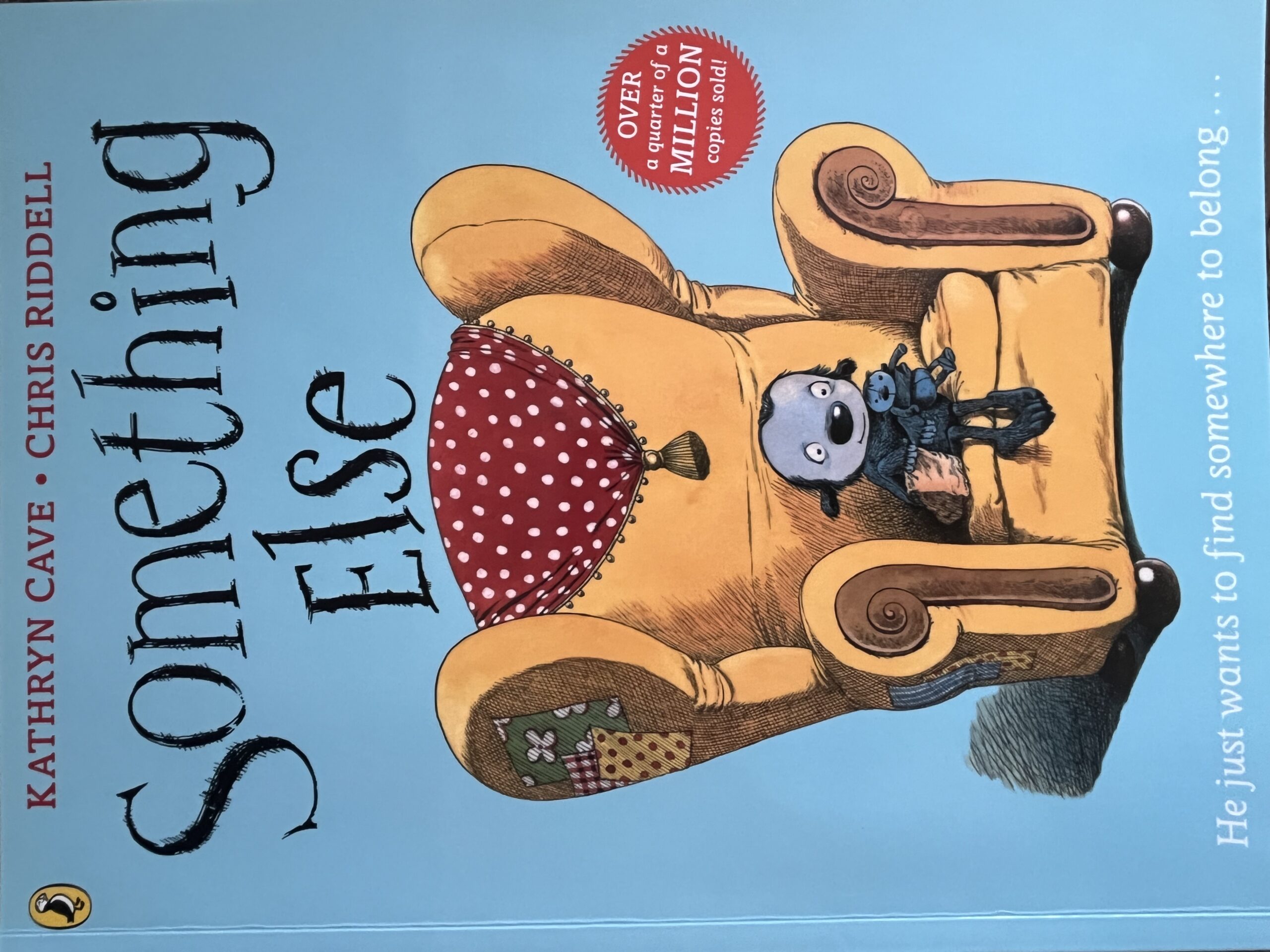
Something Else by Kathryn Cave and Chris Riddell (illustrator) (1994) publisher Puffin.
This book has been around for twenty years, but it still works its charm through a skilful blend of text and illustrations. It exists in a fantasy land but with enough recognisable elements to engage young readers. This book explores what it is like to be excluded by others. The Something Else is a small and rather forlorn figure, who is not accepted because he is not like other creatures in the story. However hard he tries to fit in, he fails and is rejected.
One evening he opens the door to find another being, who does not look like him or anything else we have seen so far, but who has the confidence to make himself at home in Something Else’s house. At first Something Else is alarmed and upset and orders the new creature out of the door. The newcomer is suddenly deflated and looks both sadder and smaller. As he leaves Something Else recognises the distress he is seeing as similar to his own. He runs after the creature and offers it a new home. Together they find friendship and recognise that difference is not a reason to reject someone, even when a third, unusual person arrives.
It’s place in the Reception and KS1 classroom is as a discussion text to encourage children to be excited and curious about meeting new people and experiences. It allows children to talk through the character and identify with both how they feel and what is creating sadness and joy. This is essential work with young children to set the tone of the inclusive classroom. Creating a safe space can be difficult as young children cannot always articulate what distresses them. Yet a safe classroom, where children can speak openly and be confident of being listened to, is an important element of good RE teaching. Difference needs to be seen as interesting and to be engaged with, developing confident pupils who can approach new ideas. Then, they are more able to embark on the exciting journey that RE can take them on.
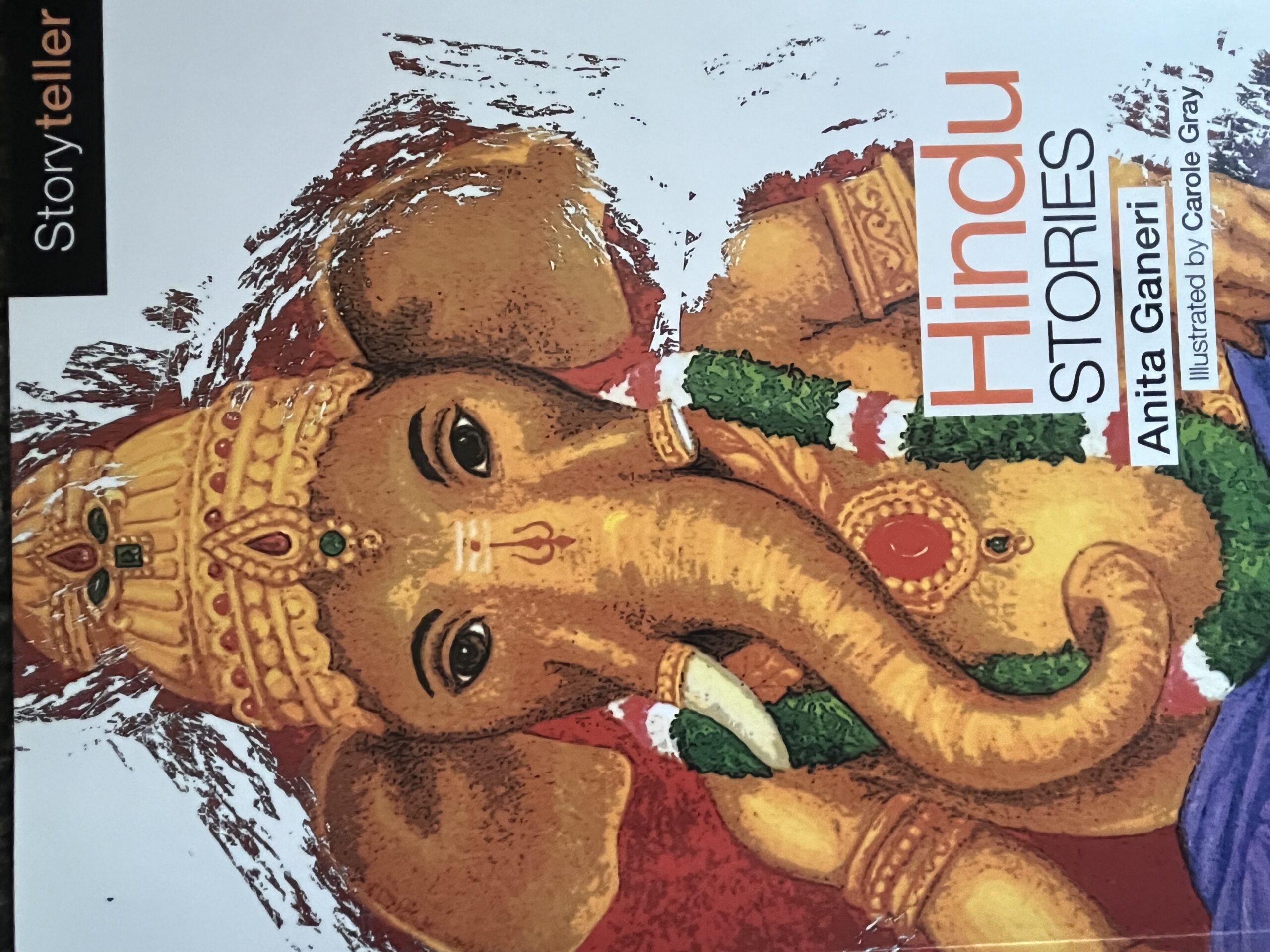
Hindu Stories by Anita Ganeri and Carole Gray (illustrator) (2013) publisher Tulip Books.
Suitable for 7-11 year olds
This is one of a series of books on different traditional religious stories in the Storyteller series. It is suitable as a text for KS2 and has seven stories from the Hindu Tradition, including versions of Rama’s rescue of Sita, the birth of Ganesh, Shiva and the Ganges and the birth of Krishna. It may already be part of your school resources and is a good introduction to Hindu stories for new teachers, to familiarise themselves with Hindu concepts and understandings.
Each story is quite short, (averaging about 3 pages long) and contains the key elements, backed up by attractive pictures and useful ‘Did you know?’ boxes. Readers are introduced to Brahman and the Trimurti of Brahma, Shiva and Vishnu including the avatars of Rama and Krishna. This is a book to be enjoyed for the traditional stories is contains and as an introduction to stories enjoyed through festivals. Sometimes these are taught in KS1, but they are worthy of revisiting in later key stages so that the morality and challenges underlying them can be considered. Individual stories pose questions about the behaviour of people, gods and goddesses. There are quests concerning goodness, truth and responsibility. Children can consider the roles played by individual characters in the Ramayana, such as Sita and Lakshman, as well as Rama and Ravana. This book can be enjoyed for the elements of story it contains: exciting plots, powerful and engaging characters and a sense of moral justice which underlies them all.
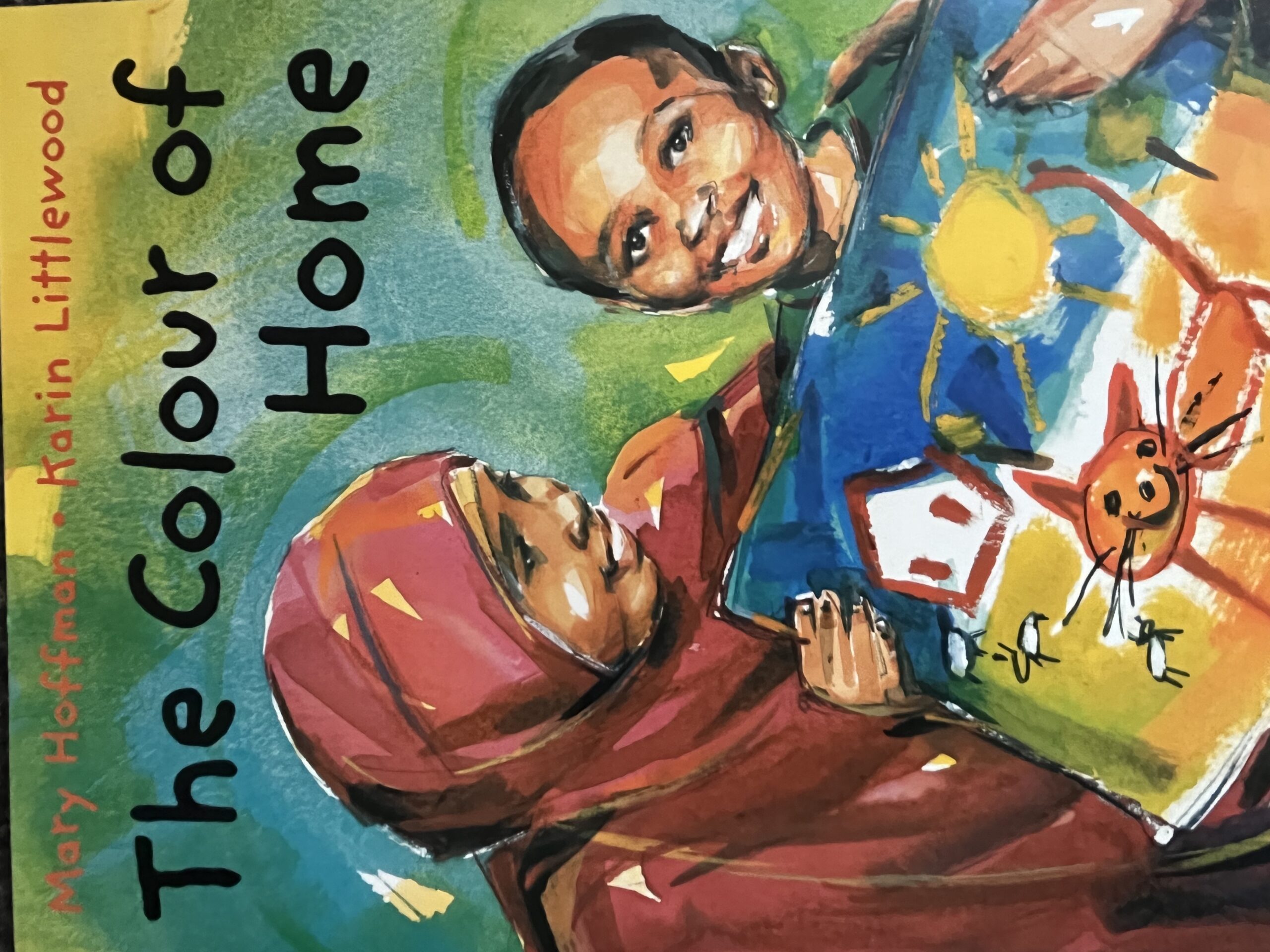
The Colour of Home by Mary Hoffman and Karin Littlewood (illustrator) (2002) publisher Frances Lincoln
Suitable for 5-7 and 7-11 year olds
This story tells of the experience of a young Muslim Somalian boy called Hassan who has arrived in England as a refugee with his family. He starts at to school but struggles to understand what is said, how to play with others and what to eat at lunchtime. He chooses to paint a picture of his old life in Somalia, including the sunshine, the trees, his house, his extended family and their animals. His teacher encourages him, commenting on the beautiful bright colours. But Hassan does not stop there. He changes to red and orange, showing flames coming from the house. He draws a figure with a gun, shooting bullets. He paints red on the walls of the house and rubs the image of his uncle away. At the end of the day he finds an excuse not to show the picture to his mother and sister. The teacher, Miss Kelly, recognises his distress and the following day a Somalian lady he has not met before comes to the school to meet him. He explains his picture to her and Miss Kelly, explaining what happened to his home and family, how they left with little but a prayer mat and Qu’ran, leaving his cat behind. He explains how they escaped, lived in a refugee camp and how his immediate family bought tickets to England, leaving other relatives behind. That afternoon he paints another picture which he shows his mother and they put it up on the wall of his new home. It is a picture of the old home and animals but without people. It is full of colour. Hassan begins to notice the colours of his new home.
For some, this story oversimplifies the process of settling, but it is a powerful story both for children who have not had such a traumatic experience and for those who have arrived as refugees or moved from elsewhere and who have struggled to settle into new experiences. The narrative is clear and direct. Trauma is identified in age-appropriate ways. Sadness and sympathy is expressed both by Hassan and the adults around him. The place of faith in the story is thoughtfully expressed and the Muslim objects chosen for the family’s journey are significant, e.g. the prayer mat on the wall of the family’s home. Story offers hope and draws out the human cost of being a refugee, which can counter misunderstandings and prejudice. Hassan is cared for by his teacher, and friends are there through the offer to play football.
This It is suitable for KS1 and 2. There are a number of talking points which are relevant to RE:
- the opportunity to understand the experience of another child who has had disruption in his life and is showing trauma. This links to teaching about care for others in many religions and non-religious texts. Notice Hassan’s care for his mother and sister in not wanting to show his first picture.
- the opportunity to talk about precious items and consider what importance is placed on holy texts and other artefacts by some religious people.
- Using Hassan’s story can create a safe distance between his experiences and what children understand, enabling discussions on the moral questions raised in the story. Then children can think of ways to encourage Hassan to enjoy his new life in school in England. Recognising religious and cultural needs and reference points is particularly important so that a child can feel welcome and hospitality is shown. Children could design welcome packs which are culturally sensitive and think about their own behaviours when meeting someone from a different background.
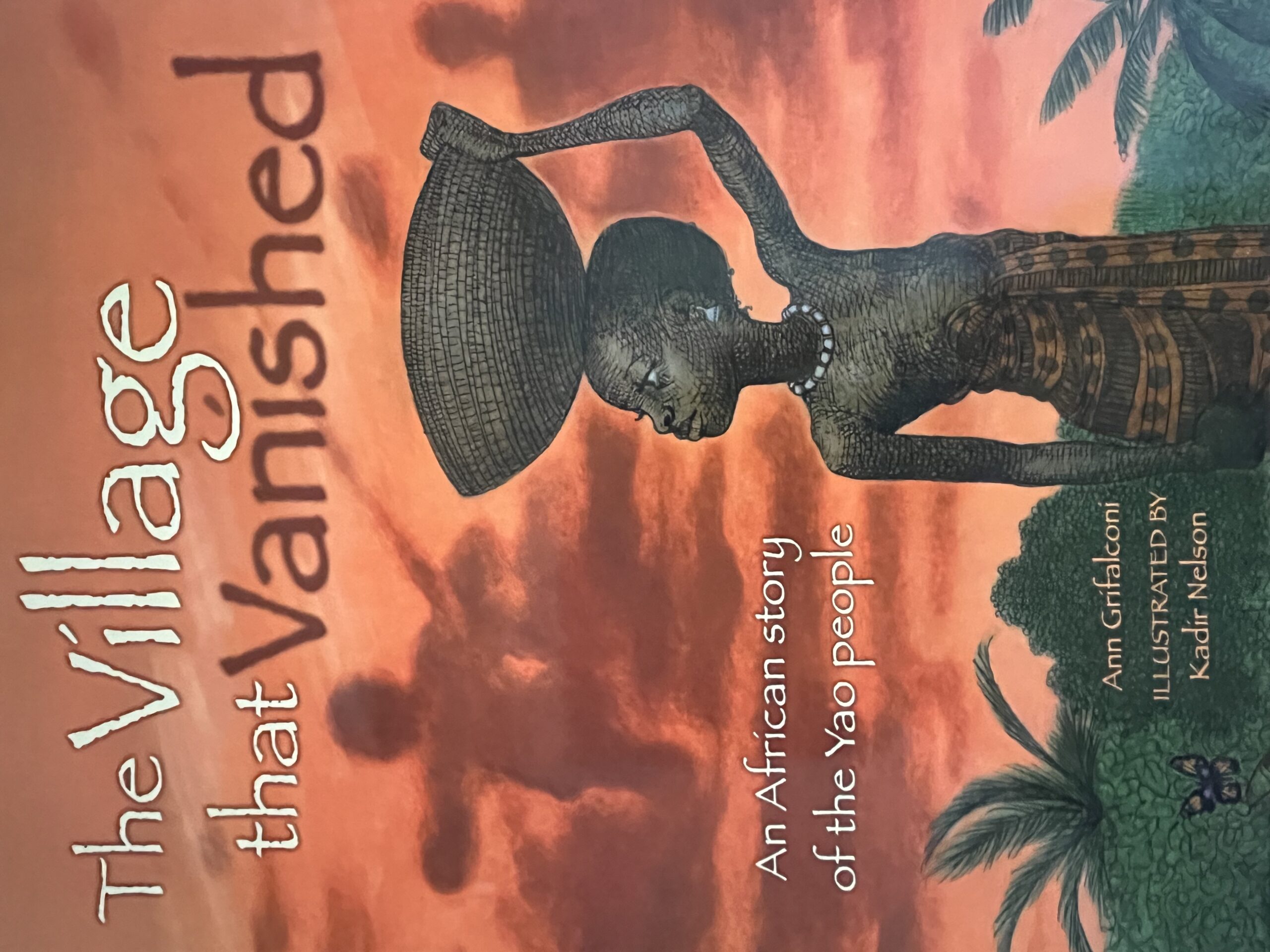
The Village that Vanished by Ann Grifalconi and Kadir Nelson (illustrator) (2009) publishers Ragged Bears.
Suitable for 7-11 year olds
This story is set in Africa and tells an incident in the history of the Yao people. It is written in the style of a professional storyteller or Griot. It tells the story of Abikanile, her mother Njemile and their village, which is threatened by slavers. It opens with Abikanile watching her mother pray to the ancestral spirits to protect their small village. The threat of capture is stark, so Njemile’s plan is for the village to be dismantled and the inhabitants to disappear into the woods until the danger is past. Abikanile’s grandmother Chimwala encourages them all to leave but decides to stay on her own as she is old. She plans to confuse the slavers by saying she is a witch who lives alone. Everyone works at dismantling the village bit by bit, leaving only one hut and raking up the vegetables and other plants until only enough for one person is left. No sign of the village remains and the people flee until they meet a fast-flowing river. Here their courage fails them, until Abikanile chants her mother’s prayer to the ancestors. This is answered by a series of stones appearing in the river. At first only Abikanile can see them, but as the people’s faith and courage return they also see the way across.
Meanwhile Chimwala is visited by the slavers who scour the local woods. When they find no one they leave, believing the river to be impassable. So the village is saved.
This is thought-provoking story of belief and belonging, which can be read for its message of the power of prayer and bravery. There can be interesting discussions about beliefs in ancestral spirits as well as the emphasis on family in the story. Pupils might also consider the members of their families who have influenced their thinking. The illustrations are powerful and sensitively draw you into the story, showing for example Abikanile’s tentative toe in the water and her joy when a path is revealed. Each illustration is worth studying for what it tells you about the people and their lives.
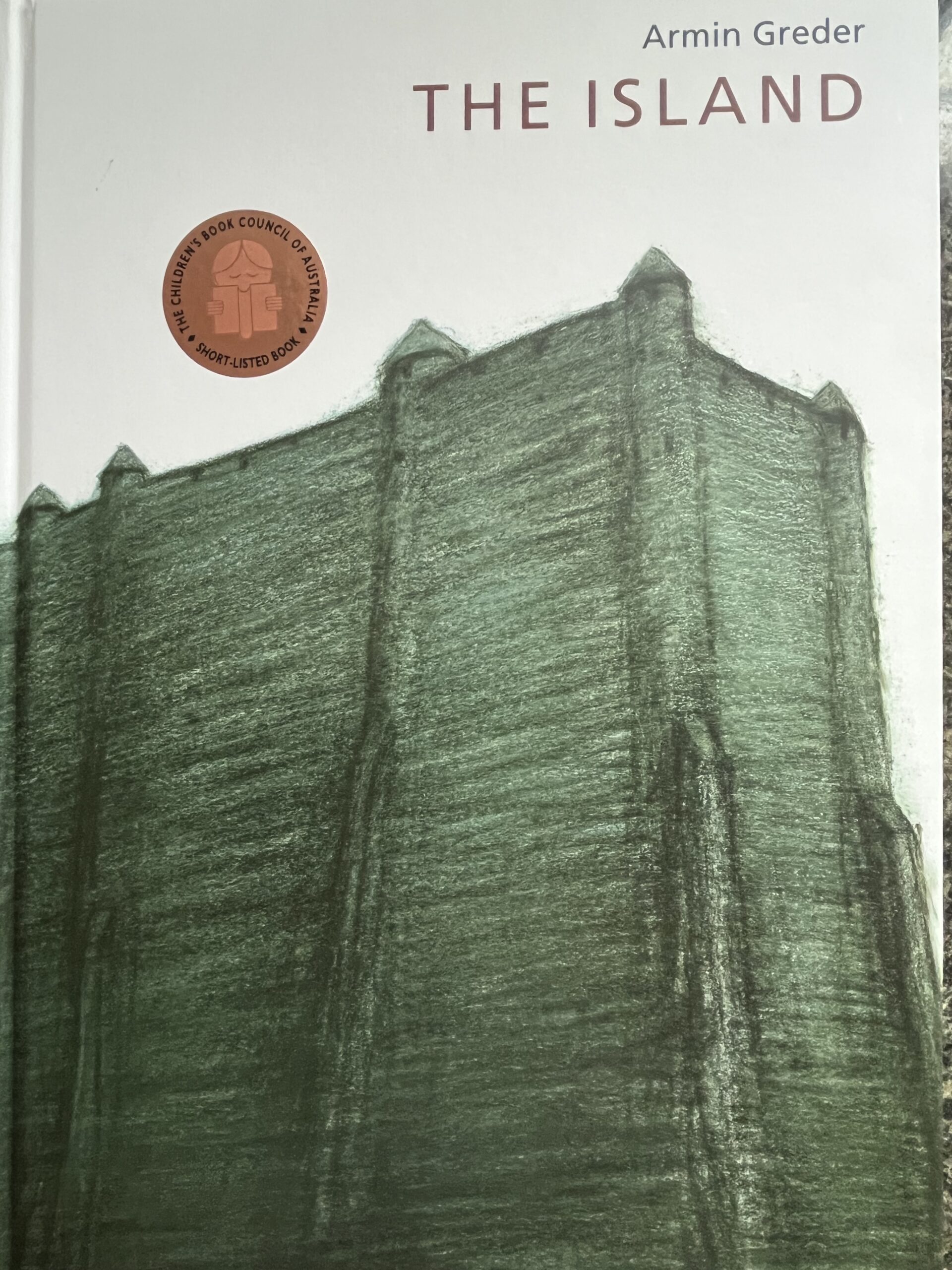
The Island by Armin Greder (2007) publishers Allen and Unwin
Suitable for 9-11 and 11-14 year olds
This is a very challenging story and one which teachers need to think about carefully before presenting it to their classes. It depicts some humans’ prejudices and fear about others and their consequent actions. It requires a mature response and can be very powerful, but also disturbing. It contains dark, evocative pictures and threatening scenes, which are not resolved by a happy ending.
It tells the story of a man who is shipwrecked on an island. His arrival is met with overt hostility by the inhabitants, except for the fisherman who does not want him to die because that would be on his conscience. He is given some shelter but left without food or comforts and ignored. When he asks for food the fisherman, who has spoken up to save him, suggests he is given employment to earn his keep. This fisherman is the one voice of hope, speaking about both individual and corporate moral responsibility, but even he suggests lower wages. The man’s continued presence upsets the inhabitants and they find reasons to reject him because he does not behave like them. He is seen as uncouth, and figures of authority, such as the school teacher and policeman, suggest he is dangerous. Eventually the islanders’ fear is so extreme that the man is driven out, placed back on his raft and sent out to sea. The fisherman’s boat is broken up because he tried to make the islanders help him. The book closes with an image of the wall and watchtowers the islanders then build to keep out other strangers. Even the birds are shot so they cannot lead anyone to find the island.
This vision of man’s inhumanity to man is sombre and very thought-provoking. Children see injustice and cruelty which is allowed to take over more humane responses and want to discuss the reasons for this behaviour.
Some questions to consider:
- Does learning about other people help to prevent such insularity?
- Do the islanders have any just arguments for their behaviour?
- Is the nature of an island the reason for the inhabitants’ behaviour?
- Do people have a moral responsibility to care for others?
Can children think of moral and religious teachings which are the opposite of this story? (This story demonstrates what happens when people do not care for others, and children may identify texts such as Matthew 25 v.35-36 and Surah 2:177 as guides to how people should behave towards the vulnerable).
Are there examples of a lack of humanity in other parts of the curriculum to which this story might link? e.g. History, Geography, Citizenship and PSHE
The role of the fisherman is helpful in looking at ideas of individual conscience and collective responsibility. Did he do enough?
What would fair and just behaviour look like in this situation? How could it be improved?
[1] Richard J Murphy The secret power of change https://www.youtube.com/watch?v=xvnCG1uilyY