From Picturebooks to Principles: Teaching Freedom of Religion or Belief Through Storytelling
05 March, 2026, Lindsay Swift
Stories and story-telling are at the heart of the curriculum for 3-5 year olds therefore when I was asked to design a series of lessons to introduce some of the principles of freedom of religion or belief (FoRB) to my pupils, I knew that I needed to find the right story. It was so important to find an age-appropriate story that had a powerful plot and one that introduced them to characters that they would have an emotional connection to. I also wanted to use a story that introduced our children to characters who have different religious beliefs to themselves. The story needed to provide our youngest children with the opportunities to talk, ask questions and be able to participate in role play.
The Proudest Blue
The story of ‘The Proudest Blue’ by Ibtihaj Muhammad was the first story I used, with the children entering the room to a large piece of glittery blue material draped across the floor with little white boats ‘floating’ across it. This story was so powerful and provoked lots of discussion, particularly when the main characters were laughed at because they had worn their hijabs for the first time. My class were able to express why this is not acceptable and that we should be respectful of other people’s religion and beliefs.
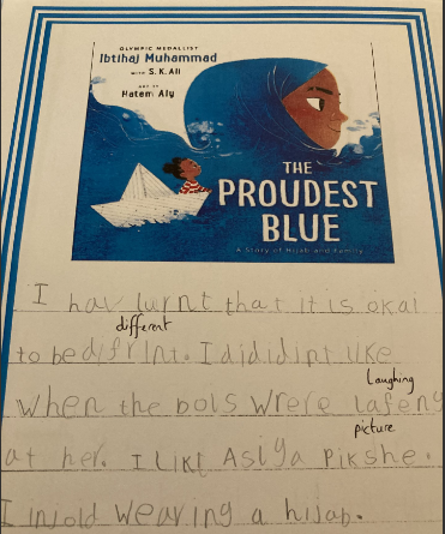
This was a written response to this story and was written by a 5-year-old in EYFS. Many of the children were shocked by other children laughing at Asiya because of her hijab.
The most important learning point at this stage in the project was that the use of one story alone would not fulfill the aims of this project. This story had such an impact on the children and enabled me to meet some of the FoRB outcomes that we had devised as part of the project, however we needed to explore some concepts further. In true Early Years Foundation Stage (EYFS ) style I wanted to further the children’s learning through their own interests and the children had shown a real interest in why hijabs are worn and are they worn in other religions?
Not now Noor
This led us to the story of ‘Not now Noor’ by Farhana Islam. Again, this story has strong characters in that the children could understand and allowed them to explore the characters experiences of wearing a hijab. A key moment in this story was when I asked the children “should they have to apologise for wearing a hijab and can you explain your answer?” The children felt strongly that we only say sorry when we have done something wrong and that they should never have to apologise for their hijab. This story was really enjoyed by the children and allowed me, as the practitioner, to introduce new vocabulary to the children.
Hats of Faith
To end this unit of learning we still needed to explore the meaning of the words faith and freedom. We introduced the book ‘Hats of Faith’ by Medeia Cohan which allowed the children to learn about other religions and beliefs. We also talked about whether our characters, throughout each story, had been free to express their religious beliefs and what the meaning of the word freedom means.
Freedom of Religion or Belief
In summary, the use of stories and story-telling were so impactful in this FoRB project as it allowed the children to enter the world of the different characters and their communities. The careful selection of the right high-quality text is vital and enables the teacher to carefully weave challenging and thought-provoking questions through the learning. Our youngest children were able to access some complex principles through the compelling story-telling and characters that they were introduced to. The children’s’ thoughts and the sheer frustration that the children felt when the characters expression of their religious beliefs were not respected was so powerful. Stories are definitely one of the greatest tools that can be used by a teacher in their EYFS classroom to unlock new communities of different religions, faiths and beliefs.
You can find about more about the Freedom of religion or belief project and complete a short, free e-learning module.