Could you, would you, should you use multiple disciplines to study sacred texts with Year 5 and 6?
18 May, 2026, Sarah Dennis
To really understand how religious and personal beliefs work, pupils need to understand where beliefs come from, how they are lived, and the deeper thinking that sits behind them.
One place many beliefs originate is in stories with rich layers of meaning. My idea was to design a lesson sequence for pupils aged 10–11 that allowed them to study beliefs through theology, lived experience through the human and social sciences, and deeper meaning through philosophy.
I also wanted to link as many stories as possible to people from our local community, so pupils could see that these stories are not just historical texts but have real influence here and now. A big ask, but was it possible?
Designing a disciplinary approach for Year 5 and 6
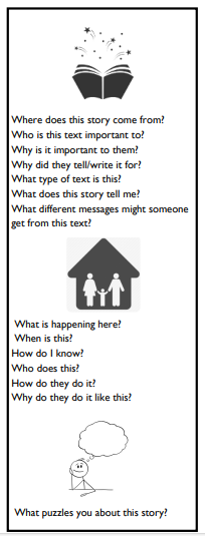
To make this work, I created a resource with three clear sections, each linked to disciplinary questions. I turned this into a bookmark (Figure 1) so pupils could make notes as they went, reducing cognitive overload.
The bookmarks were lightly taped into books so pupils could write alongside them. Notes were later developed into one paragraph per discipline. Over the course of the unit, the bookmark evolved as both the pupils and I refined the questions, focusing on those that generated the most thoughtful, open‑ended responses.
Figure 1. Disciplinary bookmark
One text, three disciplines, one lesson
Over nine weeks, we studied nine texts. Yes, one text per week, covering all three disciplines in one hour.
Every lesson followed the same pattern. Over time, pupils became increasingly confident with the disciplinary thinking, knowing what kind of questions they were being asked and why.
When subject knowledge becomes the challenge
My first step was to trial the approach using a different text. That was when I realised my biggest problem: I did not always have the subject knowledge to confidently answer the questions I had written on the bookmark.
Using support from NATRE, RE:Online, TrueTube and BBC Bitesize, I took time to build my own understanding. This was an essential step and a reminder that disciplinary teaching requires ongoing subject knowledge development for teachers as well as pupils.
What the lesson sequence looked like in practice
Each lesson followed a clear structure:
- Lesson objectives and dates were printed on stickers to save time and stuck onto a new page.
- Pupils annotated their bookmarks while reading the text for theology. I modelled this for the first three lessons using my own exercise book and a visualiser.
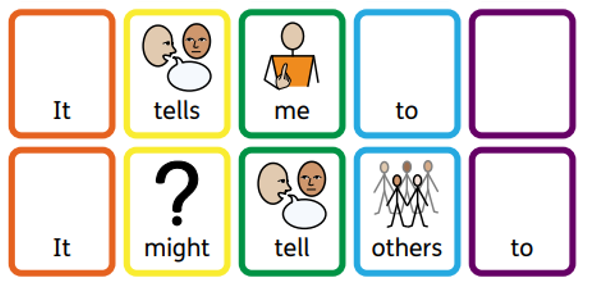
- Writing scaffolds were available for early writers. (Figure 2)
- Pupils watched short videos showing lived experiences, often from members of our local community or carefully chosen online clips. They annotated the human and social sciences section of the bookmark.
- Pupils considered what puzzled them about the story.
- Annotations were written up into short paragraphs, with images from the lived experiences added to support writing.
- Pupils pre‑read the next week’s story.
The consistent structure helped pupils focus their thinking and build confidence week by week.
Figure 2. Writing Scaffolds
What surprised me about pupil learning
A common mistake in my teaching, across all primary year groups, is underestimating what pupils can achieve.
I spoke honestly with both classes about trying something new, and they were incredible. Pupils suggested changes to the bookmark questions, refining them lesson by lesson. The feedback was thoughtful, and engagement with each text was high.
The lessons worked because the bookmark gave pupils a clear place to offload knowledge, freeing up their thinking rather than overloading their working memory.
Removing the scaffolds
In the final lesson, I wanted to see what pupils could do with less support. I removed the bookmark and asked pupils to generate their own questions.
They worked in groups of three, using two QR codes linked to texts and a BBC Newsround clip. I had the writing scaffolds ready and the pupils knew they were available. Not one pupil asked for them.
What I learned
In summary, Year 5 and 6 pupils can study texts through multiple disciplines, and do so successfully. This approach works particularly well with texts linked to lived experience or moral influence.
You may need to adapt the bookmark for your cohort. You will almost certainly need to spend time building your own subject knowledge. But the depth of understanding and the skills pupils develop might just surprise you as much as they surprised me.