Thinking Like a Theologian: Practical Tools for Reading Sacred Texts in the secondary RE classroom
19 May, 2026, Joanne Harris
In developing Theology within our Key Stage 3 curriculum, our department has been heavily influenced by a session I attended several years ago at Strictly RE, where Professor Bob Bowie introduced ‘Teachers and Texts: The Practice Guide’. This has shaped both our thinking and classroom practice, particularly in how we explicitly teach pupils the disciplinary skills needed to “think like a theologian”. As the guide suggests, RE has the potential to allow pupils to “inhabit the place of a sacred text scholar”, grappling with texts, exploring multiple interpretations, and recognising the complexity of meaning-making within religious traditions.
Introducing hermeneutics at Key Stage 3: teaching pupils how interpretation works
Too often, pupils encounter religious texts in fragmented ways or as soundbites. This is especially evident at GCSE, where many learn a bank of quotations to support exam answers rather than developing a deeper understanding of the text, its context, and layers of meaning. We wanted to address this at Key Stage 3, ensuring that pupils begin their GCSE studies equipped with the theological knowledge and interpretive skills needed to engage meaningfully with sources of wisdom and authority.
To support this, we have embedded hermeneutics into our Key Stage 3 curriculum as a way of introducing pupils to the process of reading and interpreting texts. Pupils explore multiple meanings within a passage, consider the historical, cultural and religious context, and examine how different individuals and communities might interpret it in different ways. They are also encouraged to reflect on their own perspectives as readers.
Choosing your lens: Thea, Phil and Parker as “Ways of Knowing” in the classroom
We introduce pupils to the disciplines of RE through three characters: Thea the theologian, Phil the philosopher and Parker the social scientist. This helps them recognise the different lenses they might use in a lesson, as well as the types of questions and scholarly approaches associated with each discipline.
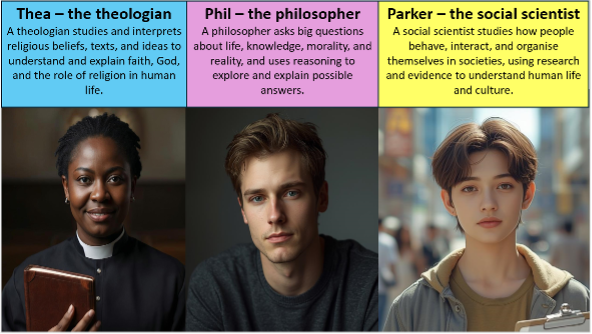
Before studying a text in detail, we focus on the person behind it:
- Who is believed to have said or written this?
- When did they live?
- What was life and society like at the time?
- Why is this individual regarded as a source of wisdom and authority today?
Establishing this foundational knowledge allows pupils to engage more confidently with the text itself. We also ensure that key vocabulary, both subject-specific (Tier 3) and more general academic language (Tier 2), is either pre-taught or clarified during reading.
Read like a theologian: guided reading, LAaSMO, and deeper text work
Promoting reading has been a key whole-school and departmental priority in recent years. Our approach includes structured reading strategies, which you can explore further here: https://www.broughtonhigh.co.uk/docs/Curriculum/RE/Reading_strategies_in_RS.pdf
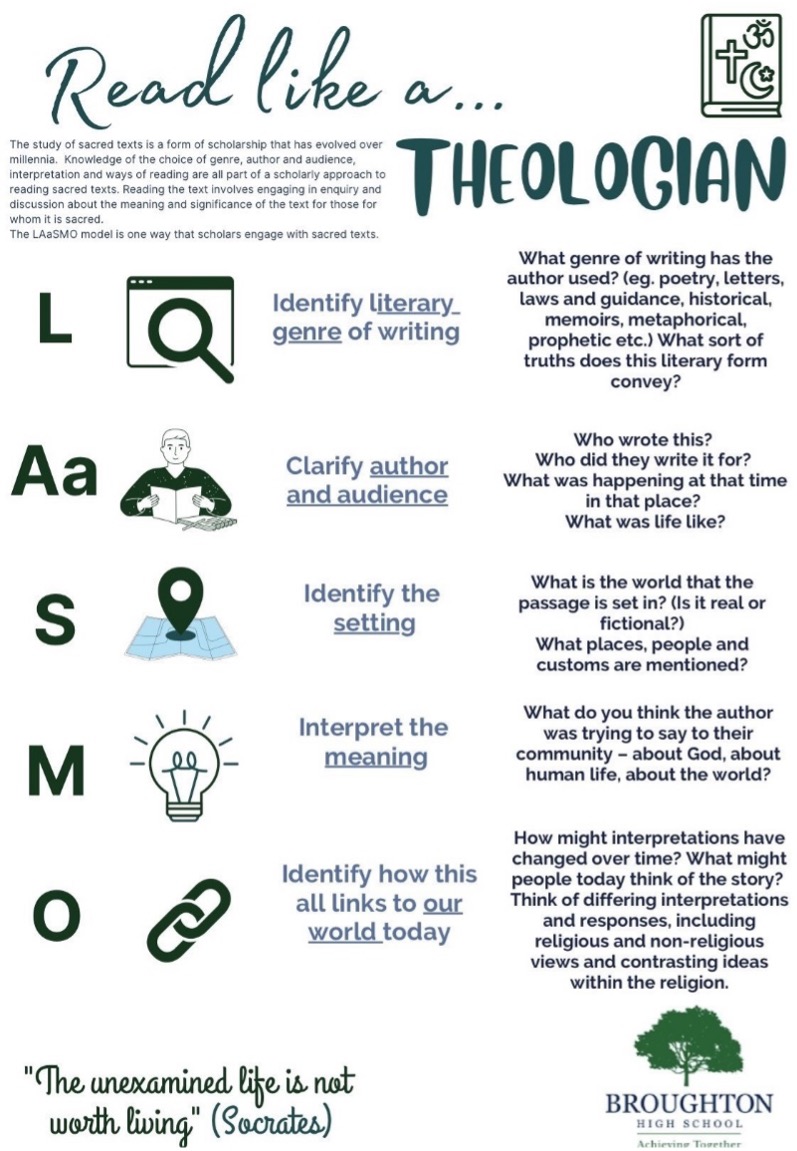
Initial engagement with a text typically involves a guided reading process, where the class reads together and responds to questions designed to support both comprehension and analysis. This often leads into more detailed exploration using the LAaSMO model, as set out in the Practice Guide. This provides a clear and structured approach to help pupils unpack sacred texts in increasing depth. For example, when exploring the Parable of the Good Samaritan from the Bible, we begin by considering the literary form, discussing why parables are used as a method of teaching and how storytelling shapes meaning. Pupils then explore author and audience, developing their understanding of Jesus not only as a religious figure but also as someone responding to the social context of his time. This is deepened through consideration of the setting and character choices, helping pupils recognise why the parable may have been controversial. With this contextual understanding in place, pupils are better able to consider the meaning at the time, interpreting the message as a challenge to social and religious boundaries. Finally, they explore meaning and application today, discussing what “loving your neighbour” might look like in contemporary contexts – locally, nationally and globally – and reflecting on the relevance of sacred texts in the modern world.
Meaning then, meaning now: helping pupils connect sacred texts to contemporary life
The Curriculum and Assessment Review in England emphasises that a successful curriculum should be fit for purpose and equip young people with the knowledge and skills needed to thrive in a rapidly changing world. In RE, exploring how sacred texts might inform responses to modern ethical, social and global challenges helps pupils to engage more meaningfully with the subject, develop critical thinking skills and see the value of what they study in their own lives. By encouraging pupils to evaluate whether religious teachings still hold relevance today, we support them in developing as thoughtful, reflective individuals who can engage with different perspectives and apply their learning beyond the classroom.