Viewing archives for

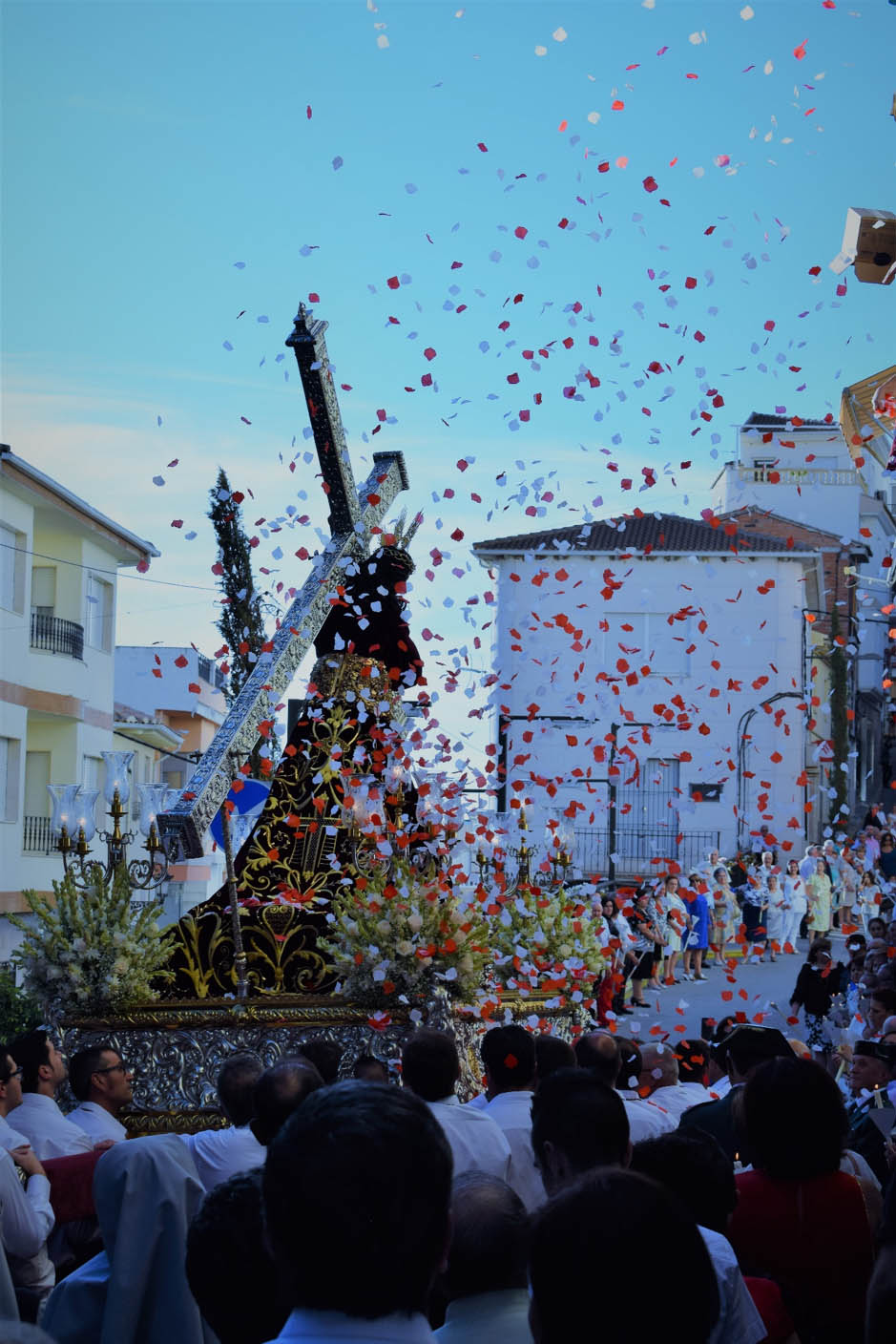
Religious procession in Spanish village
 

You might not think there’s anything touchy about the above photo. It’s a happy scene where a whole Spanish pueblo is out on a sunny September afternoon to celebrate one of the two annual occasions when their most loved religious image, Padre Jesús, is processed through the streets. Yet controversy’s rarely far beneath the surface when it comes to religion; and within the living memory of some of those in the procession, during the Spanish Civil War, the same image had to be hidden in a barn for three years to prevent anarchists and communists from destroying it. There’s an agreement amongst the villagers to try to forget about those events and not discuss them, which holds up most of the time.

Moving back into the RE classroom, it isn’t easy for teachers to handle the conflict dimensions of religions and worldviews with pupils. Moreover, we could do with knowing more about what pupils think about this element of RE. That’s why I hope you’ll forgive me for featuring recent research by myself, together with Bob Jackson, in this month’s blog. In a 2018 project, we worked with RE teachers in a South Yorkshire academy to create some research-enhanced pedagogy. We discussed some already published research with the teachers, in terms of how it might help to engage and stretch able Year 7 pupils within a topic on Christianity and the environment, and we assisted the teachers to re-plan some of the lessons on that basis. I then observed the lessons and gathered questionnaire and interview data from a pupil sample, later also interviewing some of the teachers about their experience of the project.

I can’t cover all our findings here but will give you some of the headlines. Firstly, some of the topic content was controversial (e.g. disputes between Christian groups around dominion or stewardship and conflicting pupil views over religion or the environment); clear, agreed ground rules for discussion meant that the controversies could be engaged without too much rancour or reduction, especially because the pupils helped decide the rules. Secondly, direct contact with members of faith groups made the RE more relevant and engaging for the pupils – they interviewed relatives or family friends that self-identified as Christian and reported back enthusiastically to the whole class at the start of the next lesson. Thirdly, small group discussion of Biblical texts was effectively supported by a hermeneutical questioning structure: what might this have meant when originally read or heard? What different interpretations are possible? How might people of different backgrounds or interests interpret it today? Fourthly, for the teachers, working with the researchers and research gave extra angles on teaching, built confidence, improved class management and was much more productive than the generic, data-driven CPD to which they had become used.

The description of RE as a ‘touchy subject’ comes from the pupil interview record. But the pupils also said that the chance to investigate difference (between religious and other views of the world, and between one another) is what makes RE valuable and interesting. For the teachers, thinking about research had enhanced their capacity to provide such interest and value to pupils. This is something we want to hear much more about at CStG.

You can read more about this research at ‘A Touchy Subject’: Year 7 pupils’ views on when RE is good (and RE teachers’ views on the benefits of engaging with research)

The reference for the full published article is: Kevin O’Grady & Robert Jackson (2019) ‘A touchy subject’: teaching and learning about difference in the religious education classroom, Journal of Beliefs & Values, DOI: 10.1080/13617672.2019.1614755

There may still be some free, open access downloads of the full article available via this link: https://www.tandfonline.com/eprint/hr8fZwcXS8VSH8izyItI/full?target=10.1080/13617672.2019.1614755


The aim of the Farmington Institute (part of Harris Manchester College, Oxford University), is to support and encourage teachers of Religious Education in schools. This can be in either primary or secondary settings or other centres offering RE teaching including places of worship, and often encompasses being released for a fixed period of time to research a specific area pertinent to RE, be it literacy, teaching of a specific religion or something a bit more unique.

We, as a collective, became one of the first group scholarships, with the brief to provide support to secondary RE teachers in Suffolk.

If you asked somebody to name something about Suffolk, my guess is that most think of Ed Sheeran. They will have heard of John Constable. Some might think of the Adnams or Greene King breweries or Aspall’s cider. They might mention Ipswich Town Football Club (they’ll look unhappy if they do), or they may talk about our beautiful coastline. My guess is that they might not know that the honeycomb in the centre of a Malteser is made in Suffolk, or that we are home to an endangered species – the Suffolk Punch horse.

But I can almost guarantee that they will not think of multiculturalism, or a large amount of different beliefs and worldviews being prevalent. And they would be right.

Of a population of around 750,000 people, 61% of those claim to be Christian according to the latest census. The closest belief next to that are the ‘nones’ at 30%, with each of the other major belief systems all being in the 0 point something percent. While the increasing rise of the ‘nones’ reflects UK society in general, for each of the other beliefs, Suffolk lags behind with every other belief in the country. Resultantly, many students in Suffolk are less exposed to the diversity of beliefs in the UK and, we would argue, this makes RE even more crucial in their development as citizens of our country.

And yet, RE has found itself increasingly on the margins; squeezed into PSHE schemes, given a couple of cursory drop-down days every now and again, or just purely forgotten about. And, for those schools that do commit to it, do see the benefit in it and fulfil their obligations to their students, RE teachers are often left to fend for themselves, largely in single-staffed departments. Energetic and talented NQTs often find themselves leading subjects in their first year in the job, even having to create the programmes of study on the fly. RE departments are often led by well-meaning, non-specialists crying out for a bit of guidance and no knowing where to turn for it.

And then there are the practical Suffolk issues: how can I get my students used to different places and ways or worshipping when the closest Synagogue or Mandir is 90 minutes away? Can I afford the time to drive 60 minutes for a network meeting to then drive 60 minutes back home again? How can I keep up to date with new resources and ideas to keep RE interesting? Who do I turn to when I need some support and advice?

These were the questions that the four of us were hearing through our roles as Professional Advisors to Suffolk SACRE, where we update local faith representatives and politicians about developments in RE, both nationally and locally, providing us with a clear insight into the status of RE in the county. Thanks to some clear guidance and support from passionate people such as Jan Maguire and Helen Matter on SACRE, as well as those at Farmington, Suffolk Resolve was created. All of us are subject leaders (as well as, somewhat typically for RE teachers, having other roles in our schools), but most importantly, we all care deeply about RE being done and done well.

There have been a number of outcomes from the project. Firstly, we were able to offer teachers the chance to go on an organised trip to Coventry, to look at two places of religious significance; Coventry Cathedral and the Sikh Gurdwara. This was done to show that it is possible to expose our students to wider religious beliefs and practices, as well as providing valuable CPD for teachers.

Secondly, we made ourselves available for coaching and mentoring across the county (and a little bit beyond the borders too!), especially for those aforementioned who might not have much subject specific support. The intention is that this is ongoing. One colleague who benefited from the coaching said that it was particularly beneficial to have “a subject specialist observing me for a day, giving feedback, suggestions for improvement and sharing expertise and experience. To have an experienced practitioner as a go-to, at any time has been exceptionally useful.”

Finally, our website (www.suffolkresolve.co.uk) was created to host our project and share our learning. On the website, we have made the latest research and developments in RE easily accessible in a single location, so that we can keep improving our practice in order to benefit those we teach. This includes articles, podcasts and signposting to various RE influences, including RE:ONLINE. The website also hosts a plethora of resources developed by one member of our team, with ideas based on requests from local teachers as well as looking to cover the range of specifications, topics taught and worldviews that our students should encounter. These will remain available and we hope you find them useful too.

We are yet to see the full impact of our project, but many have stated a greater confidence, a greater feeling of support and a sense of relief that there are people there to help, and who want to help. They now know that they are not on their own. This is something that we have all felt when working on the project together – the benefits of talking to each other regularly about what we are doing and why, either in person or online has made us all better teachers; as the saying goes ‘iron sharpens iron’. Despite our geographical distance and various contexts, we have felt that we are a team who have experienced each other’s struggles and successes and it has become more and more apparent that too many RE teachers feel like individuals out there in the wilderness and we want to be a part of the solution to these issues.

Teaching is a team game and this is most certainly true for RE, so we believe that we should be treating it more like that and we will be endeavouring to continue to play our part. For us, there is more and more evidence that as experienced professionals, we need to share. Share resources. Share experiences. Share ideas. Share our struggles and share our successes. So we will keep sharing, and hopefully play our small part in making this great subject a little bit better.

Find out more about us at www.suffolkresolve.co.uk

Martin Cobbold, Debenham High School

Sarah Cobbold, St Benedict’s High School

Wayne Buisst, Ormiston Denes Academy

David Yaroslaw, Debenham High School

For more information about Farmington scholarships, visit http://www.farmington.ac.uk

As the alarm sounds at 4am, through the fog, my mind clocks that today’s the day for the AREIAC conference.  It was hard to get away from class even for one day – which was all I was going to manage – not because of SLT but because of my class. Year 6 can be a volatile place at this time of year, which has meant I haven’t had chance to think about leading and supporting RE teaching for some time.  I was excited, curious and hopeful.

The conference was entitled Agents of Change.  As I sat on the train, I wondered how it was going to change me.

The first keynote speaker was Mary Myatt.  Her focus on the use of stories hit a nerve.  Two years ago, I re-evaluated and redesigned our school’s English planning.  I was worried that children had lost their love of English (or perhaps they’d never found one).  I wanted to inspire children (well I’m a teacher, it’s what we do) so I started with stories.  I know that seems an obvious thing for English but I mean really good, vocabulary rich stories.  Stories that took a term to read and became the springboard for their creativity.  Since then, our reading and writing scores have rocketed.  Children have a love of reading.

Mary talked about starting with stories, really rich, meaningful engaging stories in RE.  Of course!  Why would it only be English?  I have been striving for a way of raising children’s religious literacy – particularly in community Primaries where children have barely any.  They have no way of connecting RE to their lives, no foundation of religious vocabulary to build upon and deepen.  We needed a way in and there is nothing more profound in teaching than a story.  It is in our human nature.  Beyond culture and throughout time, stories have been used to connect, inform, engage, and inspire!  So, my first change?  Every piece of planning to include a story.  And right there – English and RE making a genuine connection where both subjects can be taught simultaneously without compromising the key skills of either.

After lunch, Luke Donnellan spoke about Humanism and World Views.  He began with the stats.  A strong case in themselves to teach non-religious world views, but along with others I was worried about just ticking the ‘no religion’ box as evidence for those who have ‘non-religious world views’.  As though reading our minds, he went on to clarify what exactly was meant by ‘non-religious world views’: that this did not, in itself, mean atheism, nihilism or ‘no religion’.  For the Primary curriculum, ‘non-religious world views’ is new to many teachers.  Indeed it’s only really touched upon in Year 6 if at all.  I have often seen humanism mixed with atheism and a lack of understanding of the ‘world view’ part of this.  So my next change?  Clarifying what is meant by ‘non-religious world views’ to my primary colleagues and removing the misunderstanding.

My time at the conference was brief, but it only took a whistle-stop tour for me to be inspired by the vision, commitment and drive to see the changes I need to make to ensure that the teaching and learning in Religious Education and World Views is accessible, rigorous and of course inspirational for all children!

AREIAC 2019’s conference was entitled Agents of Change: RE Leadership in a New World.
A New World; state of flux; uncertainty; chaos; challenging times. One RE adviser laughed, “When has RE not been in challenging times?”. As an “emerging leader” in the RE community, I must confess to being excited by this New World – in it I see potential, I see opportunity, I see hope. But, like many hopeful leaders, I don’t really know where to start.

I don’t know where to start was the point Ben Wood, Chair of NATRE and Head of RE at Haslingden High School, made in his reflections on how to change a curriculum. As a RE subject lead currently grappling with curriculum choice, I felt an enormous sense of relief listening to Ben. If he, who has read widely, shared widely and climbed to the top of the RE game, doesn’t know where to start, it’s OK that I am still deeply uncertain. Hear this, RE Subject leaders – uncertainty is OK. Don’t let the fact that, as Ben admits, the curriculum occasionally keeps us awake at night lead to paralysis. Maybe, due to the paradox of choice, we will never be satisfied.

Ben argues for the value of constraint as we consider our curriculum choices, he suggests we should enforce constraints on ourselves that chiefly concern us as teachers in school. Constraints of time, planning the planning, using subject knowledge and playing to our own strengths. Your constraints will depend on your school your circumstances. I feel now, it’s OK to take the time to look before I leap in curriculum choice – with the knowledge that I will have to leap!

Curriculum choice is keeping me awake at night. I anticipated hearing Mary Myatt speak on Curriculum: Controversies, Concepts and Conversations. Since initial RE CPD, I have been profoundly influenced by her philosophy: RE should have beauty and depth. Mary reminds us to run our schools for our children not inspectors; OFSTED are not looking for anything – they are looking at what we’re doing. When planning our curriculum, we must begin with the end – what do we want children to know at the end? It is too easy to get caught up in content and to forget that RE needs to be underpinned by demanding concepts, big ideas – we’re trying to make our learners think. We must privilege thinking over task completion, this is important for the teacher to remember in the classroom – this is empowering.

Richard Kueh too spoke of empowerment. In these times of change, we need to prioritise RE teacher agency, we must nourish, nurture, strengthen and challenge our teachers. When shaping and crafting teacher agency, teachers must have intellectual confidence, without which they are left to drown in complexity. Richard pointed out, to a room full of advisers, that there was a gulf between advisers and emerging leaders in the classroom – there is a tension here, can we make this a productive tension? There is a need for mentoring, for transformative change leading to a community of professional hybrids. Advisers must cultivate teacher agency beyond the classroom to ensure a legacy which elevates beyond new heights.

This is where my own story jigsaws in, as one of the first cohort of AREIAC REvitalise mentees. I am a HLTA who has been leading RE in a large primary school for nine years, during which time I have carried out research, led CPD, completed leadership programmes and led our school to the gold REQM. Over the last year, I have benefited from the mentoring support of Jan McGuire, an RE Adviser and former teacher. The personalised guidance of an experienced mentor has “bridged the gulf” between adviser and this emerging leader, this “professional hybrid”. At the conference, I shared with delegates how REvitalise has been a professionally formative experience. During this year, in which I became the NATRE East Anglia Regional Ambassador, culminating at the AREIAC conference, I had the opportunity to think beyond the classroom, beyond my school, my MAT, my region to a “New World” national RE agenda. These bigger picture considerations I now feel empowered to take back to my region, my MAT, my school and back to my classroom, which is after all, where the big picture really matters.

REvitalise was a one-year project funded by AREIAC and CStG, it supported 20 teachers already starting to lead RE training for others outside of their school.

Having had the privilege to be part of the REvitalise project has enabled me to have a far better understanding of how to improve RE provision within my own school, as well as for others, allowing me to grow as well as help develop the leadership qualities in others.

Every minute of my involvement with this project has been extremely useful, as I have been immersed in high quality CPD with the best people and have been given amazing opportunities to meet other organisations such the 3 Faith Forum and The Ismaili Centre in London. It was useful to find out more about these organisations so that I could impart my new-found knowledge with my RE leaders’ group. I found out about the Faith and Belief Forum’s diversity workshops and their school linking programme: I have since shared this information with other RE leaders in Frimley. The visit to the Ismaili Centre was a fantastic opportunity to find out more first-hand about a branch of Islam that I didn’t previously know much about. This subject knowledge has since been used to inform my own planning and that of other leaders’. Being part of this program has allowed me to have a year’s membership to AREIAC- a fantastic opportunity to meet and work with advisers and consultants- learning from highly experienced people in the field of RE!

One of the best things I have learnt, which has had a huge impact on my training of other teachers, was learning about andragogy. It answers the ‘So what?’ and ‘Why should I be interested?’ questions that many teachers ask when involved with CPD at the end of a day’s teaching. The power of effective andragogy is vital in order to give teachers worthwhile ideas for the classroom and a wealth of resources to take away. I now use a variety of practical and engaging ‘starters’ at the beginning of my training sessions which make teachers think deeply about the content of the training- compared to ‘jumping into’ the training content that I used to do. I feel that I now conduct useful, interesting and highly relevant CPD for all- I now look at what I do with ‘a fresh pair of eyes’!

Attending the AREIAC conference in Manchester this July seemed like a natural progression as I come to the end of my year on the REvitalise project. It was evident that within the RE community, it is vital to make connections between organisations, supporting each other and helping to grow new leaders for the future- in essence just what the REvitalise project has aimed to achieve.

It was an honour to hear the wise words of the high calibre of speakers at the AREIAC conference. Mary Myatt’s words about ‘High Challenge, Low Threat’ made me think about offering a training session for the RE planners in my school and within my trust, based on examining closely, the quality of lessons being offered to pupils. During Mary’s speech, I found myself questioning myself about the quality of texts and images being used in my own classroom. Ed Pawson gave a brilliant speech which made me think about how the CORE report translates into what we do next as an RE community. Ed’s speech also highlighted the need for preparing training for teachers of RE to prepare for ‘deep dive’ inspections. This is something I hope to do in the next academic year. It was a fantastic experience to hear about Dr Richard Kueh’s multi-disciplinary approach to stressing the importance for subjects to be more linked. I now understand more about finding a strategic way to improve the standards in my trust and to influence change with respect to RE planning and ultimately, the quality and content of what pupils are learning. Dr Kevin O’Grady made me think about research opportunities: consequently, I would like to ask my local group members if they would like to research any area of our subject, with a view to sending a research proposal to Kevin in the future. To summarise, all speakers made me think clearly about curriculum design and how my leadership can be used to help develop the quality of the subject for others. I am particularly interested in looking at previous research with a view to how it can inform my planning and teaching of RE, which in turn, will be of benefit to the teachers I train.

REvitalise has also given me the opportunity to network with others in similar roles.  I now feel empowered to ’push further’ and work with other advisers to coordinate a pupil conference for higher prior attainers in RE, with a view to providing a conference for RE teachers in Surrey. Without this incredible project, I would never have broken out of my ‘comfort zone’.  Now I have the courage to keep striving for excellence in RE on a much larger scale and taking others with me on this journey. I am so grateful for being part of the REvitalise project- I will never look back!

For more about research in RE visit Research

The CORE report recommends attention to the conceptual category of religion. [i] This is welcome. What do we mean by the word? The discussion needs opening, at both professional and classroom levels. It won’t be an easy one, as the field of religion is so varied that religion is hard to define.

According to CORE, religions are worldviews, and worldviews are philosophies of life.[ii] At the same time, the report recommends greater attention to individual lived experience and how worldviews work in practice.[iii]

Is this a conceptually clear account, or is there a tension between emphasising beliefs or philosophies on the one hand, but experiences and practices on the other? Which should be RE’s primary focus, and how should the foci relate? This month’s Research of the Month is chosen for suggesting some promising answers to these questions. It’s a book by the US scholar Christian Smith, Religion: What it is, how it works, and why it matters. [iv]

The definition of religion given by Smith has been described by one reviewer as ‘the best theoretical and analytical definition I know’.[v] It reads as follows:

‘Religion is a complex of culturally prescribed practices that are based on premises about the existence and nature of superhuman powers. These powers may be personal or impersonal, but they are always superhuman in the dual sense that they can do things which humans cannot do and that they do not depend for their existence on human activities. Religious people engage in complexes of practices in order to gain access to and communicate or align themselves with these superhuman powers. The hope involved in the cultural prescribing of these practices is to realize human goods and avoid bads, especially (but not only) to avert misfortunes and receive blessings and deliverance from crises.’[vi]

Thus, the primary focus is on practices, but the practices are seen as based on beliefs or ideas. As he develops the argument, Smith offers supporting points. Religions also have secondary aspects including the forms of identity, community or aesthetic expression associated with the primary practices. Participants don’t necessarily hold the ‘established’ related beliefs, so religion consists in the cultural meanings handed on; these are realities apart from individual experiences, and it is as religiousness rather than religion that individual experiences matter hugely.

What might Smith’s analysis mean for RE teaching? To sketch it out, teachers would engage pupils in an enquiry into a range of religious practices. Firstly: what happens during these practices? For what goods do they aim? There would then be two secondary layers of enquiry, one into how repeated religious practices flow into aspects such as social identity, aesthetic expression and power, another into religiousness at the individual level.

This form of RE might flow from a clear conceptual account of religion, but it has limitations. It doesn’t include a philosophical element, so pupils don’t exercise a right to be critical about truth-claims that may be associated with the practices and meanings. It doesn’t include a reflexive element where pupils reflect on their own viewpoints, how these affect their own views of what’s studied and how their own ideas and values may have developed through their studies. Still, the approach could be compatible with both elements. The study of non-religious worldviews might have to come from a different angle, because it may not be possible to view these primarily in terms of practices. Nevertheless, I would certainly recommend Religion: What it is, how it works, and why it matters as stimulus to further thinking and discussion regarding the conceptual category of religion within RE.


[i] RE Council of England and Wales, Religion and Worldviews: The Way Forward. A National Plan for RE, London (RE Council of England and Wales): 2018, page 31.

[ii] Ibid., page 4.

[iii] Ibid., pages 30-31.

[iv] We’ve reported part of the book at What is religion?

[v] You can read Jose Casanova’s review of the book at https://academic.oup.com/jcs/article-abstract/61/1/126/5303792?redirectedFrom=fulltext

[vi] Christian Smith, Religion: What it is, how it works, and why it matters, Princeton and Oxford (Princeton University Press): 2017, page 3.

Teachers and educationalists have taken part in two incredible days exploring Theologies of Reading at the Faculty of Divinity, University of Cambridge.

Why describe it as incredible?

The level of expertise in the room from primary and secondary teachers, RE advisors and educationalists complimented an inspiring series of lectures and discussions on aspects of RE.  Lectures came from post-doctoral experts in their fields of study providing a  ‘deep dive’ and nourishment into elements of RE as well as careful thought on how the themes could be transferred into different education settings.

In the course of Theologies of Reading Day One Hermeneutics, Qur’anic Recitation, Religious Commentaries in Midrash and Biblical Language in texts were explored.  These challenging concepts were enlightening, particularly with expectation of translating them into my own context of primary education.  The key to doing this for me was to breakdown each lecture into simple terms; Hermeneutics crudely became different viewpoints, Biblical Language and Texts became authorship and Religious Commentaries became evidence-based argument.

I then selected two of these concepts to develop into a teaching block from the Understanding Christianity resource – The Kingdom of God.  It linked to the liturgical calendar as Pentecost was upon us, this allowing me to explore the story of Pentecost through authorship and biblical evidence.  A great find to enable this was the purchase of an Infographic Bible!

The second element allowed me to explore the theological impact of Pentecost on the beliefs of Christians in the context of The Kingdom of God.  Healthy debates were held on the reasonableness of Jesus ascending to heaven and whether people did actually experience the Holy Spirit within them.  At times this digressed into wider discussions about the origins of the universe and the nature of the miraculous.  Year 6 pupils raised the idea that for the big bang to happen someone needed to create the space for it to happen – was that proof of God?  This obviously made for more thought as a couple of days later when a Year 3 child asked if God created everything then who created God?  Another child made the connection that maybe we could interpret the big bang as the creation of God – were they one and the same?

Day Two of the Theologies of Reading seminars allowed us to showcase our work and to explore some further concepts back in Cambridge. As part of this day we visited the university library and explored some of the treasures of the sacred texts that they hold.  It was a genuine privilege to ‘get up close’ to text dating back in some cases over 500 years.  To see personal notations and additions in pontificals as well as the evolution of script into scholastic ‘textbooks’ was amazing.  I was particularly inspired by the intimacy of the Book of Hours we saw.  I pondered how these very personal collections of bible verse, prayers and psalms could be translated into an assessment piece for Year 6 as a culmination of their total RE learning.

This visit was complimented by a lecture on Practical Criticism and coming to a text with purity, no context and experiencing it as a reader.  We read collectively as a group, discussed our stumbles and our cohesion.  Brought light to the semantics of the verse and offered our reflections.

So what next?

Taking the concept of reading a text ‘cold’ not only for RE but also across the wider curriculum may be a possibility.  Likewise transferring and connecting the skills of RE across the curriculum.  A fellow colleague posed the idea of what if you presented a religious text in a format that removed the ‘religiousness’; a bible text without the verses or chapters or a psalm presented as a simple poem.  Would the children interact differently to it?  Would it be better?  Some exciting ideas to explore…


For further information about the Theologies of Reading series contact Kathryn Wright  ceo@cstg.org.uk

Details of the original Theologies of Reading seminars which inspired this CSDP programme can be found here: http://www.crassh.cam.ac.uk/programmes/theologies-of-reading

For information about the Understanding Christianity resource: http://www.understandingchristianity.org.uk

For information about University of Cambridge Treasures collection: https://www.50treasures.divinity.cam.ac.uk

Introduction 

At a recent NASACRE AGM Dilwyn Hunt asked a question about the educational value of RE as expressed in  the Commission on RE Report. This is an important question and for this reason we are publishing a blog which sets out Dilwyn’s views. Culham St Gabriel’s strongly supports the recommendations of the Commission on RE and its vision for RE. On Friday I attended an event entitled ‘What next for Religious Education?’ This brought together teachers, researchers, policy makers, curriculum developers as well as philosophers of education. Many of the points raised here in Dilwyn’s blog were debated and discussed. Whilst I may not agree with Dilwyn’s position, it is very important that we have robust conversations about these matters.

Kathryn Wright

CEO, Culham St Gabriel’s Trust


Has the CoRE brought clarity?

For some the Commission’s proposals ensure that RE is no longer burdened with personal and spiritual aims as it now has one very clear purpose, it is the academic study of religious and non-religious worldviews.

If this is what the CoRE had in mind it certainly provides RE with a straightforward purpose but it also weakens the educational value of the subject.  It’s all very well teaching young people knowledge about religions and worldviews but unless young people are taught material which they can engage with and reflect on, that informs their lives and answers their questions all we would be achieving is filling up the minds of young people with what Michael Grimmitt called so much ‘verbal lumber’, which is inert and quickly forgotten.

Religious Education at its best has two principal ambitions or purposes.  Of course, one of those ambitions is the study of religious and non-religious worldviews.   The second is to help young people in their own attempt to find something in life, it may be a worldview, or it may be something much looser, whatever it is it helps them to make sense of existence.

Religious Education is not just a spectator activity which studies religious and non-religious worldviews.  The subject is also for participants in that it supports young people in the human desire to find something in life that helps them make sense of existence.  We are poor creatures if we choose not to think very deeply about the world and in the light of what we make of it live our lives accordingly.  It is this second ambition that moves RE into high gear in terms of its educational value.

The idea that RE has two ambitions is not new.  Back in 1971 the highly influential ‘Working Paper 36’ affirmed that RE has two ambitions and expressed this neatly in the statement, ‘We incline to the view that religious education must include both the personal search for meaning and the objective study of the phenomena of religion’ (p.43).  The words ‘phenomena of religion’ didn’t just mean the religions.  Non-religious worldviews was also clearly on the agenda.

Why do some people think the CoRE has abandoned the idea that the subject has two main ambitions?  Commission members have expressed surprise that people have this view
but the CoRE’s report does lend itself to this interpretation.  The report is over 23,000 words but only around 200 words are about pupil’s own personal worldview and what is said is often ambiguous.  The CoRE’s entitlement statement is over 500 words but only around 30 are about making sense of life.  What is written tells us that pupils should be taught about, ‘the different roles that worldviews play in providing people with ways of making sense of their lives.’ (p.12) What does this mean?  It looks like an entitlement to explore the ways other people’s worldviews help them make sense of their lives.  What it doesn’t say is that pupils have an entitlement to reflect on their own their own worldview.

In the report there are only two or three brief references to pupils and their personal worldview.  For example, we are told, ‘It is one of the core tasks of education to enable each pupil to understand, reflect on and develop their own personal worldview’ (p.5).  These words are more or less repeated on p.26.  However, both of these statements are not about Religious Education, they are about education in general.  The CoRE’s view appears to be that young people’s own exploration of meaning is not a matter for which RE has a special responsibility but is a whole-school responsibility.

Of course, it is true that RE is not the only subject in the curriculum that can contribute to young people’s exploration of meaning but by placing it in the wooly area of being a whole-school responsibility with no subject being given responsibility for it is a recipe for weakening this aspect of education and weakening RE.

To be fair in Appendix 2 in the last few pages of the report there is a clear statement that as well as the study of worldviews the subject must also provide ‘space’ for pupils ‘to reflect on one’s own worldviews.’  Appendix 2 has none of the ambiguities that are in the rest of the report.  It effectively articulates the two ambitions of RE expressed in ‘Working Paper 36’.  This raises a number of questions – why the pretence that a ‘new vision’ is being offered when much of what is in Appendix 2 has been a part of RE for over four decades?  Why rebrand the subject as Religion and Worldviews when this is misleading people into thinking the subject is just the academic study of religion and worldviews and nothing else?

There are plenty of questions and issues that arise from the CoRE’s report.  Before we spend yet more money on political lobbying and demand legislation we should be having an open and frank discussion.  We should be listening to each other and not pretending that there is broad agreement when some see the report as a green light to just offering a study of religion and worldviews while there are others that see the subject as one that goes well beyond that and aims to help young people to think more deeply about life and what it is they stand for.

Gert Biesta isn’t sure. He thinks that the benefit of research is to offer ‘informed uncertainty’ to them; teaching is a journey with pupils into the unknown. So, in response to a short presentation from me that showed how engaging with reports on Research for RE had built teachers’ confidence, he wondered whether that is a good thing or not.

This conversation happened during the AULRE[i] conference of May 9-10 at Newman University, Birmingham. We’re planning a series of blogs that reflect on this conference, in which the other writers and myself are asked to weigh up what the AULRE conference offers to teachers. It’s a good question, since AULRE wishes to become an association for a broad range of RE professionals and (I’d argue) the research presented at its conference needs to reach teachers to develop RE. If it can, it has tremendous potential. I’ll try to show why by drawing on a few of my conference experiences.

First, back to the confidence dispute. Having had time to think about it, I don’t disagree with Gert, the issues just need spelling out. This definition of positive emotional energy from the sociologist Randall Collins helps:

“. . . a feeling of confidence, courage to take action, boldness in taking initiative. It is a morally suffused energy; it makes the individual feel not only good, but exalted, with the sense of doing what is the most important and most valuable . . . Emotional energy has a powerfully motivating effect on the individual; whoever has experienced this kind of moment wants to repeat it.” [ii]

That’s what kept me going for thirty years as a teacher. Arguably, the contested nature and content of RE make this kind of confidence particularly needed. I do think that RE teachers need to have confidence, but it’s the confidence to face difference, uncertainty and ambiguity with pupils, so that they grow up able to relate to the world as it is. We need to be professionally robust and epistemologically humble.

The AULRE conference had three keynote sessions, all of which visited this same kind of territory, as all three speakers resisted the narrow accountability model that continues to dominate English education. Joyce Miller spoke on the CORE report and its reception, regretting that some commentators had seen an overemphasis on content knowledge and lack of attention to pupil self-awareness and reflexivity. [iii] David Aldridge considered a pedagogy of belonging; an alternative to technicist models, emphasising attentive listening, slowness and love. I was particularly provoked by Pat Hannam’s address, on education, RE and the future of the world. She illustrated the crises of environmental degradation, children’s unhappiness and policy drift (namely the Ofsted definition of ‘good’ education which alludes to neither the world nor children) and underlined our responsibility to bring children to action. It was commented that they may be doing so already without us, and whilst this may be true, it doesn’t remove our responsibilities as educators.

It was an excellent conference, and many more examples could be given, but it’s time to come back to the question of how teachers might benefit. Well, I hope it’s clear that visionary thinking is happening in our subject. At one level, I’d like teachers to be aware of it, participate in it and help it to build RE’s future; at another level, I’d like it to have to connect with the everyday reality of school. The two levels can be bridged, of course, and I’ll just mention one more AULRE conference example, Frances Lane’s presentation on using research communities of practice to support trainee and beginning teachers. It’s at this kind of interface where I see Culham St Gabriel’s research strategy developing in the future, as well as supporting later stage teachers to become researchers via master’s and doctoral work which informs classroom practice.[iv] If you are interested in making this kind of professional journey, you might well find inspiration and possible starting points at the AULRE conference, so do take confidence and get in touch if we might support you to attend. Kevin@cstg.org.uk


[i] The Association of University Lecturers in Religious Education now describes itself as the network for learning, teaching and research in religion and education. See http://aulre.org/

[ii] Randall Collins (2004), Interaction Ritual Chains, Princeton: Princeton University Press, pages 39, 49, 121, 134, 105-9, 108, quoted in Christian Smith (2017), Religion: what it is, how it works and why it matters, Princeton: Princeton University Press, page 223.

[iii] See my May blog at https://www.reonline.org.uk/news/kevins-blog-religion-worldviews-and-big-ideas-where-do-you-stand/

[iv] We do already support doctoral researchers to present at AULRE through a bursary – again, those interested are welcome to email me.

At every conference I attend, you will find me with a neat notebook and pen poised to take down as many ideas as I possibly can from the sessions I select. I find it useful afterwards to go through and highlight the key ideas that will stay with me either for immediate use or for me to think about more and maybe even read up on! This year’s AULRE was no different and with 18 pages of notes I thought I would try to distil some of it here:

  • We need to teach the pupils about people. Pupils are also people.

This came from Joyce Miller’s opening keynote. She was talking about avoiding the use of the easy label in RE. Let’s stop talking about people being Christians or Muslims, Sikhs or Hindus and so on. People of faith have jobs, families, hobbies, communities, wider interests…..and so do our pupils. Let’s recognise that people are more than a label. We need to avoid our pupils feeling that they are not a part of the RE landscape. Avoid the disconnection they can feel and make them see that just like, for example, Christians, they have a view on matters in RE too.

  • We teach children, not just RE.

This theme was one that came up in papers by Julian Stern, Elizabeth Russell and Pat Hannam. RE isn’t just about teaching our subject and for many of us, it is not the primary focus. Teaching has an ethical aspect and we want to positively impact on the lives of the young people in front of us. We need to care about them. Our key motivation for teaching may vary but the day to day is always about children.

  • Collaborating with others leads to impactful innovation.

This came from a paper by Frances Lane about a module for her NQTs. By insisting they work in small RE teams and clearly identifying a joint project, they were encouraged to support, problem solve and innovate their way through their NQT year. I bet they had fun doing it too!

  • Stop using the word ‘explore’.

As a learning objective that is. We don’t often head out to explore anywhere in RE! Thanks to Nigel Fancourt, Liam Guilfoyle and Jessica Chan for reminding me of this. There must be better verbs for what we are doing in class?

  • Brainwashing might work, and be quick, but it is not what we want to do.

Dave Aldridge also gave us an introduction to time travel (yes, really!) but it was this point about brainwashing that I found most striking. Yes, we could, but we don’t. The kind of knowledge that could be imparted this way is probably not the kind of thing we want to teach.