Viewing archives for Blog

It is in the readings of Bernstein and Michael Young that I found a deep interest in the concept of ‘powerful knowledge’. I believe, powerful knowledge is found in RE which offers ‘esoteric knowledge’ which can contribute to developing well rounded human beings. RE can enable young people to think independently, to question and change society for the better so that they can play a full part in a democratic society, alongside learning STEM subjects. RE can also prevent the marginalisation of those from lower socio-economic groups by providing access to knowledge of the ‘powerful’. It is in RE, I believe, that students will not only develop a better understanding of the social world but will be provided with intellectual challenges that are empowering. Why do I say this? It is because that is what the subject did for me.

I grew up in in poverty, with Bengali speaking parents who observed their daily prayers and tried their best to encourage their children to take part in traditional learning that involved memorising the Qur’an and reading Bengali. My mother tried to teach me classical Arabic, but I was too interested in MTV. My parents received no formal education in Bangladesh, they struggled to make ends meet here in the UK, but they were grateful for the free schooling we received and placed huge importance on education, particularly English, Maths and Science. It is why Young’s Future 3 model which aims to focus on ensuring social justice and more equality in education speaks to me.

Simply memorising information (as I had memorised parts of the Quran) and applying that information to questions in exams is not enough. It is in the understanding of people and the world around us in its rich pluralist and diverse nature, that helps us make sense of what we read. My own experiences of not having access to (western) cultural capital had profound effects on my confidence as a young person and I believe my studies in RE, particularly when I was introduced to Western philosophy, opened doors for me. If my Muslim friends had access to Greek Philosophy and had to reflect on the English translations of the Quran and the works of the great philosophers as part of their religious education, their understanding of their own faith would be dramatically different from today. It can be argued that the purpose of education is not just to fight social injustice but to improve creativity, enjoyment, freedom to explore individual subjects of interest, which lead to real love for learning. My love for learning came from studying Greek and Medieval philosophy. I had no idea how much influence the Greeks had on the early Muslim philosophers who shaped Islam. Much of what I have learned is unknown to my friends indeed and yet, studying Religious Studies at University did not go down well with them as this was deemed unnecessary for religious practice and an inferior subject, which was a common view within my community.

Understanding of philosophical and religious knowledge freed me from accepting simplistic solutions to difficult questions about faith in my own life and in understanding world politics. RE can develop young people’s ability to participate in a conversation about themselves and their future. RE can play a pivotal role in contributing to a ‘powerful knowledge’ curriculum, adding to the intellectual development of children and providing those experiences that cultivate moral reasoning. To support rich experiences in RE would depend on whether RE serves any purpose to young people but if a student is growing up in a multicultural town with friends of different faiths, surely, they will learn more from their peers?  Who decides what knowledge is the most valuable? What about those parents who see no value in RE and see religion itself as a cause for all the problems in the world? The problem with accepting this, is that allowing students to disengage restricts students from accessing the powerful knowledge that promotes free thinking and fosters greater divisions in society.

We must not neglect the role that religious literacy plays in providing a powerful and knowledgeable workforce as well as a fully functioning democratic society with individuals all treated as equals. An RE curriculum that empowers students with powerful knowledge, that is rich in content and places an importance of allowing children to be free to think must be included in every curriculum. By doing this, we can support students to avoid making generalisations and simplistic conclusions in a world that is moving more and more towards a homogeneous way of thinking, particularly with the influences of social media on the younger generation.

RE therefore plays a vital role in providing space in the curriculum to encourage spiritual development and critical thinking. There is no absolute ‘right’ body of knowledge and whatever curriculum schools decide to teach, one risks indoctrinating pupils but learning about different worldviews can give students access to knowledge and understanding of the world beyond their immediate experience. The RE curriculum prepares students for public discourse and meaningful discussions. The need to improve religious literacy is the most significant aspect of this discussion. Whatever we teach, it must include powerful knowledge that promotes free thinking and fosters greater understanding in society between different peoples.

If we want to ‘liberate’ thinkers from their own environment and think beyond life experience then we must support the development of the whole person, not just the intellect. RE gives students the confidence in making informed decisions about the world and people around them. I believe that RE provides the type of knowledge that is associated with everyday experience. If we want our humanities curriculum to represent the cultural ‘knowledge of the powerful’ then let us give access to powerful knowledge through RE to all children to improve social mobility, tackle inequality, enhance student experiences and intellectual development.
As a teacher of Religious Education (RE), my professional background has been the driving force in ensuring the most suitable way of teaching RE (or RPE Religion Philosophy and Ethics) is appropriated within schools starting from the youngest age possible. In my teaching, I have demonstrated critical ways in helping students from various backgrounds understand the knowledge and use it to help them draw meaning to examine their own beliefs and those of others. The classroom experience has shown that RE as a subject helps in empowering our future generation through difficult conversations and taboo subjects. For example, within the theme of Peace and Conflict, students examine attitudes towards:

  • conflict and peace
  • just war
  • terrorism
  • bullying
  • forgiveness

The key responsibility for us all is to take these opportunities and create dialogue within the classroom. Helping to develop tools that enable the use of various lenses within the dialogue empowers our younger generation. Through critical engagement, challenging stereotypes with the hope of a new, better world!

However, do we have enough time in the classroom to create such safe spaces?’ Have we nurtured an environment of trust and dialogue?  How can we, as educators play our role?  Are we supporting our future generation to develop their religious literacy? How is religious literacy helping to build social relationships today, tomorrow and the future? I hope to address some of these questions in my research.

As educators, we are responsible for helping our young people develop, whether in the classroom or through various other projects and initiatives within the community. A community of learning and engaging is key to strengthening our society for today and the future.

I have come across the theoretical framework of Critical Race Theory (CRT) in my educational journey. CRT is a powerful lens in understanding various prevalent issues within society.  The framework is useful to reflect on how socially constructed concepts such as race or religion are used to maintain the interests of those in power.

History shows that between the 16th and 18th-century race was a folk idea that served as a general categorising term within the English Language, (Smedley & Smedley, 2005:19).

The term race’s usage increased by the 18th century, and its meaning became solid, leading to a new way of structuring society. Demoiny (2017) states: ‘the ultimate purpose of race was to distinguish between superior and inferior human species’. Race as a concept needs to be recognised, and the responsibility lies with us as educators.

In a nutshell, race is not biological, and as a teacher, I see it as my responsibility to help our younger generation prepare as responsible citizens. People’s lived experiences matter and give a voice to how race as a social construct or religion is constructed as the ‘other’ affects people’s lives in various situations.

CRT[i] was developed in the 1970s when lawyers, activists and legal scholars realised, ‘that the heady advances of the civil rights era of the 1960s had stalled and, in many respects, were being rolled back’ (Delgado & Stefancic 2017:4). Quite recently CRT has received publicity even in the parliament discussions[ii].

A basic tenet of CRT subscribes racism is ‘ordinary, not aberrational’. Such a powerful view reflects what is going on in society. It points out that the usual way society does business is through constructing racial discourses. It demonstrates that racism is ‘normal’ and the living everyday experience of most people of colour. ‘Because racism is an ingrained feature of our landscape, it looks ordinary and natural to persons in the culture’ (Delgado & Stefancic 2000: xvi).

A quick look at highlighted news around the world shows various cases of racism. Individuals being disadvantaged due to their racial background and in some cases, even facing police brutality. CRT helps examine racism experiences through their voices and how they have been made to feel like the minority and victimised through their accounts.

CRT helps to understand how racism operates within society on an individual level and a structural level. As a result, it shapes individuals’ lenses through the experience seen either in the media or bias filters from home. For example, as a Muslim, do I need to feel apologetic every time something happens? Can I be an independent human being who cares for the society where I live and breathe?

I would, of course, condemn the perpetrators for the evil actions they commit! Such evil actions that take away innocent lives! My Islamic religious value promotes “Saving One Life Is As If Saving Whole Of Humanity…”– Quran 5:32.

Meaningful conversations are necessary for the classroom to help lead to developing an understanding of others and their beliefs; however, can we say that all pupils participate without victimisation?

References:

Delgado, R., & Stefancic, J. (2000). Introduction. In R. Delgado & J. Stefancic (Eds.), Critical Race Theory: The cutting edge (2nd ed., pp. 1-14). Philadelphia, PA: Temple University Press.

Delgado, R. & Stefancic, J. (2017) Critical Race Theory: An Introduction. (3rd ed) New York: New York University Press.

Demoiny, Sara B & Botzakis, Stergios, 2018. Websites to Explore Race as a Social Construct. Journal of adolescent & adult literacy, 61(4), pp.469–472.

Smedley, Audrey & Smedley, Brian D, 2005. Race as Biology Is Fiction, Racism as a Social Problem Is Real. The American psychologist, 60(1), pp.16–26.

[i] In this paper CRT will be used to refer to Critical Race Theory

[ii] https://www.theguardian.com/world/2020/oct/20/teaching-white-privilege-is-a-fact-breaks-the-law-minister-says


‘No one is born hating another person because of …

his religion. … if they can learn to hate, they can be taught to love, for love comes more naturally to the human heart than its opposite.’  Nelson Mandela (1994)

Recent research by Anna Strhan and Rachael Shillitoe on the ‘stickiness of non-religion’ has got me thinking. We have reported the relevant article on Research for RE, and I also talked with Rachael about the findings at Culham St Gabriel’s January 20th In Conversation With event, as well as hearing both Anna and Rachael explain them during INFORM’s January 14th seminar on religious and non-religious transmission. [i] In this blog, I set out the research process and findings, discuss the value of the findings for Religion and Worldviews practice and conclude with a recommendation.

The research takes up the theme that ‘no religion’ is on the rise and aims to discover how this takes place. Previous data show how changes during adulthood matter less than transmission of religion or non-religion down generations: 45% of children raised Christian become non-religious, but 95% of those raised non-religious stay so. [ii] The question is how various influences (e.g., family or school) shape children’s non-religious identities. Anna’s and Rachael’s project gives us detail of this.

Studies were made in three English primary schools, in three different kinds of locality, which vary by the proportion of people identifying as not religious. The research methods were participant observation, paired interviews with children who had answered ‘no’ or ‘not sure’ to a worksheet question ‘do you believe in God?’, and interviews with parents and teachers.

What are the results? Different processes are revealed. Generally, in families, children may be affected by ‘active’ non-religious upbringing and influenced by signs of non-religiousness. Events in school RE and assembly can provoke children who do not yet ascribe an identity to themselves to realise that they are non-religious. Children are not passive in relation to what happens to them at home or school, though; they make decisions about who they are.

At home, or with friends, religion is not much discussed, if ever. Consequently, it is marginal to the children’s culture, and this, together with an absence of family religious practice, is part of what transmits non-religion to them. RE, on the other hand, can contribute to children’s more conscious formation of a non-religious identity. At one of the schools, children were asked to say whether they agreed or disagreed with some statements about forgiveness. They engaged eagerly, and though they had not been asked to state their religious or non-religious identities, discussion was provoked about who was or was not religious. In a lesson about creation stories, a child was moved to say that he believed in parts of Christianity and parts of science: God could have started off the Big Bang.

Children say that as they get older, their ability to make decisions about such matters increases, and that this individual choice is important to them.  I wonder whether another of the research findings is related to this ‘individual choice’ one: that non-religion is dissimilar to any form of organised religion. It rejects organised religion’s elements but also its type of element (authoritative scripture, person, or even authority in general).

Is Humanism dissimilar to organised religion in this way? Humanism is internally diverse; but when (it seems to me) it appears as a form of organised non-religious worldview, it might be the easiest form of non-religion to manage, in curriculum terms. Working out how to process the more diffuse, individual expressions of non-religion is harder. If that much was already clear, Anna’s and Rachael’s research has highlighted further subtleties. It is hard to distinguish between subject and object in Religion and Worldviews (the children are part of the world studied). Reflexivity is profoundly present (the children become aware of who they are because they study the world). A further finding is that the 7-13 age range may well be a long process of identity-shaping, suggesting strong potential to interest children in the subject, provided teaching gives scope for personal reflection.

Lastly, I would ask if in envisioning a Religion and Worldviews curriculum, we yet give enough attention to religious and non-religious transmission, a key feature of lived worldview. I sense that Big Ideas is the most promising curriculum development model. Religious and non-religious transmission could be studied under Big Idea 1 (Continuity, Change and Diversity) and Big Idea 3 (The Good Life). The ‘Putting Big Ideas into Practice’ document touches on these possibilities, but they could and probably should be developed much more. [iii]


[i] https://researchforre.reonline.org.uk/research_report/the-stickiness-of-non-religion/ Anna Strhan and Rachael Shillitoe, The Stickiness of Non-Religion? Intergenerational Transmission and the Formation of NonReligious Identities in Childhood. Sociology (2019) 53(6) 1094–1110.

[ii] Linda Woodhead, The rise of ‘no religion’: Towards an explanation. Sociology of Religion (2017) 78(3) 247–262.

[iii] Barbara Wintersgill with Denise Cush and Dave Francis, “Putting Big Ideas into Practice,” online material available at https://www.reonline.org.uk/resources/putting-big-ideas-into-practice-in-religious-education/ downloaded on 7 April 2019.


In my teaching of AQA GCSE RS Christian beliefs I have found one aspect perplexing, namely the paradoxical role of scripture. On the one hand, the new GCSE Religious Studies places a greater emphasis on every RE teacher’s favourite buzz words, ‘sources of wisdom and authority’ and yet pupils spend very little, if any time at all, actually engaging with scripture in any meaningful way. Instead, engagement with biblical scholarship seems to begin and end with cutting a few quotes from the synoptic gospels or John or the letters of Paul and simply pasting them in an exam answer without any engagement with the history, audience or purpose of the biblical texts.

The result is that I often find pupils asking me fantastic questions such as ‘who is Mark?’, ‘who was Luke writing for?, ‘what is a gospel?’, ‘what was life like at the time of Paul?’, ‘did Jesus actually exist?’. These are all excellent questions, and questions that pupils should be asking, and yet I felt that these questions were often ill-served by the current GCSE specification.

In response, this academic year, I did something different. I taught a lesson that was completely removed from the specification. The aim of this lesson was for pupils to gain a greater understanding of the historical Jesus and importantly how New Testament scholars use historical methods to ascertain if events contained in the gospel narratives can be considered to be historical. The lesson went something like this:

I started by briefly explaining to pupils the audiences and purposes of each of the synoptic gospels and John. The aim of this being that my pupils would begin to appreciate that the gospel texts they have been studying where written by authors to particular audiences and therefore these texts, like any other text, have a purpose and sit within a historical and social context.

Following this, I Introduced to pupils three main criterion which are often used by scholars in the study of the historical Jesus: the criterion of dissimilarity, criterion of embarrassment and the criterion of multiple attestation. The criterion of dissimilarity is simply a method that considers if the events in Jesus’ life (for example his baptism) are distinct from the teaching of 1st century Judaism or the early church. If they are, it reasons that it is more likely to be historical. The criterion of embarrassment considers if the event in Jesus’ life would have been considered embarrassing for the early church. If it would have been embarrassing for the early church it seems unlikely they would just make it up! Finally, and most importantly, the criterion of multiple attestation which focuses on if the event in Jesus’ life occurs in multiple different Christian and non-Christian sources. If an event in Jesus’ life such as the crucifixion is referenced in both Christian and non-Christian sources, such as the writings of Josephus, then it is more likely to be historical.

After my explanation, my pupils got to work. As a class, pupils read the baptism of Jesus (along with some information about baptism in first century Palestine). Then using the three criteria, I modelled step by step how each criterion could be applied to the baptism of Jesus. The benefit of modelling the first example as a whole class allowed me to reiterate what I expected my class to do and address any questions or misconceptions they had.

After scaffolding and modelling the first example, it was now time for my pupils to practice on their own with pupils applying the same criteria to several of the miracles of Jesus such as the exorcism of the blind and mute man and the raising of Jairus’ daughter. I found that my higher attaining pupils went one step further and even considered the limitations of using the criterion of embarrassment, multiple attestation and dissimilarity to study the miracles of Jesus. To end, we discussed as a class their views on if the events ascribed to Jesus in the gospels are historical and if such a question matters for Christians today.

Overall, I think my off-specification adventure helped some of my pupils to begin to think a little bit more deeply about biblical texts and historical methodology. I hope this blog provides a little bit of inspiration to go a bit beyond the specification and get your GCSE classes to delve a little deeper into the rich world of the texts they are reading. Not only would engagement with historical methodology enhance our teaching of Christianity, but other worldviews might also benefit from an appropriate form of this approach.

At Culham St Gabriel’s we are really interested in why an education in Religion and Worldviews matters. This is why we have recently launched a new pupil blog competition with this theme.

I’m biased of course! Working for a charity which is all about advocating for a high-quality education in Religion and Worldviews clearly means I think it matters! However, young people can give us unexpected answers to this question and that’s why our competition is so exciting. Here are two examples…

We will begin with Nutan. During the late 1990s I was involved with a research project about the implementation of agreed syllabuses. As part of this project my pupils were interviewed about the difference that RE made to them and why they thought it was important. Nutan announced that it was the skills she had learnt in RE that had enabled her to write better evaluative and analytical essays for English. She also felt the knowledge she gained helped her to understand some of the religious references in GCSE English set texts. She could see the transferable nature of her studies and the benefits of the subject in terms of broadening her understanding and cultural development. As a young teacher I confess I was a bit surprised!

Secondly, here is an example from closer to home:

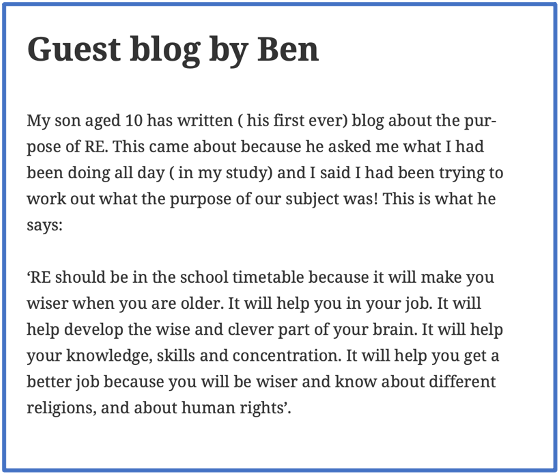
This blog is from my youngest son Ben. He  wrote it for my personal blog site in 2016. He is now 15 and I have asked his permission to use it here! I was intrigued by Ben’s response at the time because he used the term wise, and also because he connected studying religions with learning about human rights. I asked him today if he wished to update his thinking… he said that the most important reason for studying Religion and Worldviews is to understand others. He stressed the importance of learning about the diversity of different religious and non-religious worldviews. He also felt that it would help him get on well with others and enable him to identify prejudice or bias in society.

So why does an education in Religion and Worldviews matter? Why not ask some children or young people you know and see what they think?!

Details of our blog competition can be found here:

https://www.reonline.org.uk/news/pupil-blog-competition/

I finished my Theology degree intending to live with my parents whilst volunteering for a Student charity. But under encouragement from my dad, who said I would not be able to live there rent-free after all- I went back to the other end of the country to do a PGCE in Religious Studies.  I enjoyed the course, learning about how children learn as well as delving into World Religions in a way that I never could in my Judeo-Christian focused undergrad course. I got stuck into the lesson plans and assignments but didn’t feel it was the career for me.

It was when I started my second teaching placement that my attitude to teaching, and specifically the teaching of Religious Studies had a seismic shift. My placement school felt worlds away from the campus-style city of Durham. I’d spent three years studying in County Durham but it wasn’t until I got out into the schools that I felt like I was starting to know the area.

I had the introductory tour of the school and witnessed behaviours more challenging than I had ever seen- and saw teachers deal with their classes with such confidence that I thought I’d never achieve as a young, ‘soft southerner’. The kids were never shy of telling you of the hardships their families faced, or how low their expectations were. Openly telling me that they had two choices when they left school- either to work in the factory at the end of the road or go on the dole. “Most of these kids have never been into Newcastle or Durham- never mind down to London!” I was warned in the staffroom. How were my Martin Luther King or 5 Pillars of Islam lessons going to serve me here?

And then I met my new mentor- Paul Tyler. Larger than life and full of stories, I watched his lessons in awe. The kids were still cheeky and loud in his classes- but they were curious and inquisitive too. Paul had those typical behavioural systems, that I still use to this day, but he rarely used them- instead he turned disruptions into learning opportunities. He met the students as they were, where they were and invited them to join him in our lessons. Inappropriate comments were dealt with humour and brought expertly back to the topic at hand. No question was too silly or too stupid and every ability was included in the learning journey.

My absolute favourite lesson to teach, even now 16 years later, I first witnessed at the back of that classroom in Consett. It’s a guided story involving the whole class shipwrecked on an island, leading to discussions of religious authority, holy books, succession, translation and interpretations and much more.

Watching him run this with a class, I saw what engagement meant, every student in the room listening out for their name in the story, working out what was happening next, frowning as they came up with solutions to the problems the story posed. Over the years I’ve realised the skill involved with something that looks so easy- to know the students so well as to include the right ones, in exactly the right bit of the story. Paul showed me what it really means to include everyone in the room, it wasn’t enough just to know their names and use them- you had to really know the students themselves.

I was well and truly bitten by the teaching bug and smitten with being a Religious Studies teacher. If students who had every reason to not bother or care- were so engaged here by Paul- then I had to throw myself into the rest of the course and learn as much as I could from him.

He showed me his tricks for behaviour, planner management, lesson planning and resource management, but most importantly he trusted and encouraged me. Any lesson ideas I had, he told me to run with them and see how they went. With a very real and genuine interest in my life, he found ways for me to bring my passions into the classroom.

Paul had completed a Farmington Fellowship years before I met him, and 13 years after I qualified I applied to complete one myself. I stepped into the interview room, anxious and nervous that I had to convince them of the worth of my ideas- I saw his Fellowship Report on the shelf- on how to engage boys in Religious Studies- and smiled. Things had come full circle and I silently thanked him again, for changing my life.

When I was first developing my masters research project investigating the educational impact of visiting sacred spaces for GCSE RS students, I held the assumption that ambitious trips to faraway and historic temples or cathedrals would provide students with memorable and vivid encounters with the ‘lived reality’ faith. My viewpoint was that a liminal experience so different from their everyday norm would leave a significant lasting impression, and therefore would be the most effective for their academic progress and engagement in the subject. However, as I began delving into the Learning Outside the Classroom (LOtC) research literature, I discovered that my perspective was rather misconceived.

The first reason why local trips were repeatedly recommended above taking students further afield was that utilising familiar settings appears to enable an easier transferral of knowledge from the LOtC experience back into the classroom. Beames, Nicol and Ross (2011) discuss the cultivation of a genuine connection between the local area and the reality of students’ lives; contrastingly, trips that promoted the ‘novelty factor’ had limited cognitive benefit for students as they struggled to appropriate and contextualise such experiences. This chimes with other research which suggests that trips within the school’s locality are more likely to be integrated with curriculum aims, and because they are more readily repeatable, have a greater capacity for enhancing student progress and identity formation.

Another reason why the use of the local area for LOtC was encouraged both in policy and in research was for the establishment and maintenance of community relationships between schools and other institutions. Some have described these partnerships as an educational ‘duty’ to ensure that curriculum provision is holistic and dynamic. Nearby LOtC can be used to dissolve the artificial barrier between school and the outside world, and the formation of joint educational enterprises can promote community cohesion – also a broader goal of Religious Education. Although there are challenges that accompany the formation of these types of partnerships, such as a possible change to the teacher’s traditional role for the duration of the visit, the sourcing and upholding of such relationships is far more pragmatic and sustainable when entered into within the locality.

A final reason why local LOtC should be prioritised is that its usage has been shown to be particularly beneficial for students from deprived backgrounds; both for raising their future aspirations and attainment. It is a central aim to mitigate the attainment gap for typically underachieving students, and LOtC’s ability to generate ‘cultural/social capital’ is often referred to as an aim of such trips and visits. However, it is this particular cohort who are most likely to not participate in LOtC due to its regular reliance upon parental subsidy; the more ambitious or ‘grander’ the trip, the more likely it is that costs will be incurred and this cohort could be excluded. Therefore, trips in the local area are generally more inclusive and any costs could potentially be absorbed by departmental budgets or other sources of funding.

Although I had planned for three trips to local sacred spaces to take place as part of my research project, unfortunately due to the pandemic outbreak, only one proceeded as planned and so I could only arrive at rather limited conclusions about how effective the innovation had been.

Limited Reference List:

Beames, S., Higgins, P., and Nicol, R. (2011). Learning Outside the Classroom: Theory and Guidelines for Practice. London: Routledge.

Department for Education. (2006). Learning Outside the Classroom: How Far Should You Go? London: DfE.

Fagerstam, E. (2014). High School Teachers’ Experience of the Educational Potential of Outdoor Teaching and Learning. Journal of Adventure Education and Outdoor Learning, 14:1, 56-81.

Hawxwell, L., O’Shaugnessy, M., Russell, C., and Shortt, D. (2019). Do you need a Kayak to Learn Outside? A Literature Review into Learning Outside the Classroom. Education 3-13, 47:3, 322-332.

Mackenzie, S. H., and Goodnow, J. (2020). Adventure in the Age of COVID-19: Embracing Microadventures and Locavism in a Post-Pandemic World. Leisure Sciences, 42:2, 1-8.

Marchant, E., Todd, C., Cooksey, R., Dredge, S., Jones, H., Reynolds, D., et al. (2019). Curriculum-Based Outdoor Learning for Children Aged 9-11: A Qualitative Analysis of Pupils’ and Teachers’ Views. London. Available from: https://journals.plos.org/plosone/article/file?id=10.1371/journal.pone.0212242&type=printable [Accessed 25/08/2020].

Smith, G. A., and Sobel, D. (2010). Place and Community-Based Education in Schools. London: Routledge.

Over the last year, I have had the opportunity to build my department from essentially scratch, shaping our Key Stage 3 (KS3) curriculum in line with my vision for RE. After exhausting the Locally Agreed Syllabus, I went about ascertaining ‘priority’ topics for our pupils. Prior to the re-sequencing a student could complete secondary education spending only one one hour studying Judaism. Exploring Judaism was then my priority. However, I was stuck as to how to do justice to this extremely rich and diverse religion and tradition. Luckily, a PGCE peer came to my aid and allowed me to borrow her Scheme of Work (SOW), from which I drew much inspiration, adapting it to suit our school and pupils.

To promote religious literacy, we begin examining the notion of identity, particularly diverse identities within the Jewish tradition. The ‘Do Now’ starter task invites pupils to note what makes them, them; exploring their own identities. It is really important to start the SOW exploring the multiplicity of identities within the Jewish tradition, because if pupils’ have any knowledge of Judaism prior to the unit, it is overwhelmingly based on overgeneralized, single-lensed stereotypes, often images of Haredi Jews. Many are simply unaware that there are varied identities within Judaism and believe they do not know anyone who is Jewish, which isn’t true; they just didn’t know any Haredi Jews as they believe all Jewish people to be like.

We look at Orthodox, Liberal, and Secular identities and expression in daily and yearly life. I try to stress that Liberal and Orthodox Jews are no less ‘devoted’ or believe any less, but simply express faith differently. This provides a sustained reference point throughout the SOW. While exploring Kosher, Shabbat and Passover we refer back these and how expressions are varied in divergent Jewish tradition communities. For example, with observance of Shabbat, we suggest Orthodox Communities may avoid all work: light switches, cars, and mobile phones. Whereas some Liberal or Reform Jews may observe in adapted, often more modern ways, such as using cars to drive to Synagogue, allowing some electrical appliances (ovens, kettles) or, as one student offered from her own life observing when with Grandparents and using her phone (Instagram!) throughout.

Most effective for religious literacy is drawing on those with personal experience. I was fortunate to have Jewish pupils who offered their worldviews and traditions. This enabled students to connect ideas to varied interpretations and individuals they knew, bringing their learning to life and allowing them to interact positively with various worldviews. In addition, we invited in our local Liberal Rabbi to speak to the whole cohort about her faith, worldview and traditions. This was an incredible experience! It shocked the pupils to learn that, as part of her Liberal Jewish identity, she did not ‘keep kosher’ – for she could not then eat and celebrate with non-Jewish neigbours, and that she had had a scientific career in the traditionally male-dominated field of Chemistry prior to becoming a Rabbi, another traditionally male-dominated vocation. They were full of questions about her experience as a female faith leader: the reaction of Orthodox Jews to her position as Rabbi, her favourite parts of Shabbat – community worship, foods, time to pause and reflect on life, the week, and faith – and her experiences of Anti-Semitism. In particular, her family’s connection to the Holocaust and the inspiring journey of her Grandmother across Europe during the War, including liberation at Mauthausen in 1945 and her return to Prague, where she had fled 6 years prior. These personal experiences held the key to unlocking my pupils’ religious literacy about the multiplicity of Jewish traditions and worldviews, how lived faith was so different to the strict, traditional and ‘textbook’ religion many had expected from a Rabbi and leader in their local Jewish community – shamefully, far greater than I could achieve teaching in the classroom.

I understand this is not possible for all schools in all areas, my hometown wouldn’t have such a luxury of a nearby Liberal Rabbi however there are many websites and services online that would willingly engage in a dialogue, whether it be a prerecorded Q&A session, or even a live virtual meet, as we have all become accustomed to since the start of the pandemic! However, with certainty I say it was by far the best way of promoting religious literacy around the multiplicity of lived Judaism and real-life Jewish worldviews. I would advise starting with the basics – bust the myths, dispel stereotypes and open eyes to the diverse identities within the Jewish tradition, this will allow for more effective personal dialogue further into their learning.

Each day I face the challenge of how to sell an abstract idea to pupils who struggle with concrete ideas. You want them to walk on a path that they cannot see when they can only just comprehend a path that they can physically walk on. Recently as a link to the term’s theme of ‘Light Fantastic,’ I wanted the pupils to engage with the Christian creation story, (God said on day one, ‘Let there be light.’) The approach I took allowed pupils to glimpse the abstract through learning activities that they were easily able to access and understand.

I began with a sensory story. A sensory story makes the whole tale more real and although at times pupils can be shocked, that sense of awe and wonder is more likely to end up with them remembering what they have been listening to. When God made the oceans, I sprayed water in the pupil’s faces, when God made the trees, I threw leaves all over the classroom, when God made animals, I jumped around the room pretending to be a gorilla. The end result of this, my pupils were able to recount most of the things that God created.

To tap into the imagination, I followed up the sensory story with an animated story. I have not taught a pupil at our school yet that does not enjoy a cartoon. The screening of the animated story gives the pupils an alternative opportunity to encounter and engage with the story of creation.

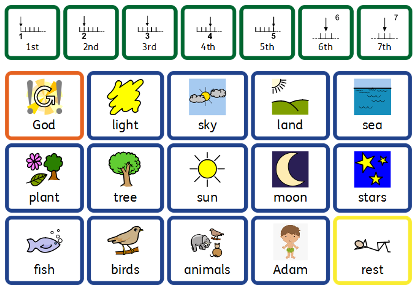
Most of our pupils use some kind of AAC (Augmentative and Alternative Communication Aid.) This takes many forms from PECS, (Picture Exchange Communication System) books to intuitive I-Pad software that uses a symbol to speech engine. Somewhere in between these is the POD, (Pragmatic Organisation Dynamic Display) board. Throughout every lesson on creation I had on display a set of picture prompts that utilised coloured semantics and contained all of the necessary information required. I referred to this during each lesson and it acted as a constant prompt for the pupils.

The final activity tapped into a different sensory approach. At the beginning of this unit of work the pupils were all given a blank A2 sheet of card. This card was white. I explained to them that this represented the light that Christians believe God brought to the world. As we experienced each day of creation, the pupils completed another piece of their creation pictures. They painted the sky, the land, they painted trees, they glued on animals, they filled the seas with life and used paint and glitter to make the sun, moon and stars. By the end of the unit of work they had created the world just as God had created the world.

By using a multi-sensory approach, the pupils were able to fully engage with the creation story and had multiple opportunities to experience, understand and recall the required information.


On my first day in my current post as class teacher and R.E. lead in a school for pupils with S.E.N aged 4 to 16, I tried to find details of the current R.E. curriculum, only to find that it did not exist. I urgently needed to write one from scratch, a daunting prospect. Fear soon turned to excitement as here was an opportunity to write a curriculum that was accessible and meaningful. However, cracks soon appeared in my enthusiasm.

Religion is an abstract concept, the idea of a God even more so. I spend a lot of time working with pupils on object permanence, things exist even when we cannot see them. A pupil arrives and their coat is taken and hung up, they then move into class. To that pupil the coat now does not exist. At the end of the day when they return to the cloakroom to find that their coat is there, it is like you have performed a miracle! If pupils cannot recognize that the coat is always there, finding a way for them to understand a God that they cannot see would be tough.

Hey, people believe there is a God who has powers beyond measure, who knows and sees everything. They believe he is looking at you right now!’ At this point there is pandemonium in the classroom as the pupil runs around the room trying to find the God that is looking at them. I continue, ‘Do not worry, he is not really here looking at you.’ The pupil is now confused, ‘But you said he sees everything?’ Another pupil offers another opinion, ‘Does God know when I am on the toilet and am I being watched because that is just weird?’ Finding a way to promote these concepts was a challenge.

Another hurdle was how to embed the locally agreed syllabus into the curriculum. The current syllabus has scant guidelines on how a school like ours should incorporate the agreed content.

After a term of work, I came up with a curriculum that had clear intent: Our pupils will benefit from learning opportunities which allow them to engage with and retell religious, moral and spiritual stories and describe the key figures, symbols and practices of a variety of religious, humanist and secular beliefs. They will be encouraged to develop their understanding by asking questions about religious beliefs, religious practices and on a variety of world views.

The curriculum also had to be implemented: Pupils will be provided with varied, dynamic and differentiated learning materials that encourage them to explore a range of beliefs. The work produced each week will be evidenced through pupil’s files of work, annotated photographs and learning journeys. Content of individual lessons will be observed on a regular basis through the school provision monitoring system.

Most important of all, the curriculum would need to have an impact on the pupils: Pupils will know about and understand a range of religions and worldviews. Pupils will be able to express their own views on religion and worldviews and empathise with other’s beliefs and practices. Pupils will have the spiritual, moral, social and cultural knowledge needed to allow them to become resilient, respectful and to feel valued.

Our pupils benefit from a kinesthetic approach. When learning about the ten plagues of Egypt, I gave my pupils buckets of plastic frogs and we spent ten minutes throwing them about, covering everything in sight. This physical representation of the plague was great fun to do and allowed the pupils to gain understanding.

Visual resources are available for all content. Our pupils struggle to absorb and recall written information, so our learning uses a range of media including animations, pictures and storytelling.

This approach has enabled all of our pupils to access R.E. This work is ongoing, we try to maximize cross-curricular opportunities and my colleagues are always coming to me with fantastic ideas of how to differentiate content, this has enabled me to build an accessible curriculum.