Viewing archives for Blog

Or

‘How to build team virtually during the Covid-19 pandemic’

I’m passionate about team!! Team is one of the essential ways in which we live out the values of our Trust. So, I wanted to explore how we could build team virtually? As an office team we have had virtual ‘non-work’ coffee mornings as well as business catch ups, we are also using Whats App and Team chat a bit more, but I wanted something a bit different. This was when the Virtual Bake-Off idea was born…. How would our office team and consultants represent the Trust through baking? The results blew me away!!!
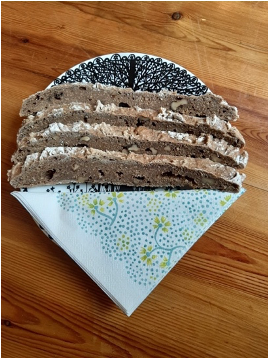
The Soda Bread: Kevin connected his ingredients with each member of the team. Here he explains….

The Organic wholewheat flour, full of goodness, which is the basis of everything – this is Deborah.

The extra-virgin olive oil, reputed in Castillo de Locubin to fix any kind of problem – this is Tracey.

The milled omega seeds giving golden sunshine to the texture – this is Kate.

The walnuts contributing dry, deep integrity – this is Dave.

A shot of espresso for a burst of energy this is our social media consultant

12-year-old malt whisky, seasoned, matured, with strong regional associations – this is John, our Chair of Trustees

Bicarbonate of soda – this is me (Kevin!) – just because I couldn’t face comparing anyone else to bicarbonate of soda!

The skilled presentation of the whole product on beautiful plates – this is Kathryn, orchestrating everything and acting as CSTG’s public face.
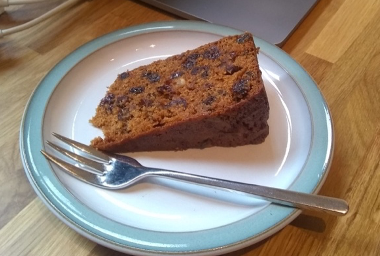
The Fruit Cake: Tracey’s fruitcake was based on the Trust values. This is what she said about it.

Collaboration – Fruit, works better together. Whole is greater than the sum of its parts

Openness – No hidden ingredients

Stewardship – Low cost simple ingredients transformed into a beautiful cake

Integrity – Traditional recipe, long slow cooking

Empowerment – cranberries added, which are said to be a super food

Service – What is a cake if not for sharing with others?
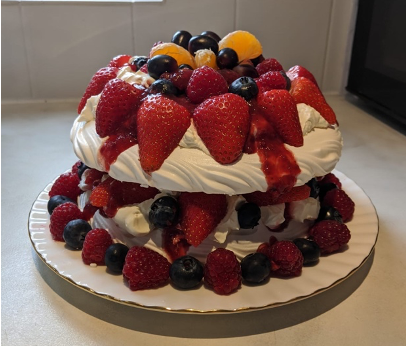
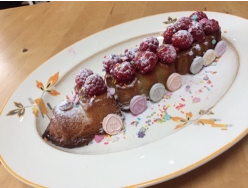
The Pavlova: Deborah’s pavlova was full of fresh cream and fruit, as the Trust is currently overflowing with fresh and fruitful ideas. The trust brings organisations together in partnership. We’re greater and can do more together than as individual organisations. Likewise, the individual components forming the pavlova are greater together. Each of the components’ initial letters together can spell CSTG (Cream, Strawberries, Tangerines, Grapes) and Religion and Worldviews Education (Raspberries, Whites of Egg). Deborah didn’t want to waste eggs and wanted to ensure the best outcome, so she outsourced for the best skills and expertise – buying the meringue is from Waitrose and getting her family to help  put it together!

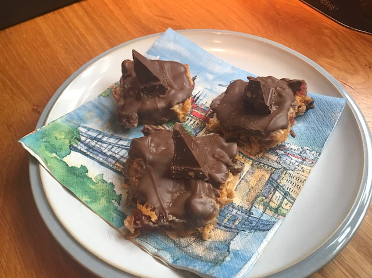
The Florentines: I made some Florentines with Kellogg Crunchy Nut cornflakes as our office in Oxford is in Kellogg College. They contain Chocolate, Sultanas, Toblerone and Glace Cherries spelling out CSTG. I used an unusual, colourful and vibrant mix of ingredients – like our amazing team. They were bound together by condensed milk. This product has longevity and is an important ingredient in many different desserts, just like CSTG. Lastly, and more practically I planned in advance to use no flour and eggs as it was possible these may be unavailable!

The Train: Kate made a train as Culham St Gabriel’s is going places. There is space for all sorts of people. We are on a journey together. The wheels are love hearts to show our positive message!

The Fat-Free Cake: Dave decided to create a Fat-Free cake. He says, ‘At the moment this is a Slimming World house – No cake making due to being supportive… If I buy a cake and present it, how does someone learn or personalise it? At CSTG we like to facilitate ways in which people can take their own cake journey – we signpost recipes, encourage sharing, research flavour combinations, explore cultural cake advice and engage in high level cake research which hopefully benefits our core cake audience. However, I did buy a cake or some rocky road bites – I also found a recipe and would encourage people to push the boundaries and personalise it – at RE:ONLINE we would ask bakers to let us know how they got on – could you blog about it? Rocky road – symbolically, it’s a rocky time and we are with you on your own rocky road– encourage people to take a recipe and make it their own – be inspired by and look to inspire others. Jaffa cakes – to show inclusion and to not shy away from controversy – Is it a cake? Is it a biscuit? Let us look at both sides and make a justified decision’. So instead of eating cake, Dave has produced a fantastic cake knowledge organiser with a religion and worldviews twist which you can download here. Of course, this is a bit of fun for you to enjoy over a coffee break, not to be taught in the classroom!

The bitesize snack: Our social media consultant also teaches full time, so she brought a bitesize snack which provided energy and quick nutrition like our social media and RE:ONLINE!

What a great team! No more words…

With huge thanks to:

Deborah Elwine, our Office and Operations Manager

Tracey Francis, our Data and Online Manager

Kevin O’Grady, our Lead Consultant for Research

Kate Christopher, our Lead Consultant for Teach:RE

Dave Rees, our Lead Consultant for RE:ONLINE

Our social media consultant
As a department, we have been trialling the use of knowledge quizzes with A level classes.  This blog will look to set out why we use them, how they are structured and the benefits we have found in their implementation.

Why we use knowledge quizzes with our A level students? 

Upon first glance at an RE A-level specification, the amount of content we need to cover in such little time is daunting.  Whilst we spend plenty of time considering how best to explore these ideas with our students, we felt that we had not spent enough time reflecting upon how best to assess the students’ understanding of the material we covered.

In previous years, we would have finished a unit of work by setting an essay question based on the topic.  However, we came to recognise that during the marking of essays, we would spend copious amounts of time dealing with knowledge errors within essays.  Whilst we would often use low stakes quizzes at the start of a lesson, we wanted to create a form of assessment at the end of the topic which would assess students’ understanding of the core knowledge within the unit before we proceeded to tackle an essay question.

How are they structured?

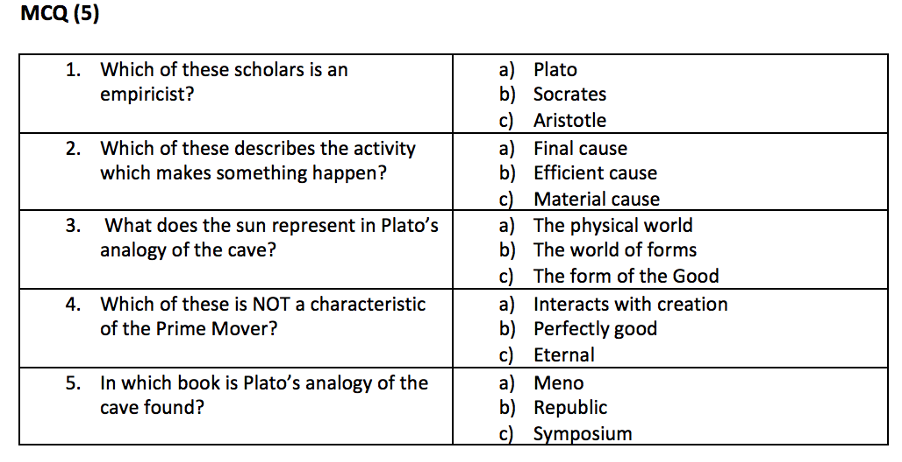
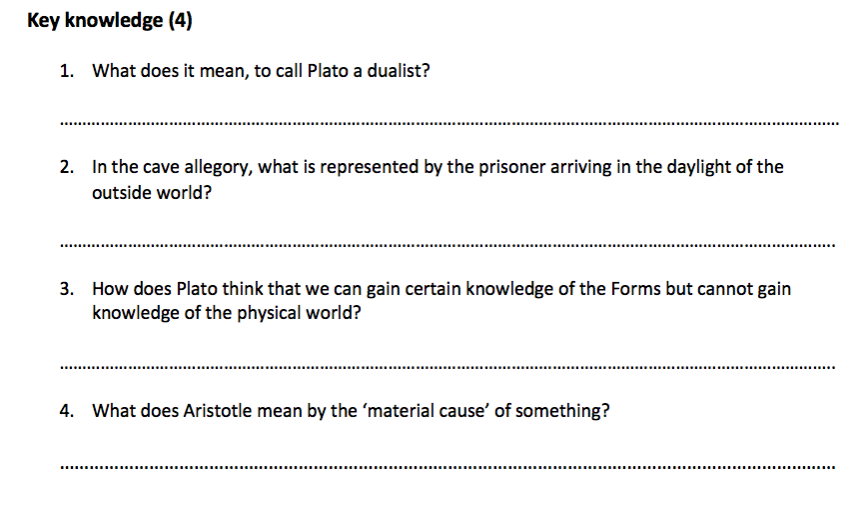
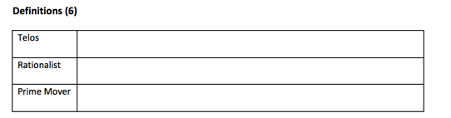
Here are the sections from a knowledge quiz set on the OCR topic of Ancient philosophical influences.  It would be the first knowledge test which Year 12 students would complete.  With future quizzes, each section may contain questions based upon a mix of topics.  This cumulative element would ensure that students are constantly revisiting prior material.

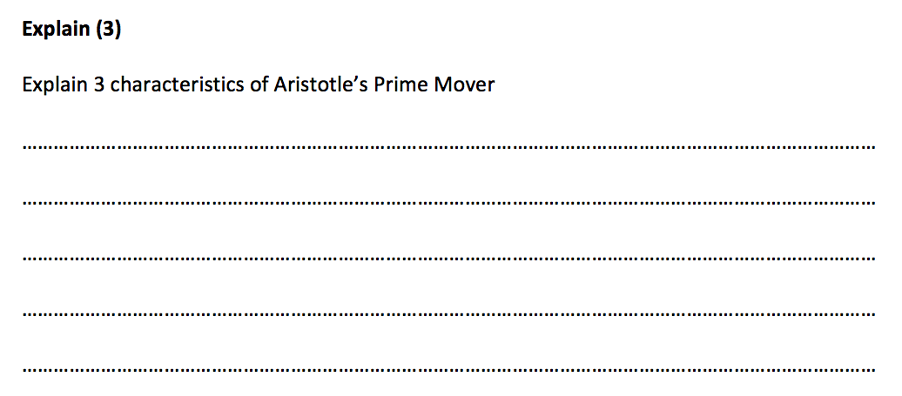
The quiz would start with asking students to define three key terms from the current topic.

Multiple-choice questions are a really useful tool in identifying any misconceptions students may have. When creating these multiple-choice questions, it is essential that they are rigorous and diagnostic.  These multiple-choice questions might be based on key terms, scholars or ideas students have explored in the topic.

These short recall questions allow students to elaborate further on core knowledge within the topic.

A longer explanation question allows students to demonstrate more in-depth understanding of core knowledge.

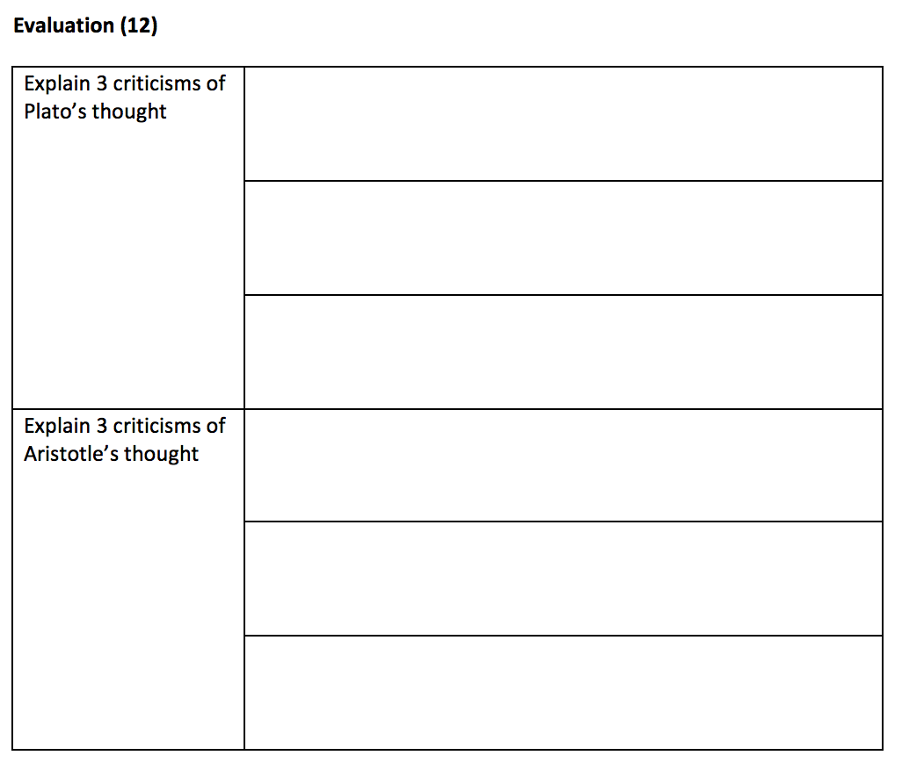
The final section of the quiz allows students to evaluate key ideas within the topic.  These points of evaluation are taken from the discussion points within the OCR A level specification for each topic.

As students to progress throughout the course, these knowledge quizzes could be expanded in various ways to assess core knowledge.  These include:

  • Timelines to sort scholars into chronological order
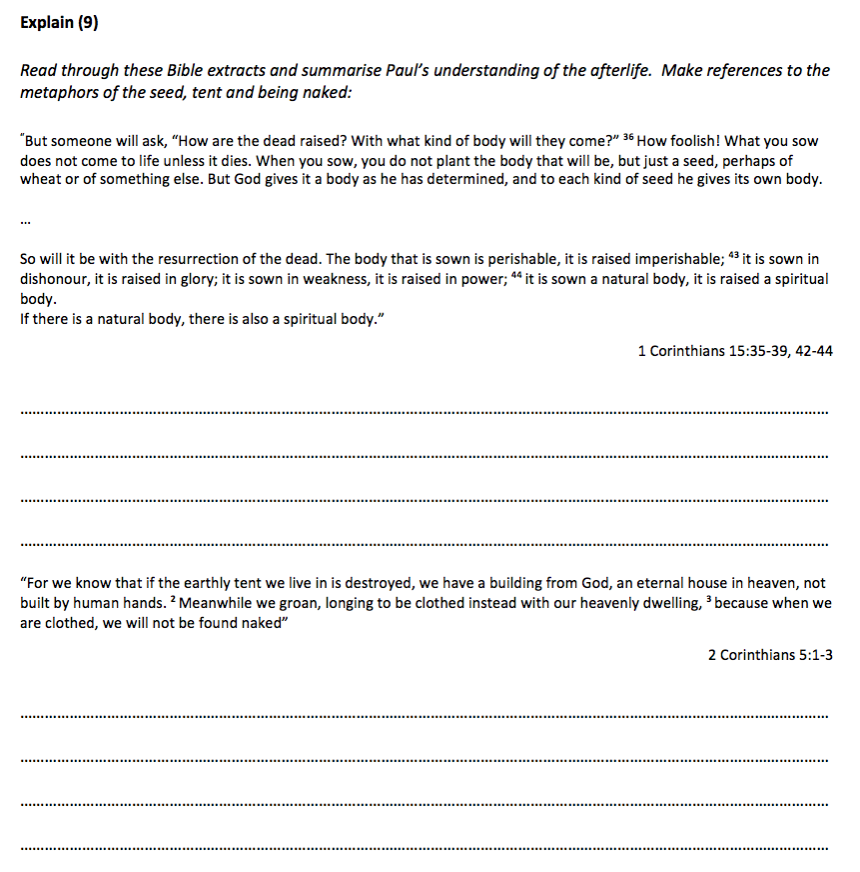
  • An extract from a philosophical or Biblical text which students have to summarise
  • Providing a relevant quote to support a specific idea or scholar.

Here is one example taken from a knowledge quiz on the Developments in Christian Thought topic Death and the Afterlife:

In addition, as students progress throughout the course and we have taught essay writing knowledge quizzes can be used to assess their disciplinary knowledge in ways such as:

  • Students selecting the best opening sentence for a paragraph in response to specific essay question
  • Students selecting the grammatically correct sentence
  • Asking students to highlight any structural errors within a paragraph

How are we using these knowledge quizzes?

We plan to use these knowledge quizzes at the end of each A-level unit prior to students completing an essay on the topic.  In addition, we have implemented them as part of our Year 12 mock exam.  In the past, the Year 12 Philosophy mock exam would have consisted of a choice of four essay questions with students answering three questions.  However, discussions with the rest of my department suggested that our traditional form of assessment for a mock exam may not be best for long term learning or provide us with a full picture of their knowledge of content covered prior to sitting the mock exam.

Firstly, students may have only completed a small amount of essay questions prior to this exam.  The task of completing three essay questions within timed conditions is something which they would not be suitably prepared for. Prior to them sitting the exam, we can already anticipate that some students may not complete all three questions within time allowed.  Secondly, this traditional form of assessment does not allow us to check the students’ understanding of the full breadth of A-level specification which they have covered prior to this exam.  Therefore, we included several knowledge quizzes within their mock exam as well as asking students to answer one essay question.

What are the benefits of using knowledge quizzes with A-level students?

From implementing knowledge quizzes within A-level teaching, we have seen various benefits for students and teachers:

  • Quick to mark – usually 10/15 minutes per quiz
  • Allows for assessment of more aspects of a specification than an essay question
  • Allows students to check their understanding of a topic before preparing for an essay question
  • Cumulative element allows students to constantly revisit prior material.

“FEEDBACK” A word used near continuously in my school setting for the last couple of years. We have attended feedback conferences, held staff meetings, changed processes and discussed with parents. But, almost all of the conversations we have are around feedback for learning and progress in English and Maths.

“ASSESSMENT” A word that invariably comes up in every single staff meeting or local network session for RE I have taken part in. Despite often feeling quite daunted or negative about assessment processes in RE, there is no doubt teachers are consumed by the need for guidance and clarity on the issue of how we assess RE learning effectively in our classrooms.

So quite recently I have tried to join the dots and try out some of the great ideas on effective feedback for learning, to support a more useful system for assessment in RE. Despite the fact that there is definitely a place for summative judgements and recording of progress is still required for most of us in primary RE, unsurprisingly many teachers would agree the most effective tool in assessment for learning in RE is formative assessment. Just as we do confidently in English and Maths, we must identify what the key objective for learning is in an RE session and identify how we will know what the children have achieved and where to take them next.

The starting point must be a clear long/medium term aim. This may well be a strong question for enquiry, forming the learning journey for a given unit of work. Then, clear steps must be in place for how pupils will travel along this pathway. For some, this might include a knowledge organiser or other planning document to identify factual knowledge, questions for discussion and resources/content to build up to answering the question. Maintaining this focus throughout the unit of work is key, in order not to attempt to drown the children in unnecessary content along the way.

Then in each session, a key skill, piece of knowledge or question can be focused upon. A decision can be made on how we will know how pupils have done today. This might be reflection on a piece of writing (not necessarily marking of it though…a discussion for another day); notes on group or class discussions; quizzes or exit tickets; thought bubbles or creative work – the possibilities are endless. The teacher can take the work, books, tickets etc and quickly judge what each pupil has achieved today. Work can be grouped, names highlighted on a list, or quick notes made on a planner. Now we decide what is needed next – content of the next lesson, continuation of the piece of work, or  questions tailored to each of the groups. Planning next steps is responsive to the feedback given by the pupils today, and we offer feedback to them through the expectation and planning of the next session.

Most of these ideas seem so obvious, because as teachers we are skilled already in assessing learning continuously and deciding what to do next. But, my experience of conversations with subject leaders and classroom teachers of primary RE is that we rarely consider transferring these skills into RE. I hope in reading these suggestions, more who haven’t yet considered these approaches might try and simplify their content and apply what they are already so good at, instead of worrying unnecessarily about time consuming and often unhelpful summative systems of assessment for RE.

Over the last two terms I have been taking on the rather daunting task of re-writing a primary curriculum from Year 1 to Year 6. The aim of this new curriculum was to build something rigorous, knowledge-focused and exciting to not only prepare our students for secondary school, but to give them a good level of religious literacy for the rest of their lives. Although I am now a primary teacher, I trained, and until recently worked as, a secondary RE teacher.

One of the biggest shocks I have had in transferring to primary was a realisation of just how much KS1 and KS2 students are capable of. Never did I think I’d be able to cover Aquinas and Augustine with Year 4 or be able to properly consider Buddhist approaches to suffering with Year 6 or even to discuss the finer points of how prayers are answered with Year 1. This shock has given me the confidence needed to build a curriculum for our context that is ambitious in its content and hopefully this article will help you do the same. I’m going to introduce three key ways to help with that: reduce, reuse and recycle.

Reduce

It may seem counterintuitive but reducing how much you try to cover in your curriculum might be the key to making it rigorous. We spend all of KS1 just introducing the key concepts in Islam and Christianity. It lays the groundwork for an in-depth discussion of those two faiths in KS2 but also for introductions to other faiths with which they can draw comparisons. Similarly it is okay to reduce the amount of content you want to use in one lesson so you can work on just securing one concept or, perhaps even just taking the time to re-cap and re-embed material already taught.

Reuse

It is important then to be economical with the time we have to teach RE. By introducing key concepts early-on and re-capping them many times we are not only building a fluency in the subject but also saving time.

For example, I chose to introduce the idea of ‘faith’ very early on in Year 1 so that students understood the difference between observing a physical object and having belief in a deity. That concept then gets further embedded in Year 2 when we talk about the Bible and Qur’an and life of Muhammad, embedded even further in Year 3 talking about Judaism, Allah, and Christian prayer. By the time students get to Year 4 we can begin to test the concept out a bit more and create some fluency around it so we begin to talk about non-religious worldviews and how they view faith and then in Year 5 we talk about how faith can be tested by war so that in Year 6 we can even start to think about the ways in which faith is, or is not, always necessary in a religion.

Recycle

I, like every primary teacher I know, am a magpie when it comes to planning. We know how important effective explanations are to good teaching and, when it comes to planning RE for other teachers, we know that good pre-planned explanations can help cover gaps in subject knowledge. Therefore, when there is a tough concept I want to introduce, I reach for the stack of books by my desk and see how other writers have introduced this concept then I recycle it. I will think about how they explain things and adapt it for the age group and previous knowledge of those it will be taught to. You can find my recommendations for good subject knowledge boosters here.

What part does religion play in shaping the world? How is religion shaped back by the world, in turn? And now, in the Covid-19 world, are the answers different? The first two are essential Religion and Worldviews (R&W) questions, the third promises perspective shifts. The pandemic is changing us all, thus generating new R&W content. That much is clear from the London School of Economics (LSE) Religion and Global Society interdisciplinary blog, an excellent resource.[i]

The LSE blog is a changing collection of articles, often research summaries, as with Grace Davie’s and Nancy Ammerman’s piece on whether religion inhibits or generates social progress. [ii] Among Davie’s and Ammerman’s key findings are these (we recommend reading the entire article, and provide only some of the main points here):

  • “Religion is a lived, situated and constantly changing reality, and has as much to do with navigating everyday life as it does with the supernatural.”
  • Therefore, we have to look at contexts and examples, closely.
  • (Researchers) . . . “will benefit from careful attention to the power of religious ideas to motivate, of religious practices to shape ways of life, of religious communities to mobilize and extend the reach of social changes, and of religious leaders and symbols to legitimate calls to action”

I would say that the advice for researchers is equally good advice for teachers. All of the points would apply whether or not we were under a pandemic, but the pandemic now gives a distinctive context and, in that context, particularised examples of religious motivation and mobilisation. The Covid-19 section of the LSE blog covers some such examples. [iii]

Firstly, Michal Kravel-Tovi and Esra Özyürek discuss religious and other gatherings in the age of coronavirus. [iv] Their analysis is provocative and unsettling:

  • They argue that a religious gathering is more likely than a secular one to be identified as a virus cluster, as part of a discourse of suspicion against foreigners or minorities.
  • They show how religiously-based defiance can often be typed as outrageous and irresponsible, as opposed to the less-than-perfect-citizenship of ‘secular’ gatherings such as a beach party.
  • They see all of this as a clash between different understandings of reality, and a pretext for increasing state control of religious groups.

We might not agree with the views in this article; nevertheless, as we will see later, it offers useful classroom teaching points and resources. So does Marina Sapritsky-Nahum, who draws a fascinating account of this year’s Passover from her research in London’s Jewish communities: [v]

  • She writes that “Next Year Together” may replace “Next Year in Jerusalem”, as the phrase of hope that concludes the celebration.
  • She reports how for some Jews, social distancing goes against everything Judaism stands for and undermines their biggest strength: standing together as a community
  • For a number of young Jewish families, she says, isolation has, however, created greater connection with their own nuclear family, bringing Jewish teachings and history to life in the comfort of their homes.
  • It is still a difficult setting in which to celebrate liberation – you cannot celebrate with the extended family or invite strangers, as is customary. But projects such as Seder-to-Go provide all of the essential elements while spreading the message “Freedom is not limited to where you are.” [vi]
  • 4,000 plus Seder boxes have been delivered across the UK, to many who are unable to source the necessary food for the holiday, or who need a step-by-step guide

Marina Sapritsky-Nahum concludes that in today’s global yet isolated world, traditions are not just handed down but also made. Recently I have heard two colleagues speaking about a natural role for R&W in offering young people a space to discuss the existential disruptions of the pandemic. I prefer Marina Sapritsky-Nahum’s focus, because whilst we should contribute to dealing with what is controversial or difficult, the responsibility to do so is not ours alone. Different curriculum areas have different contributions to make. Our distinctive contribution is to educate on the religion and worldviews aspects of Covid-19, as signposted by the articles summarised above, heeding the advice of Grace Davie and Nancy Ammerman to pay close attention to the specifics of context, example, motivation and mobilisation.

Michal Kravel-Tovi and Esra Özyürek provide a whole series of links to images and reports of different gatherings, religious and other. Teachers could use these with pupils, who could be tasked to identify and describe the different views of the world that these images and reports illustrate. Pupils could then be asked to juxtapose pairs of images that illustrate worldview differences, note the tensions that may result and suggest ways to manage these. How, for example, should a discussion proceed between the Louisiana pastor who hosted hundreds on Palm Sunday and the Anglican vicar who broadcast the Maundy Thursday service from her home? In a different learning task, pupils could consider the single images of empty places of worship. They could talk and write about why physical gatherings at sacred places are significant to people. Why do they think it is it important to join voices in shared speech and song, to physically take the Eucharist, or to adopt the prayer positions in synchrony with others? Opportunities for pupils to research now arise: what do members of different communities say about this? There are questions, too, about how societal developments challenge and reposition those communities’ self-understanding and practices.

Marina Sapritsky-Nahum’s stories provide excellent material for extending the enquiry. Teachers could present these to pupils, then providing a summary handout for annotation: when Passover took place under lockdown, what was lost, and what was gained? Feedback from the task could build into wider discussion: what do the gains experienced during Passover under lockdown tell us about how all communities can become stronger in the future?

[i] The blog’s home page is https://blogs.lse.ac.uk/religionglobalsociety/about/

[ii] Grace Davie and Nancy Ammerman, ‘A lived, situated and constantly changing reality’: Why religion is relevant to the pursuit of social progress,’ online article available at
https://blogs.lse.ac.uk/religionglobalsociety/2019/01/a-lived-situated-and-constantly-changing-reality-why-religion-is-relevant-to-the-pursuit-of-social-progress/ downloaded on 11 May 2020.

[iii] The section is at https://blogs.lse.ac.uk/religionglobalsociety/category/covid-19/ and has twelve widely varied case studies at the time of writing. Again, I have space for only a couple here.

[iv] Michal Kravel-Tovi and Esra Özyürek, ‘Contagious Crowds: Religious Gatherings in the Age of Coronavirus,’ online article available at https://blogs.lse.ac.uk/religionglobalsociety/2020/05/contagious-crowds-religious-gatherings-in-the-age-of-coronavirus/ downloaded on 19 May 2020.

[v] Marina Sapritsky-Nahum, ‘ ‘This Night is Different From All Others’: Passover in London and Celebrating Liberation in Isolation,’ online article available at https://blogs.lse.ac.uk/religionglobalsociety/2020/04/this-night-is-different-from-all-others-passover-in-london-and-celebrating-liberation-in-isolation/ downloaded on 19 May 2020. The article also gives a general introduction to Passover.

[vi] See https://www.thejc.com/community/community-news/deliveroo-to-deliver-chabad-coronavirus-seder-to-go-kits-to-the-isolated-1.498818 .

Working in a Church of England High School affords me the luxury of RE being a core subject and is therefore held with high esteem. SLT, governors, students and parents see the value in what we do and what we are trying to achieve with our young people. GCSE is compulsory and our results are slightly above national average.  Everything was going swimmingly…………. until the 18th March 2020 when the announcement was made that schools would be closing their doors to the majority of students. From the following Monday we would enter an unknown world of virtual teaching. But that’s fine!  We can all use computers, can’t we?  We can all carry on with our schemes of work and tweak them for home learning, can’t we?  My expectations were high.  I know my students and I know what they are capable of. The work was set and the days until ‘hand in’ were counting down.

Then came the reality. The students were clearly taking time to adjust to home learning.  A different way of learning, reading instructions via an online platform, guiding themselves through carefully constructed resources, downloading attachments that has challenged us, but without their teacher in the same room for reassurance.

I am immensely proud of my students and how hard they work. So, when the work that appeared in my inbox varied in quality, I had to remain reflective and ask questions of myself and my team as to why this might be the case. Well, the usual high standard of work was caught up in the minds of confused, scared and unsettled young people who were trying to find their feet in a world that had been turned upside down!

Laptops on knees, dining room tables, desks in bedrooms, living room side tables. Some working during school hours and others not until they can get a slot on the shared computer at home or after their younger siblings have gone to bed because they have been helping to care for them. The circumstances that our students are working in are so varied and, in some cases, complex. We needed to factor that in.

So, a rapid change in mind set from me and let’s see what happens. Gone are the requirements to complete every section of the PowerPoint that has been set and ‘proof’ being sent to me and welcome to quick wins. The PowerPoint is still shared and a hope that students will find the time to work through it. A differentiated approach works better, with extensions there for the more able and more scaffolded tasks for lower ability groups. Online spelling tests, quizzes and reflections on their current experience are a win.   Something changed overnight. Notification after notification!! The work was actually flooding in after all.  The online self-marking tasks also hinted to me about who had really engaged with the lesson and who had maybe gone straight for the quiz. But I can now record that and make sure that I cover those areas that seem to have received lower scores when we return to school.

I may have adapted my expectations during home learning but, in doing so, student participation has drastically increased. They are engaging much more readily and are doing more than required of them too.  In addition to the spelling test or quiz or whatever is it, they are also sending me pictures of their work that they are proud of………and I’m proud too!

Lockdown is tough, but so are we!

If anyone had told me that remote teaching would be this hard – I would never have believed them. What’s there to worry about? No time wasted travelling to and from school, far less marking, one or two Zoom calls a day as well as a daily a message to my class… A breeze! Or so I thought.

Well here I am, in my third month of lockdown and time has a different tale to tell. The ‘new normal’ has been exhausting! Having to get used to a totally new way of doing everything has been way more tiring than I thought it could be. Yes, there was a potential to have a bit more sleep – no daily 6 a.m. alarm to worry about. However, I didn’t expect to be affected by the Covid-19 news the way I have been. Sleepless nights and a fuelled anxiety have meant that I haven’t rested well at all. I constantly worry about everything and everyone around me- with elderly parents who can’t get out, to vulnerable friends and neighbours and of course, my own children.

Zoom meetings have become part of my ‘new normal’. I have learnt all the techniques and tricks to successful online meetings: I am sure this will be the way forward for so many as we come out of lockdown. It’s all been great as long as the technology hasn’t failed, or that I haven’t forgotten to set an alarm for my meetings. I have absolutely loved seeing my pupils on Zoom calls – I didn’t think I would miss them as much as I did. Just hearing about what new skills they’ve picked up or the fact that they had mastered life skills such as cooking and D.I.Y, was fabulous – this is something that I would never had known about otherwise.

Never did I think planning and putting together remote learning packs would take as long as it has. I have been meticulous in sourcing/making the right tasks with the right amount of challenge for my pupils. Not being able to teach them new concepts has made me feel as if I have let my pupils down, but it couldn’t be done. Not knowing how much support my pupils were getting at home meant that I was ‘in the dark’ about how much work they were actually doing or even if they were being supported by their parents, who had their own work to do.

Having the joys of no SATs this year (I am a year 6 teacher), should have offered a welcome reprieve but it didn’t. I didn’t realise that some pupils would actually get so upset over having no tests! Tests aren’t for everyone, we know that, but they are a form of summative assessment that many teachers rely on for data. We are now left thinking “Do we actually need that data?” especially now that teachers all over the country have had to fall back on their own assessments of pupils’ progress.

Being a RE subject lead, I have made sure that we as a school sent home sound RE activities. This has been a particularly good time to use the NATRE Spirited Arts competition to send home, giving our pupils a highly relevant and creative task to enjoy completing. Through contact with my pupils via Zoom calls, I know that many of them have thoroughly enjoyed having the time at home to sit and reflect on life, in order to write about their compositions and more importantly, they have enjoyed involving their parents in this process, which I feel is an ideal opportunity to give their parents a clearer understanding about what RE is like in schools today. I have found the home learning tasks provided by NATRE as well as RE:ONLINE to be lifesavers!

The breakdown of lesson content on the RE:ONLINE website has been extremely useful: I have loved the useful headings of activity, knowledge, lesson planning, starter and assessment to help guide me in my planning. I managed to continue teaching about Buddhism (as I had started this unit with my year 6 pupils before the lockdown began) thanks to RE:ONLINE. I was able to easily source a website giving my pupils information about Buddhist beliefs and use the suggested activities from the RE:ONLINE website to give my pupils. Being able to do this has been instrumental in easing my workload. I know that the lesson content I have given my pupils is of sound quality and I know that they will really enjoy the tasks which have been set for them.

I have really enjoyed finding links showing how religious worship has changed all over the world and using these to form the basis of new lessons. An example has been sharing current images of Mecca with my year 5 pupils, teaching about how worship has been forced to change, especially relevant during the month of Ramadan. This is turn raised questions with pupils about the importance of having a place to worship and what difference not being able to visit a mosque, church, synagogue or any other building would make to a person of faith. I have learnt that pupils have enjoyed discussing these ‘Big questions’ with their parents at home and that the classroom is not the only place where a debate can happen!

Moving forwards, I do believe that the way we teach and plan units of work from now on, will change for the better as we have learnt to think from a different perspective. I certainly know that the staff in my school have all been signposted to where to find certain resources and will now have a bank of where to access super quality lesson ideas and resources.

The lockdown has taught me one thing: that I am a dedicated teacher who loves teaching. This is what I was always meant to do! Teachers are highly resilient and they find a way of making things work. Whenever the wifi played up or my school’s remote server broke down, I sought to use the time I had doing something productive. The amount of amazing cpd opportunities available for free has been countless – for this, I will always be so grateful! The RE:ONLINE website has offered a plethora of resources and learning opportunities that I have shared with teachers in my school. NATRE and RE Today have offered excellent webinars at cheaper rates – an opportunity I couldn’t resist: such a great way to provide cpd for all staff. This has been one of the many advantages of the lock-down – a time that I will never forget!

When we do go back to school in some shape or form, I do know that I will never take anything for granted and I will cherish every moment with my pupils and my colleagues.

It can be a daunting space: this symbol is associated with what religion, this mantra belongs to whom and ‘celebrating’ in school without being disingenuous. Welcome to Primary Religious Education.

The love for diversity and communication between people is what has driven me for a long time. From personal experiences to the places we hold in society, I find it hard to shelve the subject of RE as a standalone concept. From children to adults, the notion of identity and religion is a fluid concept. It not only swims from one side of the spectrum to another, but also deviates from the stereotypes society may have. I suppose that is why it may overawe primary practitioners in their delivery of the subject.

Let us take our best assets: our pupils, our want to teach and share knowledge, and most importantly, the want for relationships. Religions seek for relationships: be it between creators and their servers, festivals and even places of worship are there to bring people together. The classroom has brought us together, and literacy leads to self-reliance and curiosity. So why can’t that be the footing of your RE lessons?

Religious literacy should aid in the delivery of your lessons, no matter the topic or question at hand. It stems from the importance of oracy. For a child to be able to vocalise their thought process, whether with visual prompts, or key words, in order to better communicate. Religious literacy strives for better communication between peers in a classroom, and also between teachers.

One of the principles of religious teaching is that religions are internally diverse. That’s a biggie: navigate slightly away from singing praises of us all being the same with different names. Yes, it can be a topic of discussion (my religion says this, that’s similar to that), however, while these ‘major religion’ labels have their uses, it is important to understand that identification as a Hindu or Muslim (or any other religion) conceals an incredible diversity of beliefs and behaviours. This is where the literacy takes place.

More so, your classroom is its own culture of (little) human behaviour, with a set of rules, beliefs and disagreements. From early theological thought in year 3, to deeper questioning by year 6. Religious literacy encompasses all aspects of human culture and behaviour in one. What it will also bring to the forefront, and it’s peeked its head into many a lesson of mine, are that religions are dynamic and changing. Concrete they are not. Why? Human practice and behaviour.
For example, by emphasising principles, you can start to engage in the rudimentary recall of facts of a religion or world view, in the hope to lead a more innovative way of communicating with people for whom religion is an integral aspect of their lives, and others where it is not. Knowing that someone has religious beliefs or practices can then be the start of an open-ended conversation, rather than an invitation to make assumptions – either positive or negative. Allowing the asking of questions, and creating an environment where judgment is suspended is key. Challenging unfounded claims others make about a ‘cultural other’ that sound unfair is also a good way to redirect the conversation and help others evaluate their own worldview to prevent the problem from perpetuating.

It sounds fiddly, with curious minds who pose another question in response to the question, but perspective broadening starts with the teachers, the assistants and the children in a whole school setting.

Religious literacy doesn’t and shouldn’t stop at the school gates.

We are lucky to have good provision at key stage 4 for those students that don’t opt for GCSE. We see them once a fortnight for 1 hour and we mainly have RE specialists teaching it. It’s called REality.

Up until recently our course has been mainly moral and ethical issues per half term, some which link to the GCSE and some don’t. To avoid repetition of work of the GCSE students we have tried to take slightly different angles on the topics in our core RE. For example, when looking at abortion we look at many more ‘real life’ case studies and look at examples of ‘forced abortion’ and the issue of who should decide about if a woman should be allowed to either have or not have a baby.

However, in the past year we have been reviewing our provision to try and plan for more challenge, progression and balance across the disciplines. Our key stage 3 (year 7&8) is purely theology and religious studies so we wanted to balance out the disciplines at key stage 4. So, we completed the Church of England audit resource (https://dioceseofyork.org.uk/uploads/attachment/4000/self-evaluation-audit-secondary-sept-18.pdf) and saw that we were doing less philosophy with students as we could be.  The moral and ethical issues were using a lot of social science and some of the philosophical ‘big questions’ in life but not much from the influential philosophers and their arguments. So, we now have a ‘Philosophy 1’ & ‘Philosophy 2’ unit in year 9 & 10 that build on each other, which is helping us to develop our subject knowledge as we’re teaching things we’ve not taught before.

We also looked up to the A level specifications to look for content that could be included in our topics to challenge students. We found that theories such as Utilitarianism could be taught simply and importantly repeated across topics, so students have the repetition of content to help them remember and understand it across topics.

Finally, to give each unit a clear focus, we are developing a clear, curricular enquiry question for students to answer at the end of the topic. Whilst these won’t be ‘in-depth’ due to the time restraints, they will allow students to pull together the beliefs and theories to answer them. For example, “Is it our right to decide what happens to our body?” for our medical ethics topic. We don’t have to complete formal assessments for REality but this does give students a sense of purpose over the topic as we can reference back to it over the 2-4 lessons and they can see how each lesson contributes to their response to the enquiry question. To keep things focussed for students we don’t use books, but we use A3, double sided sheets which have a pre-designed framework for their keywords, notes, questions and finally the enquiry question. This means that we spend less time on presentation and copying key information and more on discussion, case studies and application of the beliefs, teachings and theories. This also significantly reduces our mark load as we mainly are checking they’ve completed the correct boxes for the lesson.

Overall, we feel that these developments are encouraging the students to continue to take REality seriously as we are challenging their thinking and giving it a clear structure and focus.

Reflecting on teaching and leading RE during the lockdown period has made me realise there have been some challenges, but also some surprising advantages.

We have been teaching all of our classes the normal curriculum predominantly through a combination of audio power points (delivered via google classroom) and live zoom lessons. These have caused some challenges. For example, I had to quickly learn how to use these apps and to find time to write numerous power points and source suitable clips. I have also made many, many mistakes. Such as forgetting to turn the microphone on when I was recording! However, there have been advantages. In particular, creating the audio power points have enabled me to deepen and consolidate my understanding of a unit and how this links to other curriculum areas. As well as introduce some new ideas sparked from my attendance at Strictly RE earlier in the year. In addition, as the students have found these audio power points to be so useful, I plan to write more of these and utilise them to better support flipped learning and to aid those revising for an examination or to catch up due to absence.

Deciding how to teach the year 11 and year 13 has also been a challenge. We made the decision to provide lessons which enable students to make the transition to the A level or a university degree respectively. However, although this was time consuming, as there were no previous materials to draw on, it too has been advantageous and even enjoyable. Firstly, it has enabled me to further my engagement with various academics in order to identify beneficial topics for pupils to explore and to discuss the suitability of materials they already provide (I am lucky in this respect as, due to my role on NATRE, I already work with various scholars). This has led to fruitful, ongoing dialogues, concerning how these materials could be adapted and developed to better support school pupils; something that will be continue to be useful for all in the future I hope. Secondly, this also drew my attention to various free webinars being provided for teachers. Thus, I have been attending, virtually, webinars (which include those given by ResearchED and James Holt/TRS at Chester University) that have enabled me to deepen and reflect on my subject knowledge, pedagogy and teaching practice. Such engagement has already been beneficial as it has led to adaptions being made to the curriculum and in the resources used to support pupil learning; something I hope will also continue over the summer term.

Therefore, although there have been many challenges (not all mentioned here), there have also been benefits both in terms of my own practice and in the experience I have provided for the pupils, as I try to do the best I can to deliver my lessons in this ‘new normal’.