Viewing archives for Blog


It was a year ago today that I started in the role of Chief CEO at Culham St Gabriel’s. It’s been an amazing year. It’s been great to work with so many talented people and organisations which are passionate about education in religion and worldviews. In the last couple of weeks, it’s been fantastic to see over 1000 teachers sign up to our self-study courses. I’m also really thrilled about new virtual seminars and events coming up this term in partnership with all the main RE organisations.As today marks my first anniversary, it also seemed a good opportunity to share with you some of our plans for the future. The Trustees, staff and consultants have worked hard over the last few months to shape a new vision, mission and strategy for the Trust. We have also reflected on our values and ways of working.

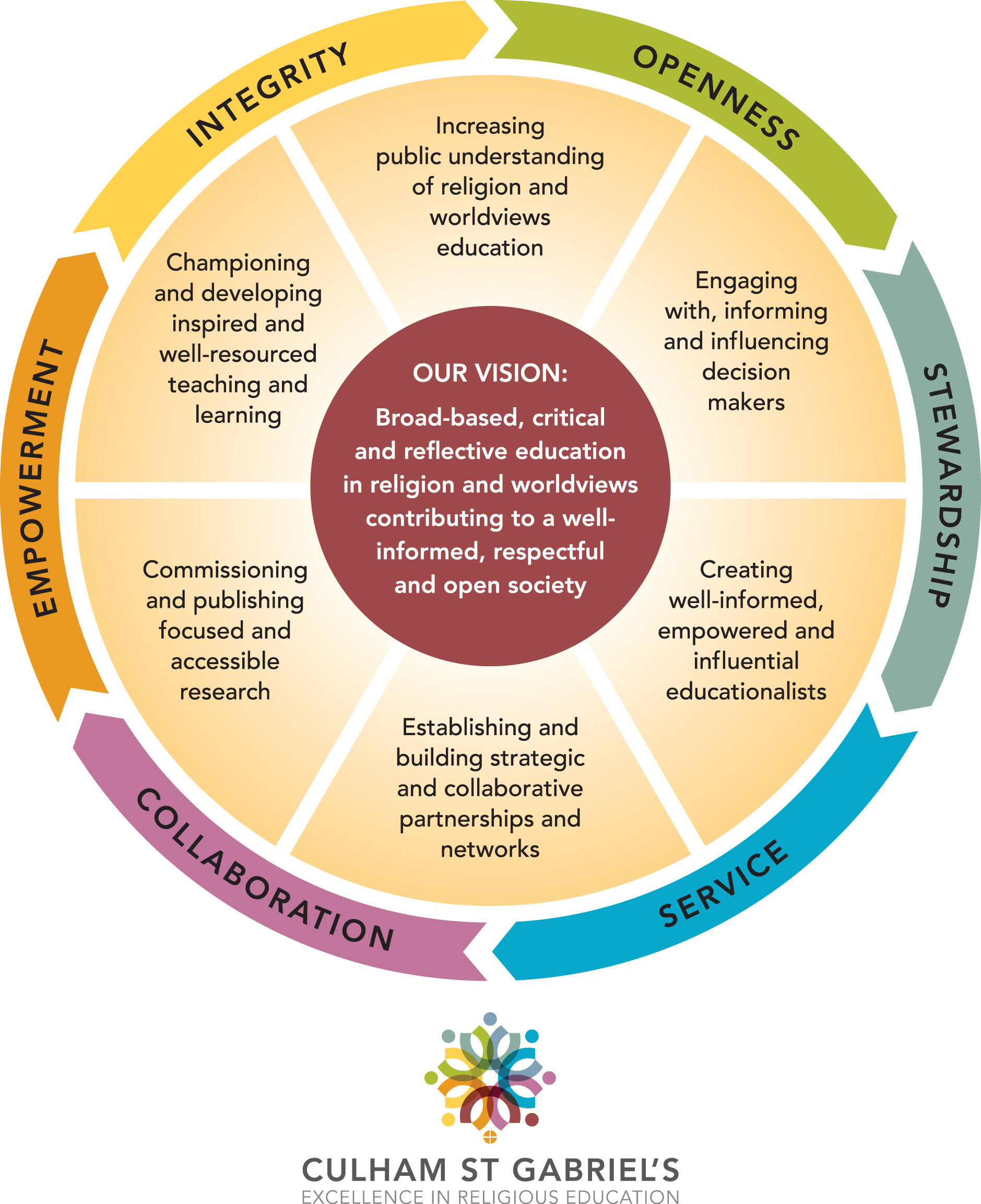
Our new vision is for a broad based, critical and reflective education in religion and worldviews contributing to a well-informed, respectful and open society. We are deliberately using the language of religion and worldviews supporting the vision of the Commission on RE (2018) and look forward to the shaping of this newly defined subject over the coming year. There is much work going on around this at the moment, including a number of publications already in the public domain or soon to be published. In addition, we have emphasised, that high-quality religion and worldviews is not an end in itself but contributes to the transformation of society. This is really important for us as a charity. Above all, we exist to make a difference.

So, we have a big vision! It has therefore been important to consider what the Trust’s unique contribution to this vision is, our specific mission. We have identified six strands to this, and they are:

  • Increasing public understanding of religion and worldviews education
  • Engaging with, informing and influencing decision makers
  • Creating well-informed, empowered and influential educationalists
  • Establishing and building strategic and collaborative partnerships and networks
  • Commissioning and publishing focused and accessible research
  • Championing and developing inspired and well-resourced teaching and learning

You will see that we are shifting our focus to work not only with the immediate world of RE professionals but also to engage with the public, with policy makers, and other influencers. We are really excited about the new emphasis in our mission and look forward to conversations with many of you about how we can work together towards fulfilling it.

So how will we do this? This is about the ways we work and the values that underpin all we do. In talking with colleagues, two of the most important words that came through were collaboration and connectivity. We aim for positive relationships with an emphasis on partnership and networking. We have also been moving towards being more open and transparent.

Listening to others, valuing diversity and sharing our work. Having integrity in all we do is vital.  We strive to be honest, authentic, dependable and trustworthy in the way we work. Above all we are about serving and empowering others. We endeavour to be responsive, generous and available to everyone. We aim to facilitate others to grow in confidence, be creative and bring about change. As an endowed foundation, being good stewards is paramount. We are committed to ensuring a good return on our investments and to use time and resources effectively. Over the coming months we will be making these values more explicit in our communications and they will shape the ways we work now and in the future.

I hope you have captured some of my enthusiasm and excitement for where the Trust is going next. We are really delighted by our new vision, mission and distinct values. We look forward to partnering with you in working towards our vision and putting our mission into action.

In my next blog/vlog I will share more about our specific strategic objectives for the next three years and how we plan to put these into action.
‘How I..’ feels misleading for the title of this blog post. When it comes to developing schemes of work in my department it is very much ‘how we…’. Taking a collaborative approach to developing our KS3 curriculum is important to ensure that all of us are invested in it and share the same vision.

The first thing we discuss when wishing to introduce a new scheme of work is ‘what knowledge do we want students to know by the end of their time in school?’ The National Curriculum states that we should ‘introduce pupils to the best that has been thought and said’. In RE, this could encompass a huge amount: allowing students to encounter the ideas of the Greek philosophers, engage with religious texts, debate ultimate questions about meaning and purpose, discover contributions that have shaped our response to ethical issues in society today. The list goes on. This appears wildly ambitious. The first question you might ask is ‘How can I fit it all in?’ Unfortunately, we can’t. Being selective is difficult but consider what concepts it is that you wish your students to learn that will enable them to succeed later on at GCSE and A Level. A couple of years ago I shockingly discovered, on introducing A Level at my school, that although students had achieved 9’s at GCSE, they did not know how to look up a Bible verse because I had always provided the texts for them. I knew this was something I had to rectify immediately and embed earlier on in the curriculum.

The second question may be ‘Well surely I can’t possibly teach Descartes’ philosophy to Year 7 or explore how the Great Schism changed the face of Christianity forever in Year 8?’ Actually, this is exactly what I am suggesting – all students deserve access to such groundbreaking and influential ideas, however complex they may be. We shouldn’t assume that our students would not be able to ‘do it’ and therefore, we won’t teach it. I actually find that students enjoy learning the most when they are challenged. The feeling of finally understanding something is much more rewarding when they have had to struggle to get there.

In our Year 7 Introduction to Philosophy unit we explore Descartes’ infamous cogito ergo sum (usually translated into English as “I think, therefore I am”). We begin by asking students ‘what they know for certain to be true? How do they know?’ which leads onto a class discussion about empiricism. We then use a clip from the film ‘Inception’ to reinforce the idea; the main character Cobb cannot know whether he was dreaming throughout (spoiler alert!) because dreams feel so real when we are in them. This gives students enough background knowledge to look at Part 1, Article 7 of Descartes’ Principles of Philosophy. We use the original text and students are asked to infer whatever they can from it. Support comes with the live questioning and unpacking of the text together that follows. In our Year 8 History of Christianity unit students summarise each event studied on their own timeline throughout the lessons so they can put them in context and analyze their impact. The ‘Knowing Religion – Christianity’ textbook and the Truetube ‘Church History in Ten Minutes’ video have been useful resources. Most students can relate to the arguments that led to the Great Schism when they think about the disagreements that they have with family or within school, despite shared values.

Finally, context is equally as important as content. Mary Myatt stresses the importance of ensuring that students understand the bigger picture. This is crucial for when students apply knowledge to new topics throughout the curriculum. Our Year 8 curriculum is centred around the theme of morality and rights. Students begin by studying ideas of right and wrong including different responses to ethical dilemmas e.g. the trolley problem (a thought experiment where a decision has to made to save the lives of 5 people by killing 1 or do nothing and allow the 5 to die). We then move on to looking at how religion has both been a force for equality and discrimination throughout history before enquiring how Jews can still believe in an all loving, all powerful God after the Holocaust? Finally, we examine why Muslims face prejudice today and how we need to learn from the mistakes of the past in how they are treated. Each of our lessons starts with a retrieval quiz where we ask students recall questions from ‘last lesson…’, ‘last term…’ and ‘last year…’. This allows us to make explicit links with knowledge from previous topics that we will be building on in that lesson.

Due to the new Ofsted framework the words ‘intent, implementation and impact’ may now strike fear into teachers, however, considering these has very much allowed our department to review what we want out of our curriculum and to engage afresh with the subject we love.

In September 2017, I started what I could only describe as my dream job. A supportive, local secondary modern school appointed me as Subject Leader of RS. I was to teach from KS3 to A Level. I couldn’t be more excited to get started.

One thing, however, troubled me. In a larger than average school, I taught only twenty students in Year 11. The Year 10 cohort numbered twenty-seven. Whilst this made for an easy marking load, it didn’t bode well for the survival of the subject as a GCSE option and put our A Level numbers in jeopardy. Something had to be done at Key Stage 3 in order to boost the numbers.

The most obvious place to start was with the Year 9 course – my priority was to ‘sell’ the subject as a challenging, respected GCSE option, and one that would prepare students for life in modern Britain. In line with the SACRE Agreed Syllabus, I kept the first half of the year focusing on Sikhism but introduced a Philosophy module for the latter half. Broadly inspired by the ‘Existence of God’ theme from the OCR GCSE, this module introduces topics such as evil and suffering, arguments for the existence of God and religious experience. I was also keen to bring in a lot of discussion and evaluation – so P4C techniques and Socratic Circle discussions feature heavily.

However, I knew it wouldn’t be enough just to re-write Year 9. In order to promote sustainable growth and genuinely attract students to the subject (as opposed to them choosing it to fill a spot on their timetables), Year 7 and 8 needed well-resourced, challenging and interesting lessons. A further challenge was posed by the large number of non-subject specialists teaching RS across the two years – I needed to ensure that they felt confident and supported in delivering lessons which stretched and enthused the students.

I had inherited a handful of schemes of work and a few resources which didn’t have the depth that I felt was needed. I decided to re-start from the Agreed Syllabus. We decided to keep Years 7 and 8 to comparative religion, exploring Christianity and Buddhism in Year 7, allowing students to build on their work from KS2, and Islam and Judaism in Year 8. This meant that students could draw comparisons between Islam and Judaism and see the overlaps – important in promoting the British Values of individual liberty and respect of those with different faiths. We introduced a further module at the end of Year 7 called ‘Big Questions’, which boosted listening and debate skills through exploring the nature of humanity and morals from Buddhist, Humanist and Christian perspectives. I was keen to promote student-led working and independence, as well as keeping lessons fairly fast paced, so we have lots of ‘chunked’ activities and mini-plenaries throughout to assess understanding. Lastly, I wanted to emphasise the academic value of RS in terms of developing written skills, so we have embedded evaluation questions in order to develop empathy and appreciation of different views.

To say that I have been pleased with the results of the re-development would be an understatement. From a cohort of twenty, now over sixty students have chosen RS as one of their GCSE options to start next year, tripling our numbers in three years. From three in our current Year 13 class, we are set to have 15 A Level students start in September. I haven’t declared the RS lessons ‘finished’ yet – I’m exploring a re-design of KS3 to introduce a more thematic based approach, however it is clear that students value the challenge and depth of study that our subject can offer.

‘Are you sure about that?’


Five of the most powerful words in any teacher’s vocabulary. In my modest career teaching RE across a variety of settings and ages, nothing in my teaching toolbox has been more effective than casting doubt on a student’s knowledge. By ‘doubt’ what I really mean is finding creative and subtle ways to make students question their knowledge, but it starts by making them doubt themselves first.

One of my favourite ways to do this is in something like a card sort activity. I remember one I had set up providing the students with a range of quotes that were said by either Martin Luther King Jr. or Malcolm X. Their task was to match the quotes to the person using their knowledge of both. What I discovered was a very low level of learning and students not really engaging with their knowledge. I could hear lines such as ‘Malcolm X couldn’t possibly have said this, so it must be the other one’. On the face of it this is good stuff, that student knows enough about Malcolm X to know that he wouldn’t have said that. But that’s not what learning in RE is about. We want the students to go just that little bit deeper with their thinking. That’s what I wanted to achieve.

Next day, same activity, different class but this time (having reflected on my practice of course) I changed things up a bit. To make the students begin to really question their knowledge, I put a quote in there from a small green character from a well-known science fiction film. Except I didn’t tell the students. This changes the game completely, because now when students looked at that card they said ‘Well it can’t be Malcolm X but hang on, I can’t imagine Martin Luther King Jr. said that either. What is going on? Did we get this card by mistake? Could it possibly be one of them?’ Now we have it, the proverbial cogs are turning and the deep learning is happening. Plus, it’s always a delight to reveal at the end which one was the ‘outsider’.

Call this what you want, ‘the red herring’, ‘the odd one out’, ‘the elephant in the room’ but the principle is still the same. Include in their learning something outside the paradigm of what you’re asking them to learn in order to question their knowledge and get them really thinking about what you’re teaching them. The applications for it are endless – adding a quote from the Qur’an in with Bible quotes for example, or even replacing one of the 8 Fold Path with one of the Decalogue. If you’re really creative you can cast doubt on the student’s current knowledge by building in elements of their previous knowledge.

Don’t do this too frequently though. Recently a student of mine took one look at something and within 30 seconds said ‘That’s not right. Sir has put that in just to try and mess with us.’ He was right, I did. I was so proud of him.

We are in unprecedented times that offer new challenges for the teaching profession and our students. It has been difficult setting work that is worthwhile, easy to monitor, works with family commitments at home and is not going to create an excessive workload.

Keep it simple

Keeping it simple means bullet point instructions via an email sent each morning and resources in clearly labelled folders on our VLE. I am trying to balance working from home with family life and so I set up my emails the night before using delay send. We also have whole year groups doing the same tasks rather than individual teachers setting their own work. This reduces workload and keeps it simple in the event of staff absence. We need to remember that parents are often trying to help multiple children with one laptop in already difficult circumstances – now is not the time for experimenting with lots of new ideas.

Key Stage 3

I am going to say something now that is a tad controversial but I don’t think it should be – we like textbooks and I think that they can provide some of the solutions to the challenges of remote learning. Our Key Stage 3 students are doing textbook work in their exercise books which is then tested every 3rd lesson using Sam Learning. I want to keep it simple and I don’t want teachers having to check that students have marked work accurately and so I have created or set pre-existing tasks that mark themselves – shockingly some students write “dunno” for everything and then award themselves full marks.

There are online platforms via which students can access electronic textbooks or part of a book can be scanned and placed onto your VLE. Information about copyright can be found here. (https://www.cla.co.uk/cla-schools-licence)

I have staggered the SAM Learning tasks so that teachers are not getting bombarded by reports constantly, this means that a full time RE teacher with 20 plus classes is only getting one or two reports emailed to them each day. When the report arrives we use SIMS to send a bulk email  for any student who has not completed the work. So far it has been very few. To minimise workload it is a copied and pasted email that politely says that we have noticed that your son/daughter has not completed their work and can we do anything to help. The student with the top score in the class gets a postcard home via sims and we give out achievement points for the top 5 in each class.

We are using this process to train students into good habits, when we have achieved this, we will consider using the excellent resources that have been provided by NATRE. http://www.natre.org.uk/about-natre/free-resources-for-you-and-your-pupils/

Key Stage 4 and 5

Most of our time and effort is going into Key Stage 4 and 5, we have small option groups and therefore the approach suggested may not work for schools that enter full cohorts for the GCSE.

We are using our existing PowerPoints and turning those into videos which we narrate ourselves using either the record slide show option in PowerPoint or screencast. https://screencast-o-matic.com/. These videos are then being uploaded onto YouTube and a link is sent to the student. We are not doing any live video lessons because this could trigger safeguarding issues. Prerecording videos is also quicker than streaming a live lesson because I am not waiting for students to complete tasks, they pause my video whilst they work. This flexibility also works for me as a parent with a young child at home because I don’t have to guarantee to be online at a certain time. Most videos are about 15-20 minutes long. The resources are all familiar to me and so it is rare that it takes me more than one take to record a video. If I don’t have time to make a video, I am just emailing students the existing PowerPoint with simple bullet pointed instructions.

In each lesson I ask the students to send something to me so I can check that they are keeping up. This is often just a screenshot of a quiz that requires a quick glance but about once a week an exam question. I have email folders set up for my GCSE and A Level classes so I can put their exam questions straight into a folder and then come back to it when I have time to look at them properly.

I am trialling whole class feedback using a recorded PowerPoint in which I will include samples of work and talk through strengths and weaknesses as they annotate their work – just as we do in class.

I am keen that any resources that we make can be used in future years as revision resources, we are working hard and this must have an impact on future cohorts.

Rewards

We are a department that recognises the power of the carrot and we don’t want to lose this when the students are working from home. We send home and tweet a merit league table each fortnight (just the top ten) and we will continue to do this because teachers are still giving out merits and sending home postcards from SIMS.

We also have a department twitter account from which we share examples of student work and we will continue to do this.

Enrichment

We all have those students who love RE and want to go that extra mile, those students are our GCSE and A Level students of the future and so we need to keep them engaged with enrichment activities.

We will be inviting students to take part in the Spirited Arts competition at home.

http://www.natre.org.uk/about-natre/projects/spirited-arts/introduction/

We have also published on our twitter feed a guide to RE related programmes they can watch on TV or stream. I am also planning to share on our twitter feed links to virtual trips to key sacred sites around the globe.

Being born in the Midlands I was aware of and very comfortable with diversity from a young age. I was interested in particular by the different foods and colourful cultures which just seemed so vibrant and celebratory. This early interest has stayed with me throughout my life. So, when I moved down to the Bournemouth area aged 13, I was surprised to find a much more monocultural situation. However, being 13 I had plenty of other things to concern me, so I just got on with being awkward and trying to work out who I was and what I wanted to be.

Fast forward 10 years and I began teaching at a secondary school in Poole in a department of 1 and trying to introduce seriously apathetic students to the faith of Islam. I realised that what I really needed was a ‘wow’ factor or a connected human factor.

Could I visit a mosque? No, the nearest one was over 30 miles away and with no budget or likelihood of gaining permission for a trip this clearly wasn’t going to happen. Add to that the absence of any nearby Muslims I felt rather stuck…

So, when three years ago the opportunity arose to be involved with RE:ONLINE I was thrilled. Not only because of the teaching resources but because of ‘Email a Believer’.

Here you will find 10 believers from the following religions and worldviews

  • Baha’i
  • Buddhism
  • Christianity
  • Church of Jesus Christ and the Latter-Day Saints
  • Hinduism
  • Humanism
  • Islam
  • Judaism
  • Paganism
  • Sikhism

Each believer is available for you to ask questions about their faith or worldview.

These answers are all quality controlled and the service is completely free.

This would have helped me when I was teaching so much. Let me give you an example:

When I was teaching GCSE Islam, I was totally comfortable with the knowledge aspect of the hajj pilgrimage but I would never be able to say how it would feel as a Muslim to walk around the Kab’ah or stand on the Mount of Mercy.

As a non-Muslim I would not even be allowed anywhere near Makkah however our Muslim believer has performed the hajj and can give that personal connection. So, if you live in an area without many opportunities to connect with different faith communities personally ‘Email a Believer ‘ can help provide some missing answers and personal insights.

Our believers have already answered many questions on a variety of topics, these can be found on the webpage. Some are now also being turned into resources which can be accessed in the RE:ONLINE teaching resources, just select the theme ‘lived experience’ to see them all.

Sometimes teachers use ‘Email a Believer’ to set a homework task.

The homework could be ‘ think of 5 questions each that you would ask a believer about an aspect of their faith’. Then bring all the questions back and have a class discussion before submitting some to the believer. We aim to get the questions answered within a few days. I would always suggest asking a question that would involve the impact on daily life or lived experience. If you also mention the age of your class, we will try to answer in age appropriate language.

I hope this will encourage you to engage with ‘Email a Believer’. Personally, I know that reading the answers has helped me develop my personal understanding of the faiths and worldviews. I hope it will help many others too.

Throughout the first part of my training I believed that a good teacher was someone with a good PowerPoint. I remember planning every single aspect of my lessons on a PowerPoint, believing that I must absolutely rigidly stick to the sequence of slides, otherwise the lessons would go off plan. Two years into my career and thankfully I have seen the light, the PowerPoint doesn’t make the teacher, in fact it is often liberating to teach without one!

For a long time, Microsoft was the only technology I exposed myself and students too. All my lessons were planned on and delivered through PowerPoint, it wasn’t until this year I started to look into the many existing and also new and emerging technologies that can be used to digitally enhance learning in the RE classroom. I believe that RE can often be a subject not linked with using technology much. It all started with the trusty visualiser, I love using this piece of kit, it allows me to live mark, plan and answer exam questions right in-front of my students, giving them an opportunity not only to open up the exam specification but also to see the thought process behind answering a GCSE style question. This new addition to my teaching and learning got me thinking of the many different ways we can integrate technology into our classrooms not only with the aim of supporting pupil progress and collecting assessment data but also with the hope of engaging pupils with the subject.

My next step was to set up a departmental website on Weebly, with revision guides for KS4 and homework support for KS3 classes. As a department we were able to create QR codes which were stuck in planners, meaning pupils could scan and access all of the information they needed on their phones or tablet devices for additional support which has so far proved successful. This was also linked to other blogs created by members of the department so that students have a wealth of resources available to them.

Recently, I completed the Apple Teacher qualification which opened my eyes to the potential apple technology can have in the classroom. It’s ability to allow me to teach with apps, such as Quizlet and Nearpod, which not only allow me to assess learning in real time and collect and store formative assessment data, but they also afford me the opportunity to open up the real world from within my classroom. An example of which would be, Nearpod which allows you the opportunity to walk your pupils through the Sistine Chapel, so that they can see the Creation of Adam painting in all of its wonder and glory, the way it was intended. Technology gives us the opportunity to instil a sense of awe and wonder in our pupils, that perhaps other teaching styles cannot.

However, probably the most revolutionary aspect of technology I use regularly to enhance my teaching is twitter! Twitter is full of dedicated and knowledge rich-

practitioners with tons of ideas that they want to share with others in the profession. I use twitter every day, and often signpost other teachers that use tech in the classroom, and whilst I’m fairly new and still finding my feet in the world of digitally enhanced teaching I am sharing my research and evidence via Twitter. You can follow this journey via @tjones_m.

My final thought is this, technology without pedagogy is useless. In order to properly integrate technology into the classroom successfully first ask yourself the question “what is the purpose?”. If the answer is because it will genuinely enhance your teaching, then great go for it, however, sometimes sticking to a PowerPoint and a whiteboard is ok too.

Bahá’i visitors to schools are often asked if they have artefacts which can be used in RE lessons about the Bahá’i Faith. There are not many things which could be put into a conventional artefact box:  there is no specific Bahá’i item of clothing, no Bahá’i statues or icons, and no rituals which are linked to certain objects.

Some Bahá’is use prayer beads for their daily invocation, ninety-five utterances of “Alláh’u’ Abhá!” – “God is Most Glorious”-   but although the verse is a requisite, the beads are not.

A photograph of Bahá’u’lláh – Founder of the Faith – exists but is viewed only on pilgrimage to the Bahá’i Holy places in Haifa, Israel. Most Bahá’is will have a picture of ‘Abdu’l-Bahá (Bahá’u’lláh’s son, regarded as a ‘Perfect Example’) but again, this is not compulsory.

One of few items of specific significance is the Bahá’i burial ring – a simple ring bearing the inscription, ”I came forth from God and return unto Him, detached from all save Him, holding fast to His name, the Merciful, the Compassionate.”  Just how appropriate it would be to show to a Reception class would have to be the teacher’s decision!

The focus, then, becomes the teachings and scriptures themselves rather than artefacts. Bahá’u’lláh wrote thousands of passages on spiritual and social matters, and ‘Abdu’l-Bahá wrote many more. Copies of Bahá’i prayer books, illustrated and suitable for young children, make a tangible resource.

What else could be used to give a visual representation of the spiritual teachings? Though not artefacts in the usual sense, certain objects can help to illustrate some key Bahá’i concepts:

Gemstones

“Regard man as a mine rich in jewels of inestimable value. Education can, alone, cause it to reveal its splendours.”

According to the Bahá’i teachings, every one of us has talents and faculties innate within us which must be drawn out by identifying, recognising and practising ‘virtues’ – qualities such as kindness, honesty and compassion. For one lesson, I covered a large many-faceted glass gemstone with mud. After discussing virtues and the need to practice them with the children, we polished the gemstone until it shone, drawing parallels with the soul, potential, and treasures within.

Flowers

“Ye are all fruits of one tree, the leaves of one branch, the flowers of one garden.”

One of the key teachings in the Bahá’i Faith is that of the unity of mankind, and specifically, unity in diversity. The metaphor of flowers of many colours, shapes and forms is found in many Bahá’i passages.

 “Consider the flowers of the rose garden. Although they are of different kinds, various colours and diverse forms and appearances, yet as they drink from one water, are swayed by one breeze and grow by the warmth and light of one sun, this variation and this difference cause each to enhance the beauty and splendour of the others.” – ‘Abdu’l-Bahá

A well-known children’s song amongst Bahá’is is “We are Drops of One Ocean”, an easy one to share, and which teaches this principle of the oneness of humankind: https://www.youtube.com/watch?v=qsDHH5T5B5M

Lamp

Light is a central image in most religions. One of the simplest Bahá’i prayers for children says, “O God! Guide me, protect me, make of me a shining lamp and a brilliant star. Thou art the Mighty and the Powerful.” (‘Abdu’l-Bahá)

There are many layers of meaning to be explored with the use of light: light is used to refer to the Almighty, and the Divine Educators are likened to perfect mirrors. It is used as a metaphor for the soul, for goodness, for love.

The sun is the life-giver to the physical bodies of all creatures upon earth; without its warmth their growth would be stunted, their development would be arrested, they would decay and die. Even so do the souls of men need the Sun of Truth to shed its rays upon their souls, to develop them, to educate and encourage them. As the sun is to the body of a man so is the Sun of Truth to his soul. (‘Abdu’l-Bahá, Paris Talks)

Glass lanterns can illustrate the ‘light within’ with young children: talk about the need to keep the glass clean to allow the light to shine out; sit in near-darkness, save for the light of the lamp, and reflect on the feelings evoked by having a light to reassure, guide and comfort us.

These are just a few examples of themes in the Bahá’i faith which can be easily included in RE lessons and made accessible to even the youngest children.

Teaching about the parable of the Good Samaritan is standard practice in RE, and for good reasons. It encapsulates essential elements of Jesus’ teaching in a memorable and adaptable story. That’s why pupils are often asked to show their understanding of it by making the Good Samaritan into a modern-day character, but sometimes the process misrepresents the parable.

More attention is needed to who, exactly, the Samaritans were (and are), and this is where research helps. The differences between Jews and Samaritans were religious. The Samaritans accept only the Pentateuch as authoritative, have their own version of it and did not accept Jerusalem-related traditions (they have a commandment to build an altar on Mount Gerizim, near modern-day Nablus).

The open-access journal Religions has a 2020 special edition on the Samaritans, prompted by the fact that despite the fame of the parable, people tend to know little about them. We’ve reported one of the articles on Research for RE. [i] Let’s turn to its key findings. Part of the interest is that some of them are very unexpected.

  • The Samaritans of today are a community of about 810 people split between Mount Gerizim, their holy place near Nablus (West Bank) and Holon (Israel).
  • According to them, their name comes not from the province of Samaria from which they originate, but from the Hebrew word Shômrîm, which means “the keepers” and, by extension, “the keepers of the Law.”
  • The researcher, Fanny Urien-Lefranc, states that although there is debate over their origins, Samaritans are now considered Jews by the Israeli state.
  • Kyriat Luza, their village on Mount Gerizim, attracts more and more tourists each year, particularly on the Samaritan Passover, during which about fifty sheep are sacrificed. The ceremony brings together Palestinians, Israelis, and many foreign tourists curious to attend a ritual supposedly representing a centuries-old heritage.
  • ‘Cultural entrepreneurs’ make full use of this: there is a market in ‘authentic’ Samaritan foods, amulets, texts, music, etc.
  • There are now about 300 Brazilian ‘entrants’ into Samaritanism (there is no concept or method of conversion). This movement began in 2015. Many members have Jewish links and seek an authentic, pure, ancient form of Judaism.
  • Migration is not a part of this spreading of Samaritanism out of its historical / geographical roots: it tends to be fuelled by the internet, e.g. a way of identification is to post a Facebook photo of yourself holding a laminated amulet containing a verse in Samaritan Hebrew.

How might you make use of these findings in classroom teaching? Well, they don’t add up to a lesson plan, unless you particularly want to teach a lesson about the Samaritans. They’re more likely to give you ways to refine teaching about the Good Samaritan parable, bringing your teaching into line with what is known about Samaritans.

  • Use the findings to explain to pupils the religious differences between Jews and Samaritans.
  • If you are adapting the parable to a modern-day setting, or asking pupils to do so, make sure that the religious differences are those reflected. Generic enmity (e.g. supporting a different football team) doesn’t really capture the point. Focusing on the real differences will help develop religious literacy.
  • Explore with pupils why Jesus would champion outsiders. Are there other cases where he is an outsider himself? Pupils may be able to identify these, as links with previous learning, or you could supply them. [ii]
  • Later, open up more general questions on the basis of learning about the Samaritans. Should religion be a form of tourism? [iii]
  • And: are pupils surprised to find Samaritanism spreading in Brazil – or religion moving via the internet, in ways that don’t relate to countries of origin, or people physically migrating from one part of the world to another? Are there clues about the future of religion here?


[i] The Good Samaritan: what was his religion and does it still exist?

The original article is Fanny Urien-Lefranc, From Religious to Cultural and Back Again: Tourism Development, Heritage Revitalization and Religious Transnationalizations among the Samaritans: Religions 2020, 11, 86,  available open-access at https://doi.org/10.3390/rel11020086

[ii]E.g. John 1:46, Luke 6:20-26, Luke 9:58-60.

[iii] See e.g. https://www.youtube.com/watch?v=ZDxy795P_gU, which also provides a visual stimulus on Mount Gerizim. Youtube has a range of video materials on Samaritanism.


Change is not something humans do well. Starting a new job is listed as one of the most stressful events in our lives, so when the new Norfolk Agreed Syllabus called for a new curriculum and new pedagogy in RE, it was a revolution that would require empathetic leadership and lots of planning.

At the heart of the new Syllabus is a multi-disciplinary pedagogy (often called Balanced RE). The approach explores suggested key questions through three lenses: theological (thinking through believing and studying sacred texts), philosophical (thinking through thinking) and the human & social sciences (thinking through living). Students apply each of these lenses equally over the course of a year, using all three lenses to a greater or lesser degree within each unit. The new Syllabus gives suggested units and key questions with a focus on comparing and contrasting religions and to foster “informed conversations about religions and world views”.

To begin our revolution, I firstly – and most importantly – made clear the reason for change: using Balanced RE as our pedagogy supported the aims of the new Agreed Syllabus and would enhance our teaching. I was honest about the challenges ahead and how I would be supporting staff to overcome them as this would be a major change from what we have done before. Risk assessing the change and planning ahead not only negates issues but also reassures staff you are thinking about them.

Talking the talk was easy, now staff had to walk the walk. I gave out sample units so staff could use the new pedagogy without the added work of designing new lessons. Staff were invited to adapt current units to the new pedagogy if this better suited their long-term plans. Giving staff a choice garnered support for the change. For 6 months we trialed units and met regularly to share successes and improve subject knowledge through CPD. Whilst this change was for the benefit of pupils, it was the staff delivering the revolution, so my time and budget was concentrated on them.

With the start of a new academic year, it was time to fully launch the new curriculum. Communication is key: I regularly updated the Curriculum documents, so staff had a single central source to refer to – especially after CPD to include new content or to address questions. Between the various guides, curriculum maps and unit templates these writings are at 12,000 words and counting! We continued to meet each half term for staff to share their success and for me to share what I had been less successful with in my own lessons. A little humility won a lot of support and allowed me to highlight points for development for the staff whilst using my own teaching as a talking point.

Staff training became key. I developed training in conjunction with our school’s vicar (who just happened to have previously been a Secondary RE teacher) and another member of staff with a Theology background. There was not a ready supply of external agencies to provide Primary RE CPD so we designed and built our own. Yes, it was scary to do – but it was also really successful.

Two years in the revolution is still going strong. Staff are confident in the new pedagogy and have taken the new curriculum in great directions I had not expected. I am now more the “guide on the side” than leading from the front. This revolution has been full of smiles and accomplishment which has shown me the importance of teaching our own teachers.


If you would like to read about how Matthew used John Kotter’s 8 Step-Process for Change Management to support this revolution, you can find his article published in TES https://www.tes.com/magazine/article/how-lead-curriculum-revolution (paywall).