Karen Armstrong explains the concept behind the ‘Charter of Compassion’
Jesus’ parables reveal the range of different approaches to interpretation, or hermeneutical method. Compare historical and reader response approaches. From an historical perspective we can always try to put the parable in the context, the situation of the time. Some parables open up a narrative world, and invite a response from the reader. Which is correct? Will they lead to a ‘right’ interpretation?
Dodd’s definition of a parable is “At its simplest the parable is a metaphor or simile drawn from nature or common life, arresting the hearer by its vividness or strangeness, and leaving the mind in sufficient doubt about its precise application to provoke it into active thought.” This is often summarised as a story with a hidden meaning, but actually key active elements here are doubt and active thought. They stimulate engagement. This is a little different from suggesting that there is a single hidden meaning that can be explained easier and definitively. They are metaphors, rather than simply analogies as they are person-centred. They are vivid, drawn from everyday life. So they are about just and unjust managers, they are focussed on agriculture, or some other aspect of culture or working life. Other scholars suggest some parables contain self-evident truths, rather than the uncertain doubts to which Dodd refers.
Anthony Thiselton (Hermeneutics, An introduction, 2009, Eerdmans, Cambridge) thinks both views are a little right, and both are a little wrong. Parables have quite different patterns and are not easily analysed or simplified by these definitions. He argues, “A parable proper catches a listener off guard. It wounds from behind. How did the prophet Nathan approach King David when God told him to expose his adultery with Bathsheba? He could simply have confronted him, but confrontation is seldom wise with Oriental kings, even an Israelite king. He told him a story… The parable draws the listener into a narrative world, and gently the application places him under attack.”
Thiselton considers the different approaches including existential, historical, rhetorical and post-modern.
There are existential readings of parables. For example, in the parable of the labourers in the vineyard (Matthew 20:1-16) every worker receives an agreed upon wage. Some object feeling that justice is more important than grace, and the latecomers should not get as much as those who truly worked all day long. In tragic parables, such as the parable of the foolish maidens, the maidens presumptuously believed their wellbeing was guaranteed, that someone else would look after them and they were deceived because for a long time nothing happened.
The historical approach is concerned to establish whether the parable is authentically Jesus’ words, whether it is based on the life of Jesus or the life of the early Church, whether it relates to general truths or specific situations. Many parables are concerned with the Kingdom, a central element of Jesus teaching. Some parables cannot be understood unless groups such as Pharisees, or tax collectors are understood in their historical setting. It may be argued that if we understand these elements, we are more likely to have a better grasp of the meaning.
A third approach is rhetorical and literary criticism. This focuses on the literary style, rather than historical or theological. Here patterns of language and form are sought out in the text. As dynamic and potent words they invite a reader response. They can lead to a modification of the tradition. In some parables there is a profound reversal, such as the unforgiving servant. And so in reading parables reversals or unexpected turns should be a feature of how they are understood.
More post-modern approaches are drawn from the work of Paul Ricoeur and others. Ricoeur sees the world of the active agent, and the self as a narrative world. Readers therefore are participants, active agents and not simply spectators. Dialogue with the parables and the text is what is necessary.
Do parables have a correct interpretation? For some the answer is a clear ‘yes’, while other approaches suggest this is not the case. Can one interpretative approach be taken over the others? Or from the other approach, is it possible to mix post-modern or reader responses with historical approaches? Consider these questions with the parables you are studying and identify how different interpretations may be drawn from these and other distinctive hermeneutics.
An investigation into differering Christian repsonses to environmental issues.
for 15-19 year olds. Originally written by Anna Davis, updated in April 2019.
Anthropocentric: human-centered; focusing on human beings as of most value and importance, especially in relation to animals or the rest of the natural world.
Apocalyptic: in biblical studies, refers to a kind of literature that reveals God’s perspective on current and future events, often with vivid and coded imagery, stark opposition between good and evil, and a prediction of what is to come. The best-known biblical example is the Book of Revelation (the Greek title of which is equivalent to the word ‘apocalypse’) in the Bible
Conservative Evangelicalism: a Christian tradition, found across a range of established and independent churches, which places particular emphasis on the authority and infallibility of the Bible, among other doctrines.
Dominion: sovereignty or control. Especially used to refer to the idea that humanity has power over the rest of creation. See Genesis 26-28.
Ecology: the part of biology that looks at how different organisms relate to one another and to their physical surroundings. Some environmentalists are concerned that human activity is damaging the delicate balance of ecology and thus endangering the future of the planet.
Ecosystem: a particular group of organisms that understood in relation to their physical surroundings.
Environment: the natural world, particularly as it is affected by human activity.
Environmentalism: a movement that is concerned with protecting the natural world from the harmful actions of humanity.
Eschatology: used by theologians to refer to beliefs about the future, and particularly about the ultimate ‘end’ of the world. It comes from the Greek word ‘eschatos’ meaning last or final. Also used to talk about God’s plans for the future of creation, including humans, animals and the environment.
Evangelism: spreading the Christian gospel with the particular aim of converting people to Christianity.
Francis of Assisi: an Italian Catholic friar and preacher of the twelfth and thirteenth centuries who founded a number of monastic orders and has become known as the Patron Saint of animals and the environment.
Fundamentalism: in this context, a form of Christianity focused on what are believed to be its fundamentals, with a particular emphasis on the authority, infallibility and inerrancy of the Bible. This label overlaps with Conservative Evangelicalism (see above).
Gaia hypothesis: the view of scientist James Lovelock that the earth is a kind of superorganism – a complex system that automatically self-regulates in ways that maintain an environment in which life can flourish.
Genesis: The first book of the ‘Old Testament’ or ‘Hebrew Bible’. It begins with two accounts of God’s creation of the world and contains various commands by God about how humans should act in relation to other parts of creation. These commands have been the subject of differing interpretations, hence the existence of current debates about how Christianity should respond to environmental challenges.
Global warming: a gradual increase in the temperature of the earth’s atmosphere and oceans. Generally attributed to the ‘greenhouse effect’, which is caused by increased levels of carbon dioxide, CFCs and other pollutants as a result of human activity. There is concern that global warming could cause sea levels to rise, having catastrophic effects of human life.
Imminent expectation: in this context, refers to the belief of some Christians that Jesus will return soon – perhaps within their lifetimes – to bring about the final end of the world.
Parable: a story or image used to illustrate a moral or spiritual lesson, as told by Jesus and recorded in the Gospels.
Rapture: the transporting of believers to heaven during the Second Coming of Jesus at the end of the world.
Stewardship: in Christianity, the idea that humans have been given responsibility for the rest of the natural world, and have a duty to care for it.
As well as enabling students to engage critically with different approaches to environmental stewardship, this material also develops knowledge about the Bible, and the different ways this can be approached and understood. Different methods used in Biblical Studies underpin this, as outlined below:
Historical criticism
Historical criticism is based on the presumption that the task of the biblical scholar is to discern what the text originally meant, and what events actually happened, from an objective and unbiased perspective. It has value not least in ‘distancing’ the Bible from its contemporary readers: the Bible is a collection of ancient texts, rooted in the cultural assumptions of ancient societies, that cannot cogently be regarded as simply a textbook of eternal religious or moral truths. Using this method, students can be encouraged to approach biblical texts critically, as historical sources. They may, for example, seek to identify different sources and traditions, to question which sayings of Jesus are likely to be authentic, or to consider aspects of biblical teaching that reflect ancient cultural or cosmological presuppositions. Historical criticism is no longer an uncontested or dominant method in biblical studies since it has been recognised that detached, objective historiography is impossible, and may in fact serve to conceal the interests and commitments that underlie particular construals of the past and particular readings of the texts. Nonetheless, it remains significant to a critical engagement with biblical texts as part of the study of topics such as environmental ethics.
History of interpretation
A recent development of interest within biblical studies is in the history of interpretation and influence of biblical texts (their Wirkungsgeschichte). Rather than looking to the world behind the text – the social context in which it arose, as in historical criticism – this approach instead concentrates on the world in front of the text, that is, on the diverse ways in which the text has been understood and has shaped and influenced aspects of life and culture from art and music to ethics and politics. This method means that rather than assuming that the text has one clear, correct meaning, and attempting to decide upon this, attention is directed instead to the diversity of meanings that has, through history, been derived from this text. In relation to environmental issues, it enables consideration of how Christians at different times and places have interpreted texts like Genesis 1–2 in relation to their particular convictions and concerns. It also serves to connect biblical studies much more directly with the study of issues and approaches in Christian ethics, from the earliest times right up to the present.
Reading from modern perspectives: the located reader
More recent methods of biblical study reflect the conviction that different readings can be generated depending on the social identity and location of the reader, and have given rise to feminist, black, liberationist and many other readings of the Bible. Such approaches place much greater emphasis on the role of the reader in the construction of meaning and on the influence of the reader’s context – a development which is also to be found in the study of other kinds of literature, as well as in disciplines such as history and politics, given a widespread acknowledgment that objective and detached analysis is impossible, and that the researcher’s own convictions and approach shape their presentation. Students might therefore be encouraged to ask how modern convictions and contexts shape readings of the Bible, or how different groups might read and respond to different texts.
The Evangelical Churches and Organisations
There are a number of evangelical Christian organisations that strongly support the idea that Christians must care for the environment. Stewardship is a prominent theme.
The Evangelical Environmental Network has stated that:
Because we have sinned, we have failed in our stewardship of creation. Therefore we repent of the way we have polluted, distorted, or destroyed so much of the Creator’s work.
They argue that we need to take better care of creation – to become better stewards – in order to live as God desires. (On the Care of Creation)
Other motivations for environmental care include an appeal to love of neighbour, encouraging people to act justly and out of consideration for those who are less fortunate. For example, the Evangelical Environmental Network includes ‘human and cultural degradation’ as among the ways in which we harm creation when we fail to act as stewards.
Tearfund, the Evangelical Alliance’s relief fund, campaigns on a variety of global humanitarian concerns including matters affecting the environment and climate change to encourage people to consider how their actions harm those who live in countries that are adversely affected by climate change. It cites a paraphrase of Romans 10.13 – ‘Love does no harm to its neighbour’ – as a call to responsible stewardship so that others do not suffer from the effects of climate change.
The Church of England
In 1991, the General Synod of the Church of England prepared a report on ‘Christian Stewardship’ with the aim of encouraging ‘a critical review of human responsibility to the living environment’. It states that:
Christians believe that this world belongs to God by creation, redemption and sustenance, and that he has entrusted it to humankind made in his image and responsible to him; we are in the position of stewards, tenants, curators, trustees or guardians, whether or not we acknowledge this responsibility.
The report cites Genesis 1.26-30 as giving humans authority over the natural world. However, at the same time it reads Genesis 2.15-17 as instructing humans to both ‘work’ it and ‘care’ for it. So humans have ‘dominion’ over the earth but this is a gift from God. This means that humans should care for the world ‘in the way God himself demands’.
Other motivations for environmental care include an appeal to love of neighbour, encouraging people to act justly and out of consideration for those who are less fortunate. For example, the Church of England writes of how ‘we are tenants of the world only in our own generation’, highlighting the importance of preserving the natural environment out of concern for the wellbeing of future generations. (Christians and the Environment: Report by the Board for Social Responsibility).
The Catholic Church
The Catholic Church understands stewardship as resulting from humans having been created in the image of God (the Catholic doctrine of the imago Dei).
Agneta Sutton from the Catholic Truth Society writes that:
From the very first, the biblical account of our role in creation declares that we have a special position and stand in a special relationship to God and so to the rest of creation. (Ecology and Stewardship: What Catholics Believe About the Environment. London: CTS. 2012. p. 8)
The International Theological Commission states that humans are:
…made in [God’s] image to participate in his work, in his project of love and salvation, indeed in his own lordship over the universe. Since man’s place as ruler is in fact a participation in the divine governance of creation, we speak of it here as a form of stewardship. (Communion and Stewardship: Human Persons Created in the Image of God, Section 57)
Pope John Paul II, a former leader of the Catholic Church, has spoken of the need for an ‘ecological conversion’. He remarks that:
Man’s lordship is not absolute, but ministerial…not the mission of an absolute and unquestionable master, but of a steward of God’s kingdom. (Communion and Stewardship, Section 73)
So for Catholics, ‘God appoints man as his steward in the manner of the master in the Gospel parables (cf. Luke 19:12)’. (Communion and Stewardship, Section 58).
The Orthodox Church
The Orthodox Church understands Genesis 1 as a call to stewardship, requiring humans to be responsible for creation. This is also linked with the Orthodox emphasis on ‘deification’ – the idea that humans come to share fully in God’s being and nature through the process of salvation. The Report of the WCC Inter-Orthodox Consultation states that:
We are called to exercise dominion over all creatures on earth (cf. Gen. 1:28), i.e. to be stewards … of God’s material world, caring for it, maintaining it in its integrity and perfecting it by opening it up to God through our own deification. (Orthodox Perspectives on Creation, Section 11).
Orthodox theology also places emphasis on the importance of priesthood, not only as an office within the Church, but as a role that can be played by humanity in relation to the rest of creation: humans can help to offer the creation to God and mediate and express its praise to God. This may be linked with the idea of ‘deification’: the goal for humanity and for creation is to be transformed, renewed, perfected, and taken up into God. Some have suggested that these ideas about the transformation of all creation – its incorporation into the divine – may be especially valuable ideas to inspire environmental care. They express different ideas and emphases from the kind of stewardship expressed in the Protestant Churches, which is more concerned with the role of humans in relation to the rest of creation.
Conservative Evangelical and Fundamentalist Christian groups opposed to environmentalism
Not all Christians agree that we should be concerned about preserving the environment, or acting to reduce carbon emissions. Some conservative evangelical and fundamentalist groups see the environmental movement as a dangerous threat – a false, non-Christian religion.
It is important to note that such groups do not necessarily reject the idea of stewardship, but that they understand it in particular ways. Members of such groups are likely to put greater stress on the importance of evangelism (converting individuals to faith), the imminent return of Jesus, and ethical values related to sexual and family ethics than on conservation or care for the planet. Certain biblical texts to do with the end of the world are of particular importance here, for example, 1 Thessalonians 4.13-5.2 and Mark 13.7-31.
Sometimes these views are expressed in academic books, or on organisations’ websites, but more often they are to be found at a popular level on individuals’ blogs and websites.
For example, the American Evangelical organization Cornwall Alliance for the Stewardship of Creation the environmentalist view of the world which it claims ‘elevates nature above the needs of people, of even the poorest and the most helpless’. The Cornwall Alliance argues that such environmentalism is a ‘green dragon’ that presents a major threat to the Christian religion.
Further, Calvin Beisner, spokesman for the Cornwall Alliance, sees the domination of nature by humans as an essential task. He writes: ‘…continued population growth will result not in the depletion but in the increased abundance of resources, and not in increased pollution of the earth but in its increased cleansing and transformation from wilderness to garden, “from its bondage to decay…into the glorious freedom of the children of God” (Rom. 8:21).’ (Where Garden Meets Wilderness: Evangelical Entry into the Environmental Debate. Grand Rapids, MI: Acton Institute for the Study of Religion and Liberty/Eerdmans. 1997. p. 107)
In more popular literature, Spencer Strickland, through a blog published by Jeremiah Daniel McCarver, ‘Saving Earth One Human at a Time’ draws attention to the impact of beliefs about the imminent end of the world on concern for the environment:
Christians should not be carried away into the frenzy that is being stirred up in popular culture. While it is true that we are all stewards of the earth and should thus take care of it, we should also be aware of the fact that the “heavens and earth which are now” are being prevented from being destroyed by the Word of God (2 Pet. 3:7). God will one day destroy the earth with the fire of judgment, and this is the warning that Christians must take to those who are lost, in order that they might be saved through the obedience of the Gospel.
Similarly, Todd Strandberg, writing on his website ‘Rapture Ready’ states that, in his view, ‘any preacher who decides to get involved in environmental issues is like a heart surgeon who suddenly leaves an operation to fix a clogged toilet.’
1 Is Christianity to blame?
As a class, read and discuss the ‘Beyond Stewardship?’ stimulus text ‘Lynn White: Is Christianity to blame for our ecological crisis?’ Available to download here.
2 Origins of stewardship
Divide the class into small groups. Give each group one of the following texts:
Within their groups, the students read the texts and then discuss whether:
The students should be encouraged to give reasons for their answers, and should refer to the texts the back up their views.
The groups can present their findings and views about the text they have studied to the rest of the class.
3 Contemporary Christian views
Display images depicting modern environmental problems, such as the destruction of the rainforest to grow palm oil, collapse of insect populations, reduction in water tables for cotton production and plastic pollution. Discuss what the images suggest about contemporary attitudes towards how we should care for the environment. Can any implications be drawn about Christian attitudes?
Establish the critical question: Is Christianity to blame for the Ecological Crisis? This is based on Lynn white Jr’s argument.
Divide the class into small groups. Give each group:
Using their recording sheet, each group works together to create succinct notes recording their viewpoint and three others in relation to the critical question.
After reading and discussing their viewpoint, groups send one or two envoys to other groups to discuss and learn about other viewpoints, before returning to their original group.
Allow plenty of time for reading, discussion, definition and note-taking. Students will end up with a multi-layered analysis of Christian views and a critical view.
If time, listen to a brief answer from each group to the critical question, or set as a written homework, drawing on the evidence gathered.
4 How do different Christian views shape the argument?
Ask groups to copy this graph:
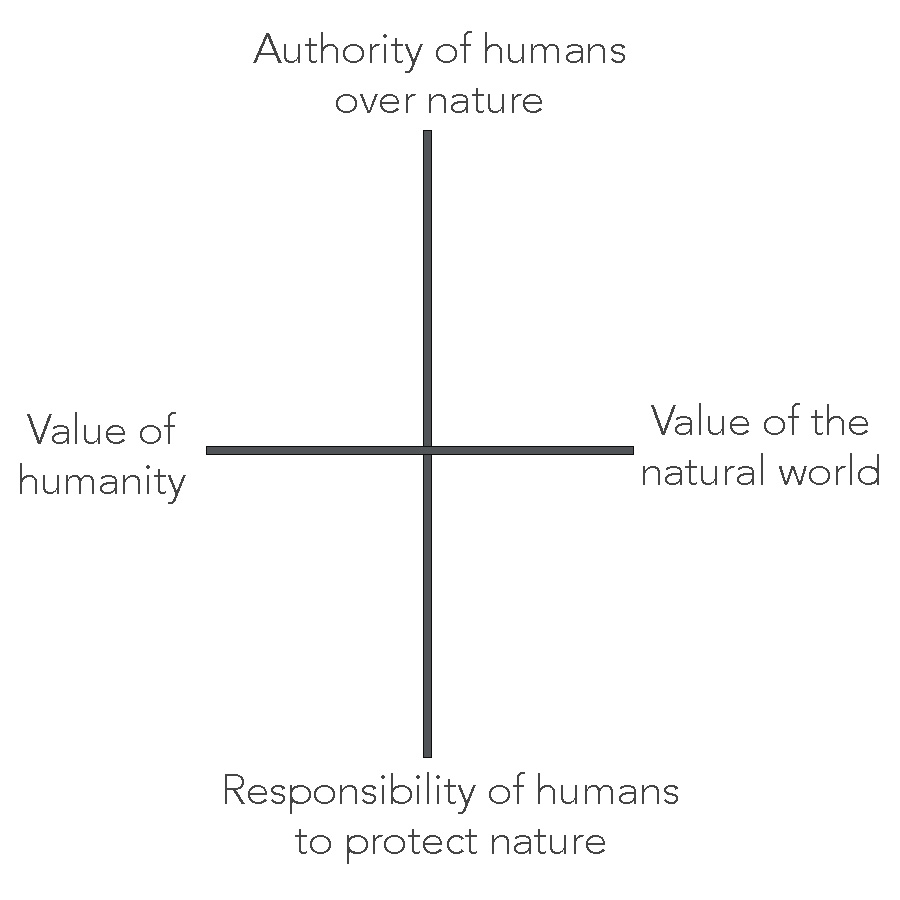
In groups, place each Christian perspective on this graph: do they place human authority over nature above human responsibility to protect nature; do they value humans above the natural world, etc?
Share and discuss graphs. As a class, ascribe reasons to each positioning; what are they based on? Either give a theological argument or a biblical reference to support each position. Through the course of the conversation, ensure these two positions are defined:
Christian Environmentalism: humans must transform the way we treat the environment; the natural world must be protected and nurtured, in both Evangelical and denominational Christian thinking.
Conservative Evangelical or Fundamentalist non-Environmentalism: God will destroy the earth at the End Times, this is God’s plan for humanity and the natural world.
Debate
Divide the class into two groups: Christian Environmentalism and non-environmentalism. Each groups has 15 minutes to create 4 strong arguments in favour of their position, in response to the motion (below).
Groups should also predict counter-arguments and prepare to meet them.
Motion: The earth is ours to use
An investigation into how feminism has led to different interpretations of the Bible.
KS4&5. Originally written by Bob Bowie. Updated in April 2019.
Emerging
Expected
Exceeding
Compare and contrast two different feminist interpretations of the Fall
Hermeneutics: How we read, understand and handle texts, especially those written in another time or in a very different life context.
Biblical Hermeneutics: The process of understanding the Bible using doctrinal, historical and critical approaches.
Biblical Criticism: Making sense of the Bible through a better understanding of the history and culture of the times.
Demythologizing the Bible: An approach to understanding that sought to remove the other-worldly outdated understandings in the Bible to find what was thought to the essential ethical understanding.
The Fall: the event in the Garden of Eden where Adam and Eve disobeyed God and ate from The Tree of the Knowledge of Good and Evil (Gen. 2 and 3).
Feminism: Movements which aim to establish women’s equal rights. A feminist is an advocator or supported of the rights and equality of women and so can be male or female.
Christian feminism: This movement seeks to understand the equality of men and women in terms of morality, society, spirituality and Christian leadership. One major area of work is in the reinterpretation of Christian doctrine. Another is in the movement for ordination.
Feminist theology: A movement found in several religions that reconsiders religion from a feminist perspective, reinterpreting existing interpretations of religion, which have tended to be exclusively or largely made by men.
Feminist theory: Thinking that seeks to understand gender inequality examining women’s social roles and lived experience.
Patriarchal/Patriarchy: A system that puts and keeps women in submissive and/or subservient role to men.
Reader response: Making sense of the Bible through personal prayer and meditation and reflection on words from the Bible and life experience.
Sexism: Beliefs, attitudes and actions that see women as second class to men.
Inequality: A basic value position that gives more recognition and importance to one ‘kind’ over and against ‘another’.
Women’s liberation: a movement that opposes inequality, patriarchy and sexism in an attempt to secure equal rights in all areas of life.
Women’s ordination: This practice of some religions and some Christian denominations is an area of dispute both across religions and within Christianity.
Explain to the students that they are going to conduct two investigations to work out what can be learnt from feminist interpretations of the Bible. Each investigation has a focus statement and some ‘tabloid headlines’. The headlines are used to characterise the learning investigation at each stage but could also be a template for producing media accounts of the examinations.
The investigations should enable students, working in small teams, to produce TV style interviews with characters in the stories examined and with the Feminist commentators in the Resource. Newspaper stories can be written to reflect sexist interpretations of the stories, in the style of tabloid revelations, with follow up denials and alternative accounts of what really happened, generating the sense of the interpretation.
Learning investigation 1: Christian comments on women and feminist comments on Christianity
Tabloid Headline: SEXIST RELIGION OR RELIGION MADE SEXIST?
Introduce the students to some of the controversy surrounding women and Christianity. Explain that they are going to investigate why some people might think the Bible, or Christianity, is sexist and to examine the thinking of some feminist theologians who in different ways respond to the question of sexism in the Bible or Christianity.
Give the following quotations. Ask students to find three challenging or unexpected quotes. Encourage them to decide in small groups: which of the quotes are most striking to them and to write a written response.
Tertullian (about 155 to 225 CE):
“Do you not know that you are each an Eve? The sentence of God on this sex of yours lives in this age: the guilt must of necessity live too. You are the Devil’s gateway: You are the unsealer of the forbidden tree: You are the first deserter of the divine law: You are she who persuaded him whom the devil was not valiant enough to attack. You destroyed so easily God’s image, man. On account of your desert even the Son of God had to die.”
Augustine of Hippo (354 to 430 CE). He wrote to a friend:
“What is the difference whether it is in a wife or a mother, it is still Eve the temptress that we must beware of in any woman……I fail to see what use woman can be to man, if one excludes the function of bearing children.”
Thomas Aquinas (1225 to 1274 CE):
“As regards the individual nature, woman is defective and misbegotten, for the active force in the male seed tends to the production of a perfect likeness in the masculine sex; while the production of woman comes from a defect in the active force or from some material indisposition, or even from some external influence.”
Martin Luther (1483 to 1546):
“If they [women] become tired or even die, that does not matter. Let them die in childbirth, that’s why they are there.”
Matilda Josyln Gage, et. al, “1876 Declaration of Rights” on the rights of women
“…we declare our faith in the principles of self-government; our full equality with man in natural rights; that woman was made first for her own happiness, with the absolute right to herself – to all the opportunities and advantages life affords for her complete development; and we deny that dogma of the centuries, incorporated in the codes of nations – that woman was made for man – her best interests, in all cases, to be sacrificed to his will. We ask of our rulers, at this hour, no special favors, no special privileges, no special legislation. We ask justice, we ask equality, we ask that all the civil and political rights that belong to citizens of the United States, be guaranteed to us and our daughters forever.”
Pope John Paul II (1995)
“Woman’s identity cannot consist in being a copy of man, since she is endowed with her own qualities and prerogatives, which give her a particular uniqueness that is always to be fostered and encouraged… To all in our age who offer selfish models for affirming the feminine personality, the luminous and holy figure of the Lord’s Mother shows how only by self-giving and self-forgetfulness towards others is it possible to attain authentic fulfillment of the divine plan for one’s own life.”
Statement by “Christians for Biblical Equality” a conservative Christian organization
“…the Bible, properly interpreted, teaches the fundamental equality of men and women of all racial and ethnic groups, all economic classes, and all age groups, based on the teachings of scripture as reflected in Galatians 3:28: ‘There is neither Jew nor Greek, there is neither slave nor free, there is neither male nor female; for you are all one in Christ Jesus.’ ”
Jerry Falwell
“Most of these feminists are radical, frustrated lesbians, many of them, and man-haters, and failures in their relationships with men, and who have declared war on the male gender. The Biblical condemnation of feminism has to do with its radical philosophy and goals. That’s the bottom line.”
Randall Terry, head of Operation Rescue
“…make dads the godly leaders [of the family] with the women in submission, raising kids for the glory of God.”
Anon, “Why women need freedom from religion,” pamphlet
“The various Christian churches fought tooth and nail against the advancement of women, opposing everything from women’s right to speak in public, to the use of anesthesia in childbirth…and woman’s suffrage. Today the most organized and formidable opponent of women’s social, economic and sexual rights remains organized religion. Religionists defeated the Equal Rights Amendment. Religious fanatics and bullies are currently engaged in an outright war of terrorism and harassment against women who have abortions and the medical staff which serves them.”
Ask students to write a newspaper column under this headline:
SHOCK REVELATIONS. EQUALITY HUMAN RIGHTS COMMISSION INVESTIGATES ACCUSATIONS OF SEXIST DISCRIMINATION IN SO CALLED COMPASSIONATE RELIGION
Alternatively, they could produce a report on an investigation into what Christianity is really all about, identifying aspects of the Christian tradition that seem sexist.
Now introduce some responses to misogyny in Christian thought. For example search online for ‘Mary Daly quotes’. Other Christian feminists are Daphne Hampson, Elisabeth Schüssler Fiorenzaand Phyllis Trible. Search You Tube for modern Christian feminist posts and videos.
Can students define the term ‘thealogians’ (with an ‘a’ instead of an ‘o’)? Teach that the Greek word for Goddess is Thea or Theia, rather than Theos (the masculine ‘God’). Are Christian feminists Thealogians?
Thealogians argue the job of Feminist Thealogy is to:
Make the ‘Five Feminist Theologians/ Thealogians’ Resource into separate cards for each of the five thinkers. Divide students into small groups and issue each group with one card. Ask them to express in a single sentence or two how their thinker has responded. This could be done with groups looking at the information on their card and responding initially to what they seem to be saying. For example, instruct them to ‘read the card with the information on your thinker and try to agree with your group on the three key things your person is saying’. So students might suggest, for example, ‘I think she is saying ….’
In a plenary session, ask each group to report on their three key things to the whole class, listen to each other’s reports and then give some initial responses. [Until the students have sought to apply these interpretative perspectives that the thinkers have, it may be difficult to for them to see the implications of these perspectives but this provides an opportunity to ask the class, ‘how do you think each of these women might view x or y?’ for some hypothesis work.]
Ask students to write a magazine column under this headline: WE TALK TO FOUR INSIDERS WHO REVEAL THE TRUTH ABOUT CHRISTIANITYʼS SEXISM! Here, the article author (or news item presenter) interviews four of the feminist thinkers capturing their beliefs about Christianity and their feminism.
Learning Investigation 2: Adam and Eve
Part A: Tabloid Headlines:
SULTRY TEMPTRESS SEDUCES ADAM AND LOSES EDEN FOR ALL OF US! WAS IT ALL EVE’S FAULT?
Ask students to apply the different kinds of feminist thinking introduced in Investigation 1 to interpret the Adam and Eve text, and to evaluate some questionable representations of Adam and Eve and the ideas they convey.
Read, with students, the account of the creation of Eve in Genesis 2:4-25 and her role in the Fall in Genesis 3. It is important to read the actual text and begin there, in a suitable translation, instead of beginning with an enactment or video impression of the account for example, as these inevitably involve interpretation.
Ask the whole class for their thoughts on the following questions:
Ask students then to work in pairs or threes to consider briefly the following ‘unpacking questions’:
Gather feedback. Ask students to discuss then suggest interpretations of the myth of Eve.
Part B. How is the story of Adam and Eve depicted in medieval pictures? Tabloid Headline:
DODGY ARTISTS BESMIRCH HONOURABLE EVE WITH ‘PAGE 3’ PAINTINGS OF GENESIS!
Move students’ focus to how some Christians in medieval times interpreted and depicted this story. This will show how it was interpreted in different times and places.
Explain that in medieval Christianity no one really questioned the existence of Adam and Eve or the Garden of Eden. The depictions of the story in paintings of the time provide an impression of what artists thought about the Creation story. Within these depictions certain attitudes and interpretations can be perceived. [Students may well have engaged with the idea of propaganda in history which could be drawn upon for comparison.]
Show the students a selection of mediaeval depictions of the creation story, such as:
Explain that the pictures chosen here are an example of one of the things feminist thinkers are concerned about so they illustrate the problem. Ask students to look at these images alongside the text and (a) pick out any ideas that appear to have been placed into the story and (b) decide whether the artist was reading other things into the account or was he revealing the implicit messages in the text itself?
Explain that this discussion is a key question for feminist theology – is it that the interpretation is wrong, or is it the source itself that is the problem? [These could be looked at together as a class or in groups if the images are printed. These could be compared with traditional easily available images on Adam and Eve which do not so clearly reveal elements that feminist thinkers are concerned about.]
Encourage students to write down their answers to the following questions:
Ask all the students to then produce their own caricature of the Genesis account emphasising the text and the interpretation. They could use a tabloid-style headline such as, “IT WAS EVE WHAT DONE IT!” with a by-line such as, “While the Bible just says she offered the fruit to him, insiders speak out in our exclusive report to reveal she was starkers at the time and the serpent was her sister”
Part C. How might Christian feminists respond differently to these images and texts?
Give pairs 5 minutes to sketch or write ‘Genesis 3 from Eve’s point of view’ in four frames, images or sentences. Share ideas. Is the story changed?
Ask students for their reflections on the Genesis accounts so far: are the stories in themselves sexist or is it the interpreters throughout history (usually men) who are sexist in their interpretation? Are they in need of reinterpretation or do they need to be rewritten?
Return to quotes or texts from the Christian feminists studied previously. Using these views, work in pairs to evaluate the myth of Eve: what is the main message, what is its purpose, what is its value?
Break the students up into small groups made up of individuals who had been studying different feminist thinkers so all are represented in the groups. Supply them with very large sheets of paper with the Genesis text inserted in the middle and some of the mediaeval Adam and Eve images round the outside. Ask each group to build an ideas map of feminist interpretations of the creation story by writing in notes on the interpretations of the feminist thinkers around the key phases of the story and next to the images. What might each thinker say, at each point? These could be highlighted in different colours. Students should demonstrate where the different feminist thinkers might agree or disagree about the interpretation of each significant part of the text by making connections on the sheets. The groups should aim to depict the possible interpretations of the story.
Once the ideas maps are complete, students should share their findings with the rest of the class.
A final report on their investigations will then enable students to demonstrate their ability to analyse and evaluate the biblical text in relation to feminist and other points of view. Ask them to compile their reports under the key question: What can be learnt from Feminist interpretations of the Bible? Ask students to include in their reports (which could be presented in a variety of ways) the following features:
Face to Faith brings students of different religions and cultures together using digital technology to connect schools in 19 countries.
Many users of RE:ONLINE may be interested in using Face to Faith, a fantastic resource provided by the Tony Blair Faith Foundation. Find out more about it here and visit: http://tonyblairfaithfoundation.org/projects/facetofaith
Face to Faith is the Tony Blair Faith Foundation’s Global Schools programme, active in a wide range of schools in countries across the world.
Face to Faith:
– gives students the opportunity to interact directly with their peers from around the world to dialogue about the range of faiths and beliefs, values and attitudes that they hold. This occurs safely through facilitated videoconferences and a moderated online community.
– supports teachers by providing a rich range of high quality, engaging and appropriate materials to help them prepare their students for dialogue.
– talks about culture and identity, but always emphasises Faith and Belief, because those two things can play a very positive role in our world, yet are almost always referred to in a negative way.
– emphasises Similarity and Difference – finding the ways in which we are similar to other people is often easy, but discovering the ways in which we are different gives us much more opportunity to learn.
– supports the development of key skills for global citizenship, including respectful dialogue, information technology, cooperation, conflict mediation, reflection, global awareness and faith literacy.
– is a set of flexible materials; designed to fit alongside, and enhance existing curriculum requirements.
Read the following for more information on video conferencing:
Face to Faith and an Introduction to Video Conferencing
Face to Faith have kindly provided the following example materials to illustrate the modules available to subscribers:
This film, produced by BBC Manchester in association with Jerusalem Productions Ltd, looks at the story of John Newton, the remarkable journey of Amazing Grace, and explores the concept of grace itself – being saved by God, without it being deserved, which connects it so strongly to the events of Easter. Rick Wakeman described Newton’s journey from slave trader to preacher, making use of the many locations that played a part in Newton’s life – including the ports he knew as a sailor; the vicarage in Olney where Amazing Grace was written, and the churches that played a part in his life. The programme shows how every word in the hymn relates to Newton’s life – an autobiography in six verses. A large part of the story of the hymn takes place in the USA, which has taken it as an unofficial anthem, sung at national events, by civil rights groups and at weddings and funerals.
Resources for KS3 (11-14) and KS4 (15-16). However, they can easily be used with KS5 (17-18).
In order to use these resources it is necessary for students to have watched the entire film. In addition sections may be re-shown in relation to each topic. The topic ‘Programme Outline’ contains the timings for each part of the film.
Teachers can select all or any of the resources and activities as suitable for the course they are pursuing. Although closely related to the film there are additional ‘Stretch and Challenge’ topics as well as cross-curricular materials.
Additional topics include:
• 20th century versions of Amazing Grace;
• Joseph Emidy;
• Notes on Amistad and 12 Years a Slave;
• Personal Revelation and Conversion;
• Slavery and the Roman Catholic Church;
• The Bible and Slavery;
• The use of hymns in worship.
Additional versions of resources are included:
• Dyslexic (D) for all topics;
and as appropriate –
• SEN – Special Educational Needs (S);
• EAL – English as an Additional Language (E)