Viewing archives for History

Key Stages 1 and 2

This resource encourages pupils to look at Islam through the eyes of the poet Rumi.

Created by Lynn Revell and Kate Christopher as part of their Canterbury Christ Church University grant funded project Teaching Islam as a Worldview. Funding provided by  Culham St Gabriel’s Trust. You can find further resources which were created as part of this project in the RE:ONLINE resource Islam as a Worldview

Key Stages 2 and 3

Find out about Muhammad Ali: the athlete, the antiracist, the conscientious objector and the devoted Muslim.

Created by Lynn Revell and Kate Christopher as part of their Canterbury Christ Church University grant funded project Teaching Islam as a Worldview. Funding provided by  Culham St Gabriel’s Trust. You can find further resources which were created as part of this project in the RE:ONLINE resource Islam as a Worldview

I am frequently asked how Jesus could be God. So this is a brief study, under the general title of Leaders and Prophets, about this central belief of Christianity.

Christianity believes that God really came into this real, material world, being fully human whilst never losing His deity: he was not just a prophet. How did Christians ever arrive at such an idea? First of all we can look to the Gospels:

  • Jesus taught it: he said ‘I and the Father are one’ (John 10.30), ‘I am in the Father and the Father is in me’ (John 14.11)
  • Jesus showed it: his many miracles – ‘it is by the Spirit of God that I cast out demons, then the kingdom of God has come upon you’ (Matt. 12.28) – healing the sick and raising the dead
  • Jesus proved it by his resurrection

Secondly, after the resurrection, and the reception of the promised Holy Spirit (Jesus had said he himself would send the Spirit) the first Christians had a great deal of thinking to do, rather like this: Jesus must have been the Messiah, fulfilled Old Testament prophecy literally (‘Mighty God, everlasting Father’ – Isaiah 9.6) and be coming back again as he promised; only if he is really divine can he do all this. And when he said ‘before Abraham was, I Am’ (John 8.58) he made the most staggering claim: he is that Word of God, that Wisdom of God, that very image of God, through whom everything was made in the first place (Proverbs 3.19) and in whom we are made!

Thirdly, talk of God’s personified Wisdom and Word were current in Judaism at the time and, differently, in contemporary Stoicism – the divine Word (Logos) is the guiding principle, the inner formula, of the universe as a while. So John opens with the claim: ‘In the beginning was the Word, and the Word was with God, and the Word was God…..the Word became flesh and dwelt among us’.

St Paul articulated what this means in his letters to the Philippians and the Colossians: he identifies Jesus as pre-eminent over all creation (Colossians 1.15-20), the means by which creation was made and is sustained, and in whom ‘all the fulness of God was pleased to dwell’. He also explains (Philippians 2.4-11) that, in becoming man, Christ divested himself of divine privileges (omnipresence, omnipotence, etc.) and submitted to an ignoble death. So the incarnation is definitely in the Bible.

However, how this came to be understood over the ensuing centuries varied

Some Christians came to see Jesus as a man adopted by God because of his holiness, ‘Son’ of God in an exceptional way but not God in the flesh. Conversely some others were so keen on Jesus being God, or God’s Word, that the human element of Jesus was considered a mere minor addition, and possibly not really real anyway (Apollinaris, Sabellianism, Gnostics). Others argued over whether Jesus’ soul was divine, human, or both (Nestorius, Origen), and a major heresy argued that though he was divine and human together, God is so immutable and transcendent that the ‘god’ in Jesus must have been a lesser aspect of divinity, a special creation not eternal and not fully God (Arius). Did Jesus have just one unique nature (Monophysites) or two unmixed (orthodox definition)? Or two, unmixed indeed but actually separate (Cyril)? And so it went on!

It took the Councils of Nivea and Constantinople, in the 4th Century, to reach the most widely accepted definition in the Nicene Creed:

We believe in one Lord, Jesus Christ, the only Son of God, eternally begotten of the Father, God from God, Light from Light, true God from true God, begotten, not made, of one Being with the Father. Through him all things were made. For us and for our salvation he came down from heaven: by the power of the Holy Spirit he became incarnate from the Virgin Mary, and was made man.

Of course all these problems were caused by old views of humans – body and soul – and at a Platonic version of God, for whom matter was untouchable. Christianity had to break both moulds to get this definition of one Lord Jesus Christ, fully God and fully Man, a definition finally fully set out at Chalcedon in AD 451 – see http://anglicansonline.org/basics/chalcedon.html and note that even so there are variations within Christendom still. That’s the thing about God, He just won’t conform to our thinking! We have not got adequate categories to explain the Incarnation, that is clear, but it is the essential central mystery of Christianity.

Divided nature – what he does as God, what he does as man


This resource was written by Richard Coupe, one of RE:ONLINE’s Email a Believer team. 


The relationship between the LGBTQ+ community and large parts of organised religion is complex. Some members of the LGBTQ+ community have been hurt by their experiences of organised religion and this has led to distrust.

I would like to say that Paganism is different. That Paganism is fully accepting toward LGBTQ+ people. But I can’t say that.
I can, however, say that the majority of Pagans are accepting toward LGBTQ+ people.

I think it is fair to say, though, that even among the small minority of Pagans who do in some way discriminate against LGBTQ+ people, the number who claim to do it on religious grounds are even fewer. This is because there is very little in Paganism that can be taken as somehow religiously proclaiming that homosexuality, etc. is wrong. So, if you do encounter one of the few Pagans that have issues with such things, my view would be that their discrimination is entirely their own and not something that has been transmitted to them as a ‘Pagan teaching’.

In fact, there is a great deal in Paganism that not only signals an acceptance of homosexuality, transsexuality, etc. but actively recognises it as something that can be religiously recognised and celebrated.

A great amount of modern Paganism is constructed from features (both religious and social) of older cultures. It is no secret that the ancient Greeks and Romans, for example, had a rather progressive attitude toward homosexuality, at key points in their history. So it should come as little surprise that there are models within their religious and mythic traditions that can be taken as representative of LGBTQ+ qualities.
The God Dionysus, for example, was depicted as both an old man and as an effeminate youth. The God Pan is unapologetically pansexual. The deity Hermaphroditus (from where we get the word hermaphrodite) was the God of hermaphrodites and the effeminate and possessed both male and female physical features. Even the Goddess of Love herself, Aphrodite, was sometimes depicted with a beard and in Theselay she was celebrated with lesbian rites. And of course, Aphrodite is regularly invoked in the ancient poetry of Sapho, celebrating love between women.

But themes and concepts that can be significant to an LGBTQ+ expression of religion, are definitely not restricted to the Greeks and Romans. In Germanic mythology, we see a number of examples of gender-bending and switching of traditional gender roles and power structures.
In South America, the God Xochipili is the patron of male homosexuality.
Polynesia and the Pacific Islands contain a number of different deities and religious traditions involving gay relationships and bisexuality. Additionally, there are a number of examples of third-gender and gender-variant shamans. In fact, Shamanism generally has numerous examples of people, behaviours and practices worldwide, that fall under the umbrella of gender-variance.

There are actually more examples than I have space to list, but we can see that such themes are common across many ancient cultures, all over the world.

The degree to which LGBTQ+ themes are celebrated and discussed in the broader Pagan community will differ from place to place.
Paganism is a very personalised path and being as the majority of people are not a part of the LGBTQ+ community, it’s hardly surprising that those themes may not feature in the practices of a lot of people. Additionally, despite the broad acceptance of LGBTQ+ people, orientations, lifestyles, and love styles, there are large amounts of Paganism that are constructed in a very heteronormative way. They’re not exclusionary of LGBTQ+ themes and people, but at their most basic level they revolve around a certain core of celebrating the cycle of life as expressed through the female and male experience, and the union of the male and female to perpetuate life. Much of this has come out of the popularity of Wicca and other modern Witchcraft traditions.

So, while on the one hand Paganism is very inclusive, I could understand if the commonality of heteronormative themes might make an LGBTQ+ person feel excluded.

However, there are Pagan groups and paths that are exclusively LGBTQ+. For example, the Pagan tradition known as Radical Faerie, is exclusively made up of “lesbians, gay men, trans*, bisexuals, queer hetero people and anyone else in between” (quote from Radical Faeries of Albion: https://albionfaeries.org.uk ).

I think it is a strength of Paganism that it is not just LGBTQ+ inclusive, but that it possesses a wealth of myth, tradition, and iconography of an LGBTQ+ nature. That this creates even more opportunity for members of the LGBTQ+ community to not merely explore their spirituality among accepting people, but to explore a spiritual path that also reflects important aspects of who they are and can be celebrated with others who are also on a similar life journey.

Glossary
LGBTQ+ : Lesbian, Gay, Bisexual, Trans*, Queer, +others.

This resource was written by Luthaneal Adams, one of RE:ONLINE’s Email a Believer team.

I think that we can all agree that while Christmas may be, essentially, a Christian holiday, the celebration of Christmas has expanded well beyond the boundaries of Christianity. These days it’s celebrated by people of many different faiths and those of none. Of course, the perception of the holiday may differ from one group to the next. A Muslim celebrating Christmas will have a different religious perception of the holiday, compared to a Christian, even though in many instances their days may appear very much alike. Likewise, secular Christmas, celebrated by the majority of Britons, is more or less the same from one household to the next, and still quite like the festivities of Christians, even though the secular, non-religious British citizen doesn’t share their faith.

Pagans, are really no different. Well, mostly.
We, generally speaking, are very happy to get in on the holiday spirit. Many Pagans have a secular Christmas. But a lot of us have other winter holidays that we either celebrate along with Christmas or instead of it. Though, even in those cases where Christmas is not celebrated, our own holidays have many similarities to a typical Christmas.

We shouldn’t be surprised by that, though. One thing that Pagans like about this time of year, is just how Pagan it is! Dozens of different traditions, many of them with Pagan roots, all weaving together into the modern Christmas.

There are a lot of theories about what aspects of Christmas have Pagan elements or origins. Part of Santa Claus’ character may have been adopted from old depictions of Odin. Bringing an evergreen tree into the house, to be decorated, a German tradition of uncertain origins, but it certainly seems very Pagan. Mistletoe, that sacred plant of the Druids, is also held in esteem in Heathen mythology. Even the ancient Romans exchanged gifts as a part of their Saturnalia festival, at this time of year. And having a big winter feast with lots of merriment and drinking, has been a part of mid-winter traditions all over Europe.
So, even those Pagans who engage with Christmas as a public, secular holiday, are still able to enjoy it through Pagan eyes.

Some of us, however, don’t ‘do’ Christmas. We have our own winter festivals, which typically fall around the same time.
In many instances, the placement of these festivals is determined by the winter solstice, which typically falls on December 21st (sometimes the 20th or 22nd). These are, in most instances, Yule celebrations, and are shared by several different Pagan faiths. Yule originally comes from the Germanic peoples of Europe (like the Norse and Anglo-Saxons) and was the whole month. Those who follow a Germanic Pagan faith, like Heathenry and Asatru, tend to celebrate Yule at around the same time as Christmas.

Wiccans also have Yule as a part of their ritual calendar and so it is common practice for them to have a Yule ritual, which marks and celebrates the winter solstice. Druids, likewise, also mark the winter solstice. Those who follow a Pagan path that draws from ancient Roman religion, may have a Saturnalia celebration. Traditionally, Saturnalia could last up to a couple of weeks, though for the modern Pagan who has a job to go to, needs to pay bills, etc. such celebrations may have to be skimmed down to a single party or gathering.

Despite having our own holidays, being a minority religion often means that taking part in holiday revelry has to be a small affair or, as can be the case at this time of year, it can mean that we have to fold our festivities into those of other people. So, Pagans from many different paths may all share a public Yule gathering. More notably though, Pagans may often have to blend their Paganism into the broader gatherings of friends and family. So, we might go to our family Christmas dinner, share in it as our “winter feast”, enjoying it from a Pagan perspective, even while our families enjoy it from their own (religious or non-religious) perspective.

That’s not always the case, though. Modern Paganism is now old enough that we can talk about generations of Pagans. Pagan parents raising their children with Pagan traditions. I know of a number of Pagan families who don’t celebrate Christmas, at all, but they do all celebrate Yule. The kids seem to be quite happy about this arrangement, as Yule tends to take place on December 21st, meaning that they get their presents before all their friends get theirs! Perhaps, as Paganism continues to grow and create more Pagan families, this will become more commonplace – or at least as common as the festivals of any other non-Christian religion in the UK.

For now, though…
Happy Yule – Merry Christmas – Io Saturnalia – Happy Hanukkah – Blessed Sol Invictus – Or whatever your tradition may be, have a good one!


This resource was written by Luthaneal Adams, one of RE:ONLINE’s Email a Believer team.
In 2020 Latter-day Saints celebrate the 200th anniversary of the First Vision of the Prophet Joseph Smith. Who was this man? Firstly, it is important to note who he was not- he is not our Saviour, nor is he an object of our worship. I’m sure if he were here today, he would want us to focus on the life and teachings of his and our Master- Jesus Christ, but through Joseph Smith we learn many things about our Saviour.

So, who was Joseph Smith?

1.He was a man.

As we look at the life of Joseph, we see he had many human qualities that were to be admire. Often, we look at the Saviour and think how hard an example he is to live up to, but Joseph Smith- mere mortal that he was gave us an example of how we can follow the Saviour even with our limitations and imperfections. There are many stories from Joseph’s life that help us understand his ‘human qualities’.

I like to use an example from his life as I strive to remain steadfast in my faith. When he was challenged about his experiences, and in particular the First Vision (see below) he recorded:

I had actually seen a light, and in the midst of that light I saw two Personages, and they did in reality speak to me; and though I was hated and persecuted for saying that I had seen a vision, yet it was true; and while they were persecuting me, reviling me, and speaking all manner of evil against me falsely for so saying, I was led to say in my heart: Why persecute me for telling the truth? I have actually seen a vision; and who am I that I can withstand God, or why does the world think to make me deny what I have actually seen? For I had seen a vision; I knew it, and I knew that God knew it, and I could not deny it, neither dared I do it; at least I knew that by so doing I would offend God, and come under condemnation (Joseph Smith History 1:25).

2.He was a Prophet.

Some may have a tendency to emphasize his human qualities and perhaps give them an excuse to dismiss some of the teachings of the Saviour which Joseph taught. Above all the important fact of Joseph’s life is that he was a prophet of God. We know his standing as a Prophet of God when we read D&C 135:3:

In the short space of twenty years, he has brought forth the Book of Mormon, which he translated by the gift and power of God, and has been the means of publishing it on two continents; has sent the fulness of the everlasting gospel, which it contained, to the four quarters of the earth; has brought forth the revelations and commandments which compose this book of Doctrine and Covenants, and many other wise documents and instructions for the benefit of the children of men; gathered many thousands of the Latter-day Saints, founded a great city, and left a fame and name that cannot be slain. He lived great, and he died great in the eyes of God and his people; and like most of the Lord’s anointed in ancient times, has sealed his mission and his works with his own blood; and so has his brother Hyrum. In life they were not divided, and in death they were not separated!

A prophet is someone who teaches of Jesus Christ and warns the world as the mouthpiece of God. This began nearly 200 years ago in the Sacred Grove. On seeking for truth Joseph reached the conclusion that he needed to pray and ask God where his truth lay. Following this determination in the early spring of 1820 he retired to a grove of trees and received what is now termed, The First Vision:

After I had retired to the place where I had previously designed to go, having looked around me, and finding myself alone, I kneeled down and began to offer up the desires of my heart to God. I had scarcely done so, when immediately I was seized upon by some power which entirely overcame me, and had such an astonishing influence over me as to bind my tongue so that I could not speak. Thick darkness gathered around me, and it seemed to me for a time as if I were doomed to sudden destruction.

But, exerting all my powers to call upon God to deliver me out of the power of this enemy which had seized upon me, and at the very moment when I was ready to sink into despair and abandon myself to destruction—not to an imaginary ruin, but to the power of some actual being from the unseen world, who had such marvelous power as I had never before felt in any being—just at this moment of great alarm, I saw a pillar of light exactly over my head, above the brightness of the sun, which descended gradually until it fell upon me.

It no sooner appeared than I found myself delivered from the enemy which held me bound. When the light rested upon me I saw two Personages, whose brightness and glory defy all description, standing above me in the air. One of them spake unto me, calling me by name and said, pointing to the other—This is My Beloved Son. Hear Him! (JSH 1:15-17).

In this event Joseph saw the Father and the Son, and also received a promise that at some future point the Church would be restored through him. There were many things that Joseph revealed and restored under the direction of the Godhead. He translated the Book of Mormon, received the priesthood under the hands of Peter, James and John, and organised the Church on April 6, 1830.

3.He was a teacher.

This is linked with Joseph being a prophet. A prophet is a teacher. His subject is Christ and the plan of salvation. Through Joseph we have greater understanding of the plan of salvation. How wonderful it is to read of the teaching experiences of the Prophet Joseph. Following the death of a friend he was asked to deliver a funeral sermon; in this he taught the doctrine of baptism for the dead which excited his audience so much that they left the meeting to run to the river and start straight away.

Joseph wasn’t born a teacher- though he was foreordained so to be. He developed as all of us do- line upon line, here a little and there a little. It is this same unlettered boy who first saw Heavenly Father and Jesus Christ that delivered great sermons years later.

4.He was a revealer of truth.

This began with Joseph’s search for truth in his early years. He learnt how to seek revelation and recognize the promptings of the Spirit. This began early in his life; when searching for truth and coming to the conclusion he must ask God he was first of all reading the Bible:

I was one day reading the Epistle of James, first chapter and fifth verse, which reads: If any of you lack wisdom, let him ask of God, that giveth to all men liberally, and upbraideth not; and it shall be given him. Never did any passage of scripture come with more power to the heart of man than this did at this time to mine. It seemed to enter with great force into every feeling of my heart. I reflected on it again and again, knowing that if any person needed wisdom from God, I did; for how to act I did not know, and unless I could get more wisdom than I then had, I would never know; (JSH 1:11-12 emphasis added).

This passage highlights how the process of revelation happens through the Holy Spirit. He works in our minds and in our hearts. It strengthens me to know that this personal revelation is available to all of us, including me. Joseph once taught that “God hath not revealed any thing to Joseph, but what he will make known unto the Twelve & even the least Saint may know all things as fast as he is able to—bear them.”

As a Latter-day Saint I believe that knowledge and clarification of great truths were revealed through the Prophet Joseph including:

  • The nature of God
  • The Plan of Salvation
  • The priesthood of God
  • The apostasy and restoration
  • Book of Mormon
  • Word of Wisdom
  • Temple work

5.He was a martyr.

Joseph sealed his testimony with his blood- in June 1844 he was shot by a mob while being held in Carthage Jail. Joseph once declared:

“I am tired. I have been mobbed, I have suffered so much from outsiders and from my own family… I have to seal my testimony to this generation with my blood. I have to do it for this work will never progress until I am gone for the testimony is of no force until the testator is dead. People little know who I am when they talk about me, and they never will know until they see me weighed in the balance in the Kingdom of God. Then they will know who I am, and see me as I am.”

I was once on holiday in Cornwall and saw the following dedication on a war memorial; to me it sums up the mission of the Prophet Joseph Smith in teaching me of my Saviour and through him, my eternal destiny: 

In proud and grateful memory of the men… who gave their all and in giving raised men’s ideals of what man may become.

This resource was written by James Holt, one of RE:ONLINE’s Email a Believer team.

Well, it’s that time of year again.  Summer is coming to an end and the kids are back at school.  But the end of summer also means that the wheel of the year is turning again and the first signs of autumn are beginning to manifest.

It also means that my favourite time of year is nearly here:  Halloween!

Halloween, or as we Pagans call it Samhain, is probably our most popular and well-known festival.  It’s the one that is most in the public consciousness, though usually for spooky decorations, fun costumes, parties, and the sudden appearance of a Halloween isle in the supermarket.

Although most people might not think of this time of year in terms of it being a Pagan holiday, it very much is and so many of the things associated with Halloween find their origins in our festival of Samhain.

This is a subject I’ve written and spoken about before, in multiple places.  So, I’m going to cheat a little bit and save myself some time, by simply sharing an article on Samhain that I wrote in the past.

But for those of you looking for the cliffnotes summary:

Samhain is about recognising that death is a part of life.

It is a time for remembering the dead.

Wearing costumes, Jack O’lanterns, Bobbing for Apples, all have Pagan precedents.

Samhain was a fire festival, so bonfires have always been part of the festivities at this time of year.


For the full info, read on…

Samhain

In the modern world only Pagans and those who may be well informed are likely to use the word “Samhain”.  For most people this age-old feast has been transformed into Halloween.  But even Halloween retains traits of the ancient ways, still seen in our predisposition with the supernatural at this time of year.

Halloween is traditionally a time of ghosts and ghoulies, not to mention filling your belly with lots and lots of yummy foods.  But these things aren’t really that far removed from the practices of our ancestors and here we will examine the beliefs and traditions that they held and the dedicated Pagans who still follow them today.

Origins

Samhain (pronounced “s’ow-in”) finds its most recognisable roots in the beliefs and practices of the ancient Celts.

To the Gaulic Celts it was once known as Trinouxtion Samonii.  This translates as “three nights of the end of Summer”, which is when Samhain celebrations took place, around what we now call October/November.  This was not just the end of Summer, but some believe it was also the end of the Celtic year.  The land was slipping into a state of death, trees losing their leaves, the days are darker and shorter, and the crops are brought in for the final time that year.  It is a time of endings.

Additionally, Samhain is also a time of blood.  At this time of year, all farming is coming to a pause.  Crops are done with and the animals, seeking food, come down from the higher pastures and return to the farm to be kept through the winter.  Being as the farmers could not afford to maintain the entire herd throughout the winter, due to the shortness of resources, they would slaughter the most expendable members of the herd.  The blood of these animals was seen as an offering to appease the spirits of the land, thanking them for their help in bringing forth the crops during the year and in the hope that they will provide the same help in the following year.  It was a way to ensure that malign spirits didn’t turn on the property and its owners.

This belief in the power of blood even lasted through to the nineteenth century, where some places would still sprinkle the blood of a cockrel at the four corners of their houses in order to ward off negative spirits.

When the Dead Walk

Blood, death and darkness.  Perhaps a traditional backdrop for our modern Halloween.  But to the Celts, this may have been a time of darkness, but it was in no way a negative time of year.

Samhain was a between-time, resting between the living bright half of the year and the dead, dark half of the year.  It is a time the land (and Gods) were entering into a state of death.  The doors to the world of the dead were blown open at this time and the spirits of those that had died were free to wander the land.

It was traditional at this time to make these spirits welcome in the homes of their families.  Doors and windows would be left open to allow them entrance and food would be set aside for them, so that they could partake of its “spiritual essence” and thusly enjoy the benefits of its nourishment.

This event was often envisioned as a great host of the dead wandering through the countryside, descending upon villages and towns, moving from house to house where at each stop, those who belong would remain behind to visit their relatives.

A common term for this was The Feast of the Dead, which is a term that is still used today by some Pagans.

This was a time for celebration, when the entire tribe – living and dead – would come together to celebrate the festivities.  At the centre of these festivities was the ritual bonfire.

Fire in the darkness

One traditional practice in many Celtic communities was to extinguish all the lights in the village and light a single bonfire, central to everyone as a communal gathering point.  Later, all the lights would be relit from the flames of this bonfire.

This practice was most widely and sacredly performed in Ireland, where Samhain was synonymous with the Feast of Tara.  The Tara was the envisioned heart of the land, where every king of Ireland would come at the time of the feast.  Nearby, at a sacred area called Tlachtga, a large bonfire would be constructed, ready for Samhain.  Then the night before Samhain, all the lights in the land would be extinguished and the fire at Tlachtga would be lit.  Once the fire was raging attendees would cast charms into the flames, symbolising their wishes for the coming year.  Then torches would be lit from the bonfire and sent out across the land to relight it, beginning with its spiritual heart: the Tara.

The bonfire has retained its place in modern British culture; however, it has now been co-opted by Guy Fawkes Night and its original heritage has been forgotten in favour of the more recent gunpowder plot.

In some communities, the bonfires served a double purpose, by also acting as a protective charm against supernatural menaces.

It was a time of year when the barrier between life and death was at its thinnest, dark had triumphed over light and the spirits of the dead were free to roam.  But other things from the lands beyond life were also free to venture forth and cause whatever trouble they wanted.  In this time of darkness, the bonfire served to bring light to the community and dispel the darkness from places where nasty other-world creatures may try to lurk.

So, in this way, the bonfires were like beacons that would guide in ancestral spirits as they wandered, while at the same time driving off more malevolent beings.

It is thought that the ancient Celts would have burnt animal bones in these fires as a special measure to ward off evil spirits, which is where we get our modern word “bonfire”, from these ancient “bone-fires”.  These bone-fires were no doubt built using the bones of the cattle that were slaughtered for Samhain.

Death, Renewal and the promise of Life

We are now very familiar with the natural connection to death and the spirit world that are expressed at Samhain.  But as has already been mentioned, this is not a time for grieving.  In fact, this is as much a time for looking forward as well as looking back.

We are inclined at this time to remember those who have passed over to the land of the dead and all the times we have had with them.  As the end of the harvest we are also inclined to look back over the spring and summer that have just passed.

Remember, this is not just another passing holiday; this is the mark of the end of the year.  Think about the things that may run through your mind at the end of December.  You are probably given to spare a thought for the year that has just gone and take stock of the things that have happened.  Was it a good year?  A happy year?  In the mix of the festivities you quite probably remember a lot of the good times, as anyone would at a party.  Well Samhain is a party too, it is a celebration, albeit a solemn one in many regards.  So those involved would spare the same kind of thoughts to the past year, but in addition they would also look forwards at the year to come.

You may make New Year’s resolutions as the New Year rings in and December becomes January.  For the ancient Celts it wasn’t too different.  They would give thought to what they would do with their futures and so this also became a common time for doing simple forms of divination, often as a part of the merriment.

This also makes a lot of sense at this time of year, as Samhain is seen as the doorway between worlds.  It is the bridge between one year and the next, when reality is at its thinnest.  It is neither one year, nor the other.  A time between times and thusly “time” was just as flexible as the walls between the worlds, making it a perfect event for divining the future.

If you lived back then, you may have witnessed a local getting their future romantic interests predicted by watching walnuts crack upon a roaring hearth fire.

Samhain is also about new beginnings – or at least, envisioning new beginnings.

At this time of year, nature has retreated and died, and this brings with it the image of the Goddess descending into the underworld as she also enters the state of death.  In today’s neo-pagan religions (especially Wicca) this is commonly just “the Goddess” as represented through all of nature as the bringer of life and womb of creation.  However, in the Celtic world this concept of the Goddess would have been overlaid with that of their local Goddess who either fit the bill of the seasonal change or who stood as the most sovereign among the Goddesses, as at this time of year the Goddess (whoever she may be) was viewed as the Sovereign Goddess.  She, who in majesty, withdraws for the other worlds.

While the Goddess draws away from us and descends into the underworld, her consort sweeps across the land, taking part in the Wild Hunt.  The theme of the Wild Hunt is perhaps best represented through the horned God Cernunnos, moving across the sky at the darkening of the year.  This Wild Hunt of his signifies two things, firstly the culling of the herds that is being performed by the slaughter of livestock and secondly, the gathering of the souls of the deceased.  We visualise him stalking animals as a hunter, bringing down those that are weakest so that the herd will be strengthened and the community better benefits, thusly the animal slaughters are depicted, but he is also king of the underworld and ready to join the Goddess in her sovereignty.  So, the Wild Hunt marks his return to the underworld, gathering the souls of the dead as they finish their time on Earth.

As he descends in the underworld, he takes his place with the Goddess.  There are many myths at Samhain that describe how the God takes his position with the Goddess, sometimes showing him dying in order to be with her, some showing him as a resident guardian to her in her time in the underworld, while others depict him in the guise of two Gods with one slaying another so that the first may go to the Goddess to reclaim her for the world.  This act is a sacred sacrifice.  The God has travelled the land gathering the spoils of the Wild Hunt and now for the good of the world, he himself dies so that he can return to the Underworld.

As the Lord of the other worlds, the God shall stand as protector to the Goddess during her time in the underworld.  For this in itself is a significant time, as it shows us that death and the spirit world is not merely the cessation of life, but instead a womb from which the Goddess will be born anew with the coming of Spring.

In modern Paganism the significance of this message is very important.  Through it we understand how death is a step in life and how the dark months of winter show us the beginning of the New Year, for in these dark times life dwells in the womb of the Earth and spiritually in the other worlds.  So, the beginning of the New Year coincides with the beginning of the life of the land, here in the cosmic womb of the natural world.

Samhain into Halloween – what we do today

Any and all of these ancient practices can and do get recreated among modern Pagans, but alongside them time has also gifted us with some newer traditions that fit marvellously into the spirit of the season.  For the modern Pagan there is absolutely no reason why you shouldn’t utilise both sides of the season, old and new.  It’s your Samhain, so do what you need to enjoy it. It is, after all, supposed to be a festival.

Costumes

Dressing as ghosts and ghoulies has a very obvious connection to the holiday.  With the belief that all sorts of creatures are around and about, dressing the part to celebrate can be a good bit of fun.

But this tradition may also have some roots that are older and deeper than we may realise.  Indeed, in some Celtic communities dressing up was a regular practice.  There would be people who would often dress in masks and outfits and play pranks upon their neighbours – usually with a light-hearted attitude.

This was to symbolise the breaking of barriers that was occurring in the world.  As the common rules of time and space came to waver, so to did the rules of community behaviour and people could feel free (to a point) to do some things that they would not normally be allowed to do, by breaking the flow of ordinary behaviour.  In this fashion, people would dress up in order to look outrageous and add to the merriment.

Some researchers also suggest that it would have been common practice at this time for any Celts out on the Samhain nights, to wear costumes as disguises, so that they would not be recognised as human if they happen to cross paths with any unfriendly spirits.

Jack-O’lanterns

The history of the Jack-O’lanterns is a rather divided one and seems to be the end result of two different things.

According to some traditions, the Jack-O’lantern finds its origins in Ireland, where it was a practice to carve out root vegetables (primarily turnips) and place either a piece of coal or a candle within them, in the style of the modern Jack-O’lantern.  This was done with a double meaning:  firstly, the light from the candle acted as a guide for friendly spirits, so that they might be able to find their way and be guided in, while the scary face was a deterrent to malevolent spirits and drives them away.

If is thought that this practice didn’t specifically pertain to Samhain and that it may have occurred at other times of year as well but keeping in mind the dual purpose of the traditional Samhain bonfire, it isn’t hard to see how this tradition might have got started.

Additionally, there is the folklore tale about an unlucky Irishman by the name of Jack, who is said to have caused some kind of great mischief in his life and eventually had a run-in with the Devil.  Well, as it turns out, Jack was actually a rather shrewd thinker and managed to trick the Devil and trap him until he promised not to take Jack’s soul to Hell.  The Devil agreed in exchange for his own freedom.

Of course, when Jack came to die, he was left in a bit of a pickle.  Being far from an upstanding citizen he was refused entrance to Heaven and the Devil kept his word, barring him from Hell.

Jack wondered what he would do and where he would go, so the Devil mockingly made him a lantern with which he would endlessly wander the world seeking a place to rest.

From this folk tale he became known as Jack of the Lantern or Jack O’Lantern.

When the Irish immigrated to North America they brought the tradition of the Jack-O’lantern with them, but somewhere along the way they found it was easier to carve pumpkins than it was to carve turnips, bringing us to the modern Jack-O’Lantern that we have today.

Bobbing for Apples

This tradition actually goes back further than the Celts, finding its origins in the ancient Roman Empire.  The Romans once celebrated their own festival of the last harvest around the time of late October, called the Feralia.  During this time, they celebrated by honouring the Goddess Pomona, the Goddess of fruit trees.  The apple was a sacred symbol of Pomona and was used in celebrations of this festival.

When the Romans invaded the Celtic lands, the practices of the Romans blended a little with that of the Celts and so the symbolic reference to apples was passed across.  Today we still celebrate this via the tradition of apple bobbing.

Even today this time of year remains a time for fun and frolics, when we all have a good excuse to dress up and enjoy ourselves.

For many Pagans this is a time to welcome the dead and give honour to the Gods, but whether you call it Samhain or Halloween, everyone is free to join in the fun, throw parties or if they wish just stay in and watch horror movies.  So, make it a good one!


This resource was written by Luthaneal Adams, one of RE:ONLINE’s Email a Believer team.
© Bahá’í International Community

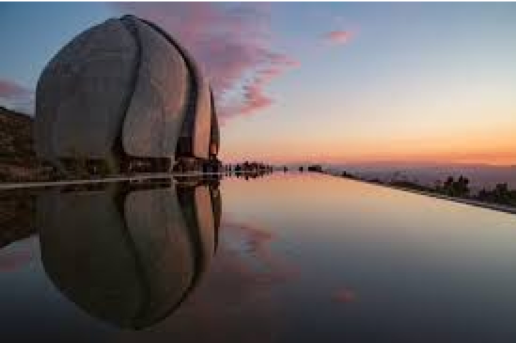
One of the things which continues to amaze me about the digital age is the way we get news from the world over within hours of it happening, and can ‘see’ the world from our computer screens. Without travelling from home, I know what the new House of Worship in Chile looks like, I have a beautiful picture in mind of the terraced gardens of the Shrine of the Báb on Mount Carmel in Haifa, and I could follow events of last year’s International Convention as they happened.

Bahá’í House of Worship, Chile © Bahá’í International Community

The Shrine of the Báb and gardens, Haifa, Israel © Bahá’í International Community

It’s easy to forget that it wasn’t always like this. In 1982, when I was a new adherent of the Bahá’í Faith, news of the British community came through the monthly British Bahá’í Journal; messages from the Universal House of Justice (our world administrative body) came printed on golden-yellow paper, mailed through the letterbox; urgent messages (the passing of a much-loved and respected fellow Bahá’í, for example) came as telegrams to the British National Spiritual Assembly to be included as mail-outs to the Bahá’is of the country or announced at Feasts and gatherings.

We are so much more closely connected these days, and at a time when society feels increasingly fragmented, these connections are a lifeline.

The events currently dominating the Bahá’i networks are centred around the celebrations for the bicentenary of the Birth of the Báb on October 28th this year. The Báb, Divine Educator and Prophet-Herald to Bahá’u’lláh, was born in 1819 in Shiraz, Persia. ‘Báb’ is a title which means ‘Gate’. Whilst calling the peoples of the world to spiritual reformation, The Báb was preparing the way for a new Manifestation of God: Bahá’u’lláh.

The Báb’s story is one of dignity, heroism, and ultimately sacrifice. His short life (He was just 31 when He was excecuted) was characterised by an innate wisdom, sharp perception and such sweetness of character that people were prepared to give their lives to spread His teachings. He was sentenced to death by the Persian authorities who were unsettled by His demand for a high standard of personal and public behaviour, and by the devotion of rapidly growing numbers of His followers. Several thousands of His followers were put to death in the ensuing years, and yet from these beginnings the Bahá’í Faith was ultimately to grow and be carried around the world.

“It was His own mission, the Báb declared, to herald the coming of this promised Manifestation of God. The Báb explained that the new Manifestation would usher in an age of peace and justice that was the hope of every longing heart and the promise of every religion. The Báb instructed His followers to spread this message throughout the country and to prepare people for this long-awaited day.” [1]

A newly-launched website, https://bicentenary.bahai.org/the-bab/  dedicated to celebrating this special Holy day, carries videos, articles and photos, and will be added to over the coming weeks as events happen. The Báb’s story can be read in full detail (including accounts from foreign ambassadors and chroniclers of the time who met Him, and who witnessed His execution.) News from every part of the globe of communities gathering to pray, share food and celebrate together feature alongside artworks inspired by the life of the Báb, His teachings and stories of His followers.

The following prayer is one of many revealed by the Báb:

O Lord! Unto Thee I repair for refuge and toward all Thy signs I set my heart. O Lord! Whether travelling or at home, and in my occupation or in my work, I place my whole trust in Thee.

Grant me then Thy sufficing help so as to make me independent of all things, O Thou Who art unsurpassed in Thy mercy! Bestow upon me my portion, O Lord, as Thou pleasest, and cause me to be satisfied with whatsoever Thou hast ordained for me.

Thine is the absolute authority to command.[2]


1 Photos and Bicentenary Logo all “Copyright © Bahá’í International Community” .

See https://media.bahai.org/ for photos and videos of Bahá’í Holy Places and the world-wide Bahá’í community. “The Bahá’í Media Bank provides photographs for download, intended for non-commercial purposes only. Copyright and terms of use can be found on the Legal Information page.”

2 The Báb, Selections from the Writings of The Báb. Hear this prayer put to music at: https://www.youtube.com/watch?v=1I-QXlILQqQ


Further Reading

RE:ONLINE resource Táhirih -The Pure One (1817 – 1852)  speaks about the Táhirih, the Báb’s first female disciple

RE:ONLINE resource Bahá’i Holy Day in July: The Martyrdom of the Báb

For a comprehensive account of the early history of the Bábi and Bahá’í Faith:

Nabil, The Dawn-Breakers: Nabíl’s Narrative of the Early Days of the Bahá’í Revelation, 

Bahá’i Publishing Trust, 1932 Edition   

https://www.bahai.org/the-bab/life-the-bab

https://www.bahai.org has lots more information

This resource was written by Debbie Tibbey, one of RE:ONLINE’s Email a Believer team. 

 

© Bahá’í International Community

The Bahá’i year, in common with most religions, has certain days which are regarded as Holy days, commemorated or celebrated by the Bahá’i community.

One of these special days falls in July each year, on either 9th or 10th depending on the solstice. On this day Bahá’is commemorate the Martyrdom of The Báb, (which means “the Gate” in Arabic), an event so shocking that were it not independently documented it would seem more legend than true story.

The Báb is regarded by Bahá’is as both a Messenger of God and the Herald of Bahá’u’lláh. Born in Shiraz, Persia, in 1819, His given name was Siyyid ‘Ali- Muhammad. He was a direct descendant of the Prophet Muhammad, and was known for His gentle nature, keen perception and wisdom even from a very young age. In 1844 He declared His mission to begin the spiritual and moral renewal of the peoples of the world, a process which would see the emancipation of women, and unite the peoples of the world. He also taught that another Messenger of God, the fulfilment of the world’s great religions, was soon to appear.

The Báb’s teachings, His call for a return to moral rectitude, His claim that He was a divinely inspired ‘Educator’, and the following which grew around Him, were huge challenges for the clerics and authorities of the time. Eventually, in 1850, a decree was made for His execution. The Báb was arrested and sentenced to death by firing squad. The following account is from Hassan Balyuzi’s book, The Báb: The Herald of the Day of Days[1]:

Sam Khan (Commander of the firing squad) approached the Bab: ‘I profess the Christian Faith and entertain no ill will against you. If your Cause be the Cause of truth, enable me to free myself from the obligation to shed your blood.’ To this the Báb replied: ‘Follow your instructions, and if your intention be sincere, the Almighty is surely able to relieve you from your perplexity.’

The Báb and His disciple were suspended by ropes from a nail in the wall, the head of Mirza Muhammad-‘Ali, Anis, resting on the breast of the Báb. Seven hundred and fifty soldiers were positioned in three files. Roofs of the buildings around teemed with spectators.

Each row of soldiers fired in turn. The smoke from so many rifles clouded the scene. When it lifted the Báb was not there. Only His disciple could be seen, standing under the nail in the wall, smiling and unconcerned. Bullets had only severed the ropes with which they were suspended. Cries rang out from the onlookers: ‘The Siyyid-i-Báb has gone from our sight!’

A frantic search followed. The Báb was found, sitting in the same room where He had been lodged the night before, in conversation with His amanuensis. That conversation had been interrupted earlier in the day. Now it was finished and He told the farrash-bashi to carry out his duty. But the farrash-bashi was terror-stricken and ran away, nor did he ever return to his post. Sam Khan, for his part, told his superiors that he had carried out the task given to him; he would not attempt it a second time. So Aqa Jan Khan-i-Khamsih and his Nasiri regiment replaced the Armenians, and the Báb and His disciple were suspended once again at the same spot. The Nasiri regiment fired. The bodies of the Báb and His disciple were shattered, and their flesh was united.

Further accounts exist from contemporary foreign journalists and officials who witnessed or were told of the event, including one from Sir Justin Shiel, Queen Victoria’s Envoy Extraordinary and Minister Plenipotentiary in Tehran to Lord Palmerston, the British Secretary of State for Foreign Affairs, July 22, 1850.

The remains of the Báb and Anis were retrieved at night by the Báb’s friends and eventually interred on Mount Carmel in Israel, a place of pilgrimage for Bahá’is across the world today.


1 Balyuzi, H.M. (1973). The Báb: The Herald of the Day of Days. Oxford, UK: George Ronald. pp. 154–161. ISBN 0853980489.


Further reading:
Nabíl-i-Zarandí (1932). Shoghi Effendi (Translator), ed. The Dawn-Breakers: Nabíl’s Narrative (Hardcover ed.). Wilmette, Illinois, USA: Bahá’í Publishing Trust. ISBN 0900125225.


See also:
https://bahaikipedia.org/Martyrdom_of_the_Báb


This resource was written by Debbie Tibbey, one of RE:ONLINE’s Email a Believer team.
Origins

The Shema may be seen as the beginning and end of Judaism. It is a Jewish prayer extracted from three places from the Torah and composed into a sequence of paragraphs. It does not appear in its entirety at the beginning of the Torah, rather it is found in Deuteronomy 6.4-9; 11.13-21 and Numbers 15.37-41. The Shema derives its name from the Hebrew word sema, meaning ‘to hear’, which is the initial word of the first verse, which states, ‘Hear O Israel’. Thereby, instructing Jews to listen. It is believed that they were received by Moses on Mount Sinai.

Significance

The Shema is included as part of every weekday synagogue service. Its significance is inferred by the fact that its centrality is recognised in all Jewish traditions, in various ways. The recitation of the passage is taken as a commandment to be fulfilled by Jewish adult men twice daily, morning and evening. It is also a core text in other prayer books.

The Shema is taught for the love of God, loyalty to the Jewish tradition and it encourages the Jewish community to study the Torah. It is reported that Jacob’s sons read it to him and therefore adults recite it to children so that they remain within their tradition. The Shema might be the first thing that some Jewish children learn in a Jewish primary schools and at home to express belonging.

Meaning

The Shema sets out what Jews believe and how they should demonstrate their dedication to God through daily actions.

It represents their belief that they have made a Covenant with God: an agreement that they will love God and follow His laws and in return God will take care of them. Thus, as an artefact, the Shema is a way for Jewish people to remind themselves of their promises to God. This is why families have a responsibility to teach their faith to the next generation.

Practice

Unsurprisingly, the Shema has acquired a pivotal position in the collective and personal life of Jewish communities. Communally, adults recite it in the morning and evening and in the afternoon at the synagogue to fulfil the commandment and remember God.

 Individually, some Jews recite it before bed and after waking up, as it is the most holy thing to say during these times. It is also a way of thanking God for waking them up from sleep and to ask God for good sleep. Thus, it is a prayer which covers all activities of the day and night.

As a family, in some homes, mothers regularly recite the Shema with their children whilst putting them to bed. Some children memorise it and others prefer to look at the text when reciting it.

At happy events, such as moving into a new home, the mezuzah, which contains the Shema, is fixed to the doorpost and is followed by a religious service.

During festival days and especially on Shabbat, a double reading honours the Shema: at the time the Torah scroll is bought out from the Ark the opening verse of the Shema is recited collectively, and again, individually by the reader prior to reading the Torah.

There are some physical gestures adopted by Jews during various prayers and worship. On the Day of Atonement whilst reciting the opening verse of the Shema, the eyes are covered to remove distractions.

As death approaches, those gathered recite some passages from the Torah and end with the opening words of the Shema. In this way the dying person is helped to affirm their faith in the oneness of God. It is worth noting that the Shema may be recited in Hebrew and in other languages too.

Structure

The Shema has three paragraphs. The English translation is provided with an explanation of what it might mean to some Jews, how they might put it into practice and what they could learn from it.

Hear O Israel, the Lord is our God, the Lord is One (Deuteronomy, 6.4)

From this, Jews learn to be attentive to the Torah so that God’s commands are with them. It also means their religion is monotheistic. Moreover, a closer examination reveals God as addressing Israel rather than Israel addressing God, thus Jews make claims of a reciprocal relationship because God chose them, and consequently, they believe God cannot ignore them.

Blessed is His name, whose glorious kingdom is forever and ever

This phrase does not appear in the Torah and is attributed to Jacob. Since he had whispered it, Jews whisper it as well. It tells the Jewish community to praise God. They know, through this, that God’s kingdom is everlasting. They recognise the holiness and greatness of God. It gives them hope too.

Love the Lord your God with all your heart, and all your soul, and all your might (Deuteronomy, 6.5)

The demand from God is unequivocal in this phrase: total obedience and wholehearted devotion and to remember God’s word. It implies that Jews be prepared to sacrifice everything. They are to love God with their might, heart and soul. God loves them; therefore, they too should have unflinching love for Him.

These words that I command you today shall be upon your heart (Deuteronomy, 6.6)

Jews learn to affirm these as laws and learn them orally. But there is also an emotional attachment. The heart is mentioned so that it can act as a guide following the dictum ‘in doing right follow your heart’, and in the heart should be the Torah.

Repeat them to your children, and talk about them when you sit in your home, and when you walk in the street; when you lie down, and when you rise up (Deuteronomy, 6.7)

This phrase gives adults the responsibility to pass on their faith to children, and this can take place in formal and informal settings. The key message is to keep it alive at all times. Literally, it means Jews should recite it every evening and morning.

Hold fast to them as a sign upon your hand, and let them be as reminders before your eyes (Deuteronomy, 6.8)

Literally, this means to hold fast onto the Shema and the Torah by wearing the verses on the hand and upon the forehead between the eyes. This is how the practice of wearing phylacteries (tefillin) became established. The tefillin consists of four small joined-up boxes containing the first two passages of the Shema (Deuteronomy, 6.4-9 and Deuteronomy, 11.13-21) and two other Exodus phrases of the Torah. These are handwritten on a parchment and worn on the stronger hand as this is what is used by individuals or on the left arm so that it is directed to the heart. It is a constant visual reminder for Jews that God is there, whatever they do.

Write them on the doorposts of your home and at your gates (Deuteronomy, 6.9)

The final instruction is to handwrite a parchment and fix it to the doorpost of the home and gates. In practice, to preserve the sanctity of the text, a rectangular elongated box with a slight opening, called a mezuzah, is made to house this kosher parchment, which contains the first two of the three paragraphs of the Shema (Deuteronomy, 6.4-9 and Deuteronomy, 11.13-21) and at the back, the word Shaddai (Almighty). The mezuzah is affixed on the right hand doorframe, with a little slant upwards in the direction of the room, at about shoulder height, in individual dwellings and collective compounds. In doing so, most Jews express their obedience, and, when they come into and go out of their homes, they are reminded to renew their covenant daily. The mezuzah is fixed on every door (except the lavatory and bathroom), so the whole house is covered in holiness and purity as a gift of God. Some Jews kiss the mezuzah to show their adherence to the Torah in everything they do, including daily actions like entering and leaving the home.

Mezuzah literally means ‘doorpost’, but over time came to refer to the doorpost and what is attached to it. Interestingly, a sukkah does not need a mezuzah as it is not permanent dwelling.

Deuteronomy 11.13-21

This section is an exhortation to obey, love and serve God alone with everything. In return God promises the Jewish community abundance in material well-being. Should they turn to serve other gods, the anger of God awaits them (Deuteronomy, 11. 13-17).

The next phrases (Deut. 11.18-21) repeat the instructions given above in (Deut. 6-9). Thereafter, God promises that should these be fulfilled then God will keep His promise of the land for them (Deut. 11. 21).

Numbers 15.37-41

This verse establishes the custom of Jews adorning clothes with tzitzit (fringes). Tzitzit are tassels made of several threads tied together to symbolise the numerical value of the name of God. The Shema says that when people look at the tassels they will remember their promise to keep God’s laws. Some Jews follow this rule all the time and wear a vest with tassels on four corners, called a tallit katan. At the synagogue, some also wear a special prayer shawl called a tallit gadol when praying in the morning.

To summarise, the Shema is a prayer in the first instance and a belief statement thereafter. It has a golden principle for the Jewish community in stressing that learning is initiated at home and establishes the duty to educate their children in the faith. The Shema establishes the practice of learning the three paragraphs contained within it, and of wearing the tefillin and affixing the mezuzah. These actions remind Jewish people of the promises made to and by God, their belief about unity of God and the One to be worshipped.

Learning about the Shema in RE

Here are some examples of what primary pupils might be able to do as a result of their learning about the Shema.

They can:

-use the right names for things that are special to Jews, e.g. when shown a picture, say: ‘That is a mezuzah’

-talk about what they find interesting or puzzling, e.g. talk about how interesting it was to hear that Jewish people put a prayer in a small box and fix it to their doorposts

-talk about some things that are similar for different religious people, e.g. say that Muslims, Christians and Jews all says prayers to God

-talk about some things in stories that make people ask questions, e.g. say, ‘It was mysterious when God spoke to Moses’

-describe things that are similar and different for religious people, e.g. record or say how Jews recite the Shema, but that they may say it in different languages

-ask important questions about life and compare their ideas with those of other people, e.g. ask why Jews think the Shemais such an important prayer and give their own ideas about important prayers and wishes

-use the right religious words to describe and compare what practices and experiences may be involved in belonging to different religious groups, e.g., say how different Jewish communities might have different ways of remembering God’s laws – through recitation of the Shema, through wearing of the tallit and tefillin, though doing good deeds and so on

-ask questions about the meaning and purpose of life, and suggest a range of answers which might be given by them as well as members of different religious groups or individuals, e.g. asking questions about the importance of the Shema in Jewish life and suggesting answers that might be given by a Jewish visitor to the classroom, or with reference to answers given in authoritative texts or websites.

Some common discussion questions:

  • What do you think it means when the Shema says: “These words […] shall be upon your heart”?
  • In the Shema, where does it say that Jews should talk about God’s laws?
  • Why do you think the Shema says that Jewish people should repeat the words to their children?
  • What could you use or do to help you to remember promises that you have made?

Further reading

Cohn-Sherbok, D. (2003) Judaism: History, Belief and Practice, London: Routledge.

Hoffman, C. M. (2010) Judaism: An Introduction, London: Hodder Education.

Written by Imran Mogra