Viewing archives for Rites of Passage

This lesson offers some historical information about the first Bat Mitzvah, the welcoming of a young Jewish woman to adulthood. Jews had for centuries celebrated a boy’s entry to adulthood with a Bar Mitzvah, meaning, ‘son of the commandments’. In 1922 Rabbi Mordechai Kaplan, a member of the Orthodox Jewish community in New York, performed the first Bat Mitzvah, for his daughter, Judith. This means ‘daughter of the commandments’. As we shall see, not everyone welcomed the move. We will explore historical information as well as information about Jewish belief, practice and community.

Lesson Outline

1. Search online for an image of Judith Kaplan at the 70th anniversary of the first Bat Mitzvah. The image is housed in the Jewish Women’s Archive, there are several versions online. You could also search for other images of Judith and her father Mordechai Kaplan, there are a few.
Give groups 3 minutes to come up with 3 questions about the image.

2) Cut the information below into cards and give a set to each group: (In the download at the end of this page there are ready made cards you can cut out.)

Judith’s father was a rabbi, and he performed her Bat Mitzvah

Bar Mitzvah is when a boy comes of age in Judaism

Judith Kaplan’s Bat Mitzvah was conducted in New York in 1922

No one had conducted a Bat Mitzvah before Judith Kaplan’s.

The young person reads from the Torah in front of the congregation

The first public Bat Mitzvah involved 13-year old Judith Kaplan

There are 316 commandments in then Torah (Jewish holy book)

Bat means ‘daughter’ in Hebrew

Bar Mitzvah means ‘son of the commandments’.

Ask groups to find answers to these questions, using the cards:
– What is a Bat Mitzvah?
– What is a Bar Mitzvah?
– why is the first Bat Mitzvah is significant in Jewish history?

3. Ask groups to predict how this was received in the Orthodox community. Do they think it was welcomed as a positive change, or resisted as an unwelcome change?

4. In fact not all New York Jews supported Judith’s Bat Mitzvah. Write the 4 statements below into 4 speech bubbles and display. Ask groups to identify TWO reasons why Judith’s Bat Mitzvah was seen as a bad idea, and TWO reasons why it was seen as a good idea.

A woman’s sphere of influence is the home, so it is right and fitting that a young woman should be welcomed into adulthood in the home.

Religions need to change with the times. Traditions adapt without destroying the religion. The belief has not changed, just the way of showing it has changed.

Women have more of a role in public life in modern times so it is correct for women to be more involved in public religious ceremonies.

Jewish women and girls have always been ‘daughters of the commandments’. A new ceremony is not necessary.

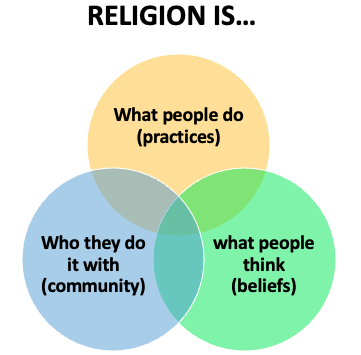
5. Introduce the idea that religion can be understood as a combination of beliefs, practices and community or tradition; how groups see the world, what they do, and who they do it with. Show a diagram like this. You could give examples of beliefs, practices and community traditions, which pupils have to match to each element to make this point.

three intersecting circles explaining what religion is. In 1 is what people do (practices). In the 2nd is who they do it with (community) and in the 3rd is what people think (beliefs)

6) Using the information squares below, answer the question; ‘Was Rabbi Kaplan seen as challenging religious beliefs, practices or traditions with the first Bat Mitzvah?’

The Torah is the first part of the Jewish bible, consisting of 5 books.

The 613 commandments cover all aspects of community & religion.

The Torah teaches about the Jewish prophets and early Jewish history.

Traditionally only men read from the Torah.

‘Torah’ means ‘teachings’ (Hebrew).

The Torah begins with God creating the universe.

The Bar Mitzvah ceremony is not mentioned in the Torah, or the Talmud (books that interpret the Torah).

The first mention of the Bar Mitzvah ceremony is in the Middle Ages, not the time of the Torah.

Traditionally, only men would read from the Torah in public. Women had no roles of authority in public; in business or religion.

The Jewish bible contains elements of the Bar Mitzvah ceremony. For example, adult Jews fast on the Day of Atonement, and children would begin their fast at 13.

At a Bar Mitzvah ceremony, the 13-year old boy reads a portion of the Torah to the congregation at the synagogue. This is the first time he has read from the Torah in public.

The Mishnah (part of the Talmud) states, ‘”At five years old one should study the Scriptures, at ten years for the Mishnah, at 13 for the commandments…’ (Mishnah Pirkei Avot 5:21)

In this BBC video we meet Me-Me, a Jewish girl, preparing for her Bat Mitzvah. Me-Me will read the Torah in front of the synagogue congregation to become a ‘Daughter of the Commandments’.

My Irish mother used to urge us to hurry by saying we should ‘run like a linty’. What? Well, a linty was a nickname for someone who lit the streetlamps in the days of gas lighting, and the lamps on their posts would often need the mantle changing, made of lint. As the linty had to hurry, and in changing mantles often got covered in lint fibres as he ran through the town from lamp to lamp, so he became a byword for someone in a great hurry. In this resource I want to slow him or her down and say we should all be thoughtful linties.

One of the great symbols of Christianity is light. ‘Lighten our darkness’ is the start of a familiar closing prayer in many Anglican services, the whole of creation began, we are told with the majestic ‘Let there be light’, and Jesus sensationally said: “I am the Light of the World” (John 8.12).

In the world up until the 19th Century, and in many parts still today, light means fire: candles, pitch, hearth fires, oil lamps, charcoal, anything that burns gives light. So, light meant heat, light could easily be extinguished, and kindling a fire/light was an arduous process, so don’t let the fire go out! All of these thoughts are involved in Christian thinking about light at this time of increasingly short days and long nights. But it is not the physical facts of light that matter, it is the spiritual significance which you can find in everything from infant baptism (christening) through to praying for the souls of the dead, from referring to conversion as ‘enlightenment’ to prayer for guidance (‘lighten our darkness’) or to making use of external light to illuminate stained glass windows.

Let’s concentrate on candles. At infant baptism in the major denominations a special candle is given and lit by the priest as a sign of that new life, a symbol of the one baptised, a picture of the light of Christ conquering the darkness of evil. Everyone who is baptised “walks in that light” for the rest of their lives, baptism being the start of that journey into faith and obedience. I quote the Anglican liturgy here:

Priest: God has delivered us from the dominion of darkness and has given us a place with the saints in light. You have received the light of Christ; walk in this light all the days of your life.

All   Shine as a light in the world to the glory of God the Father.

This is how symbolism works here: Baptism does not of itself make you a believing Christian, which is why many Protestants delay it until a person can decide for themselves. However, baptising an infant, to cut a long story short, is seen as entering the family of faith prior to playing your part in later life. The light of the candle therefore serves:

  1. As a reminder of the truths of walking in the light of Christ in your life;
  2. As a reminder of Christ as the Light of the World;
  3. As a fire, not an electric bulb, which burns away deadwood, heats, and purifies precious things: it symbolises therefore the indwelling Holy Spirit who works in us to the glory of God.

To take one more instance, All Saints (or Hallows/Souls) Day. In the last 25 years we have been overtaken by the commercialising of the evening before All Hallows Day reviving what are presumed to be ancient practices (a rather dubious claim) and encouraging people to dress up as the Dark Side. OK, for many this is a bit of fun. But if we instead remember the next day all the good and the great, the pioneers, saints and martyrs, heroes, both sung and unsung , it is a fantastic festival of lights, and we should be lighting candles and other illuminations to celebrate these – there is quite enough gloom around, so let’s have some good news!

So, as the scripture says, ‘God is Light, and in Him there is no darkness at all’ (1 John 1.5). Further, we are also told God is the ‘Father of lights’ (James 1.17): we can translate ‘lights’ here as ‘enlighteners’ – God is the Father of all those who seek to bring light to shine in the world around. This we remember in the baptismal candle, and then promise to do as we live our lives as linties.


This resource was written by Richard Coupe, one of RE:ONLINE’s Email a Believer team.

Origins

The Shema may be seen as the beginning and end of Judaism. It is a Jewish prayer extracted from three places from the Torah and composed into a sequence of paragraphs. It does not appear in its entirety at the beginning of the Torah, rather it is found in Deuteronomy 6.4-9; 11.13-21 and Numbers 15.37-41. The Shema derives its name from the Hebrew word sema, meaning ‘to hear’, which is the initial word of the first verse, which states, ‘Hear O Israel’. Thereby, instructing Jews to listen. It is believed that they were received by Moses on Mount Sinai.

Significance

The Shema is included as part of every weekday synagogue service. Its significance is inferred by the fact that its centrality is recognised in all Jewish traditions, in various ways. The recitation of the passage is taken as a commandment to be fulfilled by Jewish adult men twice daily, morning and evening. It is also a core text in other prayer books.

The Shema is taught for the love of God, loyalty to the Jewish tradition and it encourages the Jewish community to study the Torah. It is reported that Jacob’s sons read it to him and therefore adults recite it to children so that they remain within their tradition. The Shema might be the first thing that some Jewish children learn in a Jewish primary schools and at home to express belonging.

Meaning

The Shema sets out what Jews believe and how they should demonstrate their dedication to God through daily actions.

It represents their belief that they have made a Covenant with God: an agreement that they will love God and follow His laws and in return God will take care of them. Thus, as an artefact, the Shema is a way for Jewish people to remind themselves of their promises to God. This is why families have a responsibility to teach their faith to the next generation.

Practice

Unsurprisingly, the Shema has acquired a pivotal position in the collective and personal life of Jewish communities. Communally, adults recite it in the morning and evening and in the afternoon at the synagogue to fulfil the commandment and remember God.

 Individually, some Jews recite it before bed and after waking up, as it is the most holy thing to say during these times. It is also a way of thanking God for waking them up from sleep and to ask God for good sleep. Thus, it is a prayer which covers all activities of the day and night.

As a family, in some homes, mothers regularly recite the Shema with their children whilst putting them to bed. Some children memorise it and others prefer to look at the text when reciting it.

At happy events, such as moving into a new home, the mezuzah, which contains the Shema, is fixed to the doorpost and is followed by a religious service.

During festival days and especially on Shabbat, a double reading honours the Shema: at the time the Torah scroll is bought out from the Ark the opening verse of the Shema is recited collectively, and again, individually by the reader prior to reading the Torah.

There are some physical gestures adopted by Jews during various prayers and worship. On the Day of Atonement whilst reciting the opening verse of the Shema, the eyes are covered to remove distractions.

As death approaches, those gathered recite some passages from the Torah and end with the opening words of the Shema. In this way the dying person is helped to affirm their faith in the oneness of God. It is worth noting that the Shema may be recited in Hebrew and in other languages too.

Structure

The Shema has three paragraphs. The English translation is provided with an explanation of what it might mean to some Jews, how they might put it into practice and what they could learn from it.

Hear O Israel, the Lord is our God, the Lord is One (Deuteronomy, 6.4)

From this, Jews learn to be attentive to the Torah so that God’s commands are with them. It also means their religion is monotheistic. Moreover, a closer examination reveals God as addressing Israel rather than Israel addressing God, thus Jews make claims of a reciprocal relationship because God chose them, and consequently, they believe God cannot ignore them.

Blessed is His name, whose glorious kingdom is forever and ever

This phrase does not appear in the Torah and is attributed to Jacob. Since he had whispered it, Jews whisper it as well. It tells the Jewish community to praise God. They know, through this, that God’s kingdom is everlasting. They recognise the holiness and greatness of God. It gives them hope too.

Love the Lord your God with all your heart, and all your soul, and all your might (Deuteronomy, 6.5)

The demand from God is unequivocal in this phrase: total obedience and wholehearted devotion and to remember God’s word. It implies that Jews be prepared to sacrifice everything. They are to love God with their might, heart and soul. God loves them; therefore, they too should have unflinching love for Him.

These words that I command you today shall be upon your heart (Deuteronomy, 6.6)

Jews learn to affirm these as laws and learn them orally. But there is also an emotional attachment. The heart is mentioned so that it can act as a guide following the dictum ‘in doing right follow your heart’, and in the heart should be the Torah.

Repeat them to your children, and talk about them when you sit in your home, and when you walk in the street; when you lie down, and when you rise up (Deuteronomy, 6.7)

This phrase gives adults the responsibility to pass on their faith to children, and this can take place in formal and informal settings. The key message is to keep it alive at all times. Literally, it means Jews should recite it every evening and morning.

Hold fast to them as a sign upon your hand, and let them be as reminders before your eyes (Deuteronomy, 6.8)

Literally, this means to hold fast onto the Shema and the Torah by wearing the verses on the hand and upon the forehead between the eyes. This is how the practice of wearing phylacteries (tefillin) became established. The tefillin consists of four small joined-up boxes containing the first two passages of the Shema (Deuteronomy, 6.4-9 and Deuteronomy, 11.13-21) and two other Exodus phrases of the Torah. These are handwritten on a parchment and worn on the stronger hand as this is what is used by individuals or on the left arm so that it is directed to the heart. It is a constant visual reminder for Jews that God is there, whatever they do.

Write them on the doorposts of your home and at your gates (Deuteronomy, 6.9)

The final instruction is to handwrite a parchment and fix it to the doorpost of the home and gates. In practice, to preserve the sanctity of the text, a rectangular elongated box with a slight opening, called a mezuzah, is made to house this kosher parchment, which contains the first two of the three paragraphs of the Shema (Deuteronomy, 6.4-9 and Deuteronomy, 11.13-21) and at the back, the word Shaddai (Almighty). The mezuzah is affixed on the right hand doorframe, with a little slant upwards in the direction of the room, at about shoulder height, in individual dwellings and collective compounds. In doing so, most Jews express their obedience, and, when they come into and go out of their homes, they are reminded to renew their covenant daily. The mezuzah is fixed on every door (except the lavatory and bathroom), so the whole house is covered in holiness and purity as a gift of God. Some Jews kiss the mezuzah to show their adherence to the Torah in everything they do, including daily actions like entering and leaving the home.

Mezuzah literally means ‘doorpost’, but over time came to refer to the doorpost and what is attached to it. Interestingly, a sukkah does not need a mezuzah as it is not permanent dwelling.

Deuteronomy 11.13-21

This section is an exhortation to obey, love and serve God alone with everything. In return God promises the Jewish community abundance in material well-being. Should they turn to serve other gods, the anger of God awaits them (Deuteronomy, 11. 13-17).

The next phrases (Deut. 11.18-21) repeat the instructions given above in (Deut. 6-9). Thereafter, God promises that should these be fulfilled then God will keep His promise of the land for them (Deut. 11. 21).

Numbers 15.37-41

This verse establishes the custom of Jews adorning clothes with tzitzit (fringes). Tzitzit are tassels made of several threads tied together to symbolise the numerical value of the name of God. The Shema says that when people look at the tassels they will remember their promise to keep God’s laws. Some Jews follow this rule all the time and wear a vest with tassels on four corners, called a tallit katan. At the synagogue, some also wear a special prayer shawl called a tallit gadol when praying in the morning.

To summarise, the Shema is a prayer in the first instance and a belief statement thereafter. It has a golden principle for the Jewish community in stressing that learning is initiated at home and establishes the duty to educate their children in the faith. The Shema establishes the practice of learning the three paragraphs contained within it, and of wearing the tefillin and affixing the mezuzah. These actions remind Jewish people of the promises made to and by God, their belief about unity of God and the One to be worshipped.

Learning about the Shema in RE

Here are some examples of what primary pupils might be able to do as a result of their learning about the Shema.

They can:

-use the right names for things that are special to Jews, e.g. when shown a picture, say: ‘That is a mezuzah’

-talk about what they find interesting or puzzling, e.g. talk about how interesting it was to hear that Jewish people put a prayer in a small box and fix it to their doorposts

-talk about some things that are similar for different religious people, e.g. say that Muslims, Christians and Jews all says prayers to God

-talk about some things in stories that make people ask questions, e.g. say, ‘It was mysterious when God spoke to Moses’

-describe things that are similar and different for religious people, e.g. record or say how Jews recite the Shema, but that they may say it in different languages

-ask important questions about life and compare their ideas with those of other people, e.g. ask why Jews think the Shemais such an important prayer and give their own ideas about important prayers and wishes

-use the right religious words to describe and compare what practices and experiences may be involved in belonging to different religious groups, e.g., say how different Jewish communities might have different ways of remembering God’s laws – through recitation of the Shema, through wearing of the tallit and tefillin, though doing good deeds and so on

-ask questions about the meaning and purpose of life, and suggest a range of answers which might be given by them as well as members of different religious groups or individuals, e.g. asking questions about the importance of the Shema in Jewish life and suggesting answers that might be given by a Jewish visitor to the classroom, or with reference to answers given in authoritative texts or websites.

Some common discussion questions:

  • What do you think it means when the Shema says: “These words […] shall be upon your heart”?
  • In the Shema, where does it say that Jews should talk about God’s laws?
  • Why do you think the Shema says that Jewish people should repeat the words to their children?
  • What could you use or do to help you to remember promises that you have made?

Further reading

Cohn-Sherbok, D. (2003) Judaism: History, Belief and Practice, London: Routledge.

Hoffman, C. M. (2010) Judaism: An Introduction, London: Hodder Education.

Written by Imran Mogra
A consideration of the meaning, purpose and gender of Power, looking at Hinduism

For 8-12 year olds. Originally written by Sushma Sahajpal. Updated in April 2019.

Learning outcomes

Emerging

  • Explain why female deities are revered in Hinduism as well as male
  • Offer a response in discussions of gender and power

Expected

  • Explain, using at least two pieces of information, what is celebrated at the festival of Navratri
  • Explain the nature and role of Durga in Hindu belief
  • Offer a view as to whether power can or should be linked to gender

Exceeding

  • Explain the meaning of the three archetypes
  • Offer your response to the idea of balance in the universe

Key words and concepts

Divine: In the Hindu context this refers to the Benevolence that transcends normal human comprehension.

Shakti: Raw Energy that moves through all matter in every existing world (denoted as feminine comparable to the Yin/Yang concept in Chinese Philosophy).

Devi: Divine Force or Power at work in the world – feminine aspect (note: depicted as female), often translated as ‘Goddess’ but this is a confusion with popular perception of Greek/Roman Mythology.

Deva: Divine Will at work in the world – masculine aspect (note: depicted as male), often translated as ‘God’ but this is a confusion with either the Abrahamic entitlement in the singular or in the plural with popular perception of Greek/Roman Mythology.

Divine Consort: Each named Devi is depicted as the Consort (Marriage Partner) of a corresponding Deva. This teaches that Divine Intervention or Agency is the co- operative union of benevolent, transcending Will/Intention (masculine) and Power (feminine).

Trimurti: The collective reference for the three main Divine Forces at work in the world (i.e. Brahma, Vishnu and Shiva).

Tridevi: Tridevi is a collective reference for their three Consorts (Saraswati, Lakshmi and Durga).

Saraswati: The Devi who embodies the Power of Pure Knowledge, the ability to understand it (learning), explore it (science) and express it, both creatively (Arts and Music) and verbally (True Speech). Consort of Brahma (Divine Creative Intention).

Durga: The Devi who embodies the Power of Explosive Transformation. Her stories tell of fierce battles killing demons and protecting the righteous. She can manifest when needed with the supreme power of the entire universe. She is the Consort of Shiva (Divine Transformative Intention).

Lakshmi: The Devi who embodies the Power of Material Resource, such as Wealth, Health, Beauty and Good Fortune. She is the Consort of Vishnu (Divine Sustaining Intention).

Navaratri or Navratri: Name of the Hindu Festival celebrated twice a year (March and October) at two points of transition between Seasons. Sanskrit meaning literally ‘Nine Nights’ which are dedicated to Durga in some states and to the Tridevi in others.

Raas Garba and Dandiya: Two folk dances originating in the Indian state of Gujarat which are specifically danced during Navratri and are linked to the themes of the festival. (Worth a go!)

Learning activities

The learning is based around the Navratri festival. Find images or videos of Navratri being celebrated such as on the BBC schools service, You Tube or True Tube.

You will also want to find images of three female deities: Durga, Lakshmi and Saraswati for later in the activities.

Basic information about this festival:

  • Navratri is celebrated twice a year.
  • Navratri celebrated at harvest (October) is dedicated to the goddess Durga
  • Durga represents the power of the mother or the female
  • Navratri lasts for 9 days
  • Hindus ask for a good harvest, for peace and prosperity and celebrate the fertility and bounty of feminine power

Lakshmi and Saraswati are also honoured; together Durga, Lakshmi and Saraswati are three different representations of cosmic power.

Explain that pupils are going to learn about the Festival of Navratri when Hindus celebrate the Divine Power they believe is available to all of us (not just Hindus) in whichever form is best for us, in the way a loving mother helps her children. This will help them explore what people think about types of power in themselves and the world and question what role gender plays and what power as a force for good might look like.

Remind them that Hindus believe that God is neither male nor female but is everywhere in everything and everyone. Thus they believe God can intervene to support righteous living (meaning for universal good) at anytime in any form including as a man, woman, child, animal, river, etc. Explain the forms that are celebrated at Navratri are three Mothers.

Ask the pupils to think of words they may use to describe a mother. List these up on a Now ask them to think of activities/actions that they think mothers do. Again capture these on the board. Now consider mothers from the animal kingdom (hunting, fighting off predators, etc.), does this bring forth any more adjectives or verbs?

[N.B. The three archetypes are:

  1. Provider – supplying material well-being and nourishment: Lakshmi;
  2. Protector/Powerhouse – fighting off predators / pure strength: Durga;
  3. Teacher – teaching / explaining / advising: ]

Deepen and widen the discussion to get a good spread of words through as many different ‘forms’ of mothering as possible. Some words like ‘helper’ can be unpacked into types of help.

Ask pupils to work in groups with three very large pieces of paper per group. Ask the groups to write ‘Provider’ in large letters in the middle of the first sheet, ‘Protector’ in the middle of the 2nd and ‘Teacher’ in the middle of the 3rd. Their task then is to write or draw around the key aspects the ideas, actions, tools and questions they associate with those roles. Encourage the pupils to consider the differences between the three aspects.

You may need a fourth sheet (Other) for characteristics that are either more human than divine such as ‘Cranky’ or ‘Bad-tempered’ or don’t fit into the archetypes.

Reviewing the fourth sheets may offer up a potentially very useful broader discussion.

Introduce the images of the three female deities (or ‘Devis’); either handing them out or showing them on the whiteboard, one at a time. Explain that each picture represents a different form of Divine Mother. Explain that Hindus believe that all the power needed to succeed comes to human beings through Divine Mothers providing the three lists of things already discussed, that is, Knowledge (Power of Understanding), Personal Strength (Raw Transformation Power) or Material Abundance (Power of Physical Well- Being). Before exploring the images in detail, give the pupils a chance to examine carefully for themselves the symbols and colours of each picture and see if they can suggest which image goes with which of the archetypes they have defined.

Now go through each deity engaging the pupils’ questions and ideas in considering what each deity is sitting on, holding and wearing. Explain that it is possible to take these definitions literally, i.e., as supernatural beings that may manifest in the world, but that it may also apply to our lives here and now in terms of wanting more of the resources the Mothers offer to be in our lives. Clarify, that just like a human mother, the Divine Mothers do not ‘take over’ and do things ‘for us’. Hindus believe that they assist us in finding the skills and strengths we need inside ourselves.

Put the Lists of words about mothers that the pupils have already compiled on the board below each Deity and ask pupils to add some more words to their sheets that they think Hindus would associate with each of the key aspects.

Ask pupils what sorts of situations might people feel the need for wealth, wisdom or strength. Aim for concrete examples of each of these in their own lives and list them on the board. Who would many Hindus pray to for help with each of these? Go through each ‘need’ and ask How might a Hindu feel those prayers might be answered. Does strength have to be physical? Does physical well-being have to mean money?

Explain that, in the Christian Bible, God is often presented as a ‘Father’ figure (although there are some female metaphors) but that, for many Christians, prayer for help in times of trouble is often directed to holy people called ‘saints’ and there are many male and female saints. This is not because they think the saints are divine or equal to God, but because the saints lived such good lives that they are very close to God and thus have power to ask God to help those who pray to them. Many Christians in the Orthodox, Catholic and Anglican traditions pray to Mary, who, as the mother of Jesus (who is believed to be ‘God and man’), is in the best position to intercede with God to request his help. Can they see this is different from how Hindus relate to the Devis? [Highlight how the female figures in Christian traditions are loving intercessors with God rather than God themselves.]

Ask pupils to list some words that a Christian might use to describe God as Father. What words might they use to describe Mary? Ask pupils to compare her qualities to the three Hindu Deities we have looked at [Highlight similarities, e.g., loved as a mother, as well as differences, e.g. ‘holy not divine’] and to say how they are each thought to make a difference to believers’ lives.

Invite pupils to link things that are important to them, e.g. who helps them, with the way we might offer to help other people, and different kinds of help; physical and mental / spiritual. Encourage them to think about who they might turn to in their own lives. What sort of skills would the person they turn to, need to help them and what form would that help take? How might they help someone who was confused, for example unable to do their homework? or had less money or was physically weaker and being bullied? [This could be a very worthwhile drama lesson with some interesting role-play activities about what they feel is appropriate assistance/relationship with someone with less power / advantages than themselves.]

Broaden the discussion into thinking about how wealthy or powerful countries treat those with less. Ask pupils to say when they think aid or trade are most appropriate. What about Fairtrade? If powerful nations used the qualities of the Tridevi how might that affect their foreign policy?

By now the children would have a good understanding of the three Devis. Hindus remind themselves of this relationship with female divinity twice a year during Navratri. What does this festival look like?

Play the video clips you have found as well as any images you would like to display.

Explain that during Navratri many Hindus fast during the day and then feast and dance in the evening time on traditional festival food. During the fast Hindus only eat foods that can be eaten very simply and with minimal process such as fruit, nuts etc. This is to encourage them to take time out from focussing on their material appetites and wishes but instead to focus on their spiritual goals of personal discipline and following divine guidance rather than personal desires. Ask pupils to identify what it might be good for them to give up for a week even though they might find it difficult to (such as a television program or chocolate) and give reasons. Consider asking them to actually try doing this for parts of the day (or a week!) and perhaps be sponsored for each day they succeed in doing so as a charity fundraiser. Journal their thoughts and feelings if they do it or make up an imaginary journal of someone their age trying to do so.

Explain that once the fasting days and dancing nights are completed (this varies across regions and families, but typically on the 8th or 9th day), a special feast is prepared and offered to young girls. This is to celebrate and reflect on the Divine Contribution of females in families as Mothers, Sisters and Daughters, Creators of Life, Bringers of Love and Good fortune into men’s lives. The nine nights are dedicated as three nights for each of the three divine forms. Thus femaleness has a very special place in Hindu Spiritual life. Can the pupils think of other religions that have special female images [e.g., Christian Saints, Mary, Mother of Jesus, etc]; Are there any powerful females that you look up to or turn to in times of trouble? Why might it be important for some people to turn to women for help?

Ask pupils whether Hindus would traditionally think men or women are more powerful in the family? [No right or wrong answer to this – just a discussion point about who if anyone, might be ‘in charge’?] Who has most ‘say’ in the home? What do the pupils think themselves? Does it matter if it’s Father or Mother? Ask pupils to give reasons for their answers and compare across the class.

Provide pupils with a printed version of the Deities; Lakshmi, Durga and Saraswati. Ask them to work in pairs/small groups to recall aspects of each Deity, labelling the different items with key points about what Hindus believe is being illustrated/symbolised.

Encourage pupils to discuss the details of the pictures in their pairs/groups and then to share ideas on the most important aspects for them. Prompt their thinking by asking whether they can tell which figure represents what sort of Divine Maternal help and whether they can work out why each Hindu Deity is sitting on such a different symbol?

Ask pupils to then add their own labels saying what they think is good about each of the Female Deities symbolic gifts, e.g. ‘The lute plays music’, ‘The sword is powerful’, ‘The book is for wisdom’. Provide pupils with some of these words to help them. [Of course the symbolism goes deeper than this; the idea is to start pupils thinking about how worshipping the different Female Deities helps believers in a variety of ways.]

Now divide the class into three groups. Assign a deity to each group. Ask each group to note what form of ‘Blessing’ their Female Deity represents (Protection/Strength, Provider/Well-being, Wisdom/Understanding). Ask pupils to imagine three (or more) situations that a child or adult might find themselves in when being blessed by their Deity would help. Have one example prepared for each Deity in case they get stuck! Pupils can work out their ideas in smaller groups, type them up on a computer as three separate sheets, then compare across the group. Ensure that the deity’s name is NOT on any of the papers! Collect in all nine situation sheets, shuffle them up and number them 1 to 9. Hang onto these for the next activity (below).

Explain that you would now like them to work out the role and meaning of the Female Deities in a range of situations. Divide the class into nine groups. Provide each group with one situation sheet made earlier. Ask each group to read the situation and to record their answer of which Deity’s power would be most helpful on a piece of paper next to each Situation number – give each group just 3 or 4 minutes for each situation. They then pass their situation on to the next group and so on till all groups have considered all the situations. This might be easier to share electronically so pupils can all consider all the situations at their own pace in pairs on computers. Share and discuss the answers across the class. What advice might pupils give if they were being appealed to for advice about these situations?

Tell pupils the story of how Durga vanquished the Demon.

The gods (Devas) are always in conflict with the demons (Asuras). The army of the buffalo demon, Mahishasura, defeats the gods. The gods are cast out of heaven. They appeal to Vishnu and Shiva for help. These two produce a light from which Durga is born.

She enters into battle with the demon army, slaying every last one. Durga has rescued the gods and achieved victory over evil.

This is the central story of Navratri.

Ask pupils to write their own ‘metaphorical’ story with a character needing to call upon each of the three Deities turn by turn to help him or her through the challenges within the story. The challenges need to be such that each needs the particular blessing of each Deity to overcome the problem. The story should include questions that the main character asks about their dilemmas and how what the consequences might be of following or ignoring the help of the Deities.

This presentation aims to help students investigate the idea of death in Judaism.

GCSE support materials designed to give a thorough introduction to Islam for GCSE students and teachers.

Setting the Scene

What is Islam