Viewing archives for Religion and Worldviews

My three ‘take-aways’ from RExChange 2022…

Living with and navigating complexity

One of the themes running through the conference for me was the complexity of the space we are navigating regarding religion and worldviews. The vibrancy and energy generated through the conference space, with diverse and sometimes conflicting views being presented was to me inspirational. It was fascinating to hear Adam talk about the broken ‘chain of learning’ regarding religion and belief literacy, but his solution was not one of ‘uniformity’, but rather one of shared understanding characterised by contextuality. Culham St Gabriel’s is increasingly partnering with organisations across this ‘chain of learning’ and I hope we can bring some helpful contributions to this complexity. Our new promotional films are one example of this perhaps (see below). One of the positive outcomes for me of the conference was the hospitable nature in which people debated and questioned different perspectives. I thought Gillian Georgiou exemplified this particularly well coming with great humility and openness in her keynote presentation. Perhaps we can move to a place where we don’t just live with or navigate complexity but celebrate it.

Co-existing well

Being comfortable co-existing with those who have a different worldview to ourselves therefore follows from the above. Tom Fletcher CMG’s challenge to us as to whether we are promoting trust and equity, and whether we are using or being used by technology resonated with many of us, I think. Tom’s emphasis on the importance of co-existing well, rather than putting up walls of division lies at the heart of our subject. In particular, I believe a religion and worldviews approach to our subject puts this at the centre. If we understand our own positioning, and approach knowledge as interpreters, we will be able to see the value of different voices and co-exist well. The Culham St Gabriel’s vision sums this up rather well – we want to see a broad based, critically reflective education in religion and worldviews which contributes to a well- informed, respectful and open society. Once again, the Theos animation Nobody Stands Nowhere comes to mind too. This is about truly positive co-existence.

Being courageous

Tamanda Walker ended her presentation by calling for boldness and courage in relation to anti-racist education. Tom Fletcher ended his keynote by saying we need to be brave. In many ways the conference was a clarion call for teachers and other educators to step up, to show that education, particularly an education in religion and worldviews, is key for the future health and well-being of our children and young people; and beyond that for the health and well-being of humanity (I like bold claim!). It was a call for more freedom, curiosity and creativity in school curricula, and to equip our children and young people with skills of diplomacy and problem solving, and to encourage them to be curious and above all, kind.

Thankyou to all our amazing contributors!


New Promotional Films https://www.cstg.org.uk/campaigns/promoting-an-education-in-rwv/promotional-film-collection/

Theos Animation Nobody Stands Nowhere https://www.youtube.com/watch?v=AFRxKF-Jdos

Tom Fletcher CMG expands his thinking of ‘head, heart, hands’ in his book Ten Survival Skills for a World in Flux. Available here http://tomfletcher.global/

Recordings from the conference will be available soon at www.reonline.org.uk

Last October I jumped at the invitation from Angela Rundle of Wandsworth SACRE to pilot a faith trail in Wimbledon. Not least because during the covid pandemic, real school, let alone school trips had become rare pleasures. As RE coordinator, I was able to prepare Year 6 for the trip with some discussion about expectations and answer some questions. I was wondering if any parents would want to know more details, but perhaps because we had previously been in the habit of visiting a different place of worship each year, there were no concerns.

We started at the white, red and gold Buddhapadipa temple. We are immensely fortunate to have such a fabulous temple close by. After removing their shoes, the children were immediately captivated by the colourful paintings covering the interior walls and ceiling. They were able to see scenes from the Buddha’s life and spot some well-known characters besides. These, plus the dramatically drawn eyes of Mara at the temple door, raised their interest. Seated on the red carpet, a talk from the Venerable Piyobhaso gave a succinct yet detailed overview of the Buddhist faith and how the Thai monks in Wimbledon live.  A walk through the garden with a bridge across the lake imbued all with a profound sense of peace.

Next came Wimbledon Synagogue where we were welcomed by Sharon and Tony. A contrast in building style was immediately apparent. A modern structure with few external clues of what lay within, although the sharp-eyed noticed a tiny mezuzah at the entrance. Inside, a large hall with stylish stained glass windows revealed more evidence of stories of creation and prophets. As we took our seats in chairs, we were all given jewel-bright kippahs to cover our heads. Sharon and Tony invited children to take out the precious Torah scrolls from the ark and display them to us all.

Finally we walked to the Roman Catholic church of Our Lady and St Peter, where the children inspected the stations of the cross and the confessional booths. The priest demonstrated the Eucharist and Angela gave a rousing performance on the organ.

As a non-denominational school with one or two families from each of the six major faiths, each of these holy places was a source of wonder. Visiting three in one day heightened our ability to compare what we’d experienced. The children noticed the similar ways that respect was shown and were also able to reflect on how this resonated or differed from either their own faith’s place of worship or those previously visited with school. A Muslim pupil observed that she felt most connection with the synagogue where similar stories and the lack of visual images felt more familiar to her.

It takes significant organisation to line up three visits and as two schools were involved, everything has to run to time to avoid congestion. However, the outcome is even greater than the sum of its parts, so well worth the effort to arrange it if possible.

When I encountered the new Norfolk Agreed Syllabus, which brings Theology, Philosophy and the social sciences to the classroom, I experienced trepidation mixed with excitement. However, I could immediately see links with other curriculum subjects and clear opportunities for enhanced learning. For example, the new ‘Philosophy’ strand gives children ‘permission’ to ask deep and searching questions. Change is something we might be tempted to avoid, with all the new work and uncertainty it brings, but it also brings positive new opportunities.

After some reflection and time spent with the Norfolk Agreed Syllabus, a multidisciplinary syllabus, we alighted on knowledge organisers as the best way to meet several goals. We wanted to support non-specialists with planning and resourcing as well as cement good practice throughout schools, to enhance all teaching and provide consistency. We hoped that we would be developing a more effective and exciting way of teaching RE that would engage learners.

We predicted that increased challenge and opportunity for complex and reflective thinking would lead to a higher level of achievement in RE. This is certainly something we have seen in practice. We can see that our children are able to articulate complex ideas, as well as express themselves with confidence. We can also see that the children enjoy exploring the religions and worldviews in their local area. We wanted to build an awareness of worldviews in the world around us, as well as develop scholarly thinking in pupils.

Covid presented somewhat of a barrier. We had lost the face-to-face connection and immediacy of learning and conversation in the classroom, which made it hard to assess the effectiveness of our planning. Usually new teaching evolves over time through trial and evaluation. We embarked on this project before Covid hit and assumed we would have this time to assess the foundations of the new syllabus. Due to Covid, we have had to rethink what might need repeating, and building on, to ensure children have secure understanding. We have put a lot of emphasis on the Enquiry Cycle for this reason and we feel this has had a very positive impact on children’s confidence and understanding.

Through translating the Agreed Syllabus into knowledge organisers we have gained new understanding of our own. We love the idea that everyone has a worldview. It is our job to enable the children to critically engage with worldviews in a complicated and ever-changing world. We also find the multidisciplinary approach very helpful for the balance it provides. Theology builds knowledge and information, philosophy enables the children to ask questions and think freely and the human and social sciences give them the opportunity to see the impact a worldview can have in a person’s life and in a society. So far we feel the results have been positive. We are seeing inquisitive learners who want to know more, ask more, to be able to explore and experience more of the world around them.

Other teaching staff across Norfolk have also reacted positively. The syllabus offers a clear intent and steps of progression, which is welcomed. Moreover, questions that engage learners are clear to see. Overall, I am excited about the impact and opportunity to change the presumption that RE is a boring and dead subject. To anyone thinking of embarking on your own project, I would say go for it! Unlock your potential. Be part of change.

Knowledge organisers:

https://www.dioceseofnorwich.org/schools/siams-re-collective-worship/religious-education/curriculum-planning/

‘RE in a Broad and Balanced Curriculum’. This practical panning tool provides essential background thinking for developing a multidisciplinary Religion and worldviews curriculum: RE in a broad and balanced curriculum: A practical tool – RE:ONLINE (reonline.org.uk)

I am often in conversations and discussions in which the idea of religious literacy is raised. Whether in educational settings, in the workplace, or even in foreign policy settings and institutions, the idea that outcomes could be improved through the embedding of religious literacy is a tantalising prospect.

One of the first pieces of advice I always give is to encourage people to get hold of and use a really thorough calendar of Religious Festivals. For instance, in the UK the Interfaith Network produces an excellent annual calendar, as does RE:ONLINE. For me, this is important because being aware of when particular Festivals take place, and being able to wish people appropriate greetings, is such a simple way in which we can acknowledge and celebrate the faith and belief diversity in the communities in which we live.

I could also add, that for those individuals and organisations who regularly host events, being aware of when Festivals and observances are happening is important too. Full disclosure, I have made these mistakes in the past, it happens to everyone, but scheduling an event for say the second day of Rosh Hashanah (Jewish New Year) when you know you will be inviting Jewish people with the expectation that they attend, risks putting someone in an incredibly uncomfortable position. That is not to say that all Jewish people will find the choice difficult, but if when the event is scheduled there is a choice of dates available, selecting a date which enables the most people to attend without requiring them to be faced with a dilemma or made to feel different, to me seems to be the right thing to do.

I was thinking about all of this recently because I noticed that here in the UK Pesach and Easter fell over the same weekend, and then I realized that that very weekend was midway through Ramadan. Then, to add to it all, as I was walking home my neighbour stopped to wish me a happy Pesach and also to tell me that she was celebrating the Tamil new year, Puthandu, which is observed elsewhere and by others as Vaisakhi. At the time I thought that with such a conjunction of festivals that there would be plenty of material for an interfaith blog.

However, when I did sit down to write, I kept coming back to something which I had seen, or rather hadn’t seen, on social media. There had been plenty of content from religious leaders, politicians and activists expressing good wishes to those celebrating each particular festival, including religious leaders expressing good wishes to those of different faiths. It is completely correct that that should be the case. However, what was less visible was content which acknowledged that all these celebrations were happening at the same time, much less any content which actively sought to explore the ideas raised by this unusual occurrence.

When people talk about “Religious Literacy” they often suggest that it hinges on two things: firstly, the need for greater knowledge of religious identities, practices and experiences; and, secondly, the need for individuals and institutions to have a degree of confidence and skill when navigating that diversity.

Those few days on “interfaith social media” for me exemplified this duality and the challenge presented by the idea of religious literacy. Celebrating the faith and belief diversity of those living around us is certainly a critical first step towards religious literacy (requiring as it does an awareness of those different traditions and key dates in the calendars of those traditions and not forgetting that Calendar either!). However, it seems to me that the critical next step, and one which seems to require a greater confidence, is to celebrate those differences alongside one another. This is not about trying to determine which is “right” or “better”, rather it’s about being able to talk about the differences productively so that all those taking part in the conversation have opportunities to learn. In some respects, this is the opportunity that a Religion and Worldviews approach to education seeks to build on.

To me the opportunity of all those wonderful festivals coinciding, and indeed the opportunity presented by the Religions and Worldviews approach to Religious Education in schools, is that it creates authentic moments when we can learn how different faith traditions understand issues – freedom, oppression, agency, responsibility – through the lenses of how they live their faiths. For me, being aware of these moments, and authentically building on them, is the route towards a more embedded religious literacy.

I would love to hear what you think!

In my last blog I laid out my proposal for why hermeneutics should be part of any good Religion and Worldviews curriculum. It is my belief that exploring hermeneutics can start in the primary phase. Pupils can be supported to make their own interpretations of texts and consider how their own worldview impacts on their understanding. They can think about the meaning they take from text due to their own prior understanding.

What can textual hermeneutics look like in Primary? Take the Noah story, which many pupils will have encountered in several forms before studying it as a text in an RE lesson. Pupils can explore the specific historical-social context of the text, considering who wrote it and why, who they wrote it to and how it would have been interpreted and understood at the time. They can move on to consider whether the interpretation of the story is different today. They can think about the ways in which a text is interpreted.

Not sure where to access resources for hermeneutical exploration? Books such as The Lion Handbook of the Bible, websites like the British Library’s Sacred Texts or the excellent collection of materials on the Bible Project website can support teachers in locating this knowledge for hermeneutical discovery.

There is also scope for engaging KS2 pupils in philosophical discussions around where meaning lies within a text; with the author’s intention or the reader’s interpretation? Is meaning a static thing or does it evolve and change over time as texts find themselves used and read in new circumstances? Theological hermeneutics could take the form of Dawn Cox’s lenses to ask questions: How would a theologian understand this text? What about a Christian? Would it be understood differently by a Muslim and why? Is there anything of value in this text for someone with a non-religious worldview who might interpret it without religious affiliation or experience?

Primary pupils are more than capable of engaging with interpretation of sacred art in a similar way. They might explore how images represent not only theological ideas but also the contemporary worldview of the artist. For example, studying images of Jesus from different time periods, cultures and geographical regions offers pupils the opportunity to practice interpretative skills. They will consider what an artist is trying to show about their understanding of Jesus for themselves and their community. They will think about how they, as the viewer, makes meaning of the artwork, and how and why this might differ from the meaning made by their peers.

In the secondary phase, pupils can continue to hone these skills, building up their knowledge of the contexts within which sacred texts were written and the authorships and readerships of these texts, as they study more complex and sophisticated texts. They may also be introduced to the ‘hermeneutics of suspicion’, where they ask themselves what the text is not telling us at face value and for which we may have to dig a little deeper e.g. who does it benefit to interpret a text in this way? Who is harmed by such interpretations and why would that be desirable for some? This could lead to study of the Bible through the lenses of topics such as womanism or racial justice.

Not convinced? I can forgive you; maybe I am being cunning just like Hermes. But take a look at my recent article in RE Today on ‘RE Alert to Hermeneutics’, where I shared ten practical ways to bring hermeneutics into the RE classroom or dive into RE:ONLINE’s hermeneutics resource. Hermeneutics is waiting for you to discover its merits for your RE teaching! I hope you come to love it as much as I do.

Useful links:

https://retodaylibrary.org.uk/article/theologies-of-reading-ten-examples-of-re-alert-to-hermeneutics/

https://www.bl.uk/sacred-texts

https://bibleproject.com/

I have been listening with interest to conversations about the shift to Worldviews. I have long wondered how far my teaching reinforces for my mostly white, largely atheist students, the impression that all followers of a religion think and do the same thing. And moreover that religious beliefs and actions exist in a place distant to my students’ lives and concerns. Worldviews thinking seemed to respond to my concern. I wanted to move away from my comfortable World Religions focus on the holy building, the holy book, the core beliefs, but how?

I have been proactive in using and emphasising a multidisciplinary approach. I have explicitly tried to achieve a balance of theology, philosophy & social sciences in my planning – using lots of the RE: Online, NATRE & RE Today CPD and resources (I’m starting to feel like Lat Blaylock’s stalker!). Awareness of these different lenses has allowed me to clarify my aims when engaged in the constant and almost overwhelming process of selection, omission and deciding, from everything that could/should/ would be great to cover, what will actually make it into each precious little lesson.  I wanted to introduce more reality, more diversity, more challenge and a nuanced understanding at KS3 but with only a 50- minute lesson a week and largely religiously illiterate (and many uninterested) young people I wasn’t sure where to start.

Into this overloaded head space came Islam as a Worldview. What caught my eye was not just the level of research and detail, but the emphasis on the personal, lived experience of different Muslims across history. This was just what I needed. I chose the Malala Yousafzai resources for Year 8 who were already looking at Islam. I had looked at Malala for a previous ‘inspirational religious people’ unit but it had felt trite and superficial. The Islam as a Worldview on the other hand really resonated with what I was looking for. It was my first attempt in exploring wider political and geographical contexts in lessons and I was keen to try!

We began with the context & background to Pashtun life- I never knew Malala’s father was such a great example. Then we moved to fundamentalism and why the Taliban gained support.  Many students commented that it challenged their ideas to consider that terrorists weren’t necessarily ‘all bad’.  My favourite lesson was looking at what Islam taught about education and the events leading up to Malala’s shooting as a ‘what would you do?’ style activity – most of us were considerably less courageous than Malala!  We rounded off with a reflection, debrief and a ‘what Malala did next’ lesson.  I really enjoyed teaching the whole unit and felt it had been a much more thorough and engaging way to cover the tricky question of religion and terrorism. The student’s feedback was overwhelmingly positive and there were many interesting questions and conversations in the classroom.

It is exciting to trial a multidisciplinary Worldviews approach. It has given me an insight into the value of real-life contextualised ‘stories’ and a way to tackle tricky, messy questions like who is a ‘real’ believer. This process illustrated to me particularly the importance of not just telling students there is religious diversity, but of really showing them the massively wide spectrum of belief and thinking (of which religion is just one strand) that can see Malala and the Taliban striving to be ‘good Muslims’ in such different ways.

Samantha Keddie has been a Secondary teacher of RE for 15 years, firstly in South London and now East Sussex.

What is Hermeneutics?

We all have our niche topics. Hermeneutics appears to be mine. Likely, this comes from a joint-honours degree in English and Theology and a teaching career spent leading English and RE at primary level. Hermeneutics is the art or skill of interpretation. Hermeneutics involves texts but also a consideration of the positionality of the reader alongside the historical-social context of the text. This could encompass the author, the recipient, the reasons for writing, or all three. The aim is to arrive at an understanding of what texts may be saying.

Hermeneutics sits squarely in the Worldviews approach as we encounter the worldviews of authors from the past through their work. It also draws upon the disciplines of both theology and history. So, in Religion and Worldviews terms, you could say it’s an ‘all the feels’ approach.

When I throw the word ‘hermeneutics’ into the CPD I lead for local RE teachers and subject leaders, I am often met with ‘herma-what?’ in response. It’s a big, fancy word from the Greek hermēneuein, meaning ‘interpret’. The word also alludes to Hermes, the cunning messenger to the gods, who often delivered messages with his own slant to manipulate interpretation. It really just means learning how to interpret and being aware that different interpretations are part of studying religious texts.  As we increasingly talk in Religion and Worldviews circles about how important it is for pupils to understand diversity and the impact your worldview has on your thinking and expression, I fully expect hermeneutics to become something all teachers will see the merit of exploring with their pupils.

Hermeneutics can be applied to art as well as text. Pupils can explore sacred art and encounter worldviews from other eras, cultures and geographical locations as they learn to interpret the beautiful things associated with diverse religious traditions. They will learn to ask themselves what an artist is trying to show them and why. In comparing different examples of religious art intended to capture the same elements of scripture, they will see for themselves how differently the same text can be interpreted by an artist and understood by a viewer.

I’d love to see hermeneutics take its place as part of disciplinary study of religion and world views in a well-thought-out curriculum. After all, it’s a classic example of what Ofsted’s Dr Richard Kueh termed ‘ways of knowing’ and it is another key way of developing critical thinking in pupils, turning them into ‘responsible readers’ and thoughtful viewers of sacred images. Through hermeneutics, pupils are confronted with their own personal knowledge that they bring to every learning experience. It naturally requires consideration of positionality and encourages the skills of reflexivity and reflectivity.

In my next blog post I will aim to share some specific examples of hermeneutics in the primary and secondary classroom, but in the meantime you may want to check out Bowie et al’s Teachers and Texts.

The Visual Commentary of Scripture is also a great starting point for finding sacred art interpreting passages of scripture.

This year we are trialling a new approach to the start of year 7 RE. In my teaching career I have tried several approaches including looking at why we study RE and have never been happy with them. This year I created a new scheme that asks the enquiry question ‘How do we study religion and belief?’

We see students for one hour a week, so time is very tight, and I proposed to my colleague that we trial using a booklet with students. This is a great time saver as students don’t have to write titles each lesson and it’s easy to refer to page numbers which is the same for all of them. I have also found that when exploring a new approach it helps to organise my ideas and share them with my colleague as I’ve had to create and sequence the learning in the booklet.

The booklet pulls together the different ways we can study religion and belief and the things that we look at. One part of this approach involves introducing students to worldviews.

We start by thinking about our own personal worldview. We are clear that this is about how their own views have been developed over time (and will continue to develop) rather than being their specific view on something.

We have used two short clips to support this. The Theos ‘Nobody stands nowhere’ clip https://www.youtube.com/watch?v=AFRxKF-Jdos  and this ‘What is your worldview?’ clip. https://www.youtube.com/watch?v=VXnSE0uvwzM

Drawing of magnifying glass with the question what happens when we die? written on the lens. My worldview written on the handle
Interestingly, I have found a very small number of students have struggled to grasp this concept. It is very abstract and requires a conceptual understanding of themselves that some students cannot conceive. A couple of my students have replied ‘I don’t have a worldview’ or ‘My view hasn’t changed’. This kind of self-knowledge is a challenge for a small minority of students and colleagues that teach students with some types of SEN may find this more common.

To help students with this abstract concept I chose to use the metaphor of a magnifying glass; to help students understand that our personal worldview is how we ‘see’ things. I have used some ‘big questions’ to help them to understand how their worldview works and then we work together to unpick where our views may have developed from.

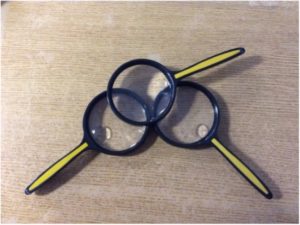
Photo of 3 magnifying glasses on a deskI have bought several magnifying glasses to add to the explanation. This has helped students to understand that we all have different personal worldviews as I hold them up when explaining each individual view. It also helps to illustrate other worldviews. I have also shown how these lenses can ‘cross over’ which illustrates how views can be ‘combined’. An example was when we were discussing ‘how did the world get here?’ Students came up with answers ‘God made it’ and ‘the Big Bang’. I held up a lens for each of these views and then crossed them over. For some students this was a new Christian worldview; that God created the Big Bang.

Drawing of 2 overlapping magnifying glasses with God made it written on the handle of 1 and The Big Bang written on the handle of the other

This has helped them to understand that it may be better for us to discuss the many views within a religion for example we discussed ‘Christianities’ as a better term to show that within Christianity there are many different interpretations.

It is interesting to see how their understanding of worldviews is shown in their explanations. Here are responses from two pupils:

“We can study religion and belief by looking at people’s worldviews and opinions. But before we start we need to understand how people get their personal worldview. You are not born in the world with our own opinions as you cannot understand anything yet. But over time as you grow up you start to develop your own worldview and beliefs as you are surrounded by many different influences like your parents and what they believe or your friends and even video games! If you are a religious person your religion may have a big impact on how you see the world as religions normally have quite a lot of sources of authority….”

Jude, Year 7

“We can study religion and belief by looking at our personal worldview. We have got our own worldviews from many things but these aren’t permanent. These worldviews can change throughout your life, for example, when you are younger your parents would be your main authority and sources of your opinions and beliefs but when you’re older you probably wouldn’t take as much notice of them”

Luke, Year 7


Hello! My name is Josh Cass and I am delighted to have recently joined the team at Culham St Gabriel’s where I will be supporting with advocacy and outreach work specifically relating to the Religion and Worldviews curriculum. As someone who has spent many, many years working in interfaith spaces, I am passionate about enabling conversations and encounters which allow more nuanced understandings of lived faith and belief to emerge. For me, that is what is so exciting about the Religion and Worldviews curriculum, and why I am delighted to be taking up this role. If you will excuse me, I will share with you something which happened recently which to me, highlights why this curriculum is so exciting.

One morning I was enjoying coffee and donuts (not necessarily a traditional Sukkot food but a treat nonetheless) in my sukkah at home with some friends (one Jewish, one Muslim, one Christian); it was a beautiful morning and sitting there I couldn’t help but feel that building a sukkah is one of Judaism’s loveliest mitzvahs full of meaning and metaphor. For those unfamiliar with the custom, a sukkah is a temporary structure which some Jews will build in their gardens, or on their balconies, or on their roofs, as part of the festival of Sukkot.

Being together in the sukkah, our conversation turned easily to its symbolism and other Sukkot customs. We talked about the origins of the festival, how it commemorates one of the three pilgrimages undertaken by the ancient Israelites, and the journey they would make up to Jerusalem to celebrate the harvest. From there, the conversation moved to harvest festivals, traditional prayers for rain in all our traditions, and the way in which our various faiths and beliefs enable us to reflect on and engage with the natural world and the changing seasons.

For me, this experience was exciting and insightful for a number of reasons. Firstly, and perhaps more superficially, I learned something new about the faith and belief traditions of my friends. Secondly, and for me, more importantly, I gained a greater understanding of how that element of their identity contributed to how they see the world and how it might play into choices which they make. I imagine that it was a similar experience for them in terms of how they understand how my Jewish identity shapes my choices and actions.

In my experience, while having a grounding in the teaching and traditions of different religions and worldviews is really important, even more critical is an understanding of how those teachings and traditions shape the way that an individual or a community engage with the wider world and with the key issues of the day. It is this contextualisation which is so central to the Religion and Worldviews curriculum, a contextualisation which I believe is critical for us all (not just students!). That is what makes the Religion and Worldviews curriculum so exciting to me and why I am delighted to be working with Culham St Gabriel’s in this role.

I would love to hear what you make of this piece and am always happy to receive feedback – I can be reached at josh@cstg.org.uk I hope to hear from you soon!

In response to the 2018 CoRE report many SACREs are considering how to update their Locally Agreed Syllabuses. Effecting change in a busy and fast-moving environment such as a school can be a daunting prospect. In this blog I present how we changed our curriculum at my Norfolk Primary school.

This was not just an update or tweak, we adopted change. We reshaped the curriculum to utilise three disciplinary pedagogies, imagined as lenses to look through; Theology, Philosophy and the Human & Social Sciences. As these names are quite the tongue twister, we call them Believing, Thinking and Living in my school when discussing with younger learners.

With a new pedagogy and new freedom in mind I sat down to look at our current RE curriculum and discussed with children what they thought of the subject:

“I like doing our stuff but it’s interesting to see their stuff and see how different people live.”

Having heard their thoughts, I threw the old curriculum in the bin and started afresh.

Our stuff and their stuff

Our student body is 95% white British and Christian heritage. It is for this reason I do not want children learning about “our stuff” (Christianity) followed by an entirely different unit of “their stuff” (everything else).

If children are to see the beauty and value of other people, religions and worldviews they will need the skills to appreciate them and, most importantly, find ways of connecting with them. This got me thinking about exploring: if you know where you have been, it gives you a good basis to explore the new. So, I decided to be bold: every unit of learning would start with Christianity. We would learn about what we already know, or thought we knew or (in the case of Christmas) thought we knew but was actually wrong; and then branch outwards. Finding links and connections between Christianity and Religions & Worldviews would form the bedrock of our curriculum.

Branching out

We are a church school and therefore at least 50% of our learning content focuses on Christianity. The first 3 or 4 lessons of each half-term have a Christian focus. This gives time to explore our Key Question and reflect on Christianity’s answers. From this solid understanding we can branch out to consider how one or more other traditions would respond.

For example a Year 6 unit begins by pondered the philosophical question, ‘why was the Earth made?’ using Genesis 1 and 2. They explore the different presentation of women and learn that the books  were written at different times by different authors and then collated together at a much later date. A lesson is spent looking at the scientific description of how the Earth was formed and what similarities this has to Genesis. This allows pupils to gain a greater sense of the context and concerns at the time Genesis was recorded.

From here we branch out to the events of the Hindu creation story and its expression of our universe as one in string of many (Samsara on a universal scale). Children quickly spot the beginning of the world in darkness and water and how a prime mover is needed to bring light and life into the world.

The most important part of the new curriculum is that the children begin by finding what is the same and then questioning why they are the same. How can two religions from different sides of the planet have similar beliefs? How can two faiths that appear so different actually be quite similar? This allows discussions of depth and richness.

Growing this new curriculum and pedagogy has taken time and lots of energy from the amazing staff at my school. As we move further towards a R&W curriculum, emphasis will be placed on denominations and how, for instance, there is no single “Christian Worldview”. The aim is that children can see how worldviews similar to their own can be very different, whilst the superficially different can be very similar.