Viewing archives for Religion and Worldviews

Would you start an RE lesson with a boxing match? By that we mean a lesson about a famous boxing match, not a re-enactment in the classroom! To celebrate Black History Month we present a set of four learning sessions (suitable for Key Stages 2- 4) on Muhammad Ali, one of the world’s all-time greatest boxers. Ali was also a conscientious objector, antiracist activist and devoted Muslim. All these aspects of his life are intertwined, as our multiple worldviews are. As well as a contribution to teaching resources for Black History Month, these lessons are also an example of what worldviews can look like in the classroom.

Pupils might be confused to learn about a famous fight in RE, although some would absolutely love it. During his career as a boxer Ali fought in and won several iconic fights. His sporting career illustrates how he constantly challenged preconceived ideas about how a black athlete should behave in public. In our lessons, we present Ali’s actions inside the ring as just as important to an understanding of him as those outside. In a worldviews approach, the strands of someone’s life and context cannot be separated.

Ali was once called the most famous Muslim in America. Like most people Ali sometimes had contradictory beliefs and his Islamic interests shifted over the years. In our lessons we trace Ali’s path from Nation of Islam to Sufi Islam, to Sunni Islam. Pupils will consider Nation of Islam in historical and political terms, as well as religious.

After he had won the 1964 match, Cassius Clay announced to the world the name he now wanted to be known as: Muhammad Ali. He had always been interested in Islam. At high school he wanted to write an English paper on black Muslims (Nation of Islam), but was not allowed to. Muhammad Ali first saw Malcom X, one of the most influential black figures of his time when he spoke at a Nation of Islam rally and the two became friends. Malcom X watched Ali’s 1964 match with Sonny Liston match from the side-lines. The next day as the world was still in shock over Ali’s victory, with Malcom X by his side, he announced he was a Muslim and that he had a new name. He said ‘Cassius Clay is a slave name, I didn’t choose it and I don’t want it. I am Muhmmad Ali, a free name – it means beloved of God, and I insist people use it when they speak to me’.

Incredibly Ali visited the town of South Shields in 1977 to have his marriage blessed in the mosque there. The Al-Azhar Mosque serves the Yemeni community of South Shields, who had settled in the area around the First World War to work for the Merchant Navy. A short documentary details this moment, showing footage of Ali and his wife in South Shields and the pride of the local Yemeni community to welcome this dazzling figure to their mosque. In our lessons we give a link to this documentary, created by photographer and artist Tina Ghavari.

A worldviews approach to learning about Ali, whether in a lesson or at a lunchtime or whole-school event, means his antiracist struggle or his devotion to Islam is not separated from his whole life. Ali was an athlete, a campaigner, a public figure, a conscientious objector, a husband and father and a Muslim. All these strands make up the man. We hope you enjoy exploring Muhammad Ali with your pupils, you can find the resources on RE:ONLINE here.

Kate Christopher, part-time in a Secondary school teacher in East London and independent RE adviser

Lynn Revell, Faculty Director of Research, Canterbury Christ Chuch University
How important can 2 minutes 34 seconds be?

Time can be significant – the reign of the dinosaurs was long and will always captivate me yet sometimes tiny fragments of time are also significant – the famous football coach Brian Clough said it only takes a second to score a goal. I’d like to add to that – it only takes 2 mins 34 seconds to make you question everything! This is what happened to me.

The new animated film from the Theos Think Tank ‘Nobody stands nowhere’ by Emily Downe completely stopped me in my tracks! 2 mins 34 of film stuffed with powerful questions and statements. If you haven’t seen it please do – if I was still teaching I would be using this in so many ways!

So why am I so affected by it? Is it because my way of life has been to just get on with things? Always being aware that I was never the sharpest tool in the box? Have I just not really stopped and thought about Who I am or why I am the way I am?

Could it be that I just haven’t thought about my worldview? This film has changed that.

The film opens with the narration

‘What is your view of the world? How do you see things? What makes you who you are?  On what do you base your decisions? Why did you react like that?’

Wow – all this delivered over vibrant and thought-provoking animations… suddenly I asked myself these questions for what felt like the first time, particularly the reaction one.

As the film continues more engaging material emerges – everyone has their own worldview and the lens we look through is affected by our upbringing, surroundings or religion – sounds so obvious but over the years I have never really considered the different subtle and unsubtle things which have shaped my worldview. As I look back now I can see moments in my life where shifts were made. Big changes like when my family relocated from the West Midlands to Dorset when I was 13 leaving everyone and everything I knew behind.

The film goes on to say that our worldview changes throughout life – wouldn’t it be great if we all realised and accepted that? I am not the man I was when I was 18, 21, 33, 40 , etc my worldview has changed so much. I can recognise that I was deeply unrewarding as a youth and am eternally grateful that my family and some good friends have stuck with me through that process – now my worldview is ensuring everyone I come into contact with is helped by me where possible and given the chance to flourish. As a teacher I would always advise new teachers to my school to always think before speaking and acting ‘never give a message you wouldn’t want to receive’ – some of my colleagues were permanently cross and rude to students, unsurprisingly they did not gain much respect or co-operation.

The film goes on to say that we have a personal worldview, it shapes how we live but we need to recognise the worldviews of those around us – even if we have much in common on the surface our lenses will be different and consequently our worldview will be different too – how fascinating to see and understand a different worldview to our own?

One of the final questions raised is ‘Where does truth lie?’ – so much can come from this; truth claims from religions and worldviews, media bias and enforced stereotypes, ‘knowledge’ passed down from families as well as things that directly happen to us or those we know.

This film challenges us to think about, examine and understand our worldview, then recognise the right of others to a completely different personal worldview. We need to be perfectly happy that we are all different, able to share our world with those who are different but have just as much right to inhabit the space as we do.

I think this film is an exceptional teaching aid for all phases – there are so many ways you can build from it.

Next time you have 3 minutes to spare and a cup of whichever beverage your worldview favours, please watch this and reflect upon your personal lens.

This week we’d like to highlight the following blog on the Religious Education Council of England and Wales website where Dr Kathryn Wright, our Chief Executive and Chair of the RE Council Education Committee opens up the conversation about religion and worldviews.

https://www.religiouseducationcouncil.org.uk/news/religion-and-worldviews-a-conversation/

Kathryn says, ‘It was a privilege to write this blog for the RE Council and share some of the current thinking within the Education Committee about a shift to a religion and worldviews approach. As I began writing it struck me that our religion and worldviews community is very much thriving and alive with debate and discussion at the moment. I wanted to encourage everyone to be part of the conversation’.

The recent Ofsted Research Review has sparked much debate and discussion particularly on social media. The review sets out what it understands by a quality education in RE. In terms of the curriculum this is defined in terms of three types of knowledge:

  • Substantive
  • Ways of knowing
  • Personal

One of the questions which struck me as I read the review, was how we theorise the relationship between these three types of knowledge. This is illuded to in the report (see Interplay of knowledge in the RE curriculum), but I felt I needed to think about it creatively. I like to think in pictures. So, what I offer here is an analogy. It is not perfect, but I hope it will help us to understand a little more about the interdependence of different types of knowledge.

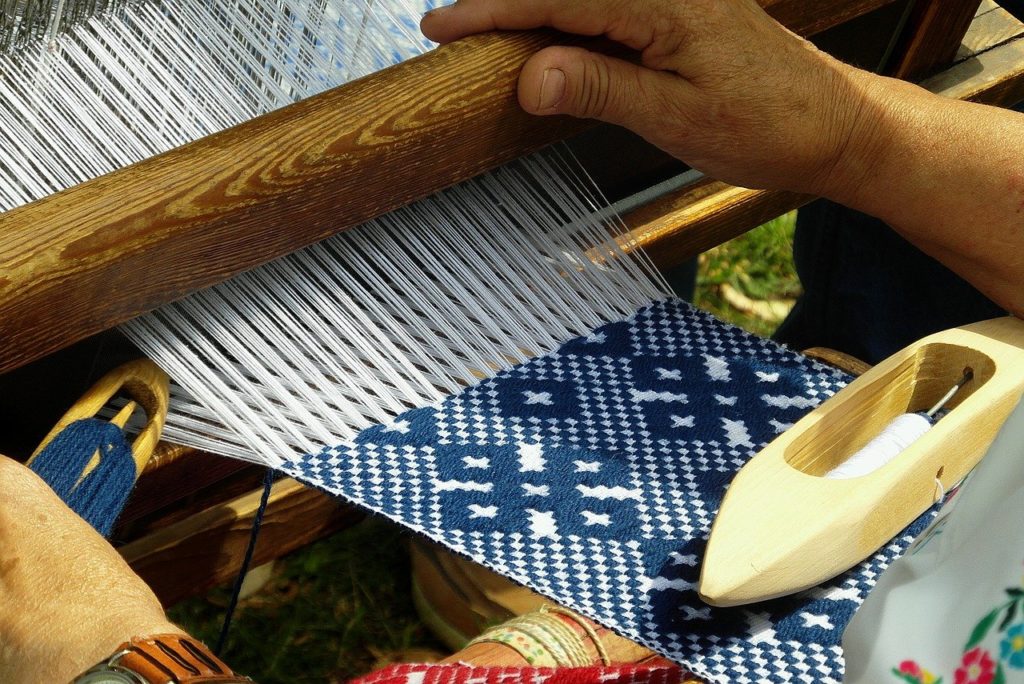
Let us weave a knowledge tapestry….

Image of a hand waving loom with a blue and white fabric being created

The curriculum– this is like a developing tapestry. In theory it may have an ‘end point’ (i.e., end of formal education) but in my opinion it continues through our lifetime as we develop the three different types of knowledge.  Therefore, it might be described as an unfinished tapestry. This emphasises the flexible nature of curricula. Yet this fluidity still enables the tapestry or knowledge to build over time into a beautiful masterpiece….

Substantive Knowledge – this is the warp. These are the threads on the loom over and under which other threads are passed to make the tapestry. Without this there would be no tapestry! The warp is laid out at the beginning with a clear sense of what you are going to produce. There is some intent here. Choices must be made about how many threads, how wide the tapestry will be and so on. This is like the choices that must be made in relation to the substantive content. Ofsted talks about illustrative content that leads to an end goal.

Ways of Knowing or Disciplinary Knowledge – these are threads of the weft. They are woven in and out of the substantive content. This is important. Unless they are woven into the content, they will not contribute to the overall tapestry.  This means that as pupils’ journey through the substantive content they learn about and use a range of tools and methods such as interpretation, observation, analysing data and so on.

Personal Knowledge– these are also threads of the weft. They are also woven in and out of the substantive content. Our own positionality, our own worldview is woven into what it is we learn about. This means being self-aware, recognising and reflecting on how we relate to the ‘warp’ or content. This is a process of reflexivity.

So, now is the time to think about the tapestry you are creating, what choices will you make to build towards and create a masterpiece….


References:

https://www.gov.uk/government/publications/research-review-series-religious-education

Voices of children and young people.

This was the question that many teachers posed to their pupils last term for our inaugural Blog Competition. We had an amazing number of entries and it is clear that everyone has a view on Religion and Worldviews (or Religious Education). At the end of this blog you can see the names of all the winners, but here I want to draw out some of the key themes and creative ways in which pupils want to advocate for our incredible subject.

An education in Religion and Worldviews enables us to understand diversity in our world.

The diversity of our complex world was a recurrent theme. Bloggers spoke of everyone being different, having different worldviews and the importance of appreciating this. Many felt that studying Religion and Worldviews brought a genuine, real and authentic understanding of the lived experience of being a religious or non-religious believer. For many blog writers, Religion and Worldviews is about the nature of humanity; understanding who and what we are as human beings with all the complexity and divergence that this brings.

An education in Religion and Worldviews increases our knowledge, providing global and historical perspectives.

The importance of knowing about and understanding religious and non-religious worldviews came through very strongly in many of the blogs. Young people spoke about the importance of understanding historical contexts to comprehend the way things are today. They highlighted the interweaving of history with religion. Many felt that knowledge acquisition led to respect and to challenging some of the media stereotypes of some worldviews.

An education in Religion and Worldviews supports development of positive values.

Bloggers talked about the many values they felt an education in Religion and Worldviews promoted. These included peace, respect and empathy. A number talked about the way in which this was modelled in their schools by safe spaces being created to talk about controversial issues.

An education in Religion and Worldviews helps you with your future career.

From the youngest to the oldest, bloggers highlighted the value of Religion and Worldviews in terms of future career paths; professions highlighted included law, international development work, counselling, mental health services, diplomatic roles and journalism. Many more spoke about the importance of the subject for simple daily interactions with people they meet.

An education in Religion and Worldviews offers something more…..

For many of our bloggers though the subject offers something more…. It sparks the imagination and curiosity, it empowers and opens doors of communication, it unlocks a tapestry of ideas and enables young people to develop their own patchwork of views. It gives each one of them confidence to talk about religious and non-religious worldviews in the public sphere.

For our bloggers, an education in Religion and Worldviews is considered vital so they are prepared for the real, complex society in which we all live. They want to be able to navigate this world and begin to make sense of it. They want to have knowledge, understanding and skills, but also values and attitudes which will enable them to be confident, free- thinking participants in this ever-changing global landscape.

CONGRATULATIONS TO ALL OUR WINNERS!!

Key Stage 1

Winners

Areilla, Newbold and Tredington Primary School

Abhijot, Clifton Primary School

Harnoor, Clifton Primary School

Highly Commended

Namanpreet, Clifton Primary School

Ishana, St Andrews (Barnsbury) Church of England Primary School

Key Stage 2

Winners

Soha, Old Trafford Community Academy

Catherine, Lythe Church of England Primary School

Nancy, Newbold and Tredington Primary School

Emily, St Andrews (Barnsbury) Church of England Primary School

Highly Commended:

Sohani, Clifton Primary School

Farzad and Idris, Old Trafford Community Academy

Avineet, Clifton Primary School

Hunter, Pickhurst Junior Academy

Key Stage 3

Winners

Matthew, Thomas Gainsborough School

Abby, Saint Francis Xavier School

Arwen, St James’  Senior Girls School

Maxwell, The Bishops’ Blue Coat Church of England School

Cara, King’s Rochester Preparatory School

Highly Commended

Skye, Prenton High School for Girls

Maisie, The Morley Academy

Brooke, Prenton High School for Girls

Niamh, The Bishops’ Blue Coat Church of England High School

Vanessa, Goldington Academy

Ella, Lincoln Christ’s Hospital School

Olivia, St Mary’s Catholic School

Key Stage 4

Winners

Scarlett, Fulston Manor School

Caitlin, Goldington Academy

Lucy, Cox Green School

Maisy, Hagley Catholic High School

Highly Commended

Meadow, Saltash Community School

Jordan, Saint Francis Xavier School

Lily, Albany Academy

Pennie, St Hild’s Church of England School

Zama, Bradford Academy

Key Stage 5

Winners

Ashton, Old Hulme Grammar School

Ella, Highworth Grammar School

Jessica, Highworth Grammar School

Anna, Hagley Catholic High School

Megha, Langley Grammar School

Highly Commended

Reva, Langley Grammar School

Philippa, Old Hulme Grammar School


You can read all of the winning blogs on RE:ONLINE


Kathryn Wright, on behalf of the Judging Team 2021

“O you who believe, fasting is prescribed for you as it was prescribed for those before you, that you may develop God-consciousness.” (Quran 2:183)

Every now and then, a notification will pop up on our phones. It will ask us to complete a software update so that the applications, functionality and performance of our devices will work to its optimum level. I would like to think that the month of Ramadan is the ‘software update’ for our souls where the one who fasts, once the month is over, can perform to his or her optimum level for the rest of the year.

Contrary to what many may perceive, both within and outside the Muslim community, Ramadan is not about food and drink. The aim of Ramadan, as the Quran verse mentions, is God-consciousness. If I don’t feed my pet for a day, it has fasted. If I do similar, I would ask myself if I am better than this pet of mine when in reality, Islam teaches me that the human being is the highest of God’s creation. When I fast, I am aiming to defeat my animal nature and tap into the divine nature that God breathed into us. This is what fasting aims for – defeating the animalistic desires (food, drink, sex, anger etc.) and realising the divine nature through becoming God conscious.

Here I will explain 3 levels of fasting using familiar language:

Grade E Fast

If I was to get an E grade for one of my A-Levels, I would have passed but in all honesty, it may not open the door to many opportunities. An ‘E-grade fast’ is where I simply abstain from food and drink for a day. However, I may not change any vices I may have such as anger, bad language etc.

Grade C Fast

If I was to get a C grade for one of my A-Levels, I have more than passed and it will open the door to some opportunities. A ‘C-grade fast’ is where I do not just abstain from food and drink for a day but my ethics become virtuous too. Whilst usually I may road rage when someone is driving slow in front of me, whilst fasting I remain calm. I remove my vices and transform them into virtues.

Grade A* Fast

If I was to get an A* grade for one of my A-Levels, I have reached the peak of my subject area and it will open any door for me. An ‘A*-grade fast’ is where I quash my animalistic desires, become virtuous but also activate my divine nature in some form of union with God. Union with God means that I would do everything that God is pleased with and avoid what He is displeased with. My will becomes the same as His where He is pleased with me and I am always pleased with Him.

Imam Ali, the first Shia Imam (whose death anniversary is also mourned by Shia Muslims this month), summarises these levels of fasting well: “Some people get nothing from fasting except hunger and thirst.” Every Ramadan I always aim to achieve an A* with my fasting. It is a struggle and there are days where I achieve an E or C grade. However, I know that if I do achieve the A* one day, I will have the best of software upgrade for my soul that will help me function properly all year around.

No change in change

I’ve been a religious studies practitioner for over two decades. Nearing three, if truth be told. And those years have seen much change in the context of the subject, with much to be excited about. Each change seems to have reinvigorated my passion for the subject and, I hope, lead to me being a more effective classroom teacher and subject lead.

When the 2018 Commission on Religious Education provided a new framing of the subject – as “Religion & Worldviews” rather than Religion – it was accompanied by a fresh wave of informed conversation that will have lasting impact on the subject and the pupils who are studying it.

And this conversation has a number of important new terms in it, terms that those participating in it need to be clear about. What is a ‘worldview’ and what sets it apart from a ‘religion’? What is ‘religious literacy’? And quite how many ‘multidisciplinary lenses’ are there?

A worldview

The report describes a worldview as ‘a person’s way of understanding, experiencing and responding to the world … as a philosophy of life or an approach to life’. (CofRE P8) Whilst this definition could cover the six principle religions of the United Kingdom (although I know this is contested), it does allow an individual who considers themselves not to be ‘religious’ to use terminology that places value and coherence upon their specific framework. And it allows others to place value upon it too.

No longer is a considerable proportion of our population defined by a negative – ‘not-religious’ or ‘not believing in God’ – but instead acknowledged as being a community drawn together by shared values and beliefs.

Multi-disciplinary Lenses

However many you might consider there to be, ‘multi-disciplinary lenses’ refers to using different academic disciplines or approaches or methodologies to study an aspect of a worldview. In Norfolk, the latest Locally Agreed Syllabus (Norfolk Agreed Syllabus 2019, P5) has settled on three – theology, philosophy and human/social sciences. In practical terms this might mean approaching the topic of pilgrimage by asking three different questions; “what does this pilgrimage teach the pilgrims about their deity?” (theology – thinking about and thinking through believing), “is it right that one place is more significant than another?” (philosophy – thinking about and thinking through thinking) and “what significant acts do the pilgrims carry out?” (human/social sciences – thinking about and thinking through living).

Serving religious literacy

No term has done more to reinvigorate my passion for RE than ‘religious literacy’.

The Norfolk Locally Agreed Syllabus defines religious literacy is ‘how well pupils are able to hold balanced and well-informed conversations about religion and worldviews.’ (P5) It advocates equipping the pupils to go beyond – whilst still embracing – personal reflection and academic excellence, becoming significant, independent, participants in the world in which they find themselves.

And in order to hold these ‘balanced and well-informed conversations’ with the wide-ranging worldviews they will encounter our pupils must engage with the unique beliefs, wrestle with the unique questions and negotiate the unique expressions of each. They will bring the lenses to bear on the worldviews in their journey to religious literacy.

And after nearly three decades, I’m still excited to be on the journey too.

At Culham St Gabriel’s we are really interested in why an education in Religion and Worldviews matters. This is why we have recently launched a new pupil blog competition with this theme.

I’m biased of course! Working for a charity which is all about advocating for a high-quality education in Religion and Worldviews clearly means I think it matters! However, young people can give us unexpected answers to this question and that’s why our competition is so exciting. Here are two examples…

We will begin with Nutan. During the late 1990s I was involved with a research project about the implementation of agreed syllabuses. As part of this project my pupils were interviewed about the difference that RE made to them and why they thought it was important. Nutan announced that it was the skills she had learnt in RE that had enabled her to write better evaluative and analytical essays for English. She also felt the knowledge she gained helped her to understand some of the religious references in GCSE English set texts. She could see the transferable nature of her studies and the benefits of the subject in terms of broadening her understanding and cultural development. As a young teacher I confess I was a bit surprised!

Secondly, here is an example from closer to home:

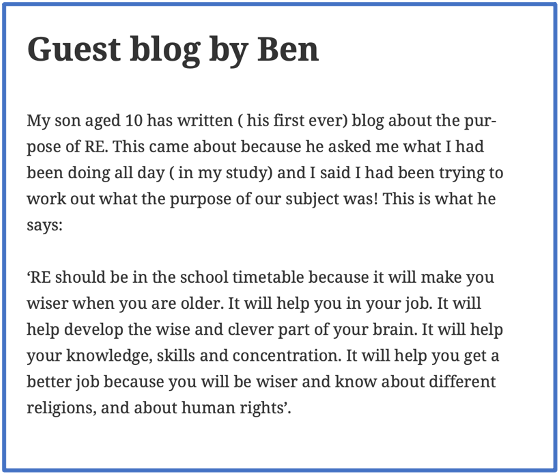
This blog is from my youngest son Ben. He  wrote it for my personal blog site in 2016. He is now 15 and I have asked his permission to use it here! I was intrigued by Ben’s response at the time because he used the term wise, and also because he connected studying religions with learning about human rights. I asked him today if he wished to update his thinking… he said that the most important reason for studying Religion and Worldviews is to understand others. He stressed the importance of learning about the diversity of different religious and non-religious worldviews. He also felt that it would help him get on well with others and enable him to identify prejudice or bias in society.

So why does an education in Religion and Worldviews matter? Why not ask some children or young people you know and see what they think?!

Details of our blog competition can be found here:

https://www.reonline.org.uk/news/pupil-blog-competition/

The last few years have been an interesting journey for me, not only in terms of my career, but also in terms of my thinking. When the Commission on RE’s Interim Report came out in 2017, I admit to being rather sceptical about a change of name for RE. However, I reflected, read and reflected more. I used to find the train or car journey’s useful for thinking about these matters!! Now I have to carve out time in the week to do this. It is important, because I believe what is being suggested in the Final Commission on RE Report (2018) regarding Religion and Worldviews is a vital paradigm shift, and not just a name change, and a potential game-changer for our subject.

On a personal level this has been a challenging and enthralling journey so far, and it is not at an end. My thinking is fluid, I am trying to see possibilities, to continue to read more and to learn from others across the diversity of our Religion and Worldviews community.  At the launch of a recent Theos report Dr Lois Lee talked about being part of a meaningful process. For me, this described not only my personal journey, but also what I think is happening in our subject community at the moment.

This is why I welcome two recent reports. The first is a literature review entitled ‘Worldview: A Multidisciplinary Report’.  This review was commissioned by the Religious Education Council of England and Wales working in partnership with TRS-UK. It aims to provide clarity as to the historical and contemporary use of the term ‘worldview’ in a number of disciplines. This report raises questions and at the end there is an invitation to engage; to be part of the conversation.

The second report, alluded to above is an independent academic report authored by Cooling with Bowie and Panjwani, entitled ‘Worldviews in Religious Education’ and published by Theos. One of the most powerful chapters in this report comprises three autobiographical reflections that illustrate the impact of worldview on academic development. The interaction between personal worldviews and what we might call worldview traditions in this section illustrates to me the educational potential of the worldview concept.

For me both these reports emphasise the fact that as a subject community we are in a meaningful process. These reports are not in themselves destinations; they are to be engaged with, discussed and reflected upon. They provide vital tools to help us work through what the new language means. Alongside these reports I have noticed  conversations opening up; I have observed and read about teachers sharing what a paradigm shift might mean for the curriculum; I have taken part in a media discussion where journalists asked questions about what Religion and Worldviews means; I have listened to Ofsted’s Dr Richard Kueh, talking about new ways of understanding knowledge within this paradigm shift…. All these moves are part of a meaningful process of engagement. The question is, will you be part of this process?


https://www.religiouseducationcouncil.org.uk/wp-content/uploads/2020/10/20-19438-REC-Worldview-Report-A4-v2.pdf Literature Review

https://www.theosthinktank.co.uk/research/2020/10/21/worldviews-in-religious-education Theos Report

https://www.youtube.com/watch?v=hAK1lCS2_y0 You Tube Recording of Theos Report Launch Event

https://www.reonline.org.uk/news/opening-up-conversations-about-religion-and-worldviews/ Includes teachers and other professionals discussing Religion and Worldviews in a series of blogs


We are delighted to be launching a new summer blog series called ‘Opening up conversations about religion and worldviews’. This blog series is being run in collaboration with the RE Policy Unit, a partnership between NATRE, the RE Council and RE Today. It will include contributions from a wide range of teachers, those working in initial teacher education and researchers in this field.

Some questions don’t seem to get asked in religious education as much as others. Here are three examples designed to pose questions about the relationship between questions and curriculum and what we think an education in religion and worldviews might be for.

Question One

Explain how a common response to poverty can be reached from people who hold different religious and non-religious worldviews.

In your answer show:

  • how a point of consensus can be reached from different theological and or philosophical principles, and
  • refer to hypothetical or actual case studies.

Two observations about question one: We tend to prefer questions that are about difference leading to disagreement, rather than difference leading to overlapping consensus. Should RE consider having structured questions designed to test out the possible range of areas where difference might still lead to cooperation or consensus?  We don’t explicitly ask for case studies (although students can use them in their reasoning). As case studies are interesting way of thinking about communities in context, might this be a useful tool for RE?

Question Two (designed to follow from a longer sacred text extract)

Read the extract from a sacred text. Identify and explain different ways this text is engaged within religious traditions. In your answer refer to each of:

  • communal ritual or private prayer/meditation/reflection
  • scholarly debate or public moral discussion
  • communities / individuals living in contrasting contexts (poverty and wealth or peace and war)

This question is designed to show diverse ways of ‘knowing’ and ‘engaging’ in religions and worldviews. It is also about the importance of context in textual interpretation and in the way religious life develops. This goes further in explicitly acknowledging different kinds of dialogue that the subject should entertain: scholarly and public.

Question Three

Should voluntary assisted dying be permitted?

Explore this question and two different settings in which it might be answered. First consider a political debate in the media. Second consider a hospital chaplain asked to counsel a family faced with a request from a terminally ill relative. Identify any differences or similarities in the way the question might be engaged. 

This question illuminates the kind of classroom experience we want to have happening and the sort of argumentation there might be. Should RE help students win arguments? Should it help them be good listeners and pastoral helpers of others in times of personal crisis?

A few things might jump out from these questions. First, the question structure will ‘beg’ for different kinds of content shaped in different kinds of ways in any curriculum that prepares the students for this question. Second, distinct social aims are apparent. Question one requires the idea of consensus being reached from different starting points to be structured into the exploration of the content. Question two requires blocks of texts to have been explored through multiple types of engagement and multiple contexts (it is multidimensional and contextual in character). Question three requires an explicit treatment of different settings for discussion: one that speaks to a pastoral context, the other that speaks to a more traditional debating context. I think all of these are interesting, and all of them should have space in a religion and worldviews classroom.

Now it is possible that my suggestions are not the ‘right questions to ask’. Indeed, some of these might not work very well in practice – they could surely be improved. However, they do reveal the relationship between question and curriculum, the way knowledge is organised, and the kinds of skills developed in association with that content. They reveal something of the possible character of learning in religion and worldviews classrooms and they focus on the ‘how’ of the subject, as well as the ‘what’, something highlighted by the Commission for RE (2018) report.


Professor Bob Bowie, Canterbury Christ Church University

@bobbowie, bob.bowie@canterbury.ac.uk, www.bobbowie.com,


This blog is linked to a piece of work written by me in a book currently in press. ‘The implicit knowledge structure preferred by questions in English Religious Studies public exams’. The book, edited by Gert Biesta and Pat Hannam is Religion and education: The forgotten dimensions of religious education? Leiden: Brill | Sense. It also links to the Texts and Teachers research project (www.nicer.org.uk).