In response to the 2018 CoRE report many SACREs are considering how to update their Locally Agreed Syllabuses. Effecting change in a busy and fast-moving environment such as a school can be a daunting prospect. In this blog I present how we changed our curriculum at my Norfolk Primary school.
This was not just an update or tweak, we adopted change. We reshaped the curriculum to utilise three disciplinary pedagogies, imagined as lenses to look through; Theology, Philosophy and the Human & Social Sciences. As these names are quite the tongue twister, we call them Believing, Thinking and Living in my school when discussing with younger learners.
With a new pedagogy and new freedom in mind I sat down to look at our current RE curriculum and discussed with children what they thought of the subject:
“I like doing our stuff but it’s interesting to see their stuff and see how different people live.”
Having heard their thoughts, I threw the old curriculum in the bin and started afresh.
Our stuff and their stuff
Our student body is 95% white British and Christian heritage. It is for this reason I do not want children learning about “our stuff” (Christianity) followed by an entirely different unit of “their stuff” (everything else).
If children are to see the beauty and value of other people, religions and worldviews they will need the skills to appreciate them and, most importantly, find ways of connecting with them. This got me thinking about exploring: if you know where you have been, it gives you a good basis to explore the new. So, I decided to be bold: every unit of learning would start with Christianity. We would learn about what we already know, or thought we knew or (in the case of Christmas) thought we knew but was actually wrong; and then branch outwards. Finding links and connections between Christianity and Religions & Worldviews would form the bedrock of our curriculum.
Branching out
We are a church school and therefore at least 50% of our learning content focuses on Christianity. The first 3 or 4 lessons of each half-term have a Christian focus. This gives time to explore our Key Question and reflect on Christianity’s answers. From this solid understanding we can branch out to consider how one or more other traditions would respond.
For example a Year 6 unit begins by pondered the philosophical question, ‘why was the Earth made?’ using Genesis 1 and 2. They explore the different presentation of women and learn that the books were written at different times by different authors and then collated together at a much later date. A lesson is spent looking at the scientific description of how the Earth was formed and what similarities this has to Genesis. This allows pupils to gain a greater sense of the context and concerns at the time Genesis was recorded.
From here we branch out to the events of the Hindu creation story and its expression of our universe as one in string of many (Samsara on a universal scale). Children quickly spot the beginning of the world in darkness and water and how a prime mover is needed to bring light and life into the world.
The most important part of the new curriculum is that the children begin by finding what is the same and then questioning why they are the same. How can two religions from different sides of the planet have similar beliefs? How can two faiths that appear so different actually be quite similar? This allows discussions of depth and richness.
Growing this new curriculum and pedagogy has taken time and lots of energy from the amazing staff at my school. As we move further towards a R&W curriculum, emphasis will be placed on denominations and how, for instance, there is no single “Christian Worldview”. The aim is that children can see how worldviews similar to their own can be very different, whilst the superficially different can be very similar.
About
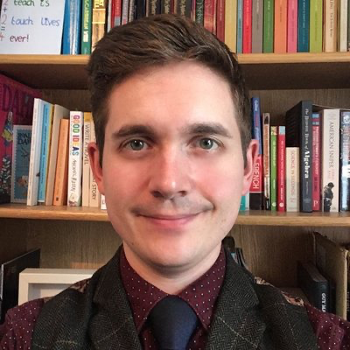
Matthew is RE Lead at Hethersett CEVC Primary School in Norfolk. He tweets about Religious Education and leadership @MrMJLane and on his website www.theteachinglane.co.uk