Global terms: Ethics and Philosophy

What do religions say about human rights?

An investigation into the relationship between the development of the universal declaration on human rights and some key texts from three religions.

KS4. Originally written by Adrian Skilbeck, updated in April 2019.

Key words and concepts

Human Rights: those rights which are inherent in our nature and without which we cannot live as human beings. Human rights and fundamental freedoms allow us to develop fully and use our human qualities, our intelligence, our talents and our conscience.

Universal: in relation to human rights they are conceptually possessed by all people in the world, by virtue of being human.

Inalienable: again in relation to human rights it is the idea that what we possess should not be taken away from or given away by the possessor.

Responsibilities: In relation to human rights it is the idea that those who are in possession of their human rights have a responsibility to help those who do not. In respect of religious teachings, it is common to all the main religions that followers are taught they have a responsibility for those in need.

Needs: as a variation on the concept of rights they are those things required by human beings because they are essential and not merely desirable. In Simone Weil’s work needs are both needs of the body and needs of the soul.

Obligations: acts or courses of action that a person is morally bound to carry out. In relation to human needs they are the things human beings are required to do for other human beings to ensure their needs are met.

Promised Land: The land that God promised to the descendants of Abraham, Isaac and Jacob (Genesis 12:7), a land said to flow with milk and honey.

Jerusalem: A holy city for Jews, Christians and Muslims. The name means ‘city of peace’. Israel claims it as its eternal, undivided capital, while the Palestinians claim East Jerusalem as the capital of a future Palestinian state. Today Israel controls the whole city, and its ongoing status is disputed.

Homeland: a person or a people’s native land.

Palestine: Often called the Holy Land. Historic region on the east of the Mediterranean Sea, comprising parts of modern Israel, Jordan and Egypt.

Zionism: The belief that Jews should have their own nation. Zionism gained much support in the first half of the twentieth century, leading to the founding of the state of Israel in Palestine in 1948.

Diaspora: the dispersion of the Jews beyond the borders of their country. In general a diaspora refers to any more or less homogenous group of people with a shared heritage or homeland who have moved out to other parts of the world.

Shoah (The Holocaust): a biblical word meaning destruction which has come to stand for the mass murder of European Jewry by the Nazis and their associates during World War 2.

Angel of Death: The figure that appears in the animation is taken from the reference in the Old Testament Book of Exodus Chapter 11 and 12 to the angel who delivers the tenth plague upon Egypt – the death of the firstborn which the Jews are warned to protect themselves against by marking their doors with lamb’s blood. In Judaism the angel of death is known as Samael, Sariel or Azrael, in Islam as Malak Al-Mawt. The visitations of the plagues upon the Egyptians is also described in the Qur’an in Surah al- A’raf 133.

Pupils will need some background information that puts both the animation and the Israeli – Palestinian conflict in context so that they can make sense of it and begin to articulate their responses which will then lead into the rest of this resource.

The song ‘This Land Is Mine’ is taken from the 1960 Hollywood film Exodus, which is about the founding of the state of Israel following World War 2 and in the aftermath of the Shoah (Holocaust). The film focusses on the life of Ari ben Canaan (‘ben’ means ‘son of’) and his attempt to create a peaceful Jewish homeland in Palestine. It is a tale of struggle which does not question the underlying assumptions expressed by the central character and places his actions in an heroic light. Nina Paley’s animation challenges the absolute nature of the statement that ‘This Land is Mine’. Nina Paley is an American Jew and so the animation should be seen as a critical American response to what the Palestinian scholar and writer Edward Said called ‘the main narrative model that dominates American thinking’ with regard to the foundation of Israel, that the Israelis have a God-given right to the land of Palestine. Paley’s film brings out the contrast between the absolute claim to land based on holy scripture and the historical reality of a land that has been fought over by many different peoples for thousands of years. It introduces us to human rights and the complex relationship between religion and politics in the modern world.

This is a stimulus resource that can be used for a range of different pedagogical outcomes. It is used here to facilitate discussion of human rights but it could also be used to explore issues of peace, conflict and reconciliation, the relationship between art and religion, the different ways in which individuals express their beliefs, values and commitments and the conflict between personal and religious/cultural values.

You will need to find ‘This Land is Mine’ by Nina Paley. It is available online.

You will also need to find the following texts online:

  • Universal Declaration of Human Rights
  • Draft For A Statement of Human Obligations by Simone Weil
  • Luke 10: 25-37, the Parable of the Good Samaritan.

Learning activities

Activity 1: The Israeli-Palestinian conflict

(adapted from Susanna Hookway’s ‘Conflict: Jerusalem’ in Questions of Truth)

Before introducing Nina Paley’s ‘This Land Is Mine’, split the class into four or five teams. Each team is presented with five statements about Israeli/Jewish claims to the land and five statements about Palestinian/Muslim claims to the land. Remind pupils that not all Israelis are Jewish and not all Palestinians are Muslims. The following statements are simplified for this activity – not all Jews or Muslims believe exactly this!

Israeli/Jewish

  1. Our history is one of suffering and persecution, especially in the Holocaust. We have been and still are, badly treated and regarded with suspicion by other cultures. We need to establish our identity, freedom and national development and we need to secure the land to do that.
  2. God made promises to Abraham which included that we would live in the land forever.
  3. The Jews are now a political nation with Israel our historic homeland.
  4. For centuries we have prayed that we would celebrate the Passover ‘next year’ in Now our prayers are being answered.
  5. Our ancestors have lived here since the twentieth century BCE.

Palestinian/Muslim

  1. Our ancestors have lived in the land for at least thirteen centuries.
  2. Jews and Palestinians are blood brothers. We share the same father, Abraham, and the same God.
  3. The 1922 mandate said the rights of non-Jews should be protected. American presidents promised to consult Arabs. These promises have been broken and continue to be ignored, creating suffering and misery.
  4. We have a stake in Abraham’s heritage. Abraham himself never tried to take away anyone’s land. The only land he owned was the field he purchased in order to bury his wife Sarah.
  5. We have suffered greatly and been cruelly treated. We need to establish our identity, guarantee our basic human rights including our right to respect, our freedom and our right to self determination as a Palestinian people.

Ask the teams to group their facts under three headings: Religious, Historical and Political. Explain that there will be overlaps but the teams should aim to recognise the close connections between the three.

Encourage the pupils to develop their reasons for their groupings. Do they find any of the statements more persuasive than the others?

Activity 2: ‘This Land Is Mine’: the song and the animation

Bring up the lyrics of the song on a whiteboard. [These can be found on several lyrics websites, but note that although Nina Paley freely shares her material, the lyrics of the song are copyright and should only be used for educational purposes within your Use the information provided in the Key words and concepts section above to provide the relevant context but take care not to reduce the impact of the animation by saying too much about it at this stage.]

Ask pupils for their initial impressions of the lyrics – the thoughts and sentiments expressed, images invoked, the tone of the lyrics.

In small groups, ask pupils to make a list of all the positive words, phrases and images in the lyrics. As a follow up ask them to consider whether there is anything negative in the lyrics.

Play the song (it can be found on You Tube and is the version sung by Andy Williams). Did the music bear out their thoughts? What words would they use to describe the mood or feeling of the song?

Tell the class they are now going to watch a short animation in which the song is Play the animation.

What are students thoughts about the animation? Were they shocked?

Suggested questions:

  • What kind of images do the words of the song evoke?
  • What kind of feelings/emotions/thoughts do they express?
  • What were your reactions to hearing the song?
  • What kind of impression did the song and the music make on you?
  • How surprised or shocked were you by the video?
  • What images were memorable?
  • How has it changed your understanding of the song?
  • Leaving aside the violent action of the animation, how is the land represented?
  • What is the position of the film-maker in relation to conflict in general and the Israeli – Palestinian conflict in particular?
  • Does she favour one side over the other?
  • Is this a biased or unbiased video?
  • What is the film maker saying about the conflict?
  • How does the film help us understand the religious nature of the problem?
  • The animation has been described as ‘facile’. This means it is too simple and avoids the complexities of the conflict. Do you agree?
  • How is the artist using the figure of the angel of death in the animation?
  • Which people did you recognise in the animation? [It might be worth identifying the section from the appearance of the British onwards as the important one for the discussion of human rights.]
  • The animation uses stereotypes to make a point. Which stereotypes did you recognise?
  • The animation is both shocking funny. Why do you think Nina Paley has used humour to make a serious point?

Activity 3a: What is human in ‘Human Rights’?

(adapted from the Human Rights Resource Centre)

Write the words ‘HUMAN’ and ‘RIGHTS’ at the top of chart on a Smartboard. Below the word ‘human’ draw a circle or the outline of a human being. Ask pupils to suggest what qualities define a human being and write the words inside the outline. For example, ‘intelligence,’ ‘sympathy.’

Next ask pupils what they think is needed in order to protect, enhance, and fully develop these qualities of a human being. List their answers outside the circle.

and ask participants to explain them. For example, ‘education,’ ‘friendship,’ ‘loving family.’ [Note: save this list for use in Activity 3b.]

Explain that everything inside the circle relates to human dignity, the wholeness of being Everything written around the outline represents what is necessary to human dignity. Human rights are based on these necessities.

Explain that the Universal Declaration of Human Rights (UDHR) sets the standard for how human beings should behave towards one another so that everyone’s human dignity is respected. Display these two sentences from the UDHR and ask pupils to read and reflect on them for a few minutes:

…recognition of the inherent dignity and of the equal and inalienable rights of all members of the human family is the foundation of the freedom, justice, and peace in the world…

Preamble, Universal Declaration of Human Rights

All human beings are born free and equal in dignity and rights. They are endowed with reason and conscience and should act towards one another in a spirit of brotherhood.

Article 1, Universal Declaration of Human Rights


Activity 3b: What do we mean by rights?

Ask pupils to suggest different meanings the word ‘right’ can have (e.g., ‘correct’, ‘opposite of left’, ‘just’.) Ask them to consider common expressions like ‘We’re within our rights’ or ‘You have no right to say that’. Record these different meanings on the board. What is the meaning of ‘right’ when we speak of a human right?

In small groups, ask pupils to suggest a definition for human rights: write these possibilities on the board. Negotiate a definition that gains class consensus and write it on a chart sheet by itself.

Write on the whiteboard this definition of human rights:

Human rights belong to all people regardless of their sex, race, colour, language, national origin, age, class, religion, or political beliefs. They are universal, inalienable, indivisible, and interdependent.

Ask the pupils what they think is meant by: ‘universal’, ‘inalienable’, ‘indivisible’, ‘interdependent’? and then to look up these terms in a dictionary and to write down their meaning.

Write ‘SURVIVAL/SUBSISTENCE,’ ‘HUMAN DIGNITY,’ and ‘CONVENIENCES AND LUXURIES’ on another part of the whiteboard. Discuss the meaning of these terms, then remind pupils of the list of things needed in order to protect, enhance, and fully develop the qualities of a human being that they created in Activity 3a. Ask them to place each item under one of the headings. For example, is education necessary to survival? To human dignity? Is education a convenience or a luxury?

Activity 4: Ranking rights

Provide pupils with a simplified version of nine of the articles from the Universal Declaration of Human Rights. They are:

  • No one should be held in slavery.
  • No one should be tortured.
  • Everyone has the right to freedom of opinion and expression of that opinion in any way they wish.
  • All human beings are born free and equal and should treat all people as if they are brothers.
  • Everyone has the right to a standard of living that allows for good health.
  • Everyone has the right to be taken care of if they are unemployed, sick, disabled, widowed, old or unable to look after themselves.
  • Everyone has the right to freedom of thought, conscience and religion.
  • Everyone has the right to freedom of movement and residence within the borders of each state.
  • Everyone has the right to education.

Using the Think-Pair-Share strategy, encourage pupils to decide on what they think is the most important human right from the list provided. As a pair they then rank the others. A good approach to the second part of this would be to do it as a Diamond Nine activity. Where does freedom of thought, conscience and religion figure in their ranking?

Activity 5: What Is a Universal Right?

Show pupils the comments of Eleanor Roosevelt, Chair of the UN commission that drafted the UDHR, on the importance of universal human rights standards:

Where, after all, do universal rights begin? In small places, close to home – so close and so small that they cannot be seen on any maps of the world. Yet they are the world of the individual person; the neighborhood he lives in; the school or college he attends; the factory, farm or office where he works. Such are the places where every man, woman, and child seeks equal justice, equal opportunity, equal dignity without discrimination. Unless these rights have meaning there, they have little meaning anywhere.

Without concerned citizen action to uphold them close to home, we shall look in vain for progress in the larger world.

Eleanor Roosevelt: The Great Question


Engage pupils in some reflection on Eleanor Roosevelt’s words.

Ask them then to suggest examples of how someone’ s human rights might be infringed on a local level and to identify which article in the UDHR is being infringed.

Encourage pupils to work in small groups to develop and role-play a scene in which they show the infringement of the right. Techniques such as marking the moment and thoughts aloud can be employed to explore the significance of the moment and the thoughts of those involved. Who does the person appeal to in order to redress the wrong? Are they taken seriously?

Activity 6: Religion and human rights

Explain that in order to gain a full picture of human rights they will now have the opportunity to investigate teachings from Judaism, Islam and Christianity about the importance of social justice, our responsibilities for others, particularly looking after the most vulnerable in society and to compare the teachings with the Declaration of Human They will be making decisions about which article best matches the religious teaching.

Provide pupils with the following quotations and give them time to read and reflect:

Islam

It is righteous to …spend of your substance out of love for [Allah], for your kin, for orphans, for the needy, for the wayfarer, for those who ask, and for the ransom of slaves (Surah 2:177).

And of his signs is this: he created you of dust and you are now human beings dispersed everywhere (ar-Rum 30:20).

You who have attained to faith! Be ever steadfast in your devotion to God, bearing witness to the truth in all equity; and never let hatred of any one lead you into the sin of deviating from justice. Be just: this is closest to being God-conscious. (Surah 5:8).

Judaism

[The Lord]… secures justice for those who are wronged and gives food to the hungry (Psalm 146:7).

Then God said, ‘Let us make man in our image, after our likeness. And let them have dominion over the fish of the sea and over the birds of the heavens and over the livestock and over all the earth and over every creeping thing that creeps on the earth.’ (Genesis 1:26).

If your brother becomes poor beside you and sells himself to you, you shall not make him serve as a slave: (Leviticus 25:39).

Christianity

For I was hungry and you gave me something to eat, I was thirsty and you gave me something to drink, I was a stranger and you invited me in, I needed clothes and you clothed me, I was sick and you looked after me, I was in prison and you came to visit me (Matthew 25: 35-36).

Human life is precious (Luke 12: 6-7).

There is neither Jew nor Greek, there is neither slave nor free, there is no male and female, for you are all one in Christ Jesus (Galatians 3:28).

Explain that the three religions here do have much more to say about rights and responsibilities, but that these verses are a focus for the current investigation.

Ask pupils to decide in pairs which articles of the UDHR may be linked to different quotations and to offer some analysis of how religious teachings such as these, which predate the UDHR by hundreds of years, may have been influential in the formation of the Declaration.

Encourage them to make some notes on the similarities and difference they have noticed in the statements.

Activity 7: Comparing Simone Weil’s idea of needs and obligations with human rights via the parable of the Good Samaritan

Explain to pupils that they will have the opportunity now to gain some real depth in their understanding of the possible relationship between religion and human rights through a ‘triangular activity’ in which they compare versions of two texts through the medium of a third:

The two texts are extracts from the Universal Declaration of Human Rights and the Draft For A Statement of Human Obligations by Simone Weil

Mediating text: Luke 10: 25-37, the Parable of the Good Samaritan.

Introduce pupils to Simone Weil’s work in the context of human rights and the period in which she was writing and provide them with copies of (a) the UDHR.

Remind pupils of the Parable of the Good Samaritan by reading Luke 10:25-37 and encourage them in twos or threes to read through the UDHR and Simone Weil’s essay, picking out features that could be related to the Parable. Ask them to share their connections in a brief class feedback session.

Ask the pupils to then imagine that following a human catastrophe that has wiped out most of humanity, they have been tasked with providing guidance in the setting up of a new human community. Working in two groups or in larger groups that are then split into two, ask one group to draw up a set of ten fundamental rights, and the other to draw up a set of ten fundamental needs and corresponding obligations, with justifying wording in the appropriate language. Encourage each group to then decide on recommendations for ensuring the guidelines can and will be met, how they are to be kept under review and a mechanism for revising them.

Provide an opportunity for the groups to relate their proposals, e.g., as posters displayed on the walls, or as a digital presentation, and ask the class to work out how they will decide on which set of proposals would be the most effective.

Set pupils an evaluation questions, such as, ‘How far do you think some Jewish, Christian and Muslim teachings are consistent with the Universal Declaration of Human Rights?’
 

Seven videos of good learning in RE, produced by NATRE. Taken from the DVD Good Learning in Religious Education: Seven Short Films to Make Teachers Think.

The following videos are provided by NATRE, Good Learning in Religious Education: Seven short films to makes teachers think.  The films were sponsored by Culham St Gabriel’s and the Diocese of St Albans and are available to watch on NATRE’s website. There is one sample film below and the rest can be found on the NATRE website or here.


Enquiring into Worship with 7-9 Year Olds

Beyond Stewardship: Is Christianity to blame for our ecological crisis?

An investigation into differering Christian repsonses to environmental issues.

for 15-19 year olds. Originally written by Anna Davis, updated in April 2019.

Key words and concepts

Anthropocentric: human-centered; focusing on human beings as of most value and importance, especially in relation to animals or the rest of the natural world.

Apocalyptic: in biblical studies, refers to a kind of literature that reveals God’s perspective on current and future events, often with vivid and coded imagery, stark opposition between good and evil, and a prediction of what is to come. The best-known biblical example is the Book of Revelation (the Greek title of which is equivalent to the word ‘apocalypse’) in the Bible

Conservative Evangelicalism: a Christian tradition, found across a range of established and independent churches, which places particular emphasis on the authority and infallibility of the Bible, among other doctrines.

Dominion: sovereignty or control. Especially used to refer to the idea that humanity has power over the rest of creation. See Genesis 26-28.

Ecology: the part of biology that looks at how different organisms relate to one another and to their physical surroundings. Some environmentalists are concerned that human activity is damaging the delicate balance of ecology and thus endangering the future of the planet.

Ecosystem: a particular group of organisms that understood in relation to their physical surroundings.

Environment: the natural world, particularly as it is affected by human activity.

Environmentalism: a movement that is concerned with protecting the natural world from the harmful actions of humanity.

Eschatology: used by theologians to refer to beliefs about the future, and particularly about the ultimate ‘end’ of the world. It comes from the Greek word ‘eschatos’ meaning last or final. Also used to talk about God’s plans for the future of creation, including humans, animals and the environment.

Evangelism: spreading the Christian gospel with the particular aim of converting people to Christianity.

Francis of Assisi: an Italian Catholic friar and preacher of the twelfth and thirteenth centuries who founded a number of monastic orders and has become known as the Patron Saint of animals and the environment.

Fundamentalism: in this context, a form of Christianity focused on what are believed to be its fundamentals, with a particular emphasis on the authority, infallibility and inerrancy of the Bible. This label overlaps with Conservative Evangelicalism (see above).

Gaia hypothesis: the view of scientist James Lovelock that the earth is a kind of superorganism – a complex system that automatically self-regulates in ways that maintain an environment in which life can flourish.

Genesis: The first book of the ‘Old Testament’ or ‘Hebrew Bible’. It begins with two accounts of God’s creation of the world and contains various commands by God about how humans should act in relation to other parts of creation. These commands have been the subject of differing interpretations, hence the existence of current debates about how Christianity should respond to environmental challenges.

Global warming: a gradual increase in the temperature of the earth’s atmosphere and oceans. Generally attributed to the ‘greenhouse effect’, which is caused by increased levels of carbon dioxide, CFCs and other pollutants as a result of human activity. There is concern that global warming could cause sea levels to rise, having catastrophic effects of human life.

Imminent expectation: in this context, refers to the belief of some Christians that Jesus will return soon – perhaps within their lifetimes – to bring about the final end of the world.

Parable: a story or image used to illustrate a moral or spiritual lesson, as told by Jesus and recorded in the Gospels.

Rapture: the transporting of believers to heaven during the Second Coming of Jesus at the end of the world.

Stewardship: in Christianity, the idea that humans have been given responsibility for the rest of the natural world, and have a duty to care for it.

As well as enabling students to engage critically with different approaches to environmental stewardship, this material also develops knowledge about the Bible, and the different ways this can be approached and understood. Different methods used in Biblical Studies underpin this, as outlined below:

Historical criticism

Historical criticism is based on the presumption that the task of the biblical scholar is to discern what the text originally meant, and what events actually happened, from an objective and unbiased perspective. It has value not least in ‘distancing’ the Bible from its contemporary readers: the Bible is a collection of ancient texts, rooted in the cultural assumptions of ancient societies, that cannot cogently be regarded as simply a textbook of eternal religious or moral truths. Using this method, students can be encouraged to approach biblical texts critically, as historical sources. They may, for example, seek to identify different sources and traditions, to question which sayings of Jesus are likely to be authentic, or to consider aspects of biblical teaching that reflect ancient cultural or cosmological presuppositions. Historical criticism is no longer an uncontested or dominant method in biblical studies since it has been recognised that detached, objective historiography is impossible, and may in fact serve to conceal the interests and commitments that underlie particular construals of the past and particular readings of the texts. Nonetheless, it remains significant to a critical engagement with biblical texts as part of the study of topics such as environmental ethics.

History of interpretation

A recent development of interest within biblical studies is in the history of interpretation and influence of biblical texts (their Wirkungsgeschichte). Rather than looking to the world behind the text – the social context in which it arose, as in historical criticism – this approach instead concentrates on the world in front of the text, that is, on the diverse ways in which the text has been understood and has shaped and influenced aspects of life and culture from art and music to ethics and politics. This method means that rather than assuming that the text has one clear, correct meaning, and attempting to decide upon this, attention is directed instead to the diversity of meanings that has, through history, been derived from this text. In relation to environmental issues, it enables consideration of how Christians at different times and places have interpreted texts like Genesis 1–2 in relation to their particular convictions and concerns. It also serves to connect biblical studies much more directly with the study of issues and approaches in Christian ethics, from the earliest times right up to the present.

Reading from modern perspectives: the located reader

More recent methods of biblical study reflect the conviction that different readings can be generated depending on the social identity and location of the reader, and have given rise to feminist, black, liberationist and many other readings of the Bible. Such approaches place much greater emphasis on the role of the reader in the construction of meaning and on the influence of the reader’s context – a development which is also to be found in the study of other kinds of literature, as well as in disciplines such as history and politics, given a widespread acknowledgment that objective and detached analysis is impossible, and that the researcher’s own convictions and approach shape their presentation. Students might therefore be encouraged to ask how modern convictions and contexts shape readings of the Bible, or how different groups might read and respond to different texts.

Christian perspectives on the environment

The Evangelical Churches and Organisations

There are a number of evangelical Christian organisations that strongly support the idea that Christians must care for the environment. Stewardship is a prominent theme.

The Evangelical Environmental Network has stated that:

Because we have sinned, we have failed in our stewardship of creation. Therefore we repent of the way we have polluted, distorted, or destroyed so much of the Creator’s work.

They argue that we need to take better care of creation – to become better stewards – in order to live as God desires. (On the Care of Creation)

Other motivations for environmental care include an appeal to love of neighbour, encouraging people to act justly and out of consideration for those who are less fortunate. For example, the Evangelical Environmental Network includes ‘human and cultural degradation’ as among the ways in which we harm creation when we fail to act as stewards.

Tearfund, the Evangelical Alliance’s relief fund, campaigns on a variety of global humanitarian concerns including matters affecting the environment and climate change to encourage people to consider how their actions harm those who live in countries that are adversely affected by climate change. It cites a paraphrase of Romans 10.13 – ‘Love does no harm to its neighbour’ – as a call to responsible stewardship so that others do not suffer from the effects of climate change.

The Church of England

In 1991, the General Synod of the Church of England prepared a report on ‘Christian Stewardship’ with the aim of encouraging ‘a critical review of human responsibility to the living environment’. It states that:

Christians believe that this world belongs to God by creation, redemption and sustenance, and that he has entrusted it to humankind made in his image and responsible to him; we are in the position of stewards, tenants, curators, trustees or guardians, whether or not we acknowledge this responsibility.

The report cites Genesis 1.26-30 as giving humans authority over the natural world. However, at the same time it reads Genesis 2.15-17 as instructing humans to both ‘work’ it and ‘care’ for it. So humans have ‘dominion’ over the earth but this is a gift from God. This means that humans should care for the world ‘in the way God himself demands’.

Other motivations for environmental care include an appeal to love of neighbour, encouraging people to act justly and out of consideration for those who are less fortunate. For example, the Church of England writes of how ‘we are tenants of the world only in our own generation’, highlighting the importance of preserving the natural environment out of concern for the wellbeing of future generations. (Christians and the Environment: Report by the Board for Social Responsibility).

The Catholic Church

The Catholic Church understands stewardship as resulting from humans having been created in the image of God (the Catholic doctrine of the imago Dei).

Agneta Sutton from the Catholic Truth Society writes that:

From the very first, the biblical account of our role in creation declares that we have a special position and stand in a special relationship to God and so to the rest of creation. (Ecology and Stewardship: What Catholics Believe About the Environment. London: CTS. 2012. p. 8)

The International Theological Commission states that humans are:

…made in [God’s] image to participate in his work, in his project of love and salvation, indeed in his own lordship over the universe. Since man’s place as ruler is in fact a participation in the divine governance of creation, we speak of it here as a form of stewardship. (Communion and Stewardship: Human Persons Created in the Image of God, Section 57)

Pope John Paul II, a former leader of the Catholic Church, has spoken of the need for an ‘ecological conversion’. He remarks that:

Man’s lordship is not absolute, but ministerial…not the mission of an absolute and unquestionable master, but of a steward of God’s kingdom. (Communion and Stewardship, Section 73)

So for Catholics, ‘God appoints man as his steward in the manner of the master in the Gospel parables (cf. Luke 19:12)’. (Communion and Stewardship, Section 58).

The Orthodox Church

The Orthodox Church understands Genesis 1 as a call to stewardship, requiring humans to be responsible for creation. This is also linked with the Orthodox emphasis on ‘deification’ – the idea that humans come to share fully in God’s being and nature through the process of salvation. The Report of the WCC Inter-Orthodox Consultation states that:

We are called to exercise dominion over all creatures on earth (cf. Gen. 1:28), i.e. to be stewards … of God’s material world, caring for it, maintaining it in its integrity and perfecting it by opening it up to God through our own deification.  (Orthodox Perspectives on Creation, Section 11).

Orthodox theology also places emphasis on the importance of priesthood, not only as an office within the Church, but as a role that can be played by humanity in relation to the rest of creation: humans can help to offer the creation to God and mediate and express its praise to God. This may be linked with the idea of ‘deification’: the goal for humanity and for creation is to be transformed, renewed, perfected, and taken up into God. Some have suggested that these ideas about the transformation of all creation – its incorporation into the divine – may be especially valuable ideas to inspire environmental care. They express different ideas and emphases from the kind of stewardship expressed in the Protestant Churches, which is more concerned with the role of humans in relation to the rest of creation.

Conservative Evangelical and Fundamentalist Christian groups opposed to environmentalism

Not all Christians agree that we should be concerned about preserving the environment, or acting to reduce carbon emissions. Some conservative evangelical and fundamentalist groups see the environmental movement as a dangerous threat – a false, non-Christian religion.

It is important to note that such groups do not necessarily reject the idea of stewardship, but that they understand it in particular ways. Members of such groups are likely to put greater stress on the importance of evangelism (converting individuals to faith), the imminent return of Jesus, and ethical values related to sexual and family ethics than on conservation or care for the planet. Certain biblical texts to do with the end of the world are of particular importance here, for example, 1 Thessalonians 4.13-5.2 and Mark 13.7-31.

Sometimes these views are expressed in academic books, or on organisations’ websites, but more often they are to be found at a popular level on individuals’ blogs and websites.

For example, the American Evangelical organization Cornwall Alliance for the Stewardship of Creation the environmentalist view of the world which it claims ‘elevates nature above the needs of people, of even the poorest and the most helpless’. The Cornwall Alliance argues that such environmentalism is a ‘green dragon’ that presents a major threat to the Christian religion.

Further, Calvin Beisner, spokesman for the Cornwall Alliance, sees the domination of nature by humans as an essential task. He writes: ‘…continued population growth will result not in the depletion but in the increased abundance of resources, and not in increased pollution of the earth but in its increased cleansing and transformation from wilderness to garden, “from its bondage to decay…into the glorious freedom of the children of God” (Rom. 8:21).’ (Where Garden Meets Wilderness: Evangelical Entry into the Environmental Debate. Grand Rapids, MI: Acton Institute for the Study of Religion and Liberty/Eerdmans. 1997. p. 107)

In more popular literature, Spencer Strickland, through a blog published by Jeremiah Daniel McCarver, ‘Saving Earth One Human at a Time’ draws attention to the impact of beliefs about the imminent end of the world on concern for the environment:

Christians should not be carried away into the frenzy that is being stirred up in popular culture. While it is true that we are all stewards of the earth and should thus take care of it, we should also be aware of the fact that the “heavens and earth which are now” are being prevented from being destroyed by the Word of God (2 Pet. 3:7). God will one day destroy the earth with the fire of judgment, and this is the warning that Christians must take to those who are lost, in order that they might be saved through the obedience of the Gospel.

Similarly, Todd Strandberg, writing on his website ‘Rapture Ready’ states that, in his view, ‘any preacher who decides to get involved in environmental issues is like a heart surgeon who suddenly leaves an operation to fix a clogged toilet.’

Learning activities

1 Is Christianity to blame?

As a class, read and discuss the ‘Beyond Stewardship?’ stimulus text ‘Lynn White: Is Christianity to blame for our ecological crisis?’. Available to download below.

2 Origins of stewardship

Divide the class into small groups. Give each group one of the following texts (see available to download below):

  • Genesis 1
  • Genesis 2
  • Genesis 3
  • Genesis 4

Within their groups, the students read the texts and then discuss whether:

  • the text encourages care of the planet?
  • the text suggests humans are ‘in charge’?
  • the text suggests the land has intrinsic/instrumental value?
  • humans being made in the image of God change their relationship with the Earth?

The students should be encouraged to give reasons for their answers, and should refer to the texts the back up their views.

The groups can present their findings and views about the text they have studied to the rest of the class.

3 Contemporary Christian views

Display images depicting modern environmental problems, such as the destruction of the rainforest to grow palm oil, collapse of insect populations, reduction in water tables for cotton production and plastic pollution. Discuss what the images suggest about contemporary attitudes towards how we should care for the environment. Can any implications be drawn about Christian attitudes?

Establish the critical question: Is Christianity to blame for the Ecological Crisis? This is based on Lynn white Jr’s argument.

Divide the class into small groups. Give each group:

  • one of the viewpoints from the ‘Christian Perspective’ section of this resource;
  • a large recording sheet with space for notes on their Christian viewpoint, and THREE additional viewpoints.

Using their recording sheet, each group works together to create succinct notes recording their viewpoint and three others in relation to the critical question.

After reading and discussing their viewpoint, groups send one or two envoys to other groups to discuss and learn about other viewpoints, before returning to their original group.

Allow plenty of time for reading, discussion, definition and note-taking. Students will end up with a multi-layered analysis of Christian views and a critical view.

If time, listen to a brief answer from each group to the critical question, or set as a written homework, drawing on the evidence gathered.

4 How do different Christian views shape the argument?

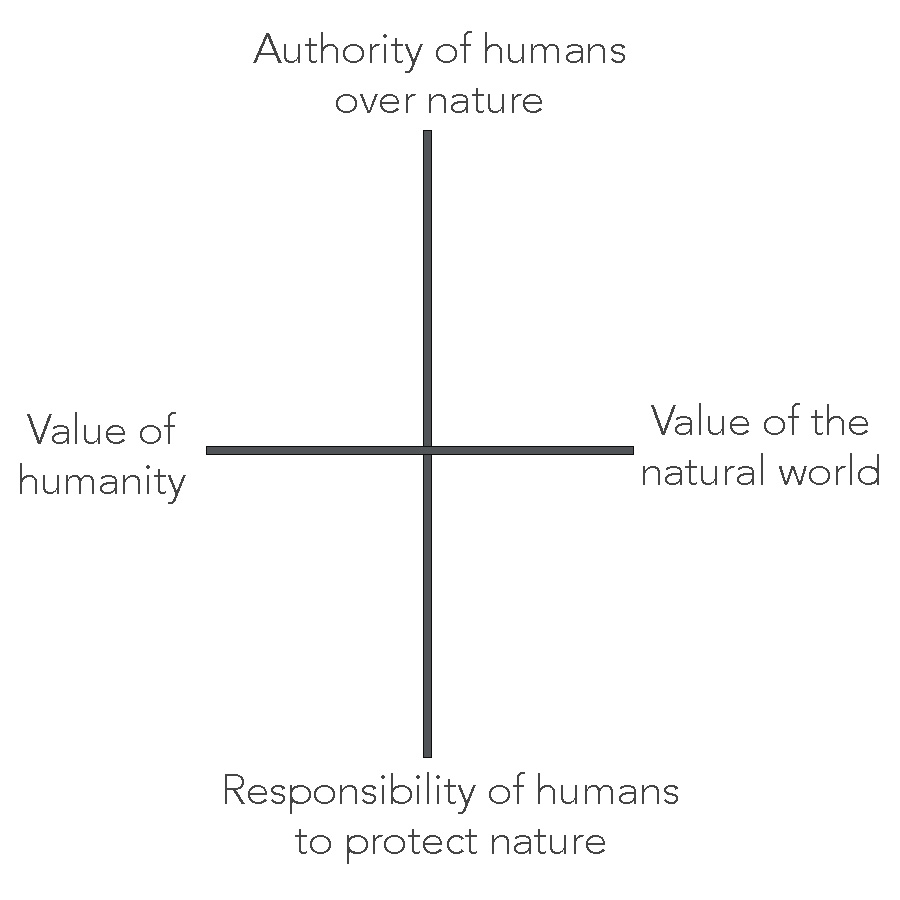
Ask groups to copy this graph:

In groups, place each Christian perspective on this graph: do they place human authority over nature above human responsibility to protect nature; do they value humans above the natural world, etc?

Share and discuss graphs. As a class, ascribe reasons to each positioning; what are they based on? Either give a theological argument or a biblical reference to support each position. Through the course of the conversation, ensure these two positions are defined:

Christian Environmentalism: humans must transform the way we treat the environment; the natural world must be protected and nurtured, in both Evangelical and denominational Christian thinking.

Conservative Evangelical or Fundamentalist non-Environmentalism: God will destroy the earth at the End Times, this is God’s plan for humanity and the natural world.

Debate

Divide the class into two groups: Christian Environmentalism and non-environmentalism. Each groups has 15 minutes to create 4 strong arguments in favour of their position, in response to the motion (below).

Groups should also predict counter-arguments and prepare to meet them.

Motion: The earth is ours to use