Global terms: Leadership

Inclusive Schools: Promoting and Protecting Freedom of Religion or Belief

At Culham St Gabriel’s Trust, we are committed to supporting high-quality education that enables young people to live well together in a diverse and changing world. Central to this is Freedom of Religion or Belief (FoRB) – a fundamental human right that underpins respect, dignity, and inclusion in society.

FoRB, rooted in Article 18 of the Universal Declaration of Human Rights, affirms every individual’s right to hold, change and express their beliefs, whether religious or non-religious. It also highlights the importance of balancing freedom with responsibility, particularly in shared spaces such as schools.

Supporting School Leaders and Educators

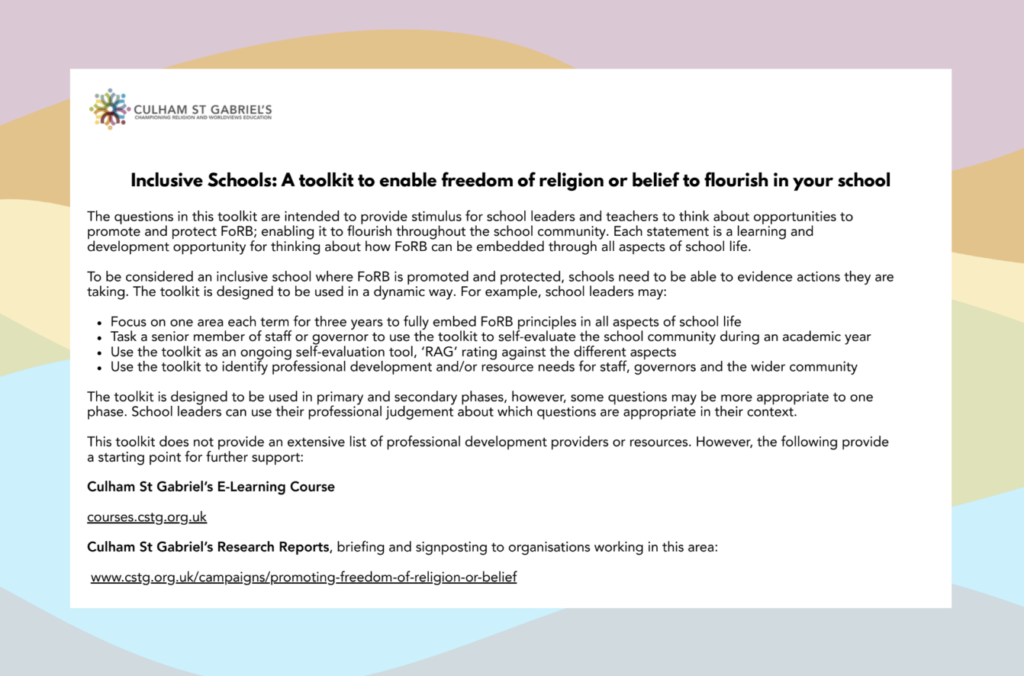
This suite of three resources has been designed to help school and trust leaders, governors and teachers embed FoRB principles in meaningful and practical ways. Together, they offer:

  • A clear introduction to the concept and legal foundations of FoRB
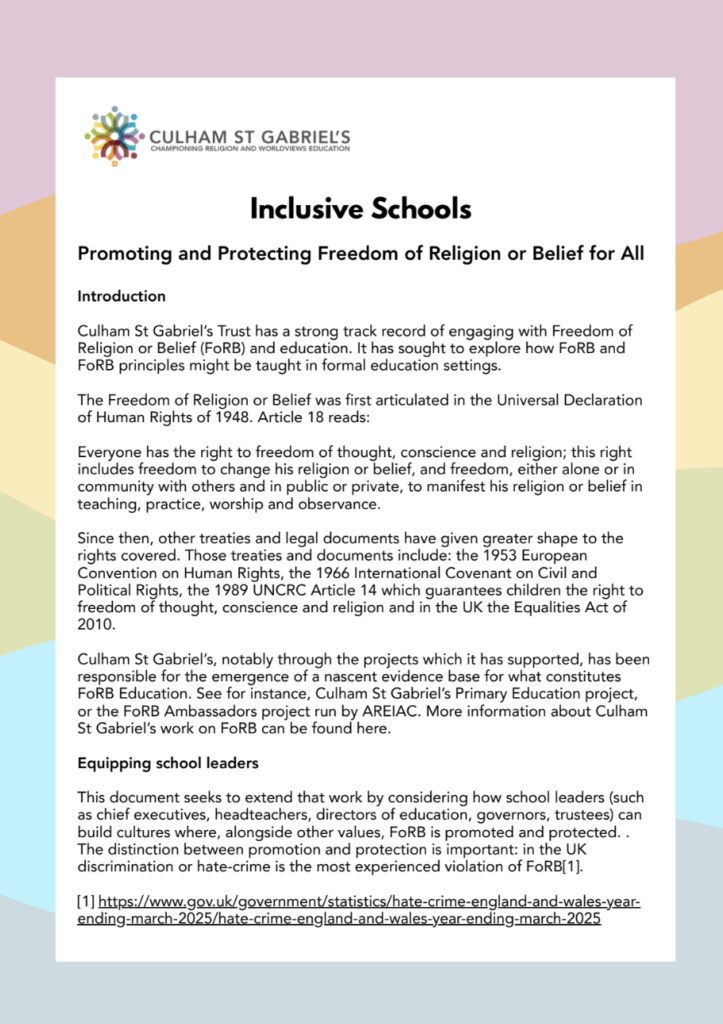
  • Practical guidance for developing policies and inclusive school cultures
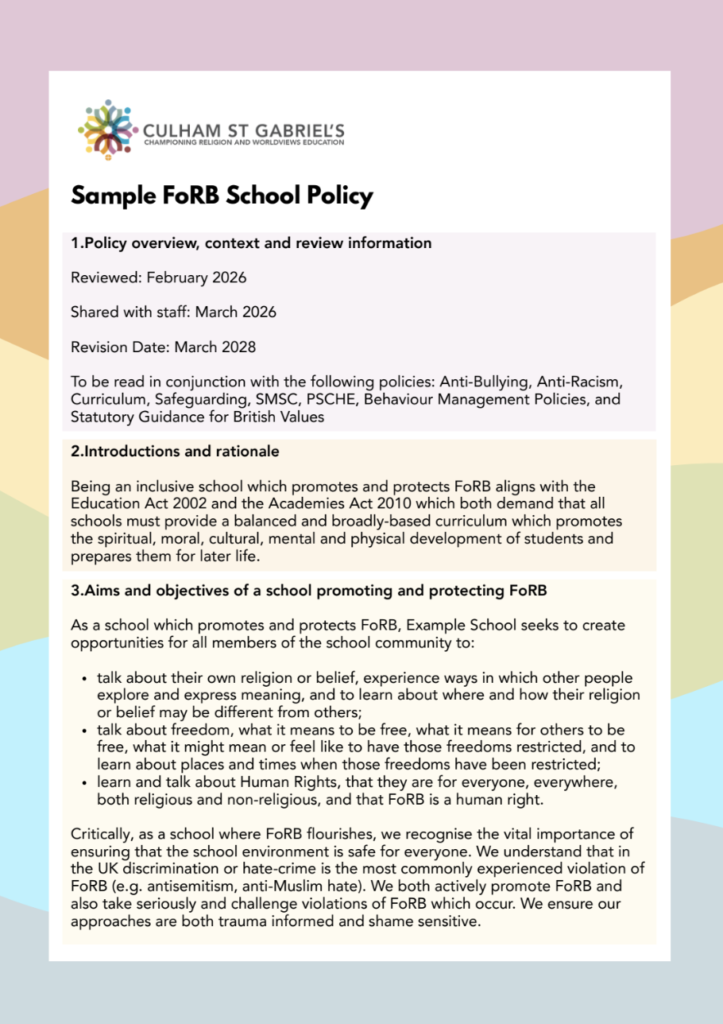
  • A detailed toolkit to support classroom practice, professional development and leadership

These materials explore how FoRB can be integrated across curriculum, leadership and professional practice, enabling pupils to develop their own beliefs while learning to respect the beliefs of others.

Building Inclusive and Respectful School Communities

By engaging with these resources, schools can strengthen their approach to equality, diversity and inclusion, while fostering dialogue, critical thinking and mutual understanding.We hope this work supports educators to create environments where freedom, respect and belonging are not only taught, but lived every day.

All three documents are available for download. Click on the images below to download.

Practical guidance for developing policies and inclusive school cultures

Practical guidance for developing policies and inclusive school cultures
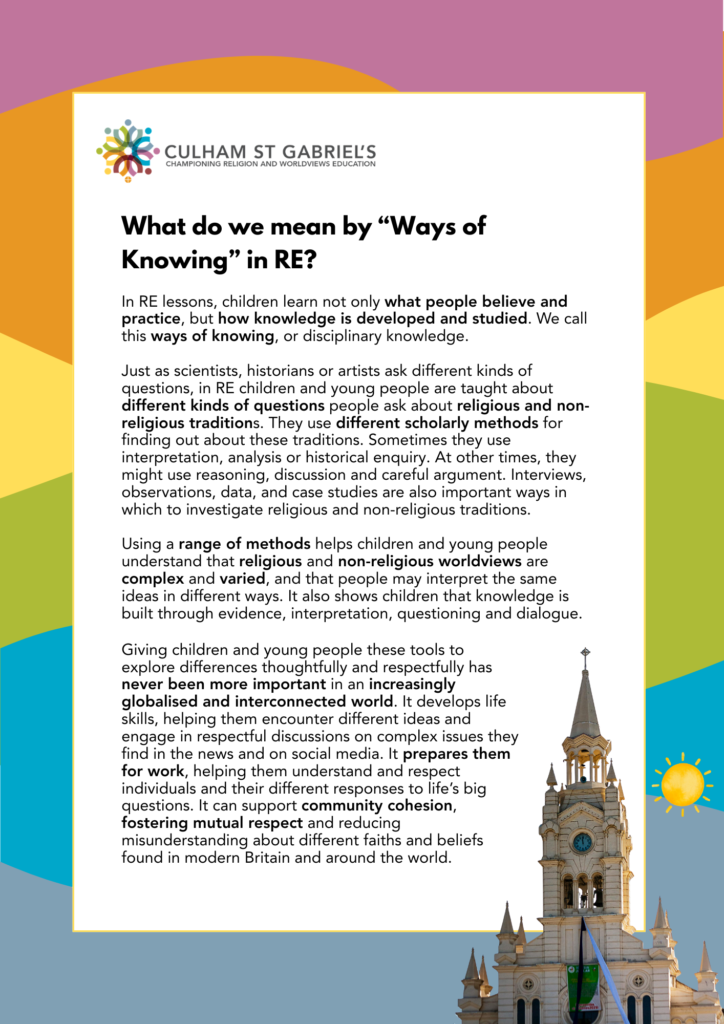
What do we mean by ways of knowing in RE?

A document and short film to help parents and carers understand how different ways of knowing can open up richer conversations and deeper understandings in the religion and worldviews classroom. The information in this animation is also available to download below.

A useful introduction to the concept for parents and carers.

In RE lessons, children learn not only what people believe and practice, but how knowledge is developed and studied. We call this ways of knowing, or disciplinary knowledge.

Just as scientists, historians or artists ask different kinds of questions, in RE children and young people are taught about different kinds of questions people ask about religious and non-religious traditions. They use different scholarly methods for finding out about these traditions. Sometimes they use interpretation, analysis or historical enquiry. At other times, they might use reasoning, discussion and careful argument. Interviews, observations, data, and case studies are also important ways in which to investigate religious and non-religious traditions.

Using a range of methods helps children and young people understand that religious and non-religious worldviews are complex and varied, and that people may interpret the same ideas in different ways. It also shows children that knowledge is built through evidence, interpretation, questioning and dialogue.

Giving children and young people these tools to explore differences thoughtfully and respectfully has never been more important in an increasingly globalised and interconnected world. It develops life skills, helping them encounter different ideas and engage in respectful discussions on complex issues they find in the news and on social media. It prepares them for work, helping them understand and respect individuals and their different responses to life’s big questions. It can support community cohesion, fostering mutual respect and reducing misunderstanding about different faiths and beliefs found in modern Britain and around the world.