Global terms: Leadership

Teacher/Researcher Case Study: Zoe Higgins


RE Connect: RE and Climate Crisis Teacher Fellowship Programme

I had been teaching for 19 years, mainly in KS2, when I spotted the opportunity to join a teacher fellowship run in partnership with Dr Jeremy Kidwell, Senior Lecturer in Theological Ethics at the University of Birmingham and Dr Ian Jones of St Peter’s Saltley Trust. The fellowship was designed to give teachers a deeper knowledge and understanding of the climate crisis with a focus on religion and worldviews and lead to projects about how to transfer this learning into classroom practice. A teacher fellowship is a part time project, in this case 7 online evening sessions and 2 full days over 9 months, which enables teachers to work closely with researchers and specialists on transforming practice in a particular area. Having been RE Lead for over 10 years, Global Lead for 3 years and with a keen personal interest in climate issues I applied straight away. My school is a Church of England VA school in a large village setting and part of a diocese MAT. There are 320 pupils on role from Reception to Year 6 with 25% of these children coming from out of catchment. The majority of the children are White British.

The fellowship provided opportunities to hear from specialists, beginning with an introduction to the science behind the current climate situation which left me well informed, a little overwhelmed but also inspired by the knowledge. My main thoughts were; if this is what the Science is telling us, I need to continue with this project and find ways to include the climate crisis in my teaching of RE. Over the next few sessions we heard from a member of Extinction Rebellion Muslims, a Professor of Sikh Studies, a member of Young Christian Climate Network which explained how some Muslims, Christians and Sikhs are responding to the Climate Crisis and how their beliefs impact this. Again, more food for thought about how this could be shared with pupils and used to help them consider their own responses.

The next few sessions were more focused on pedagogy with Jeremy Kidwell speaking about ethics and culture, Lat Blaylock exploring classroom practice with the group, Ian Jones discussing Religion, Climate Change and the Affect. We tried scriptural reasoning with Nick Adams and went on to hear about creative and experiential ways of teaching and learning in RE. In our final session together we were inspired by Justine Ball, an adviser/inspector for primary RE in Hampshire, about an art project she had done with local schools focusing on climate changes and Charlie Syson, a secondary teacher, who has been developing a scheme of work on less widely taught religions as part of a Farmington Scholarship. Throughout the months of the project we were also provided with suggested reading and watching which provided further background knowledge and food for thought.

With all this content the difficulty was narrowing down what my individual project would look like as I came away with ideas and new knowledge after every session. I finally settled on a scheme of work with a set of accompanying photo cards. The scheme of work would focus on how people’s religious beliefs influence their thoughts and actions about climate change. I used key enquiry questions for each key stage to frame the learning; ‘What do people love about Earth and how do they look after it?’; ‘Why does caring for the world matter?’; ‘What do different people do to care for the world and why do they do it?’; and ‘How do beliefs influence people’s responses to the climate crisis?’. The scheme of work would include 6 lessons for Reception, Key Stage 1, Lower Key Stage 2 and Upper Key Stage 2 and could be used as a half term’s block of work or as RE focus week. I also wanted to include the photo cards and some accompanying resources that could be used without the scheme of work.

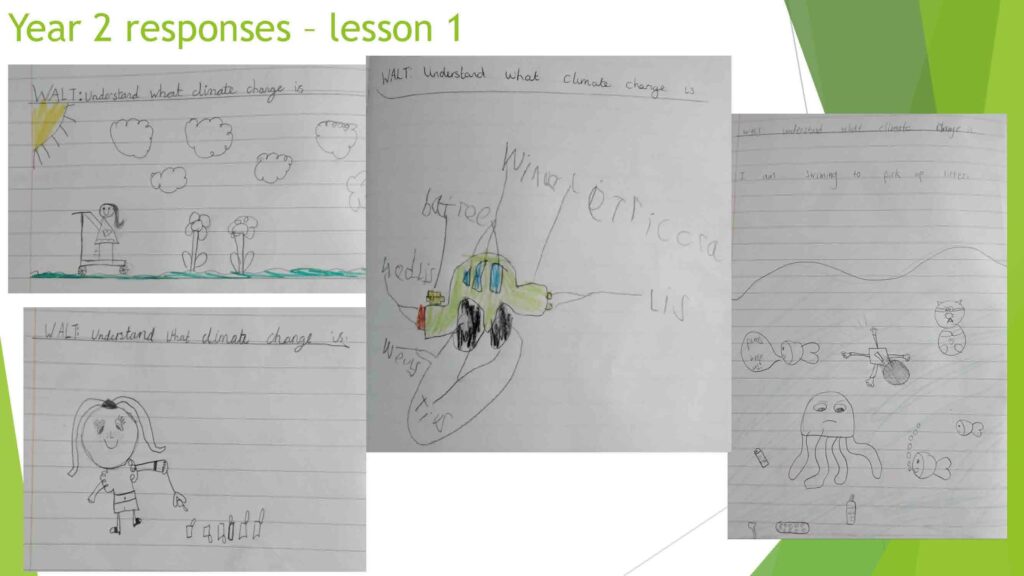
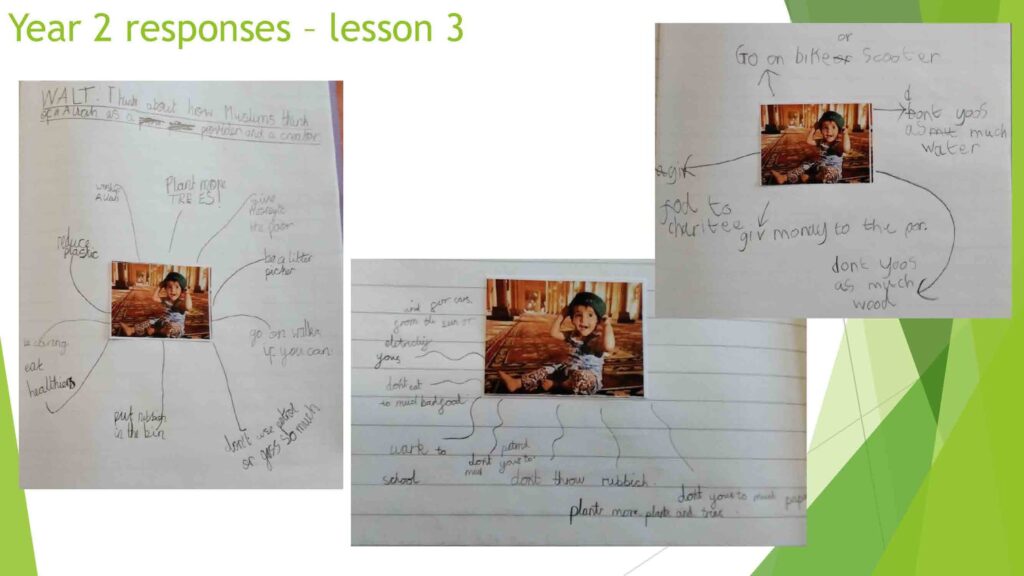
When trialling some of the resources and lesson plans, I found that all of the children were engaged and excited about the learning and when using the photo cards they found havingpictures of real people inspiring and interesting. In the initial y1/2 lesson, which looked at what climate change is, the children were very eager to discuss their ideas. What I also found was that the y4 children looking at the photos needed some structure to help them focus their discussion about encourage deeper thinking. With the y1/2 lessons, the teachers who trialled the first two lessons found them easy to use and appropriate in length and activity but found that the children lacked some subject knowledge to fully access the lesson.

At this stage, I have a working scheme of work and accompanying resources, which I will continue to develop based on trialling and discussions with the teacher fellows and RE specialists who met in person on the official final day of the fellowship. The aim is that this will be shared more widely allowing other schools to include a focus on RE and Climate Change within their curriculum. Being part of the fellowship has been an opportunity to focus my time and thinking on RE and about the importance of including climate change. The opportunity to work with others who are passionate about both RE and raising awareness about climate change amongst young people really has been inspiring.

For further information or to discuss the project please email: zhiggins@scargill.derbyshire.sch.uk

 Zoe Higgins Teacher and Religion & Worldviews Lead

Research Summary: The Doughnut and the Hole: Spiritual Development in Primary schools

‘The Doughnut and the Hole’ (1997), aimed to try to find through talking with teachers, advisers, children, researchers and reading widely, some simple, appropriate ways to encourage Spiritual Development in Primary Schools. The resulting images from this research have been useful in further work by myself and others. Seeing ourselves as spiritual in the sense of being Holy Doughnuts: Holy Wholes with Holy Holes, and the need to allow time for openings: as Windows, of wondering about the Wows and Ows of life; as Mirrors (of reflecting on this;) and Doors (of opportunity to express and act on what is being learnt from this). This piece of research can be found via the link below and supports other work in which I am now involved.

Researchers

Liz Mills

Research Institution

Farmington Institute

What is this about?

‘The Doughnut and the Hole’ (1997), aimed to try to find some simple, appropriate ways to encourage Spiritual Development in Primary Schools.

What was done?

This was a piece of Action Research in schools involving interviewing and working with teachers, children, parents and governors as well as background networking with advisers and researchers around the country, together with wide reading.

Main findings and outputs

What is spiritual development? Here a simple definition image was offered: a Holy Doughnut. An image which might help us see ourselves as ‘spiritual’ in the sense of being like doughnuts with holes: Holy Wholes with Holy Holes. Secondly, how might spirituality be developed? Here an alternative understanding of the word ‘development’ was offered: development as a process of realisation, like developing a photo, rather than a continuous push for ‘progressive’ development.

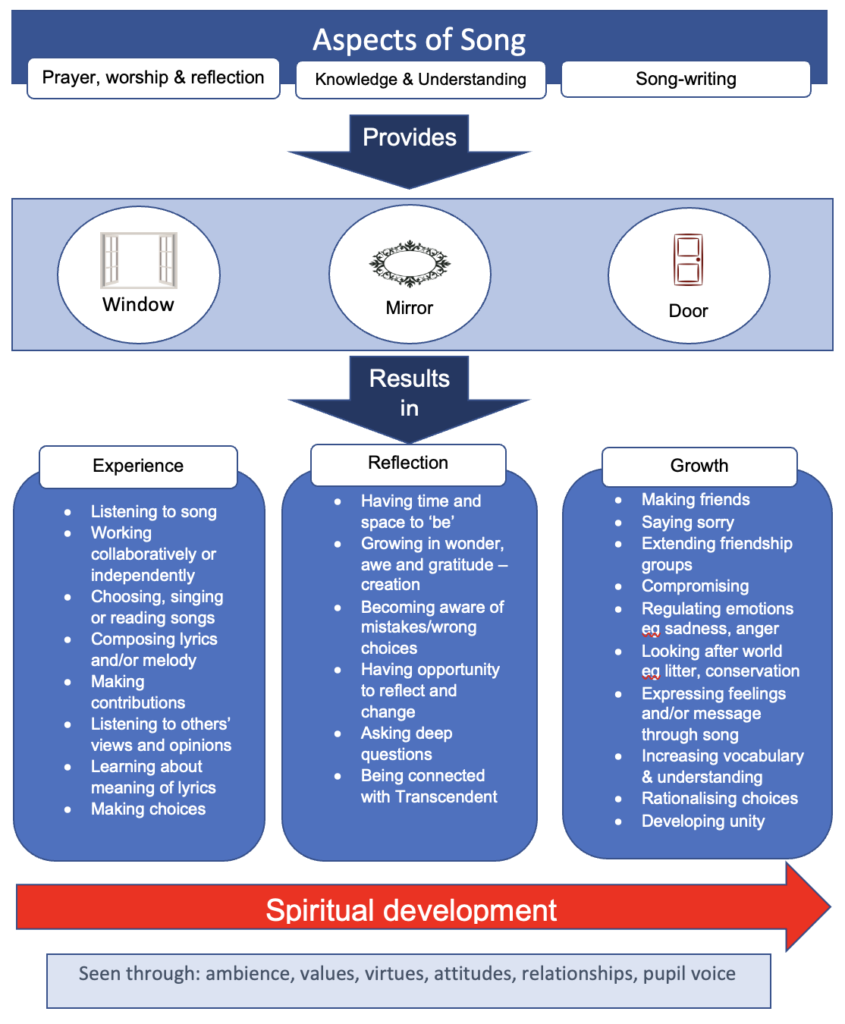
Three images resulted from this research, to help schools to plan practically. Windows (of wondering about the Wows and Ows of life), Mirrors (of reflecting on this) and Doors, (of opportunity to express and act on what is being learnt from this).

Relevance to RE

Teachers might use the research to help develop appropriate, inclusive ways to understand the term spiritual development in primary schools; and to do practical, creative work with this in RE, SMSCD or throughout the curriculum.

Generalisability and potential limitations

Other teachers might like to make use of and build on the ideas contained in the research.

Find out more

http://www.farmington.ac.uk/index.php/ps12-the-doughnut-and-the-hole/

Teacher Case Study: Rebecca Wright

RE Connect: RE and Climate Crisis Teacher Fellowship Programme

Fellowship Aims
 When I saw the advertisement to join the project, I was certainly intrigued. Ian Jones (Director of the Saltley Trust) and Dr Jeremy Kidwell (University of Birmingham) had organised a Teacher Fellowship Programme, focusing upon RE and the environment/ climate change. The interrelationship between ecology and the RE classroom was not a connection I had previously made or seen explicitly on a KS3 curriculum.
The project involved evening sessions led by a variety of experts to support fellows with their own projects. These projects were then presented during a symposium in Birmingham to a panel of experts.

Focus of my project
I was very aware when developing my project, that not all schools would be able to remove one of their existing units entirely in order to make space for a topic covering RE and ecology. Criteria set by the Local Agreed Syllabus and ever-decreasing curriculum time means that it can be a struggle to teach students required content, without shoehorning another topic in. So, my plan was to create an interdisciplinary unit of work that could either be a standalone topic or used as individual lessons within key topics already covered on KS3 curriculums.
My unit of work (‘People and the Planet’) is presented as a booklet, as I find these to be effective tools within my classroom. It provides clear instructions and routine, but it is important to use it as a resource, rather than a lesson. The booklet is also helpful if there are non-specialists in the department, as it provides structure and uniformity across the whole school delivery of RE.
The ‘People and the Planet’ topic focuses on student reflection and allowing students to fully embed themselves in the narrative. In the classroom, while I make links to experiences that the students can relate to, encourage discussion/ personal reflection, etc., certain topics can be easier to link with the lives of the students than others. This was discussed during our first workshop and became a focus when trialling my project in the classroom. As the topic of climate change is everywhere, students were very eager to share their personal experiences and contexts. The aim of the project is for students to fully place themselves into the narrative of climate emergency, rather than seeing it as a problem for others to solve.

Reflection upon action research
After planning a first draft of my booklet, I trialled the lesson with one of my year 7 groups. When first exploring the topic, student’s thoughts revolved around the phrases “they should”/ “they need to.” Students were all well-versed in the causes of climate change and what steps could be taken to resolve it. Many proudly shared that they recycle/ walk to school/ have an electric car, but ultimately the focus was placed upon others. Exploring this further, many felt they were too young, or inhibited by their family lifestyle. While I cannot change these factors, this allowed us to explore collective responsibility and how everyone can make a difference. Many activities were situation based, allowing students to apply learning to their everyday circumstances.
At the beginning and end of the topic, students created an artistic response to the phrase ‘People and the Planet.’ The initial response was completed simply based upon the phrasing, prior to commencing the topic. There was a contrast between the two responses, with the final responses showing a greater sense of connectedness and togetherness. Students have shifted towards using collective pronouns, rather than “they” when talking about the climate emergency.

What next?
The fellowship concluded with a symposium, allowing us to share our project with the other teacher fellows. It was fantastic to hear how other teachers within different contexts interpreted the project and applied it to their setting. We were also able to receive feedback on our projects, which are being refined prior to being published on the fellowship website.
Based on feedback, I have adjusted aspects of my project and will trial these with students. I will also be able to apply learning from the fellowship to other units of work and share with my department.
The experience of the teacher fellowship has been applied to my classroom through emphasising the challenges of intersectionality in teaching around environmental crisis and religion. In the classroom I am very aware not to say statements such as “all Christians/ Muslims etc” however we focus completely on how religion influences individuals. While it is vital to learn about religious beliefs in RE, we often forget to discuss how other aspects of social identity influence decision. No religious believer is only defined by their religion, and the fellowship highlighted that I should focus upon this more in the classroom.

I will be presenting alongside with Dr Kidwell, Ian Jones and Amy Powell at the RExChange conference later in the year about the project and the concept of a teacher fellowship in RE as a form of research and CPD.
 

Rebecca Wright is currently the Head of RE at a secondary school in Northampton. She studied Theology and Religion at the University of Oxford.

Research Spotlight: Deep and meaningful? The Ofsted religious education subject report

January 2025

Nine months have passed since the publication of the religious education subject report. Twenty-five primary school and twenty-five secondary school research visits were undertaken between September 2021 and April 2023. This evidence, together with the OFSTED conception of quality in the 2021 RE research review, provided the basis for the OFSTED subject report.

The inspectors gathered evidence relating to curriculum, pedagogy, assessment as well as school level systems and their impact on RE. It is interesting note, as we await the publication of the of the interim report of the Curriculum and assessment review in England, that OFSTED commented on the statutory arrangements for RE and the lack of clarity in expectations. The report noted that the OFSTED subject report in 2013 had suggested reviewing statutory arrangements but that this had not happened. One of the recommendations of this 2024 report is that;

‘The government should urgently update guidance for schools about its statutory expectations for RE. The government should also ensure that there is appropriate clarity about what is taught in RE, and when and where it is taught, for those schools where Ofsted inspects the subject. This would help schools and, particularly, leaders and teachers of RE.’

OFSTED 2024

Although Deep and meaningful? The Ofsted religious education subject report is a long read, it is an important read for those working in English settings. If you are pressed for time read the first section and then the section for your phase- primary or secondary.

  • How does this research based subject report support you to review RE?
  • How have you used the findings and recommendations from the report in your school, MAT, local group, group or establishment?

One finding of the report was that the quality of RE was not determined by school type of the source of the curriculum that was used. Instead they found that better quality RE was found when key factors were in place including

  • strong teacher subject knowledge
  • access to professional development
  • regular time for RE lessons
  • a well-organised curriculum containing knowledge chosen by leaders to enable pupils to deepen their understanding term by term

As you look at the above

  •  what are the strengths or areas for development in your school or schools you support?

Finally, you might find it useful to watch this short clip that goes through the main findings and poses some questions.


Teacher/Researcher Case Study: Mark Plater

Previous experience

I have a growing experience of Religious Education research, dating back to my time as a diocesan education adviser in Chelmsford, when I ran an All Saints Trust funded RE Resources Project with a group of schools, comparing teachers’ responses to specific resources at three different stages: firstly, their immediate response to seeing the resource (a five-second glance, such as one might give at a bookstall); their more-considered reactions after a fifteen minute look through it; and finally, their reactions after having made use of it with a class of pupils. All of the resources were classroom materials, and it was interesting to note that quite often, what at first sight didn’t appeal, often was seen in a very different light once it had actually been used by pupils (and vice versa!).

Shortly after that project I embarked on an MPhil/PhD programme to explore Hallowe’en in schools. This was quite a different style of study, using a questionnaire to discover what was actually happening in respect of the festival in three local authorities, as well as an exploration of teachers’ attitudes to Hallowe’en. Although I eventually decided not to complete a PhD, I did publish this work (Plater, 2007) and continued to explore the topic, publishing a few years later the results of a pupil survey, examining their activities during Hallowe’en and their attitudes to it (Plater, 2013).

By now I had moved into higher education teaching, and, alongside my teaching, was actively engaged in leading regular field visits, locally to religious centres in the region, but also further afield, to London, Turkey, Rome, and India. Especially for students in Lincolnshire, such first-hand experience of non-Christian places of worship was often a novel experience, and some of my students had never previously even been to London, let alone Europe or Asia. I was already convinced of the value of travel, having myself lived in Australia and India, but these university visits further confirmed for me Allport’s ideas about contact theory (Allport, 1954): that such immediate experiences of the ‘other’ are invaluable for breaking down stereotypes and assumptions, and for helping the study of religion to come alive for students.

Dialogue

Another key concept threading through my experience of university teaching is dialogue. Apart from teaching several modules with this word in the title, I have also established strong links over many years with the Dialogue Society, a Hizmet-inspired, Turkish Muslim group who are based in London and several other cities around the UK, but who also were instrumental in setting up my student visits to Turkey. I have participated in many of their activities over the years, and now count them as good friends.

The same concept of dialogue has also been central in discussions about school religious education. Mike Castelli proposes Dialogic RE (Castelli, 2012; Castelli, 2018) as a pedagogic methodology for RE. A former work colleague- Antony Luby (Luby, 2019) – also works in this field, identifying different forms of dialogue used by pupils in a Catholic school setting, and Kevin O’Grady’s work (O’Grady, 2018) portrays the whole purpose of RE as being a dialogue with difference. These, and many others from across the world (e.g. Bagrowicz, 2010; Schihalejev, 2009; Linden, 2016; Shuster, 2016) lay emphasis on the importance of dialogue as a focus and methodology in the teaching of school religious education.

An idea is born

I have been the coordinator for a Lincolnshire RE Hub group for several years, seeking to support and develop RE in the region through teacher support and resourcing. In discussing this group with a director of the All Saints Educational Trust (ASET), the idea was developed for a local project which would help to fund the coming together of schools and faith practitioners for mutual benefit. The funding would enable us to purchase the expertise of the St Philip’s Centre, Leicester, as well as provide support for schools to fully engage with the programme. A funding bid was drawn up, using the expertise of this local ASET director, and we were successful in gaining funding for an initial pilot programme.

The programme was based on a very simple idea: to link faith practitioners to six schools for a year, allowing a relationship to develop between the two, and with funding to both incentivise engagement and cover the costs of active participation. The schools were free to engage in the programme in any way that they wished, and ideas and training was provided in order to stimulate suggestions and to enhance their enthusiasm.

The challenge of implementation

No difficulties were encountered in attracting interest from local schools, and I was then faced with the challenge of selecting six schools from the thirteen applications. The selected schools offered a balance of primary and secondary, large and small, rural and city. Named contacts were identified from all six schools, and faith representatives were identified by St Philip’s Centre according to school preferences.

A timeline had the pilot stage of the programme running from September 2019 through to July 2020, with the possibility of bids for further funding to expand the project into 2021 onwards. However, Covid-19 lockdown resulted in an extension of the first phase to December 2020, and the freezing of ASET funds from the same period, meaning that any expansion of the project had to go on hold, at least for the time being.

 Outcomes of the project

At three stages during the course of the pilot project intermediate feedback was gained from all participants and this was summarised into published Project Update leaflets. The purpose of the updates was to maintain enthusiasm, and to share ideas on how individual schools were engaging with this unique opportunity.  These leaflets provided photos of activities and descriptions and quotations from schools and faith practitioners. However, lockdown had affected participating schools in different ways, so that some of the planned visits had to be cancelled, and other activities were significantly curtailed. Most schools did manage to maintain involvement however, but often in different ways than they had initially intended or hoped.

A final project conference was held online in December 2020 to consider the impact of the programme and to update participants on how it might be developed further into the future. Follow up interviews were also held with all participants in order to ascertain the individual impact on schools and participants, and to seek their advice on how the programme might be refined. A Final Report on the project was published in November 2021 and can be accessed here: https://bgro.repository.guildhe.ac.uk/id/eprint/884/

Participants in the project were unanimously positive about its impact, and in some instances the claim was made that it had left a lasting impact on pupils and teachers. One teacher commented, “This project was amazing! It’s one of the best things we’ve ever been involved in” (Primary teacher).

However, there were two schools (one primary, one secondary) which did not fully engage. In one instance this was because the link staff member moved on from the school during the start of the programme, and in the other, personal circumstances led to a delay in establishing practical actions, and then came the impact of Covid. With such a small cohort of participating schools, two ‘failures’ amounted to one third of the participating schools, so this was a great disappointment for me.

Another learning point for me was the fact that, in the follow up interviews, several of the school link-teachers expressed the wish that clearer guidance and targets had been provided. As one teacher put it: “We’re used to being told what to do” (Primary teacher). My hope had been that schools would appreciate the freedom and flexibility that was provided through the open structures of the project, but in fact the lack of such targets only implied that there were no minimum requirements, that it did not matter how much they engaged: they were free to do as little or as much as time and circumstances allowed. I guess that I had underestimated the extent to which performativity and target-culture had infiltrated the teacher mindset. Without threshold standards and minimum targets, there was no framework within which to work; no set standard meant that the task was inconsequential, that it did not matter. In the event, all of these teachers did engage with the task and did make arrangements with their linked faith visitor, but this was due to their own interest and motivation, not, as was the norm for them, because there was a task that had to be done and for which they might be held accountable.

What next?

I am still hopeful that it might be possible to expand this project to a wider range of schools in the Lincolnshire area. However, this would not be possible without further funding to appropriately engage all participants in the setting up of the programme, and, in view of what I have said above, next time I might work with participants more closely to identify appropriate expectations and targets.

Meantime, lockdown afforded me the opportunity to engage with another fascinating piece of research: to explore the make-up of the 2020-21 cohort of secondary Religious Education trainees on various Initial Teacher Training courses across the country. Because this involved completion of an online survey, it ideally suited the lockdown context, and, because this proved to be the largest ever cohort of trainees for RE ITT, it was a unique group to work with in seeking to discover their motivations for entering teaching as a profession and to discover various other demographic details about the group. The results of this piece of work have now been published, and can be downloaded from: https://bgro.repository.guildhe.ac.uk/id/eprint/881/

References

Allport, G. W. (1954). The nature of prejudice. Cambridge, MA: Perseus Books.

Bagrowicz, J. (2010). Dialogue in religious education. Paedagogia Christiana 26:2 pp. 215-232. DOI https://doi.org/10.12775/PCh.2010.032

Castelli, M. (2012). Faith dialogue as a pedagogy for a post secular religious education. Journal of Beliefs and Values, 33 (2), 207-216.

Castelli, M. (2018) Principles and procedures for classroom dialogue. In: Chater M (ed.) We Need to Talk about Religious Education. London: Jessica Kingsley Publishers, pp. 143–154.

Linden, L. (2016) From Freire to religious pluralism: exploring dialogue in the classroom, International Studies in Catholic Education, 8:2, 231-240. DOI: 10.1080/19422539.2016.1206404

Luby, A. (2019) Dialogic skills in RE: recontextualising the dialogue school. Journal of Religious Education (67). Pp.127–142.

O’Grady, K. (2018) Religious Education as a Dialogue with Difference: Fostering Democratic Citizenship through the Study of Religions in Schools. NY: Routledge. DOI https://doi.org/10.4324/9781351064385

Plater, M (2007) ‘Toil & trouble revisited: Hallowe’en in schools’, British Journal of Religious Education 29:2

Plater, M (2013) ‘Children’s attitudes towards Hallowe’en’, British Journal of Religious Education 35:2.

Schihalejev, O. (2009) Dialogue in religious education lessons – possibilities and hindrances in the Estonian context. British Journal of Religious Education, 31:3, pp. 277-288

Shuster, D. (2016) Mutuality and Intersubjective Dialogue in Religious Education. Studia Paedagogica Ignatiana, 18:0 pp. 149 – 176.


Mark Plater

Mark has been a religious education teacher all of his working life, but has experienced a range of employment opportunities within that field over the past forty years. He is married, with two children and one grandchild, and, alongside work and family, enjoys a recently purchased small piece of woodland as a source of retreat and creativity.
Teacher/Researcher Case Study: Lucy Peacock

I do not identify as a Religious Education specialist. Rather, I am an interdisciplinary researcher spanning education, the sociology of religion and interfaith studies. Nevertheless, my PhD research into interfaith encounters in schools provided an unexpected opportunity to constructively and critically engage in RE debates.


School Linking: A PhD case study
My 2016-2020 PhD examined the relationship between ‘interfaith encounters’ and ‘peaceful relations’ among young people in England’s schools by evaluating the work of the Faith and Belief Forum’s (F&BF’s) School Linking programme, an extracurricular scheme which brings students together to creatively engage with questions of identity, belonging and belief. School Linking pairs two classes, from two different schools (mostly, but not necessarily, from schools with a religious character), for one academic year. The linked teachers are trained in interfaith dialogue facilitation skills, before delivering three joint interfaith workshops, called Link Days, in which the students visit each other’s schools and take part in creative activities. For a student on the scheme, Link Days present opportunities to creatively explore their background, beliefs and communities with students that they may otherwise never meet.
For my PhD, I analysed 1,488 student and teacher surveys, conducted focus groups and observed School Linking activities in four faith schools in London to better understand how interfaith encounters foster interpersonal relationships between students, and what factors influence how School Linking is experienced by its participants. I completed my PhD in 2020, presenting my research findings in a report published on F&BF’s website. Recognising the need to challenge the assumptions of School Linking and articulate the complex processes underlying the relationships between the programme’s activities and ‘peaceful relations’ in a manner that was grounded in academic theory, I chose to reassess the intergroup model of contact theory (Allport 1954; Hewstone and Brown 1986), which essentially argues that contact between two or more groups reduces prejudiced attitudes. By mapping my findings onto Allport’s (1954) four ‘conditions’ for effective prejudice reduction (equal status, common goals, cooperation and institutional support), I presented F&BF with a practical ‘recipe for successful interfaith contact’ and reflected on how School Linking can further our understanding of the theory itself.


Implications for RE: An unexpected element
My academic background is in theology, and I see myself now as a researcher straddling the sociology of religion, education and interfaith studies. Whilst I expected my research to lightly touch upon RE, the extent to which it spoke to curriculum debates and teacher practice surprised me.
Early on, I noticed that students and teachers mentioned RE in their motivation for taking part in School Linking. A year 9 student from a Muslim-ethos school, linked with a Roman Catholic-ethos school said, “I am interested in learning RE in a different environment and this may also help me in my GCSEs”. When I asked teachers to simply state why they are taking part, responses included “raises the profile of the RE department at school”, “part of our RE curriculum is living / practising your faith so by teaching others our signs and symbols / celebrations of Catholicism we are fulfilling the curriculum”, and “support study of RS”. This was in the back of my mind, when, following a Link Day visit to a school’s local mosque, I observed a teacher telling his students, “as well as being important for interfaith relationships, everything we’ve covered here will be part of your GCSEs in six months’ time”.
During my data collection, School Linking’s reach was expanding beyond schools with a religious character to include community schools. Moreover, RE teachers were regularly being nominated by their schools to lead a School Linking class. It was important to me that I positioned my research in such a way that it spoke to the educational landscape experienced by my participants, but I struggled at times to configure my empirical and theoretical insights with the RE landscape. How significant is the connection between RE and extra-curricular activities? Will the scope of my research limit the implications for RE teachers? Can the research truly speak to RE when I don’t identify as an RE specialist?


Things ‘clicked’ for me upon reading the Commission on Religious Education’s Religion and Worldviews: The Way Forward report (CoRE 2018). It was clear that the report’s proposed move towards and Religion and Worldviews curriculum fundamentally emphasised the complexity and diversity of religious and non-religious worldviews; it intrinsically questioned notions of ‘typicality’. I could not ignore that School Linking was, and still is, used as a tool to enhance RE provision and experience in schools, thus it was vital for me to examine whether its theoretical underpinnings enable the programme to engage in discursive shifts in RE. My findings indicated that framing School Linking through contact theory risks closing worldview complexity down. The type of knowledge reportedly gained by School Linking students is sometimes oversimplified; generalisable ‘facts’ speak to principles of intergroup contact theory, and often align with school assessment measures, but do not accurately capture the religious and worldview plurality of the programme’s participants. I explored this in more detail in my (2021) open access article, Contact-based interfaith programmes in schools and the changing religious education landscape: negotiating a worldviews curriculum, in which I proposed an alternative theoretical framework to School Linking – the ‘decategorization’ model of contact (Brewer and Miller 1984, 1988; Miller 2002).


The process of writing the article affirmed to me a hope that academic and policy debate will recognise the value that extra-curricular programmes can provide in exploring questions of religious and non-religious belief in the classroom moving forward. I invite RE teachers to explore alternative literature, such as my own research, when considering how to facilitate meaningful student encounters across worldview difference. A summary of its application to RE teaching in this RE:ONLINE feature is a very welcome first step.


Next steps: exploring worldviews in more detail
I continue to explore interfaith encounters in education. For now, I am working on two projects related to higher education. I am a research fellow on the Building Positive Relationships among University Students across Religion and Worldview Diversity (‘IDEALS UK’) project, which explores how university students develop attitudes towards religion and worldview diversity, and examines how different aspects of university life shape interfaith learning and development. This month also marks the start of my new project, STEM and Belief in UK and USA Higher Education, which aims to promote meaningful university Science, Technology, Engineering and Mathematics (STEM) opportunities for underrepresented belief groups by better understanding how to foster STEM environments inclusive of belief diversity. Both of these projects consciously adopt the terminology ‘religion and worldview diversity’ to recognise that barriers in communication and understanding can arise from differences of perspective not captured by conventional categories of religion or faith. Considering ‘worldview’ alongside religion enables us to explore conceptual and empirical links between our higher education research and the continued Religion and Worldviews curriculum debate, something I look forward to sharing with the RE:ONLINE community in the coming months and years.


References
Allport, G. W. 1954. The Nature of Prejudice. Reading, MA: Addison-Wesley.
Brewer, M., and N. S. Miller. 1984. “Beyond the Contact Hypothesis: Theoretical Perspectives on Desegregation.” In Groups in Contact: The Psychology of Desegregation, edited by N. S. Miller and M. B. Brewer, 281–302. Orlando, Fl: Academic Press.
Brewer, M., and N. S. Miller. 1988. “Contact and Cooperation: When Do They Work?” In Eliminating Racism: Profiles in Controversy, edited by P. A. Katz and D. A. Taylor, 315–326. New York, NY: Plenum.
CoRE (Commission on Religious Education). 2018. “Final Report: Religion and Worldviews: The Way Forward.” Commission on Religious Education. Accessed 2 July 2022. https://www.commissiononre.org.uk/final-report-religion-and-worldviews-the-way-forward-a-national-plan-for-re/
Hewstone, M., and R. Brown. 1986. “Contact Is Not Enough: An Intergroup Perspective on the ‘Contact Hypothesis.” In Contact and Conflict in Intergroup Encounters, edited by M. Hewstone and R. Brown, 1–44. Oxford: Blackwell.
Miller, N. 2002. “Personalization and the Promise of Contact Theory.” Journal of Social Issues 58 (2): 387–410. doi:https://doi.org/10.1111/1540-4560.00267.
Peacock, L. 2021. “Contact-based interfaith programmes in schools and the changing religious education landscape: negotiating a worldviews curriculum.” Journal of Beliefs & Values, DOI: 10.1080/13617672.2021.2004708


Dr Lucy Peacock is a Research Fellow in Sociology of Religion

Research Summary: Knowing Well in Religious Education

 
What distinctive contribution does Religious Education make to the development of epistemic literacy in relation to big questions in religion and science?

Teacher Case Study: Karen Steele

Beyond the ‘Proof Text’: Analysing Islamic Texts at GCSE

It took just moments to decide the focus of my project for the Edge Hill RE Subject Knowledge Summer School in 2021. I’ve always loved teaching Islam and enjoyed the challenge of developing my subject knowledge for the 2016 specification. The support of people like Zameer Hussain with Shi’a Islam has been greatly appreciated. However, at times my lessons felt a bit plodding and superficial. I recognised immediately the Ofsted Research Review [i] reference to the use of ‘proof texts’ in GCSE. I’ve been guilty of that. Although I had included some textual analysis and scholarship into my lessons, I still felt I could do better. I knew straight away, therefore, I wanted to develop my confidence with Islamic texts and consider how to deliver the content in a more memorable, engaging and meaningful way. After attending the Summer School, I developed a student anthology with carefully selected and sequenced readings, clearly linked to the specification content.

Day 1 of the Summer School included an inspiring session on text and story by Mary Myatt. She reminded us of something we all know, but too often forget when preparing students to sit exams: humans love stories and stories matter. Daniel Willingham claims ‘our brains privilege story’[ii]. RE has an abundance! Text and story are a wonderful way into learning about the Islamic traditions and can be used to enhance our GCSE. That’s what I set out to do.

Islamic texts are daunting: the many collections of Hadith, the varied commentaries and interpretations. Even as an RE specialist, I worried about my ability to get it right. This is why Edge Hill’s offer is so important. Surrounded by specialists including RE teachers and academics, I could ask questions, share ideas and consider feedback. The very patient Dr Harith Ramil supported me with my project, answering my endless questions, offering suggestions and critiquing my work. If only every RE teacher had opportunities like this.

The ‘final product’ is by no means final. Like the tradition of textual interpretation in Islam, it will continue to evolve. Not everyone will agree with my selections and the interpretations I have offered. However, I’m now able to justify my choices and engage my students in a deeper dialogue about the ways texts and story are used in the tradition. The anthology includes 7 texts from the Qur’an and Hadith, chronologically covering key events in the early development of Islam.

Back in the classroom I have been using the anthology with my students. Together we have analysed and annotated Al-Fatihah (Surah 1:1-7) and an Al-Bukhari Hadith narrating the Night of Power among other texts. I can see that they have developed a strong foundation for investigating Islam. They are instinctively referring to the texts they have studied to support their claims rather that ‘sticking in a quote’. Will this have the desired impact? Time will tell, but the early signs are good; students are showing a richer and more contextual knowledge.

You can find all of my resources on the Edge Hill website alongside those produced by others who attended the Summer School. I have included a list of the many resources I discovered and notes for each text designed to help busy teachers.

I feel privileged and grateful to have had this opportunity. If you get the chance to apply to the Summer School, I recommend you go for it.

i Ofsted Research Review Series: Religious Education

ii Mary Myatt’s blog: Using stories in the curriculum

Teacher Case Study: Elaine Arundell

Developing spiritual wellbeing through song in RE

Inspiration

Having served as a primary teacher and RE coordinator for over 16 years and an AST in RE for a number of these, I have always championed the use of creativity in RE, for example through song. Ironically, I am not what would be considered ‘musical’ as I have never sung in a choir nor play an instrument; however, this has not been a barrier for me in developing pupils’ RE because I have found that primary children are able to bring their own experience of song into RE lessons. One of the reasons for my interest in this area is that I have witnessed how it has helped to create a ‘buzz’ in lessons, even for pupils who are generally disengaged; I also saw how it can encourage collaboration and build self-esteem and a sense of community. Therefore, for the last 20 years, I have used song as a tool in the primary classroom and supported others in doing so in my role as diocesan adviser over the last six years. Some of the creations over the years were published in an article I wrote for RE Today (Arundell, 2021).

Context

It was through my experience as adviser that I heard from a multitude of leaders about the negative effects of technology and covid on the wellbeing of our pupils during lockdown. As I work with faith schools, a number of leaders reported to me that one of the sore bruises of social distancing was the inability to gather as a community to worship or sing and this also impacted negatively on pupils’ sense of wellbeing and relationships. Aware of the myriad benefits of music on the both the individual and community and having embarked on an MA in RE, heavily supported by Culham St Gabriel’s Trust, I wanted to explore the use of song in RE in order to offer some way forward . Although there was a plethora of literature on spirituality and music, there was little in regards to song, particularly in RE, so I intended to fill this gap and investigate whether song in RE and worship was just a ‘fun’ activity or if it could have a meaningful impact on the spiritual development and wellbeing of pupils in key stage 2, and if so, how.

Spiritual development and song

For the purposes of this research, song in RE and worship referred to any type of religious song that was used within the RE lesson or outside of it including hymn practice, assemblies, prayer or liturgy while the use of song encompassed three ‘aspects’: composition, knowledge & understanding and prayer, worship & reflection. Having been inspired by Hay & Nye (2006), de Souza & Halafoff (2018) as well as Aristotle’s notion of eudaimonia and flourishing (Kraut, 2022; Honderich, 2005), spiritual development was therefore a combination of their definitions and, for this investigation, had five ‘characteristics’ which all pertained to connectivity and relationships, namely with: The Transcendent, Self, Others, Cosmos and Social Action, and which also related to Ofsted’s own definition (Ofsted, 1994; 2004; 2019). My intention was to discover which of the aspects could be used effectively and if song in RE might have an effect on each of the characteristics.

Song in RE – A case study

One of the greatest challenges of this research was that it was conducted in a primary school with which I was not familiar around Christmas and New Year 2020-2021. This meant that covid and other illnesses were still rife, staff turnover and absences were high and pressures on various members of the community were great. Gaining consent from parents and finding willing professionals with the time and energy to support with the project was, therefore, not straight-forward initially and I needed to be creative with proceeding with the project so as to ensure that wellbeing was at the very heart of it. Another deanery school was then invited to take part and all key stage 2 classes from both schools were involved. As a result, both qualitative and quantitative data were used for this case-study research, with surveys being completed by 180 pupils and 9 teachers. Interviews were conducted with small groups of diverse pupils (45 pupils in total) and one-to-one interviews with 9 teachers, with a wide range of experience and level of responsibility, took place.

While the two schools were similar in their context as they were both Catholic schools in the same deanery with creativity in RE on their action plan, there were significant differences in approaches. School A had used songs in the past for worship and reflection as well as for listening and understanding during RE lessons and hymn practice; however, they had not composed songs in RE prior to this project and so I led staff training using some of the examples and tips given in the RE Today article (Arundell, 2021). The headteacher of this School A then tasked all key stage two classes with composing their own song to share at their Christmas concert having had three months to work on these. School B, on the other hand, were also confident in using songs for worship and reflection as well as listening and understanding. However, they were not unfamiliar with the concept of composing songs in RE, although this was mainly led by the school’s music coordinator with class teachers free to also use song within the RE classroom should they wish.

Findings

Due to the diversity in approach and experience as well as the wide spectrum of participants, the data was quite rich and robust and, although it was varied, the majority of participants agreed on several points, the main one of which was unanimous that song in RE created a sense of happiness and calm within the classroom. As a result of listening to, singing or composing religious songs, pupils reported that they were less likely to feel angry or anxious and reported that this can have a positive impact on their actions such as making friends again or looking after the environment by picking up litter. All teachers reported that using songs in RE increased their memory and the vast majority of pupils responded that choosing songs in RE and worship made them more engaged. One of the most surprising findings was that over half of the 180 pupils surveyed said that they would prefer to sing their song silently as opposed to almost a fifth who would rather read it aloud and almost a third who would enjoy singing it aloud.
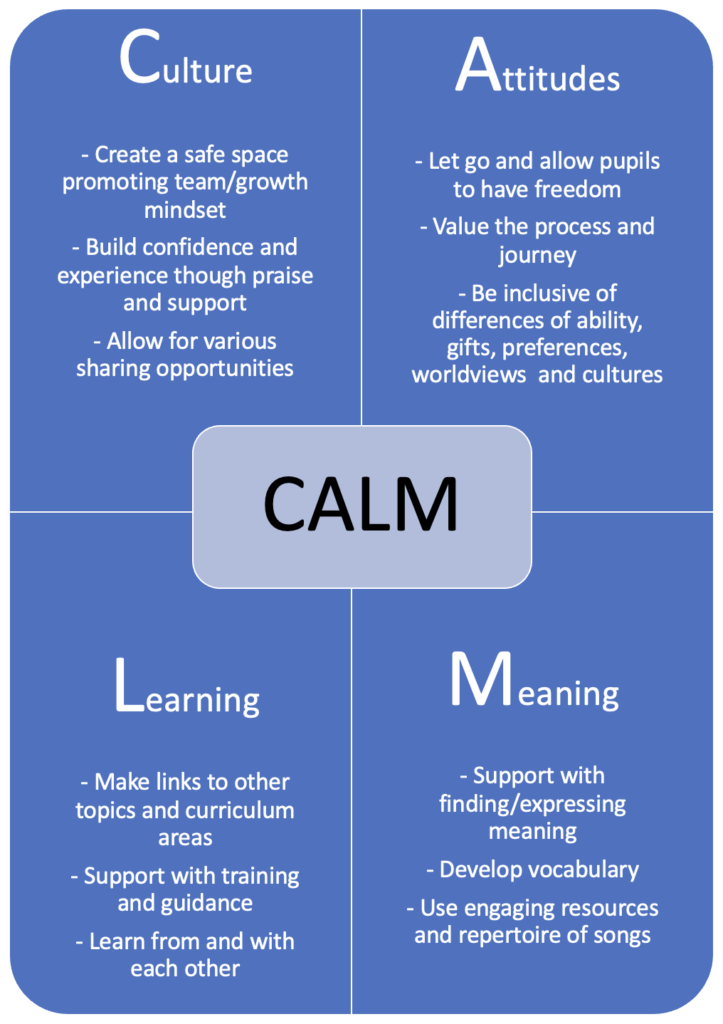
Overall, the key findings were that using song in RE and worship can have an impact on all five of the characteristics of spiritual development and that all three aspects of song can be effective in developing the spiritual wellbeing of pupils in KS2. Perhaps the finding of greatest significance, however, was that the use of song in RE naturally encouraged the practice of all Gospel values (Richter, 2000) and virtues (CDCEF & CBCEW, 2020) and participants spoke indirectly about these, although they were not asked specifically about them. For example, pupils described the love, peace or courage they felt as a result of singing, listening to or composing religious song and how the mood created through the song influenced their actions in a positive way. Through close analysis of the data, it was possible to match all of the Gospel values and virtues, as well as all of the Holy Spirit’s gifts (New International Version [NIV] 2011, Is 11:2-3) and fruits of the Holy Spirit, (NIV, Gal 5:22-23) to responses of either pupils or staff. This may be significant because the values and virtues are not limited to any faith or worldview but cross many boundaries which music and song also can.

What next?

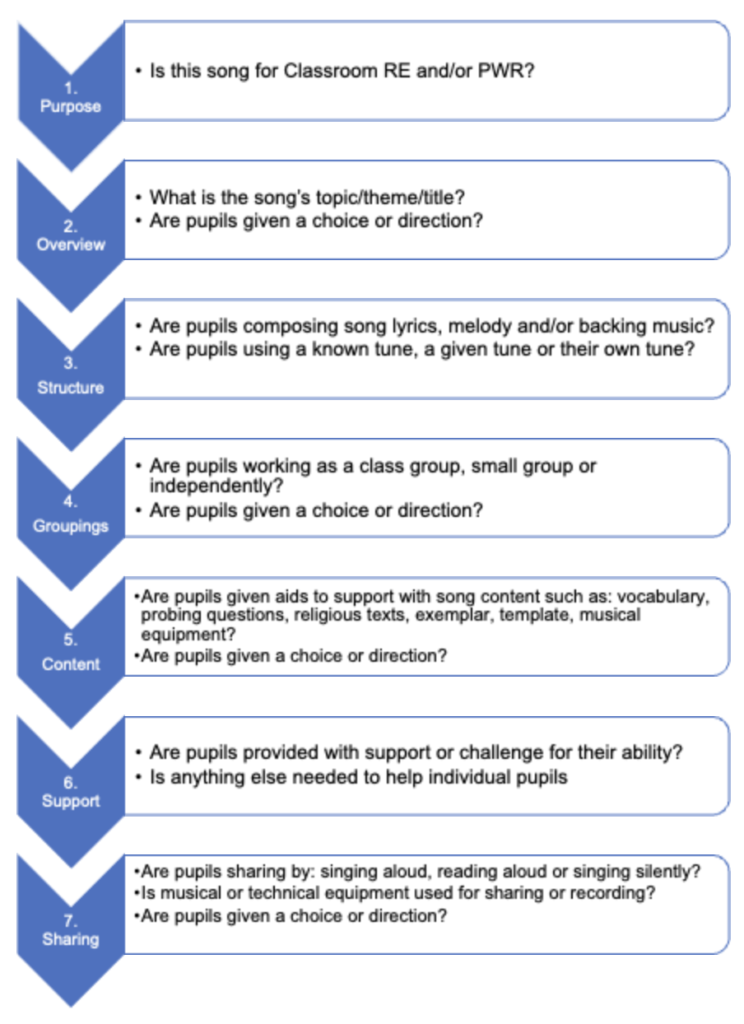
To support schools with the process of using song, particularly with composition of song in RE which is the aspect with which schools are less familiar, several models have been created and some of these are included below. These models have been shared at RE Coordinator conferences in both Southwark and Westminster dioceses as well as in various schools in which I am the adviser along with several examples of songs created by pupils, either as a whole class, small group or individually. Some of these songs have a known melody of a religious or popular song while others had both the melody and lyrics written by the pupils. All findings from this research have been shared in detail with schools A and B along with various other models and resources so that they can move this forward in their own contexts; the use of song in RE has also been mapped to the expectations for the new national inspection for Catholic schools so that it further reassures colleagues of the myriad benefits of using song in RE.

Over the past year, I have also been able to link this project to my diocesan work on Racial Justice, Equality and Diversity as pupils have had the opportunity to create songs based on this important theme; these have been shared on the diocesan website with several pupils having had the opportunity to share theirs publicly in front of an audience of 1000 people in Westminster Cathedral. Going forward, I hope to research this area in greater detail through more academic study, perhaps by exploring song in RE and worship in non-Catholic schools, by looking specifically at only song in RE lessons, or by doing a longitudinal study. I also aim to share and collate guidance and examples of good practice on song in RE and worship through my courses and resources and I am open to opportunities in which to share and develop this learning more widely.

References

Arundell, E. (2021b). ‘Song-writing in RE: a top ten of ideas’, RE Today, May 2021 pp. 22–23.

de Souza, M. & A. Halafoff. (eds.). (2018). Re-Enchanting Education and Spiritual Wellbeing: Fostering Belonging and Meaning-Making for Global Citizens. London and New York: Routledge pp. 1–22.

Department of Catholic Education and Formation Catholic Bishops’ Conference of England and Wales [DCEF & CBCEW]. (2020). Formation in Virtues: Educating the Whole Person. Available at: https://www.catholiceducation.org.uk/images/Formation_in_virtues_Final.pdf Accessed on 23rd February 2023.

Hay D. & R. Nye. (2006). The Spirit of the child (Revised Edition). London: Jessica Kingsley Publishers.

Kraut, R. (2022). Edward N. Zalta (ed.). ‘Aristotle’s Ethics’, The Stanford Encyclopedia of Philosophy. Available at https://plato.stanford.edu/entries/aristotle-ethics/ . Accessed on 28th May 2022.

Mills, L. (1997). The Doughnut and the Hole: Spiritual Development in Primary Schools. Farmington Institute Research Projects. Available at http://www.farmington.ac.uk/index.php/ps12-the-doughnut-and-the-hole/ Accessed on 1st June 2022.

Mills, L (2019). ‘Growing Together? Spiritual development in schools and communities’. In Rickett, A. (ed.), ‘Spiritual Development: Interpretations of Spiritual Development in the Classroom’. The Church of England Education Office. Available at https://www.stalbans.anglican.org/wp-content/uploads/CE-Spiritual-Development-Interpretations-in-the-Classroom.pdf Accessed on 16th May 2021.
New International Version. Biblica, 2011. Bible Gateway. Available at www.biblegateway.com/versions/NewInternational-Version-NIV-Bible/ Accessed on 29th May 2022.

Office for Standards in Education, Children’s Services and Skills [Ofsted], (1994) Handbook for the Inspection of Schools. Part 4. Inspection Schedule Guidance. Consolidated Edition. London, HMSO. Available at https://www.gov.uk/government/publications/school-inspection-handbook-eif/school-inspection-handbook updated 14th April 2022 https://www.gov.uk/government/publications/school-inspection-handbook-eif/summary-of-changes Accessed on 20th May 2022.

Office for Standards in Education, Children’s Services and Skills [Ofsted], (2004). Promoting and evaluating pupils’ spiritual, moral, social and cultural development. London, HMSO. Document reference number: HMI 2125. Available at https://dera.ioe.ac.uk/4959/1/Promoting_and_evaluating_pupils%27_spiritual%2C_moral%2C_social_and_cultural_development_%28PDF_format%29.pdf Accessed on 30th May 2022.

Office for Standards in Education, Children’s Services and Skills [Ofsted]. (2019). School inspection handbook. Ofsted. [Online]. Available at https://www.gov.uk/government/publications/school-inspection-handbook-eif. Accessed on 29th May 2022.

Richter, K. (2000). ‘Gospel Values Across the Curriculum’. St Mary’s Press. Available at https://cici-online.org/catechetical-connections/gospel-values Accessed on 23rd February 2023.

Model A: Journey from experience to growth and transformation using song (inspired by Mills: 1997, 2019)

Model B: The process of song composition for the use of song in REW for SDW

Model C: CALM Model to summarise findings

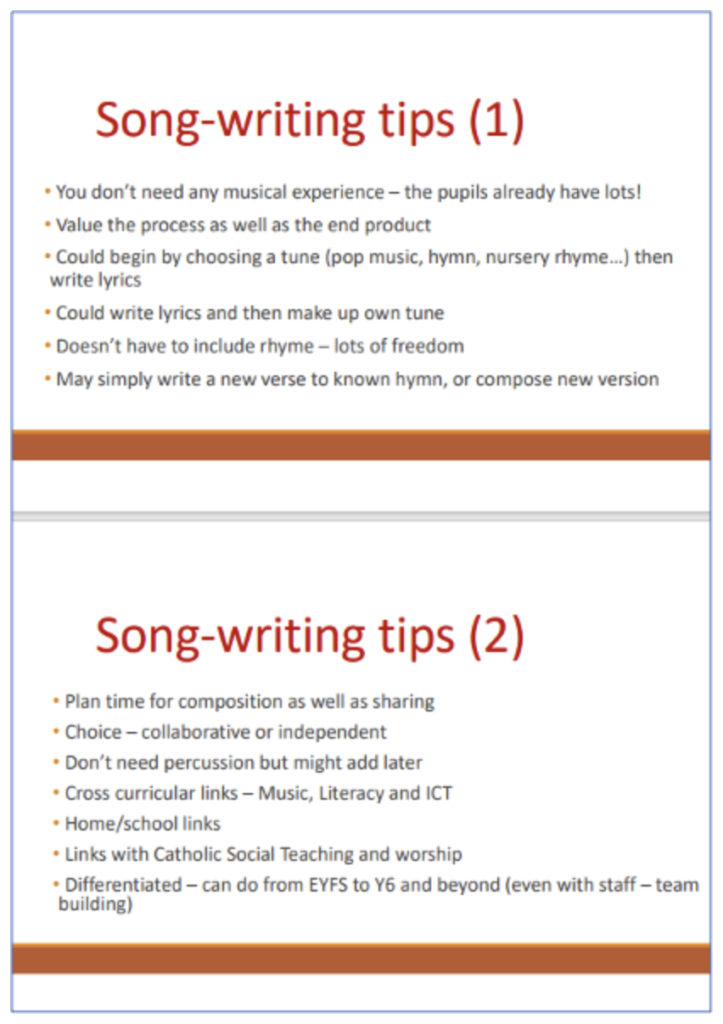
Model D: Song-writing tips

Teacher Case Study: Fay Lowe

I am Researching…

the extent to which a locally agreed syllabus can meet the moral development needs of white British working-class boys, in an area where there is a high prevalence of far-right extremism.  This topic is one that matters because it is now being recognised that far-right extremism, which has to some extent been overlooked by the media and even government policy in the past, is a growing threat to our society (Thomas, 2012; Abbas and Awan, 2015).

My research will engage with the challenges facing white working-class boys in education and the implications this has for their moral development. It is not until more recently that white working-class boys have been recognised in their underachievement in school (Demie and Kirstin, 2014; Demie and Mclean, 2017). The factors contributing to their educational underachievement including social, economic, and cultural are beginning to be acknowledged and the wider implications these have, including and importantly for this research, a lack of identity within educational contexts. The curriculum doesn’t reflect the culture and lives of working-class children (Demie and Kirstin, 2014)  For Reay (2018), this is an inherent problem with an education system that was not created for the working classes. This can lead to resistance from the pupils (Bright, 2011) and a struggle to understand their identity in such a context (Ingram, 2009, 2011). It is this lack of identity and specifically for this research, their moral identity, which can contribute to the reason why some of these boys then become involved in far-right extremism. My research will explore this further and consider if there are ways this can be countered through the Religious Studies curriculum.

When exploring morality and moral identity, I will consider what morality is and why I believe RE has a place in supporting a pupil’s moral development. Moral education can be seen to “assist young people to live more meaningfully and rightly in the light of a clear recognition of the greater value for positive human development of some principles and qualities over others” (Carr, 2005, p. 25). For this research, the unique moral development need being considered is how white British boys living in areas of high prevalence of right-wing extremism, can identify the principles and qualities that are of greater value, against some local acceptance of extreme views, racism and violence. Eaude (2011) in relation to the role RE has to play in this, whilst accepting that moral education needs to be in the whole life of the school, recognises that RE has a distinctive contribution to make to moral education. For him, this contribution is to consider how religious traditions have understood morality and to set issues of morality within this context, encouraging critical engagement.

To consider the ways which the curriculum can meet the moral development needs of white British working-class boys, a preliminary study of the locally agreed syllabuses needs to be carried out. The locally agreed syllabus is a curriculum document unique to Religious Education in England (and Wales). Local Authorities are required to produce their own syllabus for the teaching of RE. The area where this research is based uses a syllabus written in collaboration with RE Today Services, the trading arm of the ecumenical charity Christian Education and an organisation that has provided syllabuses for many areas across the country. My research will consider the place of white British working-class boys within this syllabus, but also highlight its intended contribution to moral development. As a result, I will begin to highlight how this syllabus may or may not be meeting their moral development needs. Following this a more in-depth analysis will be made through mixed methods research, engaging with the target group of boys themselves, to find out their views on their own moral development and the contribution RE has played. I will also consider the views of those involved in the production of the syllabus and the teachers who have recontextualised the syllabus for their classrooms about the extent to which they see the syllabus having an impact. Further research could be carried out with those involved in preventing violent extremism or policy makers when considering the recommendations that may be made by this research.

References:

Abbas, T. and Awan, I. (2015) Limits of UK Counterterrorism Policy and its Implications for Islamophobia and Far Right Extremism, International Journal for Crime, Justice and Social Democracy. Available at: https://www.crimejusticejournal.com/article/view (Accessed: 25 January 2021).

Bright, N. G. (2011) ‘“Off The Model”: resistant spaces, school disaffection and “aspiration” in a former coal-mining community’, Children’s geographies, 9(1), pp. 63–78. doi: 10.1080/14733285.2011.540440.

Carr, D. (2005) Making Sense of Education: An Introduction to the Philosophy and Theory of Education and Teaching. Routledge.

Demie, F. and Kirstin, L. (2014) Raising the Achievement of White Working Class Pupils. Lambeth Research and Statistics Unit Education, p. 43. Available at: https://www.lambeth.gov.uk/rsu/sites/www.lambeth.gov.uk.rsu/files/Raising_the_Achievement_of_White_Working_Class_Pupils_-_Barriers_and_School_Strategies_2014.pdf (Accessed: 9 January 2021).

Demie, F. and Mclean, C. (2017) Narrowing the Achievement Gap of Disadvantaged Pupils. Lambeth Research and Statistics Unit Education. Available at: https://www.researchgate.net/profile/Feyisa-Demie/publication/316701342_Narrowing_the_Achievement_Gap_of_Disadvantaged_Pupils/links/590de27ba6fdccad7b10b818/Narrowing-the-Achievement-Gap-of-Disadvantaged-Pupils.pdf.

Eaude, T. (2011) ‘Spiritual and Moral Development’, in Barnes, L. P. (ed.) Debates in Religious Education. Routledge, pp. 134–145. doi: 10.4324/9780203813805-19.

Ingram, N. (2009) ‘Working‐class boys, educational success and the misrecognition of working‐class culture’, British Journal of Sociology of Education, 30(4), pp. 421–434. doi: 10.1080/01425690902954604.

Ingram, N. (2011) ‘Within School and Beyond the Gate: The Complexities of Being Educationally Successful and Working Class’, Sociology (Oxford), 45(2), pp. 287–302. doi: 10.1177/0038038510394017.

Reay, D. (2018) ‘Miseducation: inequality, education and the working classes’, International Studies in Sociology of Education, 27(4), pp. 453–456. doi: 10.1080/09620214.2018.1531229.

Thomas, P. (2012) Responding to the Threat of Violent Extremism – Failing to Prevent. London, UK: Bloomsbury Academic. Available at: http://eprints.hud.ac.uk/id/eprint/14969/ (Accessed: 8 March 2021).

Fay Lowe

has been teaching RE for 15 years.  She is currently the Head of RE at a high school in Rochdale.  She is also studying for a PhD in Education at the School of Interdisciplinary Studies, Glasgow University where her research interests include moral education, the locally agreed syllabus and preventing far-right extremism. In that precious unit of time called ‘free-time’, she is usually either playing the violin or walking the hills and reservoirs around Manchester.

@FayLucille08

Update: Fay has now completed her research and has written about it here and in the Scotsman. Look out for further writing.