Research Poster
David Lundie & Mi Young Ahn, Education Studies, Liverpool Hope University
David Lundie & Mi Young Ahn, Education Studies, Liverpool Hope University
In a time of growing division, where religion is often seen as a problem, religious education cannot, and indeed does not, only take place within the classroom or within formal education. If we are to build compassionate, cohesive societies, we need to understand religious education as something active, lifelong, evolving and to be taken seriously.
The ‘Beyond the Classroom’ report from Theos* supported by Culham St Gabriel’s, explores where informal religious education happens across the UK; where are the places and spaces where people of all ages, in all kinds of communities, learn about and encounter other religions, belief systems and worldviews?
Through various sectors, including youth work, arts and culture, public services, media and sport, as well as extra-curricular spaces, campuses, anchor institutions and local interfaith networks, we map the opportunities and challenges of informal learning about religions and worldviews.
What have we found?
Informal religious education is strongest in areas of greater religious diversity, where there is greater opportunity for organic, unstructured encounters with those of other beliefs, reinforced by stronger interfaith networks. This raises the question of how to develop better religion and belief literacy in the whole population, not only those living in more diverse communities.
We find that informal religious education varies significantly from locality to locality, and context to context; nationally, the picture is somewhat patchy although there are myriad examples of good practice at a local level, which we highlight through case studies here. In some sectors, we identify a ‘squeamishness’ or tentativeness in talking about religion and belief, which we argue needs to be combatted in order to grow the religious literacy of everyone, regardless of background.
What can we do?
If every sector of society is provided with the tools and confidence for good conversations about religion and belief, then informal religious education can and will happen naturally anywhere. Greater formal literacy will lead to greater informal opportunities for religious education, which will in turn mean a more religiously literate population and a more cohesive community. The fact that this is not currently occurring universally or strategically across the UK is, we argue, a missed opportunity for a better society.
* Theos stimulates the debate about the place of religion in society, challenging and changing ideas through research, commentary and events. They are a Christian think tank based in the UK.
I had been teaching for 19 years, mainly in KS2, when I spotted the opportunity to join a teacher fellowship run in partnership with Dr Jeremy Kidwell, Senior Lecturer in Theological Ethics at the University of Birmingham and Dr Ian Jones of St Peter’s Saltley Trust. The fellowship was designed to give teachers a deeper knowledge and understanding of the climate crisis with a focus on religion and worldviews and lead to projects about how to transfer this learning into classroom practice. A teacher fellowship is a part time project, in this case 7 online evening sessions and 2 full days over 9 months, which enables teachers to work closely with researchers and specialists on transforming practice in a particular area. Having been RE Lead for over 10 years, Global Lead for 3 years and with a keen personal interest in climate issues I applied straight away. My school is a Church of England VA school in a large village setting and part of a diocese MAT. There are 320 pupils on role from Reception to Year 6 with 25% of these children coming from out of catchment. The majority of the children are White British.
The fellowship provided opportunities to hear from specialists, beginning with an introduction to the science behind the current climate situation which left me well informed, a little overwhelmed but also inspired by the knowledge. My main thoughts were; if this is what the Science is telling us, I need to continue with this project and find ways to include the climate crisis in my teaching of RE. Over the next few sessions we heard from a member of Extinction Rebellion Muslims, a Professor of Sikh Studies, a member of Young Christian Climate Network which explained how some Muslims, Christians and Sikhs are responding to the Climate Crisis and how their beliefs impact this. Again, more food for thought about how this could be shared with pupils and used to help them consider their own responses.
The next few sessions were more focused on pedagogy with Jeremy Kidwell speaking about ethics and culture, Lat Blaylock exploring classroom practice with the group, Ian Jones discussing Religion, Climate Change and the Affect. We tried scriptural reasoning with Nick Adams and went on to hear about creative and experiential ways of teaching and learning in RE. In our final session together we were inspired by Justine Ball, an adviser/inspector for primary RE in Hampshire, about an art project she had done with local schools focusing on climate changes and Charlie Syson, a secondary teacher, who has been developing a scheme of work on less widely taught religions as part of a Farmington Scholarship. Throughout the months of the project we were also provided with suggested reading and watching which provided further background knowledge and food for thought.
With all this content the difficulty was narrowing down what my individual project would look like as I came away with ideas and new knowledge after every session. I finally settled on a scheme of work with a set of accompanying photo cards. The scheme of work would focus on how people’s religious beliefs influence their thoughts and actions about climate change. I used key enquiry questions for each key stage to frame the learning; ‘What do people love about Earth and how do they look after it?’; ‘Why does caring for the world matter?’; ‘What do different people do to care for the world and why do they do it?’; and ‘How do beliefs influence people’s responses to the climate crisis?’. The scheme of work would include 6 lessons for Reception, Key Stage 1, Lower Key Stage 2 and Upper Key Stage 2 and could be used as a half term’s block of work or as RE focus week. I also wanted to include the photo cards and some accompanying resources that could be used without the scheme of work.
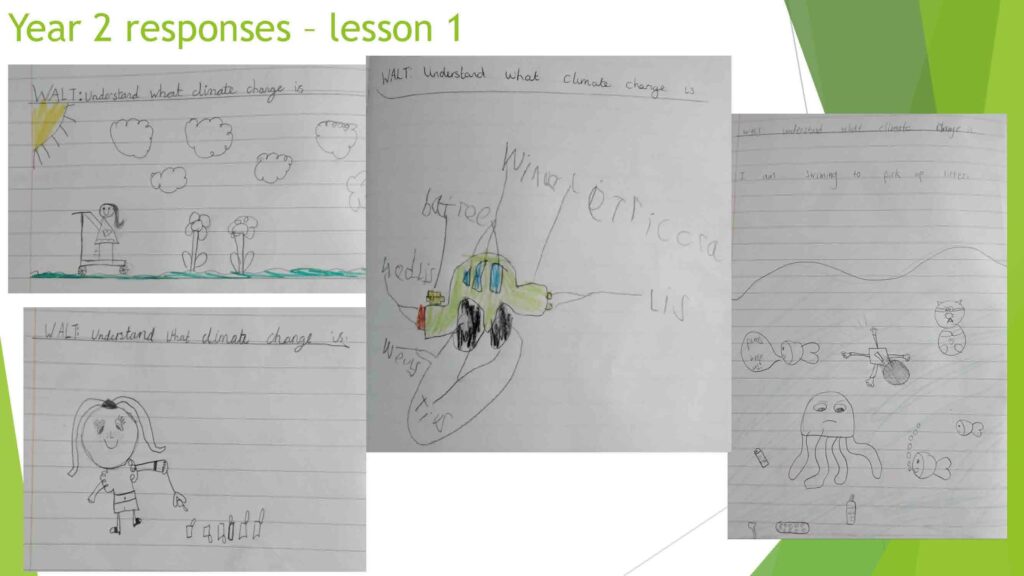
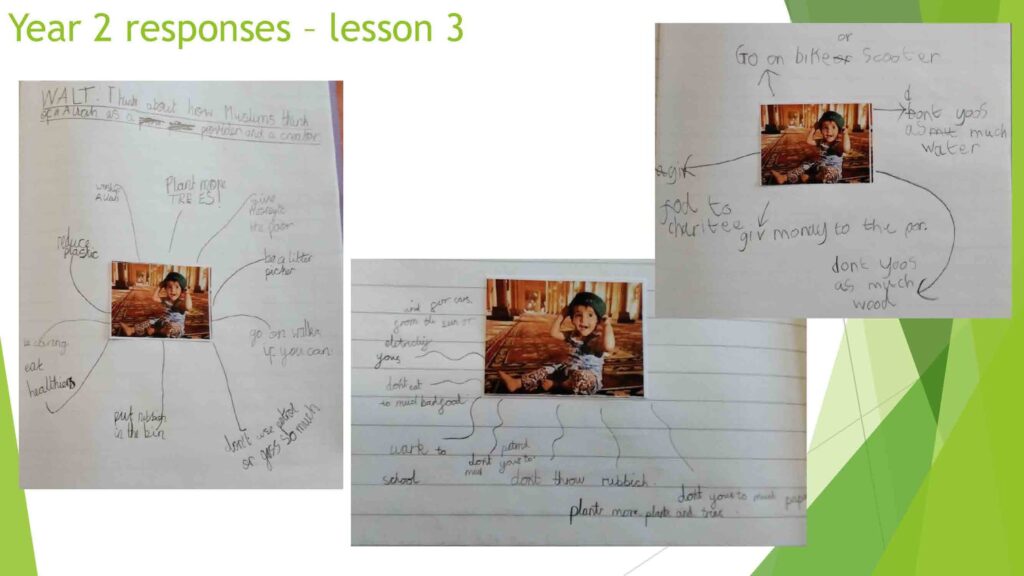
When trialling some of the resources and lesson plans, I found that all of the children were engaged and excited about the learning and when using the photo cards they found havingpictures of real people inspiring and interesting. In the initial y1/2 lesson, which looked at what climate change is, the children were very eager to discuss their ideas. What I also found was that the y4 children looking at the photos needed some structure to help them focus their discussion about encourage deeper thinking. With the y1/2 lessons, the teachers who trialled the first two lessons found them easy to use and appropriate in length and activity but found that the children lacked some subject knowledge to fully access the lesson.
At this stage, I have a working scheme of work and accompanying resources, which I will continue to develop based on trialling and discussions with the teacher fellows and RE specialists who met in person on the official final day of the fellowship. The aim is that this will be shared more widely allowing other schools to include a focus on RE and Climate Change within their curriculum. Being part of the fellowship has been an opportunity to focus my time and thinking on RE and about the importance of including climate change. The opportunity to work with others who are passionate about both RE and raising awareness about climate change amongst young people really has been inspiring.
For further information or to discuss the project please email: zhiggins@scargill.derbyshire.sch.uk
Zoe Higgins Teacher and Religion & Worldviews Lead
Religious Education in British schools seeks to help students learn critically about, and from, a wide range of religious phenomena. Yet, how do we ensure that these religious traditions, in all their rich diversity, are authentically represented within the Religious Education classroom? Many will do so without ever interacting with these faith communities personally. Building on the work of Robert Jackson, this research thus explores the extent to which ethnographic material can be used to invite diverse religious perspectives into the classroom, to ensure that generalised understandings of religious communities are debunked and not perpetuated.
Zoë Grainger
University of Cambridge
There was a review of relevant literature, followed by action research on two questions: What prior knowledge did the class have of Christianity’s internal diversity? What insights did students gain through engaging with the ethnographic material? Jackson’s interpretive approach was adapted in a Y12 scheme of work, using various materials and methods to bring diverse Christian insider voices into the classroom. The students completed questionnaires, the teacher-researcher and her mentor made observation notes, the students’ classwork was analysed and visitors from the different Christian communities were interviewed.
The research has various forms of relevance to RE. The original article gives a useful introduction to the interpretive approach, including practical applications and criticisms, and takes the approach into KS5 for the first documented time. It shows the value to KS5 students of interactions with religious insiders. The main findings suggest potentially useful classroom teaching strategies.
As an action research study, the research does not aim for generalisibility, but the findings certainly suggest promising avenues for other teachers to explore in their own classrooms; and the background and context of the study are very well accounted.
The original article is: Zoë Grainger. 2023. Seeing the kaleidoscope: Investigating whether Year 12 understandings of Christianity’s internal diversity can be enhanced through an ethnographic approach. Journal of Trainee Teacher Education Research.
It can be freely downloaded from https://doi.org/10.17863/CAM.96937
Jacomijn van der Kooij and colleagues provide a clear and concise definition of worldview, for use in RE curriculum development and pedagogy.
Jacomijn van der Kooij, Doret de Ruyter and Siebren Miedema
VU University, Amsterdam, the Netherlands
Whilst the original article is about what worldview means in relation to RE, and is a very interesting and detailed read, the summary below under Main findings and outputs should give curriculum developers and teachers at least a start and a framework for getting to grips with the issue – and you can follow up the link to the original article if you have library access and want the wider context.
The researchers looked over literature on worldview and distilled some principles for curriculum and pedagogy in RE, as summarised in the Main findings and outputs section.
Curriculum developers and teachers need a clear concept of worldview, as applied to RE, in order to consider what to include in the curriculum and how to approach it in the classroom.
This isn’t the only way in which the concept of worldview has been understood, but it was developed with RE in mind, is widely cited, and may well be of good use.
Jacomijn C. van der Kooij , Doret J. de Ruyter and Siebren Miedema, “‘Worldview’: the Meaning of the Concept and the Impact on Religious Education,” Religious Education, 108 (2) (2013): 210-228.
Disagreements about how Christianity should be taught in state-funded school RE have a long history. In this article are considered debates that have arisen about theologically-based pedagogy. The focus is Understanding Christianity, a resource inspired by recent developments in hermeneutics. When studying the Bible, should pupils should be viewed as insiders or outsiders? The argument is that hermeneutics offers a robust model for an academically rigorous approach that enables pupils to be both insiders and outsiders. There is explanation of how Understanding Christianity has attempted to embody this aspiration.
Stephen Pett & Professor Trevor Cooling
RE Today Services / Canterbury Christ Church University
The article is a scholarly essay on theological approaches to RE, examining the different arguments for and against and presenting the strengths of a hermeneutical theological approach, as exemplified in the Understanding Christianity resource.
The article presents and defends the merits of an increasingly known though contested approach to Christianity in RE. It offers thought-provoking points for teachers to consider when preparing lessons (e.g. on page 265 where we are asked to consider the effect of offering pupils various titles for the same parable: Prodigal Son, Wasteful Son, Lost Son, Foolish Father, Careless Country, Forgiving Father or Two Lost Sons). Many RE teachers will be familiar with the Understanding Christianity materials and readers are encouraged to read the original BJRE article.
Because this is a scholarly essay, the question of generalisability does not really apply. Rather, readers are encouraged to try out and evaluate the approach in their own classrooms.
Stephen Pett & Trevor Cooling (2018) Understanding Christianity: exploring a hermeneutical pedagogy for teaching Christianity, British Journal of Religious Education, 40:3, 257-267.
https://www.tandfonline.com/doi/abs/10.1080/01416200.2018.1493268?journalCode=cbre20
This research covers global issues relating to the decline of the popularity of institutional religions, the rise of numbers of non-religious persons, and new models of spirituality in ‘superdiverse’ societies. It shows the need to reconceptualise religious diversity as worldviews diversity, and to critically examine calls for the provision of worldviews education in schools. It gives an overview of scholarship on worldviews and worldviews education. It provides case studies of worldview/s education in Finland and Australia, drawing on data of recently completed qualitative and quantitative studies in the two countries. It compares the two contexts, and makes recommendations on worldviews education as a means of enhancing cross-cultural literacy, positive attitudes to religious diversity and social inclusion.
Tuuli Lipiäinen, Anna Halafoff, Fethi Mansouri & Gary Bouma
University of Helsinki; Deakin University, Melbourne; Deakin University, Melbourne; Monash University, Melbourne
A wide range of literature was reviewed, across worldviews, religion, education, state statistics and education policy documents. Two jurisdictions were considered in some detail, in relation to their worldviews education provision, and recommendations for future good practice were drawn.
This analysis presents major challenges to policy makers and curriculum developers, and, in time, to teachers. How can structures be established to replace the outdated ‘old-style religion’ RE model with one that reflects the ‘superdiverse’ R&W situation? Possibly this means more attention to personal worldviews, with organised religious and non-religious traditions studied as background resources.
As the authors say, their research focuses on two particular contexts, and cannot simply be transferred to others. But superdiversity and worldview or spiritual hybridity can be recognised in different places, and the research clearly connects with English discussions on the introduction of R&W.
The original article is Tuuli Lipiäinen, Anna Halafoff, Fethi Mansouri & Gary Bouma (2020): Diverse worldviews education and social inclusion: a comparison between Finnish and Australian approaches to build intercultural and interreligious understanding, British Journal of Religious Education, DOI: 10.1080/01416200.2020.1737918
This report reviews over 200 pieces of research to identify the elements of teaching with the strongest evidence of improving attainment. It finds some common practices can be harmful to learning and have no grounding in research. Specific practices which are supported by good evidence of their effectiveness are also examined and six key factors that contribute to great teaching are identified. The report also analyses different methods of evaluating teaching including: using ‘value-added’ results from student test scores; observing classroom teaching; and getting students to rate the quality of their teaching.
Robert Coe, Cesare Aloisi, Steve Higgins & Lee Elliot Major
Centre for Evaluation and Monitoring, Durham University, Sutton Trust
This review set out to address three apparently simple questions:
The researchers carried out a review of a large number of international research sources on what makes great teaching and different ways to evaluate teaching quality. Those found to be most relevant are included in the review. The review concludes with recommendations about how the findings might be taken forward, i.e. keeping a focus on student learning, using multiple measures of evaluation, asking school leaders to develop high quality assessment and data skills and balancing challenge and acceptance so that there is not too big a gap between the research evidence and what teachers are already doing.
The two factors with the strongest evidence of improving pupil attainment are:
Specific practices which have good evidence of improving attainment include:
Common practices which are not supported by evidence include:
The emphasis on teacher content knowledge underlines the need for RE to be taught by qualified specialists. It also encourages RE teachers to think hard when planning topics and lessons about how their specialist subject knowledge might be used to promote student learning. The other main findings are also relevant to RE classroom practice, e.g. the emphasis on quality of instruction suggests that teachers and departments might build up banks of questions and assessment tasks found to be effective in promoting student learning.
The authors do recognise limitations. For example, their review is focused on teacher effectiveness, “that which leads to high achievement by students in valued outcomes, other things being equal.” (p.9). However, they acknowledge that this might not fully capture desirable aims for education. They also acknowledge that attributing effects on student outcomes to individual teachers is not straightforward and that a range of factors should really be taken into account. The report merits careful consideration and cannot be understood as a check-list.
The report is freely downloadable from https://www.suttontrust.com/research-paper/great-teaching/
Existing GCSE and A-level syllabuses include modules on religion and the media, but these have not been widely or well studied. The modules may be difficult to teach well, and teachers have few good resources to use. The newly launched specifications for RS GCSE and A-level examinations have eliminated, almost entirely, any study of religion and the media. The absence of this theme is troubling. Critical appreciation of the ways media depicts religion is especially important for forming responsible, educated citizens in modern Britain. Key principles and questions that might help equip teachers to tackle critically and intelligently issues about religion in the media are offered. The approach is illustrated by considering media responses to the Charlie Hebdo attacks in Paris.
David G. Horrell, Karen O’Donnell & David Tollerton
University of Exeter, University of Durham
This research is partly a survey and commentary on GCSE and A level RS specifications and examiner’s reports past and present, focusing on religion and the media; partly a document analysis of different newspapers’ coverage of the Charlie Hebdo attacks; and partly a set of suggestions on how teachers might engage students with issues of media representation of religions in a balanced, critical and intelligent way.
The research is directly relevant to RE teaching, demonstrating the necessity of analysing media representations of religion as part of the subject and offering teachers a suggested framework and set of questions to use to do so.
The RE teaching framework and questions have wide generalisability – they could be applied in a very wide range of cases. Some of the language of the questions may need to be adapted to the learning needs of pupils of different ages and abilities, e.g. rather than ‘How do different media reports reflect particular interpretations of events with religious significance and what meanings are constructed in these depictions?’, it might be asked ‘How do different media reports show different attitudes to religions or events involving religions? What messages are passed on?’.
The full article is: David G. Horrell, Karen O’Donnell & David Tollerton (2018) Religion and the media in GCSE and A-level syllabuses: a regrettable gap and proposals to fill it, British Journal of Religious Education, 40:2, 114-123.
https://www.tandfonline.com/doi/abs/10.1080/01416200.2016.1190686?journalCode=cbre20
The notion of worldview is prominent in recent discussions of RE, following the publication of the CORE report. This research reflects on this development. It gives a nuanced understanding of the notion of worldview. It explores the pedagogical implications of the shift to worldview, drawing on the work of Robert Jackson, Michael Grimmitt and Anthony Thiselton.
Professor Trevor Cooling
Canterbury Christ Church University
The researcher considered the impact of the concept of worldview on his own work, in an autobiographical manner. He then analysed the treatment of worldview in the CORE report and subsequent discussions, including points made by critics of CORE or of the worldview concept. He then identified the pedagogical implications of CORE, arguing that R&W teaching will need to take a hermeneutical approach (explained further below) if the proposed changes are to take effect.
The research is of high relevance to teachers who are concerned to understand the meaning of the CORE report and the shift to worldviews as far as their own professional practice is concerned. As the researcher concludes, it is not yet a workable curriculum or resources. This needs to come next, but the researcher has outlined a basis for it.
This research does not present a set of generalisable data from a survey or other instrument. Rather, it is a detailed, balanced discussion of the worldview concept, based on reading, analysis and reflection. It offers teachers and other professionals an account of what the CORE report and the move from RE to R&W mean in practice, though (as yet) without details of curriculum or resources.
The original article is Trevor Cooling (2020) Worldview in religious education: autobiographical reflections on The Commission on Religious Education in England final report, British Journal of Religious Education, DOI: 10.1080/01416200.2020.1764497
The article is available open-access at 10.1080/01416200.2020.1764497