Global terms: Other Resources

Buddhism differs from many other major religious traditions by not being based on belief in God, but upon human potential. The concept of ‘religion’ in the West tends to be dominated by the model of the monotheistic Abrahamic traditions – Judaism, Christianity and Islam – so much so that some (both within and outside of Buddhism) prefer to refer to Buddhism as a ‘philosophy’ or ‘way of life’. Nevertheless, Buddhism shares many other characteristics associated with ‘religion’ such as a belief in a reality which lies beyond the senses, life beyond death, rituals, moral precepts, paths of spiritual development, monastic organisations, and has temples, sacred texts and social, cultural and political impacts, so that it might be best to call it an ‘atheistic religion’. Both Jainism and some schools of thought in Hinduism could also be classed in this way.

Ultimate Reality

Where monotheistic religions are centred on God, Buddhism is centred on the Dharma, or the ultimate truth about the way things really are. Human beings are deluded about the true nature of reality, for example thinking that impermanent things can make us eternally happy, and enlightenment consists of seeing reality as it really is. The title ‘Buddha’ means one who has ‘woken up’ to the truth. The truth is that life as we normally experience it is characterised by suffering, impermanence and lack of enduring self. We come into such a life because of ignorance and selfishness. There is however an alternative state, nirvana, free from suffering, which can be realised by living a life of morality, meditation and wisdom. However it is impossible to describe the truth in words, it can only be experienced, and the Buddha is one who has experienced it.

There are however many different forms of Buddhism, often oversimplified into the Theravada / Mahayana division. The paragraph above would be accepted by most Buddhists, but is couched in language characteristic of Theravada Buddhism. Mahayana Buddhist traditions have further and varied ideas about ‘ultimate reality’, but tend to agree that nirvana is not so much an alternate state, but a different way of seeing the same reality. Madhyamaka philosophy teaches ‘emptiness’: that nothing has independent real existence, but only relative, interdependent existence. Yogachara philosophy teaches that we think there are real, separate things, but there is only a flow of mental constructs. Other Mahayana traditions talk of ‘Buddha-nature’, not referring to the individual or individuals given the title Buddha, whether earthly or heavenly beings, but the ultimate reality behind everything which, potentially, or actually, is in all of us. So ultimate reality in Buddhism can be seen as seeing the truth about life, as nirvana, as ‘emptiness’, as ‘mind-only’ or ‘Buddha-nature’. These may be different ways of describing the same realisation, but you would have to be enlightened to know!

No God

It is clear that there is no personal monotheistic God in Buddhism, transcendent and separate from the material world, which is his creation. There is no need for a creator, either because there was never a beginning (Theravada) or because in ultimate reality, no things actually ‘exist’ (some forms of Mahayana thought). A story told by the Buddha in the Theravada Pali Canon mocks the idea of a single creator God. According to the story, the great god Brahma, traditionally the Indian creator god, was reborn just before the beginning of a particular world cycle. When Brahma observed this world coming into being, he imagined that he himself had created it. Modern Theravada Buddhism in particular rejects the monotheistic concept of God. Some forms of Mahayana Buddhism might be interpreted as including concepts of ultimate reality that begin to resemble some ways of understanding God (see below), but never as a transcendent, separate being.

Gods and Goddesses

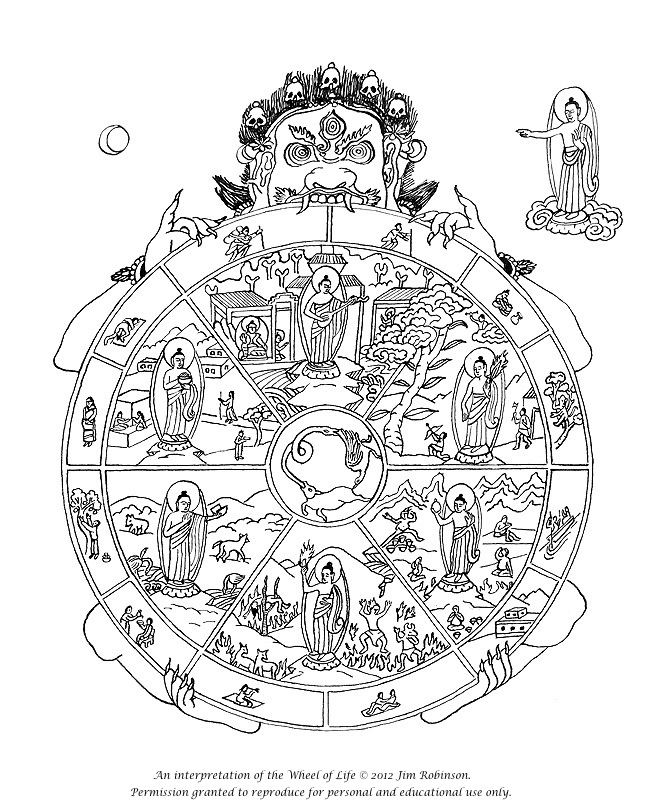
Although some forms of modernist Buddhist thinking play down the role of gods and goddesses in Buddhism, both the earliest ancient texts and contemporary Buddhist societies feature deities and ‘supernatural’ beings galore. The deities that we associate with ‘Hinduism’ and other deities from countries to which Buddhism spread are not denied but seen as other inhabitants of the complex and multi-dimensional universe or universes in which we dwell. However, they are best understood as another life-form, superior in powers to humans, but nevertheless not immortal nor ultimate. One can be reborn as a god or goddess, as well as in human, animal, ghost, or demon form or in a (temporary) hell world. They can however help within their sphere of influence, so Buddhism in practice includes worship of a variety of such beings. This may be dismissed by some as ‘folk religion’, but they do seem to appear at the highest levels of text and practice. Indeed, a traditional story of the Buddha’s enlightenment says that the god Brahma was the one who persuaded the newly enlightened Buddha that it would be worth teaching others. Indian deities such as Ganesha and Vishnu can be seen in Sri Lankan temples, and even as far away from India as Japan, Benzaiten, a version of the goddess Saraswati, remains a popular deity.

Buddhas and bodhisattvas* as ‘deities’?

The simplest answer to the question ‘do Buddhists believe in God or gods?’ would be, no, not in God, and gods exist but are just another impermanent life form, or even for some more liberal, modernist Buddhists, poetic metaphors. However, particularly in some forms of Mahayana Buddhism, the multitude of different Buddhas and bodhisattvas can functionally resemble gods and goddesses, in that they are worshipped, pictured, and prayed to. The Buddha Amitabha / Amida, who in Pure Land forms of Buddhism, saves those who have faith in him to join him in the Pure Land after death, can sound a little like a Christian idea of God. Various bodhisattvas such as Avalokiteshvara / Chenrezi or Tara may be prayed to for worldly benefits as well as spiritual progress. The crucial difference that must be grasped is that neither human Buddhas nor celestial Buddhas and bodhisattvas are ultimately real, and they are not separate from ourselves. All beings have the potential to become Buddhas and bodhisattvas, and in some forms of Mahayana philosophy, from the eternal ultimate perspective, already are.

Buddha as God?

Some forms of Mahayana Buddhism use the concept of the ‘trikaya’ or ‘three bodies’ of the Buddha. The Buddha can appear in earthly form for example as the human Gautama, or in a heavenly form, for example Amitabha. However, the ultimate form of the Buddha is the Dharmakaya, or true form, which is the ultimate reality behind everything. This can start sound something like God as understood by some modern Christian theologians, such as those who would prefer to describe God as ‘being-itself’ rather than ‘a being’, or like the concept of Brahman in Advaita Vedanta Hinduism, or the Goddess in Paganism, or mystical traditions in all three Abrahamic traditions where unity with God is spoken of. Even more God-like is the idea of the Adi-Buddha, or ‘original Buddha’ in some forms of Nepali Buddhism. This ‘drawing near’ of the concepts of Buddha and God has been of use in interfaith dialogue between Christians and Mahayana Buddhists.  Nevertheless, Buddha understood as ultimate reality is not a being separate from ourselves, not a creator, not transcendent and so very different from the God of monotheism as generally understood. Therefore the quick answer to whether Buddhists believe in God is still ‘no’ rather than ‘yes’.

*The term bodhisattva (enlightenment being) is used in Theravada Buddhism to refer to a being on their way to becoming a Buddha, such as Gautama before his enlightenment experience. However, in Mahayana Buddhism, the bodhisattva may be thought of as an enlightened (or almost enlightened) being who ‘postpones’ their final Buddhahood in order to help all other beings on their path to enlightenment.

The nature of God in Sikhi

While some Sikhs are happy to use the term ‘God’ to refer to the Ultimate, the Base of Being, others are more suspicious for it is difficult for some people to conceive of ‘God’ without thinking of a sort of bearded man in the sky. For Sikhs this is problematic as they believe that the Ultimate is neither male, nor female but also because they believe that the Creator is in the creation and the creation is in the Creator.

The Sikh scripture, the Guru Granth Sahib, begins with the numeral ‘1’. Therefore, it is true to say that Sikhs are monotheistic. However, Sikhs may also be called panentheistic as they believe that the One is present in creation: “One Light fills all creation. That Light is You” (Guru Granth Sahib, p.13).

Sikh are not pantheists, people who believe that God is the world. For Sikhs the Divine is not the universe but is the Life within it, its driving force, like fire inside wood, a “reflection in a mirror or fragrance within a flower” (Guru Granth Sahib, p.684). It is this belief about Divinity that gives rise to the Sikh ethos of the sant-sipahi or saint-soldier.

The saintly element follows from connecting with the Divine within. This Presence is called Naam or name. Naming is integral to a relationship and relationships shape, and are shaped by, our being – our ideas and practices – in the world. The Presence is revealed to us through the Sabd, or word, that inscribes our existence and which therefore constantly reaches out to us as our Inner Tutor or intuition. This Sabd is regarded as the SatGuru or Real Guru, with the interaction between the Guru Granth Sahib or Sikh scripture and Sikhs, a reflection of the dialogue between consciousness and intuition. The action of the Sabd is called gurprasad or grace.

The soldierly element follows from the recognition that there is Divinity and, therefore, dignity in every person. For this reason social action is a corollary of spiritual realisation. Grace reaching to us flows through us as meeta or loving-kindness. “After spending time with saints I lost the sense of ‘us’ and ‘them’. No one automatically is my enemy, nor do I regard others as strangers. I am friendly towards everyone” (Guru Granth Sahib, p.1299). These friendly relations are best expressed in the langar which is a free kitchen where free vegetarian food is available to everyone, whatever their race, gender, faith or class – it represents equality, inclusion and the importance of social service.

Such service can feed into political action. The fifth Guru, Guru Arjun wrote: “From now such is the Will of God: No one shall force another, no one shall take advantage of and use another. Everyone, each individual, has the right to look for and work for happiness and self-fulfilment. Love and persuasion is the only law of social cohesion” (Guru Granth Sahib, p.74). He became the first Sikh martyr in 1606 as the Emperor feared that his words and actions were a threat to the divine right of kings – the belief that God chose rulers and gave them the authority to rule others. A second Guru was martyred, in 1675. The Dasam Granth, a Sikh religious text, says that his sacrifice was for three principles: the right to worship; the right to have your views about the ultimate nature of the world and life respected; the right to pursue happiness and self-fulfilment (Dasam Granth p.54). In 1699, the Khalsa was formed. This remains a self-governing community of equals that anyone is eligible to join providing they agree to abide by its code of conduct, designed to transform a person into a knight.

The battle-drum beats in the sky of the mind; aim is taken, wounds inflicted. The spiritual heroes enter the field of battle; the time for war is here and now! Only
They may be cut, piece by piece, but they never leave the field of battle

(Guru Granth Sahib, p.1105).


The hymn refers to the battle within each person as they struggle with the five thieves that oppress us – pride, greed, lust, anger and undue attachment; and forces of fear, desires and hopes that imprison us in stories of the future and past. These elements may govern and shape our lives. But the stories they tell are part of wider social stories that feed into, and reflect, social realities. Therefore, the struggle for freedom and authenticity has a social as well as spiritual dimension.

The in/out structure of believer/unbeliever; male/female; black/white; high caste/untouchable is replaced by unity through the Presence of the Divine. This oneness of God and oneness of humanity is manifested in the common intellectual human cauldron of the Guru Granth Sahib, featuring 36 non-Sikh authors, symbolised by the sword of discriminating intelligence and will that stirs the pot of the human body. The sword and cauldron together symbolise the amrit ceremony whereby people join the Khalsa. This nexus of spiritual-social is found in the langar where people serve but also eat. Free and abundant food challenge stories of scarcity that justify poverty and restricted access to power in the human species. “The wealth of nature is there to be used. There is enough for all, but it is not shared justly in this world” (Guru Granth Sahib, p.1171). The generosity or grace of God involves other species. “In the deepest rocks there are living beings and even there food is provided for them” (Guru Granth Sahib, p.10).

The implications for ideas of space are clear. Each person’s heart is a sacred space. Moreover, even other planets have sacred spaces as, “The saints of many worlds live there. They celebrate, blooming with the divine” (Guru Granth Sahib, p.8), implying intelligent life and perhaps even more religions. “The concept of time emphasises present/Presence. Seconds, minutes, hours, days, weeks, months, and seasons all originate from the 1 Sun”, says Nanak, “in just the same way that different religions originate from the 1 Creator” (Guru Granth Sahib, p.12-13).

God’s truths were established with the “first breath” and persist through time. There was neither a golden age nor will there be one. Suffering exists due to free will and provides the opportunity for relationship between Being and beings. Faced with carnage when Babur invaded India, Guru Nanak wrote: “Nanak sings of the virtues of the King in the city of corpses and gives this lesson: the Creator who allocates unique opportunities sits apart, watching our choices” (Guru Granth Sahib p.723).

Sikhs believe in an afterlife where God acts as Judge. “The rulers are tigers and their officials are dogs. Together they go out to wake up the sleeping people to harass them. Those who should be serving the public wound people with their claws while the dogs lick up the blood that is spilled. But in the Court of God everyone will be judged. Those who have betrayed the trust of the people will be shamed and punished” (Guru Granth Sahib p.1288).

The Hindu Concept of God

Try to explain the Hindu concept of God and suddenly RE teachers become cosmologists saying that God is a trinity represented by Brahma who creates the universe, Vishnu who preserves it and Shiva who destroys it (even though this means buying in to a cyclical rather than a linear view of a time-bound universe). Or else physicists, saying that, like clear white light refracted through a prism and emerging as all the colours of the rainbow the other side, so God is one but seen in many forms. Or else genealogists, comparing the different ways of seeing God as a mother, sister, daughter, cousin, neice and so on yet still the same person. Ultimately, there is only one God seen in many forms and ways, all forms of Brahman the Absolute, Ultimate Reality (not to be confused with Brahma the creator God of course).

In one sense this is fair enough, if you are also prepared to explain that this is only one of many ways of understanding God in Hinduism. If you want to be really clever about it you give this way of seeing God a name and call it Vedanta, or at least a form of it. Vedanta promotes the notion that ‘knowledge’ of God is achieved through a process of self-realisation, a process that is open to all. What is meant by God is Brahman, the Absolute, the Supreme and Ultimate Reality, although God is also referred to in less abstract terms by the epithet Ishvara meaning Lord. God-consciousness and self-realisation are bound up together in this system of thought which is based around the phrase ‘That thou art’ from Chandogya Upanishad 6.8.7. This phrase came to be interpreted differently by each of the 6 schools of Vedanta with a modern version being represented by the Advaita (monism, non-dualism) of Swami Vivekananda. In the Vishistadvaita (qualified non-dualism) and Dvaita (dualism) forms of Vedanta, bhakti to Vishnu and his incarnations is the path to moskha or liberation.

However, even Swami Vivekananda (19th c) was not averse to bhakti and meditation on a personal god with ‘form’ and ‘qualities’ rather than a ‘formless’ Absolute devoid of such things, at least initially. He realised that ‘God with form’ was easier for most people to grasp than ‘God without form’. Which is fine as Brahman can be seen as both a personal God ‘with form’ (Saguna  Brahman) as well as ‘formless’ Absolute (Nirguna Brahman). Play around with this notion of God with or without form and you might get a sense of what Vivekananda meant when he said ‘A Hindu does not worship an image made of wood and clay, he sees consciousness within the earthen-ness and loses himself in it’. You also come to sense that it is something to do with consciousness, meditation, self-realisation, God-realisation.

Vedanta is a spiritual understanding of God represented by the Ramakrishna Vedanta Centre in Buckinghamshire and Jay Lakhani the education director of the Hindu Council UK. It is also an understanding that promotes community cohesion. Just as Swami Vivekananda encouraged religious tolerance in his world tours, stating that all religions strive towards the same truth, so Jay Lakhani is quoted as saying ‘All faiths must accept pluralism if we are to diffuse strife caused in the name of religion’ (Face to Faith 2007). As such it may be considered more ‘mainstream’ than the westernised version of bhakti represented by ISKCON and Bhaktivedanta Manor which promotes Krishna consciousness overall.

So if as an RE teacher you subscribe to the Vedantin view of God, then you are not alone in finding this an attractive route. Vedanta has been a major influence on many Western writers and philosophers such Aldous Huxley, T S Eliot, Voltaire and Nietzsche. But also be aware that for the majority of rural Hindus in India who worship not only a personal God (ishtadevata), but also a family God and a village God, the abstract philosophies of Vedanta, let alone the concept of Trimurti, may have little or no relevance. God ‘with form’ and personal or ‘God without form’ and abstract may be two sides of the coin and the notion of starting with the former before moving to the latter may give us some sense of the way that Hindus approach the concept of God as both personal Ishvara as well as abstract Brahman. It also highlights the need for us as RE teachers to be more aware of how we present the Hindu concept of God to our students and not to be tempted to oversimplify.

Judaism and G-d – David Hampshire

The nub of the problem

If you look at books on Judaism you’ll find very little about G-d. This seems to be quite odd from a non-Jewish perspective. Christians have whole books about God: from the nature of the Trinity to the nature of the incarnation and God’s relationship to humanity in Jesus. Not so for Jews. In fact the flourishing of writings about G-d from a Jewish perspective occur in two specific contexts. Firstly, though, why so little about G-d? Judaism tends to focus on the covenants that G-d established with Abraham, Isaac, Jacob and Moses. These covenants, especially the covenant at Sinai with the people of Israel, focus on G-d’s promises and Israel’s responsibilities in fulfilling the covenant. Hence, Jews tend to focus on what they should do to fulfil the covenant as opposed to speculating about the nature of G-d.

All Jewish thinking about G-d starts in the Torah, the first five books of the Hebrew Bible. The Torah is more significant than the Prophets or the Writings as a source for Jewish understanding about G-d. Anybody who has read the Hebrew Bible, though, will realise that it does not present a systematic view about the nature of G-d. On the contrary the picture of G-d is quite confusing. This is because the Hebrew Bible was compiled over a period of five hundred years with some traditions going back over a thousand years.

So what can be said about G-d from the Hebrew Bible? Well, there is only one G-d who is the creator of the universe, our world and us. This G-d enters into relationship with human beings and has expectations of us. These are universal expectations, the Noahide Code. G-d also chooses a nation to be a witness to G-d in the world, this is Am Israel (the People Israel) they do this by fulfilling the commandments in the Torah. G-d also appears tender and loving and at the same time jealous and vindictive. Jews lived with this tension until challenged by Greek thinkers and later by Christians and Muslims.

Two contexts for Jewish theology

As stated above there are two contexts in which Jewish thinking about G-d has developed. The first context is when Jews have been challenged to explain their beliefs about G-d to others. The second context is when Jews have faced persecution; often these contexts have coincided. The first real Jewish thinker who tries to make sense of G-d to others, Jews and non-Jews, is Philo of Alexandria (c20 BCE to 40 CE). Philo tries to defend the Jewish Scriptures to the Greek world, the world of Socrates, Plato and Aristotle. Philo sees G-d as the One who ‘speaks’ and it is through the Word that the world is created. For G-d to speak G-d must have a mind and the world, and us, reflect something of that mind of G-d. Philo sees G-d as transcendent and has having two supreme powers: goodness and authority. As we are made in the image and likeness of G-d we too share these powers.

Other notable Jewish theologians are Maimonides (1135 – 1204 CE) and Nachmanides (1194 – 1270 CE). They became Jewish theologians because they had to defend Judaism in light of their encounter with Christianity and Islam. The most famous philosophical work of Maimonides is the Guide for the Perplexed. The Guide attempts to present Judaism according to a rationalist model and in it Maimonides develops what is sometimes called a negative theology. Such a theology states that G-d is so different from what we are that what we can say about G-d is extremely limited. In fact it is easier to say what G-d isn’t (negative). But Maimonides does say some things about G-d in his Thirteen Principles of Faith in his commentary on the Mishnah Sanhedrin:

  • G-d exists and our existence is dependent on G-d
  • G-d is ONE and is indivisible
  • G-d is pure spirit and has no body
  • G-d is eternal – without beginning or end
  • G-d reveals the Self
  • G-d knows what we think and do
  • G-d judges our actions and will reward and punish them
  • G-d has the power to resurrect the dead

In many Jewish prayer books (Siddurim) these Thirteen Principles are included in full and they have been turned into a hymn often sung on Shabbat (Yigdal).

Perhaps the most infamous Jewish theologian was Baruch Spinoza (1632 – 1677 CE) who tried to re-think Jewish ideas about G-d in terms of the emerging Enlightenment. In the end he was expelled from the Jewish community where he lived because he seemed to suggest that G-d is the world’s soul, making him a pantheist or panentheist. More worryingly he argued that Good and Evil have no real meaning.

Perhaps the greatest and most neglected Jewish theologian was Bahya ben Joseph ibn Pakuda (c1000 CE), his great work The Book of Direction to the Duties of the Heart deserves reading and rereading and gives one of the best systematic presentations of theology in action of any Jewish writer.

The second context for Jewish thinking about G-d is persecution. This might at first appear odd but it makes sense in terms of the Jewish belief that the Jews are G-d’s chosen people. If the Jews are G-d’s chosen people and are faithful to the covenant by keeping the commandments why do they face persecution? The response to this is Jewish mysticism, often referred to as Kabbalah. It is impossible to underestimate the influence of the Kabbalah on Jewish thinking and practice but its most important contribution has been to Jewish thinking about G-d.

The Kabbalah isn’t one single set of ideas or school of thought but it develops in response to the lived experience of Jews. It has its roots in the apocalyptic writings in the Hebrew Bible, such as Daniel – who is not a prophet in the Jewish Biblical tradition. As such the Kabbalah is a dynamic mix of the Biblical and Rabbinic tradition with Neo-Platonism. This works out in a number of ways. Firstly, G-d’s creation is perfect and is possible because G-d contracts (tzimtzum) the Self to enable the universe to exist. A cosmic accident occurs which causes our world to emerge, a world of mixed spirit and matter. G-d gives us the Torah so we can start to piece our world back together. By keeping the commandments we bring G-d into the world and the cosmic accident is repaired. We will know it is repaired when the Messiah comes and the world is perfected. Hence, our actions have cosmic consequences and therefore if we are faithful in keeping the commandments our lives have meaning and purpose, even in persecution. Perhaps the most important Kabbalistic thinker was Isaac Luria (1534 – 1572 CE) and his work has been developed in the Chassidic tradition by Shneur Zalman of Liadi (1745 – 1812) the Baal HaTanya, among others.

One way that this has developed Jewish thinking about G-d results in the reflection on the destruction of the Temple in Jerusalem. A Kabbalistic teaching is that when the Temple was destroyed the Tiferet (Glory m.) of G-d was separated from the Shekhinah (Presence f.) of G-d. Now the Shekhinah wanders the earth with the lost as one of the lost. The only time this isn’t true is when the candles are lit in the home on a Friday evening and the glory of G-d is apparent to all. In this act of divine copulation souls flood the world and as a result righteous souls are born when a husband and wife are united.

So what does this tell us about G-d? Firstly, G-d is One but contains both male and female aspects. If humans are made in the image and likeness of G-d we are only fully human when we are united as male and female. Secondly, there is virtually nothing about any opposition to G-d. Whilst Satan is mentioned in Jewish sources Satan is not the source of evil. It is G-d who is the origin of all and ‘all’ includes evil. The Kabbalistic tradition refers to this as the Sitra Achra – literally the ‘other side’ of G-d.

Jewish thinking about G-d was further challenged by the Holocaust and provoked much debate about where G-d was in the camps. Writers of note have been Eliezer Berkovitz, Milton Steinberg and Irving Greenberg amongst others.

So what?

If you’ve followed the argument so far you might feel more confused than when you started. This confusion might arise out of thinking that Jews haven’t really done any thinking about G-d since the Bible. In reality Jews have only really had to develop their thinking about G-d when they’ve been challenged by others to do so or by their experience. So what can be said? Here are some pointers:

  1. G-d is not definable, we can use human language but it will always be limited.
  2. The Biblical tradition, supported by the Rabbinic tradition, uses language about G-d which is contradictory because G-d cannot be rationalised by human thought but G-d created all that is whilst remaining uncreated.
  3. G-d is transcendent, totally other, and eternal. Everything that exists exists only to the extent that G-d exists. We are contingent beings and our meaning is dependent on G-d.
  4. G-d is immanent, open to us as One who desires to enter into covenant but that implies responsibility on both parts.
  5. We can’t always make sense of G-d or our world or our experience.

In the end Jews will probably never develop a theology to compare with Christianity or Islam because they are much more concerned on how to live a life in faith with the G-d of Abraham, Isaac and Jacob, my G-d and the G-d of my fathers.

Note: Many Jews substitute the English word ‘God’ as ‘G-d’ in order to avoid any disrespect. A document containing the holiest Name should not be destroyed, so a potential difficulty can be avoided if the name of God is not used. For other Jews this is not so important, particularly if God’s Hebrew name is not being used.

RE-searchers Approach

A team from Exeter University and the Learning Institute has developed a new approach to Religious Education in Primary Schools. It is called ‘the RE-searchers approach’. It encourages pupils to think about the significance and effectiveness of different methodologies and methods of enquiry in Religious Education. To make these accessible to young children, they have personified some of them as cartoon characters. Individually these characters are called Debate-it-all Derek, Ask-it-all Ava, Have-a-go Hugo, and See-the-story Suzie, but collectively they’re known as the ‘RE-searchers’. Each character holds different assumptions about religion(s) and advocates different research methods (e.g. questioning and arguing, interviewing and empathizing, participating and experiencing, and narrating and exploring interpretations). Once acquainted with our characters and their respective characteristics as researchers, pupils can undertake learning activities associated with each of them in pursuit of different understandings of religion(s).

Putting Big Ideas into Practice in Religious Education

By Barbara Wintersgill
with Denise Cush & Dave Francis

This book is a sequel to ‘Big Ideas for Religious Education’. As the name suggests, it demonstrates how Big Ideas might be put into practice in providing a rationale and learning objectives for the selection and organisation of subject knowledge and for assessment. It is intended for anyone who designs syllabuses, schemes of learning and units of work in RE. The book takes account of the recommendations of the Commission for Religious Education and also of the feedback received after the publication of Big Ideas for Religious Education.

Parables and Hermeneutics an introduction

Jesus’ parables reveal the range of different approaches to interpretation, or hermeneutical method. Compare historical and reader response approaches. From an historical perspective we can always try to put the parable in the context, the situation of the time. Some parables open up a narrative world, and invite a response from the reader. Which is correct? Will they lead to a ‘right’ interpretation?

Dodd’s definition of a parable is “At its simplest the parable is a metaphor or simile drawn from nature or common life, arresting the hearer by its vividness or strangeness, and leaving the mind in sufficient doubt about its precise application to provoke it into active thought.” This is often summarised as a story with a hidden meaning, but actually key active elements here are doubt and active thought. They stimulate engagement. This is a little different from suggesting that there is a single hidden meaning that can be explained easier and definitively. They are metaphors, rather than simply analogies as they are person-centred. They are vivid, drawn from everyday life. So they are about just and unjust managers, they are focussed on agriculture, or some other aspect of culture or working life. Other scholars suggest some parables contain self-evident truths, rather than the uncertain doubts to which Dodd refers.

Anthony Thiselton (Hermeneutics, An introduction, 2009, Eerdmans, Cambridge) thinks both views are a little right, and both are a little wrong. Parables have quite different patterns and are not easily analysed or simplified by these definitions. He argues, “A parable proper catches a listener off guard. It wounds from behind. How did the prophet Nathan approach King David when God told him to expose his adultery with Bathsheba? He could simply have confronted him, but confrontation is seldom wise with Oriental kings, even an Israelite king. He told him a story… The parable draws the listener into a narrative world, and gently the application places him under attack.”

Thiselton considers the different approaches including existential, historical, rhetorical and post-modern.

There are existential readings of parables. For example, in the parable of the labourers in the vineyard (Matthew 20:1-16) every worker receives an agreed upon wage. Some object feeling that justice is more important than grace, and the latecomers should not get as much as those who truly worked all day long. In tragic parables, such as the parable of the foolish maidens, the maidens presumptuously believed their wellbeing was guaranteed, that someone else would look after them and they were deceived because for a long time nothing happened.

The historical approach is concerned to establish whether the parable is authentically Jesus’ words, whether it is based on the life of Jesus or the life of the early Church, whether it relates to general truths or specific situations. Many parables are concerned with the Kingdom, a central element of Jesus teaching. Some parables cannot be understood unless groups such as Pharisees, or tax collectors are understood in their historical setting. It may be argued that if we understand these elements, we are more likely to have a better grasp of the meaning.

A third approach is rhetorical and literary criticism. This focuses on the literary style, rather than historical or theological. Here patterns of language and form are sought out in the text. As dynamic and potent words they invite a reader response. They can lead to a modification of the tradition. In some parables there is a profound reversal, such as the unforgiving servant. And so in reading parables reversals or unexpected turns should be a feature of how they are understood.

More post-modern approaches are drawn from the work of Paul Ricoeur and others. Ricoeur sees the world of the active agent, and the self as a narrative world. Readers therefore are participants, active agents and not simply spectators. Dialogue with the parables and the text is what is necessary.

Do parables have a correct interpretation? For some the answer is a clear ‘yes’, while other approaches suggest this is not the case. Can one interpretative approach be taken over the others? Or from the other approach, is it possible to mix post-modern or reader responses with historical approaches? Consider these questions with the parables you are studying and identify how different interpretations may be drawn from these and other distinctive hermeneutics.

Islam and God

The worldwide community of Islam is diverse with many variations in understanding between the different groups but there is one statement of faith that binds them all together.  This is the shahada, the basic creed which states: “There is no god but God and Muhammad is the Messenger of God.”  This statement gives the primary understanding of God in Islam, “there is nothing worthy of worship except the one and only God.”  God is one in two senses in this statement: God is unique and God is one and indivisible.  Muslims do not believe that God is “their God” in the sense of “the Muslim God” but rather the only God that there is; the same one God that was revealed through all the Prophets from Adam onwards, the same God proclaimed by Moses and the Jews, and by Jesus and the Christians.  Thus God is not a tribal God belonging to one ethnic group or religious group; God is the only god that exists.  This rules out all ideas of polytheism (a belief in many gods) or henotheism (a belief in a hierarchy of gods).  The indivisibility of God is central to Islamic understanding; God cannot be divided into parts and thus God does not share divinity with any other being, either created or uncreated.  The most fundamental sin in Muslim theology is to give God partners or to associate divinity with any other being; this is the sin of shirk.

God is totally transcendent; God is not part of the creation but rather the creator of everything that exists.  God is totally “other,” beyond our world, our imaginings, our ability to grasp.  God is thus ineffable, unknowable; of the essence of God we humans can say precisely nothing.  God is beyond all our earthly categories of knowledge (transcategorial); everything that we say about God is a statement within our earthly categories that points us in the right direction towards God but is not a statement of what God is like in God’s very essence, that remains unknowable.  This means that Islamic theology proceeds by negatives, it is apophatic; when speaking of God, we must use human language and concepts in the knowledge that they do not penetrate through to the reality of God.  Thus we can say that God is merciful, which is a human concept that we can understand but we cannot conceive of the quality of the mercy of God as that lies beyond our comprehension.  A saying common amongst Muslims helps to make this clear: “God has one hundred mercies.  God sends one mercy to the earth and keeps ninety-nine in reserve for the Day of Judgement.”  Thus, if we could conceive of the totality of mercy within all human experience in all ages, we would then know only one per cent of the totality of the mercy of God.

God is pure spirit and not a material being, therefore God is beyond the category of space; there is nowhere that God “is” and nowhere that God “is not.”  Similarly, God is the only eternally existing being, therefore God is not limited by time but rather God is beyond time and time itself is part of God’s creation.  God thus knows in the eternal present, which encompasses what we humans call past, present and future.  In this sense, God possesses all knowledge (omniscience), nothing is unknown to God.  As the creator and sustainer of all things and as the only eternally existing being, God is all-powerful (omnipotent).  Thus the power that humans use to perform evil acts is God’s power, which is abused by human beings.  God is wholly good, there is no evil in God, and God wills only what is good.  Even the most evil creature of which we can conceive is a creation of God, who was created good and who has used the God-given gift of freedom to rebel against the will of God and do evil.  God commands creatures to do good, that is, to obey the ethical will of God; thus sin is fundamentally rebellion and disobedience.

As a transcendent being, God is above all concepts of gender; God is neither male nor female.  God is one and has no consort or partner, therefore God does not have offspring (son/daughter).  It is inconceivable to think of God coupling with any creature to produce an offspring.  Again, as a transcendent being, God does not incarnate or appear in human or any other form.  When God reveals guidance to humankind, as in the Islamic scripture, the Qur’an, God has to use human language to communicate with human beings and, as is the case with Arabic, when such language is gendered, the Qur’an uses masculine pronouns of God but without any connotation that God is masculine. “Allah” is simply the Arabic word for God.

God is not uninterested in human beings but rather calls human beings into an eternal quest to grow closer to God by progressing in purity and wisdom.  As God is infinite, this is a quest without end; even in the life hereafter, the resurrected person in Paradise continues in this progression drawing ever closer to but never reaching the infinite being of God.  As God is not limited by space, God is close to every human being (the Qur’an speaks of God being closer to each one than their jugular vein).  There is, in this sense, a personal and intimate affinity and relationship between each person and God.

Given our human dependency on language, the scholars of Islam searched the Qur’an and teachings of Muhammad (PBH) (Hadith) to seek the names by which God is known.  Each of these names gives some insight into a quality of God.  As an infinite being, God has more names/qualities than human beings can ever comprehend but the names thus revealed (typically contained in the widespread list: the Ninety-Nine Beautiful Names of God) allow human beings to have the capacity for speaking about God to the limits of their categories; it gives us some “God-speak” which is genuine but limited.

Humanism, Ultimate Reality, God and Gods

The one thing that most people know about humanists is that we don’t believe in gods or goddesses. In fact, as the most recognisable non-religious worldview, you could say this is one of our defining features. But Humanism is a positive lifestance – It is an approach to life based on reason and our common humanity, recognising that moral values are properly founded on human nature and experience alone.

Most humanists find that the concepts of gods or goddesses simply don’t make sense – the idea isn’t relevant in daily life and the decisions we take.

Humanists come in many forms – some of us are atheists, a term which originated from the Greek atheos, meaning ‘without god(s)’ and some of us are agnostic meaning ‘without knowledge’, but many of us choose to describe ourselves humanist because we want to define ourselves by our positive beliefs (‘I am a humanist’) rather than by a negative term (‘I am not religious/I don’t believe in gods or goddesses’).

While humanists reject the belief in gods or goddesses, many humanists want to understand why some people believe in them and if this should this impact on how we live our lives.

The origin of gods and goddesses

Throughout recorded human history many people have used the idea of the supernatural to explain the workings of the natural world around them.

It’s not surprising that people might explain natural phenomenon using supernatural ideas – without greater knowledge of the natural world it would have been difficult to explain why the sun rose and set, or the tide moved. A lot of these explanations, especially sun-worship, have influenced modern religions such as Christianity (for example, the symbol of Sol Invictus, the Roman Sun-God, becoming the halo over Christian Saints at the order of Constantine, when he moved the holy day from Sabbath to SUNday).

Humanism and ‘Ultimate Reality’

Humanists turn to science when it comes to thinking about whether there is an ultimate reality or truth about existence and whether that might ever be known by human beings. The term ‘ultimate reality’ has religious overtones (some definitions state that it is a supreme or fundamental power reality or else hint that it is something beyond the natural world – that it exists in a supernatural world or there is a second layer to reality). Humanists use evidence and reason to understand the world around them, and there is no evidence to suggest that there is some supernatural ‘second layer’ to reality. We can use science to measure, understand, and explain the world around us in terms of it being a natural place. Some might say this is a materialist view of the world – a view that matter is the fundamental substance in nature, and that all phenomena, including mental phenomena (like our thoughts) and consciousness, are the result of material interactions. However, all the impressive advances in science of the past century have found no evidence whatsoever that there is anything beyond the physical universe. Even the strange theory of quantum mechanics, so often wrongly invoked to explain all manner of pseudoscientific and paranormal nonsense, does not propose any deeper layer of reality beyond the physical, even if that reality at the microscopic level is forever beyond the grasp of our scientific instruments.

Humanism and science

Through scientific enquiry our knowledge and understanding of the natural work and the universe has increased, and with this many people’s view of gods and goddesses has altered. Many religions have changed their explanations of fundamental subjects such as the origin of humans or the movement of the planets, and most people have a natural view of how the universe began and how life on earth evolved.

Of course, some religions and people still firmly adhere to a supernatural explanation of the world – for example, young earth creationism ignores evidence that proves that Earth is over 4.5 billion years old. However, increasingly people are adopting a natural view of the world, and fewer people today believe that religious books are literally true.

What do we mean by gods or goddesses?

The word god means different things to different people. Some may think it means a loving ‘Father’, others a universal spirit, or a force that set things going. Some think gods and goddesses can and will intervene in our lives if we pray, meditate, or sacrifice.

Some say that there is a common denominator: a single god about whom the various religions have different beliefs. But that does not seem to be the case in practice. If people believe different things about god – for some god is male and a person; others say that god is a cosmic force and sexless; some say god is loving and good, some say god is purely celestial, while others think god is human or superhuman…. then the god they believe in is not the same god, and their beliefs contradict each other.

We cannot discuss whether or not gods or goddesses exist until we are all clear about what is meant. Some of the most common arguments for the existence of a god are below, with a humanist perspective on the argument.

Argument 1 – The Argument from Design

“Surely the regular movement of the planets and the arrangement of the cosmos must be the work of an intelligent designer?”

This argument is usually called ‘The Argument from Design’. It comes from ancient Greece, especially Aristotle, but was taken over by Christian thinkers such as St Thomas Aquinas, and Catholics have been taught it ever since.

This argument has big problems. Firstly, there isn’t much order in the universe, but an increasing tendency towards chaos. The universe is also expanding, rather than keeping to a particular design.

Secondly, this argument assumes that order has to be designed, and can’t just occur naturally. But the way things happen to be will give them some characteristic features, which may appear as order.

Very often, patterns follow from the nature of the thing in question. We know that a spider doesn’t have a planning intelligence – the pattern of its web has arisen through millions of years of evolution by natural selection. A shaken jar of soil and water settles to a highly ordered pattern with larger particles at the bottom, then finer particles, then liquid – and no designer is involved at all.

Argument 2 – The Ontological Argument

“If you are able to think of a perfect Being you must believe in his existence, because if he didn’t exist he wouldn’t be perfect.”

This argument is usually called ‘The Ontological Proof’. Ontology is the study of the philosophy of being. This argument is similar to saying: because something is, it is. We have to be on the look-out for arguments that go around in circles and actually prove nothing. Words such as ‘ontological’ can make something sound profound , but beware!

This argument comes from St Anselm in the 11th century. St Thomas Aquinas rejected it… so not even all the Saints were in agreement. Later, Descartes revived it, and it has been taught ever since.

It’s the sort of argument that will convince those who desperately want to be convinced. If we think about UFOs in these terms: if you can think of a perfect UFO, then it must exist, because if it didn’t exist it wouldn’t be perfect.

Another version of the argument says, ‘Because god is perfect he must have all possible attributes.’ Presumably then god is bad as well as good visible and invisible… This idea is full of contradictions.

Argument 3 – The ‘First Cause’ Argument

“Everything that happens has a cause. But something must have happened in the first place to start the chain of causation moving. This ‘First Cause’ is what we call god.”

This argument is usually called ‘The First Cause’. God created everything and started it moving; created the ancestors of all living species…  (In 1996 this was suddenly updated by the Catholic Church to incorporate evolution).

So, do we need a First Cause? And if so, how do we know it was god?

Logically, if you argue that every cause has a cause, you must face the question: what caused the First Cause? In other words, who or what made god? The Christian response is that god created the chain of causation when he created the universe. God did not need a cause, since causes are something he created.

But if god didn’t need a cause, perhaps the universe didn’t need one either. If god had pre-existed for an infinite time before he created the universe, what was it that caused him to change his mind and create it? If the pre-existing god was perfect without being a creator, why did he decide to become a creator?

Even if we did decide to say there was a First Cause, what reason would there be for thinking that this was some kind of god, rather than a great explosion, or cosmic matter or energy? What evidence is there that such a First Cause would have carried on eternally and still be in existence today? The fact that science hasn’t explained everything about the origin of the universe is not a reason for assuming a First Cause and calling it god.

Argument 4 – The Moral Argument

“Because morality exists, there must be god.”

This argument is usually called ‘The Moral Argument’. The philosopher Kant demonstrated that the previous three arguments weren’t valid, but cautiously supported this one. He said that our moral nature makes it necessary for us to believe in god – he carefully avoided saying that morality means that god exists.

Modern research looks at ‘evolutionary psychology’ and is getting closer to a full account of how our values and moral systems arose from the evolution of human nature.

Argument 5 – Argument from Belief

“God exists because people believe in him.”

By the same token, god doesn’t exist because people don’t believe in him. Everyone has their own ‘reality’, and where groups of people share their belief about what is real, then it gathers more force. From a theological viewpoint, however, it makes little sense to look at the existence of god merely as a matter of opinion, as this argument does.

Sometimes the argument stresses the number of people who believe in god or goddesses (whatever the sort they believe in). It’s about consensus of opinion, and it’s a weak argument.

Enough people have believed in Santa Claus during their childhood, but it didn’t have any bearing on his existence. Years ago, almost everyone believed the earth was flat and at the centre of the universe… but this didn’t make it true!

If there is evidence, we can say it is a widely-held rational belief – such as believing in icebergs… I’ve never seen one, but I’ve read reports of them from people I trust, seen them on television, know what they are made of, and have seen similar lumps of ice in drinks.

Argument 6 – The Personal Argument

“But I’ve had a religious experience.”

This argument is usually called ‘The Personal Argument’. Many research projects have examined religious experiences. So far there is no scientifically verifiable evidence that such experiences reveal consistent evidence about gods or goddesses.

These revelations about gods or goddesses are often mutually exclusive – they cannot all be right, though each person is convinced that their personal experience has shown them the true path.

Argument 7 – The ‘purpose’ Argument

“Without god there’s no purpose to life.”

As it stands, saying that without gods or goddesses there’s no purpose or meaning to life is neither evidence nor proof. There is also plenty of evidence of intelligent beings (people) giving meaning and purpose to their lives without help from the supernatural.

Argument 8 – God’s Test Argument

“God won’t let us discover proof of his existence, because he wants us to have faith.”

Based on an argument from the philosopher Kant, this seems to be only an opinion or a clever way with words. Like many other arguments, it isn’t evidence and it isn’t proof. You could also say that faith would be even more important if we proved that gods or goddesses didn’t exist.

Argument 9 – God as ‘force’

“God is a force beyond time and space, creating the underlying rationality of the universe.”

You will find that many scientists who study the universe are agnostic or atheist, and humanist. But there are some who believe in gods or goddesses. Their view is very different from the gods of religions’ scriptures, and is often abstract. Again, I would not see this as any sort of proof. Of course there are many things that we don’t yet know. But where the religious physicists put the word ‘god’, humanists are happy to leave a question mark. The more abstract the concept of god – ‘beyond time and space’, ‘cannot be described in terms that humans would understand’ –  the less it can be said to be a proof of god’s existence.

STOP! Just look at the suffering in the world…

Apart from the lack of evidence for gods or goddesses, the strongest arguments against their existence is the whole question of evil and suffering. Many religious people have times when they seriously doubt their faith in gods or goddesses.

When they consider horrific events like the Indian Ocean earthquake and tsunami in 2004, they find it difficult to believe in a god who is all-loving and all-powerful.

Perhaps god is either not good, or not powerful? But that would go against the teaching of most religions. And if god is cruel, why should people worship? Do they want a cruel god to bring about more cruelty? Perhaps god simply doesn’t intervene in human lives? This is like the belief of ‘Deists’, who think that god never reveals himself to us, and so won’t intervene to stop bad events. In this case, there is little point in prayer or worship.

Perhaps god doesn’t care about us? Once again, why worship? Why pray? This is a debate that could go on for pages.

Seven videos of good learning in RE, produced by NATRE. Taken from the DVD Good Learning in Religious Education: Seven Short Films to Make Teachers Think.

The following videos are provided by NATRE, Good Learning in Religious Education: Seven short films to makes teachers think.  The films were sponsored by Culham St Gabriel’s and the Diocese of St Albans and are available to watch on NATRE’s website. There is one sample film below and the rest can be found on the NATRE website or here.


Enquiring into Worship with 7-9 Year Olds