Sixty-five secondary school students are encouraged to develop the dialogic skills of consensus building through cumulative talk and constructive criticism through exploratory talk. With a stimulus of two texts – one based on science and the supernatural and the other on New Testament scholarship – the students from ten UK secondary schools engage with paired conversations. Their conversations are recorded and transcribed and subsequently analysed for quality.
Researchers
Dr Antony Luby
Research Institution
University of Glasgow
What is this about?
Research Question 1 To what extent do the students remain on task when their conversations take place out with the visible control of the teacher?
Research Question 2 To what extent does this intervention promote participation in cumulative talk and exploratory talk by the students?
Research Question 3 To what extent does dialogic RE promote a deep approach to students’ learning?
Research Question 4 How might the development of dialogic skills become a regular feature within classroom life?
What was done?
10 secondary schools selected by opportunity sampling – 9 in England (East Midlands & South Yorkshire) and 1 in Scotland.
4 are faith schools (2 Anglican; 2 Catholic); 5 are academies and 1 is a comprehensive school.
Overall then, taking together the four criteria of type, location, affluence of catchment areas and performance levels, the opportunity sample can be criticised on three grounds:
1. There is an over-representation of faith schools and academies; 2. The school locations are biased towards cities and towns; and 3. It skews towards schools performing at the lower end of the Ofsted spectrum.
Nonetheless, there is still a broad representation of schools given that: a) The three most common types of schools are well represented; b) All four kinds of location (city, town, semi-rural and rural) are represented; c) There is a broad diversity of catchment areas spread throughout the deciles spanning from ‘most deprived’ to ‘least deprived’; and d) All four categories of Ofsted performance levels are covered within the sample.
65 students were selected by the heads of department for paired conversations. 61 students participated from Y10-Y13 and 4 students from Y9. There was a wide range of religious and non-religious backgrounds i.e. the students self-declared as:
Agnostic = 22 Atheist = 14 Christian Catholic = 8 Christian Other = 12 Deist = 2 Muslim = 2 Non-religious = 4 Sikh = 1
The paired conversations were recorded, transcribed and then analysed for quality.
Main findings and outputs
The findings from the academies are particularly encouraging in that twenty-seven out of twenty-eight conversations are rated as either high quality or mid quality. High quality requires a minimum of 700 words and 70% cumulative talk and exploratory talk.
Further, using a series of 10 test items for the survey questionnaire it was ascertained that, to a high degree of statistical significance, the students claim that paired conversations promotes a deep approach to learning.
Also, the students clearly enjoyed the experience since from the sixty-two responses only two are negative; seven are mixed; and fifty-three are positive. Typical students’ comments include –
“I think this approach is generally helpful for learning in RE as it makes me question my opinion and the opinions of others when learning.”
“Useful for reinforcing information and critically analysing the information.”
“I think this way of learning is beneficial as it makes you engage in a subject and broadens your understanding through worked examples; it encourages openness.”
Some transcripts were viewed by two experienced heads of department of RE and elicited the following:
“You are getting pupils to really engage in the topic and I think it’s very difficult in a class situation where pupils can express their views clearly… I think honestly it’s just excellent, it’s so nice to see them doing critical thinking…”
With regard to future research – The community of enquiry identifies software like Book Creator, GarageBand and i-Tunes U as having the capacity to offer pedagogic strategies whereby students can have a degree of privacy for their conversations before sharing these with teachers and peers. Such technologies should feature in future interventions and research intended to promote the development of dialogic skills in RE.
Relevance to RE
A good place to start would be with A-level students and 6th formers. With no safeguarding issues to consider, they can be assigned easily to a room / place in the school to undertake their paired conversations.
Alternatively, tech savvy RE teachers could use GarageBand, Book Creator or i-Tunes U for paired conversations within the classroom that can then be shared with the rest of the class.
Generalisability and potential limitations
The research findings are both indicative and relatable as they are based on a sample of 10 schools that skews towards the lower end of both the socio-economic spectrum and Ofsted ratings. The 65 students who participated are primarily in KS4 and KS5.
Find out more
Luby, A. 2019. Dominican Thomist Pedagogy for a Post-Secular Society: Developing Dialogic Skills in RE for Students in UK Secondary Schools. Unpublished PhD thesis. Glasgow: University of Glasgow.
Research Spotlight: Debating, Oracy and Teaching Evaluation (focus week)
In this short film Beth Eades, in a conversation with Fiona Moss, explains what she means when she is talking about oracy and more specifically oracy in RE. She talks about the importance of listening as well as speaking and the importance of the subsequent dialogue that builds up. Beth explains the oral tradition of many of the things we study, the oracy skills we build up in the different disciplines of RE and the importance of modelling disagreeing well, holding different ideas, beliefs and opinions without having an argument.
You might want to watch this film and consider
How are we supporting our pupils to disagree well?
What oracy strategies do we or could we use in RE/RVE/RME?
Beth Eades studied a part time Learning and Teaching Masters at Oxford University and was part of the Culham St Gabriel’s Masters Scholarship Programme.
The research she carried out is focussed on GCSE students but may provide useful to teachers of younger and older pupils too. Looking at her research poster supports you to set up a debate in class and also shares key reading if you would like to look into this area further. Beth has generously shared her sample resources and some sample work from her pupils. Looking at her research poster supports you to set up a debate in class.
She also spoke at RExChange and her slides are available for download.
Asking pupils to make predictions about religion, to sharpen up their critical thinking
Research Summary: Asking pupils to make predictions about religion, to sharpen up their critical thinking
UK education and RE are highly politically controlled, and some writers think that RE’s emphasis on tolerance of different religions has prevented pupils from thinking critically about religion. Pupils’ learning about religions has often been found to be superficial and many popular resources present religions in terms of familiar stereotypes. The writer shows how this is especially true regarding Islam, which has undergone a transformation (once a world religion associated with the Middle East, now a potential source of terror), but its transformation is not reflected in syllabuses or resources used to teach about it. She argues that bringing questions in to RE from Sociology could help to address this weakness. Students could critically consider questions such as: how are Muslims likely to be treated and understood in the UK? Why are young Muslim girls more likely than their mothers or grandmothers to wear the veil?
Researcher
Lynn Revell
Research Institution
Canterbury Christ Church University
What was done?
This is a critical survey of relevant literature and other materials including official documents, RE text books and examination papers.
Main findings and outputs
There is a discrepancy, generally, between religions as they are experienced and known in the world and religions as they are presented in textbooks and examined in RE.
Regarding Islam, there tends to be an assumption that Muslims have common views and concerns and that the religion is not really diverse.
Examination papers from 1997 to 2013 were analysed; it was striking how little questions about Islam had changed. On page 58 the author states:
‘Islam is now the fastest growing religion in the developing world, the meaning of Jihad has become a matter of popular discussion and the role of women in Islam has become an issue of international debate. These changes are not reflected in most of the questions: it is as though the Islam examined by students is the same Islam that existed a generation ago.’
Yet examination papers do sometimes ask pupils to think critically, and the relationship between liberal values of tolerance and a lack of pupil criticism is not clear. The fact is that many different kinds of ideas influence RE in different ways.
Using sociological questions may help pupils to be more critical. How are Muslims likely to be treated and understood in the UK? Why are young Muslim girls more likely than their mothers or grandmothers to wear the veil? This should not be based on ‘projection’ (unfounded assumptions) but ‘prediction’ (where observation and analysis are used).
Relevance to RE
Regarding policy and curriculum, it would appear that examination boards should take a fresh look at their specifications and examination papers.
In relation to school-level curriculum and pedagogy, teachers might reconsider approaches to Islam in the light of this research. They should take care to address the variety of Muslims and experiences and ask pupils to follow suit.
Teachers should test the sociological questions mentioned by the author (above) for their value in helping pupils to think critically. Further, no doubt teachers and pupils will have questions of their own about the experiences of Muslims in UK society. These can be added to the list and would provide an interesting basis for follow-up research, based in classrooms.
Generalisability and potential limitations
The research draws on a varied and wide range of resources and uses these as a basis for a potentially very useful suggestion to teachers to test in their own practice.
Find out more
Predicting religion, Journal of Beliefs and Values 36:1, 54-63
An approach to decolonising teaching about Jesus in primary schools
Research Spotlight: An approach to decolonising teaching about Jesus in primary schools
January 2022 research of the month features Justine Ball.
As you look at this research here are some things to consider:
Are Jesus, angels and Christians often depicted as white-skinned and European in your RE resources?
Are you confident to teach children about Jesus’ Jewish context?
Do your teaching resources explore the diversity of Christian groups around the world?
My research centres on areas I observed with the teaching about Jesus in primary RE and considers ways to address these. The first issue is the dominant depiction of Jesus as lighter skinned and European in paintings and imagery that children see. This is well known in other related disciplines such as biblical and religious studies; for example, Pittman and Boyles state that:
The historical-cultural dominance of fair skinned, often blue-eyed Jesus is old news for theologians and biblical scholars. (2019, 315).
Although this is “old news” in other related disciplines, I still observe this in many of the paintings and imagery that children see.
A further issue that I observe is the lack of emphasis about Jesus as Jewish, which again has been noted in biblical studies for years (Pittman and Boyles, 2019, 324). This lack of focus results in younger children not understanding the connection between Jesus as Jewish and the impact of his actions in the stories they hear. When children are older, in Key Stage 2, they will also not understand the later development of the Christian church without first understanding the Jewish context of Jesus and his first disciples (for example, why Jesus is often referred to as a messiah and the fulfilment of Old Testament prophecy). This lack of emphasis does not help children appreciate the historical or religious impact of his actions, which could also result in confusion in the subsequent teaching about Judaism. For example, how to explain to children the fact that Jesus was Jewish, but his followers were Christian.
A further issue is that white, European imagery is not only used when depicting Jesus, but often used when showing pictures of Christians or characters from the gospel stories. Persona dolls, which are popular in Early Years and Key Stage 1 teaching, often present one image of a Christian child with blond hair and blue eyes, without using other dolls that might suggest there is far more diversity among Christians. Using imagery such as this without further diversity gives the impression to children that Christianity is a European religion.
The issue of such dominance in imagery is a major concern because it is not only misleading, but it also does not allow an opportunity for all children regardless of their background to see themselves in the teaching resources used and is something which suggests that a colonised curriculum is present in RE. A colonised curriculum is defined as one where the “thinking, framing and curriculum has a Europe centred, colonial lens” (EachOther, 2021). It is an area that children at a very young age notice.
This led me to research how schools use imagery in their teaching and how important it is for children to see diversity in imagery.
A further issue that I observed was the need for further knowledge about the diversity of Christian churches and the need for knowledge about how other religious groups value Jesus too. Children will often visit their local church, but it might be the case that they visit only one church and hear only one set of views. This results in children failing to see the real diversity within Christianity in the UK. Teaching often also fails to highlight that people from other different religions revere Jesus too. This led me to question how the teaching about Jesus might invite other religious people to say why he is important for them.
The imagery and diversity of views that children are exposed to matters because it is this that they will remember above any content taught in the classroom. Dale’s study in 1969 revealed how powerful images are compared to words in people’s memory. Using a diagram referred to as the Cone of Experience, Dale’s work has gone on to influence educators ever since and it clearly shows that visual imagery helps people to remember information long after the words are forgotten.
What is shown to children therefore need careful selection because getting this wrong can lead to the stereotyping of others (such as seeing Christians as mainly European) and misconceptions about Jesus (for example, not knowing that he was Jewish, or assuming that he was white). It may lead to intolerance of others if the misconceptions lead children to believe that Christianity is only for Europeans, and other cultures or traditions are not valued. Therefore, inaccurate representations of Jesus and a lack of diversity in the imagery and content about Jesus may result in RE indirectly contributing to ignorance and misrepresentations of religion to children.
In my dissertation I argue that the teaching about Jesus in English primary schools urgently needs to address these issues by using biblical studies research and religion and worldviews research, suggested by the Commission on Religious Education in 2018 (Foreword) as the approach that would present a new direction for the teaching of RE. This research calls for the study of religious and non-religious worldviews in different ways, using different disciplinary techniques such as historical and sociological approaches to help children:
understand both a wider range of religious and non-religious worldviews and the idea of diversity within worldviews. (Commission on Religious Education, 2018, 5)
Using such research will help teachers recognise that the historical and geographical context of Jesus being located in Judaea two thousand years ago must be taught so that children understand this context as well as the continuing relevance of Jesus for diverse groups today. A worldviews approach will help the teacher introduce a variety of perspectives about Jesus from different communities and present a diversity of images from the UK and around the world rather than using artwork that continues to reflect the dominant presentation of Jesus as a White Western European[1].
The approach I argue for references anti-racist approaches to education and aspects of historical and theological studies about Jesus, such as marginalised voices and Black theological views of Jesus which are currently not reflected in much primary teaching.
I show that Christianity is a global religion with growth in newer churches in the UK and worldwide in African and Latin American countries and argue that this should be reflected in teaching. I further argue that the artwork that teachers use should not only reflect the worldwide global nature of Christianity, but also reflect the multicultural nature of Christianity in the UK and I call for further resources to help teachers with this. I argue that the demand for progress in this area has become much more urgent with the recent focus on decolonising the curriculum with an emphasis on:
the process in which we rethink, reframe and reconstruct the curricula and research that preserve the Europe-centred, colonial lens. (EachOther, 2021)
This is important as decolonisation research presents opportunities to consider different approaches to the teaching about Jesus and to address the issues that I raise here.
I used qualitative research methods with a small sample of teachers and their children across 3 very different primary settings to seek further information.
My findings reveal the teachers’ comment that much of the artwork they use for the teaching about Jesus is European in style and imagery. They also comment on the lack of diversity in teaching about Christian views about Jesus or other religious views. Teachers themselves ask for further resources to help them teach about Jesus using artwork and resources from a greater diversity of sources to address this.
My findings show the importance of visual imagery for children in how they answered my questions. They show how the majority describe Jesus with dark hair, blue eyes and peach or light-coloured skin and they clearly reference that they know this from the books or films that they have seen. Children do not always know how other religious people view Jesus, but some children, particularly older children, do know that he was Jewish.
I make recommendations for RE advisors and curriculum writers to make teaching historically accurate by referencing the historical Jewish context of Jesus, to embed the principles of worldviews and decolonisation research and to approach the teaching about Jesus using much greater diversity in the imagery, artwork and examples taught to children in future.
Questions to consider:
What have you seen in your own context?
What actions can you take?
What resources would further help teachers address these issues going forward?
[1] The head of Christ by Warner Sallman has become the best known American artwork of the twentieth century of Jesus in recent years and has influenced the presentation of Jesus since it was painted. (Washington Post, 25 June, 2020).
Bibliography
Aylward, K., and Freathy, R. (2008). Children’s conceptions of Jesus. Journal of Beliefs and Values, 29/3, 297–304.
Bond, H. (2012). The Historical Jesus: A Guide to the Perplexed. London: Bloomsbury.
Carter, J. (2008). Race: A theological account. United States of America: OUP.
Chilisa, B., Major, T., Gaotlhobogwe, M., and Mokgolodi, H. (2016). Decolonising and Indigenizing Evaluation Practice in Africa: Towards African Relational Evaluation Approaches. Canadian Journal of Program Evaluation, 30/3, 313–328.
Cone, James. (2011). The Cross and the Lynching Tree. New York: Orbis Books.
Cooling, T., Bowie, R., and Panjwani, F. (2020). Worldviews in Religious Education. London: Theos.
Copley, T. (1994). Religious Education 7–11: Developing Primary Teaching Skills. London: Routledge.
Copley, T. (2008). Teaching Religion: Sixty years of religious education in England and Wales. Exeter: University of Exeter Press.
Cush, D. (1999). The Relationships between Religious Studies, Religious Education and Theology: Big Brother, Little Sister and the Clerical Uncle? British Journal of Religious Education, 21:3, 137–146.
Cush, D., and Robinson, C. (2014). Developments in religious studies: Towards a dialogue with religious education. British Journal of Religious Education, 36/1, 4–17.
Dadzie, S. (2000). Toolkit for Tackling Racism in Schools. Stoke on Trent: Trentham Books.
Docherty, S. (2018). A new dialogue between biblical scholarship and Religious Education. British Journal of Religious Education, 40/3, 298–307.
Flanagan, R. (2019). Implementing a Ricoeurian lens to examine the impact of individuals’ worldviews on subject content knowledge in RE in England: a theoretical proposition. British Journal of Religious Education, 43/4, 472–486.
Flanagan, R. (2020). Worldviews: overarching concept, discrete body of knowledge or paradigmatic tool? Journal of Religious Education, 68, 331–344.
France-Williams, A. (2020). Ghost Ship. London: SCM Press.
Garrett, L. (1997). Dewey, Dale, and Bruner: Educational Philosophy, Experiential Learning, and Library School Cataloging Instruction. Journal of Education for Library and Information Science, 38/2, 129–136.
Gayad, A., and Angus, S. (2018). Visual Pedagogies: Decolonising and Decentering the History of Photography. Studies in Art Education, 59/3, 228-242.
Gearon, L., Kuusisto, A., Matemba, Y., Benjamin, S., Du Preez, P., Koirikivi, K., and Simmonds, S.(2021). Decolonising the Religious Education Curriculum. British Journal of Religious Education. 43/1, 1-8.
Glaw, X., Hinder, K., Kable, A., and Hazleton, M. (2017). Visual Methodologies in Qualitative Research: Autophotography and Photo Elicitation Applied to Mental Health Research. International Journal of Qualitative Methods, 16, 1–8.
Harvey, J. (2011). Visual Culture. In The Routledge Handbook of Research Methods in the Study of Religion. London: Routledge, pp. 502–522.
Hayward, M. (2008). The Representation of Christianity in Religious Education in England: The shaping of a tradition. Coventry: University of Warwick.
Jennings, W. (2010). The Christian Imagination: Theology and the Origins of Race, Yale: Yale University Press.
Joy, M. (2001). Postcolonial Reflections: Challenges for Religious Studies 1. Method and Theory in the Study of Religion, 13/1, 177–195.
Knowles, E., and Ridley, W. (2005). Another Spanner in the Works: Challenging Prejudice and Racism in Mainly White Schools. London: Trentham Books Ltd.
Matemba, Y. (2021). Decolonising Religious Education in Sub-Saharan Africa through the Prism of Anti-colonialism: a Conceptual Proposition. British Journal of Religious Education, 43/1, 33–45.
Mercer, J. (2017). A Space for Hard Conversations on Race, Racism, Anti-Racism, and Religious Education. Religious Education, 112/1, 1–2.
Norris, K. (2020). James Cone’s Legacy for White Christians. Political Theology, 21/3, 207–224.
ODIHR Advisory Council of Experts on Freedom of Religion or Belief: Toledo Guiding Principles on Teaching about Religions and Beliefs in Public Schools. Retrieved September 10, 2021, from untitled (osce.org).
Owen, S. (2011). The World Religions Paradigm. Arts and Humanities in Higher Education,10/3, 253–268.
Pink, S. (2013). Doing Visual Ethnography. London: SAGE.
Pittman, A. J., and Boyles, J. H. (2019). Resisting White Jesus: Race and the Undergraduate Bible Classroom. Religious Education, 114/3, 315–327.
Radford Ruether, R. (2012). Is Christ White? In G. Yancy (ed.), Christology and Whiteness: What Would Jesus do? London: Routledge, pp. 101–113.
Revell, L. (2008). Religious Education in England. The History of Religions and ReligiousEducation, Numen, 55 2/3, 218–240.
Rose, G. (2013). On the Relation between Visual Research Methods and Contemporary Visual Culture. The Sociological Review, 62/1, 24–41.
Vince, M. (2020). ‘Neutrality’, Muslimness and the whiteness of RE professionalism. Journal of Religious Education, 68, 371–383.
Walshe, K. (2005). What Do Young People Today Really Think about Jesus? British Journal of Religious Education, 27/1, 65–78.
Walshe, K. and Copley, T. (2001). The Jesus of Agreed Syllabuses and the Jesus of Theology and Religious Studies in KS2. British Journal of Religious Education, 24/1, 65–78.
Vince, M. (2020). ‘Neutrality’, Muslimness and the whiteness of RE professionalism. Journal of Religious Education, 68, 371–383.
Walshe, K. (2005). What Do Young People Today Really Think about Jesus? British Journal of Religious Education, 27/1, 65–78.
Walshe, K. and Copley, T. (2001). The Jesus of Agreed Syllabuses and the Jesus of Theology and Religious Studies in KS2. British Journal of Religious Education, 24/1, 65–78.
Yancy, G. (2012). Christology and Whiteness: What Would Jesus Do? London: Routledge.
An Approach to Decolonising Religious Education
November / December 2021 research of the month features Krystian McInnis
Krystian presents an approach to decolonising the curriculum drawing on his research with black students.
Historically, from the fifteenth to the twentieth century, religion and education have been at the epicentre of all European empires (Gearon et al. 2021). Whilst decolonising has had little uptake in recent years, with much left to the outskirts of British academia, a more detailed focus has been found in the US, Sub-Saharan Africa (Matemba 2021) and Canada (Cote-Meek & Moeke-Pickering 2020). The senseless killing of George Floyd however, brought to the forefront not only a conversation regarding race and racism, but the need to see institutional and structural change within society and education. With this the case, my research focuses on exploring decolonising religious education through the Black student perspective, a voice far too often neglected in both society and academia.
Positionality
I feel it vital, at this early stage, in line with postcolonial theorists’ work, to state my position as a Black male secondary practitioner and researcher. With my research exploring decolonising religious education, my cultural identity allows me to write from a position of strength. With very few academics writing within this sphere, and an even fewer number Black; my insider perspective is both valuable and necessary within this topic. Furthermore, my perspective allows for not only my voice, but others like me to have their voices heard and listened to, often a privilege not afforded within education.
Having been educated within the British education system myself from EYFS to postgraduate studies; I know too well of the diversity deficiency regarding religion and culture in secondary education. Moreover, from African-Caribbean lineage, consisting of a recent and brutal past of colonised heritage, I am acutely aware of my culture’s erasure from the British curriculum, confined to an annual acknowledgment of slavery in the month of October (Campbell 2020). Therefore, for me it has been pivotal to explore and research in this space, to bring about a long overdue change, exploring literature, neglected for far too long.
Furthermore, my position as an insider within the topic of decolonising the curriculum I feel is multi-layered and vital. With a severe lack of representation within education, much of the conversation appears to be stagnant with very few academics or school practitioners pushing the conversation forward. With approximately 2.3% of teachers in the UK Black compared to 85.7% White whilst in leadership positions 2.6% Black compared to 95% White, this arguably could be why within secondary education the conversation has not progressed much further. What must be noted however, is the impact this has on students. With a lack of representation, coupled with a non-diverse and colonial-centred curriculum, students with backgrounds similar to mine will continue to not see themselves truly reflected within their educational lifespan, bringing about complex identity issues which we see present in society today.
What is meant by Decolonising?
In recent years, calls for decolonisation have echoed through educational communities with much discussion regarding form, content and interpretation of the curriculum from the colonised and former colonised (Arday and Mirza, 2018). In addition, the debate on decolonising the curriculum has not been more central within history than it is today. However, much of this debate surrounds Higher Education. Arguably, exacerbated by the death of George Floyd, the conversation within academia and education most notably erupted with the infamous, Rhodes Must Fall Campaign, which called for the removal of the Cecil Rhodes statue at Oriel College Oxford (Chaudhuri 2016; Chigudu 2020; Makori & McKay 2020). It is paramount however to assert that decolonising the curriculum is not merely demanding the removal of statues or previously taught material, or the erasure of White history, but rather for an additional lens to be provided, exploring the voice of the ‘other’, the ‘colonised’, the intentionally forgotten. This additional lens allows for a holistic view of historical events, taking into account the lives and experiences both positive and negative of all those involved.
Postcolonial Theory
In attempting to define postcolonial theory there are a plethora of definitions available, which has caused much debate over the years. Commonly accepted however, is that of a critical academic study of the cultural legacy of colonialism and imperialism, focusing on the human consequences of the control and exploitation of colonised people and their land. In addition, present within postcolonial theory is a false dichotomy between postcolonial theory and postcolonial criticism. Nevertheless, the key works and contributions of Aime Cesaire (Discourse on Colonialism), Frantz Fanon (Black Skin White Masks), Edward Said (Orientalism) and Paulo Freire (Pedagogy of the Oppressed) are a good starting point for exploration within this field. Whilst through a historical lens, postcolonial theory analyses texts, literature and prose, it is also important to note its analysis regarding race, culture and religion. By magnifying the socio-political layers of literature, postcolonial theorists show that aesthetics are not objective, disinterested or natural but rather politically constructed to put white European literature on a pedestal whilst simultaneously disregarding Black, native and aboriginal aesthetics (Eglinton 2019).
Key findings from my semi-structured interviews
Students had a lack of awareness regarding decolonising Religious Education. Students who were interviewed were aware of the need to diversify and add more ‘people that look like us’, but decolonising was a phrase they had not come across
Students were only able to make links between colonial and History; in particular, slavery however, felt this was limited to the British Empire
Students were unaware that Religion and education has played a pivotal role in the colonising of countries and expanding colonial empires
There appears to be a wider misunderstanding of what a decolonised curriculum is, with many practitioners believing it is in part to remove aspects of White British History rather than to include the voice of the oppressed
For a successful decolonised curriculum, cross-curricular collaboration will be curricular to ensure that students are getting a holistic picture, rather than it confined to one area of subject
Many practitioners appear to be apprehensive regarding decolonising the curriculum due to workload and time pressures. However, decolonising religious education does not mean new schemes of work per se, but rather for example additional resources and worksheets showing a different viewpoint
Decolonising Religious Education
My research, still in its early stages, has attempted to explore decolonising religious education taking into account the Black student voice and experience. What was stark however, through my semi-structured interviews, was that the students had no understanding or awareness of the politicised phrasing ‘decolonising the curriculum’ or ‘decolonising religious education’. Whilst students were able to suggest that they felt Religious Education did not represent them fully and needed to be ‘more diverse’ and argued they wanted to see ‘other cultures and backgrounds’ in their lessons and books, they believed that decolonising referred solely to a colonial past which was only relevant to History and the British Empire. Students did however; assert that Religious Education is more diverse than other subjects are.
Furthermore, what was more interesting is that students appeared to make no connection between the colonial past and its role within religion. Missionary work, most remarkably, was central to both the expansion and maintenance of the British Empire (Reichard 2015; Velho 2007; Vandrick 2018; Meier 2018). What this did however make me note, is that within religious education this is not an aspect often covered, nor is there investigation of the Church within History except most notably the Reformation and Counter-Reformation. I argue that perhaps a decolonised curriculum would explore the effects of missionary work in society today in particular within Sub-Saharan Africa.
As aforementioned, decolonising the curriculum requests for the inclusion of content, to both supplement the current curriculum and provide an overlay, exploring the views and perceptions of the ‘other’, the previously colonised. An example of this could be the teaching of key figures, such as Gandhi within religious education. Whilst much conversation appears to surround his teachings, it neglects to highlight his fight was directly against the decades long oppression of the British Empire on India. Additionally, perhaps the teaching of Martin Luther King Jnr, often portrayed as the epitome of pacifism, in direct opposition to Malcolm X, could be studied including recognition that the US government deemed King an ‘enemy of the state’.
Ideally, the impact of my research will help bring about the necessary decolonising of Religious Education and subsequently wider curriculum too. Whilst there is some suggestion Religious Education is already decolonised, I assert that this is not the case, however, arguably in some places the process has certainly started.
Discussion Questions
Are there, could there be, or should there be links between the worldview agenda and curriculum decolonisation in RE?
What would decolonising the RE curriculum actually mean in practice, not just rhetorically?
Discuss and identify some ways in which your own RE curriculum could be decolonised: come up with two or three specific examples of changes that could be made. Think about content, but also approach.
References
Arday, J., and H. S. Mirza, (2018) Dismantling Race in Higher Education: Racism, Whiteness and Decolonising the Academy. London: Palgrave.
Chigudu, S. (2020) Rhodes Must Fall in Oxford: a critical testimony, Critical African Studies, 12:3, 302-312
Cote-Meek, S., Moeke-Pickering, T. (2020) Decolonizing and Indigenizing Education in Canada, Canadian Scholars
Eglinton, Y. (2019) Postcolonial Literacy Criticism: An introduction Handbook, Textual Matters
Gearon, L., Kuusisto, A., Matemba, Y., Benjamin, S., Petro Du, P., Koirikivi, P., Simmonds, S. (2021) Decolonising the religious education curriculum, British Journal of Religious Education, 43:1, 1-8
Matemba, Y. (2021) Decolonising religious education in sub-Saharan Africa through the prism of anticolonialism: a conceptual proposition, British Journal of religious education 43:1, 33-45
Meier, V. (2018) Neither bloody persecution nor well intended civilizing missions changed their nature or their number, Critical Romani Studies, 1:1, 86-126.
Reichard, J. D. (2015) Mutually transformative missions: A postcolonial, process-relational Pentecostal missiology, Missiology, 43:3, 245–257
Vandrick, S. 2018. Growing up with God and Empire: A Postcolonial Analysis of Missionary Kid Memoirs, Blue Ridge Summit
Velho, O. (2007) ‘Missionization in the post-colonial world: A view from Brazil and elsewhere’, Anthropological Theory, 7:3, 273–293
What is religion?
Resource Spotlight: What is religion?
February 2024
What is religion? Despite this idea being at the heart of our subject, the word is not always defined in teaching material. In our Resource of the Month for February we are pleased to offer a teaching resource by RE adviser Ruth Marx.
Ruth’s resource is a complete scheme of work, designed for KS3 but can be adapted. It contains videos, lesson plans, information and activities. Hou will find lots here to stimulate your pupils’ understanding and allow them to explore how the phenomenon of ‘religion’ can be classified and understood.
The following films contain succinct interviews with people of faith from Cornwall. Each of the RE-searcher characters has asked two questions to five members of the Cornwall Faith Forum (http://dorkemmyn.org.uk/). This project, sponsored by Cornwall SACRE to mark Interfaith Week (https://www.interfaithweek.org/), provides teachers with video stimuli to use in the classroom as starting point or focus for a lesson. Furthermore, it provides schools using the RE-searchers approach an opportunity to see how each of the RE-searchers elicits different kinds of information from people of faith and provides them with a springboard for different forms of enquiry. For example activity ideas for each character to use in conjunction with the videos see:
P26 for Ask-it-all Ava activity ideas P33 – 35 for Debate-it-all Derek activity ideas P42 – 46 for Have-a-go Hugo activity ideas P59 – 60 for See-the-story Story Suzie activity ideas
The Good Reasoning Tree: Oracy Focus Week Resource Spotlight
Resource Spotlight: The Good Reasoning Tree
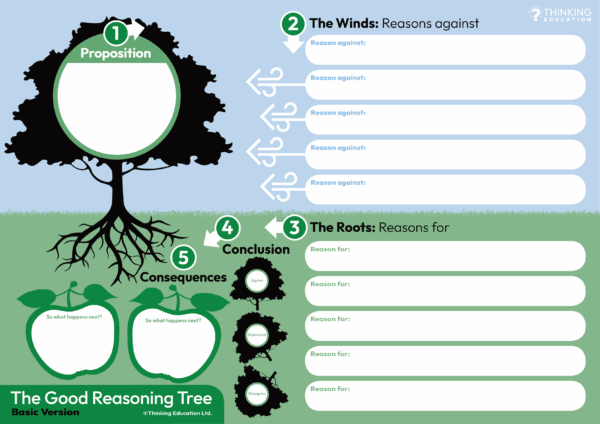
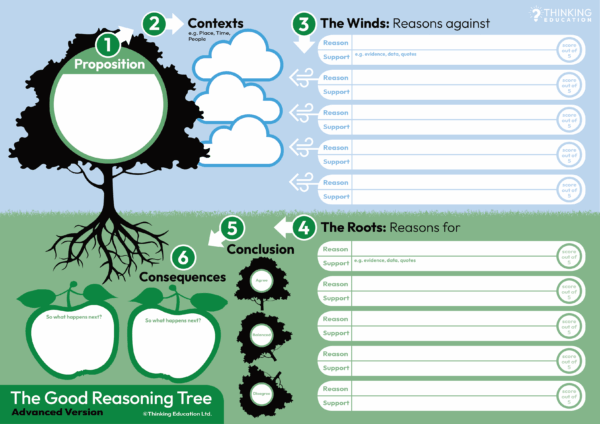
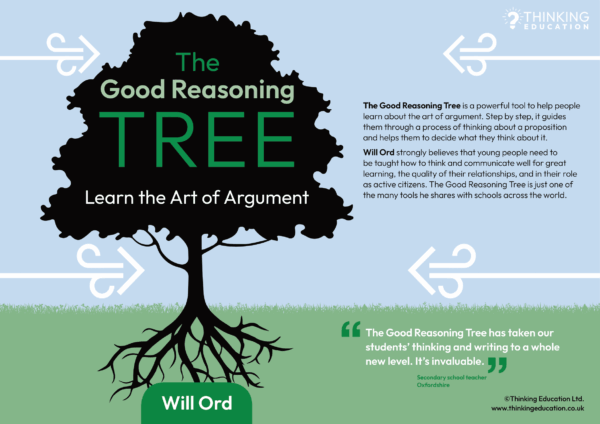
Will Ord has created the Good Reasoning Tree, a free resource suitable for use with primary and secondary age pupils. He describes this as a ‘thinking planner’ that aims to help young people learn the ‘Art of Argument’. But I would suggest the art of discussing and disagreeing well could be supported too.