Monitoring students’ use of disciplinary language in Religious Education
Research Spotlight: Monitoring students’ use of disciplinary language in Religious Education
November 2023
Cristo Rodriguez-Casado and Chris McMillan
Questions for consideration:
How is the teaching of philosophy as a discipline impacting student talk?
How can Tier 3 words support students to reason philosophically?
What impact does teaching argument related concepts have on students’ approach to philosophical arguments?
Our Project
Our project looks at student utterances across several schools in our trust in years 7, 8 and 9. We want to understand how students are using Tier 3 philosophical language. The project came about because we wanted to specifically monitor the impact of our explicit teaching of Tier 3 language (subject specific language from a particular field) from the discipline of Philosophy in our trust-wide RE curriculum. We wanted to ascertain how disciplinary language has impacted students’ ability to explain philosophical concepts, relate them to beliefs based on texts and also how students might be employing the Tier 3 words or the concepts that sit behind them to engage in reasoning.
Methodology
Our methodology took the form of audio recordings from lessons and transcript analysis (TA), pupil panel sessions capturing student talk (ST) and observations by teachers from the experience of teaching or from lesson visits by the project leader.
Our first stage was to visit lessons and record observations of student speak and analyse the audio transcripts. We then looked at what themes emerged from this talk. We asked if and how student utterances were moving beyond the descriptive and into the analytical. Based on these analyses we created questions for student panel interviews where students were asked about philosophy and engaged in philosophical discussion.
Examples of Findings
Tier 3 vocabulary enabled students to think deeply about concepts such as ‘creation’. Language such as ‘ex-nihilo’, infinite past, finite past and absolute beginning when pre-taught explicitly helped students to speak about the beginning of the universe.
Argument analysis emerged as powerful and practical. Students needed help to avoid substituting Tier 3 terms for more well-known words.
Student panels suggested there was high credibility in the purpose of learning these terms.
Disciplinary reasoning happened ‘live’ in some of our student panels.
Students became more aware of the ways to criticise a conclusion by objecting to premises.
Overall, we found that students were willing to engage with philosophical reasoning as a process or ‘extended project’ and we feel this mitigates against ‘early closure’ (Ashley, 2005 quoted in Stones and Fraser-Pearce, 2021).
Current and Future Developments
We have developed oracy tasks with authentic and accountable student talk through a Talk Moves approach (particularly Turn and Talk and Push for Justification). We have developed multiple choice questions to use at the end of a learning sequence which ask students to analyse an argument as valid but not sound, not valid or sound and then use logical chains of reasoning, tier 3 vocabulary to justify their claims. We are applying some of these oracy opportunities into other areas of RE such as theology (justifying interpretations based on texts) and this year sociology (justifying qualitative statements by sociologists and media based on quantitative data such as the 2021 census).
We are interested in the work of Stephen Toulmin (1958) in general and, in RE, how argument is conceived in curricula and syllabi, especially the differences and similarities between the disciplines of Theology, Philosophy, History and Human Sciences. We are interested in how these considerations might contribute to epistemic literacy. Please do get in touch if you are interested in these or related themes. crodriguez@dret.co.uk
References
Alexis Stones and Jo Fraser-Pearce. Some pupils should know better (because there is better knowledge than opinion). Interim findings from an empirical study of pupils’ and teachers’ understandings of knowledge and big questions in Religious Education, Journal of Religious Education 69 (353-366): 2021.
Stephen Toulmin. The Uses of Argument, Cambridge University Press: 1958.
Does a disciplinary approach to religious education improve Reception age children’s knowledge and understanding of their learning?
Research Spotlight: Does a disciplinary approach to religious education improve Reception age children’s knowledge and understanding of their learning?
June 2023
Catriona Card
This month’s research looks at exploring the use of an age-appropriate disciplinary approach to teaching religious education to children in Reception (aged 4-5 years).
Some questions to consider:
What educational philosophies or theories of education underlie your education approach? Do any of these conflict with each other?
Do you use children’s voice to inform your evaluation of how you teach? If not, is this something you could do?
How much do you know about the development of thinking in children and young people of the age group you teach? Are you aware of more recent research in this area and any new discoveries or understandings that have come from this?
My research is based on exploring the use of an age-appropriate disciplinary approach to teaching religious education to children in Reception (aged 4-5 years). My provisional research question is:
Does a disciplinary approach to religious education improve Reception age children’s knowledge and understanding of their learning? This is a doctoral research project under the supervision of Professor Julian Stern and Dr Amy Webster at Bishop Grosseteste University, Lincoln where I am studying part time.
My interest in this question came from two directions, firstly the increasing focus on a disciplinary approach to RE and my concern that if this is to take place in Reception it needs to be done in a way that fits in with good early years practice; and secondly the lack of information about whether such an approach is in fact possible and effective in Reception.
My research project is made both more interesting and more challenging by the fact that my research combines two strands, early years education and a disciplinary approach, which are based on very different philosophies and theories of education.
One finding of a small scale research project I completed in 2021 was that there is no consensus about what is meant by a disciplinary approach, or about what disciplines should be included. For the purposes of this study I am defining a disciplinary approach as using the ‘tools’ of the discipline, e.g. Philosophy being about developing and explaining your thinking.
I am still in the early stages of my study, and my focus has been on my literature review.
What is RE? Why teach RE? How do theories and philosophies of education impact on understanding of this?
The History and Geography of RE – focussing on the impact of key scholars (Hull, Smart, Cooling, Erricker, Jackson)
How RE is currently taught, including what has already been published on disciplinary approaches
Children’s voice – this will link to methodology as I want to gain children’s views on the impact of the approaches explored as part of my research
History and philosophies of early years education – where might the links and tensions be with philosophies and approaches used in disciplinary RE, much of which has been developed with older children?
Development of thinking in young children – what does this have to say about what young children may or may not be able to know/understand/do?
My focus for the next stage, from the autumn, will be my methodology. My reading on children’s voice has already identified some relevant literature, for example articles looking at methods to enable young children to effectively share their ideas.
A number of points have emerged so far from my reading. The roots of current approaches in RE, such as the emphasis on a worldviews approach and the use of a disciplinary approach, appear to be evident in the work of scholars from the 1970s onwards. Children’s voice appears to be most often used to gain information around matters not directly linked to the curriculum and the voice of the youngest children in schools is not always heard. There appear to be some links between the work of Hull and early years philosophers and practitioners.
Using British Religions in Numbers data in the RE classroom
Research Spotlight: Using British Religions in Numbers data in the RE classroom
January 2023
Debbie Yeomans, Claire Ramalli and Nadia Nadeem
In this month’s research Debbie outlines the work she has done with Claire and Nadia on using British Religion in Numbers data. Some questions for teachers to discuss or reflect on about how you might use or adapt this research:
• Is the You Gov data reflective of our community? • Why might some people want Jesus depicted to reflect their own ethnicity or culture? • Why do you think younger British people are less accepting of the idea of a white Jesus? • What can we learn from the census 2021 data on religion?
The research project commenced after three of us, who have since completed the Culham St Gabriel’s leadership programme, were offered the opportunity to create and deliver lessons using the online religious data resource; British Religion in Numbers (BRIN). www.brin.ac.uk
This project was cross-phased, we are a group combined of two Primary practitioners and one secondary practitioner. Nadia Nadeem and Debbie Yeomans are both primary practitioners with year 6 classes. Nadia teaches in Barking and Dagenham, East London, an ethnically diverse community. Debbie teaches in Stoke Golding in a small Church of England village school, serving predominantly a white middle class community. Claire Ramalli teaches RE in a large non-denominational secondary school in the coastal town of Eastbourne, East Sussex. The project involved planning and delivering lessons on two sets of religious data. Firstly, lessons linked to the decolonisation of teaching about Jesus.
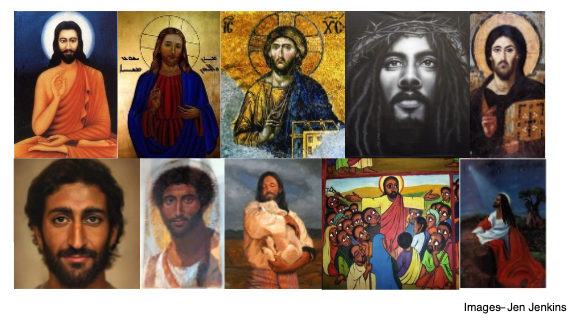
Secondly, Islamophobia and the misrepresentation of Islam and Muslims in the media. (Discussion on the latter research is found at https://vimeo.com/767284160) We were each eager to deliver lessons that would challenge and question stereotypes, better preparing students for modern day Britain. We met online to discuss and plan our lessons. We analysed the religious data and aimed to deliver similar style lessons to ensure our research could be replicated. The depiction of Jesus lesson was delivered to the two year 6 classes and a year 7 group. We all introduced our lessons by setting our classrooms up in the style of a gallery, pinning up different depictions of Jesus. Pupils walked around the classroom, guided to discuss each picture, considering questions about the representation of Jesus.
The research project commenced after three of us, who have since completed the Culham St Gabriel’s leadership programme, were offered the opportunity to create and deliver lessons using the online religious data resource; British Religion in Numbers (BRIN). www.brin.ac.uk
This project was cross-phased, we are a group combined of two Primary practitioners and one secondary practitioner. Nadia Nadeem and Debbie Yeomans are both primary practitioners with year 6 classes. Nadia teaches in Barking and Dagenham, East London, an ethnically diverse community. Debbie teaches in Stoke Golding in a small Church of England village school, serving predominantly a white middle class community. Claire Ramalli teaches RE in a large non-denominational secondary school in the coastal town of Eastbourne, East Sussex. The project involved planning and delivering lessons on two sets of religious data. Firstly, lessons linked to the decolonisation of teaching about Jesus.
Secondly, Islamophobia and the misrepresentation of Islam and Muslims in the media. (Discussion on the latter research is found at https://vimeo.com/767284160 .) We were each eager to deliver lessons that would challenge and question stereotypes, better preparing students for modern day Britain. We met online to discuss and plan our lessons. We analysed the religious data and aimed to deliver similar style lessons to ensure our research could be replicated. The depiction of Jesus lesson was delivered to the two year 6 classes and a year 7 group. We all introduced our lessons by setting our classrooms up in the style of a gallery, pinning up different depictions of Jesus. Pupils walked around the classroom, guided to discuss each picture, considering questions about the representation of Jesus.
Example questions to support this activity included:
Which image do you relate to the most and why?
Which image do you think is most realistic, why did you pick this one?
Do you think anything has influenced your thoughts?
Which picture do you think is most historically accurate and why?
Where do you predict the artwork is from?
What do you think the artist is trying to convey?
What else strikes you about the image?
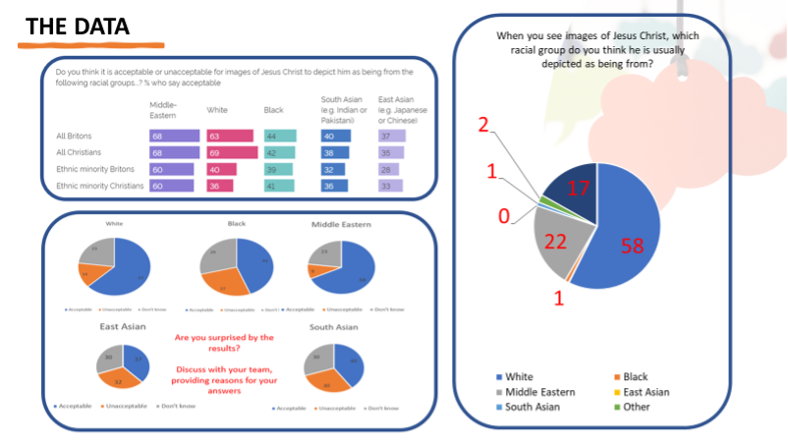
Pupils were then introduced to the YouGov poll data. The data illustrated the majority of people in the UK expect to see a white Jesus. (58%) Debbie incorporated a small group silent discussion in to one of her lessons to deepen the students’ engagement with the data.
Below are examples of questions to support these discussions:
• Why do you think British people are much more likely to see Jesus depicted as White than Middle Eastern? • Why is there a big difference between the Jesus most British people would expect to see and the depiction of Jesus that makes most sense to them? • Why do you think younger people are less accepting of the idea of a White Jesus?
What were the key findings?
Nadia’s year 6 class discussed and debated the statistics through a process of inference and critical thinking, using prior learning to support their claims. For example, a pupil reasoned that Jesus must have been tanned as he was born in Bethlehem and that is near the equator, therefore would have had a lot of sun. Another child added that Jesus cannot be blond and blue eyed because he was a Jew, Jews were killed in WW2 for not being blond and blue eyed.
When questioned have you never seen a blond blue eyed Jesus, all the children said ‘no’. This was very much a contrast to Nadia’s own experience and the experience of Claire’s children, who study in a different borough and have seen images of Jesus where he is depicted as a blond blue eyed man.
Nadia’s class were extremely confident with their opinions and conclusions regarding the data and the depiction of Jesus that they believed to be the most accurate. Nonetheless, when posed with the question, “Can Jesus be portrayed as a different ethnicity to enable people to connect with him?” – they all said “Yes, but that would be their opinion and not a fact.”
Debbie’s lessons led to some deep discussions, giving children the chance to consider not only others’ opinions on the depiction of Jesus but also their own ideas. They considered where the Bible suggests Jesus was born and grew up, which led to some powerful lightbulb moments. The children then became quite concerned that the image they were used to seeing of Jesus were not accurate representations, and led to conversations around the depictions of angels particularly at Christmas. Debbie aimed to follow this up at Christmas using Justine Ball’s work on the decolonisation of teaching about Jesus.
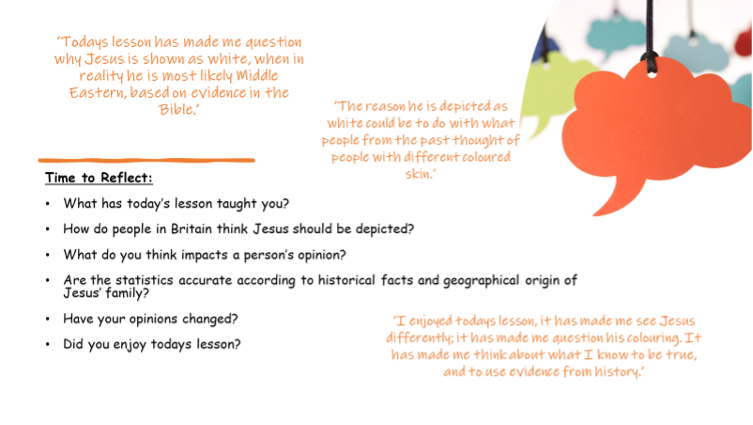
Claire’s year 7 class reflected on what they had learnt and if their opinions of the depiction of Jesus had changed since the start of the lesson. Analysing the feedback forms, the majority of students stated that their opinions of Jesus hadn’t changed, a significant number of students had already perceived Jesus to be Middle Eastern based on their prior knowledge of Jesus being Jewish and from Israel. The majority of students believed people’s attitudes towards the depiction of Jesus’ race was mostly based on an individual’s own ethnicity, whilst some students reflected that a persons’ family or stories and pictures of Jesus were the most influential in how a person perceived Jesus to look. One student commented that some Christians might want Jesus to look like them because of the act of the eucharist, with reference to transubstantiation.
What feedback did we get at RExChange?* What might be useful to do next, as a follow-up?
Lessons were taught as stand alone and we all agreed that the subject matter and data should be taught over two lessons rather than the one. All of us said we will incorporate the lessons in to our curricula. Debbie’s class went on to consider whether the data was reflective of their own community. The children made surveys using the data questions and shared them with staff and adults from home. This led to interesting discussions at home and with children’s families. Debbie’s mathematicians enjoyed collecting the data, presenting it to the class to making comparisons. This is something that we all agreed was a worthwhile activity and would deepen further engagement with the data.
Since delivering our research in the RExChange session we have received the following feedback from attendees: “I did the lessons and would like to do them again, by incorporating them into my curriculum.” “This was extremely interesting and opened up an exploration between images and data that I hadn’t even considered before! Great stuff.”