Painting a New Picture: Cultivating Learning for Its Own Sake in Religious Studies for 16-18’s
Sophia Duckworth: Teacher and recipient of a Culham St Gabriel’s Masters Scholarship
How can we help A level students move beyond feeling overwhelmed by dense Religious Studies content and instead develop a genuine curiosity for the subject?
In this spotlight, we explore the work of Sophia Duckworth, a CSTG Masters Scholar, studying part time at Cambridge University on the MEd in Education (Transforming Practice) whilst teaching.
Sophia’s action research investigated how arts-based pedagogy can open up deeper engagement, understanding, and enjoyment among 16-18 year old learners. Her project offers a compelling model for teachers seeking to cultivate a “learning for its own sake” ethos within the RS classroom. Read about her work in more detail here.
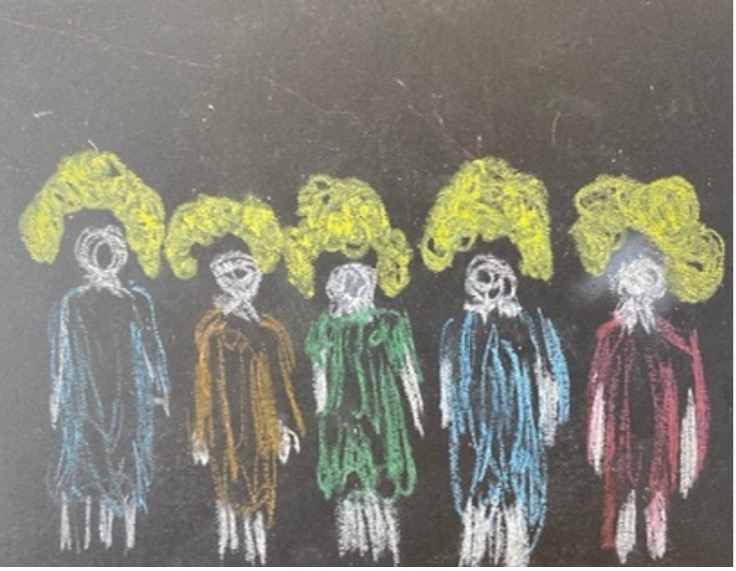
- Where might creative or visual approaches help your students grasp difficult RS concepts?
- How could you adapt Sophia’s methods to suit the needs and context of your cohort?
- What opportunities exist in your curriculum to cultivate intrinsic motivation rather than purely exam‑driven engagement?
The Research Context: Teachers of Religious Studies with 16-18 year olds know the challenges well:
- Abstract and complex concepts
- Heavy content demands
- Student perceptions that RS is academically “hard” or “too much”
These factors can limit both students’ confidence and uptake, a problem noted in wider pedagogical literature (e.g., Thorpe 2019; Examiners’ Report 2022). Sophia’s research responds directly to this by trialling three arts-based lessons on Christianity, allowing students to work with theological ideas in ways that felt creative, personal, and manageable.
Sophia used a Participant Action Research (PAR) model to design and teach a sequence of lessons that enabled students to:
- Represent theological ideas visually
- Discuss and interpret Christian concepts through creative prompts
- Reflect deeply on meaning-making
- Move between text, image, and dialogue to build understanding
Students’ artwork, classroom dialogue, and written reflections formed the basis of her analysis.
Her findings showed:
- Creativity Makes Abstraction Accessible: Students found that visual and creative activities helped them internalise and articulate theological concepts that might otherwise feel remote or intimidating.
- Engagement and Confidence Increased: Arts-based tasks allowed students to take intellectual risks. As a result, participation improved, not just in the creative tasks themselves, but also in subsequent analytical discussion.
- Intrinsic Motivation Grew: Perhaps most significantly, Sophia observed students developing greater intellectual curiosity. Freed from the immediate pressure of exam structures, pupils appeared more willing to explore ideas, ask questions, and enjoy the learning process.
How You Might Use This in Your Classroom? You may wish to experiment with:
- Symbolic artwork to explore theological concepts
- Mixed‑media responses to sacred texts
- Creative stations where students rotate through tasks (e.g., drawing, annotation, collaborative modelling)
- Displaying student work as a way to validate diverse forms of expression
Sophia Duckworth’s work offers an inspiring reminder that high‑level theological thinking does not have to rely solely on text-based analysis. When students are invited to think, create, and interpret through the arts, they may encounter RS content in ways that feel richer, more accessible, and more personally meaningful.