Viewing archives for Leadership

The answer to that is an awful lot if you ask our current and some of our previous Leadership programme scholars. Perhaps you lead RE/RME/RVE and are already working across a MAT, local area, region or in a national capacity, if so this is the programme for you! Read the thoughts of some of our current scholars and find out more.

Support…

The Culham St Gabriel’s Leadership Scholarship programme has key elements but is also designed to support and develop you in your own context. Sarah Dennis, Year 2 programme member, explains, ‘I joined the programme because I was running networking groups and wanted to support teachers better. I had friends who had completed the programme. I saw how many doors it opened for them to enhance their roles. I now run effective meetings and can point teachers to good opportunities. I run a cross-phase network, and I am now more confident talking to secondary teachers.’

We are keen that this programme supports leadership for all teachers in their different contexts. Carrie is currently on Year 1 of our programme, teaches in Wales and supports teachers in her local area. She says, ‘My mentor has been incredibly supportive, guiding me to set personal targets directly relevant to my work in RVE in Wales. The Culham St Gabriel’s leadership programme has been inclusive, allowing me to engage with and learn from other leaders, while exploring leadership strategies, research, and best practices in the subject that are relevant to my context. The course has been extremely rewarding, deepening my understanding of religious education nationally and internationally, and helping me build confidence and valuable connections’

Amy, also a primary school teacher, explained, ‘I was excited about the opportunity to develop my knowledge and skills within the world of RE! And be amongst a community of like-minded peers and leaders.’

Community…

The programme provides a community of people you can learn from including your mentor, the reading group leader and your colleagues on the programme. Several of our previous programme participants have gone on to do projects together.

Lorna John, head of RE at Oasis Coulsdon previous programme member says, ‘There is a supportive community of likeminded and passionate peers who share the journey with you and this provides opportunities for constructive discussion and networking.’

Development…

Claire Ramali, a previous programme member notes the transformation that the programme supported, ‘The leadership programme has been transformative for my professional practice and leadership journey. A direct consequence of the opportunities from the Culham St Gabriel’s programme means my work is having a wider impact on the subject community. The programme led me to join the AREIAC executive committee which has enabled me to work alongside other RE national advisors. The programme has also enabled me to support other RE leaders and share my knowledge and experience as others have done with me.’

Several members of the programme lead across a MAT. Natalie Parkin who leads RE across Outwood Grange notes the importance of seeing life outside of your own MAT, ‘From a personal perspective it has been great to meet with others who lead and are passionate about RE as you can very much get into a bubble in a MAT. Leading so many colleagues it has been really useful to have a sounding board to talk my ideas and dilemmas through with before acting on them, and connecting this to best practice in RE. It has also helped me to identity the areas I need to develop in my colleagues to enable them to deliver great RE.’

Research focus…

Jake is in year 2 of the programme, ‘I joined the Culham St Gabriel’s Leadership Programme to support me in my work furthering great RE beyond my classroom. The experience has been incredible—I’ve gained so much from the wisdom of my mentors and through thought-provoking discussions with inspiring peers. The programme has enhanced my confidence in engaging with academic reading and applying it to practice. I’m now particularly excited to complete my research and see how it will shape my leadership journey and contribution to RE.’

Alice took some time out between year 1 and 2 of the programme and describes the focus of her work on the programme, ‘…Stage 2 of the Leadership programme has enabled me to continue to develop my knowledge, skills and understanding of the assessment of our subject. I completed Stage 1 alongside my Farmington Scholarship two years ago and have thoroughly enjoyed having the opportunity to continue to develop the assessment of a religion and worldviews approach. Being able to visit a primary school and discuss assessment with both teachers and students has given me a great insight into how we can assess students throughout their religion and worldviews journey. ‘

Differing views…

Through communities of practice, reading groups and work with their mentors participants have to listen to differing ideas and sometimes ideas they disagree with. Amy says, ‘I am eager to grow in the area of ‘research engagement’ as this is brand new to me. I understand the importance of broadening my understanding of contrasting views, opinions, and research from field experts. I am excited about deepening my disciplinary knowledge, especially in the philosophy sector.’
So if you want a programme that will support you, develop you and change you take a look at the Culham St Gabriel’s Leadership Scholarship programme. Applications open on January 16th and close on 27th March. We will also be holding a webinar on Tuesday 10th February 5.30-6.30pm. See you there?

As Subject Director I oversee the provision of Religious Education (RE) and Personal Development (PD) in our 28 secondary schools. Whilst it is wonderful to have an RE Subject Director, unlike the other subject teams, I am a one-person team, which can be rather isolating. I have therefore developed a support network around me, just as lone RE teachers do in schools, which makes a big difference.

I had been suggesting that an RE Subject lead role was needed in the Trust for some time. My argument was that RE and PD are focused on producing well-rounded citizens who are ready to participate in society. When the role arose, I applied, excited to have the opportunity to advocate for RE and PD in all our schools.

When I reflect, 2 years on, I can see the curriculum is changing. From an original basis in Ninian Smart’s 7 dimensions of religion, we are shifting towards a religion and worldviews approach to Religious Education. In particular, we are taking on a wider understanding of pedagogy in RE and exploring different disciplinary lenses through which to make sense of content. One maxim I stand by is ‘less is more’ this has been enormously helpful as we embarked on the difficult first few steps towards change.

Although the developments are exciting, and necessary, it does mean that the increasing numbers of non-specialists teaching RE is a challenge – but we are all still learning, so we can develop together.

There are so many joys in this role. I work with brilliant colleagues across the Trust, and I have embraced the opportunity to develop resources for the National Institute of Teaching. Working with external partners such as UCL, The National Holocaust Centre and Museum and Lord Mann’s Office has been incredibly enriching. I also appreciate the chance to take a step back from the hectic day- to- day life of a teacher and think more reflectively about the curriculum and what our students are learning.
Effective communication is central to my work, which is all about balance. Curriculum guidance needs to be detailed enough to be clear and the reasoning behind it visible, but it also needs to be succinct enough to fit into a busy day. The most effective method of communication has been creating our internal website. This has become a one-stop-shop for everything we discuss, share and create. All staff can access guidance and resources, and it frees me up as well, as many questions can be answered by checking here.

I see green shoots emerging in so many places. Discussions about religion and worldviews are taking place! We have appointed more specialists, resources are shared across schools and the subject is now being viewed on a par with other subjects, with Subject Lead training days and other Trust-wide provision. Increased confidence and competence across the Trust is starting to emerge, with some schools taking part in UCL’s Beacon School Programme and others applying for the UCL Quality Mark.

My aim for the coming year is to map out what high quality Religion and Worldviews looks like from Early Years to Post-16. I am pleased that the Trust will continue to recruit specialists and develop those already in post. Ultimately the vision is to continue to grow in strength and understanding as a subject of benefit to all our schools and all our pupils.

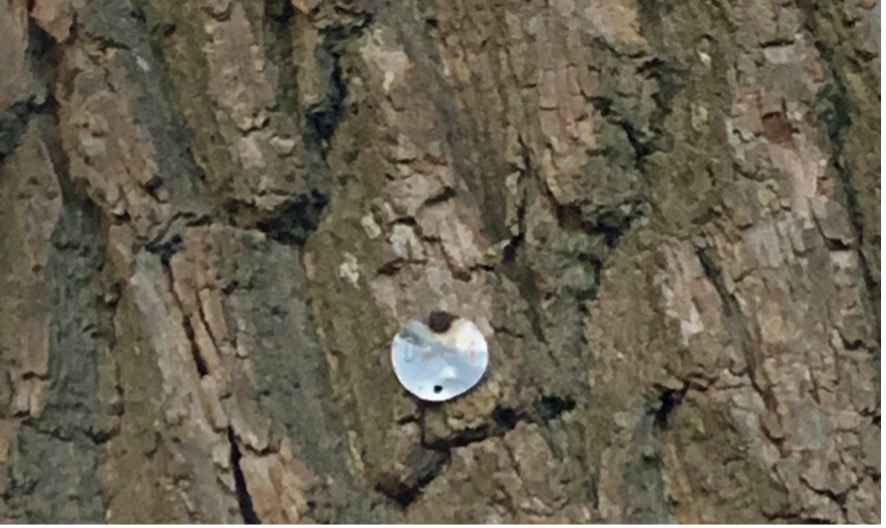
I was out taking the dog for a walk around the village the other day when I noticed that one of the oak trees on the back lane was tagged. It was only a small metal disk nailed to the tree’s trunk, but it was there to show that it was a protected tree subject to a preservation order.

small metal disk nailed to the trunk of a large old tree.

When I thought about the tree later that evening, I began to think about our role as teaching practitioners in protecting and preserving our subject in the face of the challenges education can throw at us. How can we effectively achieve this?

We need to “shout” about how important our subject is and it’s role in the school curriculum. It is not just the senior leadership team that need to hear the message but so should the school governors, the pupils and their parents. I’m not suggesting that it’s easy or that it does not need some careful planning and thought but there are some good starting points.

Firstly, make sure your RE curriculum is both progressive, engaging and stretches pupils’ learning. This is important to ensure long term pupil engagement. Help to develop the pupil voice in RE by providing ample opportunities for discussions and debates; not every lesson needs to include written work. Consider using visual evidence of pupil engagement, photographs can say a lot more than books filled with worksheets. Talking of visuals, a good way to demonstrate RE’s importance is to carry out a human mind map. This something I have used regularly at the start of each academic year. I have an A4 visual for each of the subjects on the school curriculum and I ask for a volunteer at the start explaining that the role requires someone who is very strong; I give this pupil the visual for RE. Another pupil holds up one of the subjects and the group discuss any links they can think of, once they have suggested two or three links then a string is held between them linking them together. The discussions continue in this way until all the subjects have been linked to RE. Videoing the activity with an iPad helps with the summing up at the end. Some subjects are easier to link than others; for example, history can be linked to RE because historical facts play an important role in religions. Other subjects are harder for example, physical education but with a little prompting pupils suggest things such as the issue of athletes wearing hijabs.

Some of you might think I’ve gone slightly mad, but it is a good idea to volunteer a lesson during the next round of lesson observations. As well as making sure that the lesson has plenty of evidence that meets any lesson observation briefing but include opportunities to address common misunderstandings and misconceptions. Let the pupils show that they are making links in their learning and don’t be afraid if the observer wants to talk to them. You already know that they are fully engaged and committed to their learning in your lessons. The observer will leave your lesson feeling very positive about RE and will share their thoughts with other colleagues.

Invite school governors to join one of your lessons or to observe a whole school RE activity. In my experience both as a teacher and a school governor, governors like to take advantage of opportunities to observe and learn about what goes on in our lessons. If this is not possible then volunteer to talk to the governor’s curriculum sub committee about the RE curriculum and how it strengthens the other subjects. If you can get the pupil voice and their positive thoughts on RE then so much the better. Make sure governors understand the non- academic role of RE in helping to develop pupil’s understanding and tolerance towards other peoples beliefs and how this helps them to develop their ability to be effective members of the community.

If there is a local RE Hub in your area, then make sure you join it. They are a wealth of knowledge, experience and ideas. My own local hub is called the “Pathways RE Hub,” the founding members came up with the name early and it simply stands for the “Pinch and tweak hub,” where ideas are shared and tweaked to an individual school’s need. Hubs also offer fantastic opportunities for networking and informal CPD. My other suggestion linked to hubs is to offer to host a meeting within your own school. Don’t forget to invite senior leadership and a governor or two!

As a final thought, if you are new to leading RE then in addition to joining your local hub, consider the RE Quality Mark. It can offer an excellent and effective framework for you to develop your leadership of the subject against. When you gain the quality mark whether it is bronze, silver or gold then you will have a very visual acknowledgement of how effective your RE faculty is, in the form of the certificate which can be displayed prominently for all to see.

Life contains the most unexpected changes of direction. I never set out to be an RE teacher, never mind an RE subject leader.  Even more surprising to become a paid RE Adviser to my local SACRE, a provider of RE CPD to two local Councils and the North West Lead for the RE Hubs. How did this happen? Sometimes I still ask myself this. I had been an anti-racist advisory teacher in Cumbria and when I returned to the classroom, I was delighted to take the lead on RE and Philosophy for Children (P4C). It has been a steep learning curve, but I have enjoyed every minute. I hope this blog might inspire others to stretch their wings and discover leadership.  

I initially joined my SACRE as a Humanist representative, but a decade later when I found myself leading the review of the Cumbria Agreed Syllabus, I felt I needed expert guidance. I applied for the CSTG Leadership Programme and was delighted to be offered a place.  I was acutely conscious of the changing landscape and the move to Religion and Worldviews. I felt a huge weight of responsibly to have up- to- date knowledge, especially without any formal specialist training. Another reason for applying for the Leadership Programme was also a personal desire to find opportunities to engage in RE more on a national level. 

 The Leadership Programme certainly did support me to feel confident and competent. My Mentor Fiona Moss provided an invaluable space for me to reflect on my development as a leader within the subject. She created a non-judgemental environment in which we could discuss the challenges of creating a syllabus in a changing educational landscape.  

The mentoring process helped me to address areas where I lacked confidence and tease out my strengths. I realised I don’t have to be a leader in every aspect of RE, but the skills I have can be of service to the community. Fiona also provided me with valuable connections and sources of support from the wider RE community.  

The Programme supports members to engage in academic readings, which for me was hugely important. Prior to the programme, I had little knowledge of how RE has evolved as a subject and how contestable it is. I quickly realised how crucial this knowledge of the history of the subject is for understanding the current landscape.  I won’t deny that I found the academic readings challenging at times but through the reading group, led expertly by Sean Whittle, our understanding flourished. Having the opportunity to question the authors of the academic readings was invaluable. 

I particularly enjoyed being part of a Community of Practice sessions where we could discuss and explore together. These sessions helped me to better understand, take more interest and value the lobbying and campaigning by national RE organisations. We have all kept in contact, and had the pleasure of meeting again at the AREIAC conference, where the  programme funded out attendance.  

Without a doubt it was the Leadership Programme that gave me confidence and the capability to apply for the role as North West RE Hubs Lead. In many ways, the support I am now gaining from this RE Hubs national team is comparable to the Leadership Programme community.  One of the main things I have learnt is that leadership works best in collaboration with others. 

Since finishing the leadership programme in the summer of 2023, we have launched our new Locally Agreed Syllabus and I have been busy delivering CPD to support its implementation. What next for me?  I plan to grow into both of these new roles as North West RE Hubs Lead and local RE adviser to SACRE.  I have recently become a teacher trainer for Understanding Humanism so enjoying rising to the challenge of providing some of their national training.  However, I will also be keeping an eye out for teachers in Cumbria who I can support to become the next generation of leaders of RE.  Hopefully I’ll persuade them to apply for the Leadership Programme…  

In part 1 of this blog, I described my initial motivations of choosing relevant research linked to my classroom teaching and how these articles helped my thought processes. In part 2 I will continue this story by delving more into the classroom practice of others and how these examples have helped shape what I now do in the classroom.

This leads to the work of Kevin O’Grady and Robert Jackson (2020) with their piece on Year 7 views on RE. They focus on how setting clear ground rules for discussion on religious and ethical issues can improve the learning journey for the learners. This is very closely linked to the enquiry base of P4C and also gives an ownership of the learning process to the learners. Add to this contact with faith representatives and non-religious groups helps the learners construct better modes of motivation and relevancy of RE in their studies. This can hopefully lead to better evaluation and understanding of the worldviews held by believers, and this then leads to the better development of hermeneutical awareness.

If O’Grady and Jackson stress pupil self-awareness, Ruth Flanagan (2021) has shown that the same need applies to teachers. Her article on how teachers need to become conscious of their own worldview has really highlighted to me how we should be wary of just taking our worldview and imposing it in the classroom – even just by the selection of what we teach.

As Flanagan points out, we need to become worldview- conscious, providing scaffolding and support with which to read and evaluate the worldviews of others. Rob Freathy and Helen John echo this in their “Worldviews and Big Ideas” work (2019): the clearest link to make here would be between Flanagan’s worldview consciousness and Freathy and John’s view that the set of Big Ideas needs expansion, to become aware of our own position and to be able to reflect on how our own life has ben shaped by our experiences which culminates in our personal worldviews.

Where is the place of objective criticality in all of this? Jawonyi (2014) expounds the value of critical thinking and evaluation and how it is necessary in our teaching. Certainly in the AQA Religious Studies Specification of 2017, the value of evaluation is 50% of the marks available. It is also a key skill within most syllabuses, where evaluation is asking the learners of how an idea, belief or practice fits into their lived experience and worldview and also into the worldviews of others.

Let me begin to summarise by turning to Martha Shaw and Adam Dinham’s work (2020) about how RE is being reimagined in the classroom. Using examples from five diverse school settings they show that great quality RE is being delivered through a range of different approaches. In these examples, religion and worldviews are interpreted by the learners to show both how they overlap and differ. A common agreement is that we should be worldview conscious and able to challenge our own assumptions, beginning by looking at religion and worldviews from a local perspective and expanding our horizons outwards.

For the past six months or more I have been on a research journey. This blog has not covered everything that I have read but has touched upon those sources that have come out with key ideas and views that I have reflected upon. Each of these articles has helped me look at how I teach and what I teach in the classroom. The ways in which learners are asked to evaluate and interpret texts, beliefs and ideas needs more structure; teachers and learners need better self-awareness of their own positionality and worldviews; that good RE can be taught in different ways, harnessing a range of resources and styles, to produce an effective and enjoyable learning experience. These are important points to consider in what we plan, teach, and develop.

Before I taught what was in front of me, using my own interests as a guide to what I wanted in the grand scheme of things. Now I ask myself “Why? Why do I want to teach that? What is the process that we are going through? How will we build or use that understanding or knowledge?” In my mind this has made me a better practitioner and teacher of RE as I have had to think about the process that I go through, almost to the point that it is now second nature.

References

Flanagan, R (2021) Implementing a Ricoeurian lens to examine the impact of individuals’ worldviews on subject content knowledge in RE in England: a theoretical proposition: British Journal of Religious Education, 43:4, 472-486 Online article can be found here

Freathy, R & John, H.C. (2019) Worldviews and Big Ideas: A way forward for Religious Education? Nordidactica, Journal of Humanities and Social Science Education, 2019:4 Online article can be found here

Jawoniyi, O (2015) Religious Education, Critical Thinking, Rational Autonomy, and the Child’s Right to an Open Future: Religion & Education: Vol 42: 1, 34-53 Online material can be found here

O’Grady, K & Jackson, R (2020) ‘A touchy subject’: teaching and learning about difference in the religious education classroom: Journal of Beliefs & Values: Vol 41:1, 88-1-1 online article can be found here

Shaw, M & Dinham, A (2021) Innovative teaching and learning of religion and worldviews in schools, Innovative RE: Case studies, Goldsmiths, University of London Online material can be found here

I have been teaching RE for 25 years and one of the challenges in teaching at the moment is how to keep our subject moving forward and keep our motivation going. This year I have been a participant on Stage One of the Culham St Gabriel’s Leadership programme that is supported and guided by the main national organisations that have a say on the future of RE. The subject has seen many changes over the decades in terms of approach, name, content, purpose, and value within schools. Do teachers have a say in any of this and how can they implement change? This was a motivating factor in applying for the Culham St Gabriel’s Leadership Programme; to have a voice and be heard in the debate. I decided to engage with a set of research outputs, as part of an attempt to clarify where I stand in terms of the issues in RE. I chose a range of articles reported in the RE:ONLINE archive to read, digest, think about and if possible, implement on my own teaching.

One of the first articles that I read was Nastasya van der Straten Waillet, Isabelle Roskam and Cécile Possoz’s work on the advantages of using Philosophy for Children in RE (2014). I am a long-term advocate of this approach but my use of it is hampered due to lack of time within the classroom and that P4C needs to be used in a certain way that sometimes gets lost.

Although the research takes place in Belgium, it has very clear links with my syllabus: Hampshire Agreed Syllabus, ‘Living Difference’. The interpretative nature of the process, along with an enquiry-based approach helps the learner unwrap and unbox the key ideas of the focus of enquiry. It needs careful prodding and needling (and a skilled facilitator) in order to get to the evaluation process.

This point about interpretation connects with Julia Ipgrave’s work on what secondary teachers can learn from our primary colleagues (2013). “From storybooks to bullet points” leads us to understand that primary RE is full of colour, rich in text and story and that the child is allowed to imagine and think through those stories that come to life from the holy books. This piece was written before the new GCSE specifications came into being, and these have a renewed focus on textual references but often they are just that. The context has been stripped away, they are words to back up an argument, as an example to show a believers’ faith and not as the story with meaning that they should be. Take for example the AQA GCSE spec that looks at the Incarnation and then jumps straight to the Crucifixion. Where is the narrative? Where is the story that sets the scene for the final act of Jesus’ life? Is this meant to be left for previous knowledge or learning? One thing I have taken from Ipgrave’s work is that the story is just as important as the teaching as it is the context that matters.

Bob Bowie, Farid Panjwani and Katie Clemmey (2020) may agree. Their work, “Opening the door to hermeneutical RE” has really helped me to open up the texts in ways that our English subject colleagues have been doing for decades. The pupils are familiar with taking a text, breaking it down, looking at its context and meaning, the purpose of the writer and the symbolic nature of the words. We should make more of these insights in RE, enabling pupils to learn in more focused, nuanced ways.

In part 1 of this blog, I have shown my initial motivations of choosing relevant research linked to my classroom teaching and how these articles have helped my thinking. In part 2 I will develop this by delving into more classroom practice of others and how these examples have helped shape what I now do in the classroom.

References

Bowie, R, Panjwani, F, Clemmey, K (2020) Teachers and texts: Improving Religious education through hermeneutics (canterbury.ac.uk) Online material can be found here

Ipgrave, J (2013) From storybooks to bullet points: books and the Bible in primary and secondary religious education, British Journal of Religious Education 35.3 pages 264-281 online article available here

Van der Straten Waillet, N, Roskam, I & Possoz, C (2015) On the epistemological features promoted by ‘Philosophy for Children’ and their psychological advantages when incorporated into RE: British Journal of Religious Education, 37:3, 273-292 Online article can be found here

I have been connected to the REQM since its inception. One of the co-founders, Jane Brooke, was our local RE adviser, so I had a lucky local connection. My school applied for our first REQM while it was still in its infancy and we were lucky enough to receive the Gold Award. As an SLE in RE I trained as an REQM assessor and have been involved ever since.

We were initially interested as a school because we wanted to explore our next steps for developing our RE. We were inspired to develop learning through drama, and other innovations. Over time I have enjoyed supporting clusters of schools working towards the REQM, sharing good practice and working productively with our local SACRE.

When you look back over 11 years of the REQM, I reflect on the importance of being open to different ideas. We don’t all have the same assessment methods, pedagogy or even subject content when it comes to RE but the REQM has evolved so that different voices count and criteria can be met in different ways. I also reflect on the impact which it has had on my career. Speaking at a conference is normal for me these days, but I doubt without the support of the REQM I would have taken this step. The nurture of the subject lead is also important to the REQM process, it supports, questions, evaluates and develops.

I am convinced the REQM continues to have value in the RE world, and more widely. RE needs to stand alongside the quality marks of other subject areas and to be celebrated. The Evidence Form itself as a tool to help them to design an action plan for their subject areas. Being a teacher assessor also opens up opportunities for subject development and leadership.

As well as meeting other teachers, interviewing children about their learning and experiences of RE is always a delight. They are always so keen to show you what they know. Their experiences are wide, varied as is their passion for the value of the subject in their lives within the wider world.

As a teacher myself I know how worrying an assessor visit can be so I always chat to subject leads and get to know them before the visit. It is also fabulous to be able to give a teacher a well- deserved pat on the back and reassure them that they are doing a fantastic job, and to be able to feedback to SLT. This recognition is so important as being an RE lead is often quite a lonely job and the subject doesn’t always have the status it deserves.

It would be great to see the organisation grow and offer networking events. I love the ‘REQM map’ and would like to see opportunities for schools to be working together locally, for example, REQM Gold schools supporting new subject leads and hosting events. Let us make our communities more aware of RE and its relevance to today’s society.

I would say to those thinking of applying to think of the REQM as a journey. Work towards achieving the very best you can for your school, even if this takes time. Involve your SLT and governing body and keep them informed. I have found REQM to be an exceptionally supportive organisation who are driving standards. Get involved with it to develop your own departments, celebrate your achievements, share ideas with others and open doorways to other career opportunities.

I have been an assessor with the RE Quality Mark since the award began, also serving on the review team. As subject lead I was thrilled when we achieved a Gold Award for my school. I was then so proud to see it renewed under the leadership of our current subject lead. I can say my school knows the REQM quite well!

I was excited when I first found out about the award. I loved the way subject leaders were given national expectations, this was a first. Additionally, the process provided exemplification of high-quality RE. Now I know the award better, I can see this exemplification has been an incredibly useful aspect, not just for those schools going through the quality mark process, but for the RE community generally.

There have been changes over time. These have been driven by the need to ensure the award is rigorous and fit for purpose. When educational thinking, and thinking about Religious Education shifts, the award must being able to adapt too, to reflect it being about excellent practice in the subject.

There have been changes in the leadership and administration of the award but what has not changed is the passion and inspiration to offer an award that recognizes and celebrates the very best in RE.

When I look back over 11 years of the REQM, I reflect on its ongoing importance. It is still valued in the RE community, and among school leaders. One dimension particularly close to my heart is the way the award continues to support and inspire emerging leaders, whether in Primary or Secondary.

While I appreciate the warmth with which teachers of RE view the REQM, I also hugely value the status it has outside the RE world. It speaks more widely of our professionalism, innovation and growth within education. In an individual school, the REQM demonstrates the value of the subject, but in the world of schooling and education more generally, it sends out a wider message of quality and development.

I think what surprises and delights me most, when I reflect on my years of working with colleagues as an assessor, is their determination and perseverance. Some schools face significant challenges and I have worked with many teachers doing everything they can to overcome them. Even in the face of significant setbacks and long-term challenges, the teachers I have encountered in my role never lose faith in the value of what they are doing, it is both humbling and motivating to witness.
I particularly enjoy working with teachers in schools as an assessor. As a school teacher myself, I continue to learn from and be inspired by colleagues in other schools and situations. It broadens my perspective and enriches my own expertise.

To any teachers thinking about applying for an REQM, I would say go for it! The experience will encourage and inspire you, enrich your RE provision and offer the professional and personal enhancement of reflecting critically and constructively on your practice.

If teachers are not sure if their leadership team will support their application, remember that this is a unique way to validate the quality of your RE provision whilst providing staff with complimentary CPD. I am sure the REQM will continue to champion high-quality RE and validate nationally- agreed strong RE provision well into the future.

I was a frazzled NQT when I was told I was to be the RE Lead. However of all the subjects to be given, this had real interest for me, having been a Catholic, atheist and now a member of the Church of England. But where to start in the role, especially when I was still spending so much time on planning, marking and getting to grips with behaviour? An RE week in November was something to aim for.

My knowledge of the area meant a beeline to local places of worship. Despite the rich variety in our area of Southfields, South London, this wasn’t something that was currently being done by teachers. All in all it was a great success; lots of photos of smiling, interested children and happy teachers who’d had enjoyable trips they could walk to. To this day I continue to invite speakers in, organise visits and run assemblies. I have learnt that creating a buzz around the subject is important, as well as offering valuable learning experiences. 

An experienced RE lead from a local school offered lots of support and guidance. With her help, I created a list of priorities. This is an essential place to start, not just to identify the most pressing issues, but to place other aspects lower down the list and gain a degree of clarity. Top of the list was to ensure that all classes were teaching RE according to the timetable. From there I began an audit of what was happening on the ground and developed a vision of where we wanted to be.

With my plan in place, the auditing could begin. I uncovered some year groups had a lack of planning and relied on poor resources, at odds with our usual practice. Our new RE plans have clear learning objectives and are resourced from good quality sources. Now all year groups use our shared format. With this consistency it been easy to introduce structures such as recaps, new vocabulary and reflection.

We are lucky enough to benefit from an excellent local network run by Angela Rundle. Learning from an RE Adviser and having time to spend with colleagues has been key to giving me confidence. As well as providing a safe forum to ask questions, share ideas and receive CPD, the network helps us feel connected to the subject. We have explored the shift to Religion and Worldviews, which seems such an important move, away from disconnected modules of learning about separate religions, into a much more exciting fluid, people-based reflection of our current society.

I have taken opportunities to run staff meetings when they arise. This is not only helpful for practical matters, but in opening up conversation about the big educational questions around the subject. My fellow teachers responded well in meetings, discussing the importance of the RE, ways to make the lessons exciting, ‘sticky’ and accessible to all children. We were shocked to hear the USA does not have compulsory RE, it feels of real benefit to our children.

My own teaching has developed. I ensure first and foremost that my excitement about teaching RE shines through. We learn, we have fun, we act, try food, discuss, listen and explore. I employ techniques from other subjects, such as recall, consolidation of vocabulary and active learning- in this respect RE is no different. Visiting my colleagues after a year was a joy. I experienced wonderful lessons where children were creatively engaged in the subject matter.

As time moved on I could turn to tasks further down my ‘list’, such as setting up a system of assessment, embedding progression and focusing on SEND. The move to Religion and Worldviews has opened up lots of ideas for teachers, as we can start with people in our planning, rather than abstract beliefs. We hope to use our parent body even more.

Three years later I can survey my journey with pride- I have made sense of jargon, have connected RE to wider issues such as assessment, and have laid a foundation for enjoyable and meaningful learning experiences.

After completing my Farmington Scholarship, I was ready for the next step in my journey – to have influence beyond my classroom and school. The Culham St Gabriel’s leadership programme was an excellent opportunity to build networks and with the online webinars and meetings there was a lot of flexibility. 

The programme was a balance between developing literary insight through the different modules and channelling your strengths as a leader to hone and cultivate new skills. My mentor (Olivia Seymour) was amazing – not only did she help me to recognise my own strengths and achievements, but she also reined me in when I went off on tangents. 

The programme has provided me with opportunities to consult with people across the country – dipping in and out of expert knowledge, developing and sharing ideas and resources.

As with anything new, initially I felt a little overwhelmed, especially with the reading. However once I found a balance the exploration of new materials became the key to my motivation. 

The most crucial aspect to leadership in Primary school is not strategic plans but emotional literacy. A leader must have the emotional literacy to inspire others in developing what they do, without adding to the day-to-day pressures teachers face. A leader must take into account a daunting list of factors in order to achieve change without overloading colleagues. Achieving balance is key – I do not claim to have mastered the skill, nonetheless I have begun to recognise the countless small steps that gradually enable change. 

As a leader I acknowledge that not everyone enjoys RE with my passion. However, this should not be a hinderance to their teaching of the subject and I can ensure this does not impact the quality of RE lessons by providing accessible CPD and ample resources which are engaging and enriching for pupils and teachers alike. Adaptable lesson plans with 2 or 3 different activities that can lead to the learning outcome being achieved provides teachers with flexibility to approach a lesson in a way that is suited to their style of teaching. 

The CSTG Leadership Programme has highlighted that for teachers and leaders to be effective, it is imperative to engage with research and wider professional conversations. Pupils must have opportunities to work collaboratively with outside agencies and explore challenging materials. 

As a consequence of my time on the Leadership Programme, I have come to the conclusion that the curriculum needs to be reviewed regularly and revised to incorporate new developments in the subject and changes in society. Only then we can ensure that we are delivering a high quality RE curriculum. 

Teachers must be given independence, with the capacity to make changes and personalise the subject. Only then will they feel inspired and able to step into leadership roles. A teacher needs ownership of their subject to be motivated to develop changes. This is maybe the most important insight I have taken form the Leadership Programme; that teachers need room to develop their own style and that is what the programme enabled me to identify – my own incentive for wanting to be a successful leader.