Global terms: Buddhist

Research Summary: How eco-friendly is Buddhism, really?

Different Buddhist texts and beliefs offer different kinds of attitudes to nature. Sometimes Buddhism appears to view all living beings as equal, whilst at other times it seems to place human beings at the centre of its universe and to give particular significance to them. The difference appears in the philosophy and norms of Buddhism, and this researcher wanted to investigate how it is worked out in daily life. Therefore he carried out a study of a Vietnamese Buddhist monastery in the USA, observing its daily life closely for about sixty days in total. He found that whilst in theory the monastery is eco-centric, in practice, there are aspects of its life in which humans are valued more than other life-forms, in which its motivations for environmental lifestyles are to benefit humans and in which it limits non-violence in order to favour humans. The research offers interesting material for RE teachers to consider when presenting Buddhism; and interesting questions about religion and the environment for pupils to discuss and analyse.

Researcher

Daniel Capper

Research Institution

University of Southern Mississippi

What is this about?

  •  This is about problems faced by Buddhists when they try to put very pure spiritual ideals into practice. You could say that it is about the relationship between spiritual ideals and life in the material world, more generally.
  • The background is the Buddhist teaching of the interdependence of all life, especially as represented in the ecological Buddhism of the Vietnamese teacher Thıch Nhat Hanh (“every Buddhist practitioner should be a protector of the environment”).
  • According to this teaching, everything in the universe is interconnected, humans are equal partners in a larger system and no distinction should be made between inanimate and animate beings.
  • The Buddhists in this monastery see natural beings as enlightened and as spiritual teachers to people. Consumption is kept to a minimum, the diet is vegan and strenuous efforts are made to avoid harming life-forms.
  • However, compromises are sometimes made. The researcher finds that inevitably, human interests surface and that when pushed, the sangha (community) members have to recognise this. (More detail is given below, in Main findings and outputs.)

What was done?

The researcher observed the life of a Vietnamese Buddhist monastery in the USA for about sixty days in total, participating in many of its activities, also carrying out formal interviews with ten monks.

Main findings and outputs

  • Different Buddhist beliefs offer different attitudes to nature. In Thailand, trees have been symbolically ordained as monks; but still, it is taught that for purposes of attaining enlightenment, a human rebirth is the most favourable of all.
  • The sangha members studied are strongly committed to the Buddhist teaching of the interdependence of all life. Their form of Buddhism has itself been influenced by the ‘Western’ conservation and ecology movement.
  • According to Thıch Nhat Hanh’s teaching, everything in the universe is interconnected, humans are equal partners in a larger system and no distinction should be made between inanimate and animate beings.
  • The Buddhists in this monastery see natural beings as enlightened spiritual teachers. Spiritual practice such as walking meditation involves a deep appreciation of the natural enivironment. Consumption of natural resources such as water is kept to a minimum, the diet is vegan and strenuous efforts are made to avoid harming even animals that might normally be regarded as pests.
  • However, compromises are sometimes made. Two stray dogs who were interfering with the contemplative atmosphere of the monastery were eventually removed (the researcher was asked to do this). Pesticides are used against red fire ants whose bites are very painful and can be fatal. Thus, the monastery puts human comfort and safety higher than the intrinsic value of the ants. Generally the researcher wonders how pure the Buddhists’ ideals can be, in that their ecological lifestyle sometimes seems motivated by their own spiritual wishes.

Relevance to RE

  • The material could be of great use to RE teachers when planning curriculum and in pedagogy – the issues raised invite critical pupil engagement.
  • At one level, the problems met by the Buddhists in practising their beliefs can be used as evidence of the challanges faced by people in sustaining an ideals-based religious lifestyle. When pupils learn about the problems it will deepen their understanding of the beliefs.
  • At a more critical level the problems can be offered to pupils to analyse, once they have heard and spent some time discussing the ‘story’. (They could first look up the monastery online at http://magnoliagrovemonastery.org/ ) This level of work may suit older or more able secondary pupils. If you believe that all of life is equal and interconnected, can the use of pesticides be justified? If you believe that all of life is equal and interconnected.

Generalisability and potential limitations

This research identifies some mixed messages in Buddhism in general, then investigates how – or whether – the issues are resolved in a single monastery. Rather than high generalisability, it offers a very interesting illustrative example.

Find out more

Learning Love from a Tiger: Approaches to Nature in an American Buddhist Monastery, Journal of Contemporary Religion, 30:1, 55-71 (published online 23 December 2014) dx.doi.org/10.1080/13537903.2015.986976

http://dx.doi.org/10.1080/13537903.2015.986976

Research Summary: Does it matter whether Buddhists have home shrines?

Previous research has recognized shrines in homes as sites of shared memory which bring the sacred into the home. For Buddhists, shrines occupy a grey area between the cultural and the religious. A quantitative study of 417 British teenagers self-identifying as Buddhists found that the 70% who had a home shrine were less likely to visit a Buddhist temple, but more likely to exhibit daily personal religious practice and to bow to parents. Those with shrines were generally happier at school, more communal and strict about intoxicants. Heightened religiosity was linked with having a home shrine, particularly for female, late-teen, and heritage Buddhists. For these groups of Buddhists, a shrine represents a site for shared memory, whilst for males, early teens, and converts, there is more a sense of shrines giving focus to their Buddhist identity.

Researcher

Phra Nicholas Thanissaro

Research Institution

University of Warwick

What is this about?

This research is about shrines in Buddhist homes and what they signify. Are they cultural or religious? How do they affect the religiosity of Buddhist teenagers? Does this vary according to different sub-groups, including male or female, early or late teen, heritage or convert, for example? The study is of different Buddhist teenagers in Britain.

What was done?

A survey questionnaire was completed by 417 self-identifying teenage Buddhists. The sample consisted of 225 males (54%) and 192 females (46%) aged between 13 and 20, with an ethnic composition of Asian (52%), White (34%), Mixed (11%), Chinese (2%), and Black (1%). In terms of the temple institutions they attended, to give some idea of the national Buddhist traditions included, the sample included Sinhalese (23%), Thai (16%), Tibetan (12%), Burmese (11%), Vietnamese (9%), Japanese (5%), Bangladeshi (3%), Western (2%), Chinese (2%), Nepalese (2%), and Cambodian (1%).

Main findings and outputs

  • 70% of British Buddhist teenagers had a shrine in their homes.
  • Having a shrine was likely to correspond generally with heightened religiosity but lower mystical orientation.
  • Those with a shrine at home were significantly more likely to have a daily religious practice (22%) than those without a shrine (7%). Those with a shrine were also significantly more likely to bow to their parents (66%) than those without shrines (36%). Those with a shrine were significantly less likely to attend a temple on a weekly basis (41%) than those who had no home shrine (74%).
  • Home shrines are significantly linked with Buddhist religiosity in female, heritage Buddhists in their late teens.
  • For these Buddhists in particular, the shrine helps remind them about the Buddha and Buddhist clergy as symbols of their religion.
  • This includes feeling that life has a sense of purpose, considering oneself a ‘proper’ Buddhist, and thinking that Buddhist monks do a good job.
  • For male, convert, and early teen Buddhists particularly, the presence of the shrine can be seen as a symbol of the self or identity formation.

Relevance to RE

The research is relevant to RE practice because it shows how teachers need to be sensitive to different factors about religion – it is specifically about Buddhism but has relevance regarding religious traditions in general. The researcher warns about the danger in presenting Buddhism as simply a set of beliefs, which is a distortion because ritual practice in the home as well as the temple is clearly significant to Buddhists. Yet he also presents evidence that ritual practice in the case of a home shrine is significant in different ways to different Buddhists; that it differs by gender, for instance, or whether one is a heritage or a convert Buddhist, is a reminder of the need to explore the diversity within religions when teaching about them.

Generalisability and potential limitations

This is a fairly large and differentiated survey. The researcher does identify some questions for future research, not yet addressed, which could elaborate upon the study of shrine-related practice using qualitative research. It might explore details such as observation of the daily context in which Buddhists practise in relation to their shrines, how they practise, what they worship, what they chant, how often they chant, whether they are alone when they practise or with their family, and so on.

Find out more

The original article is: Phra Nicholas Thanissaro (2018) Buddhist shrines: bringing sacred context and shared memory into the home, Journal of Contemporary Religion, 33:2, 319-335.

https://www.tandfonline.com/doi/abs/10.1080/13537903.2018.1469277

What answers might be given by Buddhists and other people to questions about life and suffering?

An examination of Buddhist beliefs about life and suffering.

For 8-12 year olds. Originally written by Dave Francis, updated in April 2019.

Key words and concepts

Kamma / karma: Action. Intentional actions that affect one’s circumstances in this and future lives.

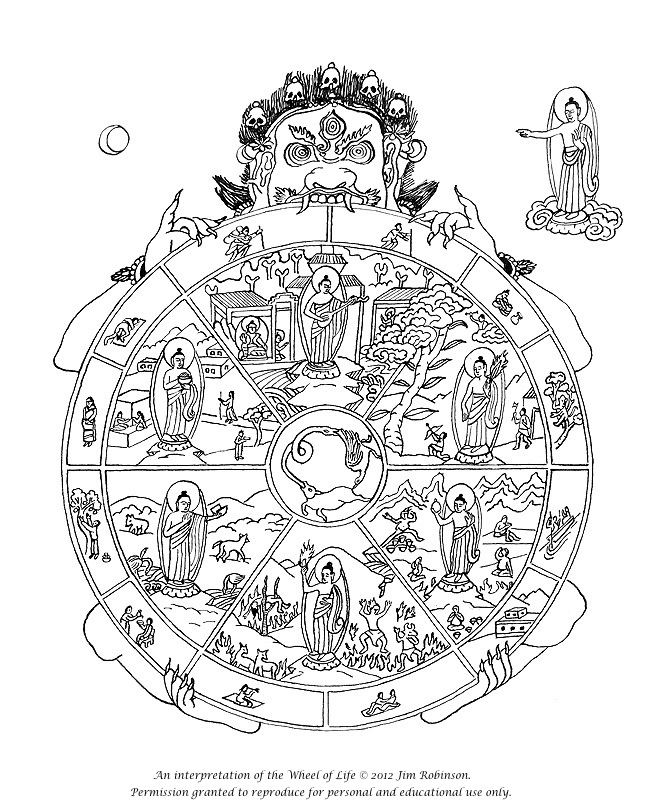
Bhavachakra: the ‘Wheel of Becoming’ or ‘Wheel of Life’.

Yama: ‘The Lord of Death’ or ‘Demon of Impermanence’. Yama is often pictured as the monster holding the Wheel of Life, symbolising the fact that suffering and death comes to all living beings. He is also known as a protector of Buddhism and Buddhists against evil.

Buddha: the ‘Awakened’ or ‘Enlightened’ One. Many Buddhists believe there have been many Buddhas through history, but that the Buddha of our age is the enlightened person Siddattha Gotama (Pali) / Siddhartha Gautama (Sanskrit), who lived in what is now Nepal around 2,500 years ago.

Dhamma / dharma: Universal law; ultimate truth. The teachings of the Buddha.

Some of these terms are also key concepts. Here is some further background to some of these to help you prepare for the teaching and learning activities:

Kamma / karma: The Buddha taught that effects depends on volition. This marks the Buddhist treatment of kamma as different from the Hindu understanding of karma.

Dhamma / dharma: In this banquet, pupils investigate Buddhist ideas about life, truth and suffering. In particular they focus on the symbolism within the Bhavachakra as a way of finding out what Buddhists believe about the ‘bad attitudes’ that can lead away from true happiness and towards increased suffering.

Wheel of life: Also known as the ‘Wheel of Becoming’. Presented here in diagrammatic form, showing the Buddha preaching / teaching in each of six realms of existence. The Buddha is working to save beings and to help them towards enlightenment whatever state they find themselves in.

Learning activities

This sequence of learning activities is built around the Bhavachakra – the Buddhist ‘Wheel of Life’, below. The image is available as an A4 pdf page in the . downloadable version of this resource. Please go to the end of this resource to download the entire resource, including the Bhavachakra.

Explain that pupils are going to investigate how the Buddha is believed to change the lives of people, animals and spirit beings, wherever they find themselves. This will help their investigation of what people believe about life and suffering.

Remind them that the Buddha was a great teacher who lived around 2,500 years ago, and that his followers are called Buddhists. They believe that the Buddha, through his own great efforts, found out the best way to live. Explain that Buddhists believe that every action has a consequence for good or ill and that in the diagram you are going to show them this is symbolised in different ways. Every form of being, wherever it is, is subject to this law of cause and effect, known as karma. So – human beings and animals cannot avoid cause and effect, and even if you think there are worlds beyond this one – like heaven and hell – karma still works.

Put the Bhavachakra image up on a whiteboard and take them round the diagram, especially the six worlds of existence, showing how there is suffering everywhere, but that in each world the Buddha is there to help. Explain that it is possible to take this account of six worlds literally, i.e., that beings may be reborn in different worlds, but that it may also apply to our lives here and now in terms of the way people behave. Ask pupils what it might mean to behave ‘like an animal’ or a ‘hungry ghost’, for example.

On the board, put six ‘bad attitudes’ that might be linked to each state of being: Jealousy, Selfishness, Willful ignorance, Pride, Greed and Planning To Do Evil. Can pupils think of examples where each of these might lead to bad consequences? List some of these on the board. Ask pupils to imagine interviewing people who had done these bad actions. What questions would they ask and what answers / excuses do you think they would receive? Compare answers across the class.

Provide pupils with a printed version of the Wheel of Life. Ask pupils to work in pairs to recall aspects of the Wheel, labelling the different sections with key points about what Buddhists believe is being illustrated/symbolized.

Encourage pupils to discuss the details of the picture in their pairs and then to share ideas on the most interesting or puzzling aspects. Prompt their thinking by asking how they can tell that one figure in each of the six ‘worlds of existence’ is the Buddha [He is the largest figure; he has a halo; he carries something to help the beings in that realm]; whether they can think of other religions that picture special people in this way [e.g., Christian Saints, Jesus, Sikh Gurus, etc]; whether they can work out what kind of beings are living in each of the six parts of the main picture, and so on.

Now ask pupils to note what the Buddha is carrying in each world. Ask pupils to imagine that a being in each world has a chance to ask the Buddha ONE question. Pupils can work out their ideas in small groups, write them down, then compare across the class. Keep a note of the questions for the final activity (below).

Point out the monster [Yama] holding the whole wheel in its mouth and ask: Why does a monster hold the wheel of life? [Because, Buddhists believe, all of life is in the grip of suffering and ]

Explain that you would now like them to work out how the Buddha might be helping the creatures in each Divide the class into six groups.

Recap the six realms shown in the Wheel of Life and their meaning:

Realm of the gods or ‘devas’: devas enjoy pleasure and relaxation, however those who live in this realm become used to luxury and cannot achieve Enlightenment.

Realm of the demi-gods: beings in this realm are powerful but angry.

Human Realm: although some human lives are hard, because a human can learn and understand, this realm holds the potential of Enlightenment.

Animal Realm: animals are driven by survival, hunger and competition; their existence is impulsive, they cannot attain wisdom or insight.

Realm of the Hungry Ghosts: these beings are never satisfied and always hungry; they live in a perpetual state of craving that is never sated.

Hell Realm: greed, anger and hatred characterises the hell realm where those inside suffer in various ways

Print out an image of each realm for each group, including information about the realm. Groups think of what it must be lie to live in this state of mind- such as a hungry ghost or an angry demi-god. They crate a modern example to describe this state of mind and explain to the class.

Talk as a class how the buddha might help beings in all the realms, or people in all of these states of mind. Refer to the Buddha’s gifts:

  • The lute
  • Flaming sword
  • Alms bowl
  • Book
  • Jar of nectar
  • Flaming torch

In groups pupils discuss the symbolism of one of these gifts and how it would help people in a specific realm or state of mind. Listen to answers.

Explain that Buddhists believe that the Buddha’s teaching can help everyone to stop suffering, wherever they are [by stopping self-centred desires]. Many Buddhists use paintings of the Wheel of Life to meditate on. They might look at each section and carefully consider what it means for them. Other Buddhists prefer not to use such paintings for meditation, but instead to meditate on a single thought or point. Ask pupils to say which method they think might help a Buddhist to lead a happier life and to give some reasons.

Remind pupils of the questions they wrote for the Buddha and ask them to choose three of the best. Ask them to work out in their groups what answers they think the Buddha might give to these questions, bearing in mind the ‘gifts’ that he is carrying in the Wheel of Life pictures. What answers would pupils give if they were being asked those questions?

Concepts of God and the Ultimate

In 2015 we commissioned a group of writers to produce articles on the concept of God and the Ultimate from a variety of different belief traditions: Buddhist, Christian, Hindu, Humanist, Muslim, Jewish and Sikhi. You can find links to each of them below.

Ultimate reality, God and gods in Buddhism – Denise Cush

Summary explaining that Buddhism does not centre on a creator God but on awakening to ultimate reality through the Dharma; seen as truth, nirvana, emptiness, mind‑only or Buddha‑nature depending on the tradition.

Christianity and God – Jane Brooke

Christian concepts of God and ultimate reality, providing insights and teaching ideas for Religious Education lessons.

The Hindu Concept of God – Jim Robinson

Summary explaining how Hindu traditions understand the divine as both one ultimate reality (Brahman) and many deities who express its different qualities, allowing diverse ways of relating to and realising the sacred.

Humanism, Ultimate Reality, God and Gods – Sara Passmore

How humanists understand ultimate reality—rejecting supernatural gods, grounding meaning and morality in human experience, and turning to science and reason to explain the natural world.

Islam and God – Aliya Azam

Summary explaining Islamic beliefs about God as absolutely one, unique and indivisible, transcendent and beyond human comprehension, with any association of partners rejected as shirk.

Judaism and G-d – David Hampshire

Summary explaining how Jewish thought focuses less on defining God’s essence and more on covenant, scripture and lived responsibility.

The nature of God in Sikhi – Ranvir Singh

Summary of Sikh belief in one formless, timeless and all‑pervading God, known through the Guru and realised by remembering the divine Name.

Dr Kevin O'Grady | 05 December, 2019

One member of the September 9 REChat on research raised the issue of ‘official’ versions of religions contrasting with how they are lived by individuals in Britain today. Research on religion gives up-to-date detail on the latter. I’ll look at one example of this and draw out some classroom applications. The research looked at the importance of home shrines. [i] It was a survey of 417 Buddhist teenagers of different traditions. The main findings were:
  • 70% of British Buddhist teenagers had a shrine in their homes.
  • Having a home shrine corresponded with heightened religiosity.
  • Those with a shrine at home were significantly more likely to have a daily religious practice (22%) than those without a shrine (7%). Those with a shrine were also significantly more likely to bow to their parents (66%) than those without shrines (36%). Those with a shrine were significantly less likely to attend a temple on a weekly basis (41%) than those without (74%).
  • Home shrines were significantly linked with Buddhist religiosity in female, heritage Buddhists in their late teens.
  • For female, heritage Buddhists in particular, the shrine helped remind them about the Buddha and Buddhist clergy as symbols of their religion. This included feeling that life has a sense of purpose, considering oneself a ‘proper’ Buddhist, and thinking that Buddhist monks do a good job.
  • For male, convert, and early teen Buddhists particularly, the presence of the shrine had more to do with identity than religiosity.
How can these data be used in teaching? Within a topic on Buddhism, you could plan a lesson on home shrines, perhaps following a more traditional one on places of worship. In the first part of the lesson, pupils could use e.g. https://www.thedhammalife.com/how-to-set-up-buddhist-altar-or-shrine-at-home/ to research what is involved in setting up a home shrine and why the different objects (and their placings) are important to Buddhists. Next, as a bridge, different pupils could feed back their findings to the class. In the second part of the lesson, groups or pairs of pupils could be given sets of the research findings, cut into individual strips, and asked to arrange these in order of interest or significance. They may wish to ask about vocabulary such as ‘heritage’, ‘convert’, or ‘religiosity’, developing religious literacy. They should note their reasons and any further questions they want to raise. The plenary would involve different pupils giving their findings and questions to the class, with the teacher also contributing questions for discussion: e.g. why might female and heritage Buddhists relate to home shrines more ‘religiously’? Why might male and convert Buddhists relate to home shrines more in terms of personal identity? Future lessons on gender in different religions might interleave back to this lesson. [i] We have reported it at Does it matter whether Buddhists have home shrines?

About

Dr Kevin O'Grady is Lead Consultant for Research at Culham St Gabriel's Trust.

See all posts by Dr Kevin O'Grady