This concept starter provides a way for teachers to introduce iconography. It consists of a powerpoint presentation and background information. It has been written by Aliya Azam.
Global terms: Classroom Resources and Practice
Hajj
A PowerPoint presentation on Hajj. It has been written by Aliya Azam.
What do we mean by ways of knowing in RE?
What do we mean by ways of knowing in RE?
A document and short film to help parents and carers understand how different ways of knowing can open up richer conversations and deeper understandings in the religion and worldviews classroom. The information in this animation is also available to download below.
A useful introduction to the concept for parents and carers.
In RE lessons, children learn not only what people believe and practice, but how knowledge is developed and studied. We call this ways of knowing, or disciplinary knowledge.
Just as scientists, historians or artists ask different kinds of questions, in RE children and young people are taught about different kinds of questions people ask about religious and non-religious traditions. They use different scholarly methods for finding out about these traditions. Sometimes they use interpretation, analysis or historical enquiry. At other times, they might use reasoning, discussion and careful argument. Interviews, observations, data, and case studies are also important ways in which to investigate religious and non-religious traditions.
Using a range of methods helps children and young people understand that religious and non-religious worldviews are complex and varied, and that people may interpret the same ideas in different ways. It also shows children that knowledge is built through evidence, interpretation, questioning and dialogue.
Giving children and young people these tools to explore differences thoughtfully and respectfully has never been more important in an increasingly globalised and interconnected world. It develops life skills, helping them encounter different ideas and engage in respectful discussions on complex issues they find in the news and on social media. It prepares them for work, helping them understand and respect individuals and their different responses to life’s big questions. It can support community cohesion, fostering mutual respect and reducing misunderstanding about different faiths and beliefs found in modern Britain and around the world.
Theologies of Reading
Theologies of Reading
Jennifer Jenkins, RE Facilitator for Coventry and Warwick, presents Theologies of Reading, a wide-ranging set of information concerning the reading of sacred texts. Taken from research, faith-based reading and techniques of interpretation and contemplation, these presentations contain much rich understanding for the classroom.
How do you read with your pupils? How do you help them make sense of sacred texts? Are there multiple interpretations, and how to explore these?
These presentations will help you consider how meaning is made and the relationship of text to reader with guidance and practical tips to try in the classroom.
Available here:
Introduction: this introductory presentation brings the general thinking to you. A script is given in the ‘notes’ function to help you lead a group through the presentation.
Judaism, Christianity and Islam: three separate presentations focusing on reading and interpretation in these three traditions.
Published January 2020.
Theologies of Reading – Introduction
Introduction to theologies of reading, explaining its role in Religious Education and strategies for classroom application.
Theologies of Reading – Christianity
Theologies of Reading – Christianity Download the presentation and accompanying resources:
Theologies of Reading – Islam
Theologies of Reading – Islam Download the Islamic approaches to the Qur’an presentation and resources:
Theologies of Reading – Judaism
Jewish perspectives in theologies of reading, offering insights and strategies for engaging pupils with sacred texts.
Theologies of Reading – New perspectives on pupil engagement with texts
Introduces new perspectives on pupil engagement with texts in Religious Education, offering strategies and classroom resources.
What answers might be given by Buddhists and other people to questions about life and suffering?
What answers might be given by Buddhists and other people to questions about life and suffering?
An examination of Buddhist beliefs about life and suffering.
For 8-12 year olds. Originally written by Dave Francis, updated in April 2019.
Key words and concepts
Kamma / karma: Action. Intentional actions that affect one’s circumstances in this and future lives.
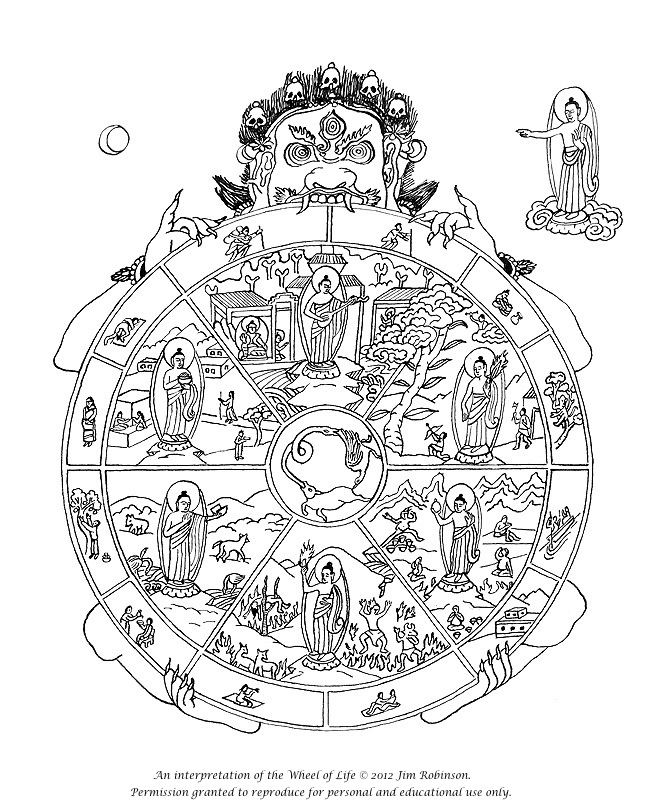
Bhavachakra: the ‘Wheel of Becoming’ or ‘Wheel of Life’.
Yama: ‘The Lord of Death’ or ‘Demon of Impermanence’. Yama is often pictured as the monster holding the Wheel of Life, symbolising the fact that suffering and death comes to all living beings. He is also known as a protector of Buddhism and Buddhists against evil.
Buddha: the ‘Awakened’ or ‘Enlightened’ One. Many Buddhists believe there have been many Buddhas through history, but that the Buddha of our age is the enlightened person Siddattha Gotama (Pali) / Siddhartha Gautama (Sanskrit), who lived in what is now Nepal around 2,500 years ago.
Dhamma / dharma: Universal law; ultimate truth. The teachings of the Buddha.
Some of these terms are also key concepts. Here is some further background to some of these to help you prepare for the teaching and learning activities:
Kamma / karma: The Buddha taught that effects depends on volition. This marks the Buddhist treatment of kamma as different from the Hindu understanding of karma.
Dhamma / dharma: In this banquet, pupils investigate Buddhist ideas about life, truth and suffering. In particular they focus on the symbolism within the Bhavachakra as a way of finding out what Buddhists believe about the ‘bad attitudes’ that can lead away from true happiness and towards increased suffering.
Wheel of life: Also known as the ‘Wheel of Becoming’. Presented here in diagrammatic form, showing the Buddha preaching / teaching in each of six realms of existence. The Buddha is working to save beings and to help them towards enlightenment whatever state they find themselves in.
Learning activities
This sequence of learning activities is built around the Bhavachakra – the Buddhist ‘Wheel of Life’, below. The image is available as an A4 pdf page in the . downloadable version of this resource. Please go to the end of this resource to download the entire resource, including the Bhavachakra.
Explain that pupils are going to investigate how the Buddha is believed to change the lives of people, animals and spirit beings, wherever they find themselves. This will help their investigation of what people believe about life and suffering.
Remind them that the Buddha was a great teacher who lived around 2,500 years ago, and that his followers are called Buddhists. They believe that the Buddha, through his own great efforts, found out the best way to live. Explain that Buddhists believe that every action has a consequence for good or ill and that in the diagram you are going to show them this is symbolised in different ways. Every form of being, wherever it is, is subject to this law of cause and effect, known as karma. So – human beings and animals cannot avoid cause and effect, and even if you think there are worlds beyond this one – like heaven and hell – karma still works.
Put the Bhavachakra image up on a whiteboard and take them round the diagram, especially the six worlds of existence, showing how there is suffering everywhere, but that in each world the Buddha is there to help. Explain that it is possible to take this account of six worlds literally, i.e., that beings may be reborn in different worlds, but that it may also apply to our lives here and now in terms of the way people behave. Ask pupils what it might mean to behave ‘like an animal’ or a ‘hungry ghost’, for example.
On the board, put six ‘bad attitudes’ that might be linked to each state of being: Jealousy, Selfishness, Willful ignorance, Pride, Greed and Planning To Do Evil. Can pupils think of examples where each of these might lead to bad consequences? List some of these on the board. Ask pupils to imagine interviewing people who had done these bad actions. What questions would they ask and what answers / excuses do you think they would receive? Compare answers across the class.
Provide pupils with a printed version of the Wheel of Life. Ask pupils to work in pairs to recall aspects of the Wheel, labelling the different sections with key points about what Buddhists believe is being illustrated/symbolized.
Encourage pupils to discuss the details of the picture in their pairs and then to share ideas on the most interesting or puzzling aspects. Prompt their thinking by asking how they can tell that one figure in each of the six ‘worlds of existence’ is the Buddha [He is the largest figure; he has a halo; he carries something to help the beings in that realm]; whether they can think of other religions that picture special people in this way [e.g., Christian Saints, Jesus, Sikh Gurus, etc]; whether they can work out what kind of beings are living in each of the six parts of the main picture, and so on.
Now ask pupils to note what the Buddha is carrying in each world. Ask pupils to imagine that a being in each world has a chance to ask the Buddha ONE question. Pupils can work out their ideas in small groups, write them down, then compare across the class. Keep a note of the questions for the final activity (below).
Point out the monster [Yama] holding the whole wheel in its mouth and ask: Why does a monster hold the wheel of life? [Because, Buddhists believe, all of life is in the grip of suffering and ]
Explain that you would now like them to work out how the Buddha might be helping the creatures in each Divide the class into six groups.
Recap the six realms shown in the Wheel of Life and their meaning:
Realm of the gods or ‘devas’: devas enjoy pleasure and relaxation, however those who live in this realm become used to luxury and cannot achieve Enlightenment.
Realm of the demi-gods: beings in this realm are powerful but angry.
Human Realm: although some human lives are hard, because a human can learn and understand, this realm holds the potential of Enlightenment.
Animal Realm: animals are driven by survival, hunger and competition; their existence is impulsive, they cannot attain wisdom or insight.
Realm of the Hungry Ghosts: these beings are never satisfied and always hungry; they live in a perpetual state of craving that is never sated.
Hell Realm: greed, anger and hatred characterises the hell realm where those inside suffer in various ways
Print out an image of each realm for each group, including information about the realm. Groups think of what it must be lie to live in this state of mind- such as a hungry ghost or an angry demi-god. They crate a modern example to describe this state of mind and explain to the class.
Talk as a class how the buddha might help beings in all the realms, or people in all of these states of mind. Refer to the Buddha’s gifts:
- The lute
- Flaming sword
- Alms bowl
- Book
- Jar of nectar
- Flaming torch
In groups pupils discuss the symbolism of one of these gifts and how it would help people in a specific realm or state of mind. Listen to answers.
Explain that Buddhists believe that the Buddha’s teaching can help everyone to stop suffering, wherever they are [by stopping self-centred desires]. Many Buddhists use paintings of the Wheel of Life to meditate on. They might look at each section and carefully consider what it means for them. Other Buddhists prefer not to use such paintings for meditation, but instead to meditate on a single thought or point. Ask pupils to say which method they think might help a Buddhist to lead a happier life and to give some reasons.
Remind pupils of the questions they wrote for the Buddha and ask them to choose three of the best. Ask them to work out in their groups what answers they think the Buddha might give to these questions, bearing in mind the ‘gifts’ that he is carrying in the Wheel of Life pictures. What answers would pupils give if they were being asked those questions?
Why is the Prophet Muhammad inspirational to Muslims?
Why is the Prophet Muhammad inspirational to Muslims?
An investigation into the importance of Muhammad (pbuh) for pupils with special needs.
For pupils with special needs. Originally written by Anne Krisman. Updated in April 2019.
Key words and concepts
Hadith: a report of what the prophet Muhammad said or did. Used as guidance by Muslims.
Nasheed: a form of unaccompanied Islamic devotional music. Sometimes a drum is used.
Qur’an: meaning ‘recitations’. God’s words revealed through the prophet Muhammad in Muslim belief.
Inspirational: influencing people to lead their lives in a special way.
This resource uses the idea of ‘burning core ideas’ to express the key knowledge to communicate to pupils:
- Muhammad is special to Muslims;
- Islam is the name of the Muslim religion;
- Muslims believe in one God called Allah;
- Muslims cannot see their God;
- Muslims do not make pictures of Allah or Muhammad as people;
- Muslims’ holy book is called the Qur’an.
Further key ideas and knowledge:
- Muhammad was trusted by people – they called him Al-Amin (the one you can trust);
- Muhammad believed in one God called Allah;
- Muslims call him a messenger and prophet of Islam (rasul);
- Muslims say ‘Peace be Upon Him’ after the name of Muhammad, sometimes written as ‘pbuh’;
- Muslims believe an angel appeared to Muhammad in a cave on a mountain (Mount Hira);
- Muslims believe the angel, called Jibril, revealed the words of the Qur’an;
- Muslims try to lead their lives from the example of Muhammad.
Learning activities
The following activities follow the ‘Five Keys Into RE’ approach (Anne Krisman)
1 Connection – How can we link our theme with pupils’ lives?
Share these thoughts with the pupils:
- We all have special unique qualities.
- We like to help others.
- We have special places where we can be calm.
- We care about
Let pupils know that Muhammad was known as ‘The Friend’ and ‘The Helper’ and that they are going to look at things that connect them with the life of Muhammad. This will begin by looking at their special unique qualities.
Share or gather the special qualities of each child in the class. This can be done by sharing ideas in the classroom, by going around the school and asking people who know them well, or by asking parents and carers to respond. Words such as helpful, kind, peaceful will be gathered.
Make the names and qualities into a class performance: names can be signed, clapped, drummed or chanted for each child, e.g., Joshua the Peaceful, Hannah the Friend.
Make a display with pupils’ pictures, their new values name and where appropriate, comments about why this name is right for them.
Paint either a) the pupil’s first name or b) their values name onto the fold of an A3 or larger piece of paper. Fold the paper to create a symmetrical design. Ask the pupils to then decorate and beautify their name.
An additional idea is to write the pupil’s values name in PVA glue and to encourage children to throw different coloured sand onto it. If you wish to highlight Muhammad’s special colour during this theme, use green sand.
While working you could play different nasheeds about Muhammad, you will find many on you Tube, such as:
- Ya Muhammad
- Muhammad (Peace be Upon Him)
- 99 Names for Muhammad
- 99 Names of Muhammad (translated)
2 Knowledge – How can we communicate burning core knowledge within the theme to our pupils?
Share these examples of burning core knowledge with the pupils:
- Muhammad was trusted by people (Al-Amin);
- Muhammad believed in one God called Allah;
- Muslims call him a prophet and messenger of God (rasul);
- Muslims believe an angel appeared to him in a cave and revealed to him the words of the Qur’an.
Let pupils know that Muhammad was valued by people and called Al-Amin – The Trustworthy. Muslims believe he was a messenger of God and that they are going to learn more about his life.
To highlight the importance of Muhammad’s name of Al-Amin – The Trustworthy – trust the pupils to take a special gold wrapped package to another class. Arrange for the member of staff who receives the package to affirm the trust placed in the pupils and to pass on something special from their room for the pupils to take back to their class.
Ask pupils to carry a message in an envelope or sign that Muslims believe there is only one God and tell this to others in the class or around the school. Anyone who hears the message can take a gold star and add it to a picture of the Arabic calligraphy for Allah, to show that the message has been heard.
Let pupils know that Muhammad believed in one God called Allah.
Listen and watch popular nasheeds which mention Allah, for example Yusuf Islam: A is for Allah, Zain Bhikha: Mountain of Mecca.
Encourage pupils to sign the letter A and the number one while responding to the music.
Islamic plaques with Muslim prayers and the raised names of Allah and Muhammad can be touched – these can be obtained from shops in areas with a Muslim population and through artefact catalogues.
Print out lots of small pictures of the word Allah in Arabic calligraphy. Ask pupils to carefully stick the words on to gold paper, trying to put them on the right way up and showing care in placing them, to reflect how Muslims respond to the name of God. [This can also be repeated with the name of Muhammad, this time sticking the names on green paper and keeping the same rules of respect and care. These two pieces of work can be stuck together and a beautiful border made around them, to link them, with glitter.]
Let pupils know that, Muslims believe that an angel appeared to Muhammad in a cave and revealed to him the words of the Qur’an
Show images of Mount Hira while listening to Zain Bhikha’s Mountain of Mecca.
Ask pupils to create a collage made from brown ripped paper, of the cave at Mount Hira. Then, without creating a human image, add the feeling of the angel Jibril, using glitter, holographic paper, cellophane etc.
Make a peaceful cave area in the classroom by putting together prayer mats, cushions and glittery material. Add light changing resources to show the presence of an angel.
Introduce pupils to the first of four stories of Muhammad and use the sensory story guide to help pupils know about the revelation that Muslims believe Muhammad received on Mount Hira.
Share the sensory story together, allow time for the stimuli to be experienced by each pupil.
Ask pupils to reflect on the story and, where appropriate, to ask questions about it.
Where appropriate, choose a question to focus on, for example, ‘Why did the angel say, “Read!”?’ and share possible answers. Adults can also ask questions and respond.
If time, share the story once more.
3 Senses – Which sensory elements are in the theme?
The following sensory activities can help pupils experience something of the life of Muhammad and the importance of Islam to Muslims:
Recitation of the Qur’an and Call to Prayer (adhan);
Islamic nasheeds (unaccompanied devotional music, sometimes using drums);
Prayer mat and topi (prayer cap).
Play a version of the Call to Prayer (adhan) to pupils while they use red, orange, purple and yellow crayons or sponge paint to create a sunset sky. Versions to be used could include those from Turkey, Bosnia, Saudi Arabia and Egypt as well as British muezzins.
Afterwards, encourage pupils to add a black paper cut-out of a dome and minaret, to give a scene of a mosque at sunset.
Engage pupils in the experience of wearing or touching a Muslim prayer cap (topi) for boys and headscarf for girls, while turning the pages of a Qur’an on the whiteboard, a resource called ‘Baybar’s Magnificent Qur’an’.
Encourage them to touch some Muslim prayer mats and then look at how Muslims pray, such as by looking at video clips or animation online.
Help pupils make a prayer mat out of sensory materials, such as textured wallpaper. The prayer mat could include arches, a picture of the Ka’bah at Mecca, and a hanging lamp to stick on.
4 Symbols – Which symbols are the most accessible in the theme?
Share these examples of Muslim symbols with the pupils:
- Moon and star;
- Arabic name of Muhammad and Allah;
- Salaam (peace) – Muslims say ‘peace be upon him’ when talking about Muhammad;
- Islamic art symmetrical designs.
Crescent Moon and Star
Invite pupils to recognise the moon and stars in a slideshow of pictures and to sort a selection of pictures of crescent moons and stars.
Encourage pupils to use Makaton signing for star and moon while listening to a song about wonder in the universe, for example There is Only One God by Zain Bhikha.
Encourage pupils to make collage pictures of the Muslim symbol – the crescent moon and star, or rub over a moon and star stencil and decorate.
Salaam – Peace
Ask pupils to identify what makes them feel peaceful out of a choice of different pictures, such as listening to music, going on the computer, lying down, praying, etc.
Help them practise writing the word Salaam in paint while listening to peaceful chill out music.
Ask pupils to make a dove of peace – there are many templates online. Add cut-outs of the name of Muhammad, with crescent moon and star symbols, to show that Muslims say ‘peace be upon him’ when talking about him.
Islamic art symmetrical designs
Explain that Muslims believe only Allah is the creator and so natural designs are shown in a non-realistic but beautiful way, with unexpected colours being used. Repetition of designs shows that God goes on for ever. An example can be found in Iznik pottery from the 16th century Ottoman Empire, although its designs are still being used for ceramics in Turkey.
Show images of Iznik art from the Turkish tradition. Ask pupils to look for the colours of blue, red and white and for flowers.
Prepare four pieces of black, blue, red and white paper and make concertina folds. The black will be used for the background. Ask pupils to draw simple flower designs and leaves shapes on the three pieces of paper and to cut these up. They should then lay out the three elements of the flower design on the concertina folded black paper, trying to repeat the pattern.
Create an Iznik Art gallery from the pictures, displayed with images of Iznik art pottery.
5 Values – Which values in the theme speak to our pupils?
Share these examples of Muslim values with the pupils:
- Following a straight path
- Helping poor people
- Caring for animals
- Forgiveness
Explain to pupils that they are going to learn about three more stories about Muhammad (Muslims say peace be upon him) that will help them understand how inspirational he is for all Muslims and how he set an example for all Muslims to follow.
Share the sensory story of Muhammad and Crying Camel allowing time for the stimuli to be delivered in a caring manner to each pupil.
Ask pupils to reflect on the story and, where appropriate, to comment and ask questions about it.
Where appropriate, choose questions to focus on, for example, ‘How do we look when we are sad?’ ‘How can we be kind to animals?’ and share possible answers. Adults can also ask questions and respond.
If time, share the story once more.
In follow up lessons, use Muhammad and the Old Woman, as a call and response poem, and Muhammad and the Sleeping Kitten, with the associated activities, to show how inspirational Muhammad is for Muslims. Can pupils identify the parts of each story that show that Muhammad was helpful, kind, compassionate, loving, generous, following a straight path, brave, forgiving?
RE-searchers Approach
RE-searchers Approach
A team from Exeter University and the Learning Institute has developed a new approach to Religious Education in Primary Schools. It is called ‘the RE-searchers approach’. It encourages pupils to think about the significance and effectiveness of different methodologies and methods of enquiry in Religious Education. To make these accessible to young children, they have personified some of them as cartoon characters. Individually these characters are called Debate-it-all Derek, Ask-it-all Ava, Have-a-go Hugo, and See-the-story Suzie, but collectively they’re known as the ‘RE-searchers’. Each character holds different assumptions about religion(s) and advocates different research methods (e.g. questioning and arguing, interviewing and empathizing, participating and experiencing, and narrating and exploring interpretations). Once acquainted with our characters and their respective characteristics as researchers, pupils can undertake learning activities associated with each of them in pursuit of different understandings of religion(s).
Good Learning in RE
Seven videos of good learning in RE, produced by NATRE. Taken from the DVD Good Learning in Religious Education: Seven Short Films to Make Teachers Think.
The following videos are provided by NATRE, Good Learning in Religious Education: Seven short films to makes teachers think. The films were sponsored by Culham St Gabriel’s and the Diocese of St Albans and are available to watch on NATRE’s website. There is one sample film below and the rest can be found on the NATRE website or here.
Enquiring into Worship with 7-9 Year Olds
Inter Faith Week Resources: 2024
Inter Faith Week Resources: 2024
From 10-17 November, 2024, it is Inter Faith Week in Schools. We are supporting the Faith and Belief Forum and National Association of Standing Advisory Councils on RE initiative this year to promote the importance of linking faiths, beliefs and communities. The theme this year is on Sharing my story: Building your future.
We have pulled together several valuable resources below to help teachers explore interfaith relations, and particularly stories, in the RE classroom, which in turn will increase pupils’ understanding of, and skills for, inter faith encounter, dialogue and action.
Blogs
Ian Coles: How do faith visitors fit in to a religion and worldviews approach?
Josh Cass: Interfaith week and the importance of excellent religion and worldviews teaching
Research
Ian Coles’ masters research on bringing worldview community visitors into the primary classroom
Kathryn Wright’s research about a hospitable approach to religion and worldviews education
Interfaith Week 2022 Report on strengthening cooperation and understanding
Matthew Guest and Lucy Peacock discuss to what extent school based RE prepares young people for the religious diversity of university life
Resources
Telling my story: a resource to support everyone to tell their own worldview story
Lived religion and worldview traditions: resources which offers personal responses to questions from lived experience of different religious and non-religious believers
Empowering Voices: a project part funded by Culham St Gabriel’s Trust led by Lincoln Diocesan Board of Education with a focus on lived experience of religious believers from and non-religious worldviews
Islam as a Worldview
Islam as a Worldview
June 2021
What does a worldviews approach look like in the classroom? Dr Kate Christopher and Professor Lynn Revell have been exploring this question through a project called ‘Islam as a Worldview’. The project considers worldviews thinking through practical resources for the classroom, focusing on the teaching of Islam.
Through thinking practically, and with all ages of pupils in mind, the team present two working principles:
- Worldviews starts with people
- Pupils need to engage with different types of knowledge
These clear, simple principles form the basis of the teaching materials produced. The teaching materials are free and available for all.
Have a look at these teaching materials and see how you can bring in a wide and rich sense of history, context and lived diversity in Islam, through starting with people, and their time and place. Don’t be limited to your own Key Stage, you can pick up all sorts of ideas you can adapt from the resources.