Global terms: Curriculum & Planning

Natalie Parkin | 22 May, 2026

During the last academic year I have been in the fortunate position of having the opportunity to design from scratch our Trust-wide curriculum. As part of this I wanted greater clarity about the kinds of knowledge students encounter in Religious Education.

Not just what they learn—but how that knowledge is constructed.

RE draws on multiple disciplines: theology, philosophy, sociology, history, psychology to name just a few. But too often, these are blurred together. Students learn content, but not how that knowledge is shaped, interpreted, or contested. But we also need to recognise the starting point of our students, introducing such terms too early risks disengaging pupils.

Therefore in our curriculum, I’ve taken a slightly different approach: build the thinking first—then name it.

Year 7: building knowledge through multiple lenses

Our Y7 programme is grounded in substantive knowledge and comparison.

Students explore both Dharmic and Abrahamic traditions, building breadth before moving into greater depth within the Abrahamic faiths. Along the way, they begin to encounter different ways of knowing—without these being explicitly labelled.

  • They work with religious texts, exploring what these might mean and how they shape lived religion.
  • They act as “data detectives”, using sources such as census data to explore patterns of belief and belonging.
  • They study the history of religion in the UK, considering how religious traditions have shaped—and been shaped by—historical events.

By the time students reach our unit on the person and nature of Jesus, they are beginning to bring these strands together. Here, the lens is primarily theological and historical:

  • What do Biblical and non-Biblical sources say about Jesus?
  • How have these accounts been interpreted?
  • How has his life and teaching influenced belief and practice over time?

Students are not just learning about Jesus—they are beginning to engage with questions of interpretation, influence, and meaning. But at this stage, we are not labelling these approaches. We are simply ensuring students are doing them.

Year 8: making ways of knowing explicit

At the start of Year 8, we make the shift visible.

Students encounter an explicit unit asking: What does it mean to study religion academically? Here, we introduce lenses such as theology, sociology, psychology, and history.

We explore ideas of bias, perspective, and interpretation. Students begin to see that different disciplines ask different questions—and may reach different conclusions.

The aim here is for a moment of clarity – what they experienced in Year 7 is now named and organised. They have prior knowledge and experience onto which to connect this new learning.

Following this, students apply these lenses to the study of lived religion across Hindu, Buddhist, Jewish, and Muslim traditions. They explore not just beliefs, but how these are lived out—and how they have developed over time. The historical lens remains important here: religion is not static, you cannot understand the current manifestation of a faith without understanding its history.

Year 9: thinking more critically

By Year 9, students are ready to engage more explicitly and critically.

They begin to think as philosophers—exploring questions of morality, truth, and meaning. They evaluate arguments, compare traditions with greater precision, and recognise complexity within and between religions.

Because the groundwork has been laid, this feels like a natural progression rather than a leap.

It is important to note that this is the first year of implementation of this curriculum. While it has been carefully planned as a three-year journey, we have not yet seen a full cohort move from Year 7 into Year 8 and into Year 9, encountering the explicit teaching of these disciplinary lenses. What we are seeing so far is promising, but this is work in progress. The real test will be how successfully students make those connections over time.

Why this matters

Across our Trust, RE is taught for one hour per week at Key Stage 3, often by non-specialists. Our curriculum needed to be clear, coherent, and teachable, while still maintaining academic depth.

Focusing on ways of knowing has helped us achieve that balance.

It gives structure to the subject, supports teachers in understanding what kind of thinking is required, and helps students move beyond surface-level answers.

Perhaps most importantly, it shifts RE away from being seen as a subject of “opinions” and towards one rooted in structured, academic thinking.

By the time students encounter terms like theology or sociology, they have already experienced them in action. The language doesn’t introduce something new—it gives shape to something familiar.

If there is one principle underpinning our approach, it is this: build the thinking first, name it later.

About

Natalie Parkin is the Strategic Lead for Religious Studies and Personal Development at a large Multi-Academy Trust in the North of England. She supports 28 secondary schools in curriculum development, alongside teaching A Level Religious Studies, and has a passion for ensuring every student receives high-quality RE, regardless of postcode or staffing. Currently Natalie is coming to the end of her second year of the Culham St Gabriel's Leadership Scholarship Programme


See all posts by Natalie Parkin

Greg Parekh | 21 May, 2026

In all I do I always start with vision. What do I want great RE to look like and what is best for the pupils in front of me?

If we are preparing students to navigate an increasingly complex, multi-faceted and diverse world, they need more than knowledge. They need to think well. That’s why I am convinced a multi-disciplinary, academically rigorous and engaging RE curriculum is the way forward.

I often think of this through the image of a stained-glass window.

  • The glass is the substantive knowledge: beliefs, texts, practices.
  • The lead is the disciplinary knowledge: theology, philosophy, social sciences.
  • The light is the student: their worldview, questions and reflections.

Without the structure, the glass is just fragments. Without the light, it has no meaning. High-quality RE brings all three together.

A disciplinary approach matters because it moves us beyond learning about religion into thinking with it. It gives students access to how scholars make sense of the world; through interpretation, reasoning and evaluation.

One of the most powerful ways to do this is through a philosophical lens.

What does a philosophical lens mean?

Using a philosophical lens means treating RE as a space for big questions, careful reasoning and conceptual precision.

It shifts us from:

  • What do people believe?

to

  • Does this idea make sense?
  • What follows if it’s true?
  • How convincing is this argument?

In my classroom, this centres on three things:

  • Clarifying concepts
  • Constructing arguments
  • Engaging with disagreement

Importantly, this doesn’t make RE more abstract—it makes thinking more visible.

What does this look like in practice?

For 11-14 year olds, this fits naturally within the Cornwall Agreed Syllabus, which we follow. The key is not to bolt philosophy on, but to draw it out of the enquiry questions already there.

Start with a big question

Instead of beginning with content, begin with a puzzle. For example, in some of the units of work we teach:

  • “How do Sikhs put ideas of equality and service into practice?”

 “Can people ever treat everyone equally?”

This opens up debate before exploring sewa and equality in Sikhi

  • “What is so radical about Jesus?”

“What makes an idea or person truly radical?”

Students can then test Jesus’ teachings against their own criteria

  • “The Buddha: how and why do his experiences and teachings have meaning for people today?”

“Can suffering ever be a good thing?”

Creates a strong philosophical bridge into the Four Noble Truths

  • “How far does it make a difference if you believe in life after death?” – “Would you live differently if you knew what happens after death?”. Sets up the entire evaluative focus of the unit

Use thought experiments

When teaching Buddhism, I use the Ship of Theseus to explore identity. I begin with a philosophical problem:

If something changes completely over time, is it still the same thing?

Students then apply this to themselves:

  • If your body changes, are you still the same person?
  • If your memories change, what makes you you?

I probe their thinking:

  • “What makes you think that?”
  • “Could someone disagree?”

Students begin to:

  • clarify what they mean by “self”
  • give reasons
  • recognise alternative views

Only then do I introduce the Buddha’s teaching of anatta (no fixed self). At this point, it isn’t just new information—it’s a response to a question they already care about.

We then evaluate:

  • Does this idea make sense?
  • What are its strengths?
  • What might challenge it?

The thought experiment isn’t just a hook—it structures the lesson. Students are thinking philosophically, not just learning content.

Teach the language of argument

If we want students to write academically, they need to be able to think and to talk like philosophers and therefore we must teach them how to build arguments.

In the unit “Should Christians be greener than everyone else?”, I begin with a question:

Do Christians have a greater responsibility to care for the environment than others?

I model a reasoned argument:

  • “One reason for this is that Christians believe the world is God’s creation…”
  • “However, this might be challenged because people of any worldview can care for the environment.”

Students then practise:

  • “One reason for this is…”
  • “This might be challenged because…”

I probe their thinking:

  • “Why is that a strong reason?”

Only then do we introduce stewardship and dominion. Students evaluate these ideas, not just learn them.

The result? Students move from “I think” to structured reasoning—in both discussion and writing.

In summary

Using philosophical tools doesn’t require a complete overhaul.

The most important shifts are small:

  • Start with better questions
  • Build in thinking time
  • Insist on reasons
  • Normalise disagreement

When these become routine, the impact is clear. Students speak with more confidence, write with more precision, and engage more deeply. We are moving through a sphere of good knowledge and understanding towards deep thinking and philosophical discussion.

About

Greg Parekh is a Head of RE and T&L lead. He is on the NATRE exec, and is a professional consultant to Cornwall SACRE. He is currently participating in the Culham St Gabriel's Leadership Scholarship Programme.

See all posts by Greg Parekh

John Semmens | 21 May, 2026

In this RE:Online focus week ‘Ways of Knowing: Diving into Different Disciplines’ we asked several teachers to share how they use a particular discipline in their classroom. John Semmens is a primary school teacher and philosophy expert. He shares one way of introducing the tools of philosophy into the classroom.

Philosophy, meaning love of wisdom, is an ancient field of study that encompasses huge swathes of human enquiry. Philosophy concerns itself with questions like:

What is real?

How do we know?

How should we live?

What is the point of life?

These Big Questions can take your classroom enquiry to encounter many exciting places and ideas. However, it is difficult to pin down exactly what philosophy is and how it might be used in the RE classroom. As there is a philosophy of almost everything it can be a wishy-washy subject. It can also be a deeply elitist subject full of obscurantism and excessive verbiage. It has a ‘canon’ which can obscure its global and historical diversity and can easily be taught without leaving Europe at all. But it is a universal subject, found in everywhere from Africa, to China, to Baghdad, to Greece and throughout British history. If you are looking to get closer to authentic voices from other cultures then philosophy can help.

Why?

For anyone who has spent any time around small children they will have been asked this question, sometimes hundreds of times a day. In the classroom this question comes up often, and it is good practice to turn the question round and ask, ‘Why do you think?’  This invites children to call upon their own knowledge and understanding, using whatever wisdom they might have to construct a hypothesis. Why not introduce the Socratic Method to class discussions?  You might find that you teach like Socrates already by eliciting understanding from the child rather than simply topping up their heads with knowledge as if they were empty vases. Questioning the world, testing ideas and thinking about your thinking makes for stronger thinkers, after all.

Who?

Who to study is a complex question. I have a philosophy timeline on my wall that ranges all over the world and begins in Ancient Egypt with Ptahhotep and ends with Phillipa Foot, Peter Singer and Prof. Olúfẹ̣́mi Táíwò. It’s important to know at least a little about the people on the timeline so you can link children’s thoughts to the great thinkers of the past. Over the years children have contributed their own philosophers, if they’ve felt someone was missing, and each has struck a chord with that child for a particular reason. As many different cultures, religions and worldviews are present on the wall, the children can see that philosophy is something that all people do. It is part of their heritage, whatever that heritage may be.

How?

A great place to start is to look at a ‘Big Question’, perhaps it’s been raised in conjunction with another study – such as ‘the nature of God’. When looking into something like this, exploring deities from the monotheism of the Abrahamic faiths to the polytheism of Paganism, children might ask how much power does a/the God have? Exploring this question can take you to all sorts of interesting places and philosophy can be one of them. You can take a logical approach: If God is all powerful and all knowing (you could always trace where this idea comes from), does He know what I am going to do before I do it? Does that mean it’s ‘pre-decided’? Thinking about predestination can bring in thinkers from all over the world: Augustine of Hippo, Al‑Ghazālī of Persia, Śaṅkara of India, Chrysippus of Greece or John Calvin of France.  To forge a strong oracy focus you can indulge in wonderful class wide or small group discussions based on thought experiments[1] about actions and their causes, thinking about huge concepts like: Free Will and Fate, the Problem of Evil and Determinism. You can then challenge these classroom ideas with the words of great thinkers, simplified if needs be.

It is a good idea to set out some kind of structure for your class when bringing in philosophy. They aren’t just learning about philosophers, they are philosophers. So, thinking about thinking is the best place to start. Try something like:

In philosophy we:

  • Ask Big Questions – these cannot simply be ‘Googled’
  • Listen carefully – hear and even repeat back what someone else has said to make sure you’ve understood
  • Give reasons – ‘I think this because…’ as a way of ensuring children reason out their thoughts
  • Respect differences – understand that reasoning can lead to alternative conclusions
  • Change our minds when we need to – I tell my class that ‘you are not married to your ideas and can change your mind if necessary’.

As you can tell from this brief structure you are inviting children to think carefully, this is metacognition at its base and can be complex for some learners. The reasoning aspect is perhaps most important and encourages children to know what they think and why they think it. It is this examination[2] of ‘knowledge’ that makes for the most interesting use of philosophy.

Philosophy can be an articulated orally, it can also be written or expressed artistically. Importantly, it can be a lens to view fundamental questions where all the children in your class can join a conversation that has been raging through history since the dawn of language.

[1] For more on this: How I… teach Phillipa Foot’s Trolley problem to 9-year olds – RE:ONLINE

[2] For more on this: https://www.philosophyinks2.co.uk/post/philosophy-is-about-thinking-sedimentary-my-dear-watson

About

John is the new chair of Norfolk SACRE, blogs about philosophy and teaches in Norwich. Follow him on Twitter @philosophyinKS2 or read his blog at www.philosophyinks2.co.uk

See all posts by John Semmens

Chris Mooney | 20 May, 2026

Why ‘Ways of Knowing’ matter in RE

‘Ways of knowing’ have been spoken about for many years in RE (Ofsted, 2021) and it has become clear that in order to teach high-quality RE it is crucial that pupils are not just taught about ‘what to know’ (substantive knowledge) but that they must be taught ‘how to know’ (disciplinary knowledge). In our new Gloucestershire locally agreed syllabus this push towards explicitly discussing and exploring scholarly methods has seen a toolkit approach introduced so that pupils can consider the tools available to them to investigate concepts, practices or beliefs.

In my classroom, one lesson in particular, showed me the impact that ‘Ways of Knowing’ can have as it radically altered my relationship with my pupils.

Let me explain.

The tool I used: ‘Looking at Data’

One of the tools our syllabus encourages us to use while exploring the history and current​ situation of the Jewish community​ in our area is titled ‘Looking at Data’.

Now I have used data before but in a very limited way. My previous approach would have been to organise the latest national census so that I could highlight the responses of the local Jewish population. During the lesson, we would have briefly discussed how the local population was quite small and identified that the local population is focussed in one locality. I might have answered one or two of the children’s questions, but primarily the encounter would have been managed by me with pupils looking on. I would have been the tour-guide pointing out what I felt was interesting, relevant and useful while ignoring those I felt were irrelevant or confusing.

This time around I decided that embracing ‘Ways of Knowing’ meant me dropping the tour-guide role to become a fellow-traveller.

Moving from ‘tour-guide’ to ‘fellow-traveller’

I started the lesson by explaining what a census was and how the information was collected. We then explored census maps relevant to their locality. As we talked, questions were raised and some answers were suggested but there were also times where we recognised that to answer our questions we might need to explore the locality’s history or complete further surveys. I was reflecting, evaluating and analysing alongside my pupils. I felt that my position had shifted my tour-guide to experienced fellow-traveller. This experience only grew richer when I presented them with the local data responses.

Again, previously, I would have directed their attention towards the data I wanted them to see so that they could come to the conclusions that I wanted them to make. This time, I was determined that to hand the hermeneutical baton over to them.

So, we went through the data slowly allowing the pupils to review it themselves and identify what they felt was ‘noticeable’. This altered my comments from explanation to provocation from “This is because…” and “You can see that…” to “What might this mean for these people?”, “How might it feel to live here?” or “How could you explore that information further?” Interestingly, pupils began to reflect on the population data across different worldviews and how this might lead to them engaging with one another. We did eventually talk about the responses of Jewish people, but we came to it together.

This exploration allowed us to interpret pictures of the local synagogue and its community in a different light. Pupils reflected on how living in a place with fewer Jewish people might impact the way the community gathered or the buildings in which they gathered. We also considered how living in a place with people of similar or differing worldviews might impact your identity or relationships with others.

What changed when I taught ‘Ways of Knowing’ explicitly

After this lesson, I reflected on how explicitly using ‘Ways of Knowing’ altered our RE experience:

  1. Explicitly showing a ‘Way of Knowing’ had allowed me to transition from tour-guide who holds all the knowledge to fellow-traveller noticing, exploring and questioning alongside my pupils.
  2. The children had embodied the role social-scientists, activists, architects and theologians. Instead of being given my conclusions and those of others they had been empowered ‘to be’ the scholar and to come to their own conclusions.
  3. The children had seen that a person’s worldview as well as their traditions and practice might be shaped and formed by their local or national experience. For children in a school whose pupils are pre-dominantly from White-British backgrounds this is powerful. Might this have ramifications for their ideas on race, religion, politics? I would hope so.
  4. The children’s confidence with the census and data meant that I could use this in other areas of the unit such as exploring the concept of ‘ethno-religion’.

This experience has encouraged me to embrace ‘ways of knowing’ as a key aspect of my RE teaching. I know that I have a way to go, but I am determined to take that path as a fellow-traveller and not as a tour-guide.

About

Chris Mooney is a Deputy Headteacher and RE Subject Leader at a primary school in the Cotswolds. He is the lead practitioner for RE across The Diocese of Gloucester Academies Trust and is passionate about supporting teachers to deliver teaching across the curriculum.

See all posts by Chris Mooney

Charlotte Newman | 20 May, 2026

If students leave secondary school knowing what religious people believe, but not how we know it, have we missed something?

This question has shaped my thinking while developing a Religion and Worldviews curriculum across a multi-academy trust. I have made a conscious effort to ensure that students do not just learn content, but are introduced to the multidisciplinary nature of RE. Alongside theology and philosophy, they learn how social sciences help us understand religion and worldviews in the real world.

Why ‘how we know’ matters in RE

Our first unit in Year 7 is What is a worldview? From the outset, students are explicitly introduced to theology, philosophy and social sciences as different ways of knowing. Crucially, they are taught the tools and methods of each discipline so that, as they move through the curriculum, they can recognise these approaches and begin to use them independently.

Learning to think like a social scientist

For social sciences, we introduce a character called Sunil, a social scientist, who guides students through the process of setting up a small-scale sociological study. We start with a familiar context: how people celebrate Christmas. Students generate questions Sunil might ask and then distinguish between those best suited to a survey and those more appropriate for an interview.

Students then design their own small study with classmates. They consider whether they need qualitative or quantitative data and how to design questions that produce reliable results. Finally, we introduce published data from Big Questions Big Answers Vol. 2 – Investigating Worldviews, which explores how people celebrate Christmas. Students compare this with their own findings, identify surprises and discuss what conclusions they can draw.

As the Ofsted Research Review: Religious Education (2021) makes clear, students need to employ disciplinary skills as well as understand how these help us know more about the lived reality of religious and non-religious people.

Exploring lived religion through data

Sunil reappears throughout the curriculum so that students recognise when they are being asked to think like a social scientist. In a Year 8 unit on what it means to be a Sikh in Britain today, students use data from the 2018 British Sikh Report (available via Investigating Sikh Worldviews). Before seeing the data, they predict which of the Five Ks are most and least likely to be worn.

Comparing predictions with the data leads to rich discussion. Why might younger Sikhs be more likely to wear a kara? Why are Sikhs often portrayed as wearing a turban when only around half of Sikh men do?

Questioning evidence and challenging stereotypes

Students are encouraged not just to use data, but to question it. They consider how survey questions might be interpreted and whether a sample can ever fully represent a diverse community. Over time, this helps students move beyond stereotypes and engage more deeply with the complexity within religious traditions.

A further example comes in our Year 9 unit What is religion and is it dying? Students analyse 2021 census data, comparing national trends with their local area. They ask critical questions: what does it mean that the religion question is voluntary? What assumptions sit behind asking, ‘What is your religion?’

We then introduce frameworks such as Grace Davie’s believing, belonging and behaving to help interpret the data. Students also consider global contexts, including Nigeria and India, where patterns look very different. Alongside this, they engage with the work of Linda Woodhead on values, spirituality and the growth of alternative worldviews.

Building confident, critical RE students

As students progress through Key Stage 3, they grow in confidence handling data, questioning sources and recognising patterns in belief and behaviour. Most importantly, they come to see RE as a serious academic subject that requires evidence, interpretation and critical thinking.

If we want students to truly understand religion and worldviews, we need to induct them into how these are studied. RE is not just about what people believe, but about how we come to understand those beliefs in the real world.

About

Charlotte is a Trust Lead for Religious Studies for Archway Learning Trust. She is on the Steering Group for the National Association for Teachers of RE (NATRE) and the Oak Academy Expert Group for RE. She is also a member of Cambridgeshire SACRE and has until recently led an RE local group, only stopping due to a geographical job move. She has delivered much CPD on RE nationally.

See all posts by Charlotte Newman

Joanne Harris | 19 May, 2026

In developing Theology within our Key Stage 3 curriculum, our department has been heavily influenced by a session I attended several years ago at Strictly RE, where Professor Bob Bowie introduced ‘Teachers and Texts: The Practice Guide’. This has shaped both our thinking and classroom practice, particularly in how we explicitly teach pupils the disciplinary skills needed to “think like a theologian”. As the guide suggests, RE has the potential to allow pupils to “inhabit the place of a sacred text scholar”, grappling with texts, exploring multiple interpretations, and recognising the complexity of meaning-making within religious traditions.

Meaning then, meaning now: helping pupils connect sacred texts to contemporary life

Too often, pupils encounter religious texts in fragmented ways or as soundbites. This is especially evident at GCSE, where many learn a bank of quotations to support exam answers rather than developing a deeper understanding of the text, its context, and layers of meaning. We wanted to address this at Key Stage 3, ensuring that pupils begin their GCSE studies equipped with the theological knowledge and interpretive skills needed to engage meaningfully with sources of wisdom and authority.

To support this, we have embedded hermeneutics into our Key Stage 3 curriculum as a way of introducing pupils to the process of reading and interpreting texts. Pupils explore multiple meanings within a passage, consider the historical, cultural and religious context, and examine how different individuals and communities might interpret it in different ways. They are also encouraged to reflect on their own perspectives as readers.

Meaning then, meaning now: helping pupils connect sacred texts to contemporary life

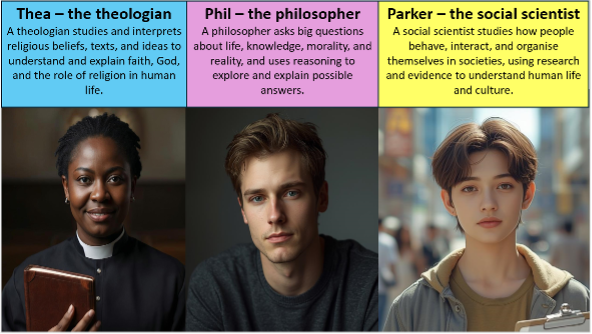
We introduce pupils to the disciplines of RE through three characters: Thea the theologian, Phil the philosopher and Parker the social scientist. This helps them recognise the different lenses they might use in a lesson, as well as the types of questions and scholarly approaches associated with each discipline.

Before studying a text in detail, we focus on the person behind it:

  • Who is believed to have said or written this?
  • When did they live?
  • What was life and society like at the time?
  • Why is this individual regarded as a source of wisdom and authority today?

Establishing this foundational knowledge allows pupils to engage more confidently with the text itself. We also ensure that key vocabulary, both subject-specific (Tier 3) and more general academic language (Tier 2), is either pre-taught or clarified during reading.

Meaning then, meaning now: helping pupils connect sacred texts to contemporary life

Promoting reading has been a key whole-school and departmental priority in recent years. Our approach includes structured reading strategies, which you can explore further here: https://www.broughtonhigh.co.uk/docs/Curriculum/RE/Reading_strategies_in_RS.pdf

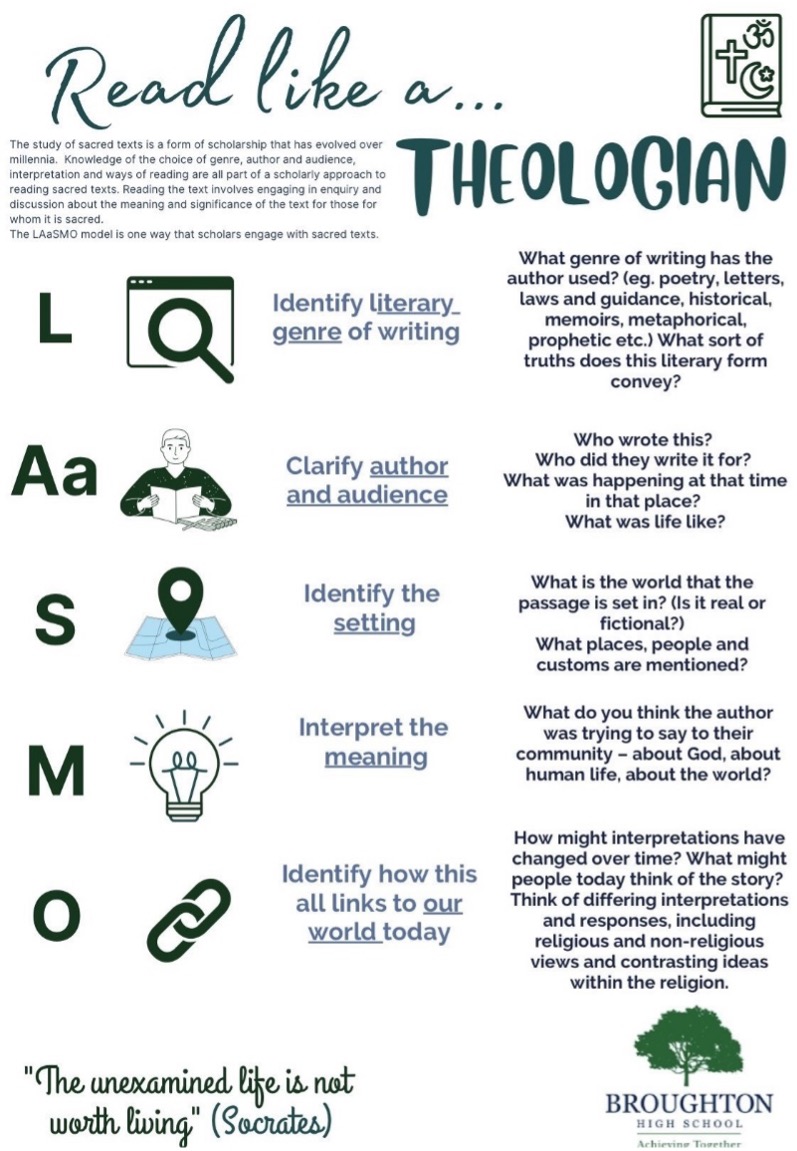
Initial engagement with a text typically involves a guided reading process, where the class reads together and responds to questions designed to support both comprehension and analysis. This often leads into more detailed exploration using the LAaSMO model, as set out in the Practice Guide. This provides a clear and structured approach to help pupils unpack sacred texts in increasing depth. For example, when exploring the Parable of the Good Samaritan from the Bible, we begin by considering the literary form, discussing why parables are used as a method of teaching and how storytelling shapes meaning. Pupils then explore author and audience, developing their understanding of Jesus not only as a religious figure but also as someone responding to the social context of his time. This is deepened through consideration of the setting and character choices, helping pupils recognise why the parable may have been controversial. With this contextual understanding in place, pupils are better able to consider the meaning at the time, interpreting the message as a challenge to social and religious boundaries. Finally, they explore meaning and application today, discussing what “loving your neighbour” might look like in contemporary contexts – locally, nationally and globally – and reflecting on the relevance of sacred texts in the modern world.

Meaning then, meaning now: helping pupils connect sacred texts to contemporary life

The Curriculum and Assessment Review in England emphasises that a successful curriculum should be fit for purpose and equip young people with the knowledge and skills needed to thrive in a rapidly changing world. In RE, exploring how sacred texts might inform responses to modern ethical, social and global challenges helps pupils to engage more meaningfully with the subject, develop critical thinking skills and see the value of what they study in their own lives. By encouraging pupils to evaluate whether religious teachings still hold relevance today, we support them in developing as thoughtful, reflective individuals who can engage with different perspectives and apply their learning beyond the classroom.

About

Joanne Harris is a Religious Education teacher at Broughton High School and Vice Chair of NATRE. She is widely involved in national work supporting high-quality RE, including curriculum development, teacher professional learning and advocacy for the subject. Joanne regularly contributes to discussions on classroom practice and leadership in RE across the UK.

See all posts by Joanne Harris

Ryan Parker | 19 May, 2026

The move to disciplinarity in religious education is exciting. Helping pupils learn how to learn about, and reflectively engage with, religious and non-religious worldviews is crucial; through knowing and using appropriate tools, methods and questions they can more effectively make sense of and navigate future encounters with religion and belief both within the classroom and outside it.

One key discipline which helps pupils make sense of the diverse religion and belief landscape of which they are participants is theology. Theology, as contextualised for a school setting, is the study of beliefs. For me, theology is not a direct arrow to an answer, but a conversation. For instance, going beyond simple and often misleading notions of ‘this text/teaching/concept means X’, pupils can consider a range of questions, methods and tools to help them richly consider why different people hold the beliefs they do. I like the idea of bringing pupils into the scholarly conversations within theology. They are commentators of and contributors to these vibrant discussions – not merely observers.

Many theologians are interested in what happens when readers encounter sacred texts (an area called hermeneutics – a fancy word for interpretation).

  • How do different people engage with them?
  • What do different people think they mean?
  • And why do different people interpret them differently?

This is an area with lots of fascinating questions – particularly as there are wide-ranging views as to how texts could, should and should not be read. Helping pupils understand and consider some of the questions that theologians might ask of texts and readers supports them in understanding how the same text can be interpreted differently by different people and the implications of this.

Below are three ways to support pupils to reason as theologians when engaging with sacred texts. I wonder which of these you might try out this term?

Explore the context(s). Stories/texts emerge from particular places and times.

  • Who told/wrote this story?
  • Where?
  • When?
  • Why?
  • Who for?
  • What response were they hoping from listeners/readers?

Out of these, which ones can we ever truly know – and does this matter? Exploring different ideas, where possible, helps students recognise that discussions around context are continuing and shifting fields of understanding. Based on the ideas offered, what do pupils currently think?

Focus on people. Just as considering the (hypothetical) first reception of a story/text is useful, so is exploring how different people – from different times and contexts – engage/have engaged with a text. I particularly like using artwork here. For instance, here are three different artists’ responses to the Parable of the Prodigal Son:

Invite pupils to compare these artworks and then pose the following questions to help students consider the role positionality can play in interpretation:

  • Why do you think the artist painted it? What meaning(s) and response(s) do you think the artist was trying to convey/provoke?
  • How do you think the artist’s context and worldview has shaped their artwork? (AI can usefully bring some background information here)
  • Which artwork do you think most reflects your view of what this text is about?
  • If you were to represent this biblical text, what might you depict? Why? How might this idea be shaped by your worldview? Why might someone take a different view?

Additionally, if possible, invite actual people from inside or outside the school to share their thoughts on a text. What has shaped their view? Have they always thought this?

Power and parameters. Many theologians raise questions about power and parameters. Why not explore the following as a class?

  • Many texts are preceded by titles – the Parable of the Prodigal Son is a case it point. Yet, these titles vary in different parts of the world. To what extent do particular titles influence what readers takeaway from the text? Who decides on these titles? What could other titles be? Does this reflect our biases?
  • Can texts be interpreted however we want, or are some interpretations inaccurate, inappropriate, or even irresponsible? Who gets to decide this, and on what grounds? Anthony Thiselton’s responsible hermeneutics is great for ideas on the limits of interpretation here.

About

Ryan Parker is the RE and Christian Ethos Adviser for the Diocese of St Albans, with teaching experience across primary and middle school settings. He recently completed a PhD at the University of Birmingham, focussing on knowledge-rich textual enquiry in primary RE. You can read more about his PhD in this recent Research Spotlight. He also hosts the ‘Flourishing Together’ podcast series which invites discussion around various aspects of high-quality RE. X: @ryanparker1991 BlueSky: @ryanparker-91.bsky.social

See all posts by Ryan Parker

Sarah Dennis | 18 May, 2026

To really understand how religious and personal beliefs work, pupils need to understand where beliefs come from, how they are lived, and the deeper thinking that sits behind them.

One place many beliefs originate is in stories with rich layers of meaning. My idea was to design a lesson sequence for pupils aged 10–11 that allowed them to study beliefs through theology, lived experience through the human and social sciences, and deeper meaning through philosophy.

I also wanted to link as many stories as possible to people from our local community, so pupils could see that these stories are not just historical texts but have real influence here and now. A big ask, but was it possible?

Designing a disciplinary approach for Year 5 and 6

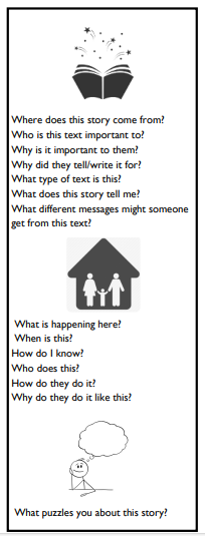
To make this work, I created a resource with three clear sections, each linked to disciplinary questions. I turned this into a bookmark (Figure 1) so pupils could make notes as they went, reducing cognitive overload.

The bookmarks were lightly taped into books so pupils could write alongside them. Notes were later developed into one paragraph per discipline. Over the course of the unit, the bookmark evolved as both the pupils and I refined the questions, focusing on those that generated the most thoughtful, open‑ended responses.

Figure 1. Disciplinary bookmark                                                                  

One text, three disciplines, one lesson

Over nine weeks, we studied nine texts. Yes, one text per week, covering all three disciplines in one hour.

Every lesson followed the same pattern. Over time, pupils became increasingly confident with the disciplinary thinking, knowing what kind of questions they were being asked and why.

When subject knowledge becomes the challenge

My first step was to trial the approach using a different text. That was when I realised my biggest problem: I did not always have the subject knowledge to confidently answer the questions I had written on the bookmark.

Using support from NATRE, RE:Online, TrueTube and BBC Bitesize, I took time to build my own understanding. This was an essential step and a reminder that disciplinary teaching requires ongoing subject knowledge development for teachers as well as pupils.

What the lesson sequence looked like in practice

Each lesson followed a clear structure:

  • Lesson objectives and dates were printed on stickers to save time and stuck onto a new page.
  • Pupils annotated their bookmarks while reading the text for theology. I modelled this for the first three lessons using my own exercise book and a visualiser.
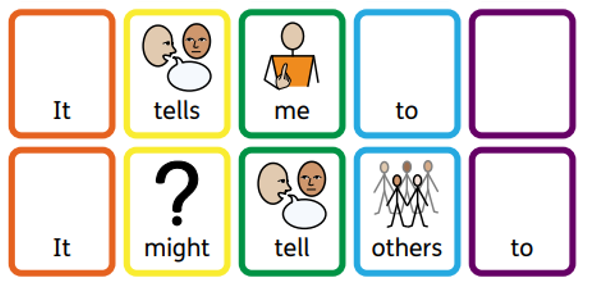
  • Writing scaffolds were available for early writers. (Figure 2)
  • Pupils watched short videos showing lived experiences, often from members of our local community or carefully chosen online clips. They annotated the human and social sciences section of the bookmark.
  • Pupils considered what puzzled them about the story.
  • Annotations were written up into short paragraphs, with images from the lived experiences added to support writing.
  • Pupils pre‑read the next week’s story.

The consistent structure helped pupils focus their thinking and build confidence week by week.

Figure 2. Writing Scaffolds

What surprised me about pupil learning

A common mistake in my teaching, across all primary year groups, is underestimating what pupils can achieve.

I spoke honestly with both classes about trying something new, and they were incredible. Pupils suggested changes to the bookmark questions, refining them lesson by lesson. The feedback was thoughtful, and engagement with each text was high.

The lessons worked because the bookmark gave pupils a clear place to offload knowledge, freeing up their thinking rather than overloading their working memory.

Removing the scaffolds

In the final lesson, I wanted to see what pupils could do with less support. I removed the bookmark and asked pupils to generate their own questions.

They worked in groups of three, using two QR codes linked to texts and a BBC Newsround clip. I had the writing scaffolds ready and the pupils knew they were available. Not one pupil asked for them.

What I learned

In summary, Year 5 and 6 pupils can study texts through multiple disciplines, and do so successfully. This approach works particularly well with texts linked to lived experience or moral influence.

You may need to adapt the bookmark for your cohort. You will almost certainly need to spend time building your own subject knowledge. But the depth of understanding and the skills pupils develop might just surprise you as much as they surprised me.

About

Sarah is a member of National Association of Teachers of RE (NATRE) Exec and RE leader at Chadsmead Primary School in Staffordshire. She has led a NATRE affiliated local group for over six years and networking lead for RE for her academy chain Community Academy Trust. Sarah completed the Culham St Gabriel's Leadership Scholarship Programme in 2025. She teaches RE across a one form entry Primary school in Lichfield in Staffordshire.

See all posts by Sarah Dennis

jenny-kaur | 08 March, 2026

“That’s not my Sikh faith” Amy Ark [Sikh panellist] said during the recent National Association of Teachers of Religious Education (NATRE) Strictly RE conference. Amy was discussing her own experience at school, where Sikhi was only covered for one week and in this short time she found the curriculum had resonated little with her lived experience; Amy is not alone, there are many Sikhs who also feel the same. I find the common phrase “She’s not Sikh her hair is cut” circling in many discussions in groups in 11-14 RE.

I’m sure I am not alone. I’m sure we have all found ourselves in the lesson where we combat generalisation and stereotypes in the classroom. I have found it best to provide examples of modern and historical Sikhs who have a story to disrupt the ‘typical Sikh look’ for students. What does it mean to look or act like a Sikh currently?

In Professor Jasjit Singh’s excellent ‘Teaching Sikhi in RE: Engaging communities with Teaching Religion’ research we learned it was clear there is insufficient community and ‘Lived Experience’ integration. There is an explicit finding of weak engagement with Sikh communities in curriculum development and delivery. This perpetuates a textbook-only approach, ignoring the richness of contemporary British Sikhi. I had also read this from Dr Phra Nicholas Thanissaros Teaching Buddhism in Britain’s schools: redefining the insider role” here we learn the “dissonance apparent between home and school presentation of Buddhism is compared to similar findings for the Hindu and Sikh communities in Britain.” One of his suggestions to bridge this gap is to enrich the conversation between “insider” (the community’s living faith) and “outsider” (the teacher’s academic presentation) perspectives. In a further report from Insight UK it is posited that the lack of accurate, quality representation is linked to an “inferiority complex” amongst South Asian children, failing the duty of RE to support identity development.

As a result of my own experience and these reports I have chosen to explore modern and historical examples of Sikhs, allowing students to see the modern ways women are shaping their fields from psychology to art. These women are all united with a shared conviction – not in a general archaic sense of Sikh identity. I would have enjoyed hearing of these voices whilst at school and teaching at a single sex girl’s school I have found providing the students with female voices resonates with them [and me]. I have also underneath each biography suggested how they can be used in different contexts from creative tasks or discussions on equality in practice with many connections to GCSE units’ such as relationships for roles of men and women and intergenerational living. I have listed them below and given a little detail about them but they are available in more detail with biographies and teaching suggestions on the RE:Online website as PDF’s to use in the classroom.

I hope you find them useful and interesting as I did!

  1. Dr Manpreet Dhuffar Pottiwal : Sikh Psychologist

Dr Manpreet Dhuffar Pottiwal is a Sikh psychologist and activist whose work focuses on intergenerational trauma within South Asian communities. Through her TEDx talk, she uses the metaphor of family trees to show how inherited burdens and strengths shape identity, encouraging healing through understanding roots, culture, and community.

  1. Mai Bhago: Female Sikh warrior

Mai Bhago was a fearless Sikh warrior who challenged forty men for abandoning their faith and led them back into battle against a vastly larger Mughal army. Though badly injured, she survived and later became Guru Gobind Singh Ji’s bodyguard, standing as a powerful example of equality and courage in Sikh history.

  1. Amrita Sher Gill: Hungarian Sikh Artist

Amrita Sher-Gil was a Hungarian Sikh artist whose paintings explored the emotional lives of women constrained by tradition. By blending Indian and European styles, she gave voice to women’s quiet struggles, resilience, and unspoken strength, especially in works like Three Girls.

  1. Neelam Kaur Gill: British Sikh model

Neelam Gill is a British Sikh model who turned experiences of bullying and racism into a mission for representation in fashion. As a trailblazer for major global brands, she speaks openly about discrimination and uses her visibility to challenge stereotypes of modern Sikh identity. 

  1. The Singh Twins: British Sikh miniature artists

Amrit Singh and Rabindra Kaur Singh, the Singh Twins, are British Sikh artists who have revived Indian miniature painting to explore modern social, political, and religious themes. Their highly detailed, vibrant work challenges Eurocentric ideas of fine art while proudly expressing Sikh history and worldview

  1. Mata Khivi: The only woman mentioned in the Guru Granth Sahib

Mata Khivi is the only woman named in the Guru Granth Sahib and is honoured for her compassion, equality, and service. She played a central role in establishing the langar system, ensuring food and care for all, and remains a lasting symbol of Sikh values in action

  1. Sophie DuLeep Singh: Suffragette

Princess Sophia Duleep Singh, daughter of the last Sikh Maharaja, was a key figure in the British suffragette movement. She used her royal status to fight for women’s rights, support Indian independence, and amplify South Asian voices in Britain.

Dr Richard Kueh | 31 January, 2025

Reflections on religious education, the Francis review and the national curriculum in England, with a little help from W.B. Yeats’ ‘Second Coming’ (1919).
Things fall apart; the centre cannot hold; Mere anarchy is loosed upon the world… The best lack all conviction, while the worst Are full of passionate intensity. Surely some revelation is at hand; Surely the Second Coming is at hand… And what rough beast, its hour come round at last, Slouches towards Bethlehem to be born? Yeats’ poetic thought-world is thrilling. His poetry imagines chapters of history turning: one epoch making way for another. Might we be on the verge of an educational chapter in England wherein religious education (RE) occupies a strengthened position in the school curriculum? If so, might the fortunes of the subject be much improved?

Surely some revelation is at hand.

Before we think about the next educational epoch or chapter, let’s look back. Let’s contrast our current educational epoch – one in which the Francis Curriculum and Assessment review is being conducted – with one that came before: the era of the legislation which underpins RE’s current status. It’s clear that the kind of educational assumptions sitting behind the 1988 legislation, and reflected within it, do not reflect the realities of schools today:
  • school structures have evolved: not all state-funded schools are maintained by local authorities (40:1(1)a,b,c);
  • assessment has moved on: practices are not shaped by end of key stage attainment targets (40:2(2)a);
  • historical duties are not enacted: it is simply not that case that “all pupils in attendance at a maintained school… on each school day take part in an act of collective worship.” (40:6(1))
In this legislation, RE sits as part of the “basic curriculum”. The basic curriculum for state-funded schools was imagined to include the national curriculum and RE. Yet, today, leaders and governors appear to have collective memory loss of this fact. But even the language of the “basic curriculum” has largely been lost in the annals of time. The kind of educational epoch which placed RE within a “basic curriculum” is quite different from the current one. Indeed, today, if any “curriculum” is perceived to be “basic” at all, it’s the national curriculum. What once obtained, no longer suffices. Clearly, the status of RE has not benefitted from this historical distinction, however worthy or defensible the reasons for it were at the time. It would be very hard indeed to argue that the subject is thriving, with pupils across the country equitably enjoying high-quality religious education in schools. In my final RE subject report at Ofsted, I reflected on a sad state of affairs for RE in many schools within the research sample. I (and my colleague Hazel Henson, HMI) found:
  • RE that didn’t help pupils prepare for living in a complex world
  • RE that gave pupils at best a superficial grasp of religious and non-religious traditions
  • RE that didn’t help pupils interrogate claims and statements about religion and non-religion
  • Worryingly unreliable assessment practices in RE
  • An absence of professional development in RE for teachers, mirrored by pupils being left with profound misconceptions
It would be hard to argue that the status of RE outside the national curriculum has served pupils in England’s schools well.

The best lack all conviction, while the worst are full of passionate intensity

Yeats uses the line “the best lack all conviction” from Shakespeare’s Hamlet to refer to the aristocracy. But these words also helpfully illuminate the current dilemma of RE: it is those with the greatest potential who may struggle with doubt and uncertainty about change the most. When it comes to RE being included within the national curriculum, rather than sitting awkwardly adjacent to it, there is much enthusiasm from RE stakeholders (by which I mean RE leaders, teachers, practitioners, advisers and professionals). There are also some who have expressed displeasure with the idea. Why might they object? Some religious communities who run state-funded VA schools (and ex-VA academies) can determine ‘denominational RE’. This kind of RE is outside the remit of Ofsted to inspect. Others like existing arrangements that RE content in maintained schools can be decided at local authority level. Though they positively advance and prioritise RE, these individuals and institutions prefer the current arrangements. Question: is it worth giving up control? Yet I can see policy positions that can offer resolution. Mitigations could still be built into any post-Francis-review national curriculum. The current national curriculum for history, for instance, already includes flexibilities on studying local history. In the case of schools with a religious character, it is more likely the case that these schools offer more RE curriculum time than their non-religious character counterparts. There should be nothing to prevent them from teaching beyond a minimum entitlement (a position that reflects the current Secretary of State’s approach to teacher pay, which might have a ‘floor’, but no ‘ceiling’).

Slouching towards Bethlehem, ready to be born

On the 8th January 2025, the second reading of the Children’s Wellbeing and Schools Bill in the House of Commons included a discussion of the Francis review. In it, the former Secretary of State Damian Hinds discussed his perception of the dangers of an over-specified, overly-prescribed National Curriculum: “…in sensitive subjects like history, like English literature, like RE, we’ve always in this country, since the start of the National Curriculum, taken an approach of not specifying what kids will learn… it’s not a list of things you will learn in schools… it’s a broad framework that helps guard against the… over-politicisation of education.” Whether or not you agree with Hinds, his wording suggests that RE is already part of the National Curriculum! Misconceptions are rife. RE – and those responsible for leading and teaching it – deserve some clarity at the very least. RE’s journey to the present hasn’t been the smoothest of paths. The inclusion of RE in the next chapter of the National Curriculum is evidently one way to obtain clarity and more-secure footing. Slouching towards Bethlehem is certainly apt, if it is indeed to happen at all.

About

Richard is Head of Primary Curriculum & Teacher Development, Inspiration Trust. Writing in a personal capacity

See all posts by Dr Richard Kueh