Working with academic researchers & teachers on religion and worldviews projects
Research Spotlight: Working with academic researchers & teachers on religion and worldviews projects
October 2022
Jennifer Jenkins
In this video Jennifer Jenkins talks about her recent project working with academic researches and teachers to look at Religion and Worldviews. In particular Christian worldviews in relation to advocacy. As you watch the video here are some questions to think about:
How might you use these materials in your own setting as part of your existing RE Curriculum or when planning for a new one?
Which other social justice topics could be explored using this framework?
Are there other topics that would benefit from cross-phase working with academics and researchers from higher education?
How can we best distil the knowledge, ideas and expertise of academics and researchers in ways that RE teachers, subject leaders and non-specialists can easily digest and utilise for learning in the classroom?
Research Summary: Why opt for A level Religious Studies?
Religious Studies (RS) is expected to impact on students’ personal development as well as enabling them to acquire knowledge and understanding of religious and philosophical traditions. A small-scale, in-depth piece of qualitative research was undertaken with A Level RS students in two Midlands sixth forms, to find out about whether that is true in practice. Students’ motivations for studying A Level RS were researched, including the value they see in the subject and how far they perceived themselves changed as a result. It was found that students appreciated the scope to discuss and debate, and the potential wider applicability of the subject. All students felt they had their own views and ideas both challenged and confirmed, although there also appeared to be limiting factors as to how far understanding of, and empathy for, the beliefs, values and worldviews of others was possible. Teachers could use the findings when considering improvements to A level teaching and as ways to market RS to possible opters.
Researcher
Ian Jones
Research Institution
St. Peter’s Saltley Trust, Birmingham
What is this about?
Does A level RS impact on students’ personal development as well as their knowledge and understanding of religion and philosophy?
What value do students see in the subject? How far do they agree that their studies change them?
What is it about discussion and debate that students appreciate, and it what ways do they see their learning in RS as widely applicable?
How far do they see empathy with others’ views as possible?
What was done?
Two sixth forms were studied over the duration of an A level course. 21 semi-structured interviews were carried out with 21 students; and in each school, lessons were observed over a month.
Three teachers were also interviewed.
Main findings and outputs
Most students chose A level RS because they enjoyed GCSE and – based on the A level specification – were curious to find out about how other people thought and acted.
Another reason was that debating, arguing and discussing were seen as interesting and useful activities.
Reflecting back on their course, all students felt glad and would make the same decision again; the opportunity to debate and hear different views was again the main reason.
The emphasis on discussion was sometimes observed as rather ‘open’ and this acted as a limitation on critical engagement with philosophy. There was sometimes a tendency (from teachers or students) to assert the absence of right or wrong answers.
At other times critical engagement with philosophy was focused and students appreciated the higher level of challenge. Students favoured topics with more personal relevance or potential for controversy. At best RS helped them to ‘sort out’ their thinking in relation to life issues. An additional positive factor was preparation for life in a society of diverse beliefs and views.
Students noted the relative absence of treatment of religious traditions, a factor that also surprised the researcher.
In terms of personal impact, it tended to be undramatic but perceptible: having one’s opinions challenged, offering tools for relating to later life situations – learning was deepened when students were asked to relate different philosophical theories to life-situations.
Even so, A level RS confirmed many students’ existing worldviews.
Relevance to RE
Teachers could use this research as evidence of the interest and benefits of RS, when presenting A level RS as an attractive option to students and parents.
Teachers can build on students’ evident preferences for discussion, debate and argument.
Where subject content provides potential for personal relevance or controversy, teachers can use this to build student engagement.
Teachers should also take note that students appear to be most engaged and challenged when: teaching goes beyond description of different ideas into critical thinking about philosophy; students are asked to relate different philosophical theories to different life-situations, and have a sense of organising their thinking in preparation for later life. If possible, teachers might include more material from different religions in the course of study.
Generalisability and potential limitations
The research only claims to be small-scale but it illustrates very interesting themes for teachers to follow up, especially because this area of RE is under-researched.
Find out more
Why study A Level Religious Studies? Qualitative perspectives from two English Midlands sixth forms, Journal of Beliefs and Values 38.1 pages 3-17 (published online 23 September 2016), 10.1080/13617672.2016.1232566
Why and how should a Key stage 3 module on contemporary religious expression in art be created?
Research Summary: Why and how should a Key stage 3 module on contemporary religious expression in art be created?
Sukaina Manji, [lead writer] & other contributors: Laura Miller, Sahra Uçar, Samuel Yates
Introduction
‘All the world’s a stage, And all the men and women merely players.’ (1)
This article brings together individual research pieces and defines a shared resource valuable to RE practitioners. The following subsidiary questions help illustrate the fundamental approach:
1) How does the identity of a teacher, for example, faith-based or non-faith-based affect their approach with creative expressions of religion in the classroom?
2) How can the module be assessed?
As researchers, our interests come together in responding to the title question. We discussed how the definition of religious literacy has shaped over time and how the current religious landscape further helps to create meaning. Evidence shows religious and non-religious identification shape curricula (2). In turn, we can question and reflect upon the impact of varied religious and non-religious epistemologies in shaping our ideas about what it means ‘to know’. Knowing about worldviews is imperative in understanding how faith and non-faith members can effectively produce a cohesive society built upon respect. Furthermore, the study of religion offers an insight into human nature, questions of knowing and being in the world, and the impact of varied worldviews and traditions in mediating a person’s life experience, both as individuals and members of society.
As qualitative researchers focused on the classroom, we hope to reveal findings by having ‘safe spaces’ within which dialogue can occur. It is the adult’s responsibility within the classroom to ensure that any resources used within the school bear respect and will not contribute towards stereotyping religious communities or causing offence in any way. We propose using contemporary art within the classroom as a means of developing critical religious literacy. As the facilitator, the teacher is responsible for guiding discussions without consciously/unconsciously imposing. We look at the RE classroom’s idea of becoming a stage, taking inspiration from Shakespeare’s words and defining the actors within and the various structures at play (3). The following section examines definitions of religious literacy and connects the RE classroom as a stage with actors in a journey of constructing meaning through expressive arts.
Context and literature
Religious literacy has been defined by a range of theorists, recognising its role within contemporary society. For instance, Wright (4) argues that a religiously educated child would critically engage with religious truth claims. This position strengthens the need for critical RE lessons, addressing the ‘decline of religious literacy’ (5). On the other hand, Moore (6) specifies how a religiously educated person can understand how religion plays a fundamental and integral role within human life. Dinham et al. (7) consider that we need to be aware of engaging respectfully with others within the public sphere. Manji’s research proposes that empowering our younger generation right from an early age with religious literacy will enhance the understanding of their peers and others within the wider community.
According to Taylor (8), RE is a type of practice like all other scientific disciplines. Hence as a practice, RE can be defined as a type of social activity, with actors, structures, action repertoires, rules and ideals (3). Doing so supports the idea of the RE classroom as a stage that helps create meaning. The teacher and students play an ‘actor’ role in creating sense through religious literacy development. As actors, both can maintain personal identity whilst learning happens within the community. At the same time, Afdal (3) suggests the class is also a community of differences as students are involved in other communities and relationships that may be invisible in the classroom. However, the invisible characteristics may determine their feelings about, experience, and understanding of religion (3). Such a position does not mean nurturing prejudices within the classroom but, in essence, fulfils the vital responsibility that RE plays in tackling stereotypes, prejudices and informing personal biases that need reframing.
Therefore, this leads to questioning how a teacher’s personal view, or lens, supports or creates biases whilst exploring religion’s creative expressions. Some valuable reflections for RE practitioners within the classroom could include questioning from an individual level to the broader whole-school level:
How do teachers apply the scheme of work or lesson using PowerPoint other than just reading from the board? How is creativity produced within the RE classroom?
How does the experience of a teacher differ, from subject knowledge to numbers of years in teaching? Does this change the nature of the lesson? Would students experience a class differently with subject knowledge expertise, or would the number of years in teaching shape the lesson?
What about the broader context of the school? What are the underpinning ethos and values of the school? How is RE as a subject valued widely within the school? Does this impact the classroom?
Through his ongoing research, Yates suggests that as art is interpretive, the student can explore secular, non-religion, and religious themes through the medium of art. The religious/non-religious identification of the teacher does not impact the student in a way they may be susceptible to with other religious-based topics. Art is a neutral ground that enables effective discussion of students’ interpretations without imposed teacher’s belief systems. Perhaps as the interpretation of art is in various ways, the student can take responsibility in their learning to ensure a positive engagement. On the other hand, Miller’s experience in her department suggests that many chaplains face personal religious identity issues affecting expressions of their religion in a classroom. Such practices require a supportive approach, for example involving with ’a Bible through arts’ group that may offer examples and ideas through discussions.
As responsible RE professionals, we ensure that safe discussion places don’t involve resources that could disrespect or create tension for any religious communities. For example, using offensive cartoon drawings for discussion purposes could perpetuate disrespect, whilst using offensive cartoon images of the Prophet further prejudices against Muslims and helps to create stereotypes when people from the faith demonstrate their religious views. As practitioners, we need to know what religious art means.
Does using religious art necessarily mean using provocative pieces?
Do we need expertise in recognising what we mean by religious art?
How can we be sure that we are using religious art genuinely to enhance teaching and learning?
Therefore, our crucial responsibility is to apply religious literacy within our teaching practice. On a practical level, religious literacy supports the practitioner in teaching and learning by having the ‘sufficient knowledge of religion to act and interact’ (5) accordingly. Dinham et al. (7). call for the ‘urgent need to re-skill public professionals and citizens for the daily encounter’ with the full range of religious plurality (7). Hannam (5) draws from Dinham and Shaw (9) to explain the framework of religious literacy, which seeks to inform thoughtful and rooted approaches towards religions to countervail reactions based on fear and stereotype. Hence, religious art can be defined as created by adherents to express devotion and can be used for engagement in critical discussions. By doing so, we create opportunities for discussions instead of fuelling prejudices. In the next section, we link to metaphors suggesting them as a way forward in relation to contemporary religious expression in art, particularly for key stage 3 who can embed their primary sector learning and enhance learning progression.
Findings-in-progress
Uçar’s research suggests that art provides enormous scope for engaging understanding in this area and offering an alternative paradigm of ‘knowing’. Further, if we view art pieces as epistemological narratives that teach us about a given religious tradition, then we can work through art to become theologically literate. Each piece of religious art represents a story and contains insight about a religious tradition – we just need to equip students with the skills to ‘read’ art in this way and therefore learn to ‘theologize’ as Copley (10) puts it.
Using metaphors to describe the various ongoing research helps to recognise how critically engaging with RE can lead to a real appreciation of what religions and their traditions can offer to create knowledge systems that act as developmental tools for the future. By decoding the metaphors, one can link to the deeply covered iceberg messages within religions and traditions. Overall it can also help differentiate between what can be religious and other cultural issues. The safe places within the RE classroom can enable such positions. For example, an experienced teacher would link FGM through deep thinking layers when teaching about human rights. Would religions advocate for such brutality towards women, both young and old? Has the practice been built further using culture as a vehicle and disguised under religious rites? There is a lot to think about, but we can tailor discussions appropriately to suit age and levels as professionals. Examples that we cite in the following section will help create an excellent scheme of work for trialling within the lower secondary sector.
Discussion
Using visuals within the classroom creates a powerful expression of what religious artefacts mean to the believer. Ingold writes on ‘materials and materiality’, showing the power of artefacts and includes art. He defines archaeology and anthropology as ‘craft’, rather than an academic discipline. Religious education can draw much from such a definition as religions have never been purely academic, written, or epistemic. This burgeoning field allows epistemic decolonisation of RE, which enable a fuller and more authentic exploration of religious tradition.
Uçar uses tapestry to recognise the ‘weaving’ within religions, where each thread helps understand the variety of views within religion and its traditions. Manji proposes to look at an ‘ocean blanket’ which aids various kinds of learners: audio, visual or kinaesthetic, to recognise that the outer layer has formed a ‘dark rim’ that surrounds the fuller and deep values within the ocean. Similarly, suppose students lack religious literacy from the primary sector going forth. In that case, we are then demonstrating irresponsible behaviours by letting stereotypes and prejudices filter our younger generation’s lenses. How far can the responsibility lie with the personal self, and how far can this be shared with the school? Could a primary educator confidently say that RE teaching was not entirely for academic purposes but rather to open up filters within the young mind in recognising worldviews both religious and non-faith?
When moving onto the secondary sector, students’ learning progression can draw knowledge and understanding from their prior years, which act as building blocks in the RE classroom. Hence, we propose using key stage 3 to enhance further and help ‘measure’ learning through creative expressions. Could such ‘measuring’ be about the informed self? If so, this could provide further opportunities to enhance learning. Or does it need to be about giving a level to students? If so, there is a risk of disengagement from students who do not attain it.
Brooks and Fancourt (11) approach whether self-assessment is unique in RE, whilst Blaylock (12) discusses issues in achievement and assessment in RE provision in England. Perhaps what we propose through our creative expression can help bridge the gap as it supports various interpretations that create meaning for the learners.
Personal worldviews help shape the lenses of individuals by drawing on aspects of both religious and non-religious worldviews. The CoRE (13) report proposes that RE as a subject can become more inclusive by reflecting the broader social changes within England and globally and offers a rebranding as Religion and Worldviews. Perhaps through metaphors and creative religious and non-religious expressions, we can provide further dialogue and breath within the RE classroom without creating biases and prejudices. Such a stance suggested as using religious art as a medium may enable open engagement, accessible by various types of learners, and discussions within the ‘safe places’ handled professionally. We have discussed how and why contemporary religious expression can further learning, and to sum up, we propose a scheme of work based on three key ideas.
Conclusion and issues for further research
Religious artefacts convey religious meaning in powerful ways in understanding religions and what they mean to believers. In the same manner, contemporary expressions of religion through the art can support and embed learning. These can be through unique opportunities that work within metaphorical arts, for example, unweaving tapestry to create meaning, looking underneath the iceberg by examining the ‘darker distorted’ areas because of prejudices and stereotypes. Finally, enabling learning through the discussions that occur eventually leads to formative assessments that help better position and equip our younger generation. The next step that we recognise is to create such resources and pilot them within supporting schools. Hopefully, it will provide us with qualitative data to reshape and enhance the resources even further. Overall it is through the teaching and learning process that, as educators, we can continue to add further to the RE world when we reflect on our teaching.
References
Bloom H. William Shakespeare’s As you like it. Philadelphia: Chelsea House; 2004
Glanzer PL, Alleman NF. The implications of religious identity for teaching ethics. Journal of Beliefs & Values. 2015;36(2):131-41.
Afdal G. Religious education as a research discipline: an activity theoretical perspective. British Journal of Religious Education. 2008;30(3):199-210.
Wright A. Religious Education in the Secondary School: Prospects for Religious Literacy. Abingdon: David Fulton Publishers.; 1993.
Hannam P, Biesta G, Whittle S, Aldridge D. Religious literacy: a way forward for religious education? Journal of beliefs and values. 2020;41(2):214-26.
Moore DL. Guidelines for Teaching about Religion in K−12 Public Schools in the United States. of Religion AA, editor. Atlanta, GA: American Academy of Religion; 2010.
Dinham A. Religious Literacy: Contesting an Idea and Practice. In: Francis ADaM, editor. In Religious Literacy in Policy and Practice. Bristol: Policy Press.; 2015b. p. 101–12.
Taylor C. Philosophical Papers: Volume 2, Philosophy and the Human Sciences: Cambridge University Press; 1985.
Dinham A, and M. Shaw. REforREal: The Future of Teaching and Learning about Religion and Belief. . 2015.
Copley T. Young People, Biblical Narrative and “Theologizing”: A UK Perspective. Religious Education. 2005;100(3):254-65.
Brooks VF, N. . Is self-assessment in religious education unique? British Journal of Religious Education. 2012;34::123-37.
Blaylock L. Issues in achievement and assessment in Religious Education in England: Which way should we turn?’. British Journal of Religious Education. 2000;23 45-8.
What’s RE got to do with equitable mental healthcare services?
Research Spotlight: What’s RE got to do with equitable mental healthcare services?
Central to all we do at Culham St Gabriel’s is our vision for a broad-based, critical and reflective education in religion and worldviews that has the capacity to contribute to a well-informed, respectful and open society. As part of our current charitable objectives, we are engaging more explicitly with a range of researchers and thinkers who can help us to consider how the RE community can be central in advancing the kinds of knowledge that might contribute to more just, inclusive and equitable engagements with religious and non-religious worldviews across every arena of social life and public services provision.
June 2021 research of the month was presented by Tamanda Walker at the University of Leeds Centre for Religion in Public Life and explores engagements with religious and non-religious worldviews within Mental Healthcare provision in the UK and beyond.
Tamanda Walker talks about her research: What’s RE got to do with equitable mental healthcare services?
While the significance of all religious and non-religious worldviews are considered within mental healthcare provision, particular attention is given in this research project to indigenous African belief systems. These worldviews have often been negated, misrepresented, and/or inferiorised within Eurocentric systems of knowledge that have emphasised learning primarily around the world religions paradigm established under colonialism (Masuzawa 2005).
Emerging evidence shows that some African and Afro-Caribbean service users seeking treatment for both common and severe ‘mental disorders’ have at times felt pathologised as a result of a lack of racial, religious and cultural literacy amongst healthcare professionals. In this context, their normative belief systems have been ignored altogether, or occasionally received by clinicians as signs of ‘disturbance’ and ‘mental illness’, rather than being worked with sensitively and inclusively as part of treatment plans.
Given the stark health inequalities exposed by COVID-19, and in the wake of the Black Lives Matter protests of 2020, there has arguably never been a better or more urgent moment for the RE community to reflect on what role it may play in advancing an understanding of all religious and non-religious worldviews within healthcare. Perhaps most especially, the RE community might have a role to play in advancing a more informed understanding of the belief systems of groups and individuals that have been historically marginalised on the basis of both race and faith and/or subject to unequal or exclusive treatment within healthcare. (Boydell et al., 2013; Guy’s and St Thomas’ Charitable Trust, 2018; Codgoe et al 2019; Kinouani in Watson 2019; Mind 2020; Creasy et al 2021; Rethink Mental Illness 2021.
We invite you to move from the experiences of those ‘at the margins’, to ‘those at the centre’ as you reflect on and explore how a more critical, decolonised and reflective education in religion and` worldviews might contribute more well informed, respectful and inclusive healthcare provision for all.
Discussion & Reflection Questions
Substantive Knowledge
In terms of the substantive knowledge offered to students: How might you develop some of your existing teaching and lessons to support pupils to explore the connection between (their own or others’) worldviews and mental health and wellbeing?
How might you use a case study such as the one offered in this video to help students understand the fluidity and complexity of worldviews? In particular, how might the stories of Nkamo and Phatsimo help illuminate how worldviews relate to each person’s social context, location and personal journey, including for example histories of colonialism and/or migration?
What substantive knowledge might it be helpful for students to have of indigenous worldviews and beliefs which are frequently left out or engaged less within RE teaching and learning?
Worldview, Personal Knowledge & Disciplinary Knowledge
My own worldview, positionality and approach to engaging with religion and worldviews and mental health in this case study might be described broadly as critical, decolonial and sociological. What can RE teachers and students learn from this approach to the subject at hand?
What other disciplinary and methodological approaches could be taken to explore and reflect on religion and worldviews and mental health and the issues thrown up by this research? What might theological, philosophical, psychoanalytic and/or clinical approaches offer to advance our thinking in this area?
Critical Religious Education and Social Justice
What role does RE have to play in increasing the public understanding of indigenous worldviews that are frequently negated, inferiorised or misrepresented within Eurocentric systems of knowledge? How might a better understanding of these worldviews contribute to a more equal and just mental health services provision?
What expertise might RE professionals have to contribute to advancing the understanding of religion and worldviews as part of your school’s ethos around values, culture and inclusion?
Tamanda has also created an extremely important policy briefing with recommendations for school leadership, school culture, teacher training, curricula reform and RE. It is available to download below.
Tamanda will be joining us for an ‘In Conversation’ event on Wednesday 1st December 2021 to chat about this research, and her wider PhD focus on religious and non-religious worldviews in the public sphere.
The Story Tent – Developing Intercultural Learning in Primary Schools
Research Summary: The Story Tent – Developing Intercultural Learning in Primary Schools
This PhD thesis explored the possibility of applying Scriptural Reasoning (SR) principles to promote Intercultural Communicative Competence (ICC) in primary schools. It did so by using storytelling and interfaith dialogue to encourage pupils to exercise ICC in classroom settings. My research title was “An inquiry into the development of intercultural learning in primary schools using applied Scriptural Reasoning principles”. My hypothesis was that ICC could be promoted in primary schools using faith stories delivered by faith representatives through applied SR practices. My aim was to test this hypothesis through practical classroom research. My objectives were:
To develop and refine a teaching strategy intervention that employed an age-appropriate adaptation of SR with a view to promoting ICC among primary school children.
To measure ICC displayed by the children during the intervention against a model currently employed by the Council of Europe’s education programmes.
This thesis takes its philosophical position from the work of Ricoeur and combines a phenomenological and interpretive approach to religious education to develop pupils understanding of both the “other” and the “self.” From this theoretical position, an age-appropriate intervention was developed based on the principles of SR in collaboration with the Cambridge Interfaith Programme. The resulting “Story Tent” RE themed day built on the established work of Julia Ipgrave’s dialogic and Esther Reed’s narrative approach to religious education.
Researcher
Dr Anne Margaret Moseley
Research Institution
Warwick Religious Education Research Unit
What is this about?
SR is an approach to studying scriptures in interreligious encounters, originally in an academic context. Its focus is on developing an understanding of religion, as experienced by faith participants through shared dialogue around sacred texts. It is a practice where people of different faith traditions come together to share their sacred texts in an environment of mutual trust and respect. Exploring difference and learning to disagree well is at the heart of the approach.
In this research I explored whether it was possible for primary aged pupils to engage with SR principles and whether this approach to reading sacred texts might encourage intercultural communication. I wanted the research to be built on applications of good classroom practice, but I also wanted to give the work a solid theoretical foundation in current academic research. Before the Intervention I developed a theoretical framework through a consideration of two primary research questions, each with associated subsidiary considerations.
What are the possibilities for and challenges to the development of SR strategies for promoting ICC?
How might SR practices be adapted to suit the experience, skills and cognitive levels of primary age pupils for them to exercise ICC?
What was done?
The underpinning work utilised Action Research methodology through a cyclical approach which took place over two iterative cycles in three different schools, each with its own distinctively different religious ethos and demographic make-up. It was unusual in combining the contributions not only of teachers and researcher but also faith representatives from local communities.
The Intervention was delivered in three schools over two iterative cycles. A research team was brought together to deliver the Intervention that consisted of academics, religious education teachers and community faith representatives. A total of eighty-seven KS2 pupils (children aged nine to eleven years), from three different schools participated in the research. Data was collected during the Story Tent Intervention day through pupil self-assessments at the end of each teaching session, and by transcribing recordings of focused group work and research team interviews. Follow-up interviews were completed the following day with a representative sample of seventeen pupils from the three schools, using a semi-structured interview developed by the Council of Europe, “The Autobiography of Intercultural Encounter” (AIE). The data was combined to produce pupil case study portfolios and ATLAS.ti was used to support the coding process and analysis of the data.
Useful Resources: Moseley, Anne (2018) An inquiry into the development of intercultural learning in primary schools using applied scriptural reasoning principles. PhD thesis, University of Warwick. (Available to view on the Warwick University library catalogue e-thesis – WRAP) The Story Tent blog at CIP https://www.interfaith.cam.ac.uk/news/storytent [Accessed: Feb 2019] Council of Europe (2009) Autobiography of Intercultural Encounters. Available at: https://www.coe.int/t/dg4/autobiography/Source/AIE_en/AIE_context_concepts_and_t heories_en.pdf [Accessed: Feb 2019].
Main findings and outputs
Primary Findings
Story proved to be an age appropriate genre for primary pupils to connect with and provided a familiar context in which pupils were quickly inspired and facilitated engagement. It enabled pupils to investigate difference through an authentic encounter of sacred texts with the support of a community faith representative. It provided a space where ICC could be practiced, and interpretations could be developed using applied SR principles.
The concept of the Story Tent “meeting” place facilitated an environment which enabled pupils to explore a “third space” place of translation, in which different viewpoints could be held in tension and explored together. Through the process of trialogue in this structured space pupils could encounter the “other” in a way that was not compromising to personal faith positions.
Drama proved to be an effective environment for pupils to exercise ICC. The process of working together to discover and interpret a story and present the findings provided a context in which many of the competences were being exercised in the moment.
Secondary Findings
Some of the competences were more frequently demonstrated than others suggesting the possibility of a hierarchy of competences. These differences were most noticeable in those skills that required cognitive thinking. From the pupils’ responses, explaining and relating were more frequently demonstrated than interpreting or critical cultural awareness.
Just as there appears to be a cognitively-related hierarchy among the skills-orientated ICC, there also appears to be an interactional hierarchy among the attitude-orientated ICC. For example, those pupils who were able to tolerate ambiguity were more likely to demonstrate a wider range and number of competences than those who did not.
Personal religious identity also impacted the pupils’ responses to the Intervention. It tended to have a polarizing impact. Those who expressed no faith position during the Intervention tended to demonstrate average overall Competence, whilst those who identified a personal faith position exhibited either high or low Competence. Pupils who had a strong sense of personal identity and were open to others and able to tolerate ambiguity were more likely to demonstrate critical cultural awareness and higher levels of overall Competence.
The Story Tent Intervention proved to be a significant learning experience for the Action Research team. The process of presenting and participating in the Intervention provided a space where a community of learning developed and all those taking part were being challenged by the experience.
Relevance to RE
Using Story – The research suggests that story is a powerful vehicle for pupils to interpret meaning without the need for irreducible truth claims. It provided a context where pupils could step out of themselves and imagine different worldviews alongside their own.
Using groups of 3 for discussion – The research suggests that pupils working together in groups of three provided a space for trialogue which moved beyond the position of binary dialogue to provide a space where multiple interpretations were possible.
Using Drama to develop ICC – The research suggests that the drama session provided a context for pupils to exercise ICC and recognises its potential to explore the views of the “Other”.
Using faith community members – The findings from this research suggest that adult and pupil participants demonstrated similar responses to the intervention indicating there is significant value to the involvement of members of faith communities.
Using the Council of Europe AIE structured interview tool – The research found that the AIE interview tool was an effective resource which enabled pupils to reflect on their intercultural learning.
Generalisability and potential limitations
Whilst it is difficult to draw conclusive evidence from the Intervention as the data sample size was small, the breadth of religious and demographic composition of the research schools provided an opportunity to explore responses to the Intervention over significantly different groups of pupils which provided an interesting comparison.
During the project I became aware of the limited opportunities the team had to fully explore the contributions of the teachers beyond the Story Tent Intervention day. Whilst the faith representatives were able to see how the Intervention worked out in different contexts over the two iterations, the teachers only encountered the experience in their own school contexts. This led to different roles emerging within the research team in which the faith representatives became more involved with the development of the Intervention and the teachers took on a more advisory role in assessing how the pupils had responded to the encounter.
Whilst the AIE interview provided a useful tool for comparison, I was aware of some limitations. Some competences were more difficult to observe, for example, very few pupils demonstrated non-verbal communication, which is by its very nature not communicated verbally. It would have been interesting to video pupils’ interactions to explore this dimension further, although there would be considerable ethical implications to this course of action. Pupils also demonstrated competences that were not included in the framework for example, an ability to collaborate and work together made a huge difference to pupils’ experience of the encounter and yet it is not recorded within the ICC framework applied.
This research drew heavily on the work of Byram and the Council of Europe to build an ICC framework for the Story Tent Intervention. However, during the research a new framework emerged from the Council of Europe. Whilst there is considerable overlap with previous models, there are significant differences, in particular a section that incorporates “Values” for intercultural competence. I chose not to change my research design midway and would further argue that Byram’s model and the AIE interview are still conceptually relevant.
Find out more
Moseley, Anne (2018) An inquiry into the development of intercultural learning in primary schools using applied scriptural reasoning principles. PhD thesis, University of Warwick. (Available to view on the Warwick University library catalogue e-thesis – WRAP)
Research Spotlight: The RE:Connect Project: RE and Climate Change
February 2022 research of the month features Jeremy Kidwell
We’ve known about climate change for centuries. Joseph Fourier theorised the greenhouse effect in the 1820s, and we’ve had data indicate the climate was warming and CO2 levels rising since the 1930s. Even the Intergovernmental Panel on Climate Change has been meeting and producing alarming reports since 1988. This is why the recent international meeting in Glasgow was COP26, because there had been 25 meetings before it. So why are we still talking about climate change and struggling to mobilise action to save life on earth on we know it? For several years now, climate scientists have also begun to ask this question, that is, why isn’t the clear and decisive information we produce on climate change not having the expected results in social change?
Social scientists call something a “wicked problem” when it becomes clear that there are dynamics at play which render a problem more difficult to solve than we might expect. Climate change is definitely one of these – especially inasmuch as we already know what sorts of changes need to happen in terms of reducing carbon emissions – but the complicated social dynamics of lifestyle and social change have left us stymied in a way that was on clear display in Glasgow at COP26 last November. To put this another way, climate change isn’t just a scientific problem after all. It is, in equal measure, a cultural problem. This realisation is really important inasmuch as we’ve confronted the climate emergency as if it was just a matter of presenting evidence about carbon emissions in snappy charts and ignored the social dimensions. This is reflected in school curriculum, where climate change is often treated as a matter for science and geography teachers, and rarely brought into teaching on other humanities subjects, and RE teaching is no exception. Given the ways that culture, vocation and values can be mobilised with such dynamism and creativity in RE, it’s time to acknowledge the crucial role that RE can and should play in confronting the climate emergency.
So how do we get climate change into our RE curricula? There are a few obvious starting points and well-trodden paths: one might start by adding discussion with pupils on the ways that religions have commented on climate change. The Yale Forum on Religion & Ecology has produced a good website which includes details of many formal statements by religious leaders. There are also an increasing number of religious groups intervening in public policy around climate change, which was seen in a presence from a wide range of religious leaders and NGOs at COP26. But as many teachers and policymakers quickly discover, the religious responses to and experiences of environmental change are far more complex and dynamic than their institutional expressions. By extension, pedagogical engagement across the messy edges of climate change and the messy edges of religion is much more complicated.
This discussion foregrounds the importance of enabling RE teachers to work with continuing research engagement. The research landscape moves in different ways across different subject areas, and whilst this is not the case for all fields, the need for ongoing engagement is particularly urgent for religion and ecology as it is a situation where multiple innovations are at play in an ongoing way: scholarship in religion & ecology often goes outside conventional formulation, highlighting ways that religion can appear in unexpected places. In a parallel way, pedagogical innovation and creativity are also demanded, not least because of barriers presented by syllabi, but also because pupils are often unprepared to engage with nature as part of learning in the Humanities. There are some good examples of dynamic and creative pedagogy which confronts climate change in the space of RE (and we’ll share more about these in a follow-up article a bit later in the year!), but by and large, this is a new frontier for RE pedagogy.
Katharine Burn at the University of Oxford, is one scholar who has done quite a lot of work to confront this challenge of research engagement for teachers. Her work, which has been done in collaboration with the Historical Association, has introduced some exciting innovations: introducing the role of Research Champions in schools, and using action research methods to collaborate with teachers around new approaches to CPD. With a shared desire to help RE confront the climate emergency, Ian Jones (Director, St Peter’s Saltley Trust), Kathryn Wright (CEO, Culham St Gabriel’s Trust) and I sat down to design a project with this same kind of collaborative ethos – aiming to find novel ways to enable collaboration between scholarly subject research and RE pedagogy. We set about to design a project that could connect up cutting-edge research with innovative pedagogical practice to confront this paradoxical challenge. Rather than simply seek to replicate a top-down transmission approach to knowledge transfer, we settled on a teacher fellowship model. With funding support from CStG and St Peter’s Saltley Trust, we’ve brought together six teachers from across primary and secondary and at various career stages. We’ve had to adapt fast under Covid and Plan B protocols, but we’ve still managed to have some really challenging and exciting conversations about the pedagogical challenges that need to be confronted in learning and curriculum design. Our teacher fellows are each working on a curriculum project, and we’ve designed a series of workshops which each present a different kind of nexus where religion, theology, and climate change meet: around environmental justice, activism, scriptural reasoning, and RE learning through fieldwork. Our project research assistant and PhD candidate Amy Barnes, has also designed an ongoing set of personal reflections designed to give fellows a chance to reflect on aspirations, pedagogical and curriculum challenges and probing potential new forms of pupil teacher dynamics.
We’ll have more to share with RE:ONLINE later in the year as our curriculum projects start to coalesce and as we digest and share data from our survey of RE teachers, but for now we’ve confirmed our initial suspicions that there is a huge amount that RE teachers can contribute through their subject teaching to the issue of climate change. And there’s a huge desire out there to get this kind of work underway – 89% of the teachers we surveyed shared that they would like to do more work to explore the environment more fully as a theme in their current RE teaching. However, there are also significant barriers to this work. On that same survey, the highest number (45%) of respondents suggested that one the current syllabus prevents them from exploring the environment more fully as a theme their RE teaching. A lack of available work schemes (35%) and resources (29%) came in second as barriers to exploring teaching on this subject. This opening for “culture” in the midst of this supposedly technological and scientific problem has been a long time coming, but we’re ready and excited to bring insights from RE practice which can help RE teachers across the country to overcome these barriers and create new and dynamic learning opportunities in our subject.
RE:Connect religion, belief and the environment
Research Spotlight: RE:Connect religion, belief and the environment
February 2025
This RE Teacher fellowship programme, part funded by Culham St Gabriel’s, aims for a generation of pupils and their teachers becoming confident, informed and generous agents in caring for the earth, through their learning about environment, climate and nature through their studies. The 12 teacher fellows, in two cohorts, worked for 6 months with the university, alongside their normal jobs. Watch this space for opportunities to be part of Cohort 3-which will hopefully be launched later in 2025.
The Teacher fellows have written and trialled primary and secondary resources as a result of their membership of the programme. Jeremy Kidwell, who along with Ian Jones is a co-director of the project, explains what the project is about and why you should engage with the results of the project
The resources that have been created can be found on the RE:Connect website in the projects gallery. More resources will be added soon.
At the beginning of the project the results of a teacher survey showed that there is a huge amount that RE teachers can contribute through their subject teaching to the issue of climate change. And there’s a huge desire out there to get this kind of work underway – 89% of the teachers we surveyed shared that they would like to do more work to explore the environment more fully as a theme in their current RE teaching. However, there are also significant barriers to this work. On that same survey, the highest number (45%) of respondents suggested that one the current syllabus prevents them from exploring the environment more fully as a theme their RE teaching. A lack of available work schemes (35%) and resources (29%) came in second as barriers to exploring teaching on this subject. The work of RE:Connect has attempted to provide some these resources based on the research that was shared with the Teacher fellows on the programme.
As you look at the work that has been created consider these questions
Where in your curriculum do you look at this area?
What different pedagogies can be used to look at this area of the curriculum?
If you want to find out more about this work, would be interested in trialling some of the resources that have been created by the teacher fellows or might be interested in being involved in the next cohort of teacher fellows contact Ian Jones on Director@saltleytrust.org.uk
Primary Practitioners Research
Research Spotlight: Primary Practitioners Research
July/August 2023
During July and August, we are featuring the research of primary practitioners from the 2022-23 Culham St Gabriel’s master’s community of practice. See their presentations below:
Ian Coles looks at the impact that using worldview community visitors in the Primary RE curriculum has
Nadia Nadeem on creating a series of sequential and progressive lessons and resources on Christian ethics and farmed animal welfare
Killian Barrett on our mission to the poor: rhetoric or reality within a Catholic Primary School
Using the voices of worldview community members in the classroom
Ian Coles
Some questions to consider:
Do you use the voices of worldview community members effectively in your classroom?
Are your pupils brave enough to satisfy their curiosity by asking important questions?
Are they brave enough to engage with the answers in a way that might change their own beliefs?
My research aims to discover the impact that using worldview community visitors in the Primary RE curriculum has. I am looking at this from four angles: the academic impact; the impact on pupils’ prejudices; the vicarious impact that this might have on parents; and the impact that these events have on the worldview community members themselves. Next year, as part of my MA, I will be conducting a small scale, practitioner research project at my own school, however I will be backing this up with research drawn from a wide variety of sources.
I have been particularly interested in the use of worldview community visitors for a number of years now. The schools in which I have worked have been populated overwhelmingly by White British staff and pupils. In my twelve years and three schools, I have never worked with a teacher or teaching assistant who was not either Christian or non-religious. I have wondered whether this has contributed to a lack of awareness, knowledge and understanding of peoples from non-Christian religions amongst the pupils, and I have always felt that worldview community members could be a significant resource in addressing these issues.
In regards to the academic impact that such visitors can have, they can of course be effective in overcoming a number of obstacles to teaching RE in the classroom. Insight’s 2021 report on the state of Hinduism in RE, which analysed data from Hindu parents of primary school children, stated that ‘76% of primary school parents are unhappy about RE teachers’ knowledge of Hinduism’ (INSIGHT UK, 2021[1]). Given that many teachers get little to no RE input in their training, it is worthwhile to assume that this lack of subject knowledge extends to other worldviews as well. This issue, which is particularly acute for primary school teachers who are required to be experts on a seemingly unending number of topics, is something that can be addressed by bringing in an expert. It also resolves the worry that many teachers have of misrepresenting a religion when trying to teach it themselves. Most importantly, worldview community members provide pupils with an example of lived religion. Real lives and real authenticity can have a real impact on pupils.
Using ‘live contact’ as opposed to videos also enables pupils to partake in, what I have noticed to be the most effective part of any faith visit, the Q&A session. Studies have shown that pupils ask considerably more questions of a visitor than they do of their teacher (Jackson, 2014[2]; Riegel and Kindermann, 2015[3]). In these situations, pupils are able to satisfy their curiosity in not just a safe space, but a ‘brave space’. A space where people are empowered to articulate their own understanding, but also willing to be vulnerable and allow their beliefs to evolve. This is effective for our children but is also a useful experience for worldview community members themselves.
Research has been done into the benefits of vicarious contact (Mazziotta, Mummendey and Wright, 2011[4]), and it will be interesting to see if any weakening of the pupils’ prejudices can be transferred to their parents. Prejudice may often arise from a lack of understanding, and a lot of research has been done into contact theory and using peer to peer contact experiences to break down prejudicial barriers (Peacock, 2020[5]; Peacock, 2023[6]; Allport, 1979[7]). However, in situations like the one I and many other teachers face it is incredibly difficult to create these experiences for our children. My hope is that my research will provide further insights into the issue of whether worldview community members can be effective in recreating the effects of peer-to-peer contact in reducing religious prejudice amongst pupils.
[2] Jackson, R. (2014) Signposts – Policy and practice for teaching about religions and non-religious world views in intercultural education, Strasbourg: Council of Europe Publishing.
[3] Riegel, U. and Kindermann, K. (2015) ‘Why leave the classroom? How field trips to the church affect cognitive learning outcomes’, Learning and Instruction, 41(2016), pp. 106-114.
[4] Mazziotta, A., Mummendey, A. and Wright, S. (2011) ‘Vicarious intergroup contact effects: Applying social-cognitive theory to intergroup contact research’, Group Processes and Intergroup Relations, 14(2), pp. 255-274.
[6] Peacock, L. (2023) ‘Contact-based interfaith programmes in schools and changing religious education landscape: negotiating a worldviews curriculum’, Journal of Beliefs and Values, 44(1), pp. 1-15.
[7] Allport, G. (1979) The Nature of Prejudice. 25th Anniversary Edition. New York: Perseus Books Publishing.
Christian Ethics and Farmed Animal Welfare
Nadia Nadeem
Questions for consideration:
Why should pupils discuss controversial issues in lessons?
How can we help pupils to learn deeply?
How can we help them to consider their future roles as adults?
I initially learnt about the Christian Ethics and Farmed Animal Welfare project (CEFAW) when I was completing stage 1 of the Culham St Gabriel’s Leadership Programme. I was fascinated to discover the harsh realities of the treatment of farmed animals in the UK. Subsequently, I completed a MA module on Research for Teaching at the University of Chester, as a Culham St Gabriel’s scholarship student.
As part of the project, I collaborated with 2 other primary school teachers to create a series of sequential and progressive lessons and resources that built on prior learning and included links for future learning.
I created lessons that were discursive in nature because from previous research experience (British Religion in Numbers in the classroom), I learnt that RE lessons are much more effective when they are discursive as they allow deeper thinking to take place.
Using discursive strategies enables pupils to apply their learning and understanding outside the classroom and potentially in later life. Using statistics to facilitate a discussion makes the experience real, purposeful and provides context with the possibility of having real impact.
Giving pupils statistics on farmed animal welfare raised many questions including: how does poor treatment hinder the animal’s ability to flourish? Here pupils had to consider what flourishing is. How is flourishing established/reduced? How can limitations on flourishing impact the quality of the animal’s life? Can they result in stress hormones being present in the animal’s meat? How does this meat impact humans after it is consumed? Would it be better to become vegan rather than put an animal through suffering – especially if it is a result of trying to meet supply and demand needs?
Moreover, I wanted pupils to think about the ethical aspect of the treatment of farmed animals and the key concepts of flourishing, stewardship, and dominion in relation to CEFAW but also other facets of life. Can they take responsibility for the flourishing of others around them? How important is flourishing for development and wellbeing?
In my opinion, R&W curriculum needs to teach ethics. In this modern era of social media where pupils have access to surplus information which they are not always mature enough to interpret or fully understand the implications of, it is pertinent for pupils to have ethical values that enable them to develop characters with moral compasses. Teaching ethics supports character building, character education and is learning that can be applied in later life.
After trialling my lessons, I felt they could be adapted further. For example, take the children to a farm, allow them to interview farmers on their practice. This would provide a concrete experience and allow pupils to think deeper and reflect on why certain practices are followed and what changes may be put in place to make a difference.
My message to other teachers is:
Use discursive/controversial lessons even if it seems daunting to begin with; they enable pupils to think in depth and breadth – use discussions regularly.
Controversial questions are great for unpicking pupils’ opinions and thinking. They help to stretch and extend pupils understanding of a particular concept/idea and how it can connect to other learning and aspects of life. Encourage pupils to analyse what they have learnt and what they are going to take away.
Lastly, use statistics because when you provide real a snapshot of society and how it really thinks and works: it compels pupils to consider the type of society they want to live in and what they need to do as the next generations of adults.
Our Mission to the Poor: rhetoric or reality within a Catholic Primary School
Killian Barrett
Questions to consider:
Where does our language of ‘the poor’ come from? How might we reflect on and critique our language of ‘the poor’?
How might we critique images and appeals we encounter through our studies that influence our attitudes to ‘the poor’?
How might we challenge neo-colonial stereotypes through this theme in RE?
The aim of my dissertation project is to explore and examine if the traditional view of duty and service to the poor and disadvantaged is evident in contemporary Catholic education today.
The research and study of literature included biblical, historical and contemporary perspectives of the poor and disadvantaged in relation to the Catholic Church’s Mission, together with a examination of challenges and opportunities related to leadership in fulfilling this mission in a meaningful and practical way today. The dissertation focused on research evidence and example through the examination of a case study school. This case study school is located in Lurgan, Co. Armagh, Northern Ireland and caters for children 4 – 11 years of age.
I was keen to examine how schools can practically improve their care and support to children who may be experiencing poverty. I was interested in investigating our school curriculum (RE programme), Personal Development and Mutual Understanding Program (PDMU), World Views on Poverty, and various other initiatives and outside agencies who visit our school to explore if these subjects and programmes in the school, alongside the pastoral care, are actively and adequately helping to fulfil our mission in helping to serve ‘the poor’.
I undertook research through the mediums of face to face interviews with our current Principal, Vice Principal and one other member of our School’s Senior Leadership Team. These interviews were followed by questionnaires for all of our permanent and temporary full-time teaching staff as well as our SEN and general classroom assistants. These forms of research involved quantitative and qualitative methods of gathering data.
After analysing the data collected it was clear to see that there was a strong agreement from all members of it staff towards supporting the poor in our society. They believed that our school was contributing to this mission by supporting various charities throughout the year, quietly helping families in need and teaching children this moral issue through our curriculum. It was interesting to note that all admin staff believed our curriculum was sufficient in helping teach children about our true Catholic mission towards helping the poor.
Furthermore, a challenge faced by schools in upholding this Mission towards the poor was the negative influence from parents and lack of support from the local parish. Through the data collected, it was clear to see that staff believe there is not enough support from families or the parish community in helping support schools in this mission and instead there is too much of a focus on academic results.
Through the use of findings in the literature reviewed and the subsequent qualitative and quantitative research methods it is recommended that teachers and staff continue to support and build upon the work already done in fulfilling our Catholic mission of helping the poor, no matter what extrinsic challenges they may face. These findings are not just for schools that are solely Catholic but can also be linked to schools of various faith denominations as it is everyones moral duty, regardless of religion, to help those in need.
References:
Byron, W. J. (2015) “What Catholic Schools Can Do About World Hunger.” International Studies in Catholic Education 7 (2): 201–209.
Grace, G. (2002) ‘Mission Integrity: Contemporary Challenges for Catholic School Leaders.’ In K. Leithwood and P. Hallinger (Eds) Second International Handbook of Catholic Educational Leadership and Administration, Dordrecht. Kluwer Academic Press.
Groome, T. (2014) ‘Catholic education: from and for faith’, International Studies in Catholic Education, 6:2, 113-127.
McKinney, S.J (2018) ‘The roots of the preferential option for the poor in Catholic schools in Luke’s Gospel,’ International Studies in Catholic Education, 10:2, 220-232.
O’Malley, D. SBD (2007) Christian Leadership, Bolton: Don Bosco Publications.
The Congregation for Catholic Education (2007) The Catholic School on the Threshold of the Third Millennium’.
Joseph Rowntree Foundation (2011) The influence of parents, places and poverty on educational attitudes and aspirations
Fay Lowe- RE and the far right
Teacher Case Study: Fay Lowe
I am Researching…
the extent to which a locally agreed syllabus can meet the moral development needs of white British working-class boys, in an area where there is a high prevalence of far-right extremism. This topic is one that matters because it is now being recognised that far-right extremism, which has to some extent been overlooked by the media and even government policy in the past, is a growing threat to our society (Thomas, 2012; Abbas and Awan, 2015).
My research will engage with the challenges facing white working-class boys in education and the implications this has for their moral development. It is not until more recently that white working-class boys have been recognised in their underachievement in school (Demie and Kirstin, 2014; Demie and Mclean, 2017). The factors contributing to their educational underachievement including social, economic, and cultural are beginning to be acknowledged and the wider implications these have, including and importantly for this research, a lack of identity within educational contexts. The curriculum doesn’t reflect the culture and lives of working-class children (Demie and Kirstin, 2014) For Reay (2018), this is an inherent problem with an education system that was not created for the working classes. This can lead to resistance from the pupils (Bright, 2011) and a struggle to understand their identity in such a context (Ingram, 2009, 2011). It is this lack of identity and specifically for this research, their moral identity, which can contribute to the reason why some of these boys then become involved in far-right extremism. My research will explore this further and consider if there are ways this can be countered through the Religious Studies curriculum.
When exploring morality and moral identity, I will consider what morality is and why I believe RE has a place in supporting a pupil’s moral development. Moral education can be seen to “assist young people to live more meaningfully and rightly in the light of a clear recognition of the greater value for positive human development of some principles and qualities over others” (Carr, 2005, p. 25). For this research, the unique moral development need being considered is how white British boys living in areas of high prevalence of right-wing extremism, can identify the principles and qualities that are of greater value, against some local acceptance of extreme views, racism and violence. Eaude (2011) in relation to the role RE has to play in this, whilst accepting that moral education needs to be in the whole life of the school, recognises that RE has a distinctive contribution to make to moral education. For him, this contribution is to consider how religious traditions have understood morality and to set issues of morality within this context, encouraging critical engagement.
To consider the ways which the curriculum can meet the moral development needs of white British working-class boys, a preliminary study of the locally agreed syllabuses needs to be carried out. The locally agreed syllabus is a curriculum document unique to Religious Education in England (and Wales). Local Authorities are required to produce their own syllabus for the teaching of RE. The area where this research is based uses a syllabus written in collaboration with RE Today Services, the trading arm of the ecumenical charity Christian Education and an organisation that has provided syllabuses for many areas across the country. My research will consider the place of white British working-class boys within this syllabus, but also highlight its intended contribution to moral development. As a result, I will begin to highlight how this syllabus may or may not be meeting their moral development needs. Following this a more in-depth analysis will be made through mixed methods research, engaging with the target group of boys themselves, to find out their views on their own moral development and the contribution RE has played. I will also consider the views of those involved in the production of the syllabus and the teachers who have recontextualised the syllabus for their classrooms about the extent to which they see the syllabus having an impact. Further research could be carried out with those involved in preventing violent extremism or policy makers when considering the recommendations that may be made by this research.
References:
Abbas, T. and Awan, I. (2015) Limits of UK Counterterrorism Policy and its Implications for Islamophobia and Far Right Extremism, International Journal for Crime, Justice and Social Democracy. Available at: https://www.crimejusticejournal.com/article/view (Accessed: 25 January 2021).
Bright, N. G. (2011) ‘“Off The Model”: resistant spaces, school disaffection and “aspiration” in a former coal-mining community’, Children’s geographies, 9(1), pp. 63–78. doi: 10.1080/14733285.2011.540440.
Carr, D. (2005) Making Sense of Education: An Introduction to the Philosophy and Theory of Education and Teaching. Routledge.
Demie, F. and Kirstin, L. (2014) Raising the Achievement of White Working Class Pupils. Lambeth Research and Statistics Unit Education, p. 43. Available at: https://www.lambeth.gov.uk/rsu/sites/www.lambeth.gov.uk.rsu/files/Raising_the_Achievement_of_White_Working_Class_Pupils_-_Barriers_and_School_Strategies_2014.pdf (Accessed: 9 January 2021).
Demie, F. and Mclean, C. (2017) Narrowing the Achievement Gap of Disadvantaged Pupils. Lambeth Research and Statistics Unit Education. Available at: https://www.researchgate.net/profile/Feyisa-Demie/publication/316701342_Narrowing_the_Achievement_Gap_of_Disadvantaged_Pupils/links/590de27ba6fdccad7b10b818/Narrowing-the-Achievement-Gap-of-Disadvantaged-Pupils.pdf.
Eaude, T. (2011) ‘Spiritual and Moral Development’, in Barnes, L. P. (ed.) Debates in Religious Education. Routledge, pp. 134–145. doi: 10.4324/9780203813805-19.
Ingram, N. (2009) ‘Working‐class boys, educational success and the misrecognition of working‐class culture’, British Journal of Sociology of Education, 30(4), pp. 421–434. doi: 10.1080/01425690902954604.
Ingram, N. (2011) ‘Within School and Beyond the Gate: The Complexities of Being Educationally Successful and Working Class’, Sociology (Oxford), 45(2), pp. 287–302. doi: 10.1177/0038038510394017.
Reay, D. (2018) ‘Miseducation: inequality, education and the working classes’, International Studies in Sociology of Education, 27(4), pp. 453–456. doi: 10.1080/09620214.2018.1531229.
Thomas, P. (2012) Responding to the Threat of Violent Extremism – Failing to Prevent. London, UK: Bloomsbury Academic. Available at: http://eprints.hud.ac.uk/id/eprint/14969/ (Accessed: 8 March 2021).
Fay Lowe
has been teaching RE for 15 years. She is currently the Head of RE at a high school in Rochdale. She is also studying for a PhD in Education at the School of Interdisciplinary Studies, Glasgow University where her research interests include moral education, the locally agreed syllabus and preventing far-right extremism. In that precious unit of time called ‘free-time’, she is usually either playing the violin or walking the hills and reservoirs around Manchester.
@FayLucille08
Update: Fay has now completed her research and has written about it here and in the Scotsman. Look out for further writing.
A hospitable approach to religion and worldviews education
Research Spotlight: A hospitable approach to religion and worldviews education
July 2024
Kathryn Wright
Kathryn Wright, CEO Culham St Gabriel’s, focuses on the notion of embrace which lies at the heart of her doctoral thesis.
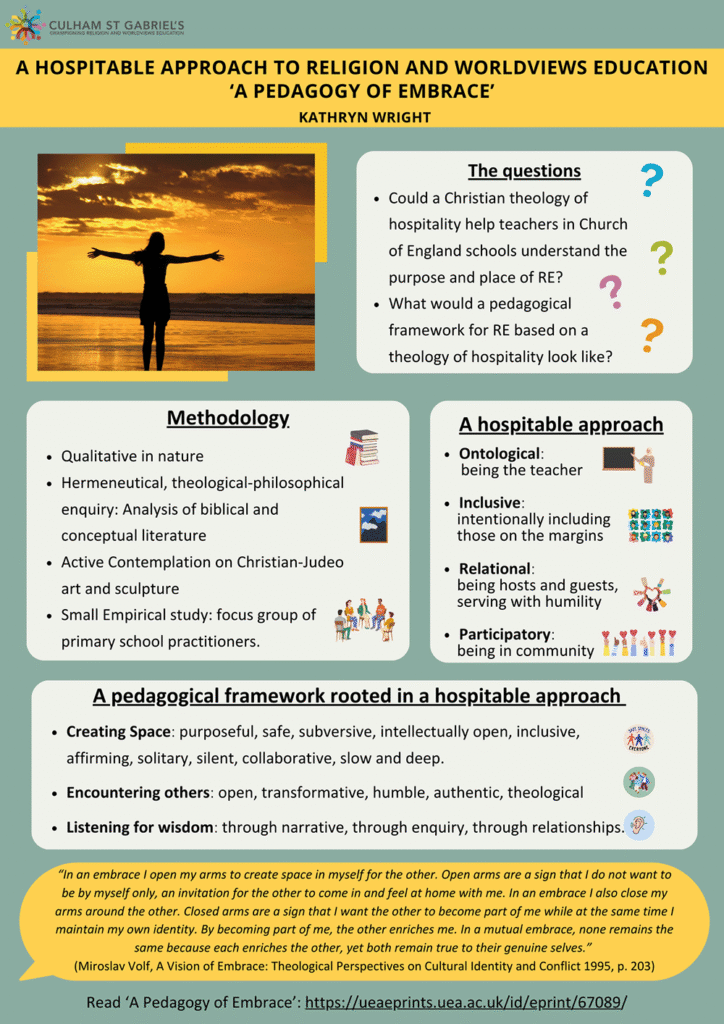
What would a hospitable approach to religion and worldviews education look like?
Questions for consideration:
How might I approach teaching and learning through a lens of hospitality?
What does creating space, encountering others and listening for wisdom look like in my classroom?
At the heart of a religion and worldviews approach to religious education is the responsibility of the educator to enable children and young people to navigate an increasingly complex, multi religious, multi secular and an increasingly unsettled world.
My own doctoral research considered a hospitable approach to the teaching of religious education which I believe aligns well with this new paradigm. My thesis, A Pedagogy of Embrace (2017) developed pedagogical principles for teaching RE based on a Christian theology of hospitality.
First, hospitality provides an ontological approach. It is about being the teacher; it is about one’s presence in the classroom. Hospitality is about the physical space, but it is far more about who we are and how we serve. At the heart of a religion and worldviews approach is the need for teachers (and pupils) to bring themselves and their own worldview and position to the classroom. Secondly, it is inclusive. Hospitality, seeks to intentionally include those on the margins; listening and engaging with voices of those often unheard. This resonates with the de-colonising of the curriculum and with a focus on lived experiences of worldview communities. Thirdly, hospitality is by nature relational. It involves a host and guests. In A Pedagogy of Embrace, the notion of the host being the guest, and vice versa is put forward. I believe, this removes the power dynamic and facilitates genuine dialogue and conversation. This places the teacher in a position of humility, where they are serving their pupils, and at the same time may be served by them or learn from them. This acknowledges the value of everyone’s worldview, seeing the importance of learning from one another as well as from the subject itself. Lastly, hospitality is by nature participatory. One cannot stand on the sidelines and observe, or if one did it would appear very rude. Imagine no one speaking at the dinner table! I believe, teachers and pupils are to be ‘in community’ with what they are learning. This is at the heart of a religion and worldviews approach. One brings oneself to the subject, participating in it ontologically, relationally and inclusively from a position of humility. A religion and worldviews approach is fundamentally interpretive as we interact with the subject, rather than sitting as an observer on the sidelines. Taking a religion and worldviews approach means we participate in interpreting knowledge; we don’t stand as observers anymore.
I put forward three pedagogical principles, which exemplify this hospitable approach:
Creating space
Encountering others
Listening for wisdom
The visual analogy of an embrace is helpful for considering the practical application of a hospitable approach. Miroslav Volf, a Croatian Protestant theologian, defines an embrace in the following way:
In an embrace I open my arms to create space in myself for the other. Open arms are a sign that I do not want to be by myself only, an invitation for the other to come in and feel at home with me. In an embrace I also close my arms around the other. Closed arms are a sign that I want the other to become part of me while at the same time I maintain my own identity. By becoming part of me, the other enriches me. In a mutual embrace, none remains the same because each enriches the other, yet both remain true to their genuine selves. (Volf 1995, p. 203)
For Volf, an embrace must have the four elements or ‘acts’. These are opening the arms, waiting, closing the arms and then opening them again. The open arms indicate creation of space and invitation. Waiting suggests acceptance of reciprocity; the embrace is not an act of invasion. Closing the arms indicates the host is guest and the guest is host as each person makes their presence felt. Volf sees this as especially powerful because the identity of the self is both preserved and transformed. Lastly, the opening of the arms shows that the two people have not become one but remain two with their difference and uniqueness.
This is a powerful way of understanding the interactions within the religion and worldviews classroom. The sense of insufficiency or having ‘open arms’ means that one needs to have space; to be in some sense empty. I cannot come to a religion and worldviews classroom with a closed mind; I must come open to listen and encounter. I must be intellectually humble. This to me speaks to our own worldviews, including our personal faith (where appropriate), being always incomplete, ever changing. Everything around us impacts on how we see and make sense of the world, including for some relationship with the Divine.