During the last academic year I have been in the fortunate position of having the opportunity to design from scratch our Trust-wide curriculum. As part of this I wanted greater clarity about the kinds of knowledge students encounter in Religious Education.
Not just what they learn—but how that knowledge is constructed.
RE draws on multiple disciplines: theology, philosophy, sociology, history, psychology to name just a few. But too often, these are blurred together. Students learn content, but not how that knowledge is shaped, interpreted, or contested. But we also need to recognise the starting point of our students, introducing such terms too early risks disengaging pupils.
Therefore in our curriculum, I’ve taken a slightly different approach: build the thinking first—then name it.
Year 7: building knowledge through multiple lenses
Our Y7 programme is grounded in substantive knowledge and comparison.
Students explore both Dharmic and Abrahamic traditions, building breadth before moving into greater depth within the Abrahamic faiths. Along the way, they begin to encounter different ways of knowing—without these being explicitly labelled.
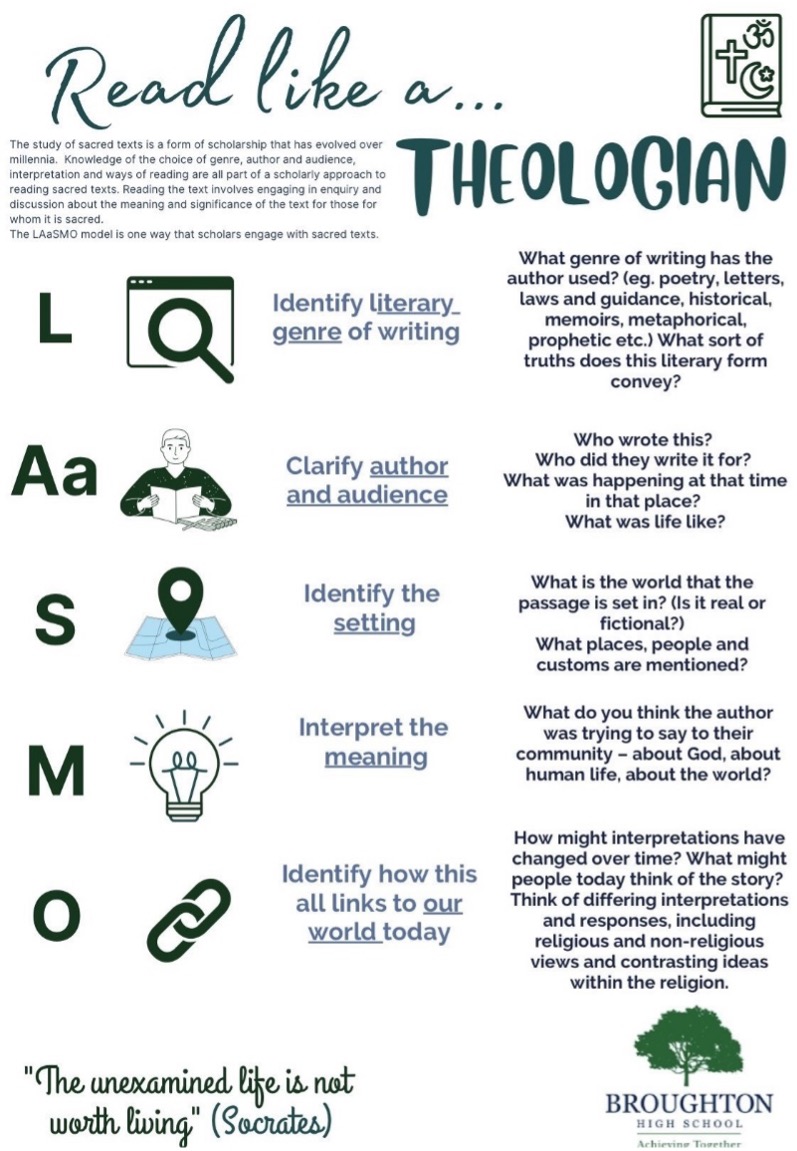
- They work with religious texts, exploring what these might mean and how they shape lived religion.
- They act as “data detectives”, using sources such as census data to explore patterns of belief and belonging.
- They study the history of religion in the UK, considering how religious traditions have shaped—and been shaped by—historical events.
By the time students reach our unit on the person and nature of Jesus, they are beginning to bring these strands together. Here, the lens is primarily theological and historical:
- What do Biblical and non-Biblical sources say about Jesus?
- How have these accounts been interpreted?
- How has his life and teaching influenced belief and practice over time?
Students are not just learning about Jesus—they are beginning to engage with questions of interpretation, influence, and meaning. But at this stage, we are not labelling these approaches. We are simply ensuring students are doing them.
Year 8: making ways of knowing explicit
At the start of Year 8, we make the shift visible.
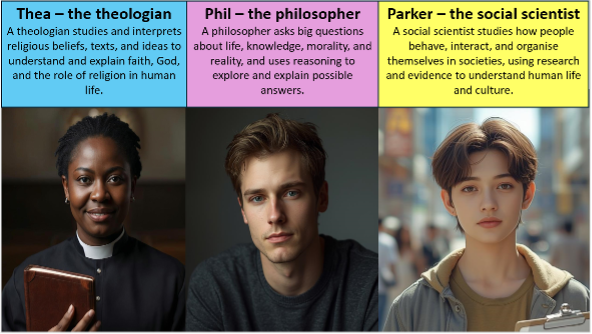
Students encounter an explicit unit asking: What does it mean to study religion academically? Here, we introduce lenses such as theology, sociology, psychology, and history.
We explore ideas of bias, perspective, and interpretation. Students begin to see that different disciplines ask different questions—and may reach different conclusions.
The aim here is for a moment of clarity – what they experienced in Year 7 is now named and organised. They have prior knowledge and experience onto which to connect this new learning.
Following this, students apply these lenses to the study of lived religion across Hindu, Buddhist, Jewish, and Muslim traditions. They explore not just beliefs, but how these are lived out—and how they have developed over time. The historical lens remains important here: religion is not static, you cannot understand the current manifestation of a faith without understanding its history.
Year 9: thinking more critically
By Year 9, students are ready to engage more explicitly and critically.
They begin to think as philosophers—exploring questions of morality, truth, and meaning. They evaluate arguments, compare traditions with greater precision, and recognise complexity within and between religions.
Because the groundwork has been laid, this feels like a natural progression rather than a leap.
It is important to note that this is the first year of implementation of this curriculum. While it has been carefully planned as a three-year journey, we have not yet seen a full cohort move from Year 7 into Year 8 and into Year 9, encountering the explicit teaching of these disciplinary lenses. What we are seeing so far is promising, but this is work in progress. The real test will be how successfully students make those connections over time.
Why this matters
Across our Trust, RE is taught for one hour per week at Key Stage 3, often by non-specialists. Our curriculum needed to be clear, coherent, and teachable, while still maintaining academic depth.
Focusing on ways of knowing has helped us achieve that balance.
It gives structure to the subject, supports teachers in understanding what kind of thinking is required, and helps students move beyond surface-level answers.
Perhaps most importantly, it shifts RE away from being seen as a subject of “opinions” and towards one rooted in structured, academic thinking.
By the time students encounter terms like theology or sociology, they have already experienced them in action. The language doesn’t introduce something new—it gives shape to something familiar.
If there is one principle underpinning our approach, it is this: build the thinking first, name it later.
About
Natalie Parkin is the Strategic Lead for Religious Studies and Personal Development at a large Multi-Academy Trust in the North of England. She supports 28 secondary schools in curriculum development, alongside teaching A Level Religious Studies, and has a passion for ensuring every student receives high-quality RE, regardless of postcode or staffing. Currently Natalie is coming to the end of her second year of the Culham St Gabriel's Leadership Scholarship Programme