Global terms: Other Evidence Informed Practice & Research
Teaching controversial issues in RE: the case of ritual circumcision
Research Summary: Teaching controversial issues in RE: the case of ritual circumcision
This is a critical scholarly essay, examining the following questions: What are controversial issues? Who decides whether something is controversial, and how does it affect how a subject is taught? These questions have been discussed often in relation to education, less so in relation to RE specifically. RE teachers need clarity and support, however. So, this research addresses the discussion to RE teaching, taking the example of ritual circumcision as a focus.
Researcher
Marie Von Der Lippe
Research Institution
University of Bergen
What is this about?
What counts as a controversial issue?
Who decides on whether an issue is controversial, and by what criteria?
How does this discussion affect RE teaching, and by what principles should RE teachers be guided?
What was done?
The researcher summarises and criticises different perspectives on what counts as controversy, also drawing on some questions of law and policy and referring to the example of ritual circumcision. She closes with some practical suggestions for RE teachers.
Main findings and outputs
Whether or not an issue is viewed as controversial often depends on the teacher’s background and the school and social context.
Teachers need to weigh up whether the issue is a matter of fact, or of political debate, and can be presented as settled or open.
So whilst ritual circumcision is a settled issue in some communities, it has been a matter of intense debate in Norway. Female circumcision is a settled issue (banned), male circumcision more open, though in Norwegian RE textbooks, female circumcision is presented as a violation whilst male circumcision is presented as a regular ritual practice.
Should RE teachers teach about it directively (with one answer in mind) or non-directively (asking for debate)? We need to deliberate and decide, as with other possibly controversial issues, and make this conversation part of teacher training and development. Even if a particular issue appears settled, directive teaching may hinder students’ critical development, so important in democratic life.
Relevance to RE
The research poses real questions to RE teachers – again, ones which they will recognise. The suggestion that RE teachers develop a professional culture of deliberation over controversial issues and how to approach them in the classroom is very good. The research could provide a basis for a CPD session or departmental meeting discussion.
Generalisability and potential limitations
This is an interesting and useful scholarly discussion orientated towards guidelines for the classroom, The issue of data generalisability does not really arise, but the issues are certainly highly relevant to RE teaching and RE teachers may well find the guidance to be helpful.
Find out more
Marie Von Der Lippe (2019): Teaching controversial issues in RE: the case of ritual circumcision, British Journal of Religious Education.
Teaching morality, developing character: lessons from John Dewey
Research Summary: Teaching morality, developing character: lessons from John Dewey
This article is about John Dewey’s philosophy of education and the problems it has been accused of causing. In the USA, some have expressed concerns about a crisis of character, leading to a decline in moral behaviour in society and in schools. For some scholars, this crisis of character has been caused by Dewey’s ideas of child-centred education, whose influence has stopped children from getting the authoritative, character-building instruction that they need. The author examines these criticisms of Dewey and finds them to be misplaced. He reviews aspects of Dewey’s educational philosophy and finds that it would support good character education and education for democracy. There is plenty of relevance to RE pedagogy here, because (whilst RE is not directly mentioned), it is shown that Dewey’s ideas on pedagogy suggest ways to study content (e.g.religious beliefs and values) whilst avoiding two potential pitfalls: using content (e.g. religious beliefs and values) as items of instruction, or allowing children the ‘freedom’ to develop their own beliefs and values without challenge.
Researcher
Brian White
Research Institution
Grand Valley State University, USA
What is this about?
Why do some scholars view John Dewey’s ‘child-centred’ philosophy of education as responsible for a ‘crisis of character’ in the USA’s society and schools?
When Dewey’s key ideas about education are revisited, can the accusations against them be maintained?
How do Dewey’s ideas about education really relate to issues of morality and character formation?
What lessons for pedagogy can be drawn from this discussion?
What was done?
This is a scholarly essay, describing and evaluating criticisms of John Dewey’s philosophy of education and shaping conclusions that are of use to teachers.
Main findings and outputs
Some critics accuse Dewey of a ‘free-wheeling child-centredness’ that prevents children from developing discipline or will. However, what Dewey actually says is that children’s interests must be harnessed and developed. This needs seriousness, absorption and purpose on the part of teachers and children.
Some critics accuse Dewey of minimising the role of teachers, but what he says is that teachers’ guidance is crucial. They must point out obstacles and guide children through them, for instance, and must establish a democratic culture in the classroom.
Some critics accuse Dewey of pushing academic subject content to the margins, but what he says is that a subject content-rich environment is needed, for children to examine the necessary problems and develop the necessary skills and traits (investigative, communicative, just, disciplined); natural interest must be engaged with content.
For Dewey, the traditional, instruction-driven, obedience-driven classroom dilutes character. If students’ natural interests are ignored, if they are outwardly compliant, they will be be inwardly engaged in avoidance. The development of character through education is dependent on teachers actually getting to know who their students are as people and as thinkers. For Dewey, values, moral or character cannot be simply ‘hammered in’ to children.
One USA character education programme, Positive Action, in a way reflects his ideas on collaboration and enquiry. Instead of being told what character is and how they should behave, students are asked how they like to be treated. They suggest the same top values of respect, fairness, etc.
Relevance to RE
There are two main ways in which this material is relevant to RE pedagogy. In the first place, it calls into serious question the pedagogy of ‘direct instruction’. If religious beliefs, values or other items of religion are simply presented to pupils to absorb or ‘learn about’ without opportunity to respond or engage, their character development will not be strengthened. A more productive pedagogy arises through the skill of matching pupils’ interests to religion and making use of their natural inclination to debate and discuss. Secondly, what Dewey says about obstacles is relevant. Religious beliefs can be used to challenge pupils’ opinions and force them to reason and develop (“but what about the idea that all life is sacred . . ?”); or vice versa (“can you see any problems with holding to the belief that all life is sacred . . ?”). Teacherly concern for pupils’ development does not mean leaving them in a comfort zone, but just the opposite.
Generalisability and potential limitations
Whilst not presenting data as such, this essay presents issues and ideas that are very worthy of general consideration by all teachers, perhaps especially those concerned with RE, moral education, citizenship education and values.
Find out more
Scapegoat: John Dewey and the character education crisis, Journal of Moral Education 44.2 pages 127-144 (published online 13 May 2015), 10.1080/03057240.2015.1028911
Through RE, many gifted students who might otherwise be missed can be identified. The findings of this research are based on a study of Heads of Department in three very different sec-ondary schools in Cambridgeshire, and how they identified and challenged students gifted and in studying religion. The lack of student challenge in much RE is discussed and ways are suggested to extend and enrich all. Strategies are discussed for doubly exceptional students (e.g. those with profound insights but poor written skills). The research suggests how the RE profession could develop an approach to giftedness, with direct implications for classroom activities including poems, debates and plays.
Researcher
Jane Mary Ramsay Simpson
Research Institution
Independent researcher
What is this about?
What does ‘being a gifted student’ mean in relation to RE?
What is a ‘doubly exceptional’ student?
What kinds of pedagogy and support do gifted students need in RE?
What are some good examples of these, and what can teachers do next?
What was done?
Literature searches on RE and giftedness, interviews with Heads of RE, surveys of schools’ policies and documentation.
Main findings and outputs
Few teachers were aware of the overlap between RE skills and ‘doubly exceptional’ giftedness (e,g autistic or dyspraxic pupils with high insight but poor writing).
Doubly exceptional pupils often show spiritual or emotional sensitivity, profound questioning, high expressivity and a sense of social justice.
However, usually, RE teachers have responded to giftedness by producing extension activities based on higher thinking skills.
‘Teacher A’ says her most important strategies are asking open-ended questions, and providing extended reading resources.
‘Teacher B’ says her department has just begun to re-write schemes of work to cater for gifted students, providing more depth to challenge the most able.
‘Teacher C’ struggles to find opportunities to train to teach gifted pupils.
‘Teacher B’ used both classroom observation and assessed tasks to write students’ reports, commenting on both empathy and knowledge level. ‘Teacher A’ provided laptops and placed doubly exceptional students in top sets.
Such pupils need support. ‘Concept cracking’ provided adequate tasks, e.g:
Pupils decide which concept they are going to crack, such as abortion, find the related concepts such as ‘Is life sacred? ’, study the core ideas in different religious traditions and then see how these religions diverged when they put their ideas into practice.
Moral dilemmas can be set: pupils can use creative methods such as poems, plays or debates to explore and respond to them. Gifted pupils themselves can help to identify suitable pedagogy.
Relevance to RE
School and departmental policies can be assessed in the light of the research: is provision for the gifted planned adequately?
The research would give an interesting and useful basis for teacher training or teacher development sessions.
Regarding RE pedagogy, the examples of tasks for the gifted that are provided by the research could be adapted for use in teachers’ own schools.
The creative, open-ended, exploratory style of pedagogy suited to the needs of gifted children could be explored and developed by RE teachers and RE departments; it could well prove to be helpful in improving provision for all children. Again, teachers can consult pupils about this.
Generalisability and potential limitations
Only three schools were researched, but the literature cited is broad and the examples of pedagogy are very interesting. For generalisability, it is really up to RE teachers to test out the conclusions of the research in their own schools, and the research gives a good basis for this.
Find out more
Bridging the gap between Religious Education and gifted education: theory and praxis in three secondary school programmes in Cambridgeshire, British Journal of Religious Education, 34:3, 247-261 (published online 6 February 2012)
RE Connect: RE and Climate Crisis Teacher Fellowship Programme
Fellowship Aims When I saw the advertisement to join the project, I was certainly intrigued. Ian Jones (Director of the Saltley Trust) and Dr Jeremy Kidwell (University of Birmingham) had organised a Teacher Fellowship Programme, focusing upon RE and the environment/ climate change. The interrelationship between ecology and the RE classroom was not a connection I had previously made or seen explicitly on a KS3 curriculum. The project involved evening sessions led by a variety of experts to support fellows with their own projects. These projects were then presented during a symposium in Birmingham to a panel of experts.
Focus of my project I was very aware when developing my project, that not all schools would be able to remove one of their existing units entirely in order to make space for a topic covering RE and ecology. Criteria set by the Local Agreed Syllabus and ever-decreasing curriculum time means that it can be a struggle to teach students required content, without shoehorning another topic in. So, my plan was to create an interdisciplinary unit of work that could either be a standalone topic or used as individual lessons within key topics already covered on KS3 curriculums. My unit of work (‘People and the Planet’) is presented as a booklet, as I find these to be effective tools within my classroom. It provides clear instructions and routine, but it is important to use it as a resource, rather than a lesson. The booklet is also helpful if there are non-specialists in the department, as it provides structure and uniformity across the whole school delivery of RE. The ‘People and the Planet’ topic focuses on student reflection and allowing students to fully embed themselves in the narrative. In the classroom, while I make links to experiences that the students can relate to, encourage discussion/ personal reflection, etc., certain topics can be easier to link with the lives of the students than others. This was discussed during our first workshop and became a focus when trialling my project in the classroom. As the topic of climate change is everywhere, students were very eager to share their personal experiences and contexts. The aim of the project is for students to fully place themselves into the narrative of climate emergency, rather than seeing it as a problem for others to solve.
Reflection upon action research After planning a first draft of my booklet, I trialled the lesson with one of my year 7 groups. When first exploring the topic, student’s thoughts revolved around the phrases “they should”/ “they need to.” Students were all well-versed in the causes of climate change and what steps could be taken to resolve it. Many proudly shared that they recycle/ walk to school/ have an electric car, but ultimately the focus was placed upon others. Exploring this further, many felt they were too young, or inhibited by their family lifestyle. While I cannot change these factors, this allowed us to explore collective responsibility and how everyone can make a difference. Many activities were situation based, allowing students to apply learning to their everyday circumstances. At the beginning and end of the topic, students created an artistic response to the phrase ‘People and the Planet.’ The initial response was completed simply based upon the phrasing, prior to commencing the topic. There was a contrast between the two responses, with the final responses showing a greater sense of connectedness and togetherness. Students have shifted towards using collective pronouns, rather than “they” when talking about the climate emergency.
What next? The fellowship concluded with a symposium, allowing us to share our project with the other teacher fellows. It was fantastic to hear how other teachers within different contexts interpreted the project and applied it to their setting. We were also able to receive feedback on our projects, which are being refined prior to being published on the fellowship website. Based on feedback, I have adjusted aspects of my project and will trial these with students. I will also be able to apply learning from the fellowship to other units of work and share with my department. The experience of the teacher fellowship has been applied to my classroom through emphasising the challenges of intersectionality in teaching around environmental crisis and religion. In the classroom I am very aware not to say statements such as “all Christians/ Muslims etc” however we focus completely on how religion influences individuals. While it is vital to learn about religious beliefs in RE, we often forget to discuss how other aspects of social identity influence decision. No religious believer is only defined by their religion, and the fellowship highlighted that I should focus upon this more in the classroom.
I will be presenting alongside with Dr Kidwell, Ian Jones and Amy Powell at the RExChange conference later in the year about the project and the concept of a teacher fellowship in RE as a form of research and CPD.
Rebecca Wright is currently the Head of RE at a secondary school in Northampton. She studied Theology and Religion at the University of Oxford.
Teachers need to become conscious of their own worldviews
Research Summary: Teachers need to become conscious of their own worldviews
For increasing numbers of teachers, religion may seem alien. This may impact on their choice of teaching content: subconsciously, they may elect to teach aspects of religious and non-religious worldviews close to their own worldviews, ignoring aspects with which they disagree. Teachers’ lack of subject content knowledge is often held up as a major problem, but questions also need to be asked about how their own worldviews relate to their subject content knowledge. Teachers should be supported to become ‘worldview-conscious’.
Researcher
Ruth Flanagan
Research Institution
University of Exeter
What is this about?
What influences teachers to choose subject content?
Do their own worldviews prompt them to emphasise some religious and non-religious worldview content, and ignore other religious and non-religious worldview content?
How can teachers be supported to become more conscious of their own worldviews and how these might influence their attitudes to lesson content? How might this process enrich teaching and learning?
What was done?
The researcher analysed a wide range of literature (RE policy, pedagogy and curriculum, research on teachers and RE teachers, philosophy, educational studies and philosophy). She applied insights from Ricoeur’s hermeneutics to the problem of teachers’ possible worldview biases in relation to subject content. She then made recommendations for teachers to develop worldview-consciousness – a form of self-awareness, in relation to one’s own background values and orientations – that will enrich RE / R&W teaching and learning. These follow below.
Main findings and outputs
To examine worldviews, teachers need to wrestle with philosophical questions of life which can enhance their own teaching and learning; this is important for pupils, but it is equally important for teachers: to examine others’ worldviews includes reflecting on one’s own.
Teaching about worldviews involves teaching about different valuations of rationality. To do so, a person must be aware of what he or she values as rational, and why (what background influences he or she has).
One’s own worldview may be held unconsciously, and support needed to bring it to consciousness. Teachers could reflect on their own definition of a good life. Once it is conscious, they can guard against only emphasising those features of others’ worldviews that are similar to their own, when teaching.
Relevance to RE
The findings are relevant to existing discussions about neutrality and impartiality in RE (teachers can be impartial to the extent that they are self-aware). They are also relevant to the move from RE to R&W; if it is true that everyone has a worldview and that the examination of personal worldviews is a part of the subject, teachers cannot be immune from the process.
Generalisability and potential limitations
The research does not present a data set whose generalisability can be assessed – but the questions raised should, at least, give all teachers pause for thought and reflection.
Find out more
Ruth Flanagan (2019): Implementing a Ricoeurian lens to examine the impact of individuals’ worldviews on subject content knowledge in RE in England: a theoretical proposition, British Journal of Religious Education, DOI: 10.1080/01416200.2019.1674779
Research Summary: Religion and social cohesion – new research
Often, faith has been seen as belonging to those outside the mainstream, as a security concern and a barrier to cohesion in UK society. There is an evidence gap on different ways in which it contributes to cohesion, hence this research. The research finds that faith groups can indeed support cohesion, in complex ways. Their networks can be a powerful force for the social good in the future.
Researcher
Madeleine Pennington
Research Institution
Theos, for the British Academy and the Faith & Belief Forum
What is this about?
How has religious faith been understood within UK social or community cohesion policy?
How could UK social or community cohesion policy take better account of the realities of religion in the contemporary UK?
What are some different ways in which religious groups contribute positively to social or community cohesion?
What was done?
From October 2019, Theos researchers visited local communities to find out about the positive ways in which religious groups fostered or undermined social cohesion. About 400 people were interviewed, and a number of in-depth case studies were written.
Main findings and outputs
The research findings are wide-ranging (reading the full report, linked below, is strongly recommended). Here are some that have particular RE / R&W relevance:
Cohesion policy has been shaped by security concerns, that frame faith as a risk factor and as the preserve of ethnic minorities.
But in the wake of Brexit, this is changing, and there are opportunities for re-assessment.
Religious membership can provide ‘spiritual capital’, or hope, to people – and it can be a platform for more inclusive public discussion.
Religious identity needs to be seen as intersecting with other identity factors; feelings of belonging can be present across religious identities.
The contribution of faith groups to social provision increased greatly during the years of ‘The Big Society’ and ‘Austerity’. A quarter of all UK charity is now faith-based. In the past 10 years, 34% of organisations registering as charities have been faith-based. This trend will increase post-COVID.
Relevance to RE
These findings are relevant in different ways, for example, the ‘intersecting’ nature of religious identity is very relevant to the RE-R&W transition. However, the main focus might be religion’s increased social function as a voluntary services provider. Given this change, subject teaching might focus more on examples of such projects. Case studies are given in the report and teachers could make contact with local groups to organise pupil fieldwork and dialogue.
Generalisability and potential limitations
The research provides broad evidence of religion’s current contribution to UK social cohesion. It is mainly focused on England.
Find out more
Madeleine Pennington, “Cohesive Societies: Faith and Belief. Examining the role of faith and belief in cohesive societies”. July 2020.
Research Spotlight: Religion and Worldviews in an Andalucian pueblo
July/August 2022
Dr Kevin O’Grady
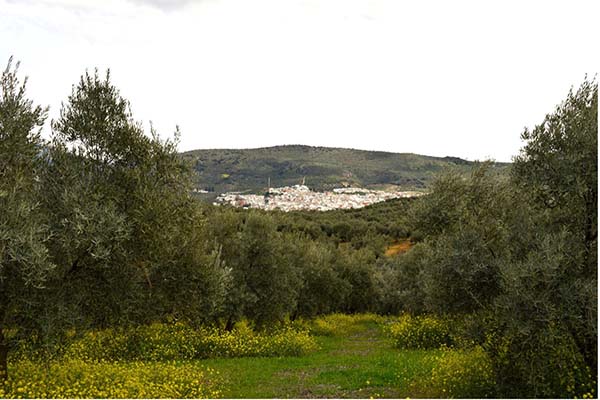
Castillo de Locubín is a traditional pueblo blanco (white village) in the Sierra Sur mountains of Jaén, Andalucía, Spain. In 2022 its population is around 4,500 and some 90% work in agriculture, these days not the subsistence culture of centuries past but mainly olive oil production for sale and export.
he village, usually referred to as Castillo or just El Pueblo, has a strong Catholic identity. As we’ll remark, this is nevertheless not straightforward, neither historically nor in the contemporary sense. We’ll focus on the 2022 Semana Santa (Holy Week) celebrations and develop the discussion from there.
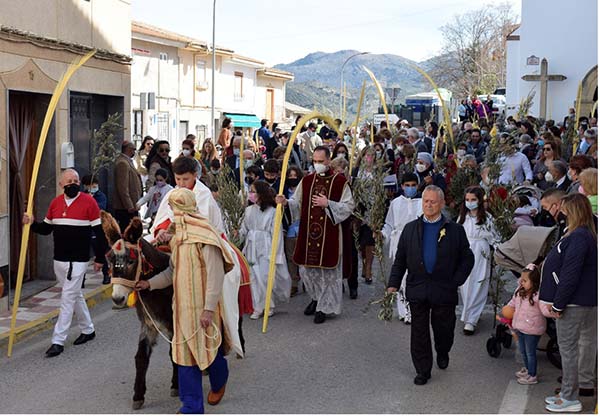
Semana Santa begins with Domingo de Ramos, an evocation of Palm Sunday that can’t strictly be called a procession since no sacred image is involved. Instead, villagers follow a child mounted on a donkey through the streets. As well as the story of the entry into Jerusalem, the event calls up Castillo’s agricultural past and present: until late into the last century most villagers (Castilleros) farmed with animals who lived in the upstairs parts of their houses, and, as you’ll see next, the palms are sometimes substituted by olive branches.
For other nearby towns, Domingo de Ramos begins a series of daily or nightly rituals that continue through the week, but not in Castillo’s case. Because most of its sacred images were destroyed at the outbreak of the Spanish Civil War in 1936, their associated processions vanishing with them, Castillo’s Semana Santa doesn’t pick up again until midnight on Viernes Santo (Good Friday; that’s to say, 00.00 on Good Friday itself).
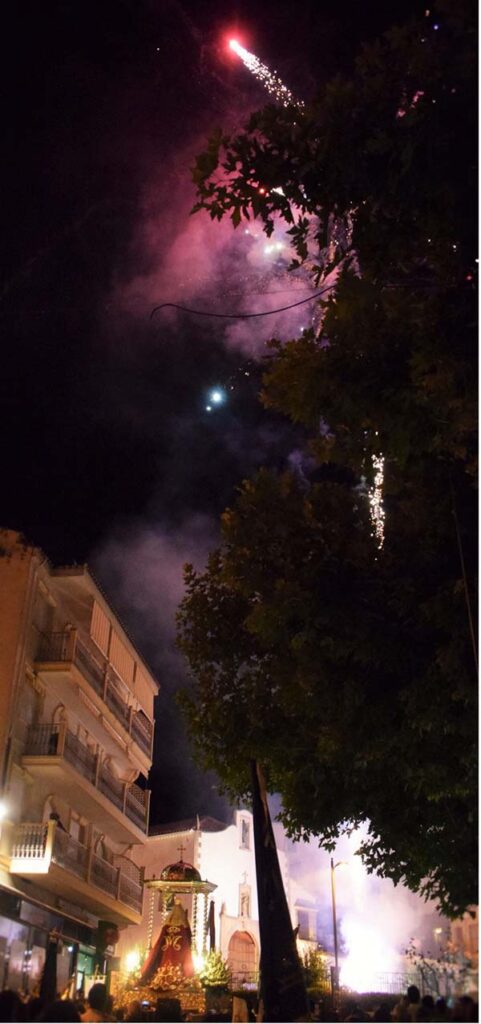
Castillo’s midnight Vía Crucis procession defies easy description. You could see it as blending austere mysticism, Biblical narrative, and street theatre (but more about that suggestion later). By torchlight, an image of Cristo del Perdón, Christ crucified, is processed through the streets to the sounds of a solitary drumbeat and chains rattling, with pauses to read each station of the cross.
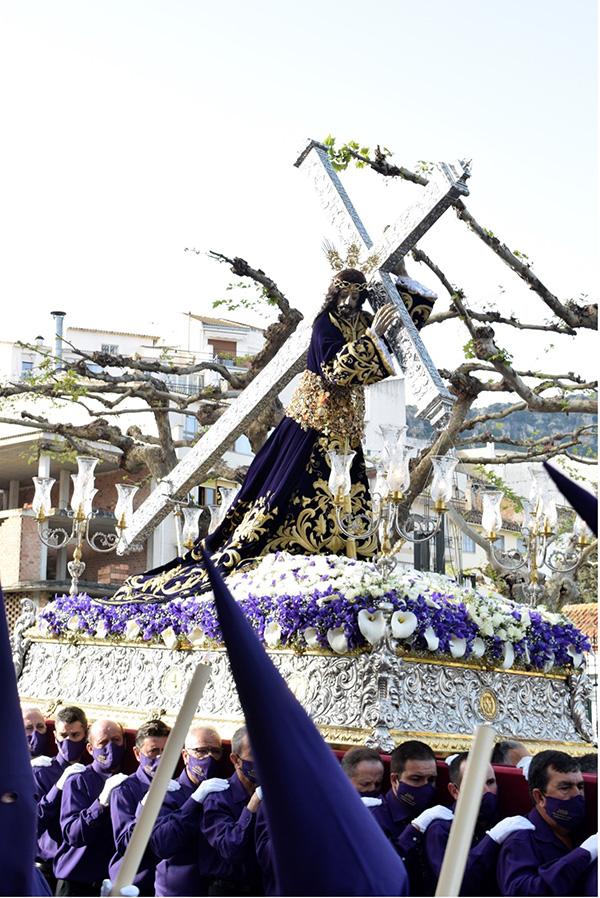
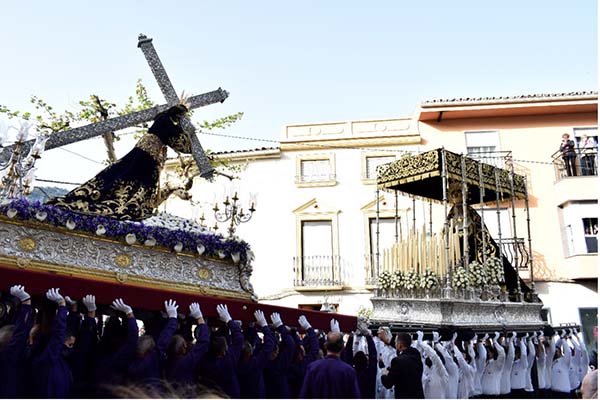
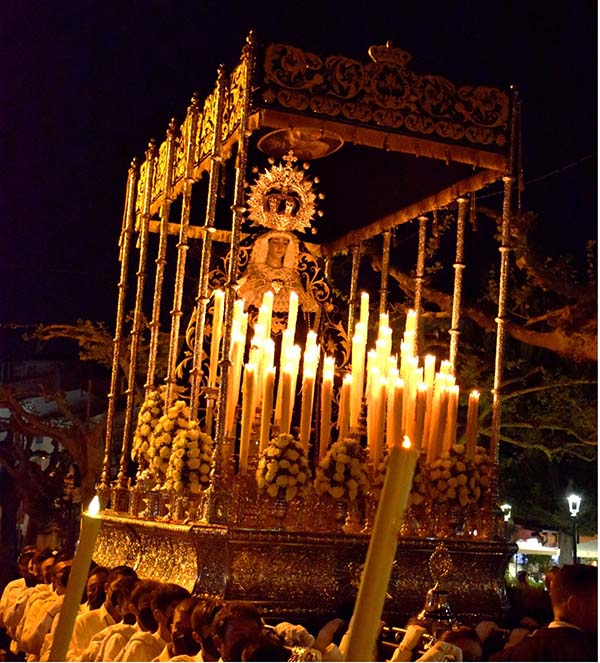
Later in the morning of Viernes Santo come two processions that combine to create an encuentro(meeting) between Jesus and Mary. The image of Jesus is Nuestro Padre Jesús Nazareno (usually shortened to Padre Jesús), that of Mary, La Virgen de los Dolores (the Virgin of Sorrows). These two images attract particularly strong devotion in Castillo, especially Padre Jesús: you could even compare loyalty to Castillo with loyalty to Padre Jesús. Again, more on that in due course, but a mention of the main Padre Jesús myth might help now. Around 1700, the image, an acknowledged masterpiece, was in transit through Castillo on its way to its intended home, the sculptor’s birthplace. The donkey providing the transport died, and this was taken as a sign from God that Padre Jesús should stay in Castillo for good; the Ermita (shrine, small church) in which he has since been housed was built on the spot. Padre Jesús is a depiction of Christ on Calvary at deepest resignation and despair; the encuentrore-creates his meeting with his mother.
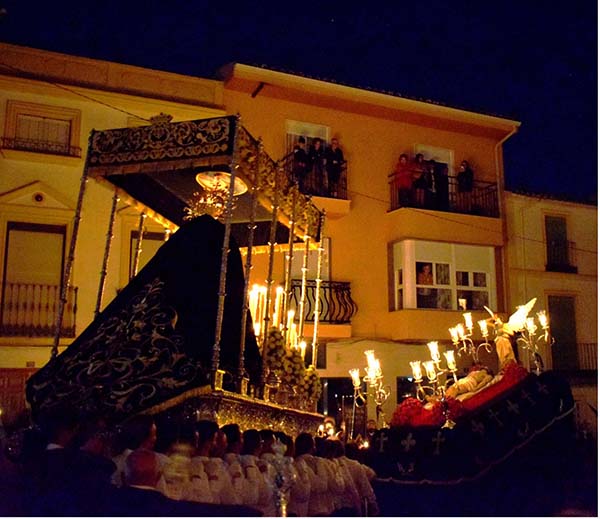
On the night of Viernes Santo, a second pair of processions creates a second encuentro, this time between Santo Entierro (Christ taken down from the cross) and the Virgin of Sorrows.
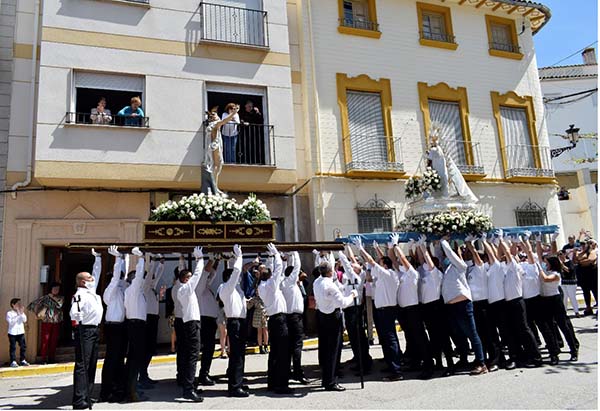
That this encuentro is the climax of Castillo’s Semana Santa can seem strange, but only to outsiders. Theologically, the resurrection would be expected to take centre stage. But Castillo’s Cristo Resucitado (Christ resurrected), is a recent image that has not built up a devotion comparable to those of Padre Jesús or the Virgin of Sorrows, and the Domingo de Resurrección (Easter Sunday) procession has been muted in the memories of most. This year attempts were made to create a fuller Domingo de Resurrección celebration, by creating an encuentro between Cristo Resucitado and La Virgen de la Cabeza. The image of La Virgen de la Cabeza commemorates an appearance of the Virgin Mary to a shepherd on the side of a head-shaped hill in nearby Andújar in the thirteenth century, so also attracts strong devotion in the locality. However, you might note in the next picture the smaller dimensions and simpler working of the images, as well as the reduced atmospheric intensity and, indeed, turnout.
In fact, theology stays in the background. There’s little discussion of the meaning of the rituals, questions about it surprise people, but that’s not to say there’s little meaning. It appears mediated more through the beauty of the images and the ritual choreography, music also playing an important role in ways that my photos can’t show. Visit https://www.youtube.com/watch?v=c9oASrnUEHs to hear how traditional band and flamenco styles create different accents at different stages of Castillo’s Semana Santa.
Social media is an increasingly used resource, in various ways. Emigration from Castillo means a diaspora whose members engage with Semana Santa via Facebook, where one group is solely dedicated to its imagery. A post on another Facebook page, El Pueblo es Tranquillo, concerning the 2022 Vía Crucis procession generated an intense discussion by comment and reply. Did Castillo’s various images of Jesus refer to the same reality? For believers, yes: but on another view, as a symbol of popular local religiosity, Padre Jesús is a singular figure whom all can understand and respect. Similarly, Semana Santa is a mixture of elements with something for everyone, even if just as spectacle or affirmation of the community (atheists and agnostics can be found in Castillo, though not non-Christian faith; and aspects of the history of the Catholic Church in the village are painful).
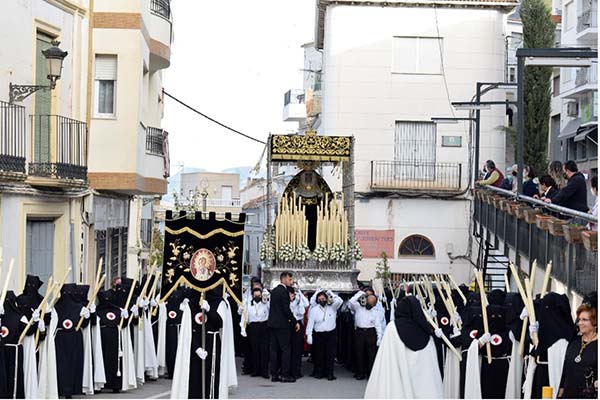
Digging deeper and more speculatively, there’s evidence that considerable numbers of Castillerosare descended from the once-Muslim population. Aspects of its culture linger, some visibly, such as the Arab irrigation system, and the remains of the fort that tower above the plain it continues to water: if you’ve visited Granada, 37 miles south of Castillo, this may sound familiar. It’s known that Sufism was influential in medieval Andalucía. Look back at the photo of the Padre Jesús procession and the purple capirotes (pointed hats) worn by some participants. They’re known as symbols of penitence, and related to the Spanish Inquisition, as those arrested were made to wear them. This is probably enough explanation for present purposes, but a visit to the tomb of Rumi in Konya, Turkey made me wonder – his own tombstone hat sits on it, and they are worn by dervishes of his order as reminders of mortality. In Spain, they don’t appear on Easter Sunday.
In summary, religion in Castillo de Locubín should usefully be seen in a worldview perspective. It helps to:
Look at the historical context.
Consider local traditions. The version of ‘Catholicism’ might not be recognisable elsewhere.
Hesitate to expect that only those identifying as Catholic join with thetraditions, or that the traditions only contain Catholic elements.
Think about emerging forms of tradition, especially digital.
Look for the lived elements. An over-emphasis on theology, or doctrine, may not be appropriate.
Think about how these lived elements add up: the aesthetic, ritual, social and ethical dimensions all connect.
In other places or cases, it might not be these elements that figure most powerfully. And, of course, you may not be considering a majority Catholic situation. However, related to the points above, here are some general questions to consider, that apply whenever you approach localised religion in a worldview perspective, whether in planning teaching or in teaching.
How has local history, tradition or custom influenced what can be seen now?
Are these religious expressions distinctive to the locality, even if related to a wider tradition? In what ways?
How do people from outside the tradition but from within the locality relate to these expressions? And is there evidence of inclusion of elements from outside the main tradition?
How have social media or other digital resources developed the local religious expressions, or how people can participate in them?
What are the main lived elements of the local religious expressions? How, for example, do artistic, ritual, community, ethical or other elements figure, and how do they relate to one another?
A discussion between colleagues in a planning or INSET session might not cover all these questions, but even one or two of them would generate a good analysis. Similarly with classroom teaching: any of the questions provides a good enquiry basis.
You may be travelling this summer. I hope you have opportunities to experience and take photos of local celebrations, talk to people about their history and significance, and listen to stories about them. If you’re in Spain on the 15th of August, look out for celebrations of El Dia de la Virgen (the feast of the assumption of the Virgin Mary into Heaven); we’ll close with a picture of Castillo’s 2017 Dia de la Virgen procession.
A note on methodology
I’ve been visiting Castillo de Locubín regularly since 2012 and lived there from 2015 to 2018. Though I’ve never thought of this in terms of a formal research project, several of my interactions with Castillo and its people have taken on research-like aspects. These include photography collection, participant observation during processions and other events, interviews with participants, reading, and discussions with researchers including local historians and a US-based anthropologist who completed a doctoral study on Castillo in the 1970s.
Signposts – guidance for RE teachers from the Council of Europe, and a related teacher training module
Research Summary: Signposts – guidance for RE teachers from the Council of Europe, and a related teacher training module
The book Signposts – Policy and practice for teaching about religions and non-religious worldviews in intercultural education (Jackson 2014) is a summary of Council of Europe initiatives on the dimension of religions and non-religious convictions within intercultural education, written by Professor Robert Jackson to help implementation of Council of Europe Recommendation CM/Rec (2008) 12 in the member countries. Signposts is structured around responses to a questionnaire sent to the ministries of education in the 47 member states, asking respondents to identify difficulties anticipated for policymakers and practitioners in implementing the 2008 recommendation in their own national setting, The book is structured around these issues and informed by examples from research and good practice. This article gives details of Signposts before concentrating on a partner project at The European Wergeland Centre (EWC) in Oslo, transforming Signposts into a teacher training module. It outlines the module, giving safe space as an example of the themes covered. The material is of interest to RE teachers and teacher educators, providing an introduction to resources intended to be used in either university-based or school-based teacher training.
Researcher
Kevin O’Grady
Research Institution
University of Warwick
What is this about?
What is the background to the book Signposts, and what are the book’s key themes?
How is the Signposts teacher training module organised, and how is it intended to be used?
What do Signposts and the teacher training module have to say about the issue of safe space, as an example of one of the issues covered?
Where can Signposts and the teacher training module be obtained?
What was done?
The article is an introductory summary of Signposts and the related teacher training module, written by one of the consultants on the EWC teacher training project.
Main findings and outputs
Signposts’ themes grow out of Council of Europe Recommendation CM/Rec (2008): understanding of cultural diversity must include attention to the role of religions and non-religious convictions in society. The book addresses potential difficulties identified by education ministries in the 47 member states.
The form of education advocated is distinct from faith nurture, and concerned with understanding of plurality, though complementary with faith nurture. Attitudes and competences are involved: e.g. challenging racism, fostering tolerance.
Seven themes are identified: terminology associated with teaching about religions and non-religious convictions, didactics, safe space, religions in the media, non-religious convictions, human rights and linking schools to communities.
The EWC teacher training module team includes colleagues from Albania, Greece, Norway, Sweden and the UK. In the module, Signposts chapters are summarised into key points, links to other Council of Europe themes – e.g. Competences for Democratic Culture – and personal and professional implications for teachers.
Following each chapter summary, follow-up activities are presented, enabling trainers to help teachers to reflect on their practice and improve their pedagogy.
The module is suitable for university-based or school-based teacher training. All sections could be used, or some selected to address particular needs.
Safe space is an example of an issue covered, referring to an inclusive classroom atmosphere where young people discuss their views openly together. Activities include practice writing to parents in preparation to teach their children about a controversial issue, considering classroom ground rules and analysing examples of pupil speech.
Relevance to RE
The Signposts and Signposts teacher training programme taken as a whole is designed with the clear aims of helping teachers to teach about religions and non-religious worldviews and helping teacher educators to prepare teachers for this task. The article reported here gives initial information about the programme. Interested teachers and teacher educators are advised to download the documents from the links provided below.
Generalisability and potential limitations
The article is a presentation and discussion of some research-based professional development resources for RE teachers and teacher educators, which should be of general interest and use. Again, Signposts is structured around potential problems in implementing Council of Europe Recommendation CM/Rec (2008), identified by education ministries across the 47 Council of Europe member states, indicating that there is a very broad basis for focusing on the issues chosen.
Find out more
Kevin O’Grady, Signposts: guidance from the Council of Europe on the dimension of religions and non-religious convictions in intercultural education, SO-didaktik (2017; 56-60), also available for free download at https://issuu.com/so-didaktik/docs/so-didaktik_nr4_2017
Research Summary: Teachers and Texts: The Findings Report
This project, a collaboration between Professor Bob Bowie and Ms Katie Clemmey of the National Institute for Christian Education Research (NICER) and the Centre for Research Evaluation in Muslim Education with Dr. Farid Panjwani at University College London (now renamed the Centre for the Study of Education in Muslim Contexts (CEMC) ), sought to support teachers in seven contrasting secondary schools, teach RE more hermeneutically. It was informed by research that the use of texts in RE classrooms is and has been an ongoing problem for many years that continues with the revised GCSE. It was inspired by the thought that a more hermeneutical approach in the subject might help both the transition to Religion and Worldviews education and also the development of a stronger disciplinary knowledge base. It was grant funded by Culham St Gabriel’s Trust and supported by Bible Society. It was a qualitative study of 7 schools with 10 teachers working to apply hermeneutical techniques to their curricula.
Researchers
Dr Robert Bowie, Farid Panjwani & Katie Clemmey
Research Institution
Canterbury Christ Church University
What is this about?
Should schools help students become good interpreters of religion, worldviews, and sacred texts? Should they help students explore what it means to be a sacred text scholar? This report is for all those interested in teaching sacred texts, in particular, the Bible and texts sacred to Muslims including the Qur’an. This project was part of REsearch 7, a Culham St Gabriel’s initiative. Academic papers about the project will be forthcoming in research journals and monographs. It took place between October 2018 and July 2019.
What was done?
We recruited ten participant teachers from seven secondary schools with diverse pupil population profiles and socio-economic and cultural contexts. Initial telephone interviews were followed by drawing up some plans of the teachers’ ideas about what they might want to test in their classrooms. The teachers were given some CPD about hermeneutics and its application. A CPD day involved an introduction to hermeneutics, sacred text scholarship, and expert guidance on classroom hermeneutics. There was also time for planning discussions. The CPD also involved six online ‘bookclub’ sessions on a group video conferencing system following a set of readings. The participants then planned and taught lessons taking ideas from the CPD and readings and adapting their curricula At the end of the summer term there were in-depth individual interviews of all the participants, carried out by the principle investigators.
Main findings and outputs
The teachers described a sense of agency that hermeneutical tools gave students in activities around the interpretation of sacred text, e.g. asking about what texts meant to the original writers, or how different interpretations of them may be made today.
The teachers reported that pupils were positive about engaging with longer extracts of sacred text including students who they had thought would struggle or lack motivation in such activities.
Hermeneutical approaches in these cases led to a deeper quality of conversation in lessons about texts.
Hermeneutics was seen as a valuable dimension in curriculum design allowing for progression through multi religious study.
Almost all of the teachers developed competent hermeneutical lessons, some with excellent examples of student work.
From their key stage 3 changes, several teachers thought that hermeneutics would lead to better GCSE responses, particularly in explaining differences within religions. They also felt that a better space for hermeneutics could be included in exams.
Relevance to RE
There is a greater possibility for change and for reform of religious education if the idea of inhabiting the place of a sacred text scholar becomes part of Religion and Worldviews in schools. It offers one pathway to unlocking a disciplinary study of how people find significance and read meaning through worldviews. Students can progress between the study of different worldviews through the scholarly study of sacred texts.
Generalisability and potential limitations
It was a qualitative study focussed on teachers, and did not seek to measure the actual change in students. The participants were self-selecting so probably had an interest in sacred texts. Findings cannot be generalised from this study and further study is needed, though the teacher responses are promising.
Research Summary: Sunday Assembly – an atheist church?
The Sunday Assembly has a complex relationship with atheism and religion. It holds events which look and feel like religious worship, but uses this format to create a ‘godless congregation’. Described as an ‘atheist church’ by the media, members prefer to talk about inclusive communities. If the Sunday Assembly simultaneously embraces and rejects both atheism and religion, then how do attendees identify and describe themselves? A qualitative study based on interviews with Sunday Assembly attendees is presented. The findings show that a significant number of attendees publicly identify as indifferent towards religion, while privately maintaining a more strongly non-religious identity, thus suggesting that for Sunday Assembly attendees, inclusivity is imperative.
Researchers
Melanie Prideaux & Tim Mortimer
Research Institution
University of Leeds
What is this about?
This research is about the Sunday Assembly, a movement with 80 chapters in 8 countries that focusses on community, service, a lack of doctrine or deity and inclusivity. Meetings resemble Anglican church services but the structure is used to create a godless alternative. The movement began in London in 2013, receiving a considerable amount of media attention as an ‘atheist church’. But the Sunday Assembly publicly rejects an atheist label or concern with related themes. The Sunday Assembly thus presents a good opportunity to study a range of issues related to religion and non-religion.
What was done?
The data were gathered through an online survey, promoted through social media, and semi-structured interviews and participant observation over a six-month period at two different Sunday Assembly meetings in the UK: Leeds and London. Thirty individuals were either interviewed or responded to the survey. The fieldwork was conducted during 2013–2014 in the first year of the Sunday Assembly.
Main findings and outputs
The expressed identities of Sunday Assembly attendees are complex.
The three concepts of non-religion, the secular sacred and indifferentism help to explain them.
The data show that attendees of the Sunday Assembly reject classification, both of the poles of observant religion and overt irreligion, and further of classifying their identity between these poles.
Sunday Assembly attendees often identify publicly with indifferentism or indifference to issues of religion or belief, though the details of their interview answers often suggest that they are not so indifferent.
Privately, respondents regularly identify as non-religious.
Many are reluctant to be identified with the Richard Dawkins style of atheism, which, together with organised religion, is sometimes described as aggressive.
The public display of indifference is due to a secular sacred boundary around the concept of inclusivity.
It is non-negotiable for Sunday Assembly members that all should be included without judgement.
An abrupt distinction between non-religion and the secular is problematic. Sunday Assembly members do not primarily identify as non-religious, but inclusive.
Relevance to RE
Within RE, there is continuing discussion of the nature of non-religious worldviews and how to approach teaching about them. The research provides evidence, insights and discussion on an interesting example. RE teachers might use it to help develop their knowledge base on non-religious worldviews (even though the researchers find that non-religious is not the best way to describe the Sunday Assembly). They could also find the material useful in preparing to teach about the Sunday Assembly, e.g. as preparation for hosting visitors in lessons and thinking about the questions pupils could ask and explore with them.
Generalisability and potential limitations
The researchers discuss some limitations of the research. The scale is quite small and the study took place when the Sunday Assembly was in its infancy. They suggest, however, that the study raises questions that would repay more detailed, updated studies.
Find out more
The full article is: Tim Mortimer & Melanie Prideaux (2018) Exploring identities between the religious and the secular through the attendees of an ostensibly ‘Atheist Church’, Religion, 48:1, 64-82.