This concept starter provides a way for teachers to introduce iconography. It consists of a powerpoint presentation and background information. It has been written by Aliya Azam.
Global terms: Religion and Worldviews
Hajj
A PowerPoint presentation on Hajj. It has been written by Aliya Azam.
Theologies of Reading
Theologies of Reading
Jennifer Jenkins, RE Facilitator for Coventry and Warwick, presents Theologies of Reading, a wide-ranging set of information concerning the reading of sacred texts. Taken from research, faith-based reading and techniques of interpretation and contemplation, these presentations contain much rich understanding for the classroom.
How do you read with your pupils? How do you help them make sense of sacred texts? Are there multiple interpretations, and how to explore these?
These presentations will help you consider how meaning is made and the relationship of text to reader with guidance and practical tips to try in the classroom.
Available here:
Introduction: this introductory presentation brings the general thinking to you. A script is given in the ‘notes’ function to help you lead a group through the presentation.
Judaism, Christianity and Islam: three separate presentations focusing on reading and interpretation in these three traditions.
Published January 2020.
Theologies of Reading – Introduction
Introduction to theologies of reading, explaining its role in Religious Education and strategies for classroom application.
Theologies of Reading – Christianity
Theologies of Reading – Christianity Download the presentation and accompanying resources:
Theologies of Reading – Islam
Theologies of Reading – Islam Download the Islamic approaches to the Qur’an presentation and resources:
Theologies of Reading – Judaism
Jewish perspectives in theologies of reading, offering insights and strategies for engaging pupils with sacred texts.
Theologies of Reading – New perspectives on pupil engagement with texts
Introduces new perspectives on pupil engagement with texts in Religious Education, offering strategies and classroom resources.
Ultimate reality, God and gods in Buddhism – Denise Cush
Buddhism differs from many other major religious traditions by not being based on belief in God, but upon human potential. The concept of ‘religion’ in the West tends to be dominated by the model of the monotheistic Abrahamic traditions – Judaism, Christianity and Islam – so much so that some (both within and outside of Buddhism) prefer to refer to Buddhism as a ‘philosophy’ or ‘way of life’. Nevertheless, Buddhism shares many other characteristics associated with ‘religion’ such as a belief in a reality which lies beyond the senses, life beyond death, rituals, moral precepts, paths of spiritual development, monastic organisations, and has temples, sacred texts and social, cultural and political impacts, so that it might be best to call it an ‘atheistic religion’. Both Jainism and some schools of thought in Hinduism could also be classed in this way.
Ultimate Reality
Where monotheistic religions are centred on God, Buddhism is centred on the Dharma, or the ultimate truth about the way things really are. Human beings are deluded about the true nature of reality, for example thinking that impermanent things can make us eternally happy, and enlightenment consists of seeing reality as it really is. The title ‘Buddha’ means one who has ‘woken up’ to the truth. The truth is that life as we normally experience it is characterised by suffering, impermanence and lack of enduring self. We come into such a life because of ignorance and selfishness. There is however an alternative state, nirvana, free from suffering, which can be realised by living a life of morality, meditation and wisdom. However it is impossible to describe the truth in words, it can only be experienced, and the Buddha is one who has experienced it.
There are however many different forms of Buddhism, often oversimplified into the Theravada / Mahayana division. The paragraph above would be accepted by most Buddhists, but is couched in language characteristic of Theravada Buddhism. Mahayana Buddhist traditions have further and varied ideas about ‘ultimate reality’, but tend to agree that nirvana is not so much an alternate state, but a different way of seeing the same reality. Madhyamaka philosophy teaches ‘emptiness’: that nothing has independent real existence, but only relative, interdependent existence. Yogachara philosophy teaches that we think there are real, separate things, but there is only a flow of mental constructs. Other Mahayana traditions talk of ‘Buddha-nature’, not referring to the individual or individuals given the title Buddha, whether earthly or heavenly beings, but the ultimate reality behind everything which, potentially, or actually, is in all of us. So ultimate reality in Buddhism can be seen as seeing the truth about life, as nirvana, as ‘emptiness’, as ‘mind-only’ or ‘Buddha-nature’. These may be different ways of describing the same realisation, but you would have to be enlightened to know!
No God
It is clear that there is no personal monotheistic God in Buddhism, transcendent and separate from the material world, which is his creation. There is no need for a creator, either because there was never a beginning (Theravada) or because in ultimate reality, no things actually ‘exist’ (some forms of Mahayana thought). A story told by the Buddha in the Theravada Pali Canon mocks the idea of a single creator God. According to the story, the great god Brahma, traditionally the Indian creator god, was reborn just before the beginning of a particular world cycle. When Brahma observed this world coming into being, he imagined that he himself had created it. Modern Theravada Buddhism in particular rejects the monotheistic concept of God. Some forms of Mahayana Buddhism might be interpreted as including concepts of ultimate reality that begin to resemble some ways of understanding God (see below), but never as a transcendent, separate being.
Gods and Goddesses
Although some forms of modernist Buddhist thinking play down the role of gods and goddesses in Buddhism, both the earliest ancient texts and contemporary Buddhist societies feature deities and ‘supernatural’ beings galore. The deities that we associate with ‘Hinduism’ and other deities from countries to which Buddhism spread are not denied but seen as other inhabitants of the complex and multi-dimensional universe or universes in which we dwell. However, they are best understood as another life-form, superior in powers to humans, but nevertheless not immortal nor ultimate. One can be reborn as a god or goddess, as well as in human, animal, ghost, or demon form or in a (temporary) hell world. They can however help within their sphere of influence, so Buddhism in practice includes worship of a variety of such beings. This may be dismissed by some as ‘folk religion’, but they do seem to appear at the highest levels of text and practice. Indeed, a traditional story of the Buddha’s enlightenment says that the god Brahma was the one who persuaded the newly enlightened Buddha that it would be worth teaching others. Indian deities such as Ganesha and Vishnu can be seen in Sri Lankan temples, and even as far away from India as Japan, Benzaiten, a version of the goddess Saraswati, remains a popular deity.
Buddhas and bodhisattvas* as ‘deities’?
The simplest answer to the question ‘do Buddhists believe in God or gods?’ would be, no, not in God, and gods exist but are just another impermanent life form, or even for some more liberal, modernist Buddhists, poetic metaphors. However, particularly in some forms of Mahayana Buddhism, the multitude of different Buddhas and bodhisattvas can functionally resemble gods and goddesses, in that they are worshipped, pictured, and prayed to. The Buddha Amitabha / Amida, who in Pure Land forms of Buddhism, saves those who have faith in him to join him in the Pure Land after death, can sound a little like a Christian idea of God. Various bodhisattvas such as Avalokiteshvara / Chenrezi or Tara may be prayed to for worldly benefits as well as spiritual progress. The crucial difference that must be grasped is that neither human Buddhas nor celestial Buddhas and bodhisattvas are ultimately real, and they are not separate from ourselves. All beings have the potential to become Buddhas and bodhisattvas, and in some forms of Mahayana philosophy, from the eternal ultimate perspective, already are.
Buddha as God?
Some forms of Mahayana Buddhism use the concept of the ‘trikaya’ or ‘three bodies’ of the Buddha. The Buddha can appear in earthly form for example as the human Gautama, or in a heavenly form, for example Amitabha. However, the ultimate form of the Buddha is the Dharmakaya, or true form, which is the ultimate reality behind everything. This can start sound something like God as understood by some modern Christian theologians, such as those who would prefer to describe God as ‘being-itself’ rather than ‘a being’, or like the concept of Brahman in Advaita Vedanta Hinduism, or the Goddess in Paganism, or mystical traditions in all three Abrahamic traditions where unity with God is spoken of. Even more God-like is the idea of the Adi-Buddha, or ‘original Buddha’ in some forms of Nepali Buddhism. This ‘drawing near’ of the concepts of Buddha and God has been of use in interfaith dialogue between Christians and Mahayana Buddhists. Nevertheless, Buddha understood as ultimate reality is not a being separate from ourselves, not a creator, not transcendent and so very different from the God of monotheism as generally understood. Therefore the quick answer to whether Buddhists believe in God is still ‘no’ rather than ‘yes’.
*The term bodhisattva (enlightenment being) is used in Theravada Buddhism to refer to a being on their way to becoming a Buddha, such as Gautama before his enlightenment experience. However, in Mahayana Buddhism, the bodhisattva may be thought of as an enlightened (or almost enlightened) being who ‘postpones’ their final Buddhahood in order to help all other beings on their path to enlightenment.
What answers might be given by Buddhists and other people to questions about life and suffering?
What answers might be given by Buddhists and other people to questions about life and suffering?
An examination of Buddhist beliefs about life and suffering.
For 8-12 year olds. Originally written by Dave Francis, updated in April 2019.
Key words and concepts
Kamma / karma: Action. Intentional actions that affect one’s circumstances in this and future lives.
Bhavachakra: the ‘Wheel of Becoming’ or ‘Wheel of Life’.
Yama: ‘The Lord of Death’ or ‘Demon of Impermanence’. Yama is often pictured as the monster holding the Wheel of Life, symbolising the fact that suffering and death comes to all living beings. He is also known as a protector of Buddhism and Buddhists against evil.
Buddha: the ‘Awakened’ or ‘Enlightened’ One. Many Buddhists believe there have been many Buddhas through history, but that the Buddha of our age is the enlightened person Siddattha Gotama (Pali) / Siddhartha Gautama (Sanskrit), who lived in what is now Nepal around 2,500 years ago.
Dhamma / dharma: Universal law; ultimate truth. The teachings of the Buddha.
Some of these terms are also key concepts. Here is some further background to some of these to help you prepare for the teaching and learning activities:
Kamma / karma: The Buddha taught that effects depends on volition. This marks the Buddhist treatment of kamma as different from the Hindu understanding of karma.
Dhamma / dharma: In this banquet, pupils investigate Buddhist ideas about life, truth and suffering. In particular they focus on the symbolism within the Bhavachakra as a way of finding out what Buddhists believe about the ‘bad attitudes’ that can lead away from true happiness and towards increased suffering.
Wheel of life: Also known as the ‘Wheel of Becoming’. Presented here in diagrammatic form, showing the Buddha preaching / teaching in each of six realms of existence. The Buddha is working to save beings and to help them towards enlightenment whatever state they find themselves in.
Learning activities
This sequence of learning activities is built around the Bhavachakra – the Buddhist ‘Wheel of Life’, below. The image is available as an A4 pdf page in the . downloadable version of this resource. Please go to the end of this resource to download the entire resource, including the Bhavachakra.
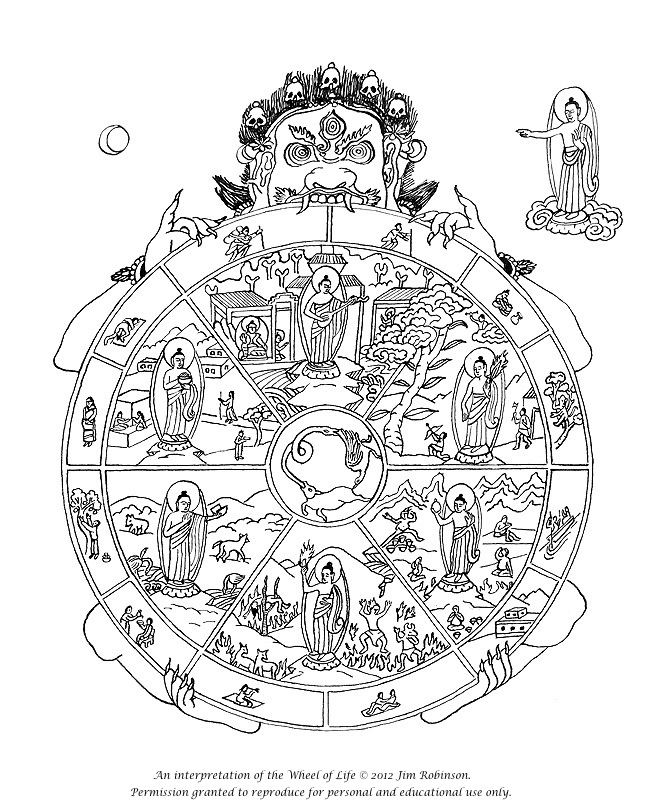
Explain that pupils are going to investigate how the Buddha is believed to change the lives of people, animals and spirit beings, wherever they find themselves. This will help their investigation of what people believe about life and suffering.
Remind them that the Buddha was a great teacher who lived around 2,500 years ago, and that his followers are called Buddhists. They believe that the Buddha, through his own great efforts, found out the best way to live. Explain that Buddhists believe that every action has a consequence for good or ill and that in the diagram you are going to show them this is symbolised in different ways. Every form of being, wherever it is, is subject to this law of cause and effect, known as karma. So – human beings and animals cannot avoid cause and effect, and even if you think there are worlds beyond this one – like heaven and hell – karma still works.
Put the Bhavachakra image up on a whiteboard and take them round the diagram, especially the six worlds of existence, showing how there is suffering everywhere, but that in each world the Buddha is there to help. Explain that it is possible to take this account of six worlds literally, i.e., that beings may be reborn in different worlds, but that it may also apply to our lives here and now in terms of the way people behave. Ask pupils what it might mean to behave ‘like an animal’ or a ‘hungry ghost’, for example.
On the board, put six ‘bad attitudes’ that might be linked to each state of being: Jealousy, Selfishness, Willful ignorance, Pride, Greed and Planning To Do Evil. Can pupils think of examples where each of these might lead to bad consequences? List some of these on the board. Ask pupils to imagine interviewing people who had done these bad actions. What questions would they ask and what answers / excuses do you think they would receive? Compare answers across the class.
Provide pupils with a printed version of the Wheel of Life. Ask pupils to work in pairs to recall aspects of the Wheel, labelling the different sections with key points about what Buddhists believe is being illustrated/symbolized.
Encourage pupils to discuss the details of the picture in their pairs and then to share ideas on the most interesting or puzzling aspects. Prompt their thinking by asking how they can tell that one figure in each of the six ‘worlds of existence’ is the Buddha [He is the largest figure; he has a halo; he carries something to help the beings in that realm]; whether they can think of other religions that picture special people in this way [e.g., Christian Saints, Jesus, Sikh Gurus, etc]; whether they can work out what kind of beings are living in each of the six parts of the main picture, and so on.
Now ask pupils to note what the Buddha is carrying in each world. Ask pupils to imagine that a being in each world has a chance to ask the Buddha ONE question. Pupils can work out their ideas in small groups, write them down, then compare across the class. Keep a note of the questions for the final activity (below).
Point out the monster [Yama] holding the whole wheel in its mouth and ask: Why does a monster hold the wheel of life? [Because, Buddhists believe, all of life is in the grip of suffering and ]
Explain that you would now like them to work out how the Buddha might be helping the creatures in each Divide the class into six groups.
Recap the six realms shown in the Wheel of Life and their meaning:
Realm of the gods or ‘devas’: devas enjoy pleasure and relaxation, however those who live in this realm become used to luxury and cannot achieve Enlightenment.
Realm of the demi-gods: beings in this realm are powerful but angry.
Human Realm: although some human lives are hard, because a human can learn and understand, this realm holds the potential of Enlightenment.
Animal Realm: animals are driven by survival, hunger and competition; their existence is impulsive, they cannot attain wisdom or insight.
Realm of the Hungry Ghosts: these beings are never satisfied and always hungry; they live in a perpetual state of craving that is never sated.
Hell Realm: greed, anger and hatred characterises the hell realm where those inside suffer in various ways
Print out an image of each realm for each group, including information about the realm. Groups think of what it must be lie to live in this state of mind- such as a hungry ghost or an angry demi-god. They crate a modern example to describe this state of mind and explain to the class.
Talk as a class how the buddha might help beings in all the realms, or people in all of these states of mind. Refer to the Buddha’s gifts:
- The lute
- Flaming sword
- Alms bowl
- Book
- Jar of nectar
- Flaming torch
In groups pupils discuss the symbolism of one of these gifts and how it would help people in a specific realm or state of mind. Listen to answers.
Explain that Buddhists believe that the Buddha’s teaching can help everyone to stop suffering, wherever they are [by stopping self-centred desires]. Many Buddhists use paintings of the Wheel of Life to meditate on. They might look at each section and carefully consider what it means for them. Other Buddhists prefer not to use such paintings for meditation, but instead to meditate on a single thought or point. Ask pupils to say which method they think might help a Buddhist to lead a happier life and to give some reasons.
Remind pupils of the questions they wrote for the Buddha and ask them to choose three of the best. Ask them to work out in their groups what answers they think the Buddha might give to these questions, bearing in mind the ‘gifts’ that he is carrying in the Wheel of Life pictures. What answers would pupils give if they were being asked those questions?
Why is the Prophet Muhammad inspirational to Muslims?
Why is the Prophet Muhammad inspirational to Muslims?
An investigation into the importance of Muhammad (pbuh) for pupils with special needs.
For pupils with special needs. Originally written by Anne Krisman. Updated in April 2019.
Key words and concepts
Hadith: a report of what the prophet Muhammad said or did. Used as guidance by Muslims.
Nasheed: a form of unaccompanied Islamic devotional music. Sometimes a drum is used.
Qur’an: meaning ‘recitations’. God’s words revealed through the prophet Muhammad in Muslim belief.
Inspirational: influencing people to lead their lives in a special way.
This resource uses the idea of ‘burning core ideas’ to express the key knowledge to communicate to pupils:
- Muhammad is special to Muslims;
- Islam is the name of the Muslim religion;
- Muslims believe in one God called Allah;
- Muslims cannot see their God;
- Muslims do not make pictures of Allah or Muhammad as people;
- Muslims’ holy book is called the Qur’an.
Further key ideas and knowledge:
- Muhammad was trusted by people – they called him Al-Amin (the one you can trust);
- Muhammad believed in one God called Allah;
- Muslims call him a messenger and prophet of Islam (rasul);
- Muslims say ‘Peace be Upon Him’ after the name of Muhammad, sometimes written as ‘pbuh’;
- Muslims believe an angel appeared to Muhammad in a cave on a mountain (Mount Hira);
- Muslims believe the angel, called Jibril, revealed the words of the Qur’an;
- Muslims try to lead their lives from the example of Muhammad.
Learning activities
The following activities follow the ‘Five Keys Into RE’ approach (Anne Krisman)
1 Connection – How can we link our theme with pupils’ lives?
Share these thoughts with the pupils:
- We all have special unique qualities.
- We like to help others.
- We have special places where we can be calm.
- We care about
Let pupils know that Muhammad was known as ‘The Friend’ and ‘The Helper’ and that they are going to look at things that connect them with the life of Muhammad. This will begin by looking at their special unique qualities.
Share or gather the special qualities of each child in the class. This can be done by sharing ideas in the classroom, by going around the school and asking people who know them well, or by asking parents and carers to respond. Words such as helpful, kind, peaceful will be gathered.
Make the names and qualities into a class performance: names can be signed, clapped, drummed or chanted for each child, e.g., Joshua the Peaceful, Hannah the Friend.
Make a display with pupils’ pictures, their new values name and where appropriate, comments about why this name is right for them.
Paint either a) the pupil’s first name or b) their values name onto the fold of an A3 or larger piece of paper. Fold the paper to create a symmetrical design. Ask the pupils to then decorate and beautify their name.
An additional idea is to write the pupil’s values name in PVA glue and to encourage children to throw different coloured sand onto it. If you wish to highlight Muhammad’s special colour during this theme, use green sand.
While working you could play different nasheeds about Muhammad, you will find many on you Tube, such as:
- Ya Muhammad
- Muhammad (Peace be Upon Him)
- 99 Names for Muhammad
- 99 Names of Muhammad (translated)
2 Knowledge – How can we communicate burning core knowledge within the theme to our pupils?
Share these examples of burning core knowledge with the pupils:
- Muhammad was trusted by people (Al-Amin);
- Muhammad believed in one God called Allah;
- Muslims call him a prophet and messenger of God (rasul);
- Muslims believe an angel appeared to him in a cave and revealed to him the words of the Qur’an.
Let pupils know that Muhammad was valued by people and called Al-Amin – The Trustworthy. Muslims believe he was a messenger of God and that they are going to learn more about his life.
To highlight the importance of Muhammad’s name of Al-Amin – The Trustworthy – trust the pupils to take a special gold wrapped package to another class. Arrange for the member of staff who receives the package to affirm the trust placed in the pupils and to pass on something special from their room for the pupils to take back to their class.
Ask pupils to carry a message in an envelope or sign that Muslims believe there is only one God and tell this to others in the class or around the school. Anyone who hears the message can take a gold star and add it to a picture of the Arabic calligraphy for Allah, to show that the message has been heard.
Let pupils know that Muhammad believed in one God called Allah.
Listen and watch popular nasheeds which mention Allah, for example Yusuf Islam: A is for Allah, Zain Bhikha: Mountain of Mecca.
Encourage pupils to sign the letter A and the number one while responding to the music.
Islamic plaques with Muslim prayers and the raised names of Allah and Muhammad can be touched – these can be obtained from shops in areas with a Muslim population and through artefact catalogues.
Print out lots of small pictures of the word Allah in Arabic calligraphy. Ask pupils to carefully stick the words on to gold paper, trying to put them on the right way up and showing care in placing them, to reflect how Muslims respond to the name of God. [This can also be repeated with the name of Muhammad, this time sticking the names on green paper and keeping the same rules of respect and care. These two pieces of work can be stuck together and a beautiful border made around them, to link them, with glitter.]
Let pupils know that, Muslims believe that an angel appeared to Muhammad in a cave and revealed to him the words of the Qur’an
Show images of Mount Hira while listening to Zain Bhikha’s Mountain of Mecca.
Ask pupils to create a collage made from brown ripped paper, of the cave at Mount Hira. Then, without creating a human image, add the feeling of the angel Jibril, using glitter, holographic paper, cellophane etc.
Make a peaceful cave area in the classroom by putting together prayer mats, cushions and glittery material. Add light changing resources to show the presence of an angel.
Introduce pupils to the first of four stories of Muhammad and use the sensory story guide to help pupils know about the revelation that Muslims believe Muhammad received on Mount Hira.
Share the sensory story together, allow time for the stimuli to be experienced by each pupil.
Ask pupils to reflect on the story and, where appropriate, to ask questions about it.
Where appropriate, choose a question to focus on, for example, ‘Why did the angel say, “Read!”?’ and share possible answers. Adults can also ask questions and respond.
If time, share the story once more.
3 Senses – Which sensory elements are in the theme?
The following sensory activities can help pupils experience something of the life of Muhammad and the importance of Islam to Muslims:
Recitation of the Qur’an and Call to Prayer (adhan);
Islamic nasheeds (unaccompanied devotional music, sometimes using drums);
Prayer mat and topi (prayer cap).
Play a version of the Call to Prayer (adhan) to pupils while they use red, orange, purple and yellow crayons or sponge paint to create a sunset sky. Versions to be used could include those from Turkey, Bosnia, Saudi Arabia and Egypt as well as British muezzins.
Afterwards, encourage pupils to add a black paper cut-out of a dome and minaret, to give a scene of a mosque at sunset.
Engage pupils in the experience of wearing or touching a Muslim prayer cap (topi) for boys and headscarf for girls, while turning the pages of a Qur’an on the whiteboard, a resource called ‘Baybar’s Magnificent Qur’an’.
Encourage them to touch some Muslim prayer mats and then look at how Muslims pray, such as by looking at video clips or animation online.
Help pupils make a prayer mat out of sensory materials, such as textured wallpaper. The prayer mat could include arches, a picture of the Ka’bah at Mecca, and a hanging lamp to stick on.
4 Symbols – Which symbols are the most accessible in the theme?
Share these examples of Muslim symbols with the pupils:
- Moon and star;
- Arabic name of Muhammad and Allah;
- Salaam (peace) – Muslims say ‘peace be upon him’ when talking about Muhammad;
- Islamic art symmetrical designs.
Crescent Moon and Star
Invite pupils to recognise the moon and stars in a slideshow of pictures and to sort a selection of pictures of crescent moons and stars.
Encourage pupils to use Makaton signing for star and moon while listening to a song about wonder in the universe, for example There is Only One God by Zain Bhikha.
Encourage pupils to make collage pictures of the Muslim symbol – the crescent moon and star, or rub over a moon and star stencil and decorate.
Salaam – Peace
Ask pupils to identify what makes them feel peaceful out of a choice of different pictures, such as listening to music, going on the computer, lying down, praying, etc.
Help them practise writing the word Salaam in paint while listening to peaceful chill out music.
Ask pupils to make a dove of peace – there are many templates online. Add cut-outs of the name of Muhammad, with crescent moon and star symbols, to show that Muslims say ‘peace be upon him’ when talking about him.
Islamic art symmetrical designs
Explain that Muslims believe only Allah is the creator and so natural designs are shown in a non-realistic but beautiful way, with unexpected colours being used. Repetition of designs shows that God goes on for ever. An example can be found in Iznik pottery from the 16th century Ottoman Empire, although its designs are still being used for ceramics in Turkey.
Show images of Iznik art from the Turkish tradition. Ask pupils to look for the colours of blue, red and white and for flowers.
Prepare four pieces of black, blue, red and white paper and make concertina folds. The black will be used for the background. Ask pupils to draw simple flower designs and leaves shapes on the three pieces of paper and to cut these up. They should then lay out the three elements of the flower design on the concertina folded black paper, trying to repeat the pattern.
Create an Iznik Art gallery from the pictures, displayed with images of Iznik art pottery.
5 Values – Which values in the theme speak to our pupils?
Share these examples of Muslim values with the pupils:
- Following a straight path
- Helping poor people
- Caring for animals
- Forgiveness
Explain to pupils that they are going to learn about three more stories about Muhammad (Muslims say peace be upon him) that will help them understand how inspirational he is for all Muslims and how he set an example for all Muslims to follow.
Share the sensory story of Muhammad and Crying Camel allowing time for the stimuli to be delivered in a caring manner to each pupil.
Ask pupils to reflect on the story and, where appropriate, to comment and ask questions about it.
Where appropriate, choose questions to focus on, for example, ‘How do we look when we are sad?’ ‘How can we be kind to animals?’ and share possible answers. Adults can also ask questions and respond.
If time, share the story once more.
In follow up lessons, use Muhammad and the Old Woman, as a call and response poem, and Muhammad and the Sleeping Kitten, with the associated activities, to show how inspirational Muhammad is for Muslims. Can pupils identify the parts of each story that show that Muhammad was helpful, kind, compassionate, loving, generous, following a straight path, brave, forgiving?
The Hindu Concept of God – Jim Robinson
The Hindu Concept of God
Try to explain the Hindu concept of God and suddenly RE teachers become cosmologists saying that God is a trinity represented by Brahma who creates the universe, Vishnu who preserves it and Shiva who destroys it (even though this means buying in to a cyclical rather than a linear view of a time-bound universe). Or else physicists, saying that, like clear white light refracted through a prism and emerging as all the colours of the rainbow the other side, so God is one but seen in many forms. Or else genealogists, comparing the different ways of seeing God as a mother, sister, daughter, cousin, neice and so on yet still the same person. Ultimately, there is only one God seen in many forms and ways, all forms of Brahman the Absolute, Ultimate Reality (not to be confused with Brahma the creator God of course).
In one sense this is fair enough, if you are also prepared to explain that this is only one of many ways of understanding God in Hinduism. If you want to be really clever about it you give this way of seeing God a name and call it Vedanta, or at least a form of it. Vedanta promotes the notion that ‘knowledge’ of God is achieved through a process of self-realisation, a process that is open to all. What is meant by God is Brahman, the Absolute, the Supreme and Ultimate Reality, although God is also referred to in less abstract terms by the epithet Ishvara meaning Lord. God-consciousness and self-realisation are bound up together in this system of thought which is based around the phrase ‘That thou art’ from Chandogya Upanishad 6.8.7. This phrase came to be interpreted differently by each of the 6 schools of Vedanta with a modern version being represented by the Advaita (monism, non-dualism) of Swami Vivekananda. In the Vishistadvaita (qualified non-dualism) and Dvaita (dualism) forms of Vedanta, bhakti to Vishnu and his incarnations is the path to moskha or liberation.
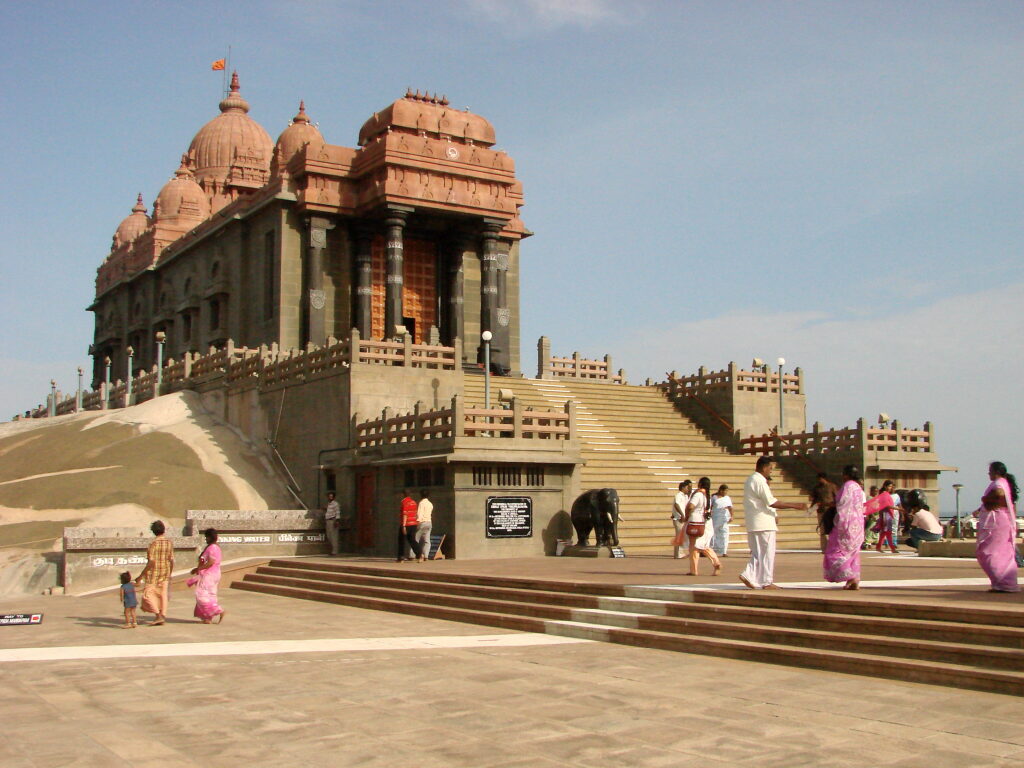
However, even Swami Vivekananda (19th c) was not averse to bhakti and meditation on a personal god with ‘form’ and ‘qualities’ rather than a ‘formless’ Absolute devoid of such things, at least initially. He realised that ‘God with form’ was easier for most people to grasp than ‘God without form’. Which is fine as Brahman can be seen as both a personal God ‘with form’ (Saguna Brahman) as well as ‘formless’ Absolute (Nirguna Brahman). Play around with this notion of God with or without form and you might get a sense of what Vivekananda meant when he said ‘A Hindu does not worship an image made of wood and clay, he sees consciousness within the earthen-ness and loses himself in it’. You also come to sense that it is something to do with consciousness, meditation, self-realisation, God-realisation.
Vedanta is a spiritual understanding of God represented by the Ramakrishna Vedanta Centre in Buckinghamshire and Jay Lakhani the education director of the Hindu Council UK. It is also an understanding that promotes community cohesion. Just as Swami Vivekananda encouraged religious tolerance in his world tours, stating that all religions strive towards the same truth, so Jay Lakhani is quoted as saying ‘All faiths must accept pluralism if we are to diffuse strife caused in the name of religion’ (Face to Faith 2007). As such it may be considered more ‘mainstream’ than the westernised version of bhakti represented by ISKCON and Bhaktivedanta Manor which promotes Krishna consciousness overall.
So if as an RE teacher you subscribe to the Vedantin view of God, then you are not alone in finding this an attractive route. Vedanta has been a major influence on many Western writers and philosophers such Aldous Huxley, T S Eliot, Voltaire and Nietzsche. But also be aware that for the majority of rural Hindus in India who worship not only a personal God (ishtadevata), but also a family God and a village God, the abstract philosophies of Vedanta, let alone the concept of Trimurti, may have little or no relevance. God ‘with form’ and personal or ‘God without form’ and abstract may be two sides of the coin and the notion of starting with the former before moving to the latter may give us some sense of the way that Hindus approach the concept of God as both personal Ishvara as well as abstract Brahman. It also highlights the need for us as RE teachers to be more aware of how we present the Hindu concept of God to our students and not to be tempted to oversimplify.
The nature of God in Sikhi – Ranvir Singh
The nature of God in Sikhi
While some Sikhs are happy to use the term ‘God’ to refer to the Ultimate, the Base of Being, others are more suspicious for it is difficult for some people to conceive of ‘God’ without thinking of a sort of bearded man in the sky. For Sikhs this is problematic as they believe that the Ultimate is neither male, nor female but also because they believe that the Creator is in the creation and the creation is in the Creator.
The Sikh scripture, the Guru Granth Sahib, begins with the numeral ‘1’. Therefore, it is true to say that Sikhs are monotheistic. However, Sikhs may also be called panentheistic as they believe that the One is present in creation: “One Light fills all creation. That Light is You” (Guru Granth Sahib, p.13).
Sikh are not pantheists, people who believe that God is the world. For Sikhs the Divine is not the universe but is the Life within it, its driving force, like fire inside wood, a “reflection in a mirror or fragrance within a flower” (Guru Granth Sahib, p.684). It is this belief about Divinity that gives rise to the Sikh ethos of the sant-sipahi or saint-soldier.
The saintly element follows from connecting with the Divine within. This Presence is called Naam or name. Naming is integral to a relationship and relationships shape, and are shaped by, our being – our ideas and practices – in the world. The Presence is revealed to us through the Sabd, or word, that inscribes our existence and which therefore constantly reaches out to us as our Inner Tutor or intuition. This Sabd is regarded as the SatGuru or Real Guru, with the interaction between the Guru Granth Sahib or Sikh scripture and Sikhs, a reflection of the dialogue between consciousness and intuition. The action of the Sabd is called gurprasad or grace.
The soldierly element follows from the recognition that there is Divinity and, therefore, dignity in every person. For this reason social action is a corollary of spiritual realisation. Grace reaching to us flows through us as meeta or loving-kindness. “After spending time with saints I lost the sense of ‘us’ and ‘them’. No one automatically is my enemy, nor do I regard others as strangers. I am friendly towards everyone” (Guru Granth Sahib, p.1299). These friendly relations are best expressed in the langar which is a free kitchen where free vegetarian food is available to everyone, whatever their race, gender, faith or class – it represents equality, inclusion and the importance of social service.
Such service can feed into political action. The fifth Guru, Guru Arjun wrote: “From now such is the Will of God: No one shall force another, no one shall take advantage of and use another. Everyone, each individual, has the right to look for and work for happiness and self-fulfilment. Love and persuasion is the only law of social cohesion” (Guru Granth Sahib, p.74). He became the first Sikh martyr in 1606 as the Emperor feared that his words and actions were a threat to the divine right of kings – the belief that God chose rulers and gave them the authority to rule others. A second Guru was martyred, in 1675. The Dasam Granth, a Sikh religious text, says that his sacrifice was for three principles: the right to worship; the right to have your views about the ultimate nature of the world and life respected; the right to pursue happiness and self-fulfilment (Dasam Granth p.54). In 1699, the Khalsa was formed. This remains a self-governing community of equals that anyone is eligible to join providing they agree to abide by its code of conduct, designed to transform a person into a knight.
The battle-drum beats in the sky of the mind; aim is taken, wounds inflicted. The spiritual heroes enter the field of battle; the time for war is here and now! Only
They may be cut, piece by piece, but they never leave the field of battle(Guru Granth Sahib, p.1105).
The hymn refers to the battle within each person as they struggle with the five thieves that oppress us – pride, greed, lust, anger and undue attachment; and forces of fear, desires and hopes that imprison us in stories of the future and past. These elements may govern and shape our lives. But the stories they tell are part of wider social stories that feed into, and reflect, social realities. Therefore, the struggle for freedom and authenticity has a social as well as spiritual dimension.
The in/out structure of believer/unbeliever; male/female; black/white; high caste/untouchable is replaced by unity through the Presence of the Divine. This oneness of God and oneness of humanity is manifested in the common intellectual human cauldron of the Guru Granth Sahib, featuring 36 non-Sikh authors, symbolised by the sword of discriminating intelligence and will that stirs the pot of the human body. The sword and cauldron together symbolise the amrit ceremony whereby people join the Khalsa. This nexus of spiritual-social is found in the langar where people serve but also eat. Free and abundant food challenge stories of scarcity that justify poverty and restricted access to power in the human species. “The wealth of nature is there to be used. There is enough for all, but it is not shared justly in this world” (Guru Granth Sahib, p.1171). The generosity or grace of God involves other species. “In the deepest rocks there are living beings and even there food is provided for them” (Guru Granth Sahib, p.10).
The implications for ideas of space are clear. Each person’s heart is a sacred space. Moreover, even other planets have sacred spaces as, “The saints of many worlds live there. They celebrate, blooming with the divine” (Guru Granth Sahib, p.8), implying intelligent life and perhaps even more religions. “The concept of time emphasises present/Presence. Seconds, minutes, hours, days, weeks, months, and seasons all originate from the 1 Sun”, says Nanak, “in just the same way that different religions originate from the 1 Creator” (Guru Granth Sahib, p.12-13).
God’s truths were established with the “first breath” and persist through time. There was neither a golden age nor will there be one. Suffering exists due to free will and provides the opportunity for relationship between Being and beings. Faced with carnage when Babur invaded India, Guru Nanak wrote: “Nanak sings of the virtues of the King in the city of corpses and gives this lesson: the Creator who allocates unique opportunities sits apart, watching our choices” (Guru Granth Sahib p.723).
Sikhs believe in an afterlife where God acts as Judge. “The rulers are tigers and their officials are dogs. Together they go out to wake up the sleeping people to harass them. Those who should be serving the public wound people with their claws while the dogs lick up the blood that is spilled. But in the Court of God everyone will be judged. Those who have betrayed the trust of the people will be shamed and punished” (Guru Granth Sahib p.1288).
Judaism and G-d – David Hampshire
Judaism and G-d – David Hampshire
The nub of the problem
If you look at books on Judaism you’ll find very little about G-d. This seems to be quite odd from a non-Jewish perspective. Christians have whole books about God: from the nature of the Trinity to the nature of the incarnation and God’s relationship to humanity in Jesus. Not so for Jews. In fact the flourishing of writings about G-d from a Jewish perspective occur in two specific contexts. Firstly, though, why so little about G-d? Judaism tends to focus on the covenants that G-d established with Abraham, Isaac, Jacob and Moses. These covenants, especially the covenant at Sinai with the people of Israel, focus on G-d’s promises and Israel’s responsibilities in fulfilling the covenant. Hence, Jews tend to focus on what they should do to fulfil the covenant as opposed to speculating about the nature of G-d.
All Jewish thinking about G-d starts in the Torah, the first five books of the Hebrew Bible. The Torah is more significant than the Prophets or the Writings as a source for Jewish understanding about G-d. Anybody who has read the Hebrew Bible, though, will realise that it does not present a systematic view about the nature of G-d. On the contrary the picture of G-d is quite confusing. This is because the Hebrew Bible was compiled over a period of five hundred years with some traditions going back over a thousand years.
So what can be said about G-d from the Hebrew Bible? Well, there is only one G-d who is the creator of the universe, our world and us. This G-d enters into relationship with human beings and has expectations of us. These are universal expectations, the Noahide Code. G-d also chooses a nation to be a witness to G-d in the world, this is Am Israel (the People Israel) they do this by fulfilling the commandments in the Torah. G-d also appears tender and loving and at the same time jealous and vindictive. Jews lived with this tension until challenged by Greek thinkers and later by Christians and Muslims.
Two contexts for Jewish theology
As stated above there are two contexts in which Jewish thinking about G-d has developed. The first context is when Jews have been challenged to explain their beliefs about G-d to others. The second context is when Jews have faced persecution; often these contexts have coincided. The first real Jewish thinker who tries to make sense of G-d to others, Jews and non-Jews, is Philo of Alexandria (c20 BCE to 40 CE). Philo tries to defend the Jewish Scriptures to the Greek world, the world of Socrates, Plato and Aristotle. Philo sees G-d as the One who ‘speaks’ and it is through the Word that the world is created. For G-d to speak G-d must have a mind and the world, and us, reflect something of that mind of G-d. Philo sees G-d as transcendent and has having two supreme powers: goodness and authority. As we are made in the image and likeness of G-d we too share these powers.
Other notable Jewish theologians are Maimonides (1135 – 1204 CE) and Nachmanides (1194 – 1270 CE). They became Jewish theologians because they had to defend Judaism in light of their encounter with Christianity and Islam. The most famous philosophical work of Maimonides is the Guide for the Perplexed. The Guide attempts to present Judaism according to a rationalist model and in it Maimonides develops what is sometimes called a negative theology. Such a theology states that G-d is so different from what we are that what we can say about G-d is extremely limited. In fact it is easier to say what G-d isn’t (negative). But Maimonides does say some things about G-d in his Thirteen Principles of Faith in his commentary on the Mishnah Sanhedrin:
- G-d exists and our existence is dependent on G-d
- G-d is ONE and is indivisible
- G-d is pure spirit and has no body
- G-d is eternal – without beginning or end
- G-d reveals the Self
- G-d knows what we think and do
- G-d judges our actions and will reward and punish them
- G-d has the power to resurrect the dead
In many Jewish prayer books (Siddurim) these Thirteen Principles are included in full and they have been turned into a hymn often sung on Shabbat (Yigdal).
Perhaps the most infamous Jewish theologian was Baruch Spinoza (1632 – 1677 CE) who tried to re-think Jewish ideas about G-d in terms of the emerging Enlightenment. In the end he was expelled from the Jewish community where he lived because he seemed to suggest that G-d is the world’s soul, making him a pantheist or panentheist. More worryingly he argued that Good and Evil have no real meaning.
Perhaps the greatest and most neglected Jewish theologian was Bahya ben Joseph ibn Pakuda (c1000 CE), his great work The Book of Direction to the Duties of the Heart deserves reading and rereading and gives one of the best systematic presentations of theology in action of any Jewish writer.
The second context for Jewish thinking about G-d is persecution. This might at first appear odd but it makes sense in terms of the Jewish belief that the Jews are G-d’s chosen people. If the Jews are G-d’s chosen people and are faithful to the covenant by keeping the commandments why do they face persecution? The response to this is Jewish mysticism, often referred to as Kabbalah. It is impossible to underestimate the influence of the Kabbalah on Jewish thinking and practice but its most important contribution has been to Jewish thinking about G-d.
The Kabbalah isn’t one single set of ideas or school of thought but it develops in response to the lived experience of Jews. It has its roots in the apocalyptic writings in the Hebrew Bible, such as Daniel – who is not a prophet in the Jewish Biblical tradition. As such the Kabbalah is a dynamic mix of the Biblical and Rabbinic tradition with Neo-Platonism. This works out in a number of ways. Firstly, G-d’s creation is perfect and is possible because G-d contracts (tzimtzum) the Self to enable the universe to exist. A cosmic accident occurs which causes our world to emerge, a world of mixed spirit and matter. G-d gives us the Torah so we can start to piece our world back together. By keeping the commandments we bring G-d into the world and the cosmic accident is repaired. We will know it is repaired when the Messiah comes and the world is perfected. Hence, our actions have cosmic consequences and therefore if we are faithful in keeping the commandments our lives have meaning and purpose, even in persecution. Perhaps the most important Kabbalistic thinker was Isaac Luria (1534 – 1572 CE) and his work has been developed in the Chassidic tradition by Shneur Zalman of Liadi (1745 – 1812) the Baal HaTanya, among others.
One way that this has developed Jewish thinking about G-d results in the reflection on the destruction of the Temple in Jerusalem. A Kabbalistic teaching is that when the Temple was destroyed the Tiferet (Glory m.) of G-d was separated from the Shekhinah (Presence f.) of G-d. Now the Shekhinah wanders the earth with the lost as one of the lost. The only time this isn’t true is when the candles are lit in the home on a Friday evening and the glory of G-d is apparent to all. In this act of divine copulation souls flood the world and as a result righteous souls are born when a husband and wife are united.
So what does this tell us about G-d? Firstly, G-d is One but contains both male and female aspects. If humans are made in the image and likeness of G-d we are only fully human when we are united as male and female. Secondly, there is virtually nothing about any opposition to G-d. Whilst Satan is mentioned in Jewish sources Satan is not the source of evil. It is G-d who is the origin of all and ‘all’ includes evil. The Kabbalistic tradition refers to this as the Sitra Achra – literally the ‘other side’ of G-d.
Jewish thinking about G-d was further challenged by the Holocaust and provoked much debate about where G-d was in the camps. Writers of note have been Eliezer Berkovitz, Milton Steinberg and Irving Greenberg amongst others.
So what?
If you’ve followed the argument so far you might feel more confused than when you started. This confusion might arise out of thinking that Jews haven’t really done any thinking about G-d since the Bible. In reality Jews have only really had to develop their thinking about G-d when they’ve been challenged by others to do so or by their experience. So what can be said? Here are some pointers:
- G-d is not definable, we can use human language but it will always be limited.
- The Biblical tradition, supported by the Rabbinic tradition, uses language about G-d which is contradictory because G-d cannot be rationalised by human thought but G-d created all that is whilst remaining uncreated.
- G-d is transcendent, totally other, and eternal. Everything that exists exists only to the extent that G-d exists. We are contingent beings and our meaning is dependent on G-d.
- G-d is immanent, open to us as One who desires to enter into covenant but that implies responsibility on both parts.
- We can’t always make sense of G-d or our world or our experience.
In the end Jews will probably never develop a theology to compare with Christianity or Islam because they are much more concerned on how to live a life in faith with the G-d of Abraham, Isaac and Jacob, my G-d and the G-d of my fathers.
Note: Many Jews substitute the English word ‘God’ as ‘G-d’ in order to avoid any disrespect. A document containing the holiest Name should not be destroyed, so a potential difficulty can be avoided if the name of God is not used. For other Jews this is not so important, particularly if God’s Hebrew name is not being used.
Humanism, Ultimate Reality, God and Gods – Sara Passmore
Humanism, Ultimate Reality, God and Gods
The one thing that most people know about humanists is that we don’t believe in gods or goddesses. In fact, as the most recognisable non-religious worldview, you could say this is one of our defining features. But Humanism is a positive lifestance – It is an approach to life based on reason and our common humanity, recognising that moral values are properly founded on human nature and experience alone.
Most humanists find that the concepts of gods or goddesses simply don’t make sense – the idea isn’t relevant in daily life and the decisions we take.
Humanists come in many forms – some of us are atheists, a term which originated from the Greek atheos, meaning ‘without god(s)’ and some of us are agnostic meaning ‘without knowledge’, but many of us choose to describe ourselves humanist because we want to define ourselves by our positive beliefs (‘I am a humanist’) rather than by a negative term (‘I am not religious/I don’t believe in gods or goddesses’).
While humanists reject the belief in gods or goddesses, many humanists want to understand why some people believe in them and if this should this impact on how we live our lives.
The origin of gods and goddesses
Throughout recorded human history many people have used the idea of the supernatural to explain the workings of the natural world around them.
It’s not surprising that people might explain natural phenomenon using supernatural ideas – without greater knowledge of the natural world it would have been difficult to explain why the sun rose and set, or the tide moved. A lot of these explanations, especially sun-worship, have influenced modern religions such as Christianity (for example, the symbol of Sol Invictus, the Roman Sun-God, becoming the halo over Christian Saints at the order of Constantine, when he moved the holy day from Sabbath to SUNday).
Humanism and ‘Ultimate Reality’
Humanists turn to science when it comes to thinking about whether there is an ultimate reality or truth about existence and whether that might ever be known by human beings. The term ‘ultimate reality’ has religious overtones (some definitions state that it is a supreme or fundamental power reality or else hint that it is something beyond the natural world – that it exists in a supernatural world or there is a second layer to reality). Humanists use evidence and reason to understand the world around them, and there is no evidence to suggest that there is some supernatural ‘second layer’ to reality. We can use science to measure, understand, and explain the world around us in terms of it being a natural place. Some might say this is a materialist view of the world – a view that matter is the fundamental substance in nature, and that all phenomena, including mental phenomena (like our thoughts) and consciousness, are the result of material interactions. However, all the impressive advances in science of the past century have found no evidence whatsoever that there is anything beyond the physical universe. Even the strange theory of quantum mechanics, so often wrongly invoked to explain all manner of pseudoscientific and paranormal nonsense, does not propose any deeper layer of reality beyond the physical, even if that reality at the microscopic level is forever beyond the grasp of our scientific instruments.
Humanism and science
Through scientific enquiry our knowledge and understanding of the natural work and the universe has increased, and with this many people’s view of gods and goddesses has altered. Many religions have changed their explanations of fundamental subjects such as the origin of humans or the movement of the planets, and most people have a natural view of how the universe began and how life on earth evolved.
Of course, some religions and people still firmly adhere to a supernatural explanation of the world – for example, young earth creationism ignores evidence that proves that Earth is over 4.5 billion years old. However, increasingly people are adopting a natural view of the world, and fewer people today believe that religious books are literally true.
What do we mean by gods or goddesses?
The word god means different things to different people. Some may think it means a loving ‘Father’, others a universal spirit, or a force that set things going. Some think gods and goddesses can and will intervene in our lives if we pray, meditate, or sacrifice.
Some say that there is a common denominator: a single god about whom the various religions have different beliefs. But that does not seem to be the case in practice. If people believe different things about god – for some god is male and a person; others say that god is a cosmic force and sexless; some say god is loving and good, some say god is purely celestial, while others think god is human or superhuman…. then the god they believe in is not the same god, and their beliefs contradict each other.
We cannot discuss whether or not gods or goddesses exist until we are all clear about what is meant. Some of the most common arguments for the existence of a god are below, with a humanist perspective on the argument.
Argument 1 – The Argument from Design
“Surely the regular movement of the planets and the arrangement of the cosmos must be the work of an intelligent designer?”
This argument is usually called ‘The Argument from Design’. It comes from ancient Greece, especially Aristotle, but was taken over by Christian thinkers such as St Thomas Aquinas, and Catholics have been taught it ever since.
This argument has big problems. Firstly, there isn’t much order in the universe, but an increasing tendency towards chaos. The universe is also expanding, rather than keeping to a particular design.
Secondly, this argument assumes that order has to be designed, and can’t just occur naturally. But the way things happen to be will give them some characteristic features, which may appear as order.
Very often, patterns follow from the nature of the thing in question. We know that a spider doesn’t have a planning intelligence – the pattern of its web has arisen through millions of years of evolution by natural selection. A shaken jar of soil and water settles to a highly ordered pattern with larger particles at the bottom, then finer particles, then liquid – and no designer is involved at all.
Argument 2 – The Ontological Argument
“If you are able to think of a perfect Being you must believe in his existence, because if he didn’t exist he wouldn’t be perfect.”
This argument is usually called ‘The Ontological Proof’. Ontology is the study of the philosophy of being. This argument is similar to saying: because something is, it is. We have to be on the look-out for arguments that go around in circles and actually prove nothing. Words such as ‘ontological’ can make something sound profound , but beware!
This argument comes from St Anselm in the 11th century. St Thomas Aquinas rejected it… so not even all the Saints were in agreement. Later, Descartes revived it, and it has been taught ever since.
It’s the sort of argument that will convince those who desperately want to be convinced. If we think about UFOs in these terms: if you can think of a perfect UFO, then it must exist, because if it didn’t exist it wouldn’t be perfect.
Another version of the argument says, ‘Because god is perfect he must have all possible attributes.’ Presumably then god is bad as well as good visible and invisible… This idea is full of contradictions.
Argument 3 – The ‘First Cause’ Argument
“Everything that happens has a cause. But something must have happened in the first place to start the chain of causation moving. This ‘First Cause’ is what we call god.”
This argument is usually called ‘The First Cause’. God created everything and started it moving; created the ancestors of all living species… (In 1996 this was suddenly updated by the Catholic Church to incorporate evolution).
So, do we need a First Cause? And if so, how do we know it was god?
Logically, if you argue that every cause has a cause, you must face the question: what caused the First Cause? In other words, who or what made god? The Christian response is that god created the chain of causation when he created the universe. God did not need a cause, since causes are something he created.
But if god didn’t need a cause, perhaps the universe didn’t need one either. If god had pre-existed for an infinite time before he created the universe, what was it that caused him to change his mind and create it? If the pre-existing god was perfect without being a creator, why did he decide to become a creator?
Even if we did decide to say there was a First Cause, what reason would there be for thinking that this was some kind of god, rather than a great explosion, or cosmic matter or energy? What evidence is there that such a First Cause would have carried on eternally and still be in existence today? The fact that science hasn’t explained everything about the origin of the universe is not a reason for assuming a First Cause and calling it god.
Argument 4 – The Moral Argument
“Because morality exists, there must be god.”
This argument is usually called ‘The Moral Argument’. The philosopher Kant demonstrated that the previous three arguments weren’t valid, but cautiously supported this one. He said that our moral nature makes it necessary for us to believe in god – he carefully avoided saying that morality means that god exists.
Modern research looks at ‘evolutionary psychology’ and is getting closer to a full account of how our values and moral systems arose from the evolution of human nature.
Argument 5 – Argument from Belief
“God exists because people believe in him.”
By the same token, god doesn’t exist because people don’t believe in him. Everyone has their own ‘reality’, and where groups of people share their belief about what is real, then it gathers more force. From a theological viewpoint, however, it makes little sense to look at the existence of god merely as a matter of opinion, as this argument does.
Sometimes the argument stresses the number of people who believe in god or goddesses (whatever the sort they believe in). It’s about consensus of opinion, and it’s a weak argument.
Enough people have believed in Santa Claus during their childhood, but it didn’t have any bearing on his existence. Years ago, almost everyone believed the earth was flat and at the centre of the universe… but this didn’t make it true!
If there is evidence, we can say it is a widely-held rational belief – such as believing in icebergs… I’ve never seen one, but I’ve read reports of them from people I trust, seen them on television, know what they are made of, and have seen similar lumps of ice in drinks.
Argument 6 – The Personal Argument
“But I’ve had a religious experience.”
This argument is usually called ‘The Personal Argument’. Many research projects have examined religious experiences. So far there is no scientifically verifiable evidence that such experiences reveal consistent evidence about gods or goddesses.
These revelations about gods or goddesses are often mutually exclusive – they cannot all be right, though each person is convinced that their personal experience has shown them the true path.
Argument 7 – The ‘purpose’ Argument
“Without god there’s no purpose to life.”
As it stands, saying that without gods or goddesses there’s no purpose or meaning to life is neither evidence nor proof. There is also plenty of evidence of intelligent beings (people) giving meaning and purpose to their lives without help from the supernatural.
Argument 8 – God’s Test Argument
“God won’t let us discover proof of his existence, because he wants us to have faith.”
Based on an argument from the philosopher Kant, this seems to be only an opinion or a clever way with words. Like many other arguments, it isn’t evidence and it isn’t proof. You could also say that faith would be even more important if we proved that gods or goddesses didn’t exist.
Argument 9 – God as ‘force’
“God is a force beyond time and space, creating the underlying rationality of the universe.”
You will find that many scientists who study the universe are agnostic or atheist, and humanist. But there are some who believe in gods or goddesses. Their view is very different from the gods of religions’ scriptures, and is often abstract. Again, I would not see this as any sort of proof. Of course there are many things that we don’t yet know. But where the religious physicists put the word ‘god’, humanists are happy to leave a question mark. The more abstract the concept of god – ‘beyond time and space’, ‘cannot be described in terms that humans would understand’ – the less it can be said to be a proof of god’s existence.
STOP! Just look at the suffering in the world…
Apart from the lack of evidence for gods or goddesses, the strongest arguments against their existence is the whole question of evil and suffering. Many religious people have times when they seriously doubt their faith in gods or goddesses.
When they consider horrific events like the Indian Ocean earthquake and tsunami in 2004, they find it difficult to believe in a god who is all-loving and all-powerful.
Perhaps god is either not good, or not powerful? But that would go against the teaching of most religions. And if god is cruel, why should people worship? Do they want a cruel god to bring about more cruelty? Perhaps god simply doesn’t intervene in human lives? This is like the belief of ‘Deists’, who think that god never reveals himself to us, and so won’t intervene to stop bad events. In this case, there is little point in prayer or worship.
Perhaps god doesn’t care about us? Once again, why worship? Why pray? This is a debate that could go on for pages.