What are the effects of migration on religion? Polish Catholics in the UK and Ireland
Research Summary: What are the effects of migration on religion? Polish Catholics in the UK and Ireland
The question is often asked, how does migration affect religion? The number of Polish Catholics in the UK and Ireland has grown rapidly, but little is known about the religious aspects of their journey. This report is based on the researchers’ fieldwork with Polish migrants in the UK and Ireland. Drawing on interviews and participant observation with Polish migrants of various ages and class backgrounds, three possible outcomes are identified for Catholics transplanted to a new context. Firstly, they continue to practise in the same way as they did in their home country. Secondly, they begin to question their faith and leave the church altogether. Thirdly, they take the opportunity to explore their faith in a flexible and relatively independent manner.
Researchers
Kerry Gallagher & Marta Trzebiatowska
Research Institution
University of Maynooth, University of Aberdeen
What is this about?
When people migrate, how does it effect their religion.
Specifically, when Catholics migrate from Poland to the UK or Ireland, how does it affect their religion?
What kinds of continuities and changes can be found in their religious views and practices? How are these religious views and practices affected by the transplantation of themselves and their Catholicism to the new country?
What was done?
The data come from two research projects conducted between 2008 and 2013. The interview material from England and Scotland is drawn from a larger study of Polish priests and parishioners in Great Britain, carried out simultaneously in London, Nottingham, and Aberdeen. The Irish portion of the data comes from a project based in County Dublin. Both projects comprised interviews with Polish migrants as well as participant observation at masses and social and cultural events. Overall, data from 71 interviews inform this research: 10 from Scotland, 20 from England, 41 from the Republic of Ireland. All participants had been residents in the UK and Ireland for at least a year. Of the 71 interviewees, 58 were female.
Main findings and outputs
Polish migration into the UK and Ireland has been significant. Official statistics from 2011 and 2008 show that Polish is the second most spoken language in the UK, 600,000 people of Polish background live in the UK, and 200,000 in Ireland.
There is a deep link between Polish identity and Catholicism. The presence of Polish migrants has ‘transformed’ Catholic parishes in the UK, with comparable effects in Ireland.
But little is known of the effect of the journey on migrants’ religion. Does it strengthen or weaken it, for instance? Faiths moving from one place to another has always been part of the religious landscape.
There is some evidence that the migrants’ Catholic identity is unchanged by the move. Masses are in Polish, people stay connected to the Church, or their connectedness increases and helps negotiate the change to the new country.
Yet there is also evidence that migrants feel freer in the new setting, presented with new choices and opportunities including the decision not to stay part of the faith community.
There is also evidence that some people use the change as a way to explore their faith in a more individual, open, personal manner, which has also altered the status of priests.
Relevance to RE
RE sets out to prepare young people for life in twenty-first century Britain, and the research is an example of how the country’s social and religious make-up changes all the time; teachers need to keep in touch with this. The relationship between migration and religion is a significant one but is perhaps under-explored in RE. Young people can sometimes express prejudices about it. Perhaps the researchers’ methodology offers a good model for a community or lived religion RE topic where pupils meet members of different communities and talk with them about how the experience of moving countries has affected their religious beliefs and practices.
Generalisability and potential limitations
The data are drawn from two fairly large-scale quantitative studies. The researchers acknowledge that their ‘snowball’ (spreading via networks) sample is not representative, but does reflect different settings and chime with other relevant literature.
Find out more
The full article is: Kerry Gallagher & Marta Trzebiatowska (2017) Becoming a ‘real’ Catholic: Polish migrants and lived religiosity in the UK and Ireland, Journal of Contemporary Religion, 32:3, 431-445.
What was the REDCo project and what were its findings?
Research Summary: What was the REDCo project and what were its findings?
This is a summary review of a very large and influential European research project on religion and education – Religion in Education. A Contribution to Dialogue or a Factor of Conflict in Transforming Societies of European Countries?’ or REDCo. The project involved specialist researchers from Germany, Holland, England, France, Norway, Russia, Spain and Estonia and ran from 2006-2009. It focused on the role of RE in European societies, especially how it might help promote dialogue between religions, in the context of citizenship education, based on Robert Jackson’s interpretive approach to RE. The article gives the background, research methodology and findings of the project; the findings especially are of relevance and use to RE teachers, helping to define and defend RE’s purpose in contemporary society and point towards the forms of teaching that serve it.
Researcher
Wolfram Weisse
Research Institution
University of Hamburg
What is this about?
What was the REDCo project (2006-2009)?
What were its research methodologies?
What were its findings?
How do they help to clarify the purpose of RE in contemporary Europe, including the UK, and what do they suggest about the forms of teaching that enable RE to fulfil its purpose?
What was done?
This article is a summary review of a major 3-year project investigating RE through a range of methods (questionnaire, interview, analysis of video-recorded lessons, etc.) in 8 European countries.
Main findings and outputs
Religion needs renewed attention within European education systems, in relation to promoting dialogue and handling or reducing conflict.
A multinational study enables comparison and highlights potentials, as do mixed research methods: participant observation, semi‐structured interviews, questionnaires (qualitative and quantitative) and videoing of RE lessons were all used. Students in the 14‐ to 16‐year age group were studied in all the countries.
Their views and experiences of RE were established (positive and negative).
From the project’s detailed findings (e.g. over 8000 pupil questionnaires were analysed), recommendations for RE were brought out. These follow: Education should promote active rather than passive tolerance, i.e. getting young people from different cultural and religious backgrounds to actually engage and work together. Religious diversity needs to be actively valued, at school and university level. Both religious and non-religious world-views should be included. These changes will not be possible without professional teacher education.
For school students still in the process of forming their opinions, encounters with people of different religions and philosophies can be an important step towards: Respecting others’ views, despite disagreements. Understanding how different cultures and religions can be expressed in different ways by different people. Helping to prevent the misuse of religion to generate political conflict. School students believe this form of RE to be desirable and possible; and they see school, rather than the family or peer group, as the place where it should happen.
Relevance to RE
This summary review is helpful to teachers in presenting evidence on the purpose of RE in society, as young people see it, or wish for. It is based on extensive expert research, and can be referred to by RE teachers when explaining and defending the subject’s importance in the curriculum, to parents or colleagues, for instance. For more detailed analysis of RE teaching within the REDCo project, readers are advised to consult individual REDCo studies, e.g. Marie von der Lippe’s research in Norway, which we have reported separately under the title: Talking about religion and diversity.
Generalisability and potential limitations
The findings have strong generalisability, having resulted from an international investigation characterised by high breadth and depth and including the UK. The data are about a decade ago at the time of writing and re-investigation would be useful.
Find out more
Reflections on the REDCo project, British Journal of Religious Education 33.2 pages 111-125 (published online 18 February 2011), 10.1080/01416200.2011.543589
Research Summary: The religious population of the world, 2060
The numbers of religious believers in the world will grow over the next half-century, according to demographic analyses and predictions. Absolute growth in their numbers might be less surprising than relative growth (i.e. they will be in an increased majority over non-religious people). Different parts of the world will be differently affected.
Researchers
Conrad Hackett & Marcin Stonawski
Research Institution
Pew Research Center, Washington DC
What is this about?
The research is about how numbers of people belonging to different religions, or not affiliated to a religion, are predicted to grow or otherwise from 2015 to 2060; and how the religious or worldview population composition of different parts of the world will be affected.
What was done?
The methodology is to begin with 2015 populations and then to consider the median ages and fertility rates of different religious or non-affiliated groups. These are the bases of predictions for future increases or decreases. For example, because the median age of Muslims is low (24) and the fertility rate high (average 2.9 children per woman), the Muslim population is predicted to increase. Factors such as conversion (‘switching rates’) are also built in to the predictions.
Main findings and outputs
The report is large and comprehensive, and readers are encouraged to continue to it (link below). However, here are selected headlines:
2015 world population= 7,284,640,000 2060 world population= 9,615,760,000
2015 Christian population= 2, 276,250,000 (31.2%) 2060 Christian population= 3,054,460,000 (31.8%)
2015 Muslim population= 1,752, 620,000 (24.1%) 2060 Muslim population= 2,987,390,000 (31.1%)
Regional trends The religiously unaffiliated population is heavily concentrated in places with ageing populations and relatively low fertility, such as China, Japan, Europe and North America. By contrast, religions with many adherents in developing countries – where birth rates are high and infant mortality rates generally have been falling – are likely to grow quickly. Much of the worldwide growth of Islam and Christianity is expected to take place in sub-Saharan Africa.
Relevance to RE
RE teachers should find useful background and teaching material here. The prediction, based on evidence, that religion’s presence in the world will increase over the next half-century underlines the need for good RE. The research should be useful in advocacy for the subject at various levels including individual school and national policy.
Generalisability and potential limitations
The research is partly predictive, but done scientifically by an internationally respected body. The findings are already generalisations and do not cover diversity within religions or the ‘non-affiliated’.
Research Summary: The representation of religions in the media
Jackson asks: how can teachers help students to analyse critically media portraits of religions in newspaper reports and television programmes which are sometimes inaccurate or emotive or both? He then draws on various Council of Europe discussions and various research projects to illustrate the importance of high quality teaching resources, also arguing that teachers must help students to use their own experiences when analysing media coverage and that attention must also be paid to visual images.
Researcher
Robert Jackson
Research Institution
University of Warwick, UK
What is this about?
The Council of Europe’s 2008 recommendation on the dimension of religions and non-religious convictions within intercultural education insists on combating prejudice and stereotypes. In subsequent Council of Europe discussions, concern was expressed about media inaccuracy and how to help teachers deal with it. This chapter addresses that concern, presenting research findings on the discussion of media representation of religions in the classroom and how to help young people to interpret media representation of religions. Jackson acknowledges that further work is needed on these areas, but hopes that the examples given will provide useful information for policy makers, schools and teacher trainers.
What was done?
The methodology of the chapter is to bring together findings from various Council of Europe discussions and various research projects, rather than offering a primary report of original research. Summaries are given of what respondents said at two Council of Europe Exchanges that brought together representatives of religion and belief organisations, representatives of the media industry, Council of Europe institutions and civil society organisations. Findings are presented from REDCo research on media discourse, UK government-sponsored research on resources used to teach about religions and Council of Europe research on intercultural encounters through visual media.
Main findings and outputs
The Council of Europe Exchanges identified challenges regarding the representation of religions in the media, some for journalists – e.g. committing to fairness – but some for schools, e.g. offering media literacy programmes, teaching students about traditional and new media, supporting teachers to deal with inaccurate media reports and analysing the portrayal of religions in textbooks and internet sites.
The REDCo research carried out in Norway by Marie von der Lippe found that young people engage in two types of discourse regarding cultural and religious plurality: ‘dominant’ discourse is media-influenced whilst ‘personal’ discourse relates to family, friends and school; these two discourses tend to be opposed and ‘personal’ discourse more positive.
The UK government-sponsored research carried out at the University of Warwick pointed out many textbook errors in the coverage of religions. It was also found that electronic resources depending on teacher knowledge and commitment are increasingly popular. It was recommended that publishers and web designers should work with academics and faith members to ensure accuracy, schools develop community partnerships with religions. and books and websites feature examples of social involvement and action between different faith communities, promoting a culture of ‘living together’. First-hand experience is desirable for understanding religions.
The Council of Europe Autobiography of Intercultural Encounters through Visual Media research showed how media images can influence people’s thoughts, often without them being aware of this. However, if learners evaluate their responses to images (including reasons for these responses), they can learn about their own assumptions.
Relevance to RE
This chapter is highly relevant to RE and there are a number of ways in which teachers, teacher trainers and policy makers might make good use of it. On policy, it seems clear that the forms of media literacy advocated in the chapter should be aligned with aims for RE, that is, that the aims of RE should include equipping learners to deal with media representations of religions. The same point applies to curriculum, in that units of study dealing with the issue of media representation of religions should be included in RE courses. On pedagogy the chapter is particularly good, suggesting that teachers might motivate students and promote student insight by setting up contrasts and comparisons between ‘dominant’ and ‘personal’ discourses of diversity. It also reminds teachers to be critical of learning resources, to encourage learners to do so, to build community links and to help students to analyse visual imagery carefully, bearing in mind that their responses to images might reveal as much about themselves as they do about the images. The potential for teacher development seems clear, as these are skilled and sensitive pedagogical strategies that would need to be thoroughly planned and repeatedly practised.
Generalisability and potential limitations
This chapter has very high credibility. It was written by an established expert and leader in the field. Its findings and recommendations were developed through the range of policy exchanges and research projects it describes and they are clear and consistent. They are generalisable across various national settings and contexts, the chapter having been written on behalf of the Council of Europe. As for limitations, the writer acknowledges that further work is needed on the discussion of media representation of religions in the classroom and how to help young people to interpret media representation of religions. Teachers will have to explore these issues in their own classrooms, but there is no doubt that the chapter provides very useful and constructive points of departure.
Find out more
This is chapter 6 of Signposts – Policy and practice for teaching about religions and non-religious worldviews in intercultural education, Strasbourg (Council of Europe Publishing) 2014, pages 59-66. Free download at:
Research Spotlight: Religion and Worldviews in an Andalucian pueblo
July/August 2022
Dr Kevin O’Grady
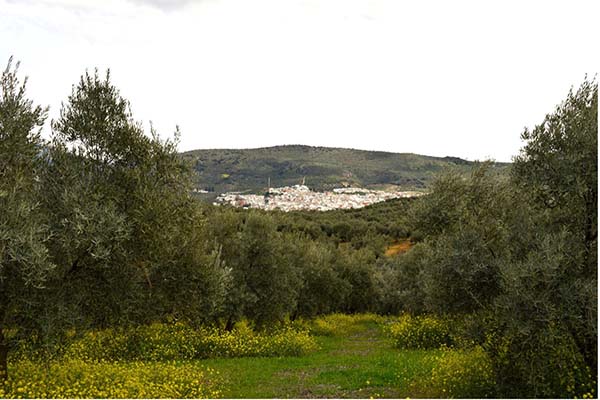
Castillo de Locubín is a traditional pueblo blanco (white village) in the Sierra Sur mountains of Jaén, Andalucía, Spain. In 2022 its population is around 4,500 and some 90% work in agriculture, these days not the subsistence culture of centuries past but mainly olive oil production for sale and export.
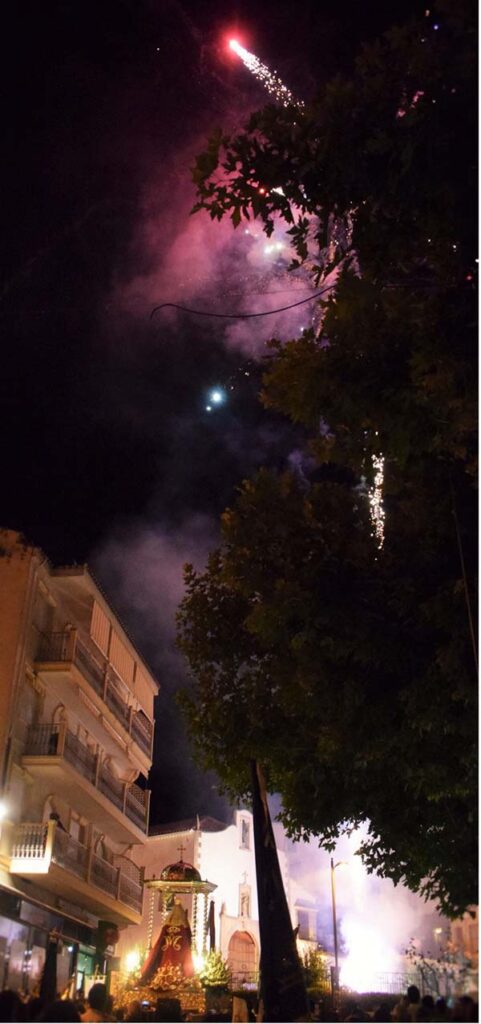
he village, usually referred to as Castillo or just El Pueblo, has a strong Catholic identity. As we’ll remark, this is nevertheless not straightforward, neither historically nor in the contemporary sense. We’ll focus on the 2022 Semana Santa (Holy Week) celebrations and develop the discussion from there.
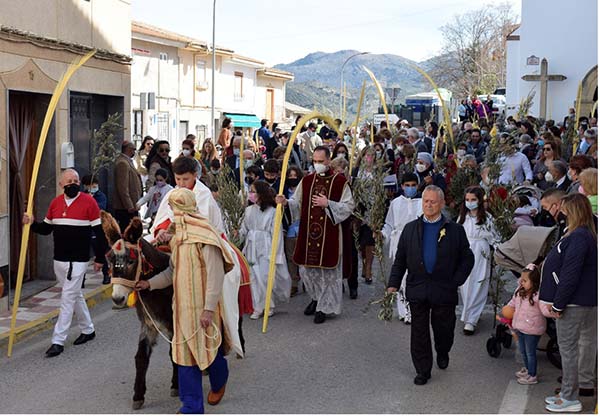
Semana Santa begins with Domingo de Ramos, an evocation of Palm Sunday that can’t strictly be called a procession since no sacred image is involved. Instead, villagers follow a child mounted on a donkey through the streets. As well as the story of the entry into Jerusalem, the event calls up Castillo’s agricultural past and present: until late into the last century most villagers (Castilleros) farmed with animals who lived in the upstairs parts of their houses, and, as you’ll see next, the palms are sometimes substituted by olive branches.
For other nearby towns, Domingo de Ramos begins a series of daily or nightly rituals that continue through the week, but not in Castillo’s case. Because most of its sacred images were destroyed at the outbreak of the Spanish Civil War in 1936, their associated processions vanishing with them, Castillo’s Semana Santa doesn’t pick up again until midnight on Viernes Santo (Good Friday; that’s to say, 00.00 on Good Friday itself).
Castillo’s midnight Vía Crucis procession defies easy description. You could see it as blending austere mysticism, Biblical narrative, and street theatre (but more about that suggestion later). By torchlight, an image of Cristo del Perdón, Christ crucified, is processed through the streets to the sounds of a solitary drumbeat and chains rattling, with pauses to read each station of the cross.
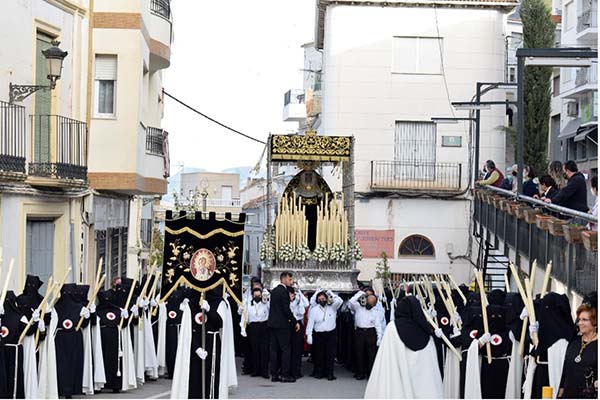
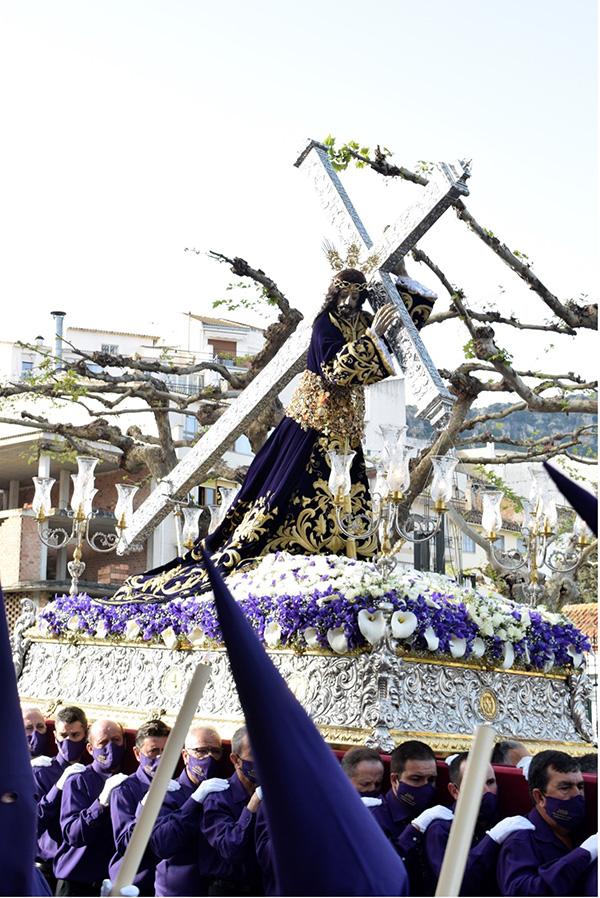
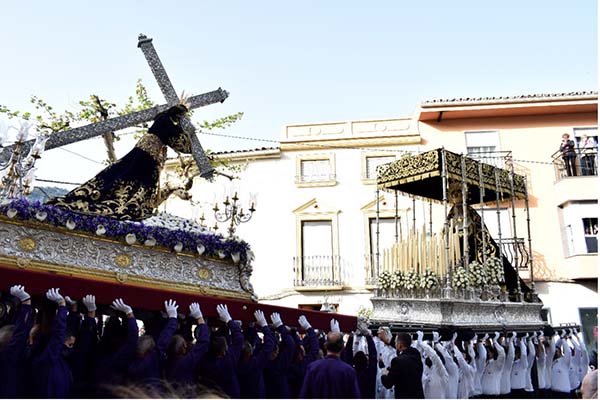
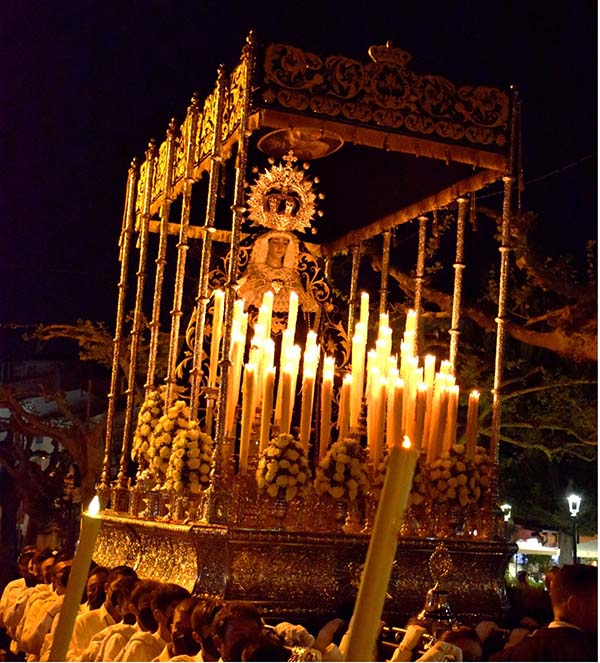
Later in the morning of Viernes Santo come two processions that combine to create an encuentro(meeting) between Jesus and Mary. The image of Jesus is Nuestro Padre Jesús Nazareno (usually shortened to Padre Jesús), that of Mary, La Virgen de los Dolores (the Virgin of Sorrows). These two images attract particularly strong devotion in Castillo, especially Padre Jesús: you could even compare loyalty to Castillo with loyalty to Padre Jesús. Again, more on that in due course, but a mention of the main Padre Jesús myth might help now. Around 1700, the image, an acknowledged masterpiece, was in transit through Castillo on its way to its intended home, the sculptor’s birthplace. The donkey providing the transport died, and this was taken as a sign from God that Padre Jesús should stay in Castillo for good; the Ermita (shrine, small church) in which he has since been housed was built on the spot. Padre Jesús is a depiction of Christ on Calvary at deepest resignation and despair; the encuentrore-creates his meeting with his mother.
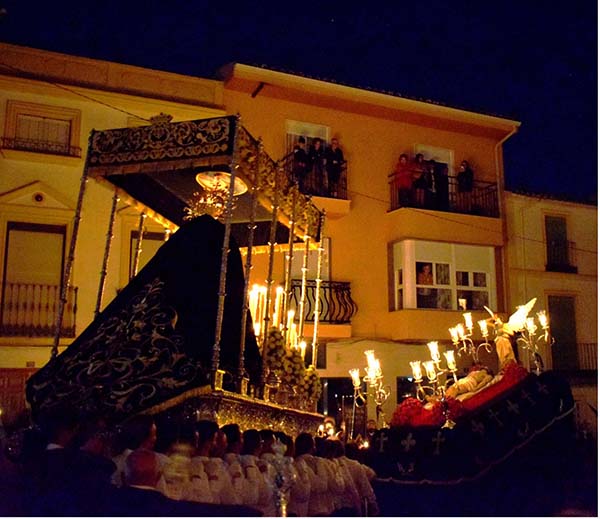
On the night of Viernes Santo, a second pair of processions creates a second encuentro, this time between Santo Entierro (Christ taken down from the cross) and the Virgin of Sorrows.
That this encuentro is the climax of Castillo’s Semana Santa can seem strange, but only to outsiders. Theologically, the resurrection would be expected to take centre stage. But Castillo’s Cristo Resucitado (Christ resurrected), is a recent image that has not built up a devotion comparable to those of Padre Jesús or the Virgin of Sorrows, and the Domingo de Resurrección (Easter Sunday) procession has been muted in the memories of most. This year attempts were made to create a fuller Domingo de Resurrección celebration, by creating an encuentro between Cristo Resucitado and La Virgen de la Cabeza. The image of La Virgen de la Cabeza commemorates an appearance of the Virgin Mary to a shepherd on the side of a head-shaped hill in nearby Andújar in the thirteenth century, so also attracts strong devotion in the locality. However, you might note in the next picture the smaller dimensions and simpler working of the images, as well as the reduced atmospheric intensity and, indeed, turnout.
In fact, theology stays in the background. There’s little discussion of the meaning of the rituals, questions about it surprise people, but that’s not to say there’s little meaning. It appears mediated more through the beauty of the images and the ritual choreography, music also playing an important role in ways that my photos can’t show. Visit https://www.youtube.com/watch?v=c9oASrnUEHs to hear how traditional band and flamenco styles create different accents at different stages of Castillo’s Semana Santa.
Social media is an increasingly used resource, in various ways. Emigration from Castillo means a diaspora whose members engage with Semana Santa via Facebook, where one group is solely dedicated to its imagery. A post on another Facebook page, El Pueblo es Tranquillo, concerning the 2022 Vía Crucis procession generated an intense discussion by comment and reply. Did Castillo’s various images of Jesus refer to the same reality? For believers, yes: but on another view, as a symbol of popular local religiosity, Padre Jesús is a singular figure whom all can understand and respect. Similarly, Semana Santa is a mixture of elements with something for everyone, even if just as spectacle or affirmation of the community (atheists and agnostics can be found in Castillo, though not non-Christian faith; and aspects of the history of the Catholic Church in the village are painful).
Digging deeper and more speculatively, there’s evidence that considerable numbers of Castillerosare descended from the once-Muslim population. Aspects of its culture linger, some visibly, such as the Arab irrigation system, and the remains of the fort that tower above the plain it continues to water: if you’ve visited Granada, 37 miles south of Castillo, this may sound familiar. It’s known that Sufism was influential in medieval Andalucía. Look back at the photo of the Padre Jesús procession and the purple capirotes (pointed hats) worn by some participants. They’re known as symbols of penitence, and related to the Spanish Inquisition, as those arrested were made to wear them. This is probably enough explanation for present purposes, but a visit to the tomb of Rumi in Konya, Turkey made me wonder – his own tombstone hat sits on it, and they are worn by dervishes of his order as reminders of mortality. In Spain, they don’t appear on Easter Sunday.
In summary, religion in Castillo de Locubín should usefully be seen in a worldview perspective. It helps to:
Look at the historical context.
Consider local traditions. The version of ‘Catholicism’ might not be recognisable elsewhere.
Hesitate to expect that only those identifying as Catholic join with thetraditions, or that the traditions only contain Catholic elements.
Think about emerging forms of tradition, especially digital.
Look for the lived elements. An over-emphasis on theology, or doctrine, may not be appropriate.
Think about how these lived elements add up: the aesthetic, ritual, social and ethical dimensions all connect.
In other places or cases, it might not be these elements that figure most powerfully. And, of course, you may not be considering a majority Catholic situation. However, related to the points above, here are some general questions to consider, that apply whenever you approach localised religion in a worldview perspective, whether in planning teaching or in teaching.
How has local history, tradition or custom influenced what can be seen now?
Are these religious expressions distinctive to the locality, even if related to a wider tradition? In what ways?
How do people from outside the tradition but from within the locality relate to these expressions? And is there evidence of inclusion of elements from outside the main tradition?
How have social media or other digital resources developed the local religious expressions, or how people can participate in them?
What are the main lived elements of the local religious expressions? How, for example, do artistic, ritual, community, ethical or other elements figure, and how do they relate to one another?
A discussion between colleagues in a planning or INSET session might not cover all these questions, but even one or two of them would generate a good analysis. Similarly with classroom teaching: any of the questions provides a good enquiry basis.
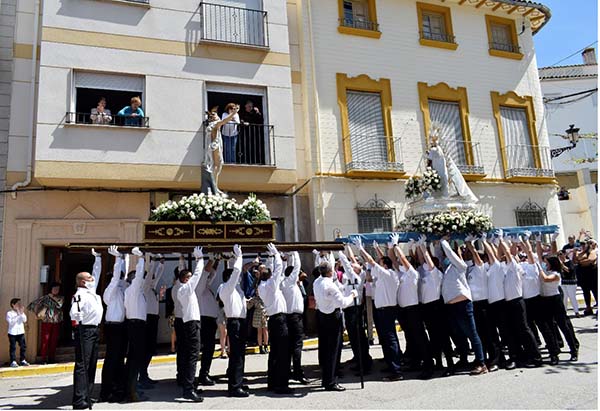
You may be travelling this summer. I hope you have opportunities to experience and take photos of local celebrations, talk to people about their history and significance, and listen to stories about them. If you’re in Spain on the 15th of August, look out for celebrations of El Dia de la Virgen (the feast of the assumption of the Virgin Mary into Heaven); we’ll close with a picture of Castillo’s 2017 Dia de la Virgen procession.
A note on methodology
I’ve been visiting Castillo de Locubín regularly since 2012 and lived there from 2015 to 2018. Though I’ve never thought of this in terms of a formal research project, several of my interactions with Castillo and its people have taken on research-like aspects. These include photography collection, participant observation during processions and other events, interviews with participants, reading, and discussions with researchers including local historians and a US-based anthropologist who completed a doctoral study on Castillo in the 1970s.
Religious education for spiritual bricoleurs? the perceptions of students in ten Christian-ethos secondary schools in England and Wales
Research Summary: Religious education for spiritual bricoleurs? the perceptions of students in ten Christian-ethos secondary schools in England and Wales
This research draws on data from a project involving 350 students, to explore why students in ten Christian ethos secondary schools in England and Wales recognised Religious Education (RE) as a significant contributor to their spiritual development. The concept of a narthical learning space (NLS) is used to examine young people’s experiences. It is argued that the concept of RE as a narthical learning space alongside the notion of young people as spiritual bricoleurs illuminates how the students in this study interpret the contribution of RE to their spiritual development. A narthical learning space (based on the narthex, the entrance to a church building) is a space between spaces where young people can explore issues of faith and spiritual development in safety. Bricolage is a process by which individuals create meaning, by making creative and resourceful use of whatever materials are to hand regardless of their original purpose.
Researchers
Ann Casson & Trevor Cooling
Research Institution
Canterbury Christ Church University
What is this about?
This is about how students in ten Christian ethos secondary schools in England and Wales view RE, in relation to its contribution to their spiritual development. Focus group data are analysed to show how, for the students, engaging with different religions cannot be separated from spiritual development, and some recommendations for professional practice in RE are drawn out.
What was done?
This research article draws on the qualitative data generated in the ten Christian-ethos schools, in particular, as part of a wider project, from semi-structured focus group interviews with 350 students. The researcher spent two weeks in each of the schools over a period of two years. Students were interviewed in groups of 6 to 8 on the school premises. The original groups were selected by a key contact in the school, from years 7 & 8 (11–13 years old); year 9 (13–14 years old); and years 10 & 11 (14 − 16 years old) and where relevant years 12& 13 (16–18 years old). In addition, students from specific groups were interviewed; for example, the school worship committee, the school council, and student chaplains.
Main findings and outputs
Students stressed that RE was different from all other subjects in school. It was a lesson where they were encouraged to be spiritual.
They drew attention to RE as being a time and space to discuss the existential questions, in-depth topics and critical issues.
Many students commented on how encountering the opinions of other people, and different worldviews influenced their spiritual development, learning about other religion ‘engaged’ their minds and helped them ‘understand other people’s kind of ways of thinking ‘(Year 9 Student).
Students were exploring who they were and the roots of their beliefs within faith traditions.
They had a fragmentary approach to the religious traditions; this was apparent in their perception that learning about and from others, provided an opportunity for them to reflect on elements relevant for their spiritual development.
Relevance to RE
The researchers sum up the relevance to RE in a succinct way: “There needs to be a recognition of the professionalism, the academic rigour of RE, alongside an acknowledgement that when engaging with religious traditions, and existential questions; there must be an openness to the implications and opportunities for spiritual development in the classroom.” The message for RE policy makers, curriculum developers and teachers is that RE needs to combine religious studies with opportunities for students to reflect on and discuss the meanings of what they study for personal and social life: this is what students will naturally do, and teachers need to recognise and build on it.
Generalisability and potential limitations
The data represent a reasonable sample size, and the clear arguments reflect the data faithfully.
Find out more
Ann Casson & Trevor Cooling (2019): Religious education for spiritual bricoleurs? the perceptions of students in ten Christian-ethos secondary schools in England and Wales, Journal of Beliefs & Values.
Learning to Listen: Inquiry into Religious Literacy in Print and Broadcast Media
Research Summary: Learning to Listen: Inquiry into Religious Literacy in Print and Broadcast Media
Interestingly, though focused on the media, the Inquiry’s report is not only for the media, but for everyone. From the Introduction: ‘Today, the UK is characterised by an incredible variety of beliefs, histories and perspectives. Complete agreement and uniformity is neither possible nor desirable. To live together well, it is beholden upon all of us to learn to listen to our fellow citizens and to do so with respect and curiosity before we move to judgement. Learning not just what people think, but why they think it, is essential in bridging gaps and crossing social and cultural divides. This is the broadest suggestion we would like to make – that our society can be richer, more harmonious and more confident in itself if we all learn to listen and empathise with that which we do not believe or support. A media that is diverse, curious and sensitive to the enormous variety of beliefs in the UK today can play a key role in fostering that society and we hope that our recommendations are useful tools to achieve that end.’ (p.4)
Researchers
The All-Party Parliamentary Group on Religion in the Media
Research Institution
The APPG on Religion in the Media report might best be described as a cross-institution output:
‘All-Party Parliamentary Groups (APPGs) are informal cross-party groups that have no official status within Parliament. They are run by and for Members of the Commons and Lords, though many choose to involve individuals and organisations from outside Parliament in their administration and activities.’ https://www.parliament.uk/about/mps-and-lords/members/apg/
What is this about?
The inquiry set out ‘to explore how to encourage a media environment which is conducive to a rounded, informed public understanding of religion and the role religious literacy can play in achieving this end.’ (p.4)
What was done?
As well as ‘desk research’ (consulting existing publications), the inquiry had three methods:
Analysis of 55 written submissions, from different organisations and individuals (in academia, journalism, think tanks, faith groups, etc.).
Analysis of responses to ‘bespoke’ questions sent to media organisations including broadcasters and regulators.
Seven ‘oral evidence’ discussion sessions, engaging with 58 panellists in total: again, academics, faith group representatives, education and media specialists.
Main findings and outputs
The meaning of religious literacy is contested, but having considered the evidence, the APPG arrived at its own definition: ‘It incorporates knowledge, competency in engaging with religious ideas and people and the respect which derives from viewing religion to be a valid source of beliefs and values.’ (p.9) There is concern that religion is often reduced to its visual or liturgical facets, and that coverage can sensationalise, stereotype, contain basic errors, or fail to represent diversity. However, by avoiding these mistakes, the media can significantly increase public understanding of religion and broadcasters can inform while they entertain. Seven ‘central recommendations’ are brought out:
Journalists and programme-makers should aim to explore the ‘lived experience’ of religion as well as its doctrinal, ritual, and ceremonial elements.
Newspapers and broadcasters should audit and publish full accounts of their religion and belief workforce statistics to provide a better sense of who is working in the industry so that disparities can be addressed.
Religious literacy training should be formally incorporated into professional media qualifications and journalists’ continuing professional development.
Newspapers should take greater care with the pictures and headlines they choose, recognising that this is all most viewers will see.
Independent regulation should be looked at again by policymakers because there remain significant issues around access to regulatory redress. In particular, groups should be able to make complaints on the grounds of discrimination.
The current religious programming hours required of the BBC should be protected in future reviews.
The remit of public service broadcasters should be redrafted to include the purpose of promoting religious literacy and all public service broadcasters should explore how they can use the full width of their output to increase religious literacy.
Relevance to RE
There are, perhaps, two main types of relevance to RE:
Teachers could use some of the seven recommendations as test criteria, for selecting media-based teaching resources and / or helping pupils to analyse and evaluate these. How far does this text / clip / image reflect lived experience of religion? Is this headline fair, balanced and appropriate? Would any groups or individuals have cause for complaint about it?
Curriculum developers and teachers could translate some of the recommendations into their own practice. How can we reflect the ‘lived experience’ of religion, as well as its doctrinal, ritual, and ceremonial elements, in curriculum plans and lessons? How can we ensure that curriculum plans, and lessons, cover religions and non-religious worldviews in fair, balanced and appropriate ways? Would any groups or individuals have cause for complaint about our curriculum plans or lessons?
In general, there are good points in the report to raise with pupils about the importance of accurate media reporting, and about how important RE / R&W is if you want to work in journalism or the media.
Generalisability and potential limitations
The report is the result of a very wide-ranging, thorough, multi-levelled inquiry and the findings are presented in some considerable detail. The findings are up-to-date (the report was published in April 2021).
Key Findings From the Global Religious Futures Project
Research Summary: Key Findings From the Global Religious Futures Project
The Pew-Templeton Global Religious Futures project, on contemporary global trends in religion, investigates religious change and its impact on societies around the world. Since 2006, it has included:
Surveys in more than 95 countries asking nearly 200,000 people about their religious identities, beliefs and practices.
Demographic studies using censuses and other data sources to estimate the size of religious groups, project how fast they are growing or shrinking, and analyse mechanisms of religious change.
Annual tracking of restrictions on religion in 198 countries and territories.
This is a report of its December 2022 bulletin.
Researchers
Pew Research Center, Washington DC
Research Institution
Pew Research Center, Washington DC
What is this about?
This is about large-scale trends across the world in religious identities, beliefs and practices; the size of religious groups, their rates of growth or shrinkage, and the drivers of changes in the global religious picture; and also figures concerned with restrictions on religion in different countries and territories.
What was done?
Global Religious Futures generates and uses a very large quantitative data set in order to establish its findings: surveys, analysis of censuses and tracking of policy across different countries. The December 2022 bulletin presents a set of headline findings and also incorporates links to related outputs where themes are covered in more detail.
Main findings and outputs
People are becoming less religious in the US and many other countries (in 2021, 29% of US citizens were religiously unaffiliated, compared to 16% in 2007). At the same time, Western Europeans are generally less religious than Americans.
Population growth is faster in highly religious countries. In Africa and the Middle East, for example, the average woman has more children than in Europe, North America or East Asia – and much larger shares of the population, both young and old, in these parts of the world say religion is very important to them (e.g. 98% in Ethiopia compared to 10% in the UK).
The vast majority of the world’s population is projected to have a religion, including about six-in-ten who will be either Christian (31%) or Muslim (30%) in 2050. 13% are projected to have no religion. Sub-Saharan Africa is the region with the fastest population growth. Its high birth rates are a major contributor to the increasing size of the world’s Christian and Muslim populations.
Is religion gaining or losing influence? It depends: in most countries surveyed, more people said the role of religion had decreased than said it had increased. But there were plenty of exceptions, including such countries as Indonesia, Kenya, Brazil and Israel, where the balance of public opinion was that religion’s role had increased.
Overall, government restrictions on religion have been rising globally. As of 2020, 57 countries now have “very high” levels of government restrictions on religion, up from 40 in 2007.
These are some examples of significant key findings, and readers are encouraged to access and use the full bulletin, freely accessible from the link below.
Relevance to RE
The bulletin provides excellent background material for policy and curriculum. Its report of increased global restriction on religion whilst the religious population of the world continues to grow, for example, underlines the importance of freedom of religion and belief, an education in religion and worldviews and the alignment of such education with democratic social values in the UK. The individual data offer valuable resources for classroom teaching, when a social science approach to religion and worldviews is being used.
Generalisability and potential limitations
The generalisability of the data is high; reliable, broad and produced by expert researchers. The key focus is on the US, but the international comparisons mean that this is not done in an isolated way. There is also a series of links embedded in the bulletin through which headline findings can be explored in more detail.
Research Summary: From Sunday Stalwarts to Solidly Secular
“Most U.S. adults identify with a particular religious denomination or group. They describe themselves as Catholic, Baptist, Methodist, Jewish, Mormon or Muslim– to name just a few of the hundreds of identities or affiliations that people give in surveys. Others describe themselves as atheist, agnostic or say they have no particular religious affiliation. These are the conventional categories into which Americans sort themselves. But a new Pew Research Center analysis looks at beliefs and behaviors that cut across many denominations – important traits that unite people of different faiths, or that divide people who have the same religious affiliation – producing a new and revealing classification, or typology, of religion in America.” (Summary taken from original press release at http://www.pewforum.org/2018/08/29/the-religious-typology/ downloaded on September 12 2018.)
Researcher
Pew Research Center, Washington DC
Research Institution
Pew Research Center, Washington DC
What is this about?
This is about the different religious groups in the US, and how they vary internally, in terms of religious commitment, behaviour or attitudes to religion. Survey data were used to generate seven categories of religiosity that cut across religious boundaries. E.g. ‘Sunday Stalwarts’ are the traditionalist, highly engaged members, ‘Diversely Devout’ are those who whilst traditionalist are also open to ‘New Age’ beliefs such as reincarnation or psychic power and ‘Religion Resisters’ are those who think that institutional religion does more harm than good. The other categories are ‘God-and-Country Believers’, ‘Relaxed Religious’, ‘Spiritually Awake’ and ‘Solidly Secular’.
What was done?
A survey of 4729 respondents was done. It included 16 questions about their religious and spiritual beliefs and practices, the value they place on their religion, and the other sources of meaning and fulfillment in their lives. The typology groups were then created using cluster analysis, a statistical technique that identified homogeneous groups of respondents based on their answers.
Main findings and outputs
The findings are quite extensive and readers are directed to the main report (link below), but some examples can be given so as to provide a flavour. What is interesting is how the categories cut across traditional religious and non-religious lines:
Some data may be unsurprising (76% of the ‘Solidly Secular’ have no religious affiliation).
However, it raises questions that 17% of the ‘Solidly Secular’ category identify as Christian.
Within Religion Resisters, non-Christian religious faiths contribute their highest overall percentage (11%).
They only make up 6% of the ‘Sunday Stalwart’ category, which could be down to population or survey factors; the word ‘Sunday’ is used because 90% of the group belong to Christian churches and it did not figure in survey questions.
There are interesting sub-findings, e.g. 19% of ‘Sunday Stalwarts’ and 12% of ‘Solidly Secular’ believe in reincarnation; 98% of ‘Religion Resisters’ believe there is spiritual energy located in physical things such as mountains, trees or crystals.
Relevance to RE
The final Commission on RE report speaks of the need for a deeper understanding of the complex, diverse and plural nature of worldviews at both institutional and personal levels, and to ensure that pupils understand that there are different ways of adhering to a worldview. This Pew Center research gives an original, imaginative illustration of these factors. RE curriculum developers and teachers could use it to consider how to represent diversity within religions; teacher trainers could use it to illustrate the need for this to trainees.
Generalisability and potential limitations
The survey was large-scale (4729 respondents) and care was taken to achieve a representative sample. One limitation is that the US rather than the UK is represented. The researchers also acknowledge that identifying cluster groups is as much art as science. However, UK teachers and researchers could take note of the problematising of religious categories and perhaps find ways to explore similar issues in our own contexts.
British Religion in Numbers is an online religious data resource. Numbers aren’t just for statisticians. People want to visualise and understand data for work, for study, for general interest, or to settle a debate: how large? how many? how typical?
That’s from the introduction to the British Religion in Numbers (BRIN) database, managed by the British Academy for the Humanities and Social Sciences: http://www.brin.ac.uk/ The database is itself an ongoing research project. And it’s for use by researchers, who are weighing up questions like these –
How secular, or religiously diverse, is Britain?
Do people see religious and political identities as conflicting?
How does religion affect lifestyle, health, and what opportunities are open to people?
It should be clear that the resource is useful to teachers as well as researchers (or illustrates how a teacher often needs to be a researcher). As it says, people need to use data for study purposes or to settle debates. Pupils are no exception, and teachers should ensure that the data we present to our pupils when teaching is up-to-date and accurate. BRIN provides a searchable database including government sources, opinion polls and faith community sources. There are figures, maps and charts, and guides to understanding the various data.
Teaching ideas
Representations of Muslims and Islam in the British media
“In a 320-page report for the Centre for Media Monitoring at the Muslim Council of Britain, Faisal Hanif explores British Media’s Coverage of Muslims and Islam (2018–2020). The methodology for the underlying research comprised daily monitoring, between October 2018 and September 2019, of 34 British media websites and 38 television channels using keyword searches, leading to the identification of 47,818 articles and 5,512 broadcast clips referring to Muslims and/or Islam, followed by analysis of each article or clip against five metrics to determine whether it was affirmative or not affirmative in nature. Almost three-fifths (59%) of the articles were found to incorporate negative references to Muslims or Islam, while 21% were judged antagonistic and 14% biased. In his conclusion, Hanif asserts that ‘a large section of the media still favours voices that echo colonial era tropes which see Muslims as dangerous fanatics, terrorists and misogynists whilst giving preference to voices which regurgitate these tropes.’ He claims not to seek any special treatment for Muslims; rather he wants journalists to depict them consistently as for other social groups. The report is available at: https://cfmm.org.uk/wp-content/uploads/2021/11/CfMM-Annual-Report-2018-2020- digital.pdf ”
Your first task is to decide where to place this content in your curriculum and why. (Translating it into teaching material could be a very engaging and productive meeting agenda!) If including it in a unit about Islam, it might be best towards the close, for reasons that are given later.
Secondly, it is important to give attention to the language use. Try to re-create the excerpt so that it meets the pupils’ needs. Remember that they don’t only need to grasp it straightaway. They need to be stretched and challenged by it, developing new or improved knowledge, understanding, skills and dispositions. So, our suggestion is to leave some of the language as it is: e.g., ‘negative’, ‘antagonistic’, ‘biased’ are terms worth exploring with pupils.
Thirdly, consider how to introduce the re-worked material. You could create a power-point slide and give a brief lecture, or a handout for pupils to go through in pairs or groups; whichever way, allow time for questions and discussion afterwards, until you are sure that all are clear about the content.
That gives you the first broad part of a lesson (but adapt these suggestions as you see fit; you might begin with a quick ‘brainstorm’ about why the coverage of any group by the media matters, to establish the purposes of the lesson on secure grounds, before moving to the excerpt).
The pupils could next move into a task focused on these figures: ‘Almost three-fifths (59%) of the articles were found to incorporate negative references to Muslims or Islam, while 21% were judged antagonistic and 14% biased.’ Can they prepare to explain the differences between ‘negative’, ‘antagonistic’ and ‘biased’, perhaps with examples?
After some pupils have offered explanations for discussion, and when all are clear about the language and meaning, move into a plenary task. This could also form the basis of a homework write-up or reflective essay. It might be in two parts: first, comment on the researcher’s call for no special treatment for Muslims; rather, journalists to depict them consistently as for other groups. Second, from what you learned about Islam and Muslims in this unit, what would you say to those negatively biased against them: what positive media stories should be told? You need to go into detail about people’s practice of Islam, in their communities. Pupils could also be directed to the work of the Religion and Media Centre.
Depicting the ethnicity of Jesus Christ: What is acceptable?
The link is to the December 2021 edition of Counting Religion in Britain. Its first entry is about an opinion poll on what is acceptable when Jesus’s ethnicity is depicted. The poll was an online survey by YouGov of a national cross-section of 1,714 Britons carried out on 14– 15 December 2021. These were the headline figures:
58% of the public think Jesus is usually depicted in images as a white person and 22% as Middle Eastern.
When asked which racial group he could be depicted as being from, 68% believed Middle Eastern was acceptable, 63% white, 44% black, 40% as South Asian, and 37% as East Asian.
The questions were also put to a sample of 1,023 black, Asian, and minority ethnic adults on 8–16 December 2021. In this case:
60% felt it acceptable to depict Jesus as Middle Eastern. In a sub-sample of respondents who were Christian, the result was the same.
More details, including full data tables, can be viewed here.
The linked article – Matthew Smith’s What race can Jesus be? – contains the following paragraphs:
“The image of Christ as a man with white skin and blue eyes would appear to be at odds with what is likely, given the biblical account of his family hailing from the Middle East.
Nevertheless, Britons are far more likely to say they usually see Jesus being depicted as White (58%) than Middle Eastern (22%).
This is despite the fact that a Middle Eastern Jesus is the one that makes most sense to Britons. Two thirds (68%) say it would be acceptable to depict Christ as having Middle Eastern racial characteristics, compared to only 9% who disagree.”
The article also gives age-related data. “There is a noticeable age difference on these two characterisations: while opinion is near identical across all ages for a Middle Eastern Jesus, younger Britons are less accepting of a White saviour (51% of 18-24 year olds, 61% of 25-49 year olds) than their elders (66-67% of those aged 50 and above).”
Some ideas for basing teaching on the research now follow.
As with the representations of Muslims and Islam in the British media research, decide where to include the material in your curriculum. It could be in a topic on Christianity, Jesus, religion and the arts, or religion and social or community cohesion.
Within a lesson, it also has various possible uses (introduction, main task(s), plenary, or summary). In the outline given below, the idea is that pupils will be initially engaged by images rather than statistics.
You could begin by presenting a series of images of Jesus, varying by ethnic or other appearance, and asking pupils to respond to each. Where is it from? What is the artist trying to convey? What else strikes you? Which is most likely to ne historically accurate and why? In looking for images, you might start at Jen Jenkins’s superb RE:engaging collection of (mainly) Christian iconography from different traditions it/6AcFrY2 We are very grateful to Jen for this resource.
Then introduce the YouGov poll, talking briefly through some headline data before giving pupils a more detailed datasheet to discuss in pairs or groups. Why do you think British people are much more likely to see Jesus depicted as White than Middle Eastern? Why is there a big difference between the Jesus most British people would expect to see and the depiction of Jesus that makes most sense to them? Why do you think younger people are less accepting of the idea of a White Jesus?
Finally, take and discuss feedback of ideas from pairs or groups. This could precede a concluding discussion on why all this matters. Is it only a question of historical accuracy, or is more at stake? For Justine Ball, a dominant White depiction of Jesus “does not allow an opportunity for all children regardless of their background to see themselves in the teaching resources used and is something which suggests that a colonised curriculum is present in RE”. See Justine Ball, An approach to decolonising teaching about Jesus in Primary Schools
Justine’s piece describes her own research in this area and makes practice recommendations, including that we should not only consider what we present, but what we leave out; that Jesus’s Jewish context should be referenced; and that “the artwork that teachers use should not only reflect the worldwide global nature of Christianity, but also reflect the multicultural nature of Christianity in the UK.”