Essentialised, sanitised and Eurocentric: an analysis of (mis)representations of Christian attitudes to homosexuality and African Christianities in English RE textbooks
Research Spotlight
Jonny Trigdell, Department of Education, University of Oxford
Jonny explores how textbooks can participate in the ‘matrix of domination’ as in the current absence of RE in the National Curriculum in England they are often used for planning, teaching and revision in the secondary school RE classroom. This also matters as RE is taught by an increasing number of teachers with other specialisms. He also notes that textbooks often suggest that Christianity is not always as positive about homosexuality as textbooks might suggest. We need to ensure that what we present to students in our pluralistic, diverse classrooms represents the wide range of different lived experiences that there are for example students may be from the African diaspora and/or the LGBTQ+ community.
Jonny’s work found that there is a real trend of essentialisation and there is no recognition of the messiness of religion. Whilst this is understandable it means there is not a very accurate or rich portrayal of lived religion. He also notes that ‘bad religion’ ceases to be ‘real religion so if you do not fit the sorts of things that liberal people in the UK would not agree with, for example the subjugation of queer people, than you cease to be seen as a Christian. Sanitisation means we refer to things as either liberal or traditional in Christianity and never anti LGBTQ+ whereas in teaching about Islam we would say this. Finally, textbooks are Eurocentric, we look at Christianities developed in Europe or America, particularly Protestant or Catholic. Jonny would like to see other churches such as the Ugandan churches, not as passive groups but as theology makers.
Ask questions about this in the right places; exam boards, DFE, resource makers
Engage with LGBTQ+ people and with people from non-Eurocentric Christianities
Think reflexively about textbook content and the sources being used in your teaching
Promote epistemic justice – tolerance comes from being able to understand other’s viewpoints, not from excluding them. More about this in this research spotlight and policy briefing)
Challenge sanitisation, essentialisation and Eurocentrism in RE whenever you can
Tell the whole story (or at least make it clear that the story you tell is incomplete!)
Essentialised, sanitised and Eurocentric
Ways of Knowing: Diving Into Disciplines
Ways of Knowing: Diving Into Disciplines
This research spotlight brings together a carefully selected range of scholarship to support teachers engaging with disciplines and “ways of knowing” in Religion and Worldviews education.
As you read this research spotlight you might like to consider;
How does a disciplinary approach to RE change the types of questions pupils are encouraged to ask, and how might this influence the depth of their understanding?
Which disciplinary lenses (for example, theological, philosophical or human and social sciences) are currently strongest in your curriculum, and where might there be opportunities to deepen or rebalance them?
What practical strategies from this reading could you adapt to help pupils engage more critically with texts, concepts or lived experience in RE?
This research spotlight highlights both broader curriculum thinking and subject-specific research, helping teachers to situate disciplinary RE within wider conversations about knowledge. Foundational work such as Christine Counsell’s writing on taking curriculum seriously and the Education Endowment Foundation’s work on disciplinary literacy provides a useful starting point, emphasising that subjects are shaped by distinctive ways of asking questions, constructing knowledge, and communicating understanding. Together, these pieces help frame why a disciplinary approach matters, particularly for building pupils’ ability to think carefully and critically within RE.
Alongside this, a growing body of research focuses specifically on how disciplinary thinking operates within Religion and Worldviews education. Reports such as Panjwani, Bowie and Clemmey’s work on hermeneutics foreground the importance of interpretation in engaging with religious texts, while the multi-disciplinary worldview report by Benoit, Hutchings and Shillitoe explores how different lenses contribute to richer understanding. Fraser-Pearce and Stones’ Knowing Well in Religious Education further develops this by examining what it means for pupils to gain depth and coherence in their knowledge. These studies are complemented by classroom-focused research, including Ryan Parker’s work on engaging primary pupils with parables, and Sophie Smith’s Farmington report on strengthening disciplinary literacy across transition points. Together, they illustrate how disciplinary approaches can move beyond theory into meaningful classroom practice.
Finally, a range of articles and books offer practical interpretations of these ideas for teachers at different phases of their careers. Katie Gooch’s work on “scholarly” RE in the primary classroom and Helen Sheehan’s exploration of intensive practice in ITE both show how disciplinary knowledge can be developed through carefully structured teaching. Earlier contributions, such as Stephen Pett’s discussion of insider and outsider perspectives, continue to shape thinking about standpoint and interpretation in RE. These ideas are extended through key texts including Reforming RE (Chater, ed.) and the Ways of Knowing toolkits for primary and secondary phases from RE Today, which provide accessible strategies and classroom resources. Taken together, this reading list supports teachers to deepen their subject knowledge, refine their curriculum thinking, and develop pupils’ understanding of how knowledge is constructed within Religion and Worldviews.
Painting a New Picture: Cultivating Learning for Its Own Sake in Religious Studies for 16-18’s
Research Spotlight: Painting a New Picture: Cultivating Learning for Its Own Sake in Religious Studies for 16-18’s
Sophia Duckworth: Teacher and recipient of a Culham St Gabriel’s Masters Scholarship
How can we help A level students move beyond feeling overwhelmed by dense Religious Studies content and instead develop a genuine curiosity for the subject? In this spotlight, we explore the work of Sophia Duckworth, a CSTG Masters Scholar, studying part time at Cambridge University on the MEd in Education (Transforming Practice) whilst teaching.
Sophia’s action research investigated how arts-based pedagogy can open up deeper engagement, understanding, and enjoyment among 16-18 year old learners. Her project offers a compelling model for teachers seeking to cultivate a “learning for its own sake” ethos within the RS classroom.
Where might creative or visual approaches help your students grasp difficult RS concepts?
How could you adapt Sophia’s methods to suit the needs and context of your cohort?
What opportunities exist in your curriculum to cultivate intrinsic motivation rather than purely exam‑driven engagement?
The Research Context: Teachers of Religious Studies with 16-18 year olds know the challenges well:
Abstract and complex concepts
Heavy content demands
Student perceptions that RS is academically “hard” or “too much”
These factors can limit both students’ confidence and uptake, a problem noted in wider pedagogical literature (e.g., Thorpe 2019; Examiners’ Report 2022). Sophia’s research responds directly to this by trialling three arts-based lessons on Christianity, allowing students to work with theological ideas in ways that felt creative, personal, and manageable.
Sophia used a Participant Action Research (PAR) model to design and teach a sequence of lessons that enabled students to:
Represent theological ideas visually
Discuss and interpret Christian concepts through creative prompts
Reflect deeply on meaning-making
Move between text, image, and dialogue to build understanding
Students’ artwork, classroom dialogue, and written reflections formed the basis of her analysis.
Her findings showed:
Creativity Makes Abstraction Accessible: Students found that visual and creative activities helped them internalise and articulate theological concepts that might otherwise feel remote or intimidating.
Engagement and Confidence Increased: Arts-based tasks allowed students to take intellectual risks. As a result, participation improved, not just in the creative tasks themselves, but also in subsequent analytical discussion.
Intrinsic Motivation Grew: Perhaps most significantly, Sophia observed students developing greater intellectual curiosity. Freed from the immediate pressure of exam structures, pupils appeared more willing to explore ideas, ask questions, and enjoy the learning process.
How You Might Use This in Your Classroom? You may wish to experiment with:
Symbolic artwork to explore theological concepts
Mixed‑media responses to sacred texts
Creative stations where students rotate through tasks (e.g., drawing, annotation, collaborative modelling)
Displaying student work as a way to validate diverse forms of expression
Sophia Duckworth’s work offers an inspiring reminder that high‑level theological thinking does not have to rely solely on text-based analysis. When students are invited to think, create, and interpret through the arts, they may encounter RS content in ways that feel richer, more accessible, and more personally meaningful.
100 years on: How the Scopes Trial impacted me as a teacher
Research Spotlight: 100 years on: How the Scopes Trial impacted me as a teacher
What is research?
We can often fall into the trap of thinking that research is only the things we see formalised; for example in doctoral studies, master’s qualifications or work done in higher education. Research is much wider than this and for most teachers it is something they are regularly engaging in to improve their teaching and the learning of the pupils.
When I received this excellent vlog from Ruth Marx I was fascinated by research she had done 20 years ago which still influences her work today.
Scopes Monkey Trial…100 years ago
Ruth unpacks what the Scopes trial was and how it was important for the development and history of fundamentalism. The trial happened 100 years ago in Tennessee where there had been a law brought into say that teachers could not teach about evolution in the classroom due to the fear of these ideas of evolution challenging the account in the book of Genesis. The trial was really about much more than this and was part of what some called a ‘battle’ between religion and science. Ruth shares how we can use this to have more nuanced debates about this topic and even act out the different characters in the trial.
Listen to this vlog from Ruth Marx to find out more.
Ruth has also been interviewed about her work on the RE Podcast and has written a cross curricular unit for 11-14 year olds with most of the lessons taught in RE/RVE/RME but two lessons taught with the science curriculum. Evolution and/or Creation: the Scopes Monkey Trial 100 Years On can be found on the Big Ideas for Religious Education website. She has shared a great set of resources on the big ideas website for you teach about this in the classroom.
If the intersection between religion and science is something you are interested in then also look at the work of Faraday, God and the Big Bang and resources from RE Today .
Researching religion and worldviews: Designing a sequential curriculum
Research Spotlight: Researching religion and worldviews: Designing a sequential curriculum
June 2024
Jan McGuire
Year Template: Learning Journey: Ann Taves Barnet Project: Complete Big Questions Journey
Ann Taves: Questions to consider
What are the Six Big Questions posed by Ann Taves?
Why could this model assist you in building a religion and worldviews approach to religious education?
How do you think this model could be applied in your school?
Jan McGuire chats to Ruth Marx about the Ann Taves Barnett project ‘Researching religion and worldviews: Designing a sequential curriculum’
Researching Religion and Worldviews: Designing a sequential curriculum
A Barnet Local Authority/ SACRE project funded by Culham St Gabriel’s.
The Barnet Ann Taves Project Team are using the academic work of Professor Ann Taves to build a sequential curriculum from age four through to age nineteen that is both appropriate for the classroom and accessible for teachers.
Aims and Impact; What is the big change you want to see?
Teachers and the wider project team are using an action research style approach to take the ‘high level’ research of Anne Taves on religion and worldviews and ‘translate it’ into an accessible format for the classroom. Working collaboratively across phase, as well as with the unrivalled academic support and steer from Professor Ann Taves (distinguished Professor (Emerita) UC Santa Barbara) and David Robertson (Open University) the team are creating a framework, templates and religion and worldviews exemplars using the Anne Taves approach. These exemplars can be used to inspire teachers to replicate the approach and create their own lessons. This will be an opportunity to see if this approach can work: high level academic research making an impact on learning in the classroom.
Ann Tave’s ‘evolutionary’ approach supports the need for Barnet’s schools to be inclusive. The six BQs can help to promote inclusivity in religious education by acknowledging and respecting the diversity of religious beliefs and practices found within and outside of the classroom. By providing a framework that is applicable to all religious traditions, students from different religious and cultural backgrounds can feel included and valued in the classroom.
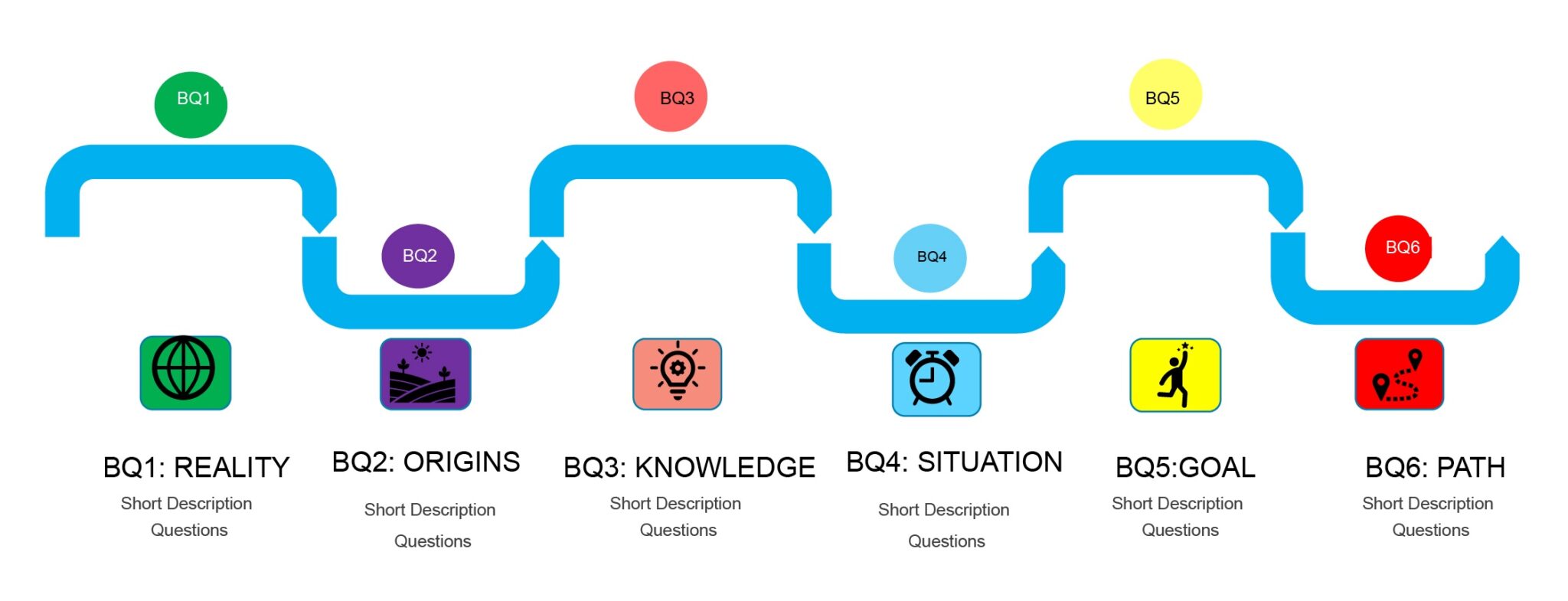
What are Ann Taves Six BQ’s (Big Questions – Evolutionary Approach)
Exploring religious and non-religious worldviews through the six Big Questions (BQ’s) of Ann Taves offers an opportunity to explore fundamental questions that have fascinated human beings for millennia. Through using the six BQ’s as our Barnet curriculum ‘golden threads’ of learning from age 4 to age 19, we are intentionally building in opportunities for the child and teacher to revisit, retrieve knowledge and reinforce learning and understanding of the six carefully constructed ‘Big Questions’ to allow for the deep exploration of key concepts.
The six Big Questions are:
REALITY (ontology) – What exists? What is real?
ORIGINS (cosmology) – Who are we? Where do we come from? How did we get here?
KNOWLEDGE (epistemology) – How do we know these things? (about ourselves and reality more generally)
SITUATION – What is the situation in which we find ourselves?
GOAL (axiology): What is the good (the goal) for which we should strive?
PATH (praxeology) – What actions should we take? What path should we follow?
By exploring these six Big Questions we hope that students will gain a deeper understanding of the diversity of religious and non-religious worldviews, as well as the common human questions and concerns that underlie them. This syllabus encourages critical thinking, reflection and open-mindedness, and promotes respect for all people and their beliefs. It is our hope that this syllabus will inspire and challenge students to engage with these Big Questions and to develop their own understanding of the world and their place in it.
Teacher Engagement in and with Research at the Edge Hill RE Summer School
Research Spotlight: Teacher Engagement in and with Research at the Edge Hill RE Summer School
April 2024
Karen Steele and Dawn Cox
This month’s research is the Edge Hill University RE Summer School for Primary and Secondary teachers. This is a fantastic opportunity for teachers to improve their subject knowledge and work on an area of development all with the support of Edge Hill’s expert team of tutors. Listen to Karen and Dawn share their experience of the Summer School and what you can expect if you attend.
Beyond the Classroom: Informal Religion and Worldviews Education in the UK
Research Spotlight: Beyond the Classroom: Informal Religion and Worldviews Education in the UK
In a time of growing division, where religion is often seen as a problem, religious education cannot, and indeed does not, only take place within the classroom or within formal education. If we are to build compassionate, cohesive societies, we need to understand religious education as something active, lifelong, evolving and to be taken seriously.
The ‘Beyond the Classroom’ report from Theos* supported by Culham St Gabriel’s, explores where informal religious education happens across the UK; where are the places and spaces where people of all ages, in all kinds of communities, learn about and encounter other religions, belief systems and worldviews?
Through various sectors, including youth work, arts and culture, public services, media and sport, as well as extra-curricular spaces, campuses, anchor institutions and local interfaith networks, we map the opportunities and challenges of informal learning about religions and worldviews.
What have we found?
Informal religious education is strongest in areas of greater religious diversity, where there is greater opportunity for organic, unstructured encounters with those of other beliefs, reinforced by stronger interfaith networks. This raises the question of how to develop better religion and belief literacy in the whole population, not only those living in more diverse communities.
We find that informal religious education varies significantly from locality to locality, and context to context; nationally, the picture is somewhat patchy although there are myriad examples of good practice at a local level, which we highlight through case studies here. In some sectors, we identify a ‘squeamishness’ or tentativeness in talking about religion and belief, which we argue needs to be combatted in order to grow the religious literacy of everyone, regardless of background.
What can we do?
If every sector of society is provided with the tools and confidence for good conversations about religion and belief, then informal religious education can and will happen naturally anywhere. Greater formal literacy will lead to greater informal opportunities for religious education, which will in turn mean a more religiously literate population and a more cohesive community. The fact that this is not currently occurring universally or strategically across the UK is, we argue, a missed opportunity for a better society.
* Theos stimulates the debate about the place of religion in society, challenging and changing ideas through research, commentary and events. They are a Christian think tank based in the UK.
Theos Beyond the Classroom Report: Informal Religion and Worldviews Education in the UK
Understanding the Interplay: Education, Lived Worldviews and Citizenship
Research Spotlight: Understanding the Interplay: Education, Lived Worldviews and Citizenship
This is a project that responds to growing polarisation in society and sometimes in our classrooms. Classrooms are a crucial space for a reflexive engagement with difference but also that there is not enough time to discuss these often sensitive and sometimes controversial topics.
How might a theoretical framework of worldview literacy as ‘reflexive engagement in plurality’ (Shaw 2022) and Lego Serious Play® work as a research methodology and a pedagogical resource?
How might these approaches support young people to explore their worldviews and those of others?
What is the potential of the concept of ‘worldview’ to enhance understanding of lived citizenship (identity, belonging and participation)?
This research from Martha Shaw and Alexis Stones responds to growing divisions in society and sees schools and classrooms as crucial spaces for the practice of reflexive citizenship, dialogue and democratic engagement. Through speaking to young people and teachers about the intersecting curriculum areas of Religious Education and Citizenship, they found that both subjects have potential to enable the practice of reflexive citizenship in plurality through recognising that young people
1) need to express their feelings and challenge norms of citizenship
2) are able to negotiate intersectional identity, belonging and action in society.
Understanding the Interplay: Education, Lived Worldviews and Citizenship draws together researchers, teachers and teacher educators in Religious Education and Citizenship, to enhance education through a co-created pedagogical framework and related resources that resonate with the complexities of young people’s experiences as citizens and the role that religion/worldviews play.
Watch and listen to Alexis and Martha as in just 3 minutes they explore their two research questions
How do young people understand being a citizen and what, if any, is the relationship to worldview?
How useful is ‘worldview’ and a ‘worldviews approach’ to understand more complex personal and civic identities, and to promote more inclusive notions of citizenship?
Faith in Encounter Project: Connecting Schools & Communities Through Faith & Belief Storytelling
Research Spotlight: Faith in Encounter Project: Connecting Schools & Communities Through Faith & Belief Storytelling
Amy Ark, Sarah March, Alejandra Sánchez – Faith and Belief Forum
This project is running in four English regions and involves primary schools taking part in a three-workshop programme, based around an ‘I, you, we’ methodology. The first workshop centres around pupils’ personal worldviews, the second involves an encounter with two speakers who talk about their lived experience of different faiths. The third workshop applies these broad themes to living in the world. The project develops pupils’ skills of dialogue, understanding, empathy and critical thinking.
The project is based on Allport’s (1954) Contact Theory. This suggests that that meaningful, positive interaction between members of different groups can reduce prejudice, especially when the contact happens with young people, but only when certain conditions are met, such as equal status, shared goals, cooperation, and a supportive environment. When these conditions are in place, contact helps individuals replace stereotypes with real understanding, leading to more harmonious intergroup relations.
The work is dialogic, involving pupils listening to the lived experience stories and interpreting the worldviews of people of differing faiths. It therefore models respectful dialogue. Speakers are encouraged to present their individual story, and not feel pressured to be the official representative of an institutional worldview.
The project provides a good model for engaging pupils in meaningful reflection about their own and differing beliefs, which schools that are not part of the project might wish to consider:
What faith and belief stories are pupils hearing as part of your curriculum? How could you add more?
In which ways can parents be invited and supported to reflect on their faith, belief, and identity journeys and share these in classrooms?
How can you support pupils to develop dialogue skills across the curriculum?
For more detail about the workshops, take a look at the Faith & Belief Forum website. It is also worth looking at their resources page, the final project resources will go on this page in the new academic year but there are also a number of resources that may be able to help in the meantime with classroom based dialogue.. If you want to know more about how Contact Theory can promote community relations in RE, then this toolkit, from an earlier project, might be helpful.
Worldviews, religious literacy and interfaith readiness: Bridging the gap between school and university
Research Spotlight: Worldviews, religious literacy and interfaith readiness: Bridging the gap between school and university
Researchers from Coventry University, Durham University and the Woolf Institute have been researching how the experience of school- based RE prepares young people for the religious diversity of University life. The research explores the relationships between UK university students’ religious literacy, their experiences of religious education (RE) at school, and what the researchers call their ‘interfaith learning and development’, a multidimensional concept representing students’ ability to engage with, and relate across, religion and worldview difference.
This research represents the first step in exploring how different types of RE might prepare students for the challenges of university and beyond, in which they are often faced with a variety of identities different from their own.
A briefing paper Worldviews, religious literacy and interfaith readiness: Bridging the gap between school and university on the research was published in October 2024.
As you read the briefing paper you may find the following questions helpful to consider:
Which of the 4 policy recommendations are relevant in your setting? Who do you need to share them with?
Research suggests a religion and worldviews approach to RE engenders greater religious literacy in some cases, but this potential is not fully realised. How might teachers develop their approach to RE so that it can be?
How are you developing pupils’ ability to recognise diversity within religious and non-religious worldviews?
Do pupils have the opportunity and skill to take part in inter-worldview dialogue? Are teachers trained and supported in these dialogue facilitation skills?
In February 2024, prior to the publication of the policy briefing Professor Matthew Guest and Dr Lucy Peacock shared the following information on their research:
As you read the briefing paper you may find the following questions helpful to consider:
Which of the 4 policy recommendations are relevant in your setting? Who do you need to share them with?
Research suggests a religion and worldviews approach to RE engenders greater religious literacy in some cases, but this potential is not fully realised. How might teachers develop their approach to RE so that it can be?
How are you developing pupils’ ability to recognise diversity within religious and non-religious worldviews?
Do pupils have the opportunity and skill to take part in inter-worldview dialogue? Are teachers trained and supported in these dialogue facilitation skills?
In February 2024, prior to the publication of the policy briefing Professor Matthew Guest and Dr Lucy Peacock shared the following information on their research:
Questions for consideration:
How might a worldviews-style RE prepare young people for the challenges of university life?
What kinds of knowledge and skills are found among those who engage with RE via a worldviews approach, and how do these relate to attitudes towards religious diversity?
Research suggests a worldviews approach to RE engenders greater religious literacy in some cases, but this potential is not fully realised. How might teachers develop their approach to RE so that it can be?
As Sociologists of Religion whose research has focused on university students’ experiences of religion and worldview diversity, we asked ourselves this: How does the experience of school-based RE prepare young people for the religious diversity of university life?
The Research
We had the opportunity to explore this question as part of our 2020-2023 project, Building Positive Relationships among University Students across Religion and Worldview Diversity. In Autumn 2022 we surveyed 4618 UK university students (3986 of whom attended secondary school in the UK) about their experiences of religious diversity at university. We included questions about their religious literacy and established the extent to which students had engaged in worldviews-style religious education prior to enrolling at university. This enabled us to identify the relationship between students’ learning about worldviews in the classroom and their interfaith learning and development at university.
Two Key Findings
Students’ experiences of worldview-style engagement in the RE classroom favour learning over self-expression. We asked students if they had engaged with worldviews in the RE classroom. More agreed with statements that had to do with learning outcomes (e.g. ‘I learnt that worldviews can be religious or non-religious’), than with statements concerning the place of their own worldview within the RE classroom (e.g. ‘I talked about my personal religious or non-religious worldview’). Less than two thirds of respondents felt their worldviews were respected in the RE classroom; further research will need to explore what is going on here in greater detail.
Different aspects of worldviews-style engagement relate to distinct measures of ‘interfaith readiness’ students demonstrate upon entering university. Looking at 912 first-year students who enrolled at university in October 2022, we found that:
a. Students who talked about personal religious or non-religious worldviews in the RE classroom enter university with a greater reflexive ability to negotiate their own worldview commitments in light of those who are different from themselves;
b. Students who studied alongside RE classmates who held a range of religious and non-religious worldviews, and those who learnt to recognise diversity within religious and non-religious traditions in RE lessons, enter university with a greater desire to proactively engage across religion and worldview differences in society;
c. Students who learnt that religious and non-religious worldviews are shaped not just by tradition but by the choices people make, enter university with higher levels of appreciation towards atheists, Buddhists, Jews, Muslims and Sikhs than those who did not.