Global terms: Resource Spotlight

Resource Spotlight: Subject Knowledge for Teachers – Apocalyptic and Millenarian Thinking

February 2023

This month we consider an aspect of religion and worldviews that does not receive much attention, although it is an important dimension of our subject. This is apocalyptic and millenarian thinking. You have probably heard the word ‘apocalypse’, referring to the end of the world. Less familiar is the term ‘millenarian’ thinking, which describes the expectation of a thousand years of Jesus’ reign on earth, or a Golden Age of justice, before the world comes to an end. A lot of what we explore in the classroom, whether the idea of an afterlife, the kingdom of God or divine judgment, contains elements of apocalyptic or millenarian thinking.

Read a blog by Dr Alastair Lockhart, academic director of the Centre for Critical Study of Apocalyptic and Millenarian Movements, who sets out in more detail why this is an important aspect of our subject knowledge: What is Millenarian Thinking and Why is it Important for RE Teachers?

We present three articles from a Dictionary of Apocalyptic and Millenarian Movements (CDAMM), two are on apocalyptic and millenarian worldviews to clarify the language and underlying ideas. The third is an intriguing example of modern apocalyptic thinking around technology and artificial intelligence. You can browse the dictionary yourself for your wider interest.

Don’t be put off if you teach younger children and do not plan to introduce this mode of thinking to them. Read this as an adult and educator. This offers you a way to make sense of apocalyptic thinking for yourself and improve your understanding of the subject matter of Religion and Worldviews. When we explore stories or religious beliefs with pupils referring to heaven, judgement or the possibility of an afterlife, this is all millenarian thinking. You can be aware of this, even if you do not teach this. In fact, with your enhanced subject knowledge you will be able to answer pupils’ questions around these sorts of topics with confidence. Apocalyptic and millenarian thinking offers a way to frame a key aspect of our subject knowledge.

What is ‘millenarianism’?
What is the ‘apocalypse’?
Technology and Artificial Intelligence

Resource Spotlight: Watch and Learn: BBC and the Educational Recording Agency

December 2024

Where do you go to find programmes suitable for showing lived religion and belief to your pupils?

As you sample the programmes below you might like to consider

  • Who might these programmes be useful to support teacher subject knowledge?
  • Where might snippets of these programmes exemplify the concepts and understanding we are teaching?

BBC

There is some interesting programming coming up on BBC radio and TV next year, but what did you miss in 2024? Look on iPlayer- lifestyle and page down to Faith and Hope to find Sacred wonders, Big Zuu goes to Mecca and much more. For those of you teaching younger pupils also look at Treasure Champs which has stories you may share in lessons.

If you would like to read a little more from Daisy Scalchi, Head of Religion and Ethics at the BBC, read this professional reflection piece, Religion, the most important subject on the curriculum?

The Educational Recording Agency (ERA)

The Educational Recording Agency (ERA) offers you free access to a wide range of high-quality, ad-free video content to support your lessons on religion, faith, and ethics. Their curated resources align with the RE curriculum and are available for instant streaming in your classroom, including:

These programmes provide engaging, real-life examples of how religion shapes individual lives and societies, making them excellent tools to bring classroom discussions to life. Search Religious Education and the age group you teach to see all the programmes available. Alternatively click on the links below for some curated resources.

Primary religious education

Secondary religious education

Resource Spotlight: Being ambitious; a religion and worldviews curriculum for all

September 2021

This month we introduce our theme of ‘curriculum’ by presenting a recorded talk by CEO Kathryn Wright.

Kathryn gave this talk in June 2021 at a Yorkshire NATRE ‘Curriculum Conversations’ conference. The talk is entitled ‘Being ambitious; a religion and worldviews curriculum for all’. Kathryn considers the paradigm shift to ‘worldviews’ and what it will mean for the curriculum. She explores disciplinary and substantive knowledge in the curriculum and presents many examples where this is already happening.

Watch the video or download the text and PowerPoint slides. Use it in a staff or department meeting or for your own CPD.

Resource Spotlight: Big Ideas for RE

The Big Ideas for Religious Education project was inspired by the work of US curriculum experts Wiggins and McTighe.

Barbara Wintersgill considered the arguments they made about the curriculum also applied to RE. In 2016 she convened a group to explore this, chosen for the breadth of their academic and professional expertise within RE. The group benefited from the chairing of Michael Reiss, a member of the ‘Big Ideas for Science’ group. The publication was received positively and attracted interest around the world.

The development group identified six ‘Big Ideas’ which focus on what is most important for pupils to grasp in RE. They seek to provide criteria for curriculum content selection, have in-built progression and knowledge transferable to life outside the classroom.

We were concerned that RE curricula no longer reflected society. RE continued to focus on ‘six world religions’ while over 50% of the adult population and a considerably higher proportion of young people no longer held any affiliation to organised religion. Moreover, research had established that these ‘Nones’ were particularly disenchanted with the very aspects of religion that occupied so much space in the RE curriculum, such as organised religion and liturgical worship.

So it was obvious that worldviews other than ‘religious’ ones should feature in the curriculum. Religions have a direct or indirect impact on the lives of most people in Britain, whether they are religious or not. Big Ideas is a curriculum which reflects the world young people experience, and seeks to provide the means for them to make sense of it.

The Big Ideas that emerged were:

  • Continuity, Change and Diversity (within and across traditions, through time and places)
  • Words and Beyond (expression/interpretation through texts and creative arts)
  • A Good Life (being a good person, living a good life, ethics)
  • Making Sense of Life’s Experiences (life experience, religious experience, ritual)
  • Influence and Power (social, cultural, political influences and interactions)
  • The Big Picture (overall account of life/universe/everything).

The Big Ideas project very much fits with a Religion and Worldviews approach. It was developed alongside the REC’s Commission on Religious Education (2016-18), which suggested renaming the subject ‘Religion and Worldviews’. Some of the Big Ideas team were involved the Commission, and in the REC’s subsequent ‘Religion and Worldviews’ Project. There has been synergy and mutual influence between the two projects.

Big Ideas now has a website https://bigideasforre.org aimed at both curriculum developers and individual teachers. The website offers guidance for developing Big Ideas curricula for pupils aged 3-18 and growing number of exemplar units of work, written by a team of teachers and other specialists ­(27 to date).

As well as developing new teaching material the Big Ideas project is currently trialling and evaluating units of work with a team of 13 teachers in a variety of classroom contexts. Four West Yorkshire Local Authorities (Leeds, Bradford, Kirklees and Calderdale) have drawn extensively upon the Big Ideas project in developing their latest Agreed Syllabus. In an exciting development, the team behind this, Pennine Learning, is also adapting this curriculum for the primary section of the Oak Academy RE curriculum.

We hope teachers will feel confident to check out the Big Ideas. We recommend starting here: https://bigideasforre.org/the-essential-guide-to-big-ideas- for-re/

Teachers might find it takes time to move from a curriculum driven by content to a curriculum focusing on the Big Ideas. At KS3, for example, where a teacher might have taught ‘rites of passage’, the Big Ideas approach suggests that students explore how ‘experience of religious rituals… helps people make a connection with God or gods and with each other, or with what is most important to them.’ This would be Big Idea 4, allowing pupils to consider how such experiences allow connection, meaning and wisdom. Here you can see a richer, deeper encounter with the complexity of our subject. It is well worth the effort.

Further reading

The full narratives for each age group are found here: https://bigideasforre.org/what-are-big-ideas-for-re/

Wiggins, G. McTighe, J. (2005) Understanding by Design (2nd ed). Alexandria VA. ASCD.

The original 2017 publication, along with later publications, can be found here: https://bigideasforre.org/Big-Ideas-Publications/
Resource Spotlight: British Religion in Numbers in the Classroom

April 2023

One benefit of a Religion and Worldviews approach is the capacity to bring contextualising, contemporary information and data into the curriculum. But how to do this?

This month we present three teachers’ work in bringing current data about religion and belief into their lessons. Our teachers are Claire Ramalli, a Secondary teacher, and Nadia Nadeem and Debbie Yeomans, who are Primary teachers. Claire, Nadia and Debbie used ‘British Religion in Numbers’, a comprehensive, searchable database to present a range of statistics on faith in Britain.

Check out the website here, there is lots of fascinating information: www.brin.ac.uk
Debbie Yeomans presents their work in a research report and video, explaining how the teachers brought to life two chosen sets of data for the classroom. These data sets concern ethnic or cultural representations of Jesus, and they ways Muslims and Islam are portrayed in the British media.

As well as Debbie’s presentation, you will find the teaching information and further research, and a recording of Debbie, Claire and Nadia presenting at RExChange Research of the month: BRIN in the classroom

You can also read Nadia’s blog about the project British Religion in Numbers

Resource Spotlight: Career Journey Map

May 2023

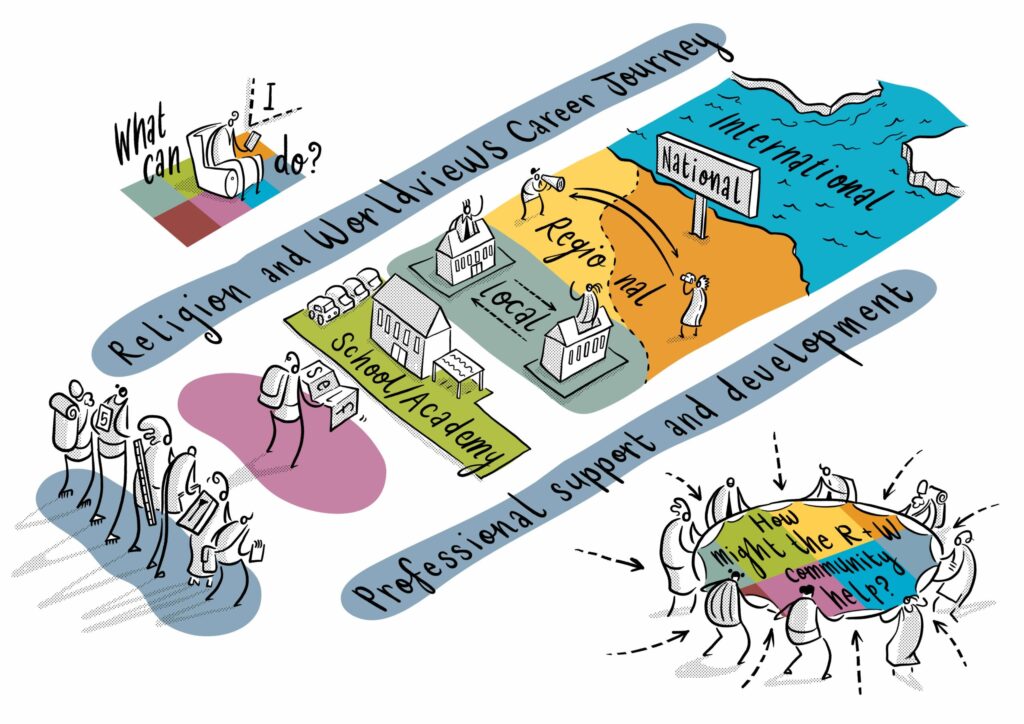
This month we present this ‘career journey map’, for whatever stage of your career, whether just starting out or developing your identity as a leader. This will help you to think about what your aims are, where you are heading and how the Religion and Worldviews community can support you. Beautifully illustrated by Jason Ramasami, the map wouldn’t look out of place on an office wall!

Think about the next steps and sources of support for you, your context and your overall vision. Whether you are in your early career, middle leadership, senior leadership or national leadership, you will find ideas and new challenges. As this resource suggests, be inspired!

Resource Spotlight: Christian Ethics of Farmed Animals Welfare (CEFAW)

December 2023

Why are Christian theologians meeting with farmers and veterinary scientists? What are they talking about? This December we bring you a ground-breaking project connecting the treatment of farmed animals with Christian ethics: the Christian Ethics of Farmed Animals Welfare (CEFAW). Humans farm huge numbers of animals around the world to eat, how can we understand what they need to flourish, and adapt farming practices to improve farmed animals’ lives? You might not think this is a religious matter, but the theologians at the CEFAW project certainly do!

For teachers exploring issues around animal welfare and the environment or looking for interesting ethical case studies, this project offers a new perspective on this significant global phenomenon.

For assemblies, lessons or your own understanding, check out the video resources created by the CEFAW team at Aberdeen University. Teacher resources have now been added on the same link.

Nadia Nadeem is a Primary teacher from East London, read her reflections on being part of this project in her blog Christian Ethics and Farmed Animals: a Teachers’ Fellowship.


Resource Spotlight: Developing a multidisciplinary curriculum through the use of knowledge organisers

September 2022

We bring you an innovative project developed by Katy McKay and colleagues at Dereham Primary School, developing a multidisciplinary curriculum through the use of knowledge organisers. Katy reports on the many positives she and colleagues found when introducing thinking and questions drawn from Theology, Philosophy and the human and social sciences. As Katy notes, her inspiration comes form the Norfolk Agreed Syllabus, a multidisciplinary curriculum for Religion and Worldviews in the Primary phase. Read all about Katy’s work here.
Katy’s blog
Knowledge organiser project
Norfolk Agreed Syllabus (download)

Resource Spotlight: Discovering Muslims in Britain

October 2023

We present a resource for teaching about Muslims created by a team at the University of Cardiff: Discovering Muslims. It is designed for Key stage 3 but Primary teachers and GCSE teachers will find a wealth of information and ideas, so don’t overlook this resource! The resource consists of a series of fully-resourced scheme of work taking a sociological perspective. Great for those of you interested in developing a multidisciplinary approach in your curricula.

The resource is an attempt to move beyond misrepresentations and stereotypes of Islam and Muslims often found in teaching materials, combined with a desire to explore the lived experiences of individual Muslims and communities in the UK. You will note the title of the resource; ‘discovering Muslims’ as opposed to ‘discovering Islam’. This reflects the rooted, contextual nature of the learning- you will find out about Muslims communities in Britain and their stories, rather than take a more abstracted view. You will find historical information, hear Muslim voices and be able to offer your pupils a richer, more authentic understanding of Muslims and Islam in the UK.

The team behind this resource are Professor Sophie Gilliat-Ray, Mark Bryant and Dr Matt Vince.

Wider information about the resource can be found on the Cardiff University website

To access the FREE scheme of work you need to complete a short survey, then you will receive the materials.

Read Matt Vince’s blog where he explains in more details the thinking behind the project.