Global terms: Teaching & Classroom Practice

Dr Kate Christopher | 21 September, 2021

This September I am more aware than usual both of new beginnings and time passing. Although I have been in my school for almost two years, it has been mostly in lockdown. My experience of the school has not been in normal times, to say the least. When colleagues talk about a room, a person, a form to fill in, a process, an event, I am lost, it is like I started yesterday. I have existed in a bubble and now the bubble is burst.

Being back in the classroom, no longer confined to my metre box at the front, feels full of possibilities- students can work in groups and we can be more active in our learning, I can wander up to the back row or talk to a student quietly at their desk, rather than from the front of the room. Students can let off steam outside at break and lunch, no longer confined to their classrooms and bubbles. Being outside with all of year 7 and 8 as they tear around the playground feels surprisingly joyful, not how I would have described break duty before the pandemic.

I am also aware of changes closer to home. My daughter has started in Year 7. I have welcomed thousands of Year 7s in my almost 20 years in the classroom. Now I am finding out what goes on at home- making sense of the new systems, what books and kit are needed for each day, the pressures of homework. It is tiring and can be fraught if we are second-guessing a teacher’s instructions. But it is also exciting- a more independent young person is emerging, ready to take on these new challenges.

I have had the pleasure of working with Kathryn and the Culham St Gabriel’s team for some years. I am excited and privileged to take over stewardship of RE:ONLINE, building on the excellent work of my friend David Rees, who is much missed. RE:ONLINE brings together practical, classroom-focused guidance and resources, current research and information to keep you up to date. We will continue to offer high quality, practical and supportive material, whether for use in your classrooms or to adapt for another period of home learning. As always we welcome blogs from teachers or those working in and around religion and worldviews education. Email ideas you would like to share, however half-formed. We will develop them together.

We are developing an exciting online CPD platform for teachers- watch this space! The ‘In Conversation’ events which ran throughout two lockdowns will continue for the foreseeable future. These have been extremely beneficial in both communicating current research and thinking and allowing people to connect with others. It has been wonderful to see new faces at every session, perhaps people who would not usually join a face-to-face group for a variety of reasons. We look forward to welcoming new people to every event. These events and others like it have been an unexpected benefit of the pandemic.

As we look forward to a new term, some things feel really new- the mingling, mixing and moving feels at once rather scary and liberating. We are also looking back at almost two years of completely different working. We have learnt how to support each other in new ways, we have learnt to use Zoom (no mean feat), we have learnt how to carry on and how to change. Whatever is around the corner, we are looking forward to working with you. Have a great term!


About

Kate teaches part-time in a secondary school in inner London, is an RE Advisor and is Culham St Gabriel's Lead Consultant for Professional Development. Email: kate@cstg.org.uk

See all posts by Dr Kate Christopher

Dr Kathryn Wright | 25 May, 2021

The recent Ofsted Research Review has sparked much debate and discussion particularly on social media. The review sets out what it understands by a quality education in RE. In terms of the curriculum this is defined in terms of three types of knowledge:
  • Substantive
  • Ways of knowing
  • Personal
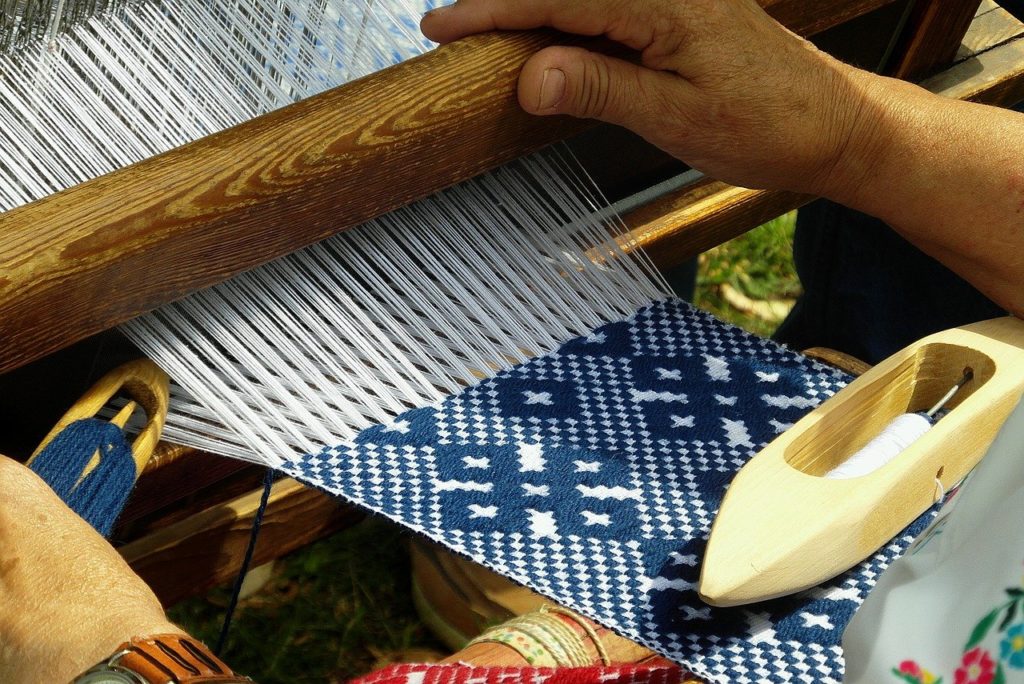
One of the questions which struck me as I read the review, was how we theorise the relationship between these three types of knowledge. This is illuded to in the report (see Interplay of knowledge in the RE curriculum), but I felt I needed to think about it creatively. I like to think in pictures. So, what I offer here is an analogy. It is not perfect, but I hope it will help us to understand a little more about the interdependence of different types of knowledge. Let us weave a knowledge tapestry…. Image of a hand waving loom with a blue and white fabric being created The curriculum– this is like a developing tapestry. In theory it may have an ‘end point’ (i.e., end of formal education) but in my opinion it continues through our lifetime as we develop the three different types of knowledge. Therefore, it might be described as an unfinished tapestry. This emphasises the flexible nature of curricula. Yet this fluidity still enables the tapestry or knowledge to build over time into a beautiful masterpiece…. Substantive Knowledge – this is the warp. These are the threads on the loom over and under which other threads are passed to make the tapestry. Without this there would be no tapestry! The warp is laid out at the beginning with a clear sense of what you are going to produce. There is some intent here. Choices must be made about how many threads, how wide the tapestry will be and so on. This is like the choices that must be made in relation to the substantive content. Ofsted talks about illustrative content that leads to an end goal. Ways of Knowing or Disciplinary Knowledge – these are threads of the weft. They are woven in and out of the substantive content. This is important. Unless they are woven into the content, they will not contribute to the overall tapestry. This means that as pupils’ journey through the substantive content they learn about and use a range of tools and methods such as interpretation, observation, analysing data and so on. Personal Knowledge– these are also threads of the weft. They are also woven in and out of the substantive content. Our own positionality, our own worldview is woven into what it is we learn about. This means being self-aware, recognising and reflecting on how we relate to the ‘warp’ or content. This is a process of reflexivity. So, now is the time to think about the tapestry you are creating, what choices will you make to build towards and create a masterpiece….   References: https://www.gov.uk/government/publications/research-review-series-religious-education

About

Dr Kathryn Wright is CEO of Culham St Gabriel's Trust

See all posts by Dr Kathryn Wright

Thomas Breakwell | 26 January, 2021

In my teaching of AQA GCSE RS Christian beliefs I have found one aspect perplexing, namely the paradoxical role of scripture. On the one hand, the new GCSE Religious Studies places a greater emphasis on every RE teacher’s favourite buzz words, ‘sources of wisdom and authority’ and yet pupils spend very little, if any time at all, actually engaging with scripture in any meaningful way. Instead, engagement with biblical scholarship seems to begin and end with cutting a few quotes from the synoptic gospels or John or the letters of Paul and simply pasting them in an exam answer without any engagement with the history, audience or purpose of the biblical texts.

The result is that I often find pupils asking me fantastic questions such as ‘who is Mark?’, ‘who was Luke writing for?, ‘what is a gospel?’, ‘what was life like at the time of Paul?’, ‘did Jesus actually exist?’. These are all excellent questions, and questions that pupils should be asking, and yet I felt that these questions were often ill-served by the current GCSE specification.

In response, this academic year, I did something different. I taught a lesson that was completely removed from the specification. The aim of this lesson was for pupils to gain a greater understanding of the historical Jesus and importantly how New Testament scholars use historical methods to ascertain if events contained in the gospel narratives can be considered to be historical. The lesson went something like this:

I started by briefly explaining to pupils the audiences and purposes of each of the synoptic gospels and John. The aim of this being that my pupils would begin to appreciate that the gospel texts they have been studying where written by authors to particular audiences and therefore these texts, like any other text, have a purpose and sit within a historical and social context.

Following this, I Introduced to pupils three main criterion which are often used by scholars in the study of the historical Jesus: the criterion of dissimilarity, criterion of embarrassment and the criterion of multiple attestation. The criterion of dissimilarity is simply a method that considers if the events in Jesus’ life (for example his baptism) are distinct from the teaching of 1st century Judaism or the early church. If they are, it reasons that it is more likely to be historical. The criterion of embarrassment considers if the event in Jesus’ life would have been considered embarrassing for the early church. If it would have been embarrassing for the early church it seems unlikely they would just make it up! Finally, and most importantly, the criterion of multiple attestation which focuses on if the event in Jesus’ life occurs in multiple different Christian and non-Christian sources. If an event in Jesus’ life such as the crucifixion is referenced in both Christian and non-Christian sources, such as the writings of Josephus, then it is more likely to be historical.

After my explanation, my pupils got to work. As a class, pupils read the baptism of Jesus (along with some information about baptism in first century Palestine). Then using the three criteria, I modelled step by step how each criterion could be applied to the baptism of Jesus. The benefit of modelling the first example as a whole class allowed me to reiterate what I expected my class to do and address any questions or misconceptions they had.

After scaffolding and modelling the first example, it was now time for my pupils to practice on their own with pupils applying the same criteria to several of the miracles of Jesus such as the exorcism of the blind and mute man and the raising of Jairus’ daughter. I found that my higher attaining pupils went one step further and even considered the limitations of using the criterion of embarrassment, multiple attestation and dissimilarity to study the miracles of Jesus. To end, we discussed as a class their views on if the events ascribed to Jesus in the gospels are historical and if such a question matters for Christians today.

Overall, I think my off-specification adventure helped some of my pupils to begin to think a little bit more deeply about biblical texts and historical methodology. I hope this blog provides a little bit of inspiration to go a bit beyond the specification and get your GCSE classes to delve a little deeper into the rich world of the texts they are reading. Not only would engagement with historical methodology enhance our teaching of Christianity, but other worldviews might also benefit from an appropriate form of this approach.

About

Thomas is a Subject Lead for Religious Studies at Colmers School & Sixth Form College, Birmingham.

See all posts by Thomas Breakwell

Ria Searle | 05 January, 2021

Over the last year, I have had the opportunity to build my department from essentially scratch, shaping our Key Stage 3 (KS3) curriculum in line with my vision for RE. After exhausting the Locally Agreed Syllabus, I went about ascertaining ‘priority’ topics for our pupils. Prior to the re-sequencing a student could complete secondary education spending only one one hour studying Judaism. Exploring Judaism was then my priority. However, I was stuck as to how to do justice to this extremely rich and diverse religion and tradition. Luckily, a PGCE peer came to my aid and allowed me to borrow her Scheme of Work (SOW), from which I drew much inspiration, adapting it to suit our school and pupils.

To promote religious literacy, we begin examining the notion of identity, particularly diverse identities within the Jewish tradition. The ‘Do Now’ starter task invites pupils to note what makes them, them; exploring their own identities. It is really important to start the SOW exploring the multiplicity of identities within the Jewish tradition, because if pupils’ have any knowledge of Judaism prior to the unit, it is overwhelmingly based on overgeneralized, single-lensed stereotypes, often images of Haredi Jews. Many are simply unaware that there are varied identities within Judaism and believe they do not know anyone who is Jewish, which isn’t true; they just didn’t know any Haredi Jews as they believe all Jewish people to be like.

We look at Orthodox, Liberal, and Secular identities and expression in daily and yearly life. I try to stress that Liberal and Orthodox Jews are no less ‘devoted’ or believe any less, but simply express faith differently. This provides a sustained reference point throughout the SOW. While exploring Kosher, Shabbat and Passover we refer back these and how expressions are varied in divergent Jewish tradition communities. For example, with observance of Shabbat, we suggest Orthodox Communities may avoid all work: light switches, cars, and mobile phones. Whereas some Liberal or Reform Jews may observe in adapted, often more modern ways, such as using cars to drive to Synagogue, allowing some electrical appliances (ovens, kettles) or, as one student offered from her own life observing when with Grandparents and using her phone (Instagram!) throughout.

Most effective for religious literacy is drawing on those with personal experience. I was fortunate to have Jewish pupils who offered their worldviews and traditions. This enabled students to connect ideas to varied interpretations and individuals they knew, bringing their learning to life and allowing them to interact positively with various worldviews. In addition, we invited in our local Liberal Rabbi to speak to the whole cohort about her faith, worldview and traditions. This was an incredible experience! It shocked the pupils to learn that, as part of her Liberal Jewish identity, she did not ‘keep kosher’ – for she could not then eat and celebrate with non-Jewish neigbours, and that she had had a scientific career in the traditionally male-dominated field of Chemistry prior to becoming a Rabbi, another traditionally male-dominated vocation. They were full of questions about her experience as a female faith leader: the reaction of Orthodox Jews to her position as Rabbi, her favourite parts of Shabbat – community worship, foods, time to pause and reflect on life, the week, and faith – and her experiences of Anti-Semitism. In particular, her family’s connection to the Holocaust and the inspiring journey of her Grandmother across Europe during the War, including liberation at Mauthausen in 1945 and her return to Prague, where she had fled 6 years prior. These personal experiences held the key to unlocking my pupils’ religious literacy about the multiplicity of Jewish traditions and worldviews, how lived faith was so different to the strict, traditional and ‘textbook’ religion many had expected from a Rabbi and leader in their local Jewish community – shamefully, far greater than I could achieve teaching in the classroom.

I understand this is not possible for all schools in all areas, my hometown wouldn’t have such a luxury of a nearby Liberal Rabbi however there are many websites and services online that would willingly engage in a dialogue, whether it be a prerecorded Q&A session, or even a live virtual meet, as we have all become accustomed to since the start of the pandemic! However, with certainty I say it was by far the best way of promoting religious literacy around the multiplicity of lived Judaism and real-life Jewish worldviews. I would advise starting with the basics – bust the myths, dispel stereotypes and open eyes to the diverse identities within the Jewish tradition, this will allow for more effective personal dialogue further into their learning.

About

Ria is Curriculum coordinator of RE and PSHCE in the London Borough of Hillingdon.

See all posts by Ria Searle

Alan Harrison | 07 July, 2020

I believe that a badly done lesson can be as bad as no lesson at all. In the classroom I’m larger than life, pitching myself to be at least 10% more enthusiastic about the day and learning than the students lollygagging towards my classroom are.

But how do you do this through a screen?

My solution was to create short, fun and fact-packed videos, which allow creativity to flow and smiles to follow. My issue with videos about religion is that they tend to be very serious about their content, which is fine and appropriate for some situations, but when trying to retain the attention of 14- and 15-year olds in the midst of a global pandemic, watching a 25 minute video with someone explaining the intricate details of the nature of God won’t hold students’ attention for long.

I don’t claim to have entirely solved this problem, as GCSE Religious Studies is very fact-heavy, but I reckoned that if I made some videos which are funny (at least to my mind!), clear and short, my students might just watch them to the end.

Because, what I’ve noticed is that my student’s enthusiasm for a topic is directly linked to my own. It does not equal it, rather they trail mine. If I am excited and curious about a topic, whatever it might be, they follow me down that path.

And the combined problems of lockdown, coronavirus-proof teaching, teenagers and social media is that information is filtered through a screen, which is easy to switch off or change what it is showing. Not to put too fine a point on it, but RE is always going to play second fiddle to English and Maths.

So I put on a fake beard and pretended to be an atheist. And I plotted out Peter’s denial of Christ using Lego stop-motion. Or I used my daughters’ farm-yard figures to demonstrate the parable of the sheep and the goats (she was upset that I didn’t ask her permission to do this). I have conducted conversations with myself, switching hats and costumes to denote a change of viewpoint (green hat with an Hawaiian shirt represents a liberal view, blue hat with a leather jacket for a more conservative view), and I have taken fruit from my son and given it to his toy dog (aka the Syrophoenician woman in Mark chapter 7).

For me, it was important to make sure they were fact-filled (so students could watch them and gain a basic understanding of the topic), short (so students would have a chance of watching it to the end) and funny (because life is too short to make boring videos!) My YouTube channel, RSin5orLess, will continue to act as a revision aid once ‘normal schooling’ returns, whenever that will be, as well as a reminder that necessity is the mother of invention. And that I’m bad at accents.

About

Alan teaches Philosophy, Theology & Ethics at Bede Academy in Blyth. His videos can be found at www.YouTube.com/RSin5orLess While we endeavour to direct you to helpful, trustworthy resources, RE:ONLINE has no control over the content of external resources.

See all posts by Alan Harrison

Joe Kinnaird | 16 June, 2020

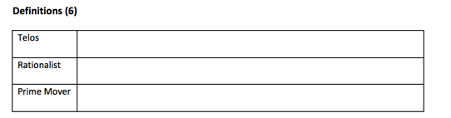
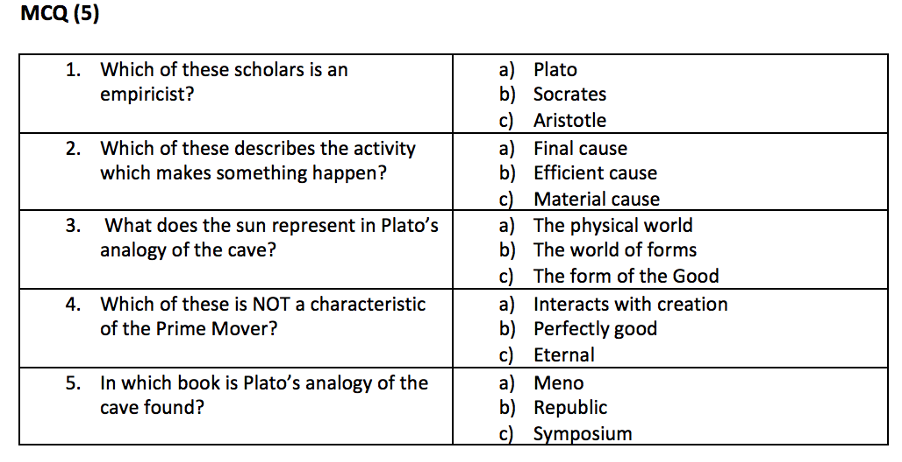
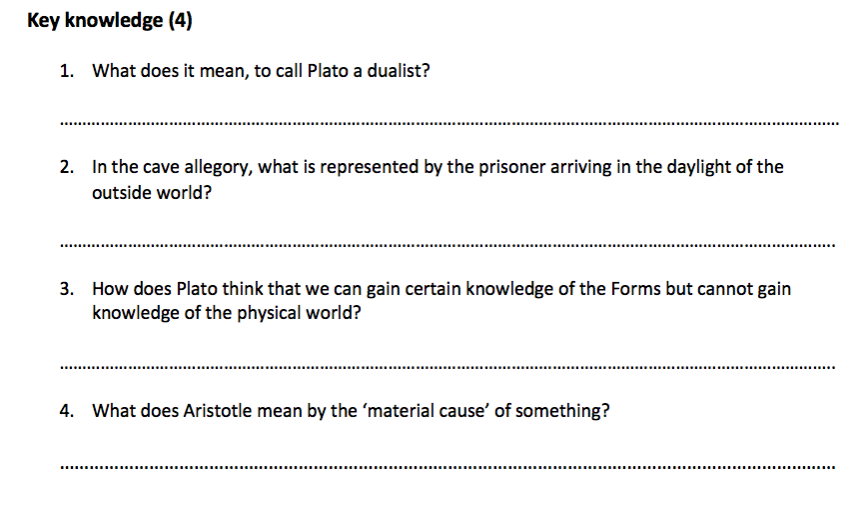
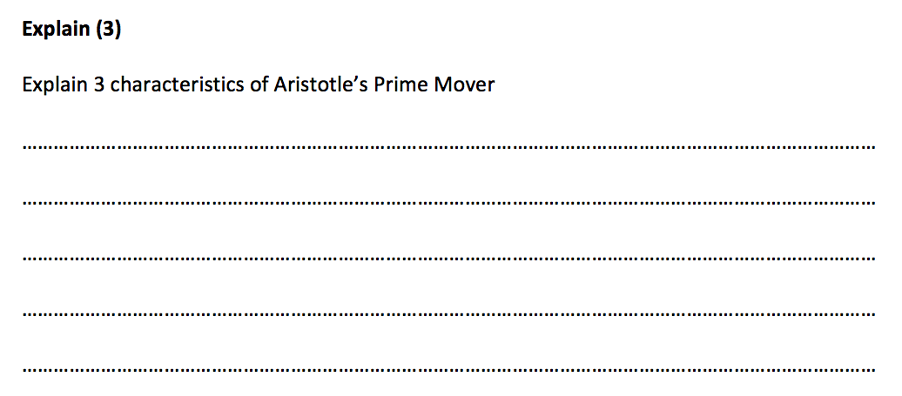
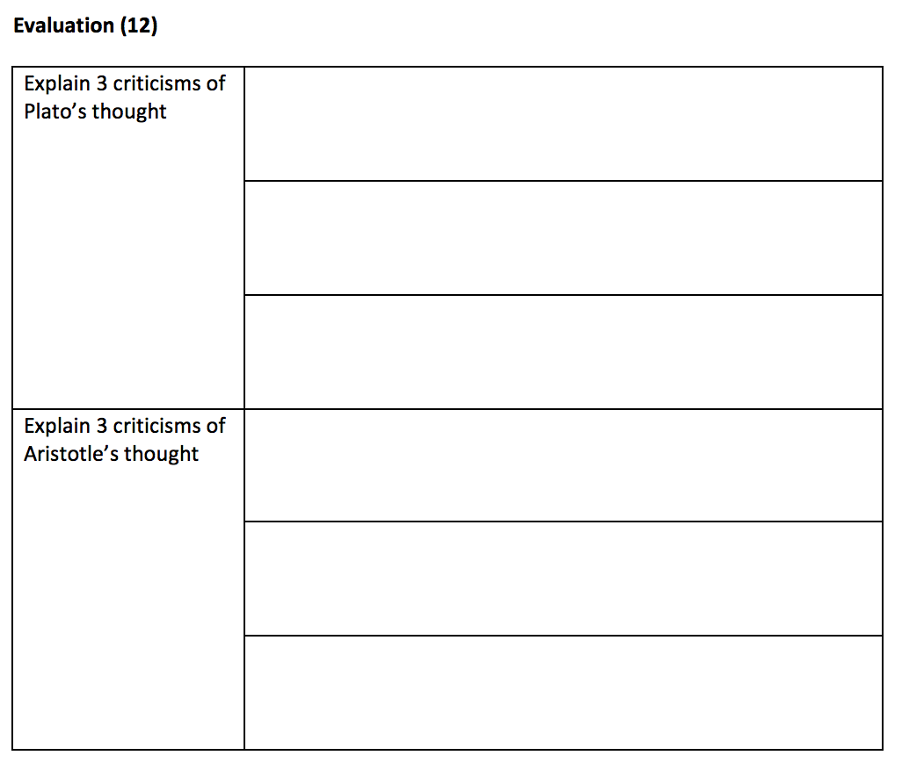
As a department, we have been trialling the use of knowledge quizzes with A level classes. This blog will look to set out why we use them, how they are structured and the benefits we have found in their implementation. Why we use knowledge quizzes with our A level students? Upon first glance at an RE A-level specification, the amount of content we need to cover in such little time is daunting. Whilst we spend plenty of time considering how best to explore these ideas with our students, we felt that we had not spent enough time reflecting upon how best to assess the students’ understanding of the material we covered. In previous years, we would have finished a unit of work by setting an essay question based on the topic. However, we came to recognise that during the marking of essays, we would spend copious amounts of time dealing with knowledge errors within essays. Whilst we would often use low stakes quizzes at the start of a lesson, we wanted to create a form of assessment at the end of the topic which would assess students’ understanding of the core knowledge within the unit before we proceeded to tackle an essay question. How are they structured? Here are the sections from a knowledge quiz set on the OCR topic of Ancient philosophical influences. It would be the first knowledge test which Year 12 students would complete. With future quizzes, each section may contain questions based upon a mix of topics. This cumulative element would ensure that students are constantly revisiting prior material. The quiz would start with asking students to define three key terms from the current topic. Multiple-choice questions are a really useful tool in identifying any misconceptions students may have. When creating these multiple-choice questions, it is essential that they are rigorous and diagnostic. These multiple-choice questions might be based on key terms, scholars or ideas students have explored in the topic. These short recall questions allow students to elaborate further on core knowledge within the topic. A longer explanation question allows students to demonstrate more in-depth understanding of core knowledge. The final section of the quiz allows students to evaluate key ideas within the topic. These points of evaluation are taken from the discussion points within the OCR A level specification for each topic. As students to progress throughout the course, these knowledge quizzes could be expanded in various ways to assess core knowledge. These include:
  • Timelines to sort scholars into chronological order
  • An extract from a philosophical or Biblical text which students have to summarise
  • Providing a relevant quote to support a specific idea or scholar.
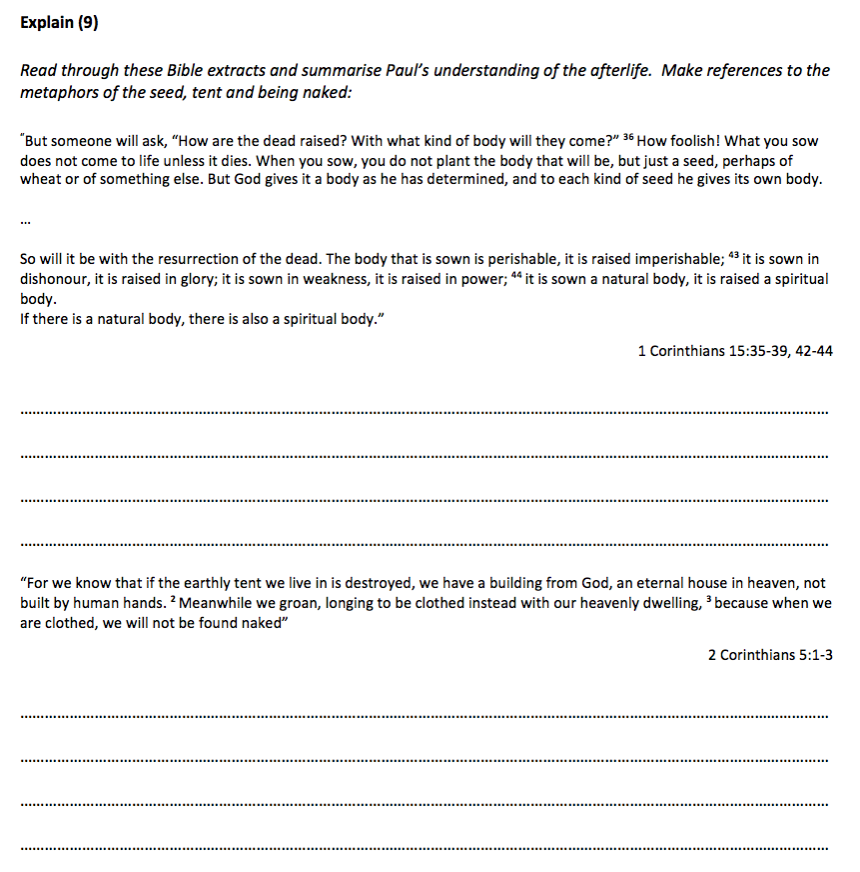
Here is one example taken from a knowledge quiz on the Developments in Christian Thought topic Death and the Afterlife: In addition, as students progress throughout the course and we have taught essay writing knowledge quizzes can be used to assess their disciplinary knowledge in ways such as:
  • Students selecting the best opening sentence for a paragraph in response to specific essay question
  • Students selecting the grammatically correct sentence
  • Asking students to highlight any structural errors within a paragraph
How are we using these knowledge quizzes? We plan to use these knowledge quizzes at the end of each A-level unit prior to students completing an essay on the topic. In addition, we have implemented them as part of our Year 12 mock exam. In the past, the Year 12 Philosophy mock exam would have consisted of a choice of four essay questions with students answering three questions. However, discussions with the rest of my department suggested that our traditional form of assessment for a mock exam may not be best for long term learning or provide us with a full picture of their knowledge of content covered prior to sitting the mock exam. Firstly, students may have only completed a small amount of essay questions prior to this exam. The task of completing three essay questions within timed conditions is something which they would not be suitably prepared for. Prior to them sitting the exam, we can already anticipate that some students may not complete all three questions within time allowed. Secondly, this traditional form of assessment does not allow us to check the students’ understanding of the full breadth of A-level specification which they have covered prior to this exam. Therefore, we included several knowledge quizzes within their mock exam as well as asking students to answer one essay question. What are the benefits of using knowledge quizzes with A-level students? From implementing knowledge quizzes within A-level teaching, we have seen various benefits for students and teachers:
  • Quick to mark – usually 10/15 minutes per quiz
  • Allows for assessment of more aspects of a specification than an essay question
  • Allows students to check their understanding of a topic before preparing for an essay question
  • Cumulative element allows students to constantly revisit prior material.

About

Joe is Head of KS3 RE at the Coopers' Company and Coborn School

See all posts by Joe Kinnaird

AJ Smith | 02 June, 2020

Over the last two terms I have been taking on the rather daunting task of re-writing a primary curriculum from Year 1 to Year 6. The aim of this new curriculum was to build something rigorous, knowledge-focused and exciting to not only prepare our students for secondary school, but to give them a good level of religious literacy for the rest of their lives. Although I am now a primary teacher, I trained, and until recently worked as, a secondary RE teacher.

One of the biggest shocks I have had in transferring to primary was a realisation of just how much KS1 and KS2 students are capable of. Never did I think I’d be able to cover Aquinas and Augustine with Year 4 or be able to properly consider Buddhist approaches to suffering with Year 6 or even to discuss the finer points of how prayers are answered with Year 1. This shock has given me the confidence needed to build a curriculum for our context that is ambitious in its content and hopefully this article will help you do the same. I’m going to introduce three key ways to help with that: reduce, reuse and recycle.

Reduce

It may seem counterintuitive but reducing how much you try to cover in your curriculum might be the key to making it rigorous. We spend all of KS1 just introducing the key concepts in Islam and Christianity. It lays the groundwork for an in-depth discussion of those two faiths in KS2 but also for introductions to other faiths with which they can draw comparisons. Similarly it is okay to reduce the amount of content you want to use in one lesson so you can work on just securing one concept or, perhaps even just taking the time to re-cap and re-embed material already taught.

Reuse

It is important then to be economical with the time we have to teach RE. By introducing key concepts early-on and re-capping them many times we are not only building a fluency in the subject but also saving time.

For example, I chose to introduce the idea of ‘faith’ very early on in Year 1 so that students understood the difference between observing a physical object and having belief in a deity. That concept then gets further embedded in Year 2 when we talk about the Bible and Qur’an and life of Muhammad, embedded even further in Year 3 talking about Judaism, Allah, and Christian prayer. By the time students get to Year 4 we can begin to test the concept out a bit more and create some fluency around it so we begin to talk about non-religious worldviews and how they view faith and then in Year 5 we talk about how faith can be tested by war so that in Year 6 we can even start to think about the ways in which faith is, or is not, always necessary in a religion.

Recycle

I, like every primary teacher I know, am a magpie when it comes to planning. We know how important effective explanations are to good teaching and, when it comes to planning RE for other teachers, we know that good pre-planned explanations can help cover gaps in subject knowledge. Therefore, when there is a tough concept I want to introduce, I reach for the stack of books by my desk and see how other writers have introduced this concept then I recycle it. I will think about how they explain things and adapt it for the age group and previous knowledge of those it will be taught to. You can find my recommendations for good subject knowledge boosters here.

About

AJ Smith is a Primary teacher and RE specialist. @mrsmithre

See all posts by AJ Smith

Dr Kevin O'Grady | 29 May, 2020

What part does religion play in shaping the world? How is religion shaped back by the world, in turn? And now, in the Covid-19 world, are the answers different? The first two are essential Religion and Worldviews (R&W) questions, the third promises perspective shifts. The pandemic is changing us all, thus generating new R&W content. That much is clear from the London School of Economics (LSE) Religion and Global Society interdisciplinary blog, an excellent resource.[i] The LSE blog is a changing collection of articles, often research summaries, as with Grace Davie’s and Nancy Ammerman’s piece on whether religion inhibits or generates social progress. [ii] Among Davie’s and Ammerman’s key findings are these (we recommend reading the entire article, and provide only some of the main points here):
  • “Religion is a lived, situated and constantly changing reality, and has as much to do with navigating everyday life as it does with the supernatural.”
  • Therefore, we have to look at contexts and examples, closely.
  • (Researchers) . . . “will benefit from careful attention to the power of religious ideas to motivate, of religious practices to shape ways of life, of religious communities to mobilize and extend the reach of social changes, and of religious leaders and symbols to legitimate calls to action”
I would say that the advice for researchers is equally good advice for teachers. All of the points would apply whether or not we were under a pandemic, but the pandemic now gives a distinctive context and, in that context, particularised examples of religious motivation and mobilisation. The Covid-19 section of the LSE blog covers some such examples. [iii] Firstly, Michal Kravel-Tovi and Esra Özyürek discuss religious and other gatherings in the age of coronavirus. [iv] Their analysis is provocative and unsettling:
  • They argue that a religious gathering is more likely than a secular one to be identified as a virus cluster, as part of a discourse of suspicion against foreigners or minorities.
  • They show how religiously-based defiance can often be typed as outrageous and irresponsible, as opposed to the less-than-perfect-citizenship of ‘secular’ gatherings such as a beach party.
  • They see all of this as a clash between different understandings of reality, and a pretext for increasing state control of religious groups.
We might not agree with the views in this article; nevertheless, as we will see later, it offers useful classroom teaching points and resources. So does Marina Sapritsky-Nahum, who draws a fascinating account of this year’s Passover from her research in London’s Jewish communities: [v]
  • She writes that “Next Year Together” may replace “Next Year in Jerusalem”, as the phrase of hope that concludes the celebration.
  • She reports how for some Jews, social distancing goes against everything Judaism stands for and undermines their biggest strength: standing together as a community
  • For a number of young Jewish families, she says, isolation has, however, created greater connection with their own nuclear family, bringing Jewish teachings and history to life in the comfort of their homes.
  • It is still a difficult setting in which to celebrate liberation – you cannot celebrate with the extended family or invite strangers, as is customary. But projects such as Seder-to-Go provide all of the essential elements while spreading the message “Freedom is not limited to where you are.” [vi]
  • 4,000 plus Seder boxes have been delivered across the UK, to many who are unable to source the necessary food for the holiday, or who need a step-by-step guide
Marina Sapritsky-Nahum concludes that in today’s global yet isolated world, traditions are not just handed down but also made. Recently I have heard two colleagues speaking about a natural role for R&W in offering young people a space to discuss the existential disruptions of the pandemic. I prefer Marina Sapritsky-Nahum’s focus, because whilst we should contribute to dealing with what is controversial or difficult, the responsibility to do so is not ours alone. Different curriculum areas have different contributions to make. Our distinctive contribution is to educate on the religion and worldviews aspects of Covid-19, as signposted by the articles summarised above, heeding the advice of Grace Davie and Nancy Ammerman to pay close attention to the specifics of context, example, motivation and mobilisation. Michal Kravel-Tovi and Esra Özyürek provide a whole series of links to images and reports of different gatherings, religious and other. Teachers could use these with pupils, who could be tasked to identify and describe the different views of the world that these images and reports illustrate. Pupils could then be asked to juxtapose pairs of images that illustrate worldview differences, note the tensions that may result and suggest ways to manage these. How, for example, should a discussion proceed between the Louisiana pastor who hosted hundreds on Palm Sunday and the Anglican vicar who broadcast the Maundy Thursday service from her home? In a different learning task, pupils could consider the single images of empty places of worship. They could talk and write about why physical gatherings at sacred places are significant to people. Why do they think it is it important to join voices in shared speech and song, to physically take the Eucharist, or to adopt the prayer positions in synchrony with others? Opportunities for pupils to research now arise: what do members of different communities say about this? There are questions, too, about how societal developments challenge and reposition those communities’ self-understanding and practices. Marina Sapritsky-Nahum’s stories provide excellent material for extending the enquiry. Teachers could present these to pupils, then providing a summary handout for annotation: when Passover took place under lockdown, what was lost, and what was gained? Feedback from the task could build into wider discussion: what do the gains experienced during Passover under lockdown tell us about how all communities can become stronger in the future? [i] The blog’s home page is https://blogs.lse.ac.uk/religionglobalsociety/about/ [ii] Grace Davie and Nancy Ammerman, ‘A lived, situated and constantly changing reality’: Why religion is relevant to the pursuit of social progress,’ online article available at https://blogs.lse.ac.uk/religionglobalsociety/2019/01/a-lived-situated-and-constantly-changing-reality-why-religion-is-relevant-to-the-pursuit-of-social-progress/ downloaded on 11 May 2020. [iii] The section is at https://blogs.lse.ac.uk/religionglobalsociety/category/covid-19/ and has twelve widely varied case studies at the time of writing. Again, I have space for only a couple here. [iv] Michal Kravel-Tovi and Esra Özyürek, ‘Contagious Crowds: Religious Gatherings in the Age of Coronavirus,’ online article available at https://blogs.lse.ac.uk/religionglobalsociety/2020/05/contagious-crowds-religious-gatherings-in-the-age-of-coronavirus/ downloaded on 19 May 2020. [v] Marina Sapritsky-Nahum, ‘ ‘This Night is Different From All Others’: Passover in London and Celebrating Liberation in Isolation,’ online article available at https://blogs.lse.ac.uk/religionglobalsociety/2020/04/this-night-is-different-from-all-others-passover-in-london-and-celebrating-liberation-in-isolation/ downloaded on 19 May 2020. The article also gives a general introduction to Passover. [vi] See https://www.thejc.com/community/community-news/deliveroo-to-deliver-chabad-coronavirus-seder-to-go-kits-to-the-isolated-1.498818 .


About

Dr Kevin O'Grady is Lead Consultant for Research at Culham St Gabriel's Trust.

See all posts by Dr Kevin O'Grady

Emma Fletcher | 28 May, 2020

Working in a Church of England High School affords me the luxury of RE being a core subject and is therefore held with high esteem. SLT, governors, students and parents see the value in what we do and what we are trying to achieve with our young people. GCSE is compulsory and our results are slightly above national average. Everything was going swimmingly…………. until the 18th March 2020 when the announcement was made that schools would be closing their doors to the majority of students. From the following Monday we would enter an unknown world of virtual teaching. But that’s fine! We can all use computers, can’t we? We can all carry on with our schemes of work and tweak them for home learning, can’t we? My expectations were high. I know my students and I know what they are capable of. The work was set and the days until ‘hand in’ were counting down.

Then came the reality. The students were clearly taking time to adjust to home learning. A different way of learning, reading instructions via an online platform, guiding themselves through carefully constructed resources, downloading attachments that has challenged us, but without their teacher in the same room for reassurance.

I am immensely proud of my students and how hard they work. So, when the work that appeared in my inbox varied in quality, I had to remain reflective and ask questions of myself and my team as to why this might be the case. Well, the usual high standard of work was caught up in the minds of confused, scared and unsettled young people who were trying to find their feet in a world that had been turned upside down!

Laptops on knees, dining room tables, desks in bedrooms, living room side tables. Some working during school hours and others not until they can get a slot on the shared computer at home or after their younger siblings have gone to bed because they have been helping to care for them. The circumstances that our students are working in are so varied and, in some cases, complex. We needed to factor that in.

So, a rapid change in mind set from me and let’s see what happens. Gone are the requirements to complete every section of the PowerPoint that has been set and ‘proof’ being sent to me and welcome to quick wins. The PowerPoint is still shared and a hope that students will find the time to work through it. A differentiated approach works better, with extensions there for the more able and more scaffolded tasks for lower ability groups. Online spelling tests, quizzes and reflections on their current experience are a win. Something changed overnight. Notification after notification!! The work was actually flooding in after all. The online self-marking tasks also hinted to me about who had really engaged with the lesson and who had maybe gone straight for the quiz. But I can now record that and make sure that I cover those areas that seem to have received lower scores when we return to school.

I may have adapted my expectations during home learning but, in doing so, student participation has drastically increased. They are engaging much more readily and are doing more than required of them too. In addition to the spelling test or quiz or whatever is it, they are also sending me pictures of their work that they are proud of………and I’m proud too!

Lockdown is tough, but so are we!

About

Emma Fletcher has been a teacher for 13 years and is Head of Academic Religious Studies and Criminology at a secondary school in Chester.

See all posts by Emma Fletcher

Saima Saleh | 26 May, 2020

If anyone had told me that remote teaching would be this hard – I would never have believed them. What’s there to worry about? No time wasted travelling to and from school, far less marking, one or two Zoom calls a day as well as a daily a message to my class… A breeze! Or so I thought.

Well here I am, in my third month of lockdown and time has a different tale to tell. The ‘new normal’ has been exhausting! Having to get used to a totally new way of doing everything has been way more tiring than I thought it could be. Yes, there was a potential to have a bit more sleep – no daily 6 a.m. alarm to worry about. However, I didn’t expect to be affected by the Covid-19 news the way I have been. Sleepless nights and a fuelled anxiety have meant that I haven’t rested well at all. I constantly worry about everything and everyone around me- with elderly parents who can’t get out, to vulnerable friends and neighbours and of course, my own children.

Zoom meetings have become part of my ‘new normal’. I have learnt all the techniques and tricks to successful online meetings: I am sure this will be the way forward for so many as we come out of lockdown. It’s all been great as long as the technology hasn’t failed, or that I haven’t forgotten to set an alarm for my meetings. I have absolutely loved seeing my pupils on Zoom calls – I didn’t think I would miss them as much as I did. Just hearing about what new skills they’ve picked up or the fact that they had mastered life skills such as cooking and D.I.Y, was fabulous – this is something that I would never had known about otherwise.

Never did I think planning and putting together remote learning packs would take as long as it has. I have been meticulous in sourcing/making the right tasks with the right amount of challenge for my pupils. Not being able to teach them new concepts has made me feel as if I have let my pupils down, but it couldn’t be done. Not knowing how much support my pupils were getting at home meant that I was ‘in the dark’ about how much work they were actually doing or even if they were being supported by their parents, who had their own work to do.

Having the joys of no SATs this year (I am a year 6 teacher), should have offered a welcome reprieve but it didn’t. I didn’t realise that some pupils would actually get so upset over having no tests! Tests aren’t for everyone, we know that, but they are a form of summative assessment that many teachers rely on for data. We are now left thinking “Do we actually need that data?” especially now that teachers all over the country have had to fall back on their own assessments of pupils’ progress.

Being a RE subject lead, I have made sure that we as a school sent home sound RE activities. This has been a particularly good time to use the NATRE Spirited Arts competition to send home, giving our pupils a highly relevant and creative task to enjoy completing. Through contact with my pupils via Zoom calls, I know that many of them have thoroughly enjoyed having the time at home to sit and reflect on life, in order to write about their compositions and more importantly, they have enjoyed involving their parents in this process, which I feel is an ideal opportunity to give their parents a clearer understanding about what RE is like in schools today. I have found the home learning tasks provided by NATRE as well as RE:ONLINE to be lifesavers!

The breakdown of lesson content on the RE:ONLINE website has been extremely useful: I have loved the useful headings of activity, knowledge, lesson planning, starter and assessment to help guide me in my planning. I managed to continue teaching about Buddhism (as I had started this unit with my year 6 pupils before the lockdown began) thanks to RE:ONLINE. I was able to easily source a website giving my pupils information about Buddhist beliefs and use the suggested activities from the RE:ONLINE website to give my pupils. Being able to do this has been instrumental in easing my workload. I know that the lesson content I have given my pupils is of sound quality and I know that they will really enjoy the tasks which have been set for them.

I have really enjoyed finding links showing how religious worship has changed all over the world and using these to form the basis of new lessons. An example has been sharing current images of Mecca with my year 5 pupils, teaching about how worship has been forced to change, especially relevant during the month of Ramadan. This is turn raised questions with pupils about the importance of having a place to worship and what difference not being able to visit a mosque, church, synagogue or any other building would make to a person of faith. I have learnt that pupils have enjoyed discussing these ‘Big questions’ with their parents at home and that the classroom is not the only place where a debate can happen!

Moving forwards, I do believe that the way we teach and plan units of work from now on, will change for the better as we have learnt to think from a different perspective. I certainly know that the staff in my school have all been signposted to where to find certain resources and will now have a bank of where to access super quality lesson ideas and resources.

The lockdown has taught me one thing: that I am a dedicated teacher who loves teaching. This is what I was always meant to do! Teachers are highly resilient and they find a way of making things work. Whenever the wifi played up or my school’s remote server broke down, I sought to use the time I had doing something productive. The amount of amazing cpd opportunities available for free has been countless – for this, I will always be so grateful! The RE:ONLINE website has offered a plethora of resources and learning opportunities that I have shared with teachers in my school. NATRE and RE Today have offered excellent webinars at cheaper rates – an opportunity I couldn’t resist: such a great way to provide cpd for all staff. This has been one of the many advantages of the lock-down – a time that I will never forget!

When we do go back to school in some shape or form, I do know that I will never take anything for granted and I will cherish every moment with my pupils and my colleagues.

About

Saima is RE SLE, Year 6 teacher and member of the NATRE Executive.

See all posts by Saima Saleh