Global terms: Teaching & Classroom Practice

Greg Parekh | 21 May, 2026

In all I do I always start with vision. What do I want great RE to look like and what is best for the pupils in front of me?

If we are preparing students to navigate an increasingly complex, multi-faceted and diverse world, they need more than knowledge. They need to think well. That’s why I am convinced a multi-disciplinary, academically rigorous and engaging RE curriculum is the way forward.

I often think of this through the image of a stained-glass window.

  • The glass is the substantive knowledge: beliefs, texts, practices.
  • The lead is the disciplinary knowledge: theology, philosophy, social sciences.
  • The light is the student: their worldview, questions and reflections.

Without the structure, the glass is just fragments. Without the light, it has no meaning. High-quality RE brings all three together.

A disciplinary approach matters because it moves us beyond learning about religion into thinking with it. It gives students access to how scholars make sense of the world; through interpretation, reasoning and evaluation.

One of the most powerful ways to do this is through a philosophical lens.

What does a philosophical lens mean?

Using a philosophical lens means treating RE as a space for big questions, careful reasoning and conceptual precision.

It shifts us from:

  • What do people believe?

to

  • Does this idea make sense?
  • What follows if it’s true?
  • How convincing is this argument?

In my classroom, this centres on three things:

  • Clarifying concepts
  • Constructing arguments
  • Engaging with disagreement

Importantly, this doesn’t make RE more abstract—it makes thinking more visible.

What does this look like in practice?

For 11-14 year olds, this fits naturally within the Cornwall Agreed Syllabus, which we follow. The key is not to bolt philosophy on, but to draw it out of the enquiry questions already there.

Start with a big question

Instead of beginning with content, begin with a puzzle. For example, in some of the units of work we teach:

  • “How do Sikhs put ideas of equality and service into practice?”

 “Can people ever treat everyone equally?”

This opens up debate before exploring sewa and equality in Sikhi

  • “What is so radical about Jesus?”

“What makes an idea or person truly radical?”

Students can then test Jesus’ teachings against their own criteria

  • “The Buddha: how and why do his experiences and teachings have meaning for people today?”

“Can suffering ever be a good thing?”

Creates a strong philosophical bridge into the Four Noble Truths

  • “How far does it make a difference if you believe in life after death?” – “Would you live differently if you knew what happens after death?”. Sets up the entire evaluative focus of the unit

Use thought experiments

When teaching Buddhism, I use the Ship of Theseus to explore identity. I begin with a philosophical problem:

If something changes completely over time, is it still the same thing?

Students then apply this to themselves:

  • If your body changes, are you still the same person?
  • If your memories change, what makes you you?

I probe their thinking:

  • “What makes you think that?”
  • “Could someone disagree?”

Students begin to:

  • clarify what they mean by “self”
  • give reasons
  • recognise alternative views

Only then do I introduce the Buddha’s teaching of anatta (no fixed self). At this point, it isn’t just new information—it’s a response to a question they already care about.

We then evaluate:

  • Does this idea make sense?
  • What are its strengths?
  • What might challenge it?

The thought experiment isn’t just a hook—it structures the lesson. Students are thinking philosophically, not just learning content.

Teach the language of argument

If we want students to write academically, they need to be able to think and to talk like philosophers and therefore we must teach them how to build arguments.

In the unit “Should Christians be greener than everyone else?”, I begin with a question:

Do Christians have a greater responsibility to care for the environment than others?

I model a reasoned argument:

  • “One reason for this is that Christians believe the world is God’s creation…”
  • “However, this might be challenged because people of any worldview can care for the environment.”

Students then practise:

  • “One reason for this is…”
  • “This might be challenged because…”

I probe their thinking:

  • “Why is that a strong reason?”

Only then do we introduce stewardship and dominion. Students evaluate these ideas, not just learn them.

The result? Students move from “I think” to structured reasoning—in both discussion and writing.

In summary

Using philosophical tools doesn’t require a complete overhaul.

The most important shifts are small:

  • Start with better questions
  • Build in thinking time
  • Insist on reasons
  • Normalise disagreement

When these become routine, the impact is clear. Students speak with more confidence, write with more precision, and engage more deeply. We are moving through a sphere of good knowledge and understanding towards deep thinking and philosophical discussion.

About

Greg Parekh is a Head of RE and T&L lead. He is on the NATRE exec, and is a professional consultant to Cornwall SACRE. He is currently participating in the Culham St Gabriel's Leadership Scholarship Programme.

See all posts by Greg Parekh

Chris Mooney | 20 May, 2026

Why ‘Ways of Knowing’ matter in RE

‘Ways of knowing’ have been spoken about for many years in RE (Ofsted, 2021) and it has become clear that in order to teach high-quality RE it is crucial that pupils are not just taught about ‘what to know’ (substantive knowledge) but that they must be taught ‘how to know’ (disciplinary knowledge). In our new Gloucestershire locally agreed syllabus this push towards explicitly discussing and exploring scholarly methods has seen a toolkit approach introduced so that pupils can consider the tools available to them to investigate concepts, practices or beliefs.

In my classroom, one lesson in particular, showed me the impact that ‘Ways of Knowing’ can have as it radically altered my relationship with my pupils.

Let me explain.

The tool I used: ‘Looking at Data’

One of the tools our syllabus encourages us to use while exploring the history and current​ situation of the Jewish community​ in our area is titled ‘Looking at Data’.

Now I have used data before but in a very limited way. My previous approach would have been to organise the latest national census so that I could highlight the responses of the local Jewish population. During the lesson, we would have briefly discussed how the local population was quite small and identified that the local population is focussed in one locality. I might have answered one or two of the children’s questions, but primarily the encounter would have been managed by me with pupils looking on. I would have been the tour-guide pointing out what I felt was interesting, relevant and useful while ignoring those I felt were irrelevant or confusing.

This time around I decided that embracing ‘Ways of Knowing’ meant me dropping the tour-guide role to become a fellow-traveller.

Moving from ‘tour-guide’ to ‘fellow-traveller’

I started the lesson by explaining what a census was and how the information was collected. We then explored census maps relevant to their locality. As we talked, questions were raised and some answers were suggested but there were also times where we recognised that to answer our questions we might need to explore the locality’s history or complete further surveys. I was reflecting, evaluating and analysing alongside my pupils. I felt that my position had shifted my tour-guide to experienced fellow-traveller. This experience only grew richer when I presented them with the local data responses.

Again, previously, I would have directed their attention towards the data I wanted them to see so that they could come to the conclusions that I wanted them to make. This time, I was determined that to hand the hermeneutical baton over to them.

So, we went through the data slowly allowing the pupils to review it themselves and identify what they felt was ‘noticeable’. This altered my comments from explanation to provocation from “This is because…” and “You can see that…” to “What might this mean for these people?”, “How might it feel to live here?” or “How could you explore that information further?” Interestingly, pupils began to reflect on the population data across different worldviews and how this might lead to them engaging with one another. We did eventually talk about the responses of Jewish people, but we came to it together.

This exploration allowed us to interpret pictures of the local synagogue and its community in a different light. Pupils reflected on how living in a place with fewer Jewish people might impact the way the community gathered or the buildings in which they gathered. We also considered how living in a place with people of similar or differing worldviews might impact your identity or relationships with others.

What changed when I taught ‘Ways of Knowing’ explicitly

After this lesson, I reflected on how explicitly using ‘Ways of Knowing’ altered our RE experience:

  1. Explicitly showing a ‘Way of Knowing’ had allowed me to transition from tour-guide who holds all the knowledge to fellow-traveller noticing, exploring and questioning alongside my pupils.
  2. The children had embodied the role social-scientists, activists, architects and theologians. Instead of being given my conclusions and those of others they had been empowered ‘to be’ the scholar and to come to their own conclusions.
  3. The children had seen that a person’s worldview as well as their traditions and practice might be shaped and formed by their local or national experience. For children in a school whose pupils are pre-dominantly from White-British backgrounds this is powerful. Might this have ramifications for their ideas on race, religion, politics? I would hope so.
  4. The children’s confidence with the census and data meant that I could use this in other areas of the unit such as exploring the concept of ‘ethno-religion’.

This experience has encouraged me to embrace ‘ways of knowing’ as a key aspect of my RE teaching. I know that I have a way to go, but I am determined to take that path as a fellow-traveller and not as a tour-guide.

About

Chris Mooney is a Deputy Headteacher and RE Subject Leader at a primary school in the Cotswolds. He is the lead practitioner for RE across The Diocese of Gloucester Academies Trust and is passionate about supporting teachers to deliver teaching across the curriculum.

See all posts by Chris Mooney

Joanne Harris | 19 May, 2026

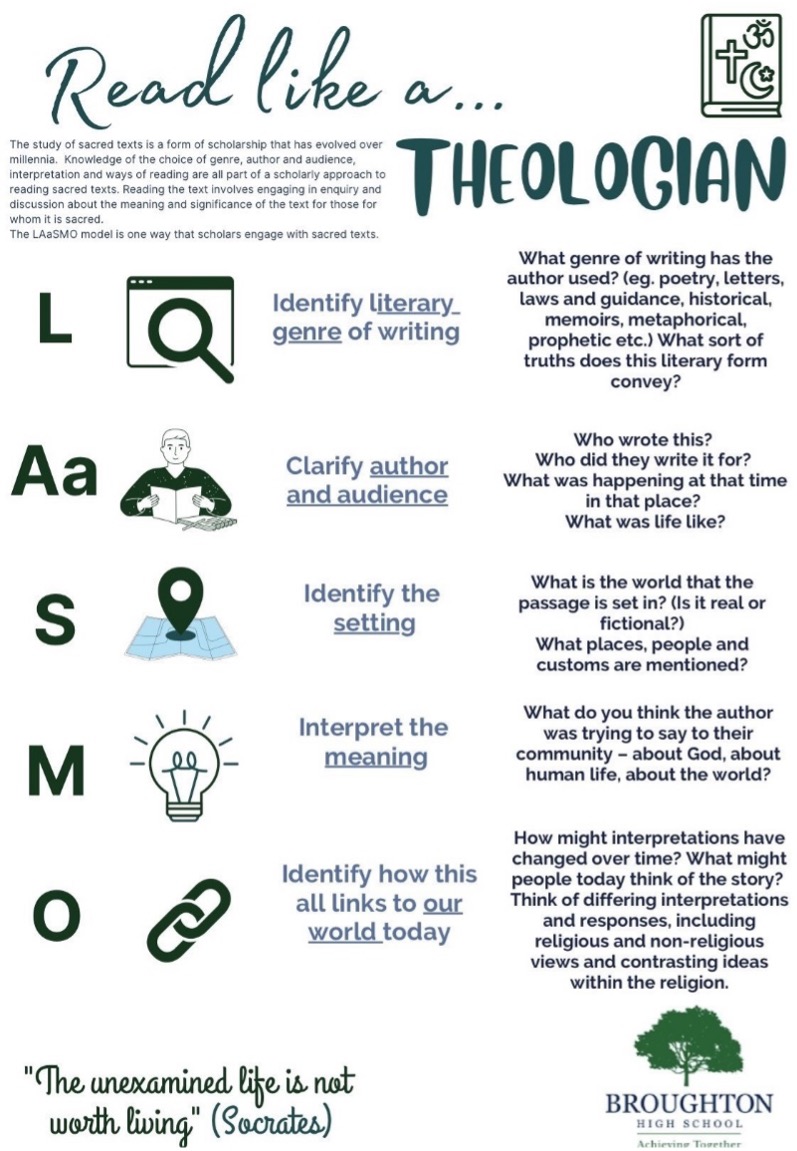
In developing Theology within our Key Stage 3 curriculum, our department has been heavily influenced by a session I attended several years ago at Strictly RE, where Professor Bob Bowie introduced ‘Teachers and Texts: The Practice Guide’. This has shaped both our thinking and classroom practice, particularly in how we explicitly teach pupils the disciplinary skills needed to “think like a theologian”. As the guide suggests, RE has the potential to allow pupils to “inhabit the place of a sacred text scholar”, grappling with texts, exploring multiple interpretations, and recognising the complexity of meaning-making within religious traditions.

Meaning then, meaning now: helping pupils connect sacred texts to contemporary life

Too often, pupils encounter religious texts in fragmented ways or as soundbites. This is especially evident at GCSE, where many learn a bank of quotations to support exam answers rather than developing a deeper understanding of the text, its context, and layers of meaning. We wanted to address this at Key Stage 3, ensuring that pupils begin their GCSE studies equipped with the theological knowledge and interpretive skills needed to engage meaningfully with sources of wisdom and authority.

To support this, we have embedded hermeneutics into our Key Stage 3 curriculum as a way of introducing pupils to the process of reading and interpreting texts. Pupils explore multiple meanings within a passage, consider the historical, cultural and religious context, and examine how different individuals and communities might interpret it in different ways. They are also encouraged to reflect on their own perspectives as readers.

Meaning then, meaning now: helping pupils connect sacred texts to contemporary life

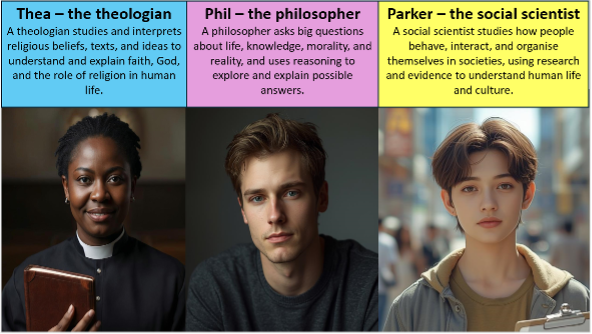
We introduce pupils to the disciplines of RE through three characters: Thea the theologian, Phil the philosopher and Parker the social scientist. This helps them recognise the different lenses they might use in a lesson, as well as the types of questions and scholarly approaches associated with each discipline.

Before studying a text in detail, we focus on the person behind it:

  • Who is believed to have said or written this?
  • When did they live?
  • What was life and society like at the time?
  • Why is this individual regarded as a source of wisdom and authority today?

Establishing this foundational knowledge allows pupils to engage more confidently with the text itself. We also ensure that key vocabulary, both subject-specific (Tier 3) and more general academic language (Tier 2), is either pre-taught or clarified during reading.

Meaning then, meaning now: helping pupils connect sacred texts to contemporary life

Promoting reading has been a key whole-school and departmental priority in recent years. Our approach includes structured reading strategies, which you can explore further here: https://www.broughtonhigh.co.uk/docs/Curriculum/RE/Reading_strategies_in_RS.pdf

Initial engagement with a text typically involves a guided reading process, where the class reads together and responds to questions designed to support both comprehension and analysis. This often leads into more detailed exploration using the LAaSMO model, as set out in the Practice Guide. This provides a clear and structured approach to help pupils unpack sacred texts in increasing depth. For example, when exploring the Parable of the Good Samaritan from the Bible, we begin by considering the literary form, discussing why parables are used as a method of teaching and how storytelling shapes meaning. Pupils then explore author and audience, developing their understanding of Jesus not only as a religious figure but also as someone responding to the social context of his time. This is deepened through consideration of the setting and character choices, helping pupils recognise why the parable may have been controversial. With this contextual understanding in place, pupils are better able to consider the meaning at the time, interpreting the message as a challenge to social and religious boundaries. Finally, they explore meaning and application today, discussing what “loving your neighbour” might look like in contemporary contexts – locally, nationally and globally – and reflecting on the relevance of sacred texts in the modern world.

Meaning then, meaning now: helping pupils connect sacred texts to contemporary life

The Curriculum and Assessment Review in England emphasises that a successful curriculum should be fit for purpose and equip young people with the knowledge and skills needed to thrive in a rapidly changing world. In RE, exploring how sacred texts might inform responses to modern ethical, social and global challenges helps pupils to engage more meaningfully with the subject, develop critical thinking skills and see the value of what they study in their own lives. By encouraging pupils to evaluate whether religious teachings still hold relevance today, we support them in developing as thoughtful, reflective individuals who can engage with different perspectives and apply their learning beyond the classroom.

About

Joanne Harris is a Religious Education teacher at Broughton High School and Vice Chair of NATRE. She is widely involved in national work supporting high-quality RE, including curriculum development, teacher professional learning and advocacy for the subject. Joanne regularly contributes to discussions on classroom practice and leadership in RE across the UK.

See all posts by Joanne Harris

Sarah Dennis | 18 May, 2026

To really understand how religious and personal beliefs work, pupils need to understand where beliefs come from, how they are lived, and the deeper thinking that sits behind them.

One place many beliefs originate is in stories with rich layers of meaning. My idea was to design a lesson sequence for pupils aged 10–11 that allowed them to study beliefs through theology, lived experience through the human and social sciences, and deeper meaning through philosophy.

I also wanted to link as many stories as possible to people from our local community, so pupils could see that these stories are not just historical texts but have real influence here and now. A big ask, but was it possible?

Designing a disciplinary approach for Year 5 and 6

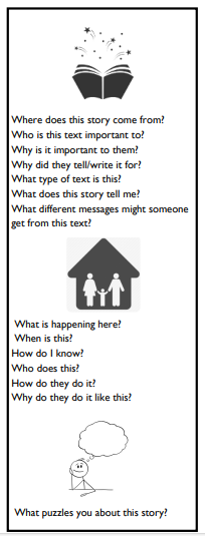
To make this work, I created a resource with three clear sections, each linked to disciplinary questions. I turned this into a bookmark (Figure 1) so pupils could make notes as they went, reducing cognitive overload.

The bookmarks were lightly taped into books so pupils could write alongside them. Notes were later developed into one paragraph per discipline. Over the course of the unit, the bookmark evolved as both the pupils and I refined the questions, focusing on those that generated the most thoughtful, open‑ended responses.

Figure 1. Disciplinary bookmark                                                                  

One text, three disciplines, one lesson

Over nine weeks, we studied nine texts. Yes, one text per week, covering all three disciplines in one hour.

Every lesson followed the same pattern. Over time, pupils became increasingly confident with the disciplinary thinking, knowing what kind of questions they were being asked and why.

When subject knowledge becomes the challenge

My first step was to trial the approach using a different text. That was when I realised my biggest problem: I did not always have the subject knowledge to confidently answer the questions I had written on the bookmark.

Using support from NATRE, RE:Online, TrueTube and BBC Bitesize, I took time to build my own understanding. This was an essential step and a reminder that disciplinary teaching requires ongoing subject knowledge development for teachers as well as pupils.

What the lesson sequence looked like in practice

Each lesson followed a clear structure:

  • Lesson objectives and dates were printed on stickers to save time and stuck onto a new page.
  • Pupils annotated their bookmarks while reading the text for theology. I modelled this for the first three lessons using my own exercise book and a visualiser.
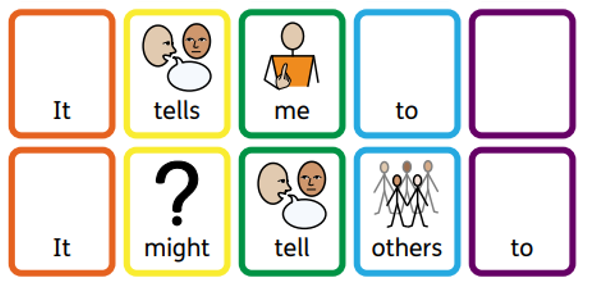
  • Writing scaffolds were available for early writers. (Figure 2)
  • Pupils watched short videos showing lived experiences, often from members of our local community or carefully chosen online clips. They annotated the human and social sciences section of the bookmark.
  • Pupils considered what puzzled them about the story.
  • Annotations were written up into short paragraphs, with images from the lived experiences added to support writing.
  • Pupils pre‑read the next week’s story.

The consistent structure helped pupils focus their thinking and build confidence week by week.

Figure 2. Writing Scaffolds

What surprised me about pupil learning

A common mistake in my teaching, across all primary year groups, is underestimating what pupils can achieve.

I spoke honestly with both classes about trying something new, and they were incredible. Pupils suggested changes to the bookmark questions, refining them lesson by lesson. The feedback was thoughtful, and engagement with each text was high.

The lessons worked because the bookmark gave pupils a clear place to offload knowledge, freeing up their thinking rather than overloading their working memory.

Removing the scaffolds

In the final lesson, I wanted to see what pupils could do with less support. I removed the bookmark and asked pupils to generate their own questions.

They worked in groups of three, using two QR codes linked to texts and a BBC Newsround clip. I had the writing scaffolds ready and the pupils knew they were available. Not one pupil asked for them.

What I learned

In summary, Year 5 and 6 pupils can study texts through multiple disciplines, and do so successfully. This approach works particularly well with texts linked to lived experience or moral influence.

You may need to adapt the bookmark for your cohort. You will almost certainly need to spend time building your own subject knowledge. But the depth of understanding and the skills pupils develop might just surprise you as much as they surprised me.

About

Sarah is a member of National Association of Teachers of RE (NATRE) Exec and RE leader at Chadsmead Primary School in Staffordshire. She has led a NATRE affiliated local group for over six years and networking lead for RE for her academy chain Community Academy Trust. Sarah completed the Culham St Gabriel's Leadership Scholarship Programme in 2025. She teaches RE across a one form entry Primary school in Lichfield in Staffordshire.

See all posts by Sarah Dennis

Belinda Twiggs | 30 April, 2026

An unexpected encounter

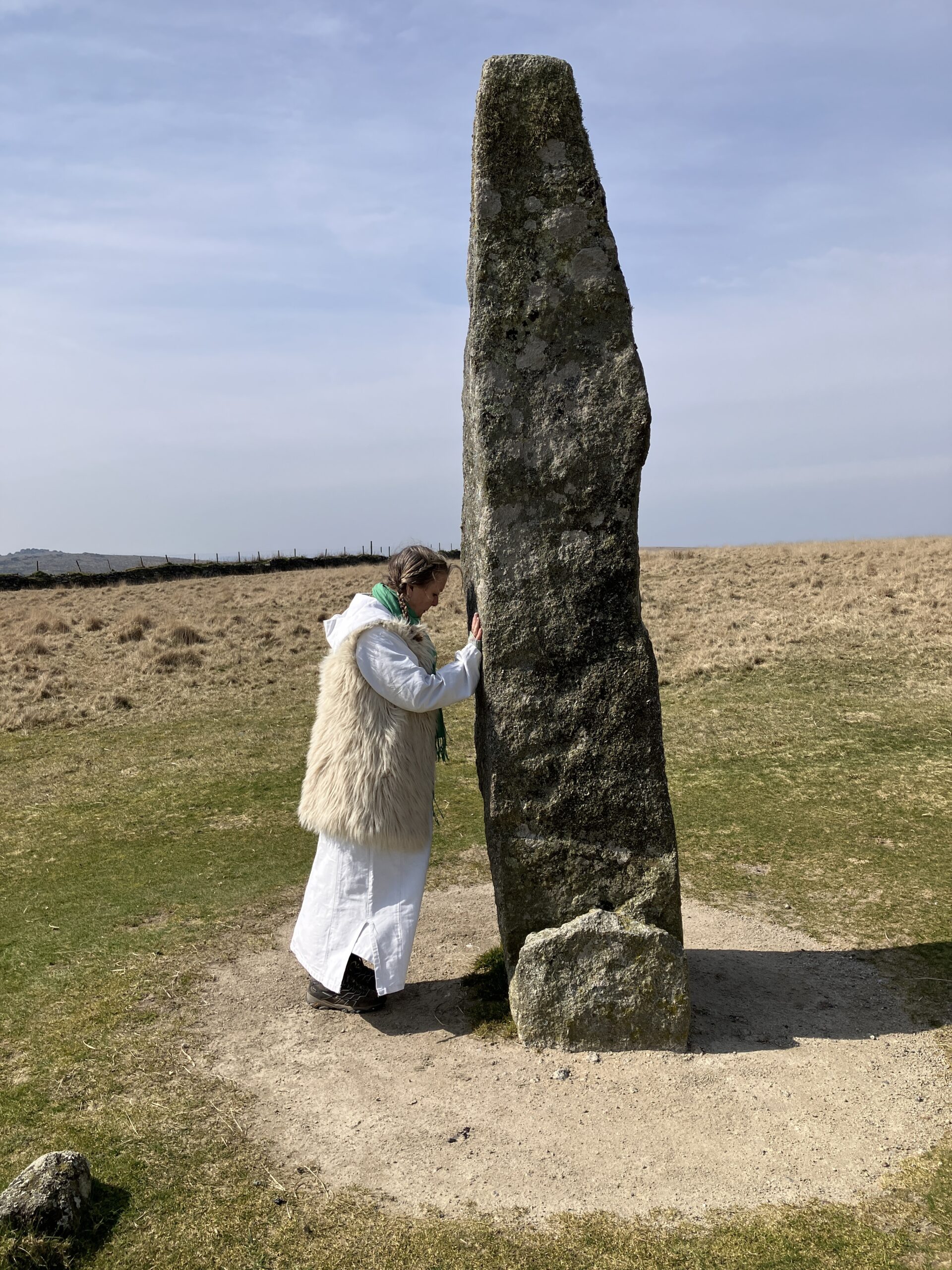
I first stumbled across a group of Druids, fully decked out in white robes, at Avebury Stone Circle in the spring of 1988.

My first thought was blunt:
What on earth do they think they are doing?

Curiosity got the better of me and I struck up a conversation with one of them. He looked for all the world like Dumbledore, dressed head to toe in white. As he talked, calmly eating a cheese sandwich that seemed tiny in his huge hands, his answers to my questions were thoughtful and profound.

When he finished eating, he reached behind a standing stone, pulled out a harp, and began to play. The tune was beautiful, lively and unmistakably Celtic. Others began to drum and dance.

At the end of the afternoon, he put on biking leathers, strapped the harp to the back of his Harley-Davidson, and roared off.

I learnt an important lesson that day: never judge a book by its cover.

Coming out as a Druid

It took me around fifteen years to feel comfortable wearing a robe in public, and nearly thirty years to ‘come out’ openly as a Druid. Fear of criticism, especially for following something seen as outside the mainstream or a little ‘wyrd’ (the spelling is deliberate-look it up), held me back.

Eventually, though, it felt important to be honest.

Occasionally, this leads to amusing moments. Children sometimes say to me in the dinner queue,
“I saw you on TV last night, Miss. Dad loves Joanna Lumley!”

They are referring to a brief appearance in Home Sweet Home, a documentary filmed at Merrivale Stones on Dartmoor during the 2021 COVID restrictions. The episode shows Joanna Lumley meeting Druids and observing a Samhain ritual. It is short, but it mattered to me as an example of lived practice being seen, however fleetingly, on national television.

Samhain: remembering those who came before us

Samhain is one of eight seasonal festivals celebrated by many (though not all) Pagans. It takes place on 31 October and has ancient roots that long predate Christianity.

This is the time of year when people historically gathered around the hearth, as the days shortened and darkness increased. Stories of spirits and the dead grew more powerful as the light faded. The idea that “the veil is thin” reflects a sense of closeness between the living and the dead.

At Samhain, we honour our well and wise ancestors. Death is something we all face, and taking time to think about loss, legacy and meaning feels both honest and necessary.

For me, this raises an ongoing question:

How can I live my life fully and well, so that my short time here is of value?

Beltane and the turning year

As the Wheel of the Year turns, we now approach Beltane (also known as Beltain or Bealtaine), marking the clear arrival of summer.

At dawn, many of us gather on Haytor on Dartmoor to watch the sun rise. It has become a large public event, with musicians, flaming torches and the Beltane Border Morris dancers. Hawthorn blossom- the second of the May blossoms- is worn in hats and woven into garlands as part of the celebration.

Songs are sung with enthusiasm, including Hal an Tow from Helston’s Furry Dance:

“We were up, long before the day-o,
To welcome in the Summer…”

Later, our Grove meets more quietly (a group where we meet together for rituals and festivals) . Having been up at around 3am to reach Haytor, we take a nap before coming together again. In ritual, we step through an archway, guarded by figures representing the Lord of the Wild Wood and the Lady Ceridwen, before leaping between two fires to symbolise cleansing and renewal.

Druidry as lived practice

For me, Druidry is an authentic and meaningful path that honours nature, the Earth, and humanity’s place within the wider universe.

Through ritual, storytelling and communal feasting (often picnics), we mark the passage of time and celebrate the life-giving role of the sun. These gatherings happen roughly every six weeks and are as much about community as belief.

At the Spring Equinox in 2026, Dartmoor Grove met at Merrivale to celebrate the tipping point towards longer days. I am no longer concerned about how I look in public as a Druid. My practice feels honest, rooted and real.

Why this matters for RE

Stories like mine remind us that worldviews are lived, evolving and deeply human.

When pupils explore religion and worldviews, they are not just learning about beliefs. They are learning about identity, belonging, meaning and how people make sense of their lives.

Never judging a book by its cover is a good place to start.

About

Belinda Twiggs is a Primary RE Lead and teacher, LTLRE Hub Lead, Chair of Devon SACRE, Deputy Education Officer for the Pagan Federation and longtime member of OBOD working with a Grove of Bards, Ovates and Druids in Devon.

See all posts by Belinda Twiggs

jenny-kaur | 08 March, 2026

“That’s not my Sikh faith” Amy Ark [Sikh panellist] said during the recent National Association of Teachers of Religious Education (NATRE) Strictly RE conference. Amy was discussing her own experience at school, where Sikhi was only covered for one week and in this short time she found the curriculum had resonated little with her lived experience; Amy is not alone, there are many Sikhs who also feel the same. I find the common phrase “She’s not Sikh her hair is cut” circling in many discussions in groups in 11-14 RE.

I’m sure I am not alone. I’m sure we have all found ourselves in the lesson where we combat generalisation and stereotypes in the classroom. I have found it best to provide examples of modern and historical Sikhs who have a story to disrupt the ‘typical Sikh look’ for students. What does it mean to look or act like a Sikh currently?

In Professor Jasjit Singh’s excellent ‘Teaching Sikhi in RE: Engaging communities with Teaching Religion’ research we learned it was clear there is insufficient community and ‘Lived Experience’ integration. There is an explicit finding of weak engagement with Sikh communities in curriculum development and delivery. This perpetuates a textbook-only approach, ignoring the richness of contemporary British Sikhi. I had also read this from Dr Phra Nicholas Thanissaros Teaching Buddhism in Britain’s schools: redefining the insider role” here we learn the “dissonance apparent between home and school presentation of Buddhism is compared to similar findings for the Hindu and Sikh communities in Britain.” One of his suggestions to bridge this gap is to enrich the conversation between “insider” (the community’s living faith) and “outsider” (the teacher’s academic presentation) perspectives. In a further report from Insight UK it is posited that the lack of accurate, quality representation is linked to an “inferiority complex” amongst South Asian children, failing the duty of RE to support identity development.

As a result of my own experience and these reports I have chosen to explore modern and historical examples of Sikhs, allowing students to see the modern ways women are shaping their fields from psychology to art. These women are all united with a shared conviction – not in a general archaic sense of Sikh identity. I would have enjoyed hearing of these voices whilst at school and teaching at a single sex girl’s school I have found providing the students with female voices resonates with them [and me]. I have also underneath each biography suggested how they can be used in different contexts from creative tasks or discussions on equality in practice with many connections to GCSE units’ such as relationships for roles of men and women and intergenerational living. I have listed them below and given a little detail about them but they are available in more detail with biographies and teaching suggestions on the RE:Online website as PDF’s to use in the classroom.

I hope you find them useful and interesting as I did!

  1. Dr Manpreet Dhuffar Pottiwal : Sikh Psychologist

Dr Manpreet Dhuffar Pottiwal is a Sikh psychologist and activist whose work focuses on intergenerational trauma within South Asian communities. Through her TEDx talk, she uses the metaphor of family trees to show how inherited burdens and strengths shape identity, encouraging healing through understanding roots, culture, and community.

  1. Mai Bhago: Female Sikh warrior

Mai Bhago was a fearless Sikh warrior who challenged forty men for abandoning their faith and led them back into battle against a vastly larger Mughal army. Though badly injured, she survived and later became Guru Gobind Singh Ji’s bodyguard, standing as a powerful example of equality and courage in Sikh history.

  1. Amrita Sher Gill: Hungarian Sikh Artist

Amrita Sher-Gil was a Hungarian Sikh artist whose paintings explored the emotional lives of women constrained by tradition. By blending Indian and European styles, she gave voice to women’s quiet struggles, resilience, and unspoken strength, especially in works like Three Girls.

  1. Neelam Kaur Gill: British Sikh model

Neelam Gill is a British Sikh model who turned experiences of bullying and racism into a mission for representation in fashion. As a trailblazer for major global brands, she speaks openly about discrimination and uses her visibility to challenge stereotypes of modern Sikh identity. 

  1. The Singh Twins: British Sikh miniature artists

Amrit Singh and Rabindra Kaur Singh, the Singh Twins, are British Sikh artists who have revived Indian miniature painting to explore modern social, political, and religious themes. Their highly detailed, vibrant work challenges Eurocentric ideas of fine art while proudly expressing Sikh history and worldview

  1. Mata Khivi: The only woman mentioned in the Guru Granth Sahib

Mata Khivi is the only woman named in the Guru Granth Sahib and is honoured for her compassion, equality, and service. She played a central role in establishing the langar system, ensuring food and care for all, and remains a lasting symbol of Sikh values in action

  1. Sophie DuLeep Singh: Suffragette

Princess Sophia Duleep Singh, daughter of the last Sikh Maharaja, was a key figure in the British suffragette movement. She used her royal status to fight for women’s rights, support Indian independence, and amplify South Asian voices in Britain.

andy-lewis | 03 March, 2026

When students ask whether faith has anything to say to modern life, the Catholic saints can sometimes feel like the wrong place to start. Too often, they appear distant – they are shaped by another century, another culture, another set of assumptions.

Carlo Acutis changes that conversation.

A teenager who loved coding, gaming, and football, Saint Carlo shows what Catholic belief can look like when it is lived seriously in the contemporary world – not as nostalgia, but as conviction.

Carlo was born in London in 1991 to Italian parents before his family returned to Milan. His upbringing was not conventionally “religious” in the way we might expect of a future saint. His parents were not regular Mass-goers, and there was no intense devotional culture at home. Yet from an early age, Carlo displayed a quiet attentiveness to faith. He asked questions, noticed details, and chose practices that slowly, but deliberately, shaped his life.

After receiving his First Holy Communion at the age of seven, Carlo chose to attend Mass daily. He developed a deep love for the rosary, reading Scripture, and acts of charity – particularly towards the poor, migrants, and those sleeping rough around Milan. These were not dramatic gestures, but steady habits. His faith was rooted in Catholic tradition, disciplined rather than showy, ordinary rather than performative.

A child of his generation

At the same time, Carlo was unmistakably a child of his generation. He loved football, video games, and technology. Like many young people of the 1990s and early 2000s, he taught himself coding, web design, and programming, becoming skilled enough to help others build websites. This is what makes him a genuinely millennial saint. Carlo did not reject modern life in order to be holy; he inhabited it fully and learned how to live faithfully within it.

At the centre of everything was Carlo’s devotion to the Eucharist. He famously described it as his “motorway to heaven” – a phrase that is often quoted because it is both ordinary and profound. For Carlo, the Eucharist was not background scenery to his faith, but the place where Christ was encountered most fully. This conviction shaped how he used his time, his talents, and his energy.

Cataloguing miracles on the web

His best-known project was a digital exhibition cataloguing Eucharistic miracles from around the world. As a teenager, Carlo researched historical accounts, visited sites, gathered sources, and presented them online with clarity and care. His aim was not to sensationalise, but to show that belief in the Real Presence was not an abstract claim – it was something the Church had taken seriously, consistently, and globally.

One example Carlo researched was the Eucharistic miracle of Lanciano. In the eighth century, a priest struggling with doubt is said to have witnessed the consecrated host and wine transform into flesh and blood during Mass. In the 1970s, independent scientific analysis identified the flesh as human heart tissue and the blood as real human blood, preserved without additives. Carlo did not use such accounts to “prove” belief to sceptics, but to point back to what Catholics already claim happens every single time Mass is celebrated.

A life cut short

Carlo’s life was tragically short. In 2006, he was diagnosed with an aggressive form of leukaemia and died within days, aged just fifteen. Even during his illness, accounts describe a calm acceptance and a concern for others rather than himself. He was beatified in 2020 and is often described as a “patron saint of the internet” – a label students immediately connect to. He was formally declared a saint on 7 September 2025.

As one young Catholic from London in Rome reflected, “The fact that you can think of a Saint doing the same things as you – wearing jeans, playing video games – it feels so much closer than other saints have in the past.”

For RE teachers, Saint Carlo’s biography does important work. He helps bridge the gap students often feel between holiness and normality, faith and technology, tradition and modern life. He offers a contemporary reference point for Catholic belief without diluting its depth or demands.

Saint Carlo Acutis offers something rare: a life close enough to feel recognisable, yet deep enough to stretch our understanding. His story does not demand instant or forced belief in the Eucharist – but it does invite serious attention to what Catholics claim is at the heart of their faith.

His website remains online here: https://www.miracolieucaristici.org/en/liste/list.html

Natalia Olszewska | 07 January, 2025

Following a turbulent summer filled with conflict and disorder fuelled by misunderstandings of the ‘other’, you might be thinking of the best way to shift prejudicial views held by your students. Schools linking is a great educational tool that can be used to address misconceptions, develop respect and tolerance, and lead to community cohesion. It is a programme based on Gordon Allport’s (1954) social contact theory whereby two classes from different schools link three times during the academic year to take part in workshops that explore identity, diversity and community. As part of my Masters study at the University of Birmingham I completed a dissertation titled ‘A critical analysis of the influence of ‘Schools Linking’ on student comprehension of Religious Literacy and the British Values of Tolerance and Respect’, which was kindly part funded by Culham St. Gabriel’s. I surveyed and interviewed a group of Year 8 students who took part in the study and this is what I found:

Overcoming Misconceptions

Schools Linking helps students to understand worldviews on a more personal level than they are able to do in the classroom. The programme gives students a safe space to ask those ‘awkward’ questions that they may shy away from in the classroom, which gives them the opportunity to correct misconceptions about the beliefs and practices of religious adherents.

I found that 82% of students agreed that meeting people of a different faith helped them to understand their faith better, and 87% reported learning something new about the religion of their link school. Misconceptions such as ‘Sikh’s believe that the cow is sacred’, and ‘Sikhs believe in multiple gods’ were resolved through simple conversations with Sikh students during the programme, showing the importance of dialogue between people of different faiths.

However, extra care is needed when facilitating schools linking as students may conflate religion and culture in their minds. After schools linking I found that students believed that Sikhism prohibits the consumption of meat as a result of the link school only serving vegetarian food in the canteen. Students were not aware that Sikhs could make the choice to be vegetarian or not. So, be warned, debriefs are needed to clarify some of the experiences that students may have on the day! That is something I will be doing differently this year, as well as carving out time during the programme for students to discuss religion in particular to reduce the risk of students leaving with further misconceptions.

Attitudinal Shift

Allport (1954) suggested that people are more likely to shift prejudicial views towards each other if they get to know each other on a personal level. In my experience, schools linking helps students to do just that. I found that 92% of students indicated that they had formed a friendship with at least one person from their link school. I suggest giving students extended unstructured time during breaks and lunches to help them form stronger bonds.

Students were more likely to feel good about the programme and to make friends if they felt ‘similar’ to the students from their link school, suggesting that they viewed ‘difference’ as a negative. So, one thing I will be doing differently this year is stressing the positive impact of diversity on our society throughout the programme, not just during the second workshop.

In my case, schools linking proved to be a useful tool in encouraging community cohesion. 77% of students felt more able to communicate with people of different faiths after schools linking, and 84% of students agreed that the programme had made them more tolerant and respectful of others. I highly recommend adding schools linking to your teacher tool kit!

References:

Allport, G. (1954). The Nature of Prejudice, 25th Anniversary Edition. New York: Perseus Books Publishing.

About

Natalia is a teacher of Religious Education and a KS3 Coordinator at a Catholic school in the West Midlands. She has facilitated schools linking for the past 3 years. Natalia was part of the Culham St Gabriel's Masters scholarship programme.

See all posts by Natalia Olszewska

Fiona Moss | 29 October, 2024

RExChange is about ‘real world research for real world classrooms’ and so we asked three secondary school teachers Beth Blizzard, Ian Dover and Kelly Keatley to share some of their reflections. Beth and Kelly are all current participants in the Culham St Gabriel’s leadership scholarship programme.
If you were at the conference, consider how you are going to apply what you heard in your context? Who might you share what you heard with?
If you were unable to be at the conference recording of the Keynotes, In Conversation and Panel sessions will be available very soon. Also look out for the post conference newsletter which will have links to some of the research shared.

Keynotes

I loved the diversity of the Friday keynote session with Chine McDonald, Jasjit Singh, Iona Hine and Anastasia Badder on researching worldviews communities. It was interesting to reflect on how the public perception of religion and worldviews has shifted over recent years and why RE can be considered to be more important than ever. Jasjit’s input on the focus on how research is conducted with the Sikh community and the work from Iona and Anastasia on behalf of the water companies and the way water is used and seen by faith communities was fascinating. (Kelly) I’m always looking for ways to engage students with real life examples of how worldviews are lived. Dr Iona Hine and Dr Anastasia Badders section of the keynote provided me with a brilliant project to use to demonstrate a catalyst into religious enquiry. I plan to implement this into lessons on the environment and ecology. (Beth) Do listen to the recordings of this keynote and the very popular and much discussed keynote on AI. Recordings are also available of the In Conversation and Panel discussions.

Seminars

Within my school and department, I am trying to incorporate more opportunities for improving literacy through work on vocabulary, extended writing and oracy and so I found the session on Using debating to teach argument and evaluation in GCSE Religious Studies by Beth Eades really inspiring. Beth’s approach with structured debates was so clear and practical and I am confident that as a result of this session, I will be incorporating lots of her strategies into my classroom with a view to conducting formal debates with my classes. (Kelly) Personal knowledge is another area within RE that I definitely want to explore further, and I am keen to reflect on the space that I give within the curriculum for students to consider their own positionality and how they approach the topics we cover but also how the topics we cover affect their positionality. Emma Salter’s session provided a useful discussion around the concept of personal knowledge and how we incorporate it and whether we can assess it and report on it. Having attended Trevor Cooling’s session on ‘What is Knowledge?‘, Emma’s session really drilled down into the practicalities of how we can support student development in this area. (Kelly) My main area of focus in my role is the development of the RE and Worldviews curriculum here and to provide support to primary schools in my MAT. David Lewin and Kate Christopher’s session on the “After RE” curriculum framework provided me with questions and ideas to carry forward to support other colleagues. It has also prompted me to go back to the teacher led resources on the REC website and highlight these to other staff within my trust. (Beth) Oli Aston’s session on supporting disadvantaged students made me consider more closely what it means for students to be disadvantaged. In many of our settings we have a narrow view about what disadvantage means in terms of Pupil Premium, SEND, Forces children etc. He encouraged careful consideration to other aspects of disadvantage, in my context, it has prompted discussion about how as a school we best support our students whose reading ages are well below those required to fully access the GCSE curriculums that we teach. (Beth) In my context we are currently really focusing on using reading to support students overcome barriers to learning and so it was particularly interesting to hear Jane Yates focus on language use from a variety of languages and traditions in her session on ‘a culture of untranslatability in the RE Classroom‘. Oli Aston talking about widening our understanding of disadvantage beyond the Pupil Premium label also supported our current focus. I feel these two sessions complemented each other nicely, as the acquisition of language, especially terms that students have not encountered before is one of the areas of disadvantage that is a focus for the department this year. (Ian) Jas Butterworth’s session on the gender gap in RE made me consider the approaches that we use MAT and school wide to support boys achievement and the assumptions that we make. Some of these are drilled into school policy, leading me to think how we might open discussion as a school and a Multi Academy Trust to look at more research and effective strategies to support these students. In my wider role within school, I am beginning to embed a teacher led CPD programme, I want to explore in more depth the barriers to learning and research further to find out some clear strategies that can be delivered to whole staff to support these students in all areas of the curriculum across the school. (Beth)

So what as you return to school…

Sessions have provided a range of different sources of research to explore a bit more, and consider how they become embedded in our curriculum, and how we ensure that we allow students to appreciate, understand, and confidently engage with a range of highly specialised vocabulary without devaluing the ideas and concepts that they are a part of. I am really looking forward to sharing the information from these sessions in the wider department and considering how best we can apply this research to support the whole of our diverse cohorts. (Ian) Thank you to all three of our bloggers. What was your key takeaway?

About

Fiona is Education and Programmes Manager at Culham St Gabriel's. Before this she was a Senior National RE Advisor for RE Today for 15 years and CEO of NATRE.

See all posts by Fiona Moss

Fiona Moss | 22 October, 2024

RExChange is about ‘Real world research for real world classrooms’ and so we asked three primary school teachers Amy Clarke, Fiona Greening and Paul Marvin to share some of their reflections. Amy, Fiona and Paul are all current participants in the Culham St Gabriel’s leadership scholarship programme.
If you were at the conference, consider how you are going to apply what you heard in your context? Who might you share what you heard with?
If you were unable to be at the conference recording of the Keynotes, In Conversation and Panel sessions will be available very soon. Also look out for the post conference newsletter which will have links to some of the research shared.

Keynotes

In the first keynote, ‘Researching Worldview Communities’, we were presented with the idea of the role that religion and religious communities still play in today’s society. The work that Dr Jasjit Singh was doing with Sikh communities, made me consider the place that conversation and interview has in researching lived examples that can be shared in the classroom. He also made us consider our positionality when interviewing and researching. The Keynote on AI seemed to provoke thoughts and wider conversations for everyone; The Keynote session ‘Disciplinary perspectives on AI’, Wow is all I can say. Although this was a whole new area for me I found the discussion was at a level that I could understand and was presented in a way that I could see links into RE. I then spent lunchtime discussing it with my family! This session left me considering how AI could be used by teachers to support their preparation for lessons. There is a serious concern around who is classifying and deciding upon the knowledge that different AI models have access to and whether this knowledge is biased or skewed in any way. Do listen to the recordings of these two keynotes.

In conversation

Two of our bloggers attended the conversation between Adam Robertson and Fiona Moss on the research and evidence underpinning the new Oak academy RE curriculum and resources. …the thinking and research from the RE Community that sits behind the curriculum has led to threads being created to link the different units together, with each unit also having a “disciplinary driver”. OAK’s remit is to create a curriculum that will close the religion and worldviews “disadvantage gap”, to offer something that will support a range of people, including ECTs and non-specialist teachers. … You can explore this in conversation and two others on our recordings.

Seminars

Trevor Cooling’s session on ‘What do we mean by knowledge in RE?’: I was left considering the question ‘What influences the formation of a worldview?’ I was also presented with the idea that proper knowledge in RE is personal, because it is influenced by our worldview (much like the idea of our positionality from Jasjit’s presentation). To be good knowers, we need to be aware of our own worldview. Trevor also compared the world religions approach (knowing information about world religions) with the religion and worldviews approach (including personal worldviews). He suggests the first is all about “information transmission”, whereas the second is about “reflexive dialogue” and “making sound judgements”. This helped to clarify the difference between the two, although Trevor did clarify that this portrayal was a crude binary model! Clare Clinton: Tackling religious and worldview stereotypes in the RE Classroom: I wanted to revisit her work to support a project I am about to start. I was soon making notes on links to different videos and thinking about a way that I could use her toolkit in a primary setting effectively. Ryan Parker Primary pupils can! A richer encounter with parables: Ryan was aware that too often we tell children the “correct” meaning of parables, without giving the children time to discover their own interpretation. As part of his doctoral studies Ryan has created two lessons based on hermeneutical questioning and the Parable of the Good Samaritan. Justine Ball Developing child voice in RE in EYFS and Key Stage 1: The references to different research I will now read as part of a small piece of research I am doing. As the teachers shared their practice, I found I was reflecting on my current practices and writing down ideas. Carrie Alderton and colleagues: Engaging parents in their children’s Religious Education: ‘How do we learn?’ is a question we were asked at the beginning of the session. Is it just reading or is it about doing, experiencing through senses, and problem-solving? And how can we involve parents in this? My key takeaways
  • Understand The Power of Objects: Instead of relying solely on textbooks the team encouraged us in how we can use religious artefacts to spark curiosity and discussion. A kanga (Sikh), mandala (Buddhist), Rose (Alevi), Red thread (Hindu), candle (Jewish) were given to parents to take home and share with children, to discuss who they may belong to and where they would place them in their home.
  • Encourage ‘Take-Home’ Projects: The research considered a project where parents and children take religious objects home to host in their own space. This allows families to engage with the item in their daily lives, prompting discussions and reflections.
  • To encourage ‘Interfaith Dialogue’: Exposing families to objects from various faiths opens up conversations about how others think and experience the world. One comment from a parent involved in the project particularly struck a chord with me as she said ‘it didn’t change my faith but it definitely increased my exposure’.
  • To see Religion as a ‘Jigsaw Puzzle’: Each object, story, or practice is a piece that contributes to the bigger picture of identity .
By involving parents in this material approach to RE, we can help pupils and parents see religion differently. It allows for deeper connections, opens up learning, and makes RE a subject that reaches the deepest parts of our understanding. This material approach can be incredibly powerful I thought, going beyond Eurocentric views and de-hierarchising texts. This approach can engage even sceptical parents, making RE a truly inclusive and enriching subject for the whole family. Thank you to all three of our bloggers. What was your key takeaway?

About

Fiona is Education and Programmes Manager at Culham St Gabriel's. Before this she was a Senior National RE Advisor for RE Today for 15 years and CEO of NATRE.

See all posts by Fiona Moss