Puja (worship) which includes arti (light offering) is a core part of Hindu worship in both home and temple. Puja at home is performed by the individual worshipper or family group, usually daily, whereas in temples priests tend to officiate. In a domestic setting it can be very simple with modest offerings made at a small shrine whereas ceremonies conducted in temples will be more complex especially during the celebration of festivals. Murtis (images) are bathed, dressed in fresh outfits, anointed and garlanded before offerings are made to them in a multi-sensory ritual. At their most basic, these offerings are water, incense, food (possibly a piece of fruit or sweets) as well as light and prayers. Arti is the culmination and conclusion of puja in which a tray bearing (normally) a lamp with five lights symbolising the five elements (earth, water, fire, air, ether) is circled in the auspicious clockwise direction before each murti in turn. During this process, mantras are chanted and prayers recited. A popular hymn that is sung in many British temples is ‘Om Jai Jagdish Hare’, to the accompaniment of a bell being rung and/or the blowing of a conch. Once the deities have been offered the light, worshippers pass their hands over the flames on the arti tray, bringing their hands towards their heads so as to share in the blessings bestowed by the deities. Following this, worshippers may also receive a tilak (mark) of coloured paste on their foreheads between their eyebrows and/or prashad (grace) in the form of a small portion of the offerings made to and now sanctified by the deities. Visitors to temples, including student groups, may be invited to pass their hands over the arti tray to share in the blessing, and given prashad.
Worldviews religions: Hindu worldview traditions
Festivals (utsavas)
There are hundreds of festivals connected with the diverse Hindu tradition, some well-known throughout India (though with many regional and local variations) and the wider world, others local or regional. The difficulty of separating out the ‘religious’ and the ‘cultural’ means that what might be classed as ‘Hindu’ festivals could be classed as local cultural events. It is possible that many such events in the UK, such as Bonfire Night or the Somerset carnivals, would be classed as ‘religious’ by observers if they happened in India.
Even the calendar is plural and diverse in India. Several calendars are currently in use including the ancient (partly lunar, partly solar) ones used to calculate the dates of festivals, which are different in North and South India. As for when the year starts, there are several New Year festivals. These can be in the spring, or late summer, or autumn (Diwali is seen as a New Year festival in Gujarat), and even, in earlier times, midwinter. It is a complex task to work out the corresponding dates in the Western Gregorian calendar for any festival in any particular year.
Diwali (October/November) is one of the most widely celebrated Hindu festivals and has become well-known in the UK, fitting in well with an autumn term theme of ‘festivals of lights’. Cities with a substantial Hindu population may put up municipal lights for Diwali and leave them up for Christmas. Associations with Diwali include the triumphant return of Rama and Sita to Ayodhya, the defeat of a demon by the dwarf avatar of Vishnu, the annual visit of the Goddess Shri Lakshmi, and the meal shared by the god and goddess Yama and Yamuna. Customs include the lighting of diva (lamps), the blessing of business accounts and offerings to Lakshmi, goddess of good fortune. It can last 2-5 days. Diwali is also celebrated, with similar customs but different associations, by Sikhs and Jains.
Other festivals popular in RE include Holi and Navratri /Durga Puja. Holi is a spring festival of fun and misrule, where the normal rules of behaviour are temporarily relaxed, and the custom of throwing coloured powders at everyone has recently been adopted by some young Westerners for events unconnected with Holi. Durga Puja celebrates the victory of good over evil, personified as the buffalo demon, and in West Bengal huge images of Durga and scenes of her victory are created and processed before being immersed in a river or the sea. At the time of writing, October 2020, some creative artists have portrayed the demon as ‘Coronasura’, the Cornonavirus demon, in the hope that Durga will defeat this evil too. Another has pictured Durga herself in the form of one of the many migrant women workers who have been displaced by the pandemic, suffering terribly but keeping strong. Of course, Covid 19 measures have meant that the festival has not been able to be celebrated with the normal crowds. Unfortunately for teachers some festivals which might appeal to children such as Krishna’s birthday, Ganesh’s birthday and Raksha Bandhan often fall in the summer holidays. Sarasvati Puja, celebrating the goddess of learning, is particularly relevant for students.
Better-known festivals include the following, with indications of the time of year and (some) associations and customs, with thanks to Jackson (1998) and the Shap Calendar.
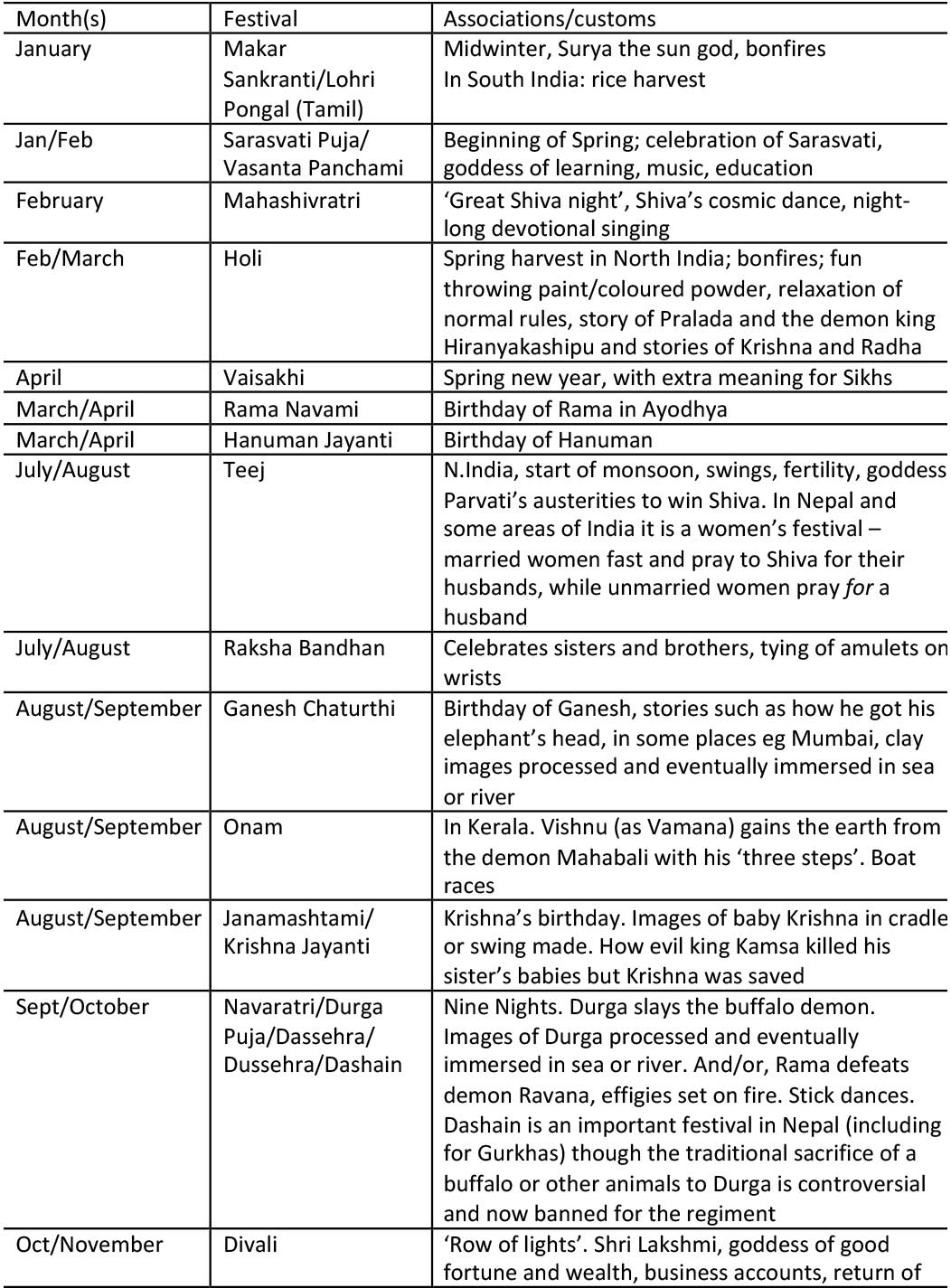
Some important festivals in particular places:
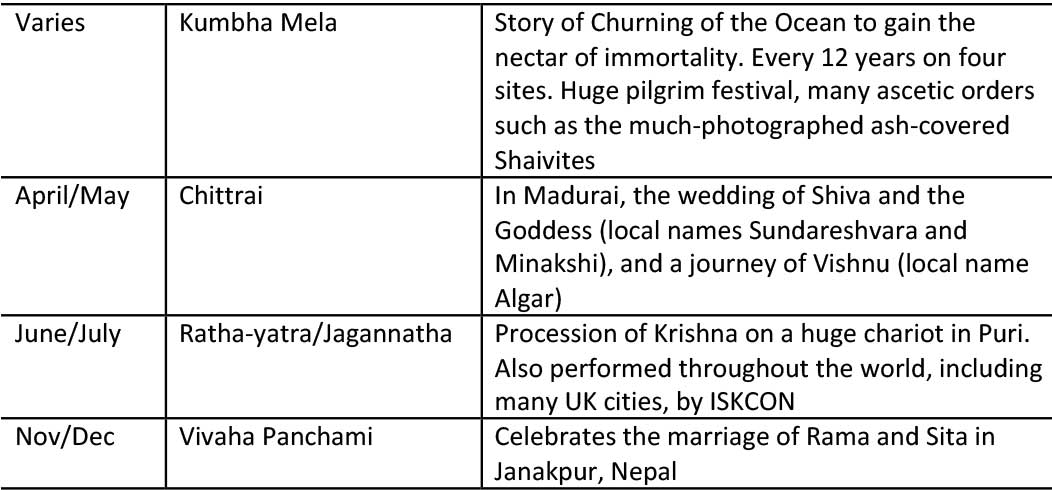
There are also annual commemorations of more recent famous Hindus such as the birthdays of Gandhi (October), Vivekananda (January) and Ramakrishna (February). Sampradayas (‘sects’) have commemorations for the founders and saints of their particular tradition.
Download the entire essay here
Pilgrimage
The Hindu terms for pilgrimage is tirthayatra (journey to a ford). Indeed, many places of pilgrimage are near rivers though the meaning is more profound than fording a river as it connotes crossing from the shore of birth and death to the shore of immortality. Varanasi, one of the seven sacred cities, situated on the banks of the sacred River Ganges, is probably the foremost pilgrimage destination. Many Hindus aspire to visit at least once, and it is considered a blessed place to die. Even if that is not possible, bereaved relatives bring the ashes of their deceased loved ones to the city to immerse them in the river which is revered as a goddess renowned for her powers to purify. The Kumbh Mela festival, observed every three years at one of four sites in a 12-year cycle, attracts millions of pilgrims. Its founding myth concerns Vishnu bearing away the pot containing the elixir of immortality produced by churning the Ocean of Milk but spilling four drops hence the four sites where the festival is celebrated. This festival is particularly notable for the attendance of ascetics and renouncers alongside ordinary pilgrims who follow in their wake when the mass bathing commences. Despite the practise of austerities by pilgrims, in these instances the distinction drawn between pilgrimage and tourism can become blurred and, while great rewards are promised to the pilgrim in this life and in terms of release from samsara (round of existence), the sincere motivation of the pilgrim is vital. Other perspectives on pilgrimage regard it as a meditative process internal to the body as a microcosm of the universe or consider any external ritual performance as pointless since only inner qualities matter.
Traditionally, pilgrimage reflects the sacred geography of the subcontinent; its cardinal points in the North, South, East and West, its mountains as well as its rivers and numerous centres sanctified by their mythological association with specific deities such as Ayodhya as Rama’s capital, Vrindavan where Krishna spent his youth, the locations of Shiva’s 12 Jyotirlingas (lingas of light) and of the 51 Shakta Pithas (seats of the Goddess). However, new pilgrimage routes have created in the diaspora including in the UK where coach trips have been arranged to convey visitors to favourite temples and, of course, Hindus in diaspora may join tours to important Indian pilgrimage centres. Also, it should be noted that Hindus have gone on pilgrimage to sites with a non-Hindu religious heritage and cross-community appeal, a practice that continues today. A popular example is the tomb of the Sufi saint Salim Chishti at Fatehpur Sikri built by the Mughal Emperor Akbar in gratitude to the saint for the birth of an heir where Hindus, Muslims and others go in the hope of having a family.
Download the entire essay here
Lifecycle ceremonies (samskaras)
Hindu lifecycle ceremonies, samskara (sacraments), sanctify the individual’s life course from before birth to after death and effect the transformations necessary to the individual’s transition from one stage and status to the next. These ceremonies include rituals dating back thousands of years. The number of these varies in different texts, but the most commonly given number is sixteen. The first nine of these relate to babies, from before conception, through pregnancy and into early childhood, reflecting the worries surrounding this period in ancient times, not completely removed by modern medicine. These include such events as the naming ceremony, weaning onto solid food, head shaving, and ear piercing.
Foremost of the educational rites is the rite of initiation (upanayana), including investiture with the sacred thread, which traditionally inaugurated a period of Vedic study that prepared the initiate to participate fully in Vedic religion and culture. In ancient times the boy/young man would spend time living with and serving his teacher (guru) and observing a vow of celibacy (brahmacharya). This practice, and the knowledge of the sacred Vedic texts and associated rituals, was traditionally only available to twice-born (dvija) men, in other words, those in the top three varnas (classes). Despite its importance, this rite is now largely restricted to brahmins and the period of studentship retained in only simplified and shortened form. A few contemporary Hindu groups have introduced equivalent ceremonies for girls, and there is some textual evidence that occasionally in ancient times both girls and boys from other social groups were initiated. More commonly, marriage has been viewed as the equivalent of initiation for women.
The rite of marriage (vivaha) which marks the beginning of life as a householder is often celebrated in elaborate and lengthy ceremonies. Among the important traditions are the welcoming of the groom and his family, the giving of the bride to the groom, and the exchange of gifts including a necklace (mangala sutra) for the bride from the groom’s mother. The couple circumambulate a sacred fire, taking seven steps together with seven prayers for the success of their partnership and casting an offering of grain into the fire. Marriage retains its central significance though there has been a move away from ‘arranged’ marriage towards both ‘assisted’ marriage where the future partners take the initiative but still involve their families and ‘love matches’.
The last of the samskaras is the funerary rite (antyeshti) which normally features cremation of the body, disposal of the ashes and offerings of rice balls to enable the deceased to join the ranks of the ancestors, succeeded by memorial rites (shraddha) at regular intervals. Renouncers, in contrast, tend to be buried and they may have undergone funerary rites before renouncing the world to symbolise the death of their old way of life.
Download the entire essay here
Sources of authority within the Hindu tradition, and their impact on wider society
There is no one central authority that can speak to or for all Hindus, either within the tradition or on behalf of the tradition to the wider world. However, various kinds and levels of authority are possessed by sacred texts – for details see Sacred texts.
There are also a number of categories of people who have authority within the tradition. The rishis (seers/sages) who ‘saw’ the Vedas are an ancient example. Brahmins (priests) traditionally situated at the apex of the varna (class) hierarchy, held religious authority from ancient times, and remain those who have expertise in both rituals and the relevant sacred texts. They also historically had a major responsibility for upholding dharma (duty, righteousness), including social relationships such as the proper conduct of the classes and the proper relationship between the priests as religious specialists and the warriors as rulers. This association with dharma still remains though centuries of social and political change have affected their status and role. Pandits (scholars), usually also a role of the Brahmin class, have the authority of expertise in sacred texts and traditional learning. The role of the guru, or teacher, was in Vedic times the person who passed on orally the sacred knowledge to young men of the top three classes. Now gurus are important in sampradayas (strands or ‘sects’ of Hinduism) where authority is passed through lineages of teachers starting with the person who founded the particular group. Gurus are often also swamis, someone who is considered to have reached direct experience of the divine, and therefore have authority to teach others, examples being Swami Vivekananda or Swami Narayan. Gurus are likely to be – but are not always – samnyasis or renouncers, and there are female as well as male gurus in some groups. Some renouncers live in monastic communities or ashrams, others live alone.
Shankaracharyas, leaders of the four orders of monastics founded by Shankara, are today often thought of as able to speak on behalf of orthodoxy, in so far as anyone can, and may speak out on controversial social and political issues. One example is the Roop Kanwar case in 1987 on which the Shankaracarya of Puri commented. Roop Kanwar became sati (technically an act of self-immolation illegal since 1829) and her death provoked a storm of protest from women’s groups alleging murder and equally forthright defences of a loving wife’s final act of faithfulness. The Shankaracharya was among those religious leaders who insisted that the act was sanctioned by sacred texts and was thus accused by his critics of glorifying sati which had become a criminal offence in the wake of Roop Kanwar’s death.
Acharya is another word meaning teacher, and it is often synonymous with ‘guru’, but tends to emphasise the subject expertise of the teacher rather than the relationship between student and teacher. Other religious specialists who are consulted regularly on various matters are jyotishis (astrologers) who are asked to prepare horoscopes for new-born children or people considering marriage and advise on the most propitious occasions for launching a new business or important initiative.
Download the entire essay here
Identity and community
Even in those traditions which actively seek to spread their teachings (such as Buddhism, Christianity and Islam), the majority of adherents identify as such because they were born into a particular family and community. The traditional view in Hinduism is that one has to be born a Hindu, although it is possible to join some Hindu or Hindu-related movements such as the International Society for Krishna Consciousness (ISKCON) which actively seeks Western (and other) converts, and other people may incorporate Hindu ideas, practices and values into their own personal worldview without necessarily using the label. The issue of Hindu identity is discussed in detail in the section ‘Who is a Hindu?’, including viewing it predominantly as a ‘religious’ identity, separable from other ‘religious’ identities, influenced by the Western notion of ‘religion’.
Much of the sheer diversity of Hindu tradition is replicated in diaspora settings such as the UK. Though Hindus may primarily identify with a particular strand of Hinduism, perhaps following the teaching of a particular guru, or following the customs of the part of India where their family originates, the situation of being a minority group in a different cultural environment has led to formation of a number of organisations which seek to represent all Hindus to the wider community, for example in dealings with government, or the organisation of religious education in schools. Examples of such organisations are the Hindu Council UK, the Hindu Forum of Britain and the National Council of Hindu Temples UK. On a more practical level, many Hindu temples in diaspora have to cater for Hindus from different backgrounds and groups, thus contributing to a sense of belonging to one ‘Hindu community’. The practical requirement for people to become spokespersons for a Hindu community perceived as unitary can lead to some glossing over the diversity of actual belief and practice, and particular portrayals may be emphasised, such as a monotheistic Hinduism that promotes equality and is not implicated in the notion of caste.
Download the entire essay here
Hinduism and politics
The somewhat romantic notion of Hinduism as a path which turns its back on the material world in a spiritual quest for realisation of one’s true self, God or ultimate truth would suggest a tradition ‘above’ such worldly concerns as politics. However, this is indeed a stereotype (see Preconceptions). The concept of Dharma, the eternal law (for more on Dharma see section on A Good Life), refers not only to the ultimate truth underpinning the universe (what is) but also to the order and harmony that ought to reflect this reality in the realm of human morality and society (what should be). Thus it is not a contradiction that Sarvapalli Radhakrishnan, the philosopher whom as an Advaitin upheld the one ultimate reality of Brahman, could also stress the need for ethical action in the relative reality of the social and political world and become the first Vice-President (1952-62) and Second President (1962-67) of India instead of (say) an ascetic renouncer. He also thought that being a teacher was one of the most important roles anyone could have because education was the key to India’s problems, and asked for his birthday (September 5th) to be celebrated instead as Teachers’ Day in India.
In earlier times, the role of kings, and the kshatriya varna (class of rulers and warriors) more generally, was vital since only they could ensure the security of the people and establish order in society, and thereby uphold dharma. Sacred texts may have a social and political resonance, such as the moral teaching of the Dharmashastra that, in the Laws of Manu, includes a section on rajadharma (the duty of the king). The king is counselled to cultivate virtue and avoid vice and reminded that to protect the people is the calling of the kshatriya. He is informed that in military matters some methods are unacceptable such as the use of concealed or poisoned weapons and that enemies should not be attacked if injured or disarmed. Memorably, he is urged to plan with the patience of a heron and fight like a lion and a wolf (if necessary, retreating with the speed of a hare).
The most famous ancient Indian treatise on statecraft, Kautilya’s Arthashastra, dating from the centuries immediately before and after the start of the Common Era, is addressed to the king and offers advice and guidance on a range of subjects such as the appointment and roles of ministers and officials, law and justice, economics and trade, foreign policy and military strategy. Asserting the primacy of artha (wealth, power) as necessary to the performance of dharma and the acquisition of kama (pleasure, aesthetics), opinions are sharply divided on the moral quality of the work and it is perhaps best understood as realist or pragmatic in approach. While the political landscape of the text has long ceased to exist, not least under Mughal rule, its very existence can be taken as evidence that India did not lack for political theory as was sometimes claimed in defence of British imperialism.
Religion has been an important factor in more recent Indian politics. The British as India’s imperial rulers saw religion as the foundation of Indian society and religious affiliation as a basic variable in the government and administration of the subcontinent. This had the effect of creating greater emphasis on ‘Hindus’, ‘Muslims’ and ‘Sikhs’ as separate exclusive ‘religious communities’ with potentially competing interests (see What is Hinduism? and When did Hinduism begin? for the argument that colonialism created the very concept of Indian ‘religions’ in the Western sense). The sense of socially exclusive groups with strong external boundaries, essentialised characteristics and competing interests led to the formation of religion-based political parties such as the Hindu Mahasabha, the (All India) Muslim League and, for Sikhs, the Shiromani Akali Dal. Political parties with distinct religious constituencies and programmes have continued to feature in independent India with a resurgence in the Hindu radical right in recent decades.
There was also a renewed stress upon activism in the modern era as different groups and organisations pursued the social and political implications of their religious values. Movements of reform and revival in the nineteenth and twentieth centuries campaigned for change in respect of the caste system and the position of women but were countered by other movements seeking to defend orthodoxy. Similarly, Hindus involved themselves in the Indian nationalist cause seeking independence from Britain and later with party politics in independent India, sometimes with an overtly Hindu agenda.
Certainly, campaigns for Indian independence from Britain were influenced by different senses of religious and national identity. Among many factions and approaches was that of
Gandhi (1869-1948) who attempted to promote Hindu-Muslim unity, as well as non-violent resistance as the way to persuade the British to leave India. His use of Hindu symbols and ideals, adopting the appearance of a traditional Hindu holy man and invoking Ramrajya (Rama’s rule) as a state of perfection inaugurated by Rama’s divine kingship, won much popular support among Hindus. This, however, differentiated him from colleagues like Jawaharlal Nehru (1889-1964), later the first Prime Minister of independent India, whose socialist principles made him uncomfortable with Gandhi’s overtly religious appeal to the masses despite the close personal relationship of the two men. Other nationalists like Bal Gangadhar Tilak (1856-1920) took a different approach. His appeal to Hindu practice and history, promotion of the Ganapati festival dedicated to Ganesh for political purposes and championing of Shivaji (a seventeenth-century Maratha ruler and hero of anti-Muslim resistance) as a role model, was intended to unite Hindus at the cost of community relations with Muslims and did not exclude violence in the service of Swaraj (self-rule).
Political struggles over independence led in the end to Gandhi failing to prevent Partition (the division of British India into two countries, India and Pakistan) which involved extreme communal violence, though Gandhi was to meet his death at the hands of Nathuram Godse, a Hindu who, like other Hindu nationalists, believed that Gandhi had made too many concessions to Pakistan.
That independent India is a secular state was made clear in the 1976 Forty-Second Amendment to the Constitution, something that was implicit in the original 1950 Constitution’s commitment to freedom of religion, equality, non-discrimination and protection of minorities. What was meant was not a non-religious or anti-religious position but a version of secularism that accepts all religions as valid that in fact owes much to the Hindu philosophy of neo-Vedanta.
However, Hindu nationalism (the aim for a Hindu state) has become more influential in recent decades. V.D. Savarkar (1883-1966), a major ideologue of Hindu nationalism, put forward the hugely influential concept of Hindutva (Hinduness) in the 1920s. Hindutva, in his view, was cultural, not religious, in character, being based on a connection to India and common ethnicity. Accordingly, his vision of a Hindu Rashtra (Hindu state) drew a distinction between Hindus (in the religious sense), together with Sikhs, Jains and Buddhists (members of traditions indigenous to India) as its citizens, and Christians and Muslims (associated with traditions of foreign origin) whose status as citizens was marginal at best. This ideology has informed the aims and activities of the Hindu radical right, spearheaded by the Sangh Parivar, including its political arm, the Bharatiya Janata Party (BJP), in power in India since 2014, having previously led a coalition government 1998-2004. In spite of the cultural emphasis of Hindutva, it does not exclude espousing causes with a strong Hindu religious rather than more broadly cultural nature. Notably, successive leaders of the BJP have taken up the cause of Ayodhya as Rama’s capital city and supported the building of a temple to mark his birthplace on a bitterly contested sacred site occupied by a mosque until 1992 when it was destroyed by Hindu activists chanting ‘Victory to Rama’. In August 2020, Narendra Modi, BJP Prime Minister of India, performed a bhumi pujan (ritual to propitiate Mother Earth preparatory to construction), laying a silver foundation stone for a new Hindu temple on the site, scheduled for completion in the next three or four years.
Download the entire essay here
Culture and cultural diversity
There is no clear division between religion and culture in India, certainly not from the perspective of many Hindus who, however diverse, constitute the majority community. Throughout this essay the difficulty of separating ‘Hindu’ from ‘Indian’ in various contexts has been noted. Indian culture from food to philosophy has proved remarkably vital and resilient over the millennia, having had important influences on both occupying empires and the majority communities of countries to which Indians have moved. A background ‘Indian culture’ is shared not only by religions with origins in India, such as Jainism, Sikhism and Buddhism, but also by South Asian Muslims, Christians, Zoroastrians and those who identify as non-religious. ‘Indian culture’ is, of course, not unitary and there are many regional, linguistic, urban/rural and other differences within such a large and populous subcontinent and globally. Since the first encounters between ‘East’ and ‘West’ thousands of years ago, ideas, artefacts and customs have moved both ways, and in the contemporary globalised context both Indian culture and more specifically Hindu ideas, literature, creative arts, ritual, moral exemplars and meditational practices have influenced wider society. Similarly, as Hindus have settled around the world beyond India, they have made creative adaptations to the cultures in which they find themselves.
Download the entire essay here
Who are Hindus?
In one sense a Hindu is anyone who identifies as such. However, it is somewhat more complicated than that, as they may also need to be accepted as Hindu by others, and in any case the meaning of the word Hindu has changed over time and continues to be fluid. While now the terms Hindu and Indian are most often used to mean something quite different, they both owe their origins to the Sanskrit Sindhu or River Indus. When pronounced by the Persians, Sindhu became Hindu which was subsequently appropriated by the Greeks for whom it became Indos. In both instances, the terms referred to the land beyond the river, the people and their way of life. Hence in the past Hindu and Indian meant much the same and were used as synonyms. Later Hindu came to have a distinctly religious meaning as an adherent of Hinduism, displacing the earlier geographic, ethnic and cultural meaning that was broad enough to encompass members of other religions, such as those now called Jains and Buddhists. The legacy of the older usage persisted into the modern period in Western sources which retained the sense of Hindus as participants in the indigenous civilisation of the subcontinent even if the narrow religious sense was acquiring dominance. Opinions differ as to when and why this change occurred (see When did Hinduism begin?).
It is clear that what began as a term used by outsiders in due course was adopted by insiders. It is less clear whether Muslim or Hindu commentators in pre-modern India conceived of Muslims and Hindus as religious communities rather than ethnic or cultural groups. Possibly, as William Oddie suggests, regional factors may go some way towards explaining apparently contradictory evidence on Muslim-Hindu relations and the development of Hindu self-identity as membership of a religious community. While this self-identity may predate the modern period, undoubtedly it developed further in British India where, for a variety of reasons, Hindus increasingly prioritised their affiliation with ‘Hinduism’ over the multitude of traditions and movements with which they were associated. Even so, ethnographic studies query the notion that Hindus and Muslims belonged to exclusive communities and qualify the extent to which Hindus recognised the label Hindu as designating their religious identity.
Certainly today those who describe themselves as Hindu in all likelihood will do so to indicate their adherence to Hinduism as a religion, albeit that ambiguity and ambivalence have not been eliminated entirely. Some contemporary Hindu nationalists are reviving the idea that Hindu and Indian are interchangeable (as did Hindu nationalists in the first half of the twentieth century), so counting adherents of Indian-origin traditions such as Buddhists, Jains and Sikhs as Hindu, while rejecting Muslims and Christians as Indians. Some religious groups cross the boundaries between communities for example some Punjabi groups (such as the Valmikis) that challenge the division of Hindus from Sikhs. The International Society for Krishna Consciousness (ISKCON) devotees have been divided on how the Society should be positioned, as separate from or part of Hinduism, though many would accept the label Hindu while also emphasising their Vaishnava allegiance. The position of some minority ‘tribal’ groups in India can also be ambiguous.
In most cases, self-identified Hindus are born and brought up in Hindu families, in India or of Indian descent in diaspora, settled in other countries. Many would maintain that to be a Hindu you have to be born into a Hindu family but there are exceptions or at least qualifications, with Westerners (and others) joining Hindu and Hindu-related movements in addition to participating more generally in Hindu religious life whether or not the label Hindu is applied to or adopted by individuals.
Nevertheless, an antipathy towards conversion as neither karmically appropriate nor ethically acceptable together with the absence of definitive criteria for establishing what is and what is not Hinduism make it more difficult to establish a Hindu religious identity independent of an ethnic basis.
Download the entire essay here
How this essay is organised
The headings in this essay are derived from the six ‘Big Ideas’ (Wintersgill ed. 2017, Wintersgill et al, 2019) and the Commission on RE’s National Entitlement (CoRE 2018). This introductory section for example links to NE2 – key concepts such as religion and the complexity of worldviews, NE4 – the ways in which worldviews develop in interaction with each other and have some shared beliefs and practices, and that people may draw upon more than one tradition, and Big Idea 1 – continuity, change and diversity and what we mean by religion(s)/worldview(s).