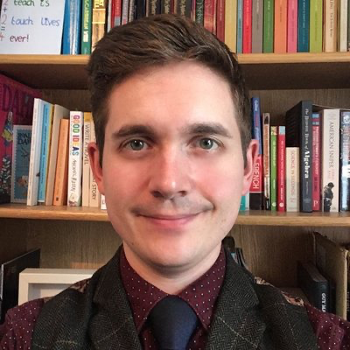
Dr Kate Gibson, Social historian of the eighteenth century
I am social historian of eighteenth century Britain and I was part of a team of researchers at the Universities of Manchester and Nottingham from 2018 to 2021. We spent three years going through dozens of archives and local record offices looking for diaries, letters and objects like pottery or needlework samplers which people would have displayed in their houses. We ended with over 200 case studies of families or individuals.
We aimed to uncover the experiences of a large range of people. We have items written or made by people of all ages, including young children, business owners who made fortunes in the cotton industry, grocers and shopkeepers, as well as people living in quite severe poverty. For example we found the diary of a man called John Burnthwaite from Cumbria. In the early 1830s he walked around the country selling religious pamphlets, partly because he had no settled home and very little money. For him, his religion was a source of comfort, so when he experienced bad weather or his boots fell apart he prayed to God for guidance, and then gave thanks to providence if he was able to sell enough pamphlets in a particular day. It is through examples such as John Burnthwaite that we can see both the changing economic and physical landscape, as well as deep roots of peoples’ Christian faith.
As part of this research project we have worked with Kate Christopher and graphic designer David Caunce to produce a range of free resources for schools. The lessons are based on the archive documents including maps, needlework samplers, letters and diaries.
Our aim has been to encourage pupils to ask what was it like to grow up, live and work in a growing industrial town. How did the upheavals affect daily life, how did it change how people thought about their place in the world, and did it change their Christian faith? These questions tie in with broader themes such as the economic and social impact of industrialisation, as well as the growing diversity of Christian belief in the eighteenth century.
The resources are designed for KS2 and 3 pupils and arranged around 7 lessons. Each lesson contains background notes and ideas for teaching. Resource packs are given with each lesson so they are ready to be taught. The themes in the lessons are flexible so Primary teachers could apply them across History, Geography and English as well as RE.
Dr Kate Christopher, Teacher and adviser
As a teacher this has been a wonderful opportunity to create resources based on new historical research. This allows teachers to experiment with looking through a historical lens and how it feels in the classroom. I have presented this project to several groups of Primary teachers who have all responded positively to the idea that children can think as historians in RE. They can look at the sources and make sense of them in their own way.
Through these resources pupils will engage with rich, sometimes complex ideas and sources. They gain a glimpse into a past age that illuminates the present. They hear different voices and listen to peoples’ hopes and fears and their daily lives. It is a fascinating glimpse into an era experiencing rapid technological, social and physical change.
These resources support a multidisciplinary approach to Religion and Worldviews in that they provide an excellent example of historical thinking.
Please access the resources through this link: https://www.library.manchester.ac.uk/rylands/research/projects/current/faith-in-the-town/
We would be very grateful for any feedback.
Check out the main website here, including blogs about the artefacts and sources for your wider interest: https://faithinthetown.wordpress.com/
Dr Kate Gibson is a researcher at the University of Manchester, specialising in the social history of eighteenth-century Britain.
Dr Kate Christopher teaches part-time in a secondary school in inner London, is an RE Advisor and is Culham St Gabriel’s Lead Consultant for Professional Development. Email: kate@cstg.org.uk
About
Kate teaches part-time in a secondary school in inner London, is an RE Advisor and is Culham St Gabriel's Lead Consultant for Professional Development. Email: kate@cstg.org.uk
Culham St Gabriel’s Trust turns 10 years old on 21st June 2022! 2012 was an important year in many different ways- the Diamond Jubliee and the London Olympics spring to mind- I also turned 40 that year too! However, the birth of Culham St Gabriel’s bringing together two church college Trusts was a very significant moment for the religious education community. In this blog a former Chair and director express their reflections, alongside the current chair. I also draw out some themes running through the last 10 years and what these might mean for the next decade.
Reflections from the first Chair of Culham St Gabriel’s, Dr Priscilla Chadwick OBE…
‘Culham St Gabriel’s was created in 2012 by the coming together of two church college trusts which had worked in close partnership for several years prior to the merger. St Gabriel’s Trust arose originally from the college’s closure by Mrs Thatcher in 1977, leading to the transfer of its buildings to Goldsmith’s College. At that time, St Gabriel’s had only enough money to offer a few book grants each year, but a wise legal adviser had inserted a footnote to the transfer that, should Goldsmith’s ever wish to relinquish the buildings, these would revert to the St Gabriel’s trustees at the original price! Thus the trustees were able to sell the college on to another educational institution, thereby providing the Trust with a significant charitable endowment for the future.
The charitable objects enabled the trustees to support RE teachers wishing to enhance their postgraduate qualifications and later created an important partnership with the Culham Educational Foundation, setting up the St Gabriel’s Programme. This initiative developed innovative resources for RE and established the annual St Gabriel’s Weekend, firstly in Sunningdale and later at Wokefield Park, offering a free of charge opportunity for RE teachers to come together in a residential setting and share good practice, something that most would otherwise be unable to do, isolated in their own schools and often undermined by government educational policy: for many, these weekends were utterly transformative professional experiences which inspired them as they returned to their schools.
When in 2012 the two clerks of St Gabriel’s and Culham were both planning to retire, the opportunity arose for the two trustee bodies to come together, building on the cooperation over many years, to create the Culham St Gabriel’s Trust. Thus the significant legacy of both colleges would be safeguarded for future generations of RE teachers. With a generous endowment, this now meant that the Trust could more easily support major national initiatives such as the RE Council and the 2018 Commission on RE. This commitment vital to RE continues to flourish under the strong leadership of Kathryn Wright.’
What strikes me about Priscilla’s reflections is that the Trust’s focus on free, transformative, and inspiring resources and professional development still very much lies at the heart of the Trust. The reimagining of RE:ONLINE over the last few years, our scholarship programmes and the recent launch of our free e-learning platform continue to fulfil this mission.
Reflections from the first Director of Culham St Gabriel’s, Dr Mark Chater…
First, the merger itself: I gather that the idea first occurred to Priscilla and John Gay while on a walk. From this the idea grew, building on the many years in which the two former Trusts had worked together. Mutual trust, confidence and enthusiasm deepened. John Keast chaired the Implementation Committee which looked after the details – of which there were many! Within only a few years, Trustees saw themselves as ‘CSTG’ rather than ‘Former C’ or ‘Former St G’. Now, everyone takes the existence of the merged Trust for granted. But it was a major achievement at the time, based on shared vision and painstaking care over detail.
Modernising the grant application process to make it more user-friendly for applicants, and less burdensome for Trustees, was an early achievement. Putting it onto an online process with new, RE-focused grant criteria helped to place CSTG on the map. The feedback from grantees was positive. Sharing information and ideas with other RE grant-givers has also grown gradually.
Three significant CSTG grant decisions which, perhaps, have deeply influenced the course of RE for the medium term: Understanding Christianity, the NATRE/RE Today regional champions, and the Commission. The first of these had a long and at times lively gestation, but eventuated in resources which really enhanced the rigour and excellence of RE. The regional champions have strengthened the infrastructure of support available to teachers, and contributed to the growth and sustainability of NATRE. The Commission, which submitted its final report and recommendations in 2018, changed the conversation about the future of RE (or Religion & Worldviews) and we wait in joyful hope for a government bold enough to implement the much-needed change which it envisaged.
But that is not the end of the story. I hope and pray that CSTG will continue its vital leadership, support, and innovative thinking for many years to come.
Having worked with Mark for a number of years as a CSTG Consultant I think he instilled in me an understanding of the Trust’s forward-thinking approach. Mark’s reflections show how the Trust has always been sensitive to the ever-changing educational landscape, responding to new contexts. At its heart, though always remains the focus on serving others in the best possible way. Therefore, we have some exciting new grant making plans to announce. Firstly, we are launching special