Global terms: Curriculum & Planning

Dawn Cox | 30 November, 2021

This year we are trialling a new approach to the start of year 7 RE. In my teaching career I have tried several approaches including looking at why we study RE and have never been happy with them. This year I created a new scheme that asks the enquiry question ‘How do we study religion and belief?’

We see students for one hour a week, so time is very tight, and I proposed to my colleague that we trial using a booklet with students. This is a great time saver as students don’t have to write titles each lesson and it’s easy to refer to page numbers which is the same for all of them. I have also found that when exploring a new approach it helps to organise my ideas and share them with my colleague as I’ve had to create and sequence the learning in the booklet.

The booklet pulls together the different ways we can study religion and belief and the things that we look at. One part of this approach involves introducing students to worldviews.

We start by thinking about our own personal worldview. We are clear that this is about how their own views have been developed over time (and will continue to develop) rather than being their specific view on something.

We have used two short clips to support this. The Theos ‘Nobody stands nowhere’ clip https://www.youtube.com/watch?v=AFRxKF-Jdos and this ‘What is your worldview?’ clip. https://www.youtube.com/watch?v=VXnSE0uvwzM

Drawing of magnifying glass with the question what happens when we die? written on the lens. My worldview written on the handle
Interestingly, I have found a very small number of students have struggled to grasp this concept. It is very abstract and requires a conceptual understanding of themselves that some students cannot conceive. A couple of my students have replied ‘I don’t have a worldview’ or ‘My view hasn’t changed’. This kind of self-knowledge is a challenge for a small minority of students and colleagues that teach students with some types of SEN may find this more common.

To help students with this abstract concept I chose to use the metaphor of a magnifying glass; to help students understand that our personal worldview is how we ‘see’ things. I have used some ‘big questions’ to help them to understand how their worldview works and then we work together to unpick where our views may have developed from.
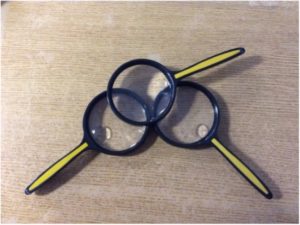
Photo of 3 magnifying glasses on a deskI have bought several magnifying glasses to add to the explanation. This has helped students to understand that we all have different personal worldviews as I hold them up when explaining each individual view. It also helps to illustrate other worldviews. I have also shown how these lenses can ‘cross over’ which illustrates how views can be ‘combined’. An example was when we were discussing ‘how did the world get here?’ Students came up with answers ‘God made it’ and ‘the Big Bang’. I held up a lens for each of these views and then crossed them over. For some students this was a new Christian worldview; that God created the Big Bang.

Drawing of 2 overlapping magnifying glasses with God made it written on the handle of 1 and The Big Bang written on the handle of the other

This has helped them to understand that it may be better for us to discuss the many views within a religion for example we discussed ‘Christianities’ as a better term to show that within Christianity there are many different interpretations.

It is interesting to see how their understanding of worldviews is shown in their explanations. Here are responses from two pupils:

“We can study religion and belief by looking at people’s worldviews and opinions. But before we start we need to understand how people get their personal worldview. You are not born in the world with our own opinions as you cannot understand anything yet. But over time as you grow up you start to develop your own worldview and beliefs as you are surrounded by many different influences like your parents and what they believe or your friends and even video games! If you are a religious person your religion may have a big impact on how you see the world as religions normally have quite a lot of sources of authority….”

Jude, Year 7

“We can study religion and belief by looking at our personal worldview. We have got our own worldviews from many things but these aren’t permanent. These worldviews can change throughout your life, for example, when you are younger your parents would be your main authority and sources of your opinions and beliefs but when you’re older you probably wouldn’t take as much notice of them”

Luke, Year 7


About

Dawn is Head of RE at a secondary school.
See all posts by Dawn Cox

Karen Steele | 02 November, 2021

It took just moments to decide the focus of my project for the Edge Hill RE Subject Knowledge Summer School. I’ve always loved teaching Islam and enjoyed the challenge of developing my subject knowledge for the 2016 specification. The support of people like Zameer Hussain with Shi’a Islam has been greatly appreciated. However, at times my lessons felt a bit plodding and superficial. I recognised immediately the Ofsted Research Review[i] reference to the use of ‘proof texts’ in GCSE. I’ve been guilty of that. Although I had included some textual analysis and scholarship into my lessons, I still felt I could do better. I knew straight away, therefore, I wanted to develop my confidence with Islamic texts and consider how to deliver the content in a more memorable, engaging and meaningful way. After attending the Summer School, I developed a student anthology with carefully selected and sequenced readings, clearly linked to the specification content.

Day 1 of the Summer School included an inspiring session on text and story by Mary Myatt. She reminded us of something we all know, but too often forget when preparing students to sit exams: humans love stories and stories matter. Daniel Willingham claims ‘our brains privilege story’[ii]. RE has an abundance! Text and story are a wonderful way into learning about the Islamic traditions and can be used to enhance our GCSE. That’s what I set out to do.

Islamic texts are daunting: the many collections of Hadith, the varied commentaries and interpretations. Even as an RE specialist, I worried about my ability to get it right. This is why Edge Hill’s offer is so important. Surrounded by specialists including RE teachers and academics, I could ask questions, share ideas and consider feedback. The very patient Dr Harith Ramil supported me with my project, answering my endless questions, offering suggestions and critiquing my work. If only every RE teacher had opportunities like this.

The ‘final product’ is by no means final. Like the tradition of textual interpretation in Islam, it will continue to evolve. Not everyone will agree with my selections and the interpretations I have offered. However, I’m now able to justify my choices and engage my students in a deeper dialogue about the ways texts and story are used in the tradition. The anthology includes 7 texts from the Qur’an and Hadith, chronologically covering key events in the early development of Islam.

Back in the classroom I have proudly issued Year 10 with their anthologies. Together we have analysed and annotated Al-Fatihah (Surah 1:1-7) and an Al-Bukhari Hadith narrating the Night of Power. I can see Year 10 already have a strong foundation for investigating the Islamic understanding of God and the importance of the Qur’an. They are instinctively referring to the texts they have studied to support their claims rather that ‘sticking in a quote’. Will this have the desired impact? Time will tell, but the early signs are good; students are showing a richer and more contextual knowledge.

Edge Hill will put my resources on their website soon. I have included a list of the many resources I discovered and notes for each text designed to help busy teachers.

I feel privileged and grateful to have had this opportunity. If you get the chance to apply to the Summer School, I recommend you go for it.

[i] https://www.gov.uk/government/publications/research-review-series-religious-education/research-review-series-religious-education

[ii] Https://www.marymyatt.com/blog/using-stories-in-the-curriculum

About

Karen Steele has taught RE in secondary schools for over 20 years. She is a senior lecturer at the University of Worcester, where she leads the secondary RE PGCE. You can link to her other blogs which are full of recommendations to improve subject knowledge. https://missevareteacher.wordpress.com/blog/

See all posts by Karen Steele

Matthew Lane | 19 October, 2021

In response to the 2018 CoRE report many SACREs are considering how to update their Locally Agreed Syllabuses. Effecting change in a busy and fast-moving environment such as a school can be a daunting prospect. In this blog I present how we changed our curriculum at my Norfolk Primary school.

This was not just an update or tweak, we adopted change. We reshaped the curriculum to utilise three disciplinary pedagogies, imagined as lenses to look through; Theology, Philosophy and the Human & Social Sciences. As these names are quite the tongue twister, we call them Believing, Thinking and Living in my school when discussing with younger learners.

With a new pedagogy and new freedom in mind I sat down to look at our current RE curriculum and discussed with children what they thought of the subject:

“I like doing our stuff but it’s interesting to see their stuff and see how different people live.”

Having heard their thoughts, I threw the old curriculum in the bin and started afresh.

Our stuff and their stuff

Our student body is 95% white British and Christian heritage. It is for this reason I do not want children learning about “our stuff” (Christianity) followed by an entirely different unit of “their stuff” (everything else).

If children are to see the beauty and value of other people, religions and worldviews they will need the skills to appreciate them and, most importantly, find ways of connecting with them. This got me thinking about exploring: if you know where you have been, it gives you a good basis to explore the new. So, I decided to be bold: every unit of learning would start with Christianity. We would learn about what we already know, or thought we knew or (in the case of Christmas) thought we knew but was actually wrong; and then branch outwards. Finding links and connections between Christianity and Religions & Worldviews would form the bedrock of our curriculum.

Branching out

We are a church school and therefore at least 50% of our learning content focuses on Christianity. The first 3 or 4 lessons of each half-term have a Christian focus. This gives time to explore our Key Question and reflect on Christianity’s answers. From this solid understanding we can branch out to consider how one or more other traditions would respond.

For example a Year 6 unit begins by pondered the philosophical question, ‘why was the Earth made?’ using Genesis 1 and 2. They explore the different presentation of women and learn that the books were written at different times by different authors and then collated together at a much later date. A lesson is spent looking at the scientific description of how the Earth was formed and what similarities this has to Genesis. This allows pupils to gain a greater sense of the context and concerns at the time Genesis was recorded.

From here we branch out to the events of the Hindu creation story and its expression of our universe as one in string of many (Samsara on a universal scale). Children quickly spot the beginning of the world in darkness and water and how a prime mover is needed to bring light and life into the world.

The most important part of the new curriculum is that the children begin by finding what is the same and then questioning why they are the same. How can two religions from different sides of the planet have similar beliefs? How can two faiths that appear so different actually be quite similar? This allows discussions of depth and richness.

Growing this new curriculum and pedagogy has taken time and lots of energy from the amazing staff at my school. As we move further towards a R&W curriculum, emphasis will be placed on denominations and how, for instance, there is no single “Christian Worldview”. The aim is that children can see how worldviews similar to their own can be very different, whilst the superficially different can be very similar.

About

Matthew is RE Lead at Hethersett CEVC Primary School in Norfolk. He tweets about Religious Education and leadership @MrMJLane and on his website www.theteachinglane.co.uk

See all posts by Matthew Lane

| 05 October, 2021

Would you start an RE lesson with a boxing match? By that we mean a lesson about a famous boxing match, not a re-enactment in the classroom! To celebrate Black History Month we present a set of four learning sessions (suitable for Key Stages 2- 4) on Muhammad Ali, one of the world’s all-time greatest boxers. Ali was also a conscientious objector, antiracist activist and devoted Muslim. All these aspects of his life are intertwined, as our multiple worldviews are. As well as a contribution to teaching resources for Black History Month, these lessons are also an example of what worldviews can look like in the classroom.

Pupils might be confused to learn about a famous fight in RE, although some would absolutely love it. During his career as a boxer Ali fought in and won several iconic fights. His sporting career illustrates how he constantly challenged preconceived ideas about how a black athlete should behave in public. In our lessons, we present Ali’s actions inside the ring as just as important to an understanding of him as those outside. In a worldviews approach, the strands of someone’s life and context cannot be separated.

Ali was once called the most famous Muslim in America. Like most people Ali sometimes had contradictory beliefs and his Islamic interests shifted over the years. In our lessons we trace Ali’s path from Nation of Islam to Sufi Islam, to Sunni Islam. Pupils will consider Nation of Islam in historical and political terms, as well as religious.

After he had won the 1964 match, Cassius Clay announced to the world the name he now wanted to be known as: Muhammad Ali. He had always been interested in Islam. At high school he wanted to write an English paper on black Muslims (Nation of Islam), but was not allowed to. Muhammad Ali first saw Malcom X, one of the most influential black figures of his time when he spoke at a Nation of Islam rally and the two became friends. Malcom X watched Ali’s 1964 match with Sonny Liston match from the side-lines. The next day as the world was still in shock over Ali’s victory, with Malcom X by his side, he announced he was a Muslim and that he had a new name. He said ‘Cassius Clay is a slave name, I didn’t choose it and I don’t want it. I am Muhmmad Ali, a free name – it means beloved of God, and I insist people use it when they speak to me’.

Incredibly Ali visited the town of South Shields in 1977 to have his marriage blessed in the mosque there. The Al-Azhar Mosque serves the Yemeni community of South Shields, who had settled in the area around the First World War to work for the Merchant Navy. A short documentary details this moment, showing footage of Ali and his wife in South Shields and the pride of the local Yemeni community to welcome this dazzling figure to their mosque. In our lessons we give a link to this documentary, created by photographer and artist Tina Ghavari.

A worldviews approach to learning about Ali, whether in a lesson or at a lunchtime or whole-school event, means his antiracist struggle or his devotion to Islam is not separated from his whole life. Ali was an athlete, a campaigner, a public figure, a conscientious objector, a husband and father and a Muslim. All these strands make up the man. We hope you enjoy exploring Muhammad Ali with your pupils, you can find the resources on RE:ONLINE here.

Kate Christopher, part-time in a Secondary school teacher in East London and independent RE adviser

Lynn Revell, Faculty Director of Research, Canterbury Christ Chuch University

About

Thomas Breakwell | 26 January, 2021

In my teaching of AQA GCSE RS Christian beliefs I have found one aspect perplexing, namely the paradoxical role of scripture. On the one hand, the new GCSE Religious Studies places a greater emphasis on every RE teacher’s favourite buzz words, ‘sources of wisdom and authority’ and yet pupils spend very little, if any time at all, actually engaging with scripture in any meaningful way. Instead, engagement with biblical scholarship seems to begin and end with cutting a few quotes from the synoptic gospels or John or the letters of Paul and simply pasting them in an exam answer without any engagement with the history, audience or purpose of the biblical texts.

The result is that I often find pupils asking me fantastic questions such as ‘who is Mark?’, ‘who was Luke writing for?, ‘what is a gospel?’, ‘what was life like at the time of Paul?’, ‘did Jesus actually exist?’. These are all excellent questions, and questions that pupils should be asking, and yet I felt that these questions were often ill-served by the current GCSE specification.

In response, this academic year, I did something different. I taught a lesson that was completely removed from the specification. The aim of this lesson was for pupils to gain a greater understanding of the historical Jesus and importantly how New Testament scholars use historical methods to ascertain if events contained in the gospel narratives can be considered to be historical. The lesson went something like this:

I started by briefly explaining to pupils the audiences and purposes of each of the synoptic gospels and John. The aim of this being that my pupils would begin to appreciate that the gospel texts they have been studying where written by authors to particular audiences and therefore these texts, like any other text, have a purpose and sit within a historical and social context.

Following this, I Introduced to pupils three main criterion which are often used by scholars in the study of the historical Jesus: the criterion of dissimilarity, criterion of embarrassment and the criterion of multiple attestation. The criterion of dissimilarity is simply a method that considers if the events in Jesus’ life (for example his baptism) are distinct from the teaching of 1st century Judaism or the early church. If they are, it reasons that it is more likely to be historical. The criterion of embarrassment considers if the event in Jesus’ life would have been considered embarrassing for the early church. If it would have been embarrassing for the early church it seems unlikely they would just make it up! Finally, and most importantly, the criterion of multiple attestation which focuses on if the event in Jesus’ life occurs in multiple different Christian and non-Christian sources. If an event in Jesus’ life such as the crucifixion is referenced in both Christian and non-Christian sources, such as the writings of Josephus, then it is more likely to be historical.

After my explanation, my pupils got to work. As a class, pupils read the baptism of Jesus (along with some information about baptism in first century Palestine). Then using the three criteria, I modelled step by step how each criterion could be applied to the baptism of Jesus. The benefit of modelling the first example as a whole class allowed me to reiterate what I expected my class to do and address any questions or misconceptions they had.

After scaffolding and modelling the first example, it was now time for my pupils to practice on their own with pupils applying the same criteria to several of the miracles of Jesus such as the exorcism of the blind and mute man and the raising of Jairus’ daughter. I found that my higher attaining pupils went one step further and even considered the limitations of using the criterion of embarrassment, multiple attestation and dissimilarity to study the miracles of Jesus. To end, we discussed as a class their views on if the events ascribed to Jesus in the gospels are historical and if such a question matters for Christians today.

Overall, I think my off-specification adventure helped some of my pupils to begin to think a little bit more deeply about biblical texts and historical methodology. I hope this blog provides a little bit of inspiration to go a bit beyond the specification and get your GCSE classes to delve a little deeper into the rich world of the texts they are reading. Not only would engagement with historical methodology enhance our teaching of Christianity, but other worldviews might also benefit from an appropriate form of this approach.

About

Thomas is a Subject Lead for Religious Studies at Colmers School & Sixth Form College, Birmingham.

See all posts by Thomas Breakwell

Matthew Lane | 12 March, 2020

Change is not something humans do well. Starting a new job is listed as one of the most stressful events in our lives, so when the new Norfolk Agreed Syllabus called for a new curriculum and new pedagogy in RE, it was a revolution that would require empathetic leadership and lots of planning.

At the heart of the new Syllabus is a multi-disciplinary pedagogy (often called Balanced RE). The approach explores suggested key questions through three lenses: theological (thinking through believing and studying sacred texts), philosophical (thinking through thinking) and the human & social sciences (thinking through living). Students apply each of these lenses equally over the course of a year, using all three lenses to a greater or lesser degree within each unit. The new Syllabus gives suggested units and key questions with a focus on comparing and contrasting religions and to foster “informed conversations about religions and world views“.

To begin our revolution, I firstly – and most importantly – made clear the reason for change: using Balanced RE as our pedagogy supported the aims of the new Agreed Syllabus and would enhance our teaching. I was honest about the challenges ahead and how I would be supporting staff to overcome them as this would be a major change from what we have done before. Risk assessing the change and planning ahead not only negates issues but also reassures staff you are thinking about them.

Talking the talk was easy, now staff had to walk the walk. I gave out sample units so staff could use the new pedagogy without the added work of designing new lessons. Staff were invited to adapt current units to the new pedagogy if this better suited their long-term plans. Giving staff a choice garnered support for the change. For 6 months we trialed units and met regularly to share successes and improve subject knowledge through CPD. Whilst this change was for the benefit of pupils, it was the staff delivering the revolution, so my time and budget was concentrated on them.

With the start of a new academic year, it was time to fully launch the new curriculum. Communication is key: I regularly updated the Curriculum documents, so staff had a single central source to refer to – especially after CPD to include new content or to address questions. Between the various guides, curriculum maps and unit templates these writings are at 12,000 words and counting! We continued to meet each half term for staff to share their success and for me to share what I had been less successful with in my own lessons. A little humility won a lot of support and allowed me to highlight points for development for the staff whilst using my own teaching as a talking point.

Staff training became key. I developed training in conjunction with our school’s vicar (who just happened to have previously been a Secondary RE teacher) and another member of staff with a Theology background. There was not a ready supply of external agencies to provide Primary RE CPD so we designed and built our own. Yes, it was scary to do – but it was also really successful.

Two years in the revolution is still going strong. Staff are confident in the new pedagogy and have taken the new curriculum in great directions I had not expected. I am now more the “guide on the side” than leading from the front. This revolution has been full of smiles and accomplishment which has shown me the importance of teaching our own teachers.


If you would like to read about how Matthew used John Kotter’s 8 Step-Process for Change Management to support this revolution, you can find his article published in TES https://www.tes.com/magazine/article/how-lead-curriculum-revolution (paywall).

About

Matthew is RE Lead at Hethersett CEVC Primary School in Norfolk. He tweets about Religious Education and leadership @MrMJLane and on his website www.theteachinglane.co.uk

See all posts by Matthew Lane

Sam McKavanagh | 20 August, 2019

A time to reflect

I’m sat writing this in a trendy coffee bar, where I’m intimidated into ordering the only drink name that I recognise, it is already deep into the summer holidays (although the weather outside would make you think otherwise), which means that I don’t mind watching the world go by and making it look that I’m working on some profound prose – a look which I think I’ve perfected well. This summer I’ve been able to switch off more than ever, I slipped seamlessly from a long and full on term, to a relaxing and culturally enriching time travelling in Germany (a beautiful country which despite my numerous visits, I have still failed to grasp the language). Now despite having around half the holiday left, I knew that I needed to start getting my brain back into gear, something which took an adventurous leap into a coffee which I couldn’t pronounce and hadn’t tried before. As a sat watching the rain fall outside and the seemingly mammoth task of what I needed to prepare for the coming school year (having recently been appointed as a Head of Department – the RE:Online practical checklist has been a real help with this https://www.reonline.org.uk/leading-re/a-practical-checklist/) I started to firstly think back to what I had already tried to do in the year gone by. I’ve thought about curriculum design a lot in the past, normally whilst completely caught up in the hustle and bustle of teaching and the chaos of school life – which isn’t always a situation conducive to innovation in the classroom. Not one to shy away from a weather metaphor, as the weather started to clear so did my mind and the fog that hung over my thoughts started to shift, giving me much needed clearance on the path that I knew I needed to take.

A wider focus

Too often my focus has been too narrow, focussing on just the aims and purposes of the subject itself, but I’ve rarely looked at the wider picture of what RE can build on from other subjects, or equally as important, what other subjects desperately need from RE. For example, we have often explored topics such as the Holocaust without due regard to when this has been studied in History, conversely in History they study the Reformation without consulting us on what prior knowledge they may have acquired from their RE lessons. Similarly, we look at ethical issues such as abortion without considering what knowledge they may have from science and in their science lessons they approach the ethical side of genetic testing without seeing which philosophical skills they have developed in their RE lessons. In my previous blogs I’ve tried to explore the nature and direction of what I am trying to achieve in my subject for the students that I teach, but my focus has been too narrow, if I want pupils to really enjoy and excel in the subject, then I need to look beyond the subject itself – to see what other subjects offer to RE and what RE offers to them – this I believe will be central to rooting RE at the core of the curriculum, as no other subject has the power and overlap to do this. This isn’t to say that I want RE to run as a course to purely compliment other subjects, I want to develop a real passion for the subject with my students. However, I also want to make better use of the material that is studied and learned in other subjects as well as showing students the wider importance and appeal of the subject itself. For this stage I had to hurry home (partly because of the rain, partly because I was on a roll) in search of the biggest piece of paper that I could find. I started by mapping out all of the topics that I want and need students to study. My initial draft looked just at topic headings, then with a different colour I went through and started fleshing out the details, what do I actually want students to learn in those topics, with a third colour I went through and added in the areas of my curriculum that linked, with a fourth I went and wrote in curriculum links that I knew already existed. Now, at this point I’ve hit a stumbling block – there is so much of the curriculum that I’m completely unaware of. In English for example, I know that they look at poems, plays (at least one is bound to be Shakespeare) and different novels. Which ones they look at, however, I’m completely at a loss. But there are bound to be invaluable links that are just waiting to be built upon, but as of yet are completely hidden within the curriculum that we are building. Whilst I can start building my new curriculum around what I already know, there will still be a lot of work and collaboration amongst departments that will need to happen across the next academic year to ensure that a genuinely coherent and supported curriculum is offered to our students.

A new direction

I believe that having the curriculum mapped out in a really explicit way, with the links and progressions between skills and content is essential, not only for teaching, but also for pupils to be aware of. If we are trying to help them to navigate their way through a complex, and often confusing, curriculum then the least we can do is provide them with a road-map of how we go from A-B. As a example of what our new Y7 will be studying: – What influences us? – Should we follow rules? – Moral maze – When disaster strikes – Religion in the media – Philosophical thinking Now, there are six topics, but these do not correspond to the fact that there are six terms in the school year. These topics introduce pupils to a range of disciplines – theology, ethics and philosophy – tackling ideas in a more thematic way. For example, the ‘When disaster strikes’ topic will look at natural events and how Christians would be influenced by their beliefs to act in charitable ways to help those in need. In many ways this reflects aspects of the GCSE exams, but is also driven by feedback that came from student voice sessions that I ran with current A-Level, GCSE and KS3 students – those who had picked the subject and those that hadn’t. Now, this might sound like I’ve just gone for topics that are the ‘fun’ ones in an attempt to win over the pupils, but I’ve mapped out all of the requirements from the locally agreed syllabus to ensure that the curriculum we are offering is completely compliant. I’ve also ensured that it equips students with the full knowledge that we would want them to have. The religion in the media topic, for example, looks at issues such as offence whether through portrayal of Christianity in comedies, or the misrepresentation of Islam and terrorism.

The coming year

The next year is going to be a steep learning curve, I’ll be starting my sixth year teaching and it will be my first as a Head of Department – I’ve been developing schemes of work for my whole teaching career, but with the new changes from Ofsted it feels like a whole different responsibility altogether. There will also be non-specialists teaching the subject, meaning that the resources and training that I need to provide will need to work to ensure that the lessons taught remain engaging and relevant. I will also be making a big push on the subject, not only in terms of visibility across the school, but with families at home and also in terms of further career opportunities. I have a set of the brilliant posters produced by RE:Online and will be doing as much as possible to raise the profile of the subject and challenge the parental misconceptions of what we learn in the subject – for example, each topic will have a homework task which involves working with a parent/guardian. Without a doubt there is a big task ahead, but it will also be enjoyable and rewarding. Hopefully my next few blogs will be detailing the successes that I am having – but also the challenges that I face.

About

Sam McKavanagh teaches RE and Philosophy at a secondary school in Oxfordshire, has completed the MSc Learning ad Teaching at University of Oxford and regularly blogs on his website My Teaching Life (http://www.myteachinglife.co.uk). He's passionate about teaching and keen to try out tech and new teaching ideas.

See all posts by Sam McKavanagh

Katie Gooch | 16 July, 2019

AREIAC 2019’s conference was entitled Agents of Change: RE Leadership in a New World.
A New World; state of flux; uncertainty; chaos; challenging times. One RE adviser laughed, “When has RE not been in challenging times?”. As an “emerging leader” in the RE community, I must confess to being excited by this New World – in it I see potential, I see opportunity, I see hope. But, like many hopeful leaders, I don’t really know where to start.

I don’t know where to start was the point Ben Wood, Chair of NATRE and Head of RE at Haslingden High School, made in his reflections on how to change a curriculum. As a RE subject lead currently grappling with curriculum choice, I felt an enormous sense of relief listening to Ben. If he, who has read widely, shared widely and climbed to the top of the RE game, doesn’t know where to start, it’s OK that I am still deeply uncertain. Hear this, RE Subject leaders – uncertainty is OK. Don’t let the fact that, as Ben admits, the curriculum occasionally keeps us awake at night lead to paralysis. Maybe, due to the paradox of choice, we will never be satisfied.

Ben argues for the value of constraint as we consider our curriculum choices, he suggests we should enforce constraints on ourselves that chiefly concern us as teachers in school. Constraints of time, planning the planning, using subject knowledge and playing to our own strengths. Your constraints will depend on your school your circumstances. I feel now, it’s OK to take the time to look before I leap in curriculum choice – with the knowledge that I will have to leap!

Curriculum choice is keeping me awake at night. I anticipated hearing Mary Myatt speak on Curriculum: Controversies, Concepts and Conversations. Since initial RE CPD, I have been profoundly influenced by her philosophy: RE should have beauty and depth. Mary reminds us to run our schools for our children not inspectors; OFSTED are not looking for anything – they are looking at what we’re doing. When planning our curriculum, we must begin with the end – what do we want children to know at the end? It is too easy to get caught up in content and to forget that RE needs to be underpinned by demanding concepts, big ideas – we’re trying to make our learners think. We must privilege thinking over task completion, this is important for the teacher to remember in the classroom – this is empowering.

Richard Kueh too spoke of empowerment. In these times of change, we need to prioritise RE teacher agency, we must nourish, nurture, strengthen and challenge our teachers. When shaping and crafting teacher agency, teachers must have intellectual confidence, without which they are left to drown in complexity. Richard pointed out, to a room full of advisers, that there was a gulf between advisers and emerging leaders in the classroom – there is a tension here, can we make this a productive tension? There is a need for mentoring, for transformative change leading to a community of professional hybrids. Advisers must cultivate teacher agency beyond the classroom to ensure a legacy which elevates beyond new heights.

This is where my own story jigsaws in, as one of the first cohort of AREIAC REvitalise mentees. I am a HLTA who has been leading RE in a large primary school for nine years, during which time I have carried out research, led CPD, completed leadership programmes and led our school to the gold REQM. Over the last year, I have benefited from the mentoring support of Jan McGuire, an RE Adviser and former teacher. The personalised guidance of an experienced mentor has “bridged the gulf” between adviser and this emerging leader, this “professional hybrid”. At the conference, I shared with delegates how REvitalise has been a professionally formative experience. During this year, in which I became the NATRE East Anglia Regional Ambassador, culminating at the AREIAC conference, I had the opportunity to think beyond the classroom, beyond my school, my MAT, my region to a “New World” national RE agenda. These bigger picture considerations I now feel empowered to take back to my region, my MAT, my school and back to my classroom, which is after all, where the big picture really matters.

About

Katie is RE Subject Lead - Sidegate Primary School, NATRE East Anglia Regional Ambassador @goochkt

See all posts by Katie Gooch