Global terms: Other Evidence Informed Practice & Research
Implicit Religion: A New Approach to the Study of Religion?
Research Summary: Implicit Religion: A New Approach to the Study of Religion?
A change brought to the study of religion by the development and ultimate failure of the secularisation thesis was a new approach that sought to answer the question, ‘What is secular religion?’ This approach was Implicit Religion, whose origin, nature and significance are discussed in the article summarized in this research report. The original article (available open-access) is linked at the end of the report, as are other links to further reading. The article is also a resource for A level teaching, especially OCR (H573/03) 2c. Developments in Christian thought, 6. Challenges: The Challenge of Secularism.
Researchers
Francis Stewart
Research Institution
Bishop Grosseteste University, Lincoln
What is this about?
This is about Implicit Religion, a new approach to the study of religion.
What was done?
The research is a concise scholarly critique of the secularisation thesis and associated ideas and developments. The secularisation thesis is that religion has gradually lost influence and significance in modern societies. The research gives particular attention to the response of Edward Bailey, who asked: how do people develop authentic selves and meaningful lives when their focus or commitment lie in what is called the secular rather than the religious? The distinction is often arbitrary. How do people express faith, belief or ritual in parts of their everyday lives?
Main findings and outputs
Examples of the above include what people sometimes feel or do in relation to sport, music or what might be called fandom (e.g. Elvis pilgrimages). To test these, Bailey developed three analytical tools or concepts:
Commitment(s) – that to which the person, group or community is committed, to the level of being willing to make sacrifices in some respect for it.
Integrating Foci – the aspects, rituals or material artefacts of the wider aspects of the commitment that enables the individual to bring the various aspects of their lives and/or identities into a coherent, meaningful whole.
Intensive Concerns with Extensive Effects – the issues or causes that arise from the commitment that the individual or community is willing repeatedly to act upon, even at great cost to themselves.
Relevance to RE
The article can be used directly as a resource for A level teaching. It can be read by students and contains discussion points on which written follow-up work could also be based. More broadly, there are similarities between the ideas of Implicit Religion and Worldview. The research can be part of discussions about curriculum development in the subject, including how pupils can learn about religion as a conceptual category: what ‘counts’ as religious and why, and what the boundaries of content in the subject should be.
Generalisability and potential limitations
The article is a scholarly discussion, and does not really present data that can be assessed as generalisable or not. It is wide-ranging, and this perhaps gets to the question of limitations. Where should the limits be? Are there limits on what might count implicitly as religious? The article presents a framework for this (see above, Main findings and outputs), so again offering stimuli for discussion with pupils in the classroom.
Find out more
The article is Francis Stewart, Implicit Religion: A New Approach to the Study of Religion?, Challenging Religious Issues, Issue 16, Spring 2020: 22-27. You can access it freely at https://stgilescentre.org/16-2/ For further coverage of Francis Stewart’s research, see: Francis Stewart (2021): Changing voices: the changing discourse of ‘religion’ and ‘implicit religious’ language, Journal of Beliefs & Values, DOI: 10.1080/13617672.2022.2005710 Francis Stewart (2021): Implicit religion: reshaping the boundary between the religious and the secular?, Journal of Beliefs & Values, DOI: 10.1080/13617672.2022.2005707
Does Critical RE work in practice?
Research Summary: Does Critical RE work in practice?
Critical Religious Education (CRE) is a pedagogy of religious education developed by Andrew Wright and various colleagues over the past two decades. Increasingly commentators have called for examples of it in practice. Over the past seven years a writing group associated with The Forum of Religious and Spiritual Education (FORASE) at King’s College London has been developing practical materials aimed at supporting teachers. An introductory scheme of work, aimed at year 7 students, has been trialled in a number of schools in and around London. In 2013, focus group interviews took place in four of these schools in order to ascertain the reception that the materials had received. The data suggest a very positive response to the introductory scheme of work and the CRE approach in general.
Researcher
Angela Goodman
Research Institution
King’s College, London
What is this about?
Critical RE, as developed by Andrew Wright and others, has been a strong influence on RE curriculum and pedagogy.
However, some commentators have offered criticisms of it, including a lack of practice examples.
The Forum of Religious and Spiritual Education (King’s College, London) has addressed this concern, developing materials including an introductory scheme of work for year 7.
This report is of the trial of the introductory scheme of work in schools in and around London.
What was done?
An introductory scheme of work, based on Critical RE, was developed and then trialled in schools in and around London.
In 2013, focus group interviews the took place in four of these schools, in order to ascertain the reception that the materials had received.
The interview data were then analysed to bring out key findings and recommendations.
Main findings and outputs
FORASE and the investigation of practice have developed Critical RE significantly
Teachers support the approach of Critical RE.
Further materials are needed in order to embed Critical RE further into teachers’ practice.
Initial teacher education providers should consider incorporating Critical RE into their programmes.
Students enjoy the approach and are able to meet the intellectual challenges involved.
Relevance to RE
The research suggests that the Critical RE approach could be investigated by teachers as a way to bring intellectual rigour to RE teaching, challenging students to debate different truth-claims and investigate and analyse different worldviews. A particular emphasis is that rather than any expressed viewpoint being held up as worthy or right, in the classroom, all should be subject to justification, evidence, argument and debate.
Generalisability and potential limitations
The researcher makes the following statement:
. . . it must be acknowledged that any conclusions from this study are contingent as a result of the sample used. It is also important to highlight the fact that the study did not include any direct access to the students’ actual learning and thus conclusions are based on teacher perceptions alone. The author is currently undertaking further research into the actual impact of the approach on student learning.
Find out more
The full article is: Angela Goodman (2018) Critical Religious Education (CRE) in practice: evaluating the reception of an introductory scheme of work, British Journal of Religious Education, 40:2, 232-241.
Does Religious Education Work? An analysis of the aims, practices and models of effectiveness in RE in the UK
Research Summary: Does Religious Education Work? An analysis of the aims, practices and models of effectiveness in RE in the UK
The project sought to trace the practice of Religious Education from official policy pronouncements, through professional interpretation, into classroom practice. Spanning secondary schools in Scotland, Northern Ireland and England, faith schools and non-faith schools, the researchers drew on perspectives from theology, philosophy and anthropology to understand the purpose and practice of RE for students and teachers. The researchers carried out focus groups with policymakers and experts, ethnographic observation in classrooms in 24 schools across the UK, textbook and policy document analysis, and a survey of Year 11/S4 pupils in order to understand the definitions teachers and students gave of good RE, and the reasons for studying it.
The project uncovered confusion as to the aims of RE, with the subject often being over-burdened with expectations beyond the substantive study of religions. These included contribution to faith nurture, collective worship, multi-cultural understanding, anti-racist education, discussion of contemporary ethical issues, critical thinking skills, social, civic, sex and relationships education. In addition, RE was often expected to deliver good results in high status tests (GCSE and Standard Grade) in significantly less classroom time than was given to similar subjects such as History. Teachers were often keen to present RE as a rigorous subject in the academic humanities, alongside History and Geography, while a majority of pupils saw the subject as more akin to Citizenship and PSHE.
Researchers
Professor James Conroy, Dr David Lundie, Professor Robert Davis, Dr Philip Barnes, Professor Tony Gallagher, Professor Vivienne Baumfield, Dr Nicole Bourque & Dr Kevin Lowden
Research Institution
University of Glasgow
What is this about?
The project was structured around three fundamental questions:
what are the stated policy intentions for RE in schools?
how are these intentions enacted through the pedagogical practices of teachers in classrooms?
what is the impact of RE on students and how is this evaluated?
What was done?
An ‘hourglass’ model was used to understand RE from policy into practice. At the top of the hourglass, at its widest point, are the ‘blizzard’ of policies, aims, interests and pedagogical models proposed by various stakeholders in the RE field – government, faith groups, academic and practitioner bodies. The hourglass narrows toward classroom enactment, and widens again when considering the diverse impacts of RE practice among pupils, faith communities and wider society.
Textual analysis was used to trace the influence of national policies on the textbooks, exam syllabuses, Agreed Syllabuses and other resources used in the classroom.
Ethnographic observations were carried out in 24 schools across Scotland, England (including several in Greater London) and Northern Ireland. Ethnographers spent a minimum of 10 days in each school, with a focus on students in the 14-16 age group (Year 10/11 in England, S3/4 in Scotland). In addition to observing lessons, researchers carried out student focus groups, teacher focus groups, analysis of student workbooks and visual displays, and the shadowing of a student through their school day, to understand RE’s similarities and distinctiveness relative to the wider curriculum.
Analysis of ethnographic fieldnotes focused on 9 key themes:
The role of examinations in setting the aims and content of RE
The fit between teacher, pupil and school values in the RE classroom
The level of resource and support given to RE
The language and treatment of immanence and transcendence, touching on pupils’ levels of religious experience and religious literacy
The level of intellectual challenge offered by RE
The frequency and practices of engagement with texts, including pedagogical and sacred texts, in the RE classroom
The impact of teachers’ pedagogical style on the experience and perceived aims of RE
The role and approach to multi-cultural awareness in the RE classroom
The implicit and explicit truth claims made about religions in the RE classroom.
A practitioner enquiry strand encouraged teachers in participating schools to carry out their own small-scale action research projects linked to the aims of the overall project.
A survey of students in participating schools was carried out in 2011, and students from some participating schools were invited to a forum theatre performance in which we elicited feedback on our interpretation of the findings by playing out fictionalised vignettes from the research data.
Main findings and outputs
Despite the confusion that exists about the meaning and purpose of the subject, the researchers concluded that it is meaningful to talk about RE as a single subject across faith and non-faith schools.
The examination syllabus has enormous power to drive, and also to distort, the meaning and purpose of the subject.
Religious education often stands in a counter-cultural position within schools, requiring a pedagogical openness which is uncommon in other academic subjects at qualification level.
Relevance to RE
The research points to a need for a shared sense of meaning in the RE classroom, an understanding not just of particular doctrines, practices or concepts in a religion, but of what it would be for the believer to find meaning in such concepts.
Teachers who demonstrated a ‘committed openness’, steering a course between dogmatic commitment and undifferentiated relativism, were best able to introduce students to these concepts in a way that did not distort students’ own beliefs and world views.
Headteacher support was acknowledged as vital to the provision of good RE, including adequate resourcing, specialist teachers and curriculum time.
Generalisability and potential limitations
The research project deliberately sought out schools which were confident of their RE provision, so cannot make any claim to be representative of RE across the UK. Nonetheless, even in schools which identified themselves as examples of good practice, there were significant challenges faced by RE.
Some elements of the research fieldwork, carried out in 2008-2010, may be dated, coming before widespread academisation, the 2013 REC Curriculum Framework and the revised GCSE and A-Level standards.
Find out more
Conroy, J C, Lundie, D et al. (2013) Does Religious Education Work? A multi-dimensional investigation. London: Bloomsbury Academic.
Research Summary: Do mindfulness techniques have a place in school?
Mindfulness techniques and programmes are becoming more and more popular, being used in a wide range of fields including education at all levels. There is growing evidence that they help people to be focused on the present moment, stabilise their emotions and aid general well-being. Yet the mindfulness phenomenon is not without its problems. ‘Mindfulness’ practice tends to operate outside its original context of Buddhist philosophy and meditation. Cruder versions of ‘mindfulness’ that are designed to increase people’s ‘effectiveness’ – popularly known as ‘McMindfulness’ – are contrary to the original spiritual nature of mindfulness practices. For the author, mindfulness needs to be reconnected to its spiritual roots if its benefits are to be fully realised. However, in relation to RE, this could be seen as a problem in itself. What are the purposes of using mindfulness techniques in RE? Pupils cannot be asked to practise Buddhism, except in a Buddhist school. General notions of increasing their attention are not, specifically, in RE’s domain. The discussion should prompt RE teachers to consider their purposes carefully and critically.
Researcher
Terry Hyland
Research Institution
Free University of Ireland, Dublin
What is this about?
Why are mindfulness techniques becoming more and more popular, in a range of settings (medicine, education, industry, etc.)?
What are the connections between original Buddhist mindfulness practices and the secular versions of ‘mindfulness’ offered today? What is ‘McMindfulness’?
How can mindfulness be reconnected to its original spiritual roots, for its benefits – especially in education – to be more fully realised?
What was done?
This is a critical, scholarly essay, reviewing different aspects of the popularity of ‘mindfulness’ in education systems, pointing out problems and setting out conclusions and questions for educational professionals to consider.
Main findings and outputs
Mindfulness practices – e.g. sitting still, silently concentrating on the inward and outward breaths – are becoming more and more popular in a range of settings (medical, educational, industrial). This is because there is growing evidence that they can decrease stress, improve people’s general sense of well-being, and so on.
In education, mindfulness practices have been found to improve focus and awareness, increase responsiveness to student needs, enhance classroom climate – and support readiness to learn, strengthen attention and concentration, reduce anxiety and enhance social and emotional learning.
Modern, secular mindfulness programmes tend to emphasise the experience of being in the present moment. However, in the original context of Buddhist meditation and philosophy, this was linked to emphases on memory and morality that are now overlooked. Taking mindfulness out of its original context has tended to lead to a simplified, partial version of it.
‘McMindfulness’ is one consequence of this tendency. In industry, workers’ attention span is improved so as to increase productivity; in the US army, soldiers on ‘mindfulness’-based fitness training programmes learn to become more alert and effective .
For the author, if mindfulness recovered its original spiritual roots, it would have the potential to do a great deal of genuine good in education. It might help learners to gain a sense of their own minds, a capacity for insight and reflection that could enhance any activity. It could be seen as a dimension of learning.
Relevance to RE
The discussion of ‘mindfulness’ provided in the article is balanced, critical and wide-ranging. It invites RE teachers to be critical about whether or not mindfulness techniques have a place in their lessons. The issue is problematic. Several questions in particular arise:
In many ways it is hard to separate mindfulness practices from their Buddhist origins. RE teachers need to be very clear about what their purposes are if using mindfulness techniques. The possibilities for misunderstanding are strong; charges of indoctrination might follow.
Educationally speaking, teachers need to be very clear about their purposes are. Some teachers champion mindfulness techniques as aiding pupil concentration, lowering stress, leading to better educational outcomes, etc. It needs to be borne in mind that these were not the original purposes of Buddhist mindfulness techniques and are also not exclusively matters for RE. Thus, RE teachers need to exercise care, so as not to misrepresent Buddhism to children, or to accept responsibility for a ‘mindfulness agenda’ in school on the vague grounds that it has religious or spiritual associations.
At worst, ‘McMindfulness’ in school – attempting to alter pupils’ psychological states in order to boost the school’s ‘results’ – needs to be resisted as unethical.
Generalisability and potential limitations
The research offers a balanced, considered view of the ‘mindfulness’ phenomenon. The points presented are worthy of careful consideration by all teachers, because they represent – and prompt – critical professional reflection over whether or not mindfulness techniques should form part of pedagogy or general educational provision.
Find out more
The Limits of Mindfulness: Emerging Issues for Education, British Journal of Educational Studies 64.1 pages 97-117 (published online 22 June 2015), 10.1080/00071005.2015.1051946
Sixty-five secondary school students are encouraged to develop the dialogic skills of consensus building through cumulative talk and constructive criticism through exploratory talk. With a stimulus of two texts – one based on science and the supernatural and the other on New Testament scholarship – the students from ten UK secondary schools engage with paired conversations. Their conversations are recorded and transcribed and subsequently analysed for quality.
Researchers
Dr Antony Luby
Research Institution
University of Glasgow
What is this about?
Research Question 1 To what extent do the students remain on task when their conversations take place out with the visible control of the teacher?
Research Question 2 To what extent does this intervention promote participation in cumulative talk and exploratory talk by the students?
Research Question 3 To what extent does dialogic RE promote a deep approach to students’ learning?
Research Question 4 How might the development of dialogic skills become a regular feature within classroom life?
What was done?
10 secondary schools selected by opportunity sampling – 9 in England (East Midlands & South Yorkshire) and 1 in Scotland.
4 are faith schools (2 Anglican; 2 Catholic); 5 are academies and 1 is a comprehensive school.
Overall then, taking together the four criteria of type, location, affluence of catchment areas and performance levels, the opportunity sample can be criticised on three grounds:
1. There is an over-representation of faith schools and academies; 2. The school locations are biased towards cities and towns; and 3. It skews towards schools performing at the lower end of the Ofsted spectrum.
Nonetheless, there is still a broad representation of schools given that: a) The three most common types of schools are well represented; b) All four kinds of location (city, town, semi-rural and rural) are represented; c) There is a broad diversity of catchment areas spread throughout the deciles spanning from ‘most deprived’ to ‘least deprived’; and d) All four categories of Ofsted performance levels are covered within the sample.
65 students were selected by the heads of department for paired conversations. 61 students participated from Y10-Y13 and 4 students from Y9. There was a wide range of religious and non-religious backgrounds i.e. the students self-declared as:
Agnostic = 22 Atheist = 14 Christian Catholic = 8 Christian Other = 12 Deist = 2 Muslim = 2 Non-religious = 4 Sikh = 1
The paired conversations were recorded, transcribed and then analysed for quality.
Main findings and outputs
The findings from the academies are particularly encouraging in that twenty-seven out of twenty-eight conversations are rated as either high quality or mid quality. High quality requires a minimum of 700 words and 70% cumulative talk and exploratory talk.
Further, using a series of 10 test items for the survey questionnaire it was ascertained that, to a high degree of statistical significance, the students claim that paired conversations promotes a deep approach to learning.
Also, the students clearly enjoyed the experience since from the sixty-two responses only two are negative; seven are mixed; and fifty-three are positive. Typical students’ comments include –
“I think this approach is generally helpful for learning in RE as it makes me question my opinion and the opinions of others when learning.”
“Useful for reinforcing information and critically analysing the information.”
“I think this way of learning is beneficial as it makes you engage in a subject and broadens your understanding through worked examples; it encourages openness.”
Some transcripts were viewed by two experienced heads of department of RE and elicited the following:
“You are getting pupils to really engage in the topic and I think it’s very difficult in a class situation where pupils can express their views clearly… I think honestly it’s just excellent, it’s so nice to see them doing critical thinking…”
With regard to future research – The community of enquiry identifies software like Book Creator, GarageBand and i-Tunes U as having the capacity to offer pedagogic strategies whereby students can have a degree of privacy for their conversations before sharing these with teachers and peers. Such technologies should feature in future interventions and research intended to promote the development of dialogic skills in RE.
Relevance to RE
A good place to start would be with A-level students and 6th formers. With no safeguarding issues to consider, they can be assigned easily to a room / place in the school to undertake their paired conversations.
Alternatively, tech savvy RE teachers could use GarageBand, Book Creator or i-Tunes U for paired conversations within the classroom that can then be shared with the rest of the class.
Generalisability and potential limitations
The research findings are both indicative and relatable as they are based on a sample of 10 schools that skews towards the lower end of both the socio-economic spectrum and Ofsted ratings. The 65 students who participated are primarily in KS4 and KS5.
Find out more
Luby, A. 2019. Dominican Thomist Pedagogy for a Post-Secular Society: Developing Dialogic Skills in RE for Students in UK Secondary Schools. Unpublished PhD thesis. Glasgow: University of Glasgow.
‘Growing, Together?’ (2018) looks into how schools might unlock potential for powerful two way support by involving their local inter-generational community in creative projects to help them with RE and SMSCD. What sort of development are we aiming for when it comes to spirituality and RE, if it is to be of long term value?
Researchers
Liz Mills
Research Institution
Farmington Institute
What is this about?
‘Growing, Together?’ (2018) looks into how schools might unlock potential for powerful two way support by involving their local inter-generational community in creative projects to help them with RE and SMSCD, especially in terms of their provision for spiritual development. What sort of development are we aiming for when it comes to spirituality and RE, if it is to be of long term value?
What was done?
This was a piece of Action Research practically trialling a series of creative projects over the course of 2 years, linking a school with its local inter-generational community to see what potential might be unlocked for a better understanding of spiritual development and ways to encourage it in the longer term.
This was coupled with extensive reading into spiritual development, especially in later life, and ongoing work as a teacher; as well as practical involvement in groups for older people, locally and nationally, and networking with others involved in inter-generational community projects involving schools.
Main findings and outputs
That spirituality is not necessarily something which develops in a conventional ‘progress’ model, but more something that develops like a photo being ‘developed’ or realised, at any stage in life. There is much potential to be gained by involving older people in schools’ work in this area, though there are barriers to overcome. The next stage will be to investigate further ways to overcome the barriers, in order to harness the potential.
Relevance to RE
Teachers might develop their own ways to involve the local inter-generational community in RE. They might be helped by reading about the barriers that appeared and how these were overcome.
Generalisability and potential limitations
This is small scale research, which others may be interested in following up and developing.
How are young British Sikhs being brought up as Sikhs?
Research Summary: How are young British Sikhs being brought up as Sikhs?
Young British Sikhs are regularly accused of not attending gurdwara and not being interested in Sikhism. However, many young Sikhs are now learning about Sikhism outside traditional religious institutions. Using data gathered as part of a project studying the religious upbringing of 18- to 30-year-old British Sikhs, the research explores how young Sikhs are learning about Sikhism in their pre-adult life stage. It examines the influences of the family and the school environment and the various methods used in gurdwaras. It provides an understanding from the perspective of young Sikhs themselves about what it can mean to be a young British Sikh. There are important messages for RE teachers. British Sikh family life can vary according to different factors such as country from which migration into Britain took place. Particular individual, social or cultural experiences can deepen young Sikhs’ sense of commitment. So far RE in school appears to make very little contribution to young Sikhs’ development of religious identity.
Researcher
Jasjit Singh
Research Institution
University of Leeds
What is this about?
Young British Sikhs are regularly accused of not attending gurdwara and not being interested in Sikhism, but is this true?
How do young British Sikhs learn about Sikhism outside traditional religious institutions, and in what ways do they do so?
What influence do family life, school education and gurdwaras have on young British Sikhs’ religious development?
What was done?
A qualitative methodological approach was taken, using a variety of sources as part of the investigation. The main methods included: semi-structured interviews with 30 18- to 30-year-old British Sikhs who had attended and participated in events organised for young Sikhs; a self-selecting online survey of young British Sikhs; focus groups with Sikh students; and participant observation at events organised for young Sikhs, including Sikh camps and university Sikh society events.
Main findings and outputs
Young British Sikhs are socialised into Sikhism in different ways – what is true of some may not be true of others.
It is important not to assume that there are discrete British and Asian cultures which necessarily clash. Although Sikh families may share some elements, many have their own way of practising Sikhism influenced by their migration experiences, caste, political affiliation, level of religious commitment, etc.
In general, the majority of East African Sikh migrants to Britain are more religiously inclined than those coming directly from India.
Sikhs not maintaining visible signs of commitment (e.g. uncut hair or the turban) may be very committed to prayer, storytelling to their children and other Sikh activities. In many families, emphases such as prayer, vegetarianism or display of images of gurus are passed down from parents or grandparents to children.
At school, experiences of not belonging to e.g. Islam or Catholicism – where these other traditions are prominent – sometimes provokes an emotional moment of identification with Sikhism, prompting more engagement with the faith.
Gurdwaras use different ways of engaging with young people, including Punjabi classes, music tuition, adapted services, youth camps or providing library facilities; but many young Sikhs themselves have started to organise events outside gurdwaras, which they are free to shape as they wish.
Many respondents reported that they had not learned about Sikhism in school.
Relevance to RE
At national levels of policy and curriculum, the absence of significant attention to teaching about Sikhism in school should be addressed.
When planning lessons about or teaching about Sikhism, teachers should bear in mind the diversity of British Sikhism and that Sikh pupils present may offer different explanations or relate differently to lesson content. Such pupils should be listened to with sensitivity.
The British context for Sikhism has evidently been rich and varied, and – again, with the sensitivity needed to avoid intrusion on privacy – teachers might usefully collect some of its stories as resources:
E.g. Sikh family experiences of coming to Britain from India or East Africa and how gurdwaras and other religious resources were developed. Contacts in local Sikh communities could be developed for this purpose.
‘Emotional moments of identification’ could offer vivid teaching stories. The following example is from p.376 of the article:
I was in the choir .. .and I thought to myself, ‘today I’ll get the Holy Communion’ … so I had my hands in the right place … and I knew from his eyes that the priest wasn’t going to give it to me … and he just said, ‘Bless you my child’. I was so angry – I thought, ‘I’ve done your kirtan [singing of religious compositions] for so many years and you don’t give me parshad [blessed food]? ’Then I thought, ‘if these gore [white people] go to a gurdwara , they’ll get parshad no matter what.’ So from then on, every time we used to say, ‘In the name of the Father, the Son and the Holy Spirit’, I used to mattha tek [bow to the Guru] … it was an internal rebellion – and I was like ‘I’m going to gurdwara, I’m going to show my friends, I ’m going to talk about Sikhism – I’m going to tell them why I don’t cut my hair.’
Generalisability and potential limitations
This research is based on contact with as wide a representation of young British Sikhs as possible. The researcher identifies an interesting possible limitation, in that those studied did not grow up with the internet in the same way as the current generation of British Sikh children, meaning that the role of the internet in Sikh identity formation is not covered.
Find out more
Keeping the faith: reflections on religious nurture among young British Sikhs, Journal of Beliefs & Values, 33:3, pages 369-383 (published online 13 December 2012)
How do pupils understand the relationship between religion and science, and how should this affect RE teaching?
Research Summary: How do pupils understand the relationship between religion and science, and how should this affect RE teaching?
There already exists a large knowledge base about teaching and learning related to the origins, diversity and history of life on Earth. We know less about teaching and learning related to wider issues pertinent to both religion and science; so in this research, wider issues of student perceptions of religion and science were investigated. There were many instances where students used language that conveyed a misconception of the different bases of, or epistemic distinctions between, religion and science. The research shows that RE needs to attend to this problem – to help students develop what the researchers call epistemic literacy – so that students avoid misconceptions and develop insights into the specific knowledge forms manifested in religion(s).
Researchers
Jo Pearce, Alexis Stones, Michael J. Reiss & Tamjid Mujtaba
Research Institution
University College London, Institute of Education
What is this about?
Teaching and learning about religion and science.
‘Epistemic literacy’ – how can teachers help students to understand that religion(s) and science have different bases for the claims that they make?
A series of lessons (6 RE, 6 Science) was developed and taught, with these aims in mind; the research is also about what these lessons contained, what students said when reflecting on them and how their own perspectives changed.
What was done?
There was a literature review on different accounts of the religion-science relationship (e.g. conflict, complementary).
40 students in years 9/10 took part in interviews before and after a specially designed series of 6 RE and 6 Science lessons.
The interview data were analysed, conclusions drawn and recommendations for school and for RE practice identified.
Main findings and outputs
Most students’ views on the religion-science relationship changed; of these 21, 18 moved from a view that religion and science are incompatible to a view that they are compatible.
8 within this group moved to a view that religion and science answer the same question in different ways.
5 referred to what the researchers call ‘coalescence’, i.e. that there can be a ‘cross-section’ between ‘belief and evidence’.
13 students expressed their appreciation of the opportunity to discuss and reflect on the natures of religion and science, and their relationship(s). Some mentioned that they did not usually get this opportunity in RE, and they considered the approach effective.
RE teachers already deal with religious difference, so are well placed to ask students to consider questions such as whether or not religion and science are competing for the same explanatory space.
In some ways. subject compartmentalisation does not help students to grasp these issues.
Relevance to RE
RE teachers could seek opportunities with science colleagues for cross-curricular collaboration, to follow up the ideas presented through the research. The researchers also recommend that the religion-science questions are addressed in more areas than the origins of life and the universe; e.g. medical ethics and artificial intelligence are good areas in which to consider the contributions of religion and science together. RE teachers could also work with students to identify criteria can be used to evaluate religious and scientific explanations, and offer students different models of the religion-science relationship to evaluate.
Generalisability and potential limitations
The sample of 40 students and number of 12 lessons are fairly limited, but evidently sufficient to generate interesting findings, which teachers are invited to follow up in innovative ways that should engage and challenge their students.
Find out more
Jo Pearce, Alexis Stones, Michael J. Reiss & Tamjid Mujtaba (2019): ‘Science is purely about the truth so I don’t think you could compare it to non-truth versus the truth.’ Students’ perceptions of religion and science, and the relationship(s) between them: religious education and the need for epistemic literacy, British Journal of Religious Education.
Research Summary: From Sunday Stalwarts to Solidly Secular
“Most U.S. adults identify with a particular religious denomination or group. They describe themselves as Catholic, Baptist, Methodist, Jewish, Mormon or Muslim– to name just a few of the hundreds of identities or affiliations that people give in surveys. Others describe themselves as atheist, agnostic or say they have no particular religious affiliation. These are the conventional categories into which Americans sort themselves. But a new Pew Research Center analysis looks at beliefs and behaviors that cut across many denominations – important traits that unite people of different faiths, or that divide people who have the same religious affiliation – producing a new and revealing classification, or typology, of religion in America.” (Summary taken from original press release at http://www.pewforum.org/2018/08/29/the-religious-typology/ downloaded on September 12 2018.)
Researcher
Pew Research Center, Washington DC
Research Institution
Pew Research Center, Washington DC
What is this about?
This is about the different religious groups in the US, and how they vary internally, in terms of religious commitment, behaviour or attitudes to religion. Survey data were used to generate seven categories of religiosity that cut across religious boundaries. E.g. ‘Sunday Stalwarts’ are the traditionalist, highly engaged members, ‘Diversely Devout’ are those who whilst traditionalist are also open to ‘New Age’ beliefs such as reincarnation or psychic power and ‘Religion Resisters’ are those who think that institutional religion does more harm than good. The other categories are ‘God-and-Country Believers’, ‘Relaxed Religious’, ‘Spiritually Awake’ and ‘Solidly Secular’.
What was done?
A survey of 4729 respondents was done. It included 16 questions about their religious and spiritual beliefs and practices, the value they place on their religion, and the other sources of meaning and fulfillment in their lives. The typology groups were then created using cluster analysis, a statistical technique that identified homogeneous groups of respondents based on their answers.
Main findings and outputs
The findings are quite extensive and readers are directed to the main report (link below), but some examples can be given so as to provide a flavour. What is interesting is how the categories cut across traditional religious and non-religious lines:
Some data may be unsurprising (76% of the ‘Solidly Secular’ have no religious affiliation).
However, it raises questions that 17% of the ‘Solidly Secular’ category identify as Christian.
Within Religion Resisters, non-Christian religious faiths contribute their highest overall percentage (11%).
They only make up 6% of the ‘Sunday Stalwart’ category, which could be down to population or survey factors; the word ‘Sunday’ is used because 90% of the group belong to Christian churches and it did not figure in survey questions.
There are interesting sub-findings, e.g. 19% of ‘Sunday Stalwarts’ and 12% of ‘Solidly Secular’ believe in reincarnation; 98% of ‘Religion Resisters’ believe there is spiritual energy located in physical things such as mountains, trees or crystals.
Relevance to RE
The final Commission on RE report speaks of the need for a deeper understanding of the complex, diverse and plural nature of worldviews at both institutional and personal levels, and to ensure that pupils understand that there are different ways of adhering to a worldview. This Pew Center research gives an original, imaginative illustration of these factors. RE curriculum developers and teachers could use it to consider how to represent diversity within religions; teacher trainers could use it to illustrate the need for this to trainees.
Generalisability and potential limitations
The survey was large-scale (4729 respondents) and care was taken to achieve a representative sample. One limitation is that the US rather than the UK is represented. The researchers also acknowledge that identifying cluster groups is as much art as science. However, UK teachers and researchers could take note of the problematising of religious categories and perhaps find ways to explore similar issues in our own contexts.
Elaine Arundell: Developing spiritual wellbeing through song in RE
Teacher Case Study: Elaine Arundell
Developing spiritual wellbeing through song in RE
Inspiration
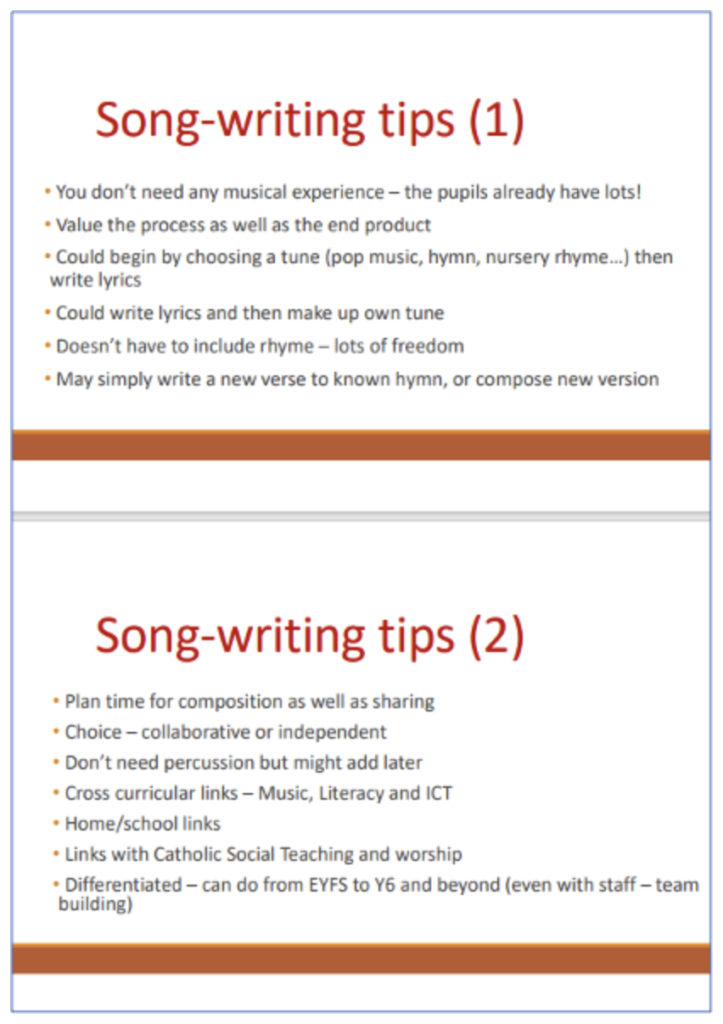
Having served as a primary teacher and RE coordinator for over 16 years and an AST in RE for a number of these, I have always championed the use of creativity in RE, for example through song. Ironically, I am not what would be considered ‘musical’ as I have never sung in a choir nor play an instrument; however, this has not been a barrier for me in developing pupils’ RE because I have found that primary children are able to bring their own experience of song into RE lessons. One of the reasons for my interest in this area is that I have witnessed how it has helped to create a ‘buzz’ in lessons, even for pupils who are generally disengaged; I also saw how it can encourage collaboration and build self-esteem and a sense of community. Therefore, for the last 20 years, I have used song as a tool in the primary classroom and supported others in doing so in my role as diocesan adviser over the last six years. Some of the creations over the years were published in an article I wrote for RE Today (Arundell, 2021).
Context
It was through my experience as adviser that I heard from a multitude of leaders about the negative effects of technology and covid on the wellbeing of our pupils during lockdown. As I work with faith schools, a number of leaders reported to me that one of the sore bruises of social distancing was the inability to gather as a community to worship or sing and this also impacted negatively on pupils’ sense of wellbeing and relationships. Aware of the myriad benefits of music on the both the individual and community and having embarked on an MA in RE, heavily supported by Culham St Gabriel’s Trust, I wanted to explore the use of song in RE in order to offer some way forward . Although there was a plethora of literature on spirituality and music, there was little in regards to song, particularly in RE, so I intended to fill this gap and investigate whether song in RE and worship was just a ‘fun’ activity or if it could have a meaningful impact on the spiritual development and wellbeing of pupils in key stage 2, and if so, how.
Spiritual development and song
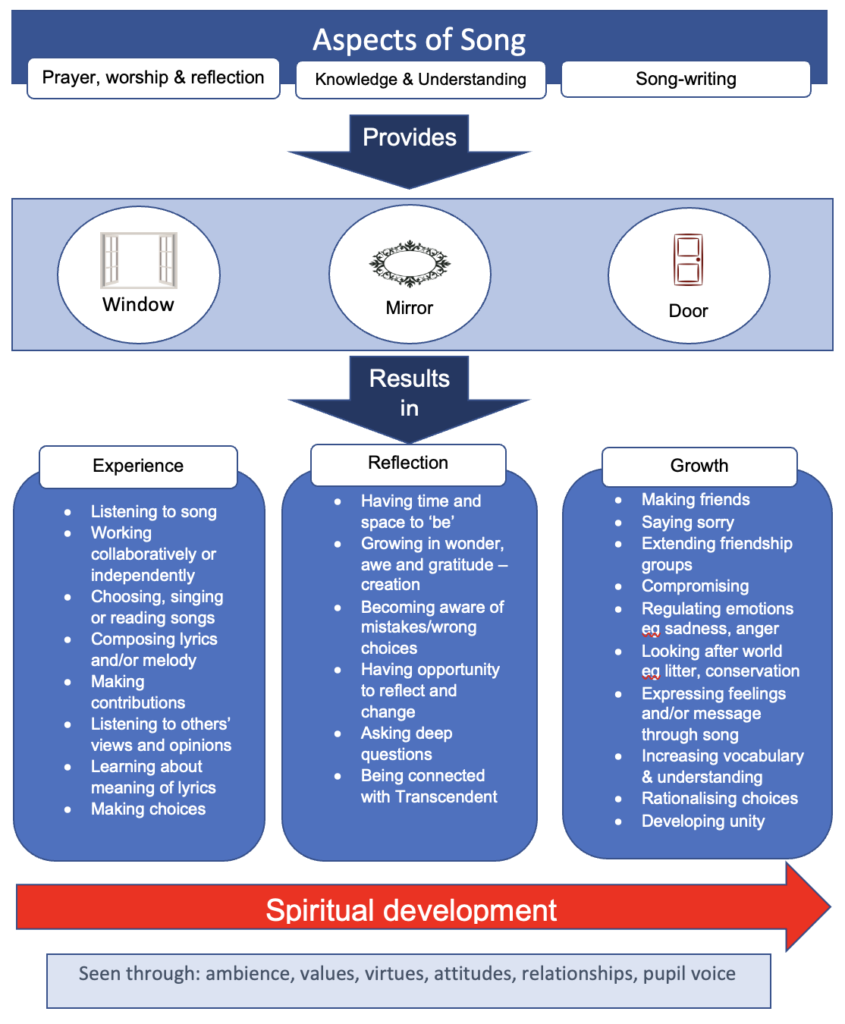
For the purposes of this research, song in RE and worship referred to any type of religious song that was used within the RE lesson or outside of it including hymn practice, assemblies, prayer or liturgy while the use of song encompassed three ‘aspects’: composition, knowledge & understanding and prayer, worship & reflection. Having been inspired by Hay & Nye (2006), de Souza & Halafoff (2018) as well as Aristotle’s notion of eudaimonia and flourishing (Kraut, 2022; Honderich, 2005), spiritual development was therefore a combination of their definitions and, for this investigation, had five ‘characteristics’ which all pertained to connectivity and relationships, namely with: The Transcendent, Self, Others, Cosmos and Social Action, and which also related to Ofsted’s own definition (Ofsted, 1994; 2004; 2019). My intention was to discover which of the aspects could be used effectively and if song in RE might have an effect on each of the characteristics.
Song in RE – A case study
One of the greatest challenges of this research was that it was conducted in a primary school with which I was not familiar around Christmas and New Year 2020-2021. This meant that covid and other illnesses were still rife, staff turnover and absences were high and pressures on various members of the community were great. Gaining consent from parents and finding willing professionals with the time and energy to support with the project was, therefore, not straight-forward initially and I needed to be creative with proceeding with the project so as to ensure that wellbeing was at the very heart of it. Another deanery school was then invited to take part and all key stage 2 classes from both schools were involved. As a result, both qualitative and quantitative data were used for this case-study research, with surveys being completed by 180 pupils and 9 teachers. Interviews were conducted with small groups of diverse pupils (45 pupils in total) and one-to-one interviews with 9 teachers, with a wide range of experience and level of responsibility, took place.
While the two schools were similar in their context as they were both Catholic schools in the same deanery with creativity in RE on their action plan, there were significant differences in approaches. School A had used songs in the past for worship and reflection as well as for listening and understanding during RE lessons and hymn practice; however, they had not composed songs in RE prior to this project and so I led staff training using some of the examples and tips given in the RE Today article (Arundell, 2021). The headteacher of this School A then tasked all key stage two classes with composing their own song to share at their Christmas concert having had three months to work on these. School B, on the other hand, were also confident in using songs for worship and reflection as well as listening and understanding. However, they were not unfamiliar with the concept of composing songs in RE, although this was mainly led by the school’s music coordinator with class teachers free to also use song within the RE classroom should they wish.
Findings
Due to the diversity in approach and experience as well as the wide spectrum of participants, the data was quite rich and robust and, although it was varied, the majority of participants agreed on several points, the main one of which was unanimous that song in RE created a sense of happiness and calm within the classroom. As a result of listening to, singing or composing religious songs, pupils reported that they were less likely to feel angry or anxious and reported that this can have a positive impact on their actions such as making friends again or looking after the environment by picking up litter. All teachers reported that using songs in RE increased their memory and the vast majority of pupils responded that choosing songs in RE and worship made them more engaged. One of the most surprising findings was that over half of the 180 pupils surveyed said that they would prefer to sing their song silently as opposed to almost a fifth who would rather read it aloud and almost a third who would enjoy singing it aloud. Overall, the key findings were that using song in RE and worship can have an impact on all five of the characteristics of spiritual development and that all three aspects of song can be effective in developing the spiritual wellbeing of pupils in KS2. Perhaps the finding of greatest significance, however, was that the use of song in RE naturally encouraged the practice of all Gospel values (Richter, 2000) and virtues (CDCEF & CBCEW, 2020) and participants spoke indirectly about these, although they were not asked specifically about them. For example, pupils described the love, peace or courage they felt as a result of singing, listening to or composing religious song and how the mood created through the song influenced their actions in a positive way. Through close analysis of the data, it was possible to match all of the Gospel values and virtues, as well as all of the Holy Spirit’s gifts (New International Version [NIV] 2011, Is 11:2-3) and fruits of the Holy Spirit, (NIV, Gal 5:22-23) to responses of either pupils or staff. This may be significant because the values and virtues are not limited to any faith or worldview but cross many boundaries which music and song also can.
What next?
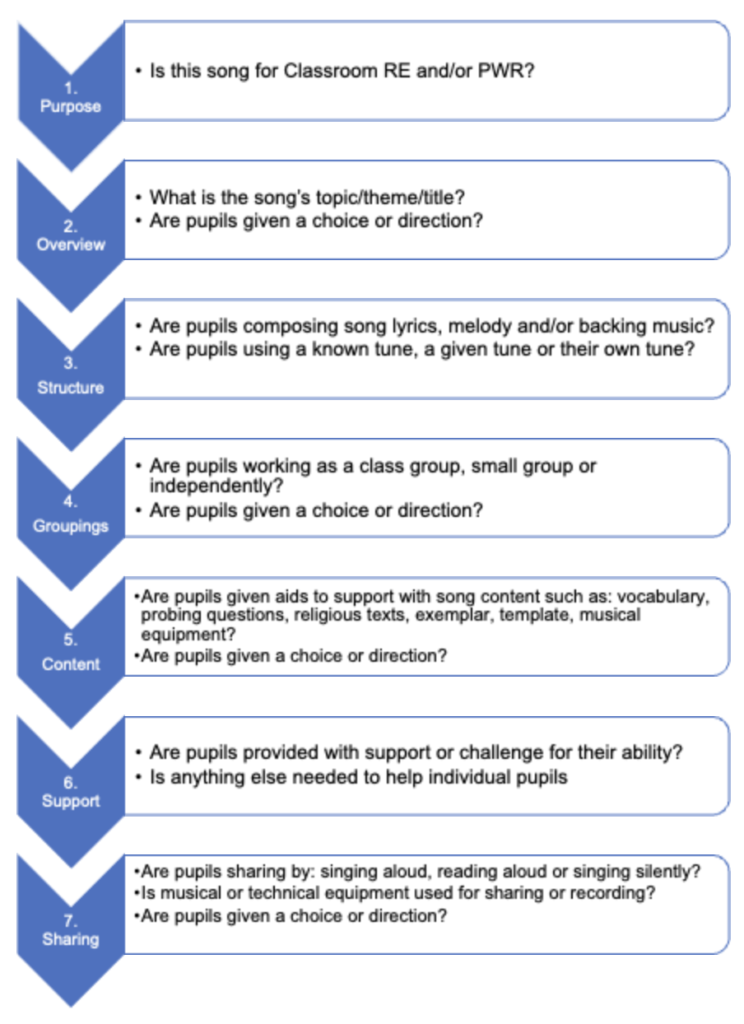
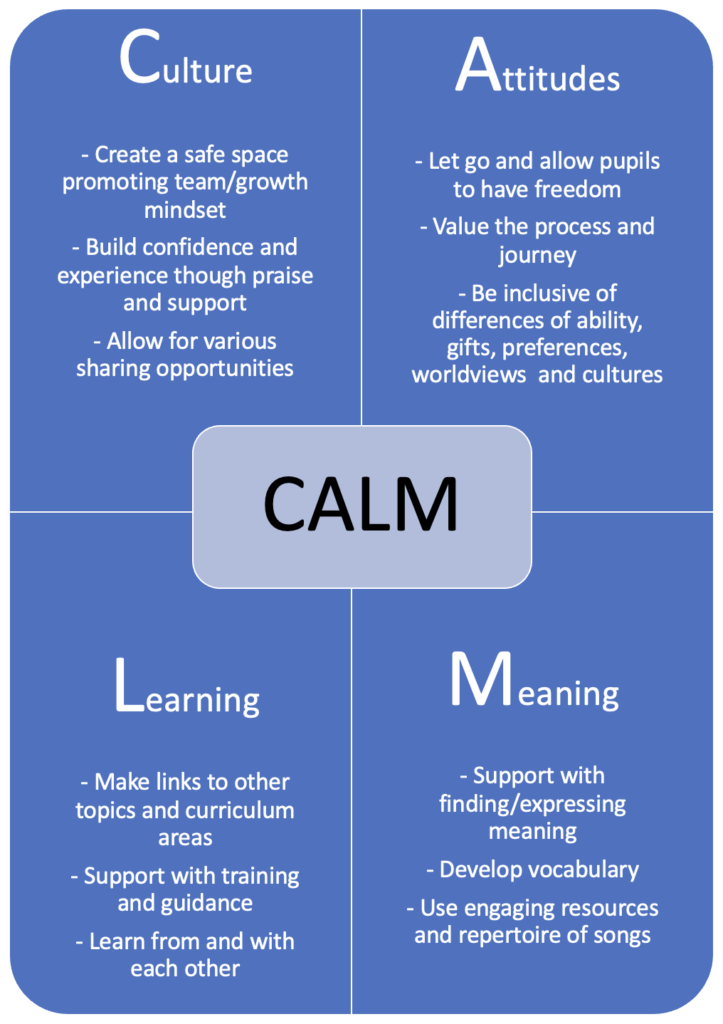
To support schools with the process of using song, particularly with composition of song in RE which is the aspect with which schools are less familiar, several models have been created and some of these are included below. These models have been shared at RE Coordinator conferences in both Southwark and Westminster dioceses as well as in various schools in which I am the adviser along with several examples of songs created by pupils, either as a whole class, small group or individually. Some of these songs have a known melody of a religious or popular song while others had both the melody and lyrics written by the pupils. All findings from this research have been shared in detail with schools A and B along with various other models and resources so that they can move this forward in their own contexts; the use of song in RE has also been mapped to the expectations for the new national inspection for Catholic schools so that it further reassures colleagues of the myriad benefits of using song in RE.
Over the past year, I have also been able to link this project to my diocesan work on Racial Justice, Equality and Diversity as pupils have had the opportunity to create songs based on this important theme; these have been shared on the diocesan website with several pupils having had the opportunity to share theirs publicly in front of an audience of 1000 people in Westminster Cathedral. Going forward, I hope to research this area in greater detail through more academic study, perhaps by exploring song in RE and worship in non-Catholic schools, by looking specifically at only song in RE lessons, or by doing a longitudinal study. I also aim to share and collate guidance and examples of good practice on song in RE and worship through my courses and resources and I am open to opportunities in which to share and develop this learning more widely.
References
Arundell, E. (2021b). ‘Song-writing in RE: a top ten of ideas’, RE Today, May 2021 pp. 22–23.
de Souza, M. & A. Halafoff. (eds.). (2018). Re-Enchanting Education and Spiritual Wellbeing: Fostering Belonging and Meaning-Making for Global Citizens. London and New York: Routledge pp. 1–22.