A new textbook – Who is Jesus? – explores and exemplifies what the RE-searchers approach might look like when applied in the upper secondary school context.
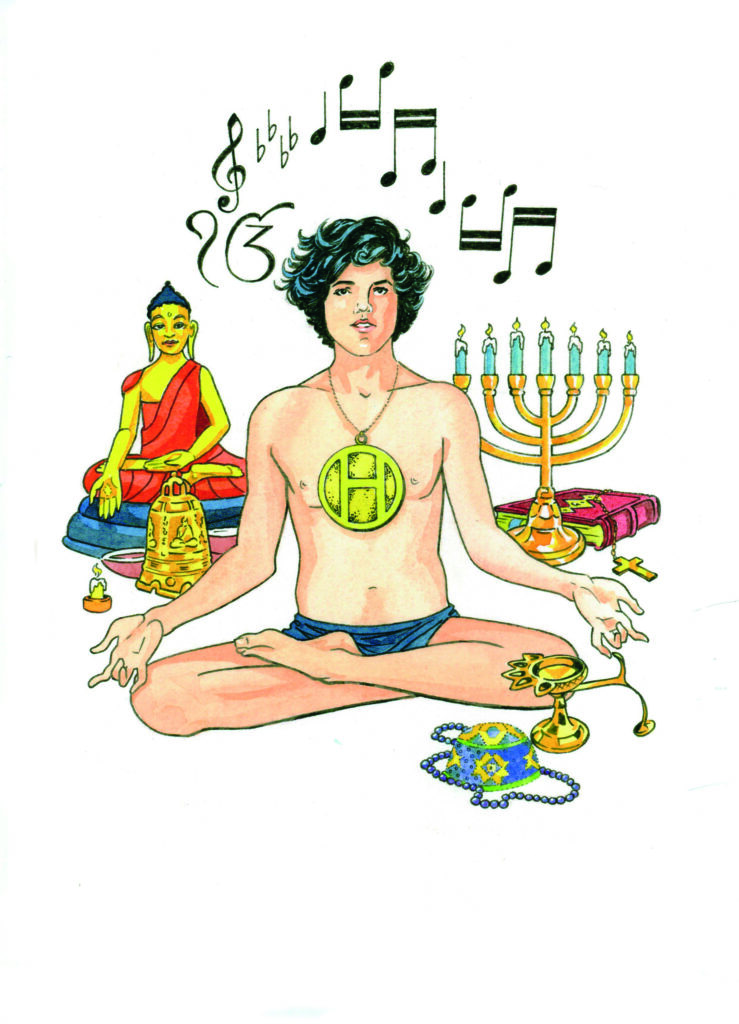
A team from Exeter University and the Learning Institute has developed a new approach to Religious Education in Primary Schools. It is called ‘the RE-searchers approach’. It encourages pupils to think about the significance and effectiveness of different methodologies and methods of enquiry in Religious Education. To make these accessible to young children, we have personified some of them as cartoon characters. Individually these characters are called Debate-it-all Derek, Ask-it-all Ava, Have-a-go Hugo, and See-the-story Suzie, but collectively they’re known as the ‘RE-searchers’. Each character holds different assumptions about religion(s) and advocates different research methods (e.g. questioning and arguing, interviewing and empathizing, participating and experiencing, and narrating and exploring interpretations). Once acquainted with our characters and their respective characteristics as researchers, pupils can undertake learning activities associated with each of them in pursuit of different understandings of religion(s).
These webpages include resources that:
explain who the RE-searcher characters are
explain how the RE-searchers approach can be used
provide examples of exemplar planning and activity ideas
explore the theoretical underpinnings of the approach
This online space will be used to provide a repository for such materials as we continue to develop the approach and accompanying resources. Materials have been written primarily for teachers, teacher educators and teacher trainees, but will be of interest to all those concerned with Religious Education in schools. We are keen to find more collaborators who wish to trial the approach and contribute to our understanding of how it can be used to support learning and learners in a range of contexts, thereby contributing to its future development. To receive more information on how to do so, please contact giles.freathy@thelearninginstitute.co.uk.
The RE-searchers approach has been developed through ‘close-to-practice’ theorisation and conceptualisation within the parameters of the policy and legal frameworks defining Religious Education in maintained schools without a religious affiliation in England. This work has been led by Rob Freathy at the University of Exeter and Giles Freathy, a Specialist Leader in Education in a primary school in South West England. The approach aims to initiate pupils into the communities of academic enquiry concerned with theological and religious studies. It takes as its starting point the following key assumptions: (i) religions are complex, diverse, multi-faceted, evolving and multi-dimensional phenomena; (ii) there are multiple methodologies and methods for generating knowledge about religion(s); and (iii) a multi-methodological pedagogy is necessary to avoid favouring one particular approach over others. Using the RE-searchers approach can help with learning about religion(s) and learning how to learn about religion(s) by creating a balance between: (i) subject content and issues of representation; (ii) learning processes and research methods; and (iii) personal evaluation and self-reflection.
The development of project materials has been generously funded by Culham St. Gabriel’s Trust and the Hockerill Foundation, and to whom we are very thankful for their faith, support and generosity. In addition to these two bodies we would also like to express our thanks to the following for supporting our work: The Learn Teach Lead RE Project, Sir Robert Geffery’s Primary School, The Learning Institute, Leigham Primary School, The University of Exeter Design Studio, Karen Walshe, Geoff Teece, Jonathan Doney, Lorraine Abbott, Emma Butler, Izzy Williams, Katie Freeman, Tatiana Wilson, Linda Rudge, Julie Curtis, Dave Francis, James Robson, Mark Chater, Nick Appleby and Danielle Golding.
Beyond Stewardship: Is Christianity to blame for our ecological crisis?
Beyond Stewardship: Is Christianity to blame for our ecological crisis?
An investigation into differering Christian repsonses to environmental issues.
for 15-19 year olds. Originally written by Anna Davis, updated in April 2019.
Key words and concepts
Anthropocentric: human-centered; focusing on human beings as of most value and importance, especially in relation to animals or the rest of the natural world.
Apocalyptic: in biblical studies, refers to a kind of literature that reveals God’s perspective on current and future events, often with vivid and coded imagery, stark opposition between good and evil, and a prediction of what is to come. The best-known biblical example is the Book of Revelation (the Greek title of which is equivalent to the word ‘apocalypse’) in the Bible
Conservative Evangelicalism: a Christian tradition, found across a range of established and independent churches, which places particular emphasis on the authority and infallibility of the Bible, among other doctrines.
Dominion: sovereignty or control. Especially used to refer to the idea that humanity has power over the rest of creation. See Genesis 26-28.
Ecology: the part of biology that looks at how different organisms relate to one another and to their physical surroundings. Some environmentalists are concerned that human activity is damaging the delicate balance of ecology and thus endangering the future of the planet.
Ecosystem: a particular group of organisms that understood in relation to their physical surroundings.
Environment: the natural world, particularly as it is affected by human activity.
Environmentalism: a movement that is concerned with protecting the natural world from the harmful actions of humanity.
Eschatology: used by theologians to refer to beliefs about the future, and particularly about the ultimate ‘end’ of the world. It comes from the Greek word ‘eschatos’ meaning last or final. Also used to talk about God’s plans for the future of creation, including humans, animals and the environment.
Evangelism: spreading the Christian gospel with the particular aim of converting people to Christianity.
Francis of Assisi: an Italian Catholic friar and preacher of the twelfth and thirteenth centuries who founded a number of monastic orders and has become known as the Patron Saint of animals and the environment.
Fundamentalism: in this context, a form of Christianity focused on what are believed to be its fundamentals, with a particular emphasis on the authority, infallibility and inerrancy of the Bible. This label overlaps with Conservative Evangelicalism (see above).
Gaia hypothesis: the view of scientist James Lovelock that the earth is a kind of superorganism – a complex system that automatically self-regulates in ways that maintain an environment in which life can flourish.
Genesis: The first book of the ‘Old Testament’ or ‘Hebrew Bible’. It begins with two accounts of God’s creation of the world and contains various commands by God about how humans should act in relation to other parts of creation. These commands have been the subject of differing interpretations, hence the existence of current debates about how Christianity should respond to environmental challenges.
Global warming: a gradual increase in the temperature of the earth’s atmosphere and oceans. Generally attributed to the ‘greenhouse effect’, which is caused by increased levels of carbon dioxide, CFCs and other pollutants as a result of human activity. There is concern that global warming could cause sea levels to rise, having catastrophic effects of human life.
Imminent expectation: in this context, refers to the belief of some Christians that Jesus will return soon – perhaps within their lifetimes – to bring about the final end of the world.
Parable: a story or image used to illustrate a moral or spiritual lesson, as told by Jesus and recorded in the Gospels.
Rapture: the transporting of believers to heaven during the Second Coming of Jesus at the end of the world.
Stewardship: in Christianity, the idea that humans have been given responsibility for the rest of the natural world, and have a duty to care for it.
As well as enabling students to engage critically with different approaches to environmental stewardship, this material also develops knowledge about the Bible, and the different ways this can be approached and understood. Different methods used in Biblical Studies underpin this, as outlined below:
Historical criticism
Historical criticism is based on the presumption that the task of the biblical scholar is to discern what the text originally meant, and what events actually happened, from an objective and unbiased perspective. It has value not least in ‘distancing’ the Bible from its contemporary readers: the Bible is a collection of ancient texts, rooted in the cultural assumptions of ancient societies, that cannot cogently be regarded as simply a textbook of eternal religious or moral truths. Using this method, students can be encouraged to approach biblical texts critically, as historical sources. They may, for example, seek to identify different sources and traditions, to question which sayings of Jesus are likely to be authentic, or to consider aspects of biblical teaching that reflect ancient cultural or cosmological presuppositions. Historical criticism is no longer an uncontested or dominant method in biblical studies since it has been recognised that detached, objective historiography is impossible, and may in fact serve to conceal the interests and commitments that underlie particular construals of the past and particular readings of the texts. Nonetheless, it remains significant to a critical engagement with biblical texts as part of the study of topics such as environmental ethics.
History of interpretation
A recent development of interest within biblical studies is in the history of interpretation and influence of biblical texts (their Wirkungsgeschichte). Rather than looking to the world behind the text – the social context in which it arose, as in historical criticism – this approach instead concentrates on the world in front of the text, that is, on the diverse ways in which the text has been understood and has shaped and influenced aspects of life and culture from art and music to ethics and politics. This method means that rather than assuming that the text has one clear, correct meaning, and attempting to decide upon this, attention is directed instead to the diversity of meanings that has, through history, been derived from this text. In relation to environmental issues, it enables consideration of how Christians at different times and places have interpreted texts like Genesis 1–2 in relation to their particular convictions and concerns. It also serves to connect biblical studies much more directly with the study of issues and approaches in Christian ethics, from the earliest times right up to the present.
Reading from modern perspectives: the located reader
More recent methods of biblical study reflect the conviction that different readings can be generated depending on the social identity and location of the reader, and have given rise to feminist, black, liberationist and many other readings of the Bible. Such approaches place much greater emphasis on the role of the reader in the construction of meaning and on the influence of the reader’s context – a development which is also to be found in the study of other kinds of literature, as well as in disciplines such as history and politics, given a widespread acknowledgment that objective and detached analysis is impossible, and that the researcher’s own convictions and approach shape their presentation. Students might therefore be encouraged to ask how modern convictions and contexts shape readings of the Bible, or how different groups might read and respond to different texts.
Christian perspectives on the environment
The Evangelical Churches and Organisations
There are a number of evangelical Christian organisations that strongly support the idea that Christians must care for the environment. Stewardship is a prominent theme.
The Evangelical Environmental Networkhas stated that:
Because we have sinned, we have failed in our stewardship of creation. Therefore we repent of the way we have polluted, distorted, or destroyed so much of the Creator’s work.
They argue that we need to take better care of creation – to become better stewards – in order to live as God desires. (On the Care of Creation)
Other motivations for environmental care include an appeal to love of neighbour, encouraging people to act justly and out of consideration for those who are less fortunate. For example, the Evangelical Environmental Network includes ‘human and cultural degradation’ as among the ways in which we harm creation when we fail to act as stewards.
Tearfund, the Evangelical Alliance’s relief fund, campaigns on a variety of global humanitarian concerns including matters affecting the environment and climate change to encourage people to consider how their actions harm those who live in countries that are adversely affected by climate change. It cites a paraphrase of Romans 10.13 – ‘Love does no harm to its neighbour’ – as a call to responsible stewardship so that others do not suffer from the effects of climate change.
The Church of England
In 1991, the General Synod of the Church of England prepared a report on ‘Christian Stewardship’ with the aim of encouraging ‘a critical review of human responsibility to the living environment’. It states that:
Christians believe that this world belongs to God by creation, redemption and sustenance, and that he has entrusted it to humankind made in his image and responsible to him; we are in the position of stewards, tenants, curators, trustees or guardians, whether or not we acknowledge this responsibility.
The report cites Genesis 1.26-30 as giving humans authority over the natural world. However, at the same time it reads Genesis 2.15-17 as instructing humans to both ‘work’ it and ‘care’ for it. So humans have ‘dominion’ over the earth but this is a gift from God. This means that humans should care for the world ‘in the way God himself demands’.
Other motivations for environmental care include an appeal to love of neighbour, encouraging people to act justly and out of consideration for those who are less fortunate. For example, the Church of England writes of how ‘we are tenants of the world only in our own generation’, highlighting the importance of preserving the natural environment out of concern for the wellbeing of future generations. (Christians and the Environment: Report by the Board for Social Responsibility).
The Catholic Church
The Catholic Church understands stewardship as resulting from humans having been created in the image of God (the Catholic doctrine of the imago Dei).
Agneta Sutton from the Catholic Truth Society writes that:
From the very first, the biblical account of our role in creation declares that we have a special position and stand in a special relationship to God and so to the rest of creation. (Ecology and Stewardship: What Catholics Believe About the Environment. London: CTS. 2012. p. 8)
The International Theological Commission states that humans are:
…made in [God’s] image to participate in his work, in his project of love and salvation, indeed in his own lordship over the universe. Since man’s place as ruler is in fact a participation in the divine governance of creation, we speak of it here as a form of stewardship. (Communion and Stewardship: Human Persons Created in the Image of God, Section 57)
Pope John Paul II, a former leader of the Catholic Church, has spoken of the need for an ‘ecological conversion’. He remarks that:
Man’s lordship is not absolute, but ministerial…not the mission of an absolute and unquestionable master, but of a steward of God’s kingdom. (Communion and Stewardship, Section 73)
So for Catholics, ‘God appoints man as his steward in the manner of the master in the Gospel parables (cf. Luke 19:12)’. (Communion and Stewardship, Section 58).
The Orthodox Church
The Orthodox Church understands Genesis 1 as a call to stewardship, requiring humans to be responsible for creation. This is also linked with the Orthodox emphasis on ‘deification’ – the idea that humans come to share fully in God’s being and nature through the process of salvation. The Report of the WCC Inter-Orthodox Consultation states that:
We are called to exercise dominion over all creatures on earth (cf. Gen. 1:28), i.e. to be stewards … of God’s material world, caring for it, maintaining it in its integrity and perfecting it by opening it up to God through our own deification. (Orthodox Perspectives on Creation, Section 11).
Orthodox theology also places emphasis on the importance of priesthood, not only as an office within the Church, but as a role that can be played by humanity in relation to the rest of creation: humans can help to offer the creation to God and mediate and express its praise to God. This may be linked with the idea of ‘deification’: the goal for humanity and for creation is to be transformed, renewed, perfected, and taken up into God. Some have suggested that these ideas about the transformation of all creation – its incorporation into the divine – may be especially valuable ideas to inspire environmental care. They express different ideas and emphases from the kind of stewardship expressed in the Protestant Churches, which is more concerned with the role of humans in relation to the rest of creation.
Conservative Evangelical and Fundamentalist Christian groups opposed to environmentalism
Not all Christians agree that we should be concerned about preserving the environment, or acting to reduce carbon emissions. Some conservative evangelical and fundamentalist groups see the environmental movement as a dangerous threat – a false, non-Christian religion.
It is important to note that such groups do not necessarily reject the idea of stewardship, but that they understand it in particular ways. Members of such groups are likely to put greater stress on the importance of evangelism (converting individuals to faith), the imminent return of Jesus, and ethical values related to sexual and family ethics than on conservation or care for the planet. Certain biblical texts to do with the end of the world are of particular importance here, for example, 1 Thessalonians 4.13-5.2 and Mark 13.7-31.
Sometimes these views are expressed in academic books, or on organisations’ websites, but more often they are to be found at a popular level on individuals’ blogs and websites.
For example, the American Evangelical organization Cornwall Alliance for the Stewardship of Creation the environmentalist view of the world which it claims ‘elevates nature above the needs of people, of even the poorest and the most helpless’. The Cornwall Alliance argues that such environmentalism is a ‘green dragon’ that presents a major threat to the Christian religion.
Further, Calvin Beisner, spokesman for the Cornwall Alliance, sees the domination of nature by humans as an essential task. He writes: ‘…continued population growth will result not in the depletion but in the increased abundance of resources, and not in increased pollution of the earth but in its increased cleansing and transformation from wilderness to garden, “from its bondage to decay…into the glorious freedom of the children of God” (Rom. 8:21).’ (Where Garden Meets Wilderness: Evangelical Entry into the Environmental Debate. Grand Rapids, MI: Acton Institute for the Study of Religion and Liberty/Eerdmans. 1997. p. 107)
In more popular literature, Spencer Strickland, through a blog published by Jeremiah Daniel McCarver, ‘Saving Earth One Human at a Time’ draws attention to the impact of beliefs about the imminent end of the world on concern for the environment:
Christians should not be carried away into the frenzy that is being stirred up in popular culture. While it is true that we are all stewards of the earth and should thus take care of it, we should also be aware of the fact that the “heavens and earth which are now” are being prevented from being destroyed by the Word of God (2 Pet. 3:7). God will one day destroy the earth with the fire of judgment, and this is the warning that Christians must take to those who are lost, in order that they might be saved through the obedience of the Gospel.
Similarly, Todd Strandberg, writing on his website ‘Rapture Ready’ states that, in his view, ‘any preacher who decides to get involved in environmental issues is like a heart surgeon who suddenly leaves an operation to fix a clogged toilet.’
Learning activities
1 Is Christianity to blame?
As a class, read and discuss the ‘Beyond Stewardship?’ stimulus text ‘Lynn White: Is Christianity to blame for our ecological crisis?’. Available to download below.
2 Origins of stewardship
Divide the class into small groups. Give each group one of the following texts (see available to download below):
Genesis 1
Genesis 2
Genesis 3
Genesis 4
Within their groups, the students read the texts and then discuss whether:
the text encourages care of the planet?
the text suggests humans are ‘in charge’?
the text suggests the land has intrinsic/instrumental value?
humans being made in the image of God change their relationship with the Earth?
The students should be encouraged to give reasons for their answers, and should refer to the texts the back up their views.
The groups can present their findings and views about the text they have studied to the rest of the class.
3 Contemporary Christian views
Display images depicting modern environmental problems, such as the destruction of the rainforest to grow palm oil, collapse of insect populations, reduction in water tables for cotton production and plastic pollution. Discuss what the images suggest about contemporary attitudes towards how we should care for the environment. Can any implications be drawn about Christian attitudes?
Establish the critical question: Is Christianity to blame for the Ecological Crisis? This is based on Lynn white Jr’s argument.
Divide the class into small groups. Give each group:
one of the viewpoints from the ‘Christian Perspective’ section of this resource;
a large recording sheet with space for notes on their Christian viewpoint, and THREE additional viewpoints.
Using their recording sheet, each group works together to create succinct notes recording their viewpoint and three others in relation to the critical question.
After reading and discussing their viewpoint, groups send one or two envoys to other groups to discuss and learn about other viewpoints, before returning to their original group.
Allow plenty of time for reading, discussion, definition and note-taking. Students will end up with a multi-layered analysis of Christian views and a critical view.
If time, listen to a brief answer from each group to the critical question, or set as a written homework, drawing on the evidence gathered.
4 How do different Christian views shape the argument?
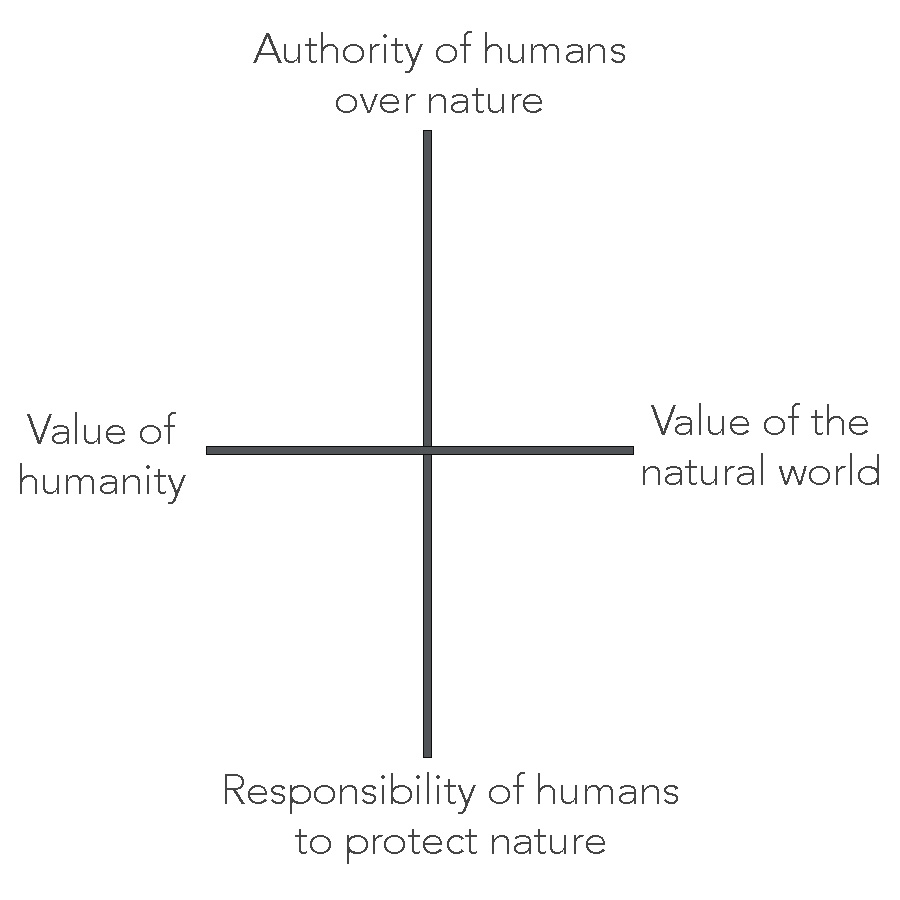
Ask groups to copy this graph:
In groups, place each Christian perspective on this graph: do they place human authority over nature above human responsibility to protect nature; do they value humans above the natural world, etc?
Share and discuss graphs. As a class, ascribe reasons to each positioning; what are they based on? Either give a theological argument or a biblical reference to support each position. Through the course of the conversation, ensure these two positions are defined:
Christian Environmentalism: humans must transform the way we treat the environment; the natural world must be protected and nurtured, in both Evangelical and denominational Christian thinking.
Conservative Evangelical or Fundamentalist non-Environmentalism: God will destroy the earth at the End Times, this is God’s plan for humanity and the natural world.
Debate
Divide the class into two groups: Christian Environmentalism and non-environmentalism. Each groups has 15 minutes to create 4 strong arguments in favour of their position, in response to the motion (below).
Groups should also predict counter-arguments and prepare to meet them.
This series of lessons progresses from Early Years to Upper Key Stage 2, exploring themes around Easter at increasing depth. The resources are adapted from the ‘Salvation’ strand in Understanding Christianity. If you already teach Understanding Christianity and are interested in moving to a Religion and Worldviews approach, this resource is for you.
Created by Lynn Revell and Kate Christopher as part of their Canterbury Christ Church University grant funded project. Funding provided by Culham St Gabriel’s Trust
Find out about Muhammad Ali: the athlete, the antiracist, the conscientious objector and the devoted Muslim.
Created by Lynn Revell and Kate Christopher as part of their Canterbury Christ Church University grant funded project Teaching Islam as a Worldview. Funding provided by Culham St Gabriel’s Trust.
You can find further resources which were created as part of this project in the RE:ONLINE resource Islam as a Worldview.
Beyond Stereotypes: Teaching Sikhi Through Powerful Women’s Stories
jenny-kaur | 08 March, 2026
“That’s not my Sikh faith” Amy Ark [Sikh panellist] said during the recent National Association of Teachers of Religious Education (NATRE) Strictly RE conference. Amy was discussing her own experience at school, where Sikhi was only covered for one week and in this short time she found the curriculum had resonated little with her lived experience; Amy is not alone, there are many Sikhs who also feel the same. I find the common phrase “She’s not Sikh her hair is cut” circling in many discussions in groups in 11-14 RE.
I’m sure I am not alone. I’m sure we have all found ourselves in the lesson where we combat generalisation and stereotypes in the classroom. I have found it best to provide examples of modern and historical Sikhs who have a story to disrupt the ‘typical Sikh look’ for students. What does it mean to look or act like a Sikh currently?
In Professor Jasjit Singh’s excellent ‘Teaching Sikhi in RE: Engaging communities with Teaching Religion’ research we learned it was clear there is insufficient community and ‘Lived Experience’ integration. There is an explicit finding of weak engagement with Sikh communities in curriculum development and delivery. This perpetuates a textbook-only approach, ignoring the richness of contemporary British Sikhi. I had also read this from Dr Phra Nicholas Thanissaros “Teaching Buddhism in Britain’s schools: redefining the insider role” here we learn the “dissonance apparent between home and school presentation of Buddhism is compared to similar findings for the Hindu and Sikh communities in Britain.” One of his suggestions to bridge this gap is to enrich the conversation between “insider” (the community’s living faith) and “outsider” (the teacher’s academic presentation) perspectives. In a further report from Insight UK it is posited that the lack of accurate, quality representation is linked to an “inferiority complex” amongst South Asian children, failing the duty of RE to support identity development.
As a result of my own experience and these reports I have chosen to explore modern and historical examples of Sikhs, allowing students to see the modern ways women are shaping their fields from psychology to art. These women are all united with a shared conviction – not in a general archaic sense of Sikh identity. I would have enjoyed hearing of these voices whilst at school and teaching at a single sex girl’s school I have found providing the students with female voices resonates with them [and me]. I have also underneath each biography suggested how they can be used in different contexts from creative tasks or discussions on equality in practice with many connections to GCSE units’ such as relationships for roles of men and women and intergenerational living. I have listed them below and given a little detail about them but they are available in more detail with biographies and teaching suggestions on the RE:Online website as PDF’s to use in the classroom.
I hope you find them useful and interesting as I did!
Dr Manpreet Dhuffar Pottiwal : Sikh Psychologist
Dr Manpreet Dhuffar Pottiwal is a Sikh psychologist and activist whose work focuses on intergenerational trauma within South Asian communities. Through her TEDx talk, she uses the metaphor of family trees to show how inherited burdens and strengths shape identity, encouraging healing through understanding roots, culture, and community.
Mai Bhago: Female Sikh warrior
Mai Bhago was a fearless Sikh warrior who challenged forty men for abandoning their faith and led them back into battle against a vastly larger Mughal army. Though badly injured, she survived and later became Guru Gobind Singh Ji’s bodyguard, standing as a powerful example of equality and courage in Sikh history.
Amrita Sher Gill: Hungarian Sikh Artist
Amrita Sher-Gil was a Hungarian Sikh artist whose paintings explored the emotional lives of women constrained by tradition. By blending Indian and European styles, she gave voice to women’s quiet struggles, resilience, and unspoken strength, especially in works like Three Girls.
Neelam Kaur Gill: British Sikh model
Neelam Gill is a British Sikh model who turned experiences of bullying and racism into a mission for representation in fashion. As a trailblazer for major global brands, she speaks openly about discrimination and uses her visibility to challenge stereotypes of modern Sikh identity.
The Singh Twins: British Sikh miniature artists
Amrit Singh and Rabindra Kaur Singh, the Singh Twins, are British Sikh artists who have revived Indian miniature painting to explore modern social, political, and religious themes. Their highly detailed, vibrant work challenges Eurocentric ideas of fine art while proudly expressing Sikh history and worldview
Mata Khivi: The only woman mentioned in the Guru Granth Sahib
Mata Khivi is the only woman named in the Guru Granth Sahib and is honoured for her compassion, equality, and service. She played a central role in establishing the langar system, ensuring food and care for all, and remains a lasting symbol of Sikh values in action
Sophie DuLeep Singh: Suffragette
Princess Sophia Duleep Singh, daughter of the last Sikh Maharaja, was a key figure in the British suffragette movement. She used her royal status to fight for women’s rights, support Indian independence, and amplify South Asian voices in Britain.
Saint Carlo Acutis: A Modern Story of Faith in the Digital Age
andy-lewis | 03 March, 2026
When students ask whether faith has anything to say to modern life, the Catholic saints can sometimes feel like the wrong place to start. Too often, they appear distant – they are shaped by another century, another culture, another set of assumptions.
Carlo Acutis changes that conversation.
A teenager who loved coding, gaming, and football, Saint Carlo shows what Catholic belief can look like when it is lived seriously in the contemporary world – not as nostalgia, but as conviction.
Carlo was born in London in 1991 to Italian parents before his family returned to Milan. His upbringing was not conventionally “religious” in the way we might expect of a future saint. His parents were not regular Mass-goers, and there was no intense devotional culture at home. Yet from an early age, Carlo displayed a quiet attentiveness to faith. He asked questions, noticed details, and chose practices that slowly, but deliberately, shaped his life.
After receiving his First Holy Communion at the age of seven, Carlo chose to attend Mass daily. He developed a deep love for the rosary, reading Scripture, and acts of charity – particularly towards the poor, migrants, and those sleeping rough around Milan. These were not dramatic gestures, but steady habits. His faith was rooted in Catholic tradition, disciplined rather than showy, ordinary rather than performative.
A child of his generation
At the same time, Carlo was unmistakably a child of his generation. He loved football, video games, and technology. Like many young people of the 1990s and early 2000s, he taught himself coding, web design, and programming, becoming skilled enough to help others build websites. This is what makes him a genuinely millennial saint. Carlo did not reject modern life in order to be holy; he inhabited it fully and learned how to live faithfully within it.
At the centre of everything was Carlo’s devotion to the Eucharist. He famously described it as his “motorway to heaven” – a phrase that is often quoted because it is both ordinary and profound. For Carlo, the Eucharist was not background scenery to his faith, but the place where Christ was encountered most fully. This conviction shaped how he used his time, his talents, and his energy.
Cataloguing miracles on the web
His best-known project was a digital exhibition cataloguing Eucharistic miracles from around the world. As a teenager, Carlo researched historical accounts, visited sites, gathered sources, and presented them online with clarity and care. His aim was not to sensationalise, but to show that belief in the Real Presence was not an abstract claim – it was something the Church had taken seriously, consistently, and globally.
One example Carlo researched was the Eucharistic miracle of Lanciano. In the eighth century, a priest struggling with doubt is said to have witnessed the consecrated host and wine transform into flesh and blood during Mass. In the 1970s, independent scientific analysis identified the flesh as human heart tissue and the blood as real human blood, preserved without additives. Carlo did not use such accounts to “prove” belief to sceptics, but to point back to what Catholics already claim happens every single time Mass is celebrated.
A life cut short
Carlo’s life was tragically short. In 2006, he was diagnosed with an aggressive form of leukaemia and died within days, aged just fifteen. Even during his illness, accounts describe a calm acceptance and a concern for others rather than himself. He was beatified in 2020 and is often described as a “patron saint of the internet” – a label students immediately connect to. He was formally declared a saint on 7 September 2025.
As one young Catholic from London in Rome reflected, “The fact that you can think of a Saint doing the same things as you – wearing jeans, playing video games – it feels so much closer than other saints have in the past.”
For RE teachers, Saint Carlo’s biography does important work. He helps bridge the gap students often feel between holiness and normality, faith and technology, tradition and modern life. He offers a contemporary reference point for Catholic belief without diluting its depth or demands.
Saint Carlo Acutis offers something rare: a life close enough to feel recognisable, yet deep enough to stretch our understanding. His story does not demand instant or forced belief in the Eucharist – but it does invite serious attention to what Catholics claim is at the heart of their faith.
A resource looking at symbols used with Paganism, to represent Pagan faith groups and concepts. Students may have seen some of the symbols on clothing, jewellery, etc.
It includes independent research, which could be suitable as a piece of homework. It would fit well into a broader lesson (or series of lessons) looking at symbols and symbolism within religion. Find out more in our subject knowledge section.
The oft heard words: the Shema in Jewish traditions
The Shema in Jewish traditions
Origins
The Shema may be seen as the beginning and end of Judaism. It is a Jewish prayer extracted from three places from the Torah and composed into a sequence of paragraphs. It does not appear in its entirety at the beginning of the Torah, rather it is found in Deuteronomy 6.4-9; 11.13-21 and Numbers 15.37-41. The Shema derives its name from the Hebrew word sema, meaning ‘to hear’, which is the initial word of the first verse, which states, ‘Hear O Israel’. Thereby, instructing Jews to listen. It is believed that they were received by Moses on Mount Sinai.
Significance
The Shema is included as part of every weekday synagogue service. Its significance is inferred by the fact that its centrality is recognised in all Jewish traditions, in various ways. The recitation of the passage is taken as a commandment to be fulfilled by Jewish adult men twice daily, morning and evening. It is also a core text in other prayer books.
The Shema is taught for the love of God, loyalty to the Jewish tradition and it encourages the Jewish community to study the Torah. It is reported that Jacob’s sons read it to him and therefore adults recite it to children so that they remain within their tradition. The Shema might be the first thing that some Jewish children learn in a Jewish primary schools and at home to express belonging.
Meaning
The Shema sets out what Jews believe and how they should demonstrate their dedication to God through daily actions.
It represents their belief that they have made a Covenant with God: an agreement that they will love God and follow His laws and in return God will take care of them. Thus, as an artefact, the Shema is a way for Jewish people to remind themselves of their promises to God. This is why families have a responsibility to teach their faith to the next generation.
Practice
Unsurprisingly, the Shema has acquired a pivotal position in the collective and personal life of Jewish communities. Communally, adults recite it in the morning and evening and in the afternoon at the synagogue to fulfil the commandment and remember God.
Individually, some Jews recite it before bed and after waking up, as it is the most holy thing to say during these times. It is also a way of thanking God for waking them up from sleep and to ask God for good sleep. Thus, it is a prayer which covers all activities of the day and night.
As a family, in some homes, mothers regularly recite the Shema with their children whilst putting them to bed. Some children memorise it and others prefer to look at the text when reciting it.
At happy events, such as moving into a new home, the mezuzah, which contains the Shema, is fixed to the doorpost and is followed by a religious service.
During festival days and especially on Shabbat, a double reading honours the Shema: at the time the Torah scroll is bought out from the Ark the opening verse of the Shema is recited collectively, and again, individually by the reader prior to reading the Torah.
There are some physical gestures adopted by Jews during various prayers and worship. On the Day of Atonement whilst reciting the opening verse of the Shema, the eyes are covered to remove distractions.
As death approaches, those gathered recite some passages from the Torah and end with the opening words of the Shema. In this way the dying person is helped to affirm their faith in the oneness of God. It is worth noting that the Shema may be recited in Hebrew and in other languages too.
Structure
The Shema has three paragraphs. The English translation is provided with an explanation of what it might mean to some Jews, how they might put it into practice and what they could learn from it.
Hear O Israel, the Lord is our God, the Lord is One (Deuteronomy, 6.4)
From this, Jews learn to be attentive to the Torah so that God’s commands are with them. It also means their religion is monotheistic. Moreover, a closer examination reveals God as addressing Israel rather than Israel addressing God, thus Jews make claims of a reciprocal relationship because God chose them, and consequently, they believe God cannot ignore them.
Blessed is His name, whose glorious kingdom is forever and ever
This phrase does not appear in the Torah and is attributed to Jacob. Since he had whispered it, Jews whisper it as well. It tells the Jewish community to praise God. They know, through this, that God’s kingdom is everlasting. They recognise the holiness and greatness of God. It gives them hope too.
Love the Lord your God with all your heart, and all your soul, and all your might (Deuteronomy, 6.5)
The demand from God is unequivocal in this phrase: total obedience and wholehearted devotion and to remember God’s word. It implies that Jews be prepared to sacrifice everything. They are to love God with their might, heart and soul. God loves them; therefore, they too should have unflinching love for Him.
These words that I command you today shall be upon your heart (Deuteronomy, 6.6)
Jews learn to affirm these as laws and learn them orally. But there is also an emotional attachment. The heart is mentioned so that it can act as a guide following the dictum ‘in doing right follow your heart’, and in the heart should be the Torah.
Repeat them to your children, and talk about them when you sit in your home, and when you walk in the street; when you lie down, and when you rise up (Deuteronomy, 6.7)
This phrase gives adults the responsibility to pass on their faith to children, and this can take place in formal and informal settings. The key message is to keep it alive at all times. Literally, it means Jews should recite it every evening and morning.
Hold fast to them as a sign upon your hand, and let them be as reminders before your eyes (Deuteronomy, 6.8)
Literally, this means to hold fast onto the Shema and the Torah by wearing the verses on the hand and upon the forehead between the eyes. This is how the practice of wearing phylacteries (tefillin) became established. The tefillin consists of four small joined-up boxes containing the first two passages of the Shema (Deuteronomy, 6.4-9 and Deuteronomy, 11.13-21) and two other Exodus phrases of the Torah. These are handwritten on a parchment and worn on the stronger hand as this is what is used by individuals or on the left arm so that it is directed to the heart. It is a constant visual reminder for Jews that God is there, whatever they do.
Write them on the doorposts of your home and at your gates (Deuteronomy, 6.9)
The final instruction is to handwrite a parchment and fix it to the doorpost of the home and gates. In practice, to preserve the sanctity of the text, a rectangular elongated box with a slight opening, called a mezuzah, is made to house this kosher parchment, which contains the first two of the three paragraphs of the Shema (Deuteronomy, 6.4-9 and Deuteronomy, 11.13-21) and at the back, the word Shaddai (Almighty). The mezuzah is affixed on the right hand doorframe, with a little slant upwards in the direction of the room, at about shoulder height, in individual dwellings and collective compounds. In doing so, most Jews express their obedience, and, when they come into and go out of their homes, they are reminded to renew their covenant daily. The mezuzah is fixed on every door (except the lavatory and bathroom), so the whole house is covered in holiness and purity as a gift of God. Some Jews kiss the mezuzah to show their adherence to the Torah in everything they do, including daily actions like entering and leaving the home.
Mezuzah literally means ‘doorpost’, but over time came to refer to the doorpost and what is attached to it. Interestingly, a sukkah does not need a mezuzah as it is not permanent dwelling.
Deuteronomy 11.13-21
This section is an exhortation to obey, love and serve God alone with everything. In return God promises the Jewish community abundance in material well-being. Should they turn to serve other gods, the anger of God awaits them (Deuteronomy, 11. 13-17).
The next phrases (Deut. 11.18-21) repeat the instructions given above in (Deut. 6-9). Thereafter, God promises that should these be fulfilled then God will keep His promise of the land for them (Deut. 11. 21).
Numbers 15.37-41
This verse establishes the custom of Jews adorning clothes with tzitzit (fringes). Tzitzit are tassels made of several threads tied together to symbolise the numerical value of the name of God. The Shema says that when people look at the tassels they will remember their promise to keep God’s laws. Some Jews follow this rule all the time and wear a vest with tassels on four corners, called a tallitkatan. At the synagogue, some also wear a special prayer shawl called a tallitgadol when praying in the morning.
To summarise, the Shema is a prayer in the first instance and a belief statement thereafter. It has a golden principle for the Jewish community in stressing that learning is initiated at home and establishes the duty to educate their children in the faith. The Shema establishes the practice of learning the three paragraphs contained within it, and of wearing the tefillin and affixing the mezuzah. These actions remind Jewish people of the promises made to and by God, their belief about unity of God and the One to be worshipped.
Learning about the Shema in RE
Here are some examples of what primary pupils might be able to do as a result of their learning about the Shema.
They can:
-use the right names for things that are special to Jews, e.g. when shown a picture, say: ‘That is a mezuzah’
-talk about what they find interesting or puzzling, e.g. talk about how interesting it was to hear that Jewish people put a prayer in a small box and fix it to their doorposts
-talk about some things that are similar for different religious people, e.g. say that Muslims, Christians and Jews all says prayers to God
-talk about some things in stories that make people ask questions, e.g. say, ‘It was mysterious when God spoke to Moses’
-describe things that are similar and different for religious people, e.g. record or say how Jews recite the Shema, but that they may say it in different languages
-ask important questions about life and compare their ideas with those of other people, e.g. ask why Jews think the Shemais such an important prayer and give their own ideas about important prayers and wishes
-use the right religious words to describe and compare what practices and experiences may be involved in belonging to different religious groups, e.g., say how different Jewish communities might have different ways of remembering God’s laws – through recitation of the Shema, through wearing of the tallit and tefillin, though doing good deeds and so on
-ask questions about the meaning and purpose of life, and suggest a range of answers which might be given by them as well as members of different religious groups or individuals, e.g. asking questions about the importance of the Shema in Jewish life and suggesting answers that might be given by a Jewish visitor to the classroom, or with reference to answers given in authoritative texts or websites.
Some common discussion questions:
What do you think it means when the Shema says: “These words […] shall be upon your heart”?
In the Shema, where does it say that Jews should talk about God’s laws?
Why do you think the Shema says that Jewish people should repeat the words to their children?
What could you use or do to help you to remember promises that you have made?
Further reading
Cohn-Sherbok, D. (2003) Judaism: History, Belief and Practice, London: Routledge.
Hoffman, C. M. (2010) Judaism: An Introduction, London: Hodder Education.
Written by Imran Mogra
Holocaust Memorial Day 2026: Building Bridges of Memory and Hope
Dr Kathryn Wright | 12 January, 2026
On 27 January, we stop and remember. We remember the six million Jewish people murdered during the Holocaust, and all those who suffered under Nazi persecution. We remember the victims of later genocides-in Cambodia, Rwanda, Bosnia and Darfur. Holocaust Memorial Day is not just about history; it is about humanity. It asks us to look honestly at the past and commit ourselves to a better future. I shall never forget walking through the Memorial to the Murdered Jews of Europe in December 2024, you may want to read my previous blog reflecting on this.
This year’s theme, “Bridging Generations,” speaks deeply to me. My own dad died last year, and he was the last person in our family to have lived through the second world war. He was not a Holocaust survivor, but even his stories of being a child evacuee in England, what it was like to be in hospital during war time or hide from air raids will stay with me. So as Holocaust survivors grow fewer, the responsibility to carry their stories forward rests with us. It is a call to action: to listen, to learn, and to ensure that the lessons of the Holocaust are never lost. Memory must not fade-it must inspire.
Education is the bridge between remembrance and hope. At Culham St Gabriel’s Trust, we believe that Religion and Worldviews Education is vital in this work. It helps young people understand diversity, wrestle with ethical questions, and develop empathy. These are not optional skills;they are the foundations of a society that rejects hatred and prejudice.
Holocaust education is not about dates and facts alone. It is about human stories-stories of courage, resilience and warning. When children and young people hear testimonies, they connect with real lives, and that connection shapes their values. It gives them the strength to challenge denial and distortion, which sadly still exist and are worryingly on the increase today.
So how do we build these bridges? I believe this is through dialogue and conversation. Through creating spaces where young people, indeed all of us, can ask questions, share feelings, and explore what remembrance means to each of us. Through intergenerational conversations -between children and grandparents, between communities and schools. And through creative use of digital tools to keep these stories alive and accessible.
So on this Holocaust Memorial Day, I invite you to:
Pause and reflect: Join the national “Light the Darkness” moment at 8pm by lighting a candle and placing it in your window.
Use the resources: The Holocaust Memorial Day Trust offers excellent materials for schools and communities – make use of them.
Champion dialogue: Encourage conversations that build understanding and resilience against prejudice.
Remembrance is active. It is a choice to learn, to speak out, and to stand for justice. Together, we can ensure that the memory of the Holocaust shapes a future rooted in empathy and peace.
Dr Kathryn Wright Chief Executive Officer Culham St Gabriel’s Trust
About
Dr Kathryn Wright is CEO of Culham St Gabriel's Trust
Christian Ethics and Farmed Animals: a Teachers’ Fellowship
Nadia Nadeem | 01 December, 2023
I was intrigued by this project because it was an opportunity for me to learn about a topic I had never given any real thought to; how animals are farmed, and what are ethical ways of thinking about this. The project is CEFAW: Christian Ethics of Farmed Animals Welfare. The CEFAW project is an engaging and accessible way to educate pupils about farming practices and the ethical questions raised, such as responsible meat consumption. As a teacher, I was able to tailor the lesson plans and resources created through the project to enable pupils from all backgrounds to explore these ideas, contextualising what this means for Christians, the animals, farmers and for pupils as individuals – now and in the future.
I have always been mindful of what children put into their bodies and how this can impact their physical, emotional and mental wellbeing and consequently their ability to learn and be responsible members of society. I had been recently researching the impact hormone injected chickens can have on children and what some of the signs are of this impact.
For these reasons, when the opportunity to work alongside leading experts like David Clough and James Holt presented itself, I was excited to explore how a topic I am interested in personally, will develop through the RE lens.
I worked with two primary colleagues – Mel Gilbert and Stacey Cowell- which was a wonderful experience in itself. We shared ideas and experiences and provided each other with advice and support to refine our thoughts. Working with teachers from different parts of the country made certain that the resources were reflective of all pupils.
Furthermore, being provided with forums where I could share my research and experience from the project has facilitated me to continuously reflect on how the project can be utilised in the primary classroom and its potential long-term impact on the environment and young people’s health. For this I am grateful to Culham St Gabriel’s Trust!
One of the many things that I have taken away from this project, is the effectiveness of using discursive questions to stimulate pupils to think critically, review their opinions and experiences considering what they are learning and researching in lessons as well as the wider implication of key concepts and ideas.
Regardless to say, participating in such projects has its own barriers. As a fulltime teacher in Year 6, I had to consider whether I would be able to manage the deadlines and workload. I couldn’t attend the residential as it clashed with SATs. Consequently, I didn’t have the first hand experience of being on a farm; a highlight of the project. Despite my own unfortunate diary clash, it is essential for teachers to take such opportunities, which prevents our teaching from becoming stale and invigorates our own thinking.
Every time I participate in classroom-based research, my class enjoys the benefits of learning something controversial, being able to ask difficult questions and appreciating it is not necessary that everyone agrees to everything.
When the CEFAW resources are available for distribution, I believe everyone should evaluate how their pupils can benefit and trial them.
Our pupils live in a complicated world where most of what they experience is through a screen – the CEFAW project teaches compassion for living things – it teaches to connect with what is happening around you.
About
Nadia Nadeem works in Primary education whilst supporting RE in Barking and Dagenham as an Advisory Teacher.