Global terms: Religion and Worldviews

Humanism, Ultimate Reality, God and Gods

The one thing that most people know about humanists is that we don’t believe in gods or goddesses. In fact, as the most recognisable non-religious worldview, you could say this is one of our defining features. But Humanism is a positive lifestance – It is an approach to life based on reason and our common humanity, recognising that moral values are properly founded on human nature and experience alone.

Most humanists find that the concepts of gods or goddesses simply don’t make sense – the idea isn’t relevant in daily life and the decisions we take.

Humanists come in many forms – some of us are atheists, a term which originated from the Greek atheos, meaning ‘without god(s)’ and some of us are agnostic meaning ‘without knowledge’, but many of us choose to describe ourselves humanist because we want to define ourselves by our positive beliefs (‘I am a humanist’) rather than by a negative term (‘I am not religious/I don’t believe in gods or goddesses’).

While humanists reject the belief in gods or goddesses, many humanists want to understand why some people believe in them and if this should this impact on how we live our lives.

The origin of gods and goddesses

Throughout recorded human history many people have used the idea of the supernatural to explain the workings of the natural world around them.

It’s not surprising that people might explain natural phenomenon using supernatural ideas – without greater knowledge of the natural world it would have been difficult to explain why the sun rose and set, or the tide moved. A lot of these explanations, especially sun-worship, have influenced modern religions such as Christianity (for example, the symbol of Sol Invictus, the Roman Sun-God, becoming the halo over Christian Saints at the order of Constantine, when he moved the holy day from Sabbath to SUNday).

Humanism and ‘Ultimate Reality’

Humanists turn to science when it comes to thinking about whether there is an ultimate reality or truth about existence and whether that might ever be known by human beings. The term ‘ultimate reality’ has religious overtones (some definitions state that it is a supreme or fundamental power reality or else hint that it is something beyond the natural world – that it exists in a supernatural world or there is a second layer to reality). Humanists use evidence and reason to understand the world around them, and there is no evidence to suggest that there is some supernatural ‘second layer’ to reality. We can use science to measure, understand, and explain the world around us in terms of it being a natural place. Some might say this is a materialist view of the world – a view that matter is the fundamental substance in nature, and that all phenomena, including mental phenomena (like our thoughts) and consciousness, are the result of material interactions. However, all the impressive advances in science of the past century have found no evidence whatsoever that there is anything beyond the physical universe. Even the strange theory of quantum mechanics, so often wrongly invoked to explain all manner of pseudoscientific and paranormal nonsense, does not propose any deeper layer of reality beyond the physical, even if that reality at the microscopic level is forever beyond the grasp of our scientific instruments.

Humanism and science

Through scientific enquiry our knowledge and understanding of the natural work and the universe has increased, and with this many people’s view of gods and goddesses has altered. Many religions have changed their explanations of fundamental subjects such as the origin of humans or the movement of the planets, and most people have a natural view of how the universe began and how life on earth evolved.

Of course, some religions and people still firmly adhere to a supernatural explanation of the world – for example, young earth creationism ignores evidence that proves that Earth is over 4.5 billion years old. However, increasingly people are adopting a natural view of the world, and fewer people today believe that religious books are literally true.

What do we mean by gods or goddesses?

The word god means different things to different people. Some may think it means a loving ‘Father’, others a universal spirit, or a force that set things going. Some think gods and goddesses can and will intervene in our lives if we pray, meditate, or sacrifice.

Some say that there is a common denominator: a single god about whom the various religions have different beliefs. But that does not seem to be the case in practice. If people believe different things about god – for some god is male and a person; others say that god is a cosmic force and sexless; some say god is loving and good, some say god is purely celestial, while others think god is human or superhuman…. then the god they believe in is not the same god, and their beliefs contradict each other.

We cannot discuss whether or not gods or goddesses exist until we are all clear about what is meant. Some of the most common arguments for the existence of a god are below, with a humanist perspective on the argument.

Argument 1 – The Argument from Design

“Surely the regular movement of the planets and the arrangement of the cosmos must be the work of an intelligent designer?”

This argument is usually called ‘The Argument from Design’. It comes from ancient Greece, especially Aristotle, but was taken over by Christian thinkers such as St Thomas Aquinas, and Catholics have been taught it ever since.

This argument has big problems. Firstly, there isn’t much order in the universe, but an increasing tendency towards chaos. The universe is also expanding, rather than keeping to a particular design.

Secondly, this argument assumes that order has to be designed, and can’t just occur naturally. But the way things happen to be will give them some characteristic features, which may appear as order.

Very often, patterns follow from the nature of the thing in question. We know that a spider doesn’t have a planning intelligence – the pattern of its web has arisen through millions of years of evolution by natural selection. A shaken jar of soil and water settles to a highly ordered pattern with larger particles at the bottom, then finer particles, then liquid – and no designer is involved at all.

Argument 2 – The Ontological Argument

“If you are able to think of a perfect Being you must believe in his existence, because if he didn’t exist he wouldn’t be perfect.”

This argument is usually called ‘The Ontological Proof’. Ontology is the study of the philosophy of being. This argument is similar to saying: because something is, it is. We have to be on the look-out for arguments that go around in circles and actually prove nothing. Words such as ‘ontological’ can make something sound profound , but beware!

This argument comes from St Anselm in the 11th century. St Thomas Aquinas rejected it… so not even all the Saints were in agreement. Later, Descartes revived it, and it has been taught ever since.

It’s the sort of argument that will convince those who desperately want to be convinced. If we think about UFOs in these terms: if you can think of a perfect UFO, then it must exist, because if it didn’t exist it wouldn’t be perfect.

Another version of the argument says, ‘Because god is perfect he must have all possible attributes.’ Presumably then god is bad as well as good visible and invisible… This idea is full of contradictions.

Argument 3 – The ‘First Cause’ Argument

“Everything that happens has a cause. But something must have happened in the first place to start the chain of causation moving. This ‘First Cause’ is what we call god.”

This argument is usually called ‘The First Cause’. God created everything and started it moving; created the ancestors of all living species…  (In 1996 this was suddenly updated by the Catholic Church to incorporate evolution).

So, do we need a First Cause? And if so, how do we know it was god?

Logically, if you argue that every cause has a cause, you must face the question: what caused the First Cause? In other words, who or what made god? The Christian response is that god created the chain of causation when he created the universe. God did not need a cause, since causes are something he created.

But if god didn’t need a cause, perhaps the universe didn’t need one either. If god had pre-existed for an infinite time before he created the universe, what was it that caused him to change his mind and create it? If the pre-existing god was perfect without being a creator, why did he decide to become a creator?

Even if we did decide to say there was a First Cause, what reason would there be for thinking that this was some kind of god, rather than a great explosion, or cosmic matter or energy? What evidence is there that such a First Cause would have carried on eternally and still be in existence today? The fact that science hasn’t explained everything about the origin of the universe is not a reason for assuming a First Cause and calling it god.

Argument 4 – The Moral Argument

“Because morality exists, there must be god.”

This argument is usually called ‘The Moral Argument’. The philosopher Kant demonstrated that the previous three arguments weren’t valid, but cautiously supported this one. He said that our moral nature makes it necessary for us to believe in god – he carefully avoided saying that morality means that god exists.

Modern research looks at ‘evolutionary psychology’ and is getting closer to a full account of how our values and moral systems arose from the evolution of human nature.

Argument 5 – Argument from Belief

“God exists because people believe in him.”

By the same token, god doesn’t exist because people don’t believe in him. Everyone has their own ‘reality’, and where groups of people share their belief about what is real, then it gathers more force. From a theological viewpoint, however, it makes little sense to look at the existence of god merely as a matter of opinion, as this argument does.

Sometimes the argument stresses the number of people who believe in god or goddesses (whatever the sort they believe in). It’s about consensus of opinion, and it’s a weak argument.

Enough people have believed in Santa Claus during their childhood, but it didn’t have any bearing on his existence. Years ago, almost everyone believed the earth was flat and at the centre of the universe… but this didn’t make it true!

If there is evidence, we can say it is a widely-held rational belief – such as believing in icebergs… I’ve never seen one, but I’ve read reports of them from people I trust, seen them on television, know what they are made of, and have seen similar lumps of ice in drinks.

Argument 6 – The Personal Argument

“But I’ve had a religious experience.”

This argument is usually called ‘The Personal Argument’. Many research projects have examined religious experiences. So far there is no scientifically verifiable evidence that such experiences reveal consistent evidence about gods or goddesses.

These revelations about gods or goddesses are often mutually exclusive – they cannot all be right, though each person is convinced that their personal experience has shown them the true path.

Argument 7 – The ‘purpose’ Argument

“Without god there’s no purpose to life.”

As it stands, saying that without gods or goddesses there’s no purpose or meaning to life is neither evidence nor proof. There is also plenty of evidence of intelligent beings (people) giving meaning and purpose to their lives without help from the supernatural.

Argument 8 – God’s Test Argument

“God won’t let us discover proof of his existence, because he wants us to have faith.”

Based on an argument from the philosopher Kant, this seems to be only an opinion or a clever way with words. Like many other arguments, it isn’t evidence and it isn’t proof. You could also say that faith would be even more important if we proved that gods or goddesses didn’t exist.

Argument 9 – God as ‘force’

“God is a force beyond time and space, creating the underlying rationality of the universe.”

You will find that many scientists who study the universe are agnostic or atheist, and humanist. But there are some who believe in gods or goddesses. Their view is very different from the gods of religions’ scriptures, and is often abstract. Again, I would not see this as any sort of proof. Of course there are many things that we don’t yet know. But where the religious physicists put the word ‘god’, humanists are happy to leave a question mark. The more abstract the concept of god – ‘beyond time and space’, ‘cannot be described in terms that humans would understand’ –  the less it can be said to be a proof of god’s existence.

STOP! Just look at the suffering in the world…

Apart from the lack of evidence for gods or goddesses, the strongest arguments against their existence is the whole question of evil and suffering. Many religious people have times when they seriously doubt their faith in gods or goddesses.

When they consider horrific events like the Indian Ocean earthquake and tsunami in 2004, they find it difficult to believe in a god who is all-loving and all-powerful.

Perhaps god is either not good, or not powerful? But that would go against the teaching of most religions. And if god is cruel, why should people worship? Do they want a cruel god to bring about more cruelty? Perhaps god simply doesn’t intervene in human lives? This is like the belief of ‘Deists’, who think that god never reveals himself to us, and so won’t intervene to stop bad events. In this case, there is little point in prayer or worship.

Perhaps god doesn’t care about us? Once again, why worship? Why pray? This is a debate that could go on for pages.
Resource Spotlight: Abrahamic Commentary to support the teaching of RSE

To continue our theme of ‘ways of knowing’ we bring you something new this month- an Abrahamic Commentary to support the teaching of RSE (Relationships and Sex Education). Aliya Azam has kindly shared this commentary for RSE teachers, or anyone who would find it useful in the classroom.

Aliya was interested to explore how teachers in faith schools could address some of the issues raised in the RSE curriculum. She found a great many people also considering this question, and this commentary is the end result. Although RSE is not part of the Religion and Worldviews curriculum, Aliya’s research speaks to a wider context of health, society, community and identity. Read more about Aliya’s findings in this field in her blog.

Resource Spotlight: Watch and Learn: BBC and the Educational Recording Agency

December 2024

Where do you go to find programmes suitable for showing lived religion and belief to your pupils?

As you sample the programmes below you might like to consider

  • Who might these programmes be useful to support teacher subject knowledge?
  • Where might snippets of these programmes exemplify the concepts and understanding we are teaching?

BBC

There is some interesting programming coming up on BBC radio and TV next year, but what did you miss in 2024? Look on iPlayer- lifestyle and page down to Faith and Hope to find Sacred wonders, Big Zuu goes to Mecca and much more. For those of you teaching younger pupils also look at Treasure Champs which has stories you may share in lessons.

If you would like to read a little more from Daisy Scalchi, Head of Religion and Ethics at the BBC, read this professional reflection piece, Religion, the most important subject on the curriculum?

The Educational Recording Agency (ERA)

The Educational Recording Agency (ERA) offers you free access to a wide range of high-quality, ad-free video content to support your lessons on religion, faith, and ethics. Their curated resources align with the RE curriculum and are available for instant streaming in your classroom, including:

These programmes provide engaging, real-life examples of how religion shapes individual lives and societies, making them excellent tools to bring classroom discussions to life. Search Religious Education and the age group you teach to see all the programmes available. Alternatively click on the links below for some curated resources.

Primary religious education

Secondary religious education

Concepts of God and the Ultimate

In 2015 we commissioned a group of writers to produce articles on the concept of God and the Ultimate from a variety of different belief traditions: Buddhist, Christian, Hindu, Humanist, Muslim, Jewish and Sikhi. You can find links to each of them below.

Ultimate reality, God and gods in Buddhism – Denise Cush

Summary explaining that Buddhism does not centre on a creator God but on awakening to ultimate reality through the Dharma; seen as truth, nirvana, emptiness, mind‑only or Buddha‑nature depending on the tradition.

Christianity and God – Jane Brooke

Christian concepts of God and ultimate reality, providing insights and teaching ideas for Religious Education lessons.

The Hindu Concept of God – Jim Robinson

Summary explaining how Hindu traditions understand the divine as both one ultimate reality (Brahman) and many deities who express its different qualities, allowing diverse ways of relating to and realising the sacred.

Humanism, Ultimate Reality, God and Gods – Sara Passmore

How humanists understand ultimate reality—rejecting supernatural gods, grounding meaning and morality in human experience, and turning to science and reason to explain the natural world.

Islam and God – Aliya Azam

Summary explaining Islamic beliefs about God as absolutely one, unique and indivisible, transcendent and beyond human comprehension, with any association of partners rejected as shirk.

Judaism and G-d – David Hampshire

Summary explaining how Jewish thought focuses less on defining God’s essence and more on covenant, scripture and lived responsibility.

The nature of God in Sikhi – Ranvir Singh

Summary of Sikh belief in one formless, timeless and all‑pervading God, known through the Guru and realised by remembering the divine Name.

Resource Spotlight: Discovering Muslims in Britain

October 2023

We present a resource for teaching about Muslims created by a team at the University of Cardiff: Discovering Muslims. It is designed for Key stage 3 but Primary teachers and GCSE teachers will find a wealth of information and ideas, so don’t overlook this resource! The resource consists of a series of fully-resourced scheme of work taking a sociological perspective. Great for those of you interested in developing a multidisciplinary approach in your curricula.

The resource is an attempt to move beyond misrepresentations and stereotypes of Islam and Muslims often found in teaching materials, combined with a desire to explore the lived experiences of individual Muslims and communities in the UK. You will note the title of the resource; ‘discovering Muslims’ as opposed to ‘discovering Islam’. This reflects the rooted, contextual nature of the learning- you will find out about Muslims communities in Britain and their stories, rather than take a more abstracted view. You will find historical information, hear Muslim voices and be able to offer your pupils a richer, more authentic understanding of Muslims and Islam in the UK.

The team behind this resource are Professor Sophie Gilliat-Ray, Mark Bryant and Dr Matt Vince.

Wider information about the resource can be found on the Cardiff University website

To access the FREE scheme of work you need to complete a short survey, then you will receive the materials.

Read Matt Vince’s blog where he explains in more details the thinking behind the project.

Christianity and God – Jane Brooke

For both Judaism and Christianity the basis for the concept of God is monotheism (one God). Abraham, one of the patriarchs, questioned the existence of many gods such as a moon or sun god and determined that there was only one. One of the meanings behind the creation accounts in Genesis is that there is only one creator God to be worshipped.

The God of the Old Testament is a God who is spoken of as the creator, the sustainer and the redeemer of the world. God permits all things and is revealed through people such as Moses and the prophets. God wants to form a covenant (two-way promise) with humanity and is seen as active and present in the world as demonstrated when Moses speaks to a voice from the burning bush (Exodus Chapter 3). The voice gives the name ‘I am..’ , an active verb rather than a noun.

God in the New Testament relates more intimately to people in the form of Jesus. God is incarnate in the world, revealed in the world and redeems humanity through the man Jesus. The old covenants are replaced by the new covenant which Jesus makes at the last supper.

The Council of Chalcedon was a turning point in stating explicitly the church’s understanding of the nature of God and of Jesus Christ. It was held from October 8 to November 1, AD 451, at Chalcedon in Asia Minor. It marked the separation of the Eastern and Western Church with the western church accepting the ‘Chalcedonian Definition’ which stated that Christ has two natures: both divine and human.

Some of the characteristics of the Christian God may be seen as:

  1. God as creator. God’s word brings order out of chaos into the world. God is living and working in and through every aspect of the world as well as continually creating (immanent).
  2. God as an omniscient (all knowing) being. Some Christians consider God knows everything whilst others would say that although God works in and through the world, God does not know the future.
  3. God as love. God’s love is demonstrated in the crucifixion of Jesus which embodies a self giving, sacrificial love. This love is not just passion but includes ethical commitment and justice.
  4. God as holy. The Lord’s prayer speaks of the intimacy of a father (Abba) and the holiness of God: ‘Our father which art in heaven, hallowed be thy name’.

The Council of Nicea in 325 (from which came the Nicene Creed), based around the Trinity, helped Christians to understand the nature of God in three parts: the Trinity. God is understood as God the Father, God the Son and God the Holy Spirit. St Patrick famously used a shamrock as a visual aid to explain how uniting all three aspects constitute the one God.

Christians understand God relationally and communication through prayer centres around the living presence of God.

God is understood as:

  1. a creator God with the closeness of a father.
  2. a son where Jesus’ love is shown in his living and dying upon the cross.
  3. the holy spirit which is an unseen but strongly felt presence within people directing and challenging decisions and actions.

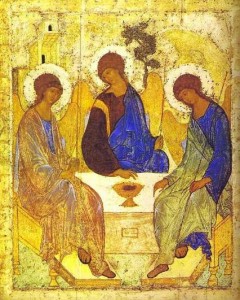
Rublev’s icon of the three visitors to Abraham, painted in the fifteenth century shows a graceful representation of the Trinity where all three elements incline to each other whilst keeping their own identity. God the Father on the left leans towards God the Son in the centre and God the Holy Spirit leans towards them both. They are seated around a table holding a wafer and a chalice representing the death of Jesus and holy communion. The icon leaves a space for the onlooker inviting them to be seated and to eat the meal. Christians understand themselves as entering into a relationship with the Trinity through worship and prayer.

Christians pray daily in a personal and intimate way to God as Abba: the conversation is two way as they wait on God to reply. Christians seek the love that has been revealed in the death of Jesus knowing that regardless of their mistakes, God’s love is sufficiently gracious and great to forgive them. Rublev’s icon shows how Christians understand, relate and love the triune God in a personal way.

St Augustine speaks of an innate longing to eat at the table and to be in the presence of God: it is only when Christians have searched and found such presence, that they find peace.

You have made us for yourself, O Lord, and our heart is restless until it rests in you’ (Augustine).

Main source: Mills, Watson E. (General Editor) 1998. The Lutterworth Dictionary of the Bible. Lutterworth Press, especially the William Hendricks article on God.

Who is Jesus?

A new textbookWho is Jesus? – explores and exemplifies what the RE-searchers approach might look like when applied in the upper secondary school context.

A team from Exeter University and the Learning Institute has developed a new approach to Religious Education in Primary Schools. It is called ‘the RE-searchers approach’. It encourages pupils to think about the significance and effectiveness of different methodologies and methods of enquiry in Religious Education. To make these accessible to young children, we have personified some of them as cartoon characters. Individually these characters are called Debate-it-all Derek, Ask-it-all Ava, Have-a-go Hugo, and See-the-story Suzie, but collectively they’re known as the ‘RE-searchers’. Each character holds different assumptions about religion(s) and advocates different research methods (e.g. questioning and arguing, interviewing and empathizing, participating and experiencing, and narrating and exploring interpretations). Once acquainted with our characters and their respective characteristics as researchers, pupils can undertake learning activities associated with each of them in pursuit of different understandings of religion(s).

These webpages include resources that:

  • explain who the RE-searcher characters are
  • explain how the RE-searchers approach can be used
  • provide examples of exemplar planning and activity ideas
  • explore the theoretical underpinnings of the approach

This online space will be used to provide a repository for such materials as we continue to develop the approach and accompanying resources. Materials have been written primarily for teachers, teacher educators and teacher trainees, but will be of interest to all those concerned with Religious Education in schools. We are keen to find more collaborators who wish to trial the approach and contribute to our understanding of how it can be used to support learning and learners in a range of contexts, thereby contributing to its future development. To receive more information on how to do so, please contact giles.freathy@thelearninginstitute.co.uk.

The RE-searchers approach has been developed through ‘close-to-practice’ theorisation and conceptualisation within the parameters of the policy and legal frameworks defining Religious Education in maintained schools without a religious affiliation in England. This work has been led by Rob Freathy at the University of Exeter and Giles Freathy, a Specialist Leader in Education in a primary school in South West England. The approach aims to initiate pupils into the communities of academic enquiry concerned with theological and religious studies. It takes as its starting point the following key assumptions: (i) religions are complex, diverse, multi-faceted, evolving and multi-dimensional phenomena; (ii) there are multiple methodologies and methods for generating knowledge about religion(s); and (iii) a multi-methodological pedagogy is necessary to avoid favouring one particular approach over others. Using the RE-searchers approach can help with learning about religion(s) and learning how to learn about religion(s) by creating a balance between: (i) subject content and issues of representation; (ii) learning processes and research methods; and (iii) personal evaluation and self-reflection.

The development of project materials has been generously funded by Culham St. Gabriel’s Trust and the Hockerill Foundation, and to whom we are very thankful for their faith, support and generosity. In addition to these two bodies we would also like to express our thanks to the following for supporting our work: The Learn Teach Lead RE Project, Sir Robert Geffery’s Primary School, The Learning Institute, Leigham Primary School, The University of Exeter Design Studio, Karen Walshe, Geoff Teece, Jonathan Doney, Lorraine Abbott, Emma Butler, Izzy Williams, Katie Freeman, Tatiana Wilson, Linda Rudge, Julie Curtis, Dave Francis, James Robson, Mark Chater, Nick Appleby and Danielle Golding.


Beyond Stewardship: Is Christianity to blame for our ecological crisis?

An investigation into differering Christian repsonses to environmental issues.

for 15-19 year olds. Originally written by Anna Davis, updated in April 2019.

Key words and concepts

Anthropocentric: human-centered; focusing on human beings as of most value and importance, especially in relation to animals or the rest of the natural world.

Apocalyptic: in biblical studies, refers to a kind of literature that reveals God’s perspective on current and future events, often with vivid and coded imagery, stark opposition between good and evil, and a prediction of what is to come. The best-known biblical example is the Book of Revelation (the Greek title of which is equivalent to the word ‘apocalypse’) in the Bible

Conservative Evangelicalism: a Christian tradition, found across a range of established and independent churches, which places particular emphasis on the authority and infallibility of the Bible, among other doctrines.

Dominion: sovereignty or control. Especially used to refer to the idea that humanity has power over the rest of creation. See Genesis 26-28.

Ecology: the part of biology that looks at how different organisms relate to one another and to their physical surroundings. Some environmentalists are concerned that human activity is damaging the delicate balance of ecology and thus endangering the future of the planet.

Ecosystem: a particular group of organisms that understood in relation to their physical surroundings.

Environment: the natural world, particularly as it is affected by human activity.

Environmentalism: a movement that is concerned with protecting the natural world from the harmful actions of humanity.

Eschatology: used by theologians to refer to beliefs about the future, and particularly about the ultimate ‘end’ of the world. It comes from the Greek word ‘eschatos’ meaning last or final. Also used to talk about God’s plans for the future of creation, including humans, animals and the environment.

Evangelism: spreading the Christian gospel with the particular aim of converting people to Christianity.

Francis of Assisi: an Italian Catholic friar and preacher of the twelfth and thirteenth centuries who founded a number of monastic orders and has become known as the Patron Saint of animals and the environment.

Fundamentalism: in this context, a form of Christianity focused on what are believed to be its fundamentals, with a particular emphasis on the authority, infallibility and inerrancy of the Bible. This label overlaps with Conservative Evangelicalism (see above).

Gaia hypothesis: the view of scientist James Lovelock that the earth is a kind of superorganism – a complex system that automatically self-regulates in ways that maintain an environment in which life can flourish.

Genesis: The first book of the ‘Old Testament’ or ‘Hebrew Bible’. It begins with two accounts of God’s creation of the world and contains various commands by God about how humans should act in relation to other parts of creation. These commands have been the subject of differing interpretations, hence the existence of current debates about how Christianity should respond to environmental challenges.

Global warming: a gradual increase in the temperature of the earth’s atmosphere and oceans. Generally attributed to the ‘greenhouse effect’, which is caused by increased levels of carbon dioxide, CFCs and other pollutants as a result of human activity. There is concern that global warming could cause sea levels to rise, having catastrophic effects of human life.

Imminent expectation: in this context, refers to the belief of some Christians that Jesus will return soon – perhaps within their lifetimes – to bring about the final end of the world.

Parable: a story or image used to illustrate a moral or spiritual lesson, as told by Jesus and recorded in the Gospels.

Rapture: the transporting of believers to heaven during the Second Coming of Jesus at the end of the world.

Stewardship: in Christianity, the idea that humans have been given responsibility for the rest of the natural world, and have a duty to care for it.

As well as enabling students to engage critically with different approaches to environmental stewardship, this material also develops knowledge about the Bible, and the different ways this can be approached and understood. Different methods used in Biblical Studies underpin this, as outlined below:

Historical criticism

Historical criticism is based on the presumption that the task of the biblical scholar is to discern what the text originally meant, and what events actually happened, from an objective and unbiased perspective. It has value not least in ‘distancing’ the Bible from its contemporary readers: the Bible is a collection of ancient texts, rooted in the cultural assumptions of ancient societies, that cannot cogently be regarded as simply a textbook of eternal religious or moral truths. Using this method, students can be encouraged to approach biblical texts critically, as historical sources. They may, for example, seek to identify different sources and traditions, to question which sayings of Jesus are likely to be authentic, or to consider aspects of biblical teaching that reflect ancient cultural or cosmological presuppositions. Historical criticism is no longer an uncontested or dominant method in biblical studies since it has been recognised that detached, objective historiography is impossible, and may in fact serve to conceal the interests and commitments that underlie particular construals of the past and particular readings of the texts. Nonetheless, it remains significant to a critical engagement with biblical texts as part of the study of topics such as environmental ethics.

History of interpretation

A recent development of interest within biblical studies is in the history of interpretation and influence of biblical texts (their Wirkungsgeschichte). Rather than looking to the world behind the text – the social context in which it arose, as in historical criticism – this approach instead concentrates on the world in front of the text, that is, on the diverse ways in which the text has been understood and has shaped and influenced aspects of life and culture from art and music to ethics and politics. This method means that rather than assuming that the text has one clear, correct meaning, and attempting to decide upon this, attention is directed instead to the diversity of meanings that has, through history, been derived from this text. In relation to environmental issues, it enables consideration of how Christians at different times and places have interpreted texts like Genesis 1–2 in relation to their particular convictions and concerns. It also serves to connect biblical studies much more directly with the study of issues and approaches in Christian ethics, from the earliest times right up to the present.

Reading from modern perspectives: the located reader

More recent methods of biblical study reflect the conviction that different readings can be generated depending on the social identity and location of the reader, and have given rise to feminist, black, liberationist and many other readings of the Bible. Such approaches place much greater emphasis on the role of the reader in the construction of meaning and on the influence of the reader’s context – a development which is also to be found in the study of other kinds of literature, as well as in disciplines such as history and politics, given a widespread acknowledgment that objective and detached analysis is impossible, and that the researcher’s own convictions and approach shape their presentation. Students might therefore be encouraged to ask how modern convictions and contexts shape readings of the Bible, or how different groups might read and respond to different texts.

Christian perspectives on the environment

The Evangelical Churches and Organisations

There are a number of evangelical Christian organisations that strongly support the idea that Christians must care for the environment. Stewardship is a prominent theme.

The Evangelical Environmental Network has stated that:

Because we have sinned, we have failed in our stewardship of creation. Therefore we repent of the way we have polluted, distorted, or destroyed so much of the Creator’s work.

They argue that we need to take better care of creation – to become better stewards – in order to live as God desires. (On the Care of Creation)

Other motivations for environmental care include an appeal to love of neighbour, encouraging people to act justly and out of consideration for those who are less fortunate. For example, the Evangelical Environmental Network includes ‘human and cultural degradation’ as among the ways in which we harm creation when we fail to act as stewards.

Tearfund, the Evangelical Alliance’s relief fund, campaigns on a variety of global humanitarian concerns including matters affecting the environment and climate change to encourage people to consider how their actions harm those who live in countries that are adversely affected by climate change. It cites a paraphrase of Romans 10.13 – ‘Love does no harm to its neighbour’ – as a call to responsible stewardship so that others do not suffer from the effects of climate change.

The Church of England

In 1991, the General Synod of the Church of England prepared a report on ‘Christian Stewardship’ with the aim of encouraging ‘a critical review of human responsibility to the living environment’. It states that:

Christians believe that this world belongs to God by creation, redemption and sustenance, and that he has entrusted it to humankind made in his image and responsible to him; we are in the position of stewards, tenants, curators, trustees or guardians, whether or not we acknowledge this responsibility.

The report cites Genesis 1.26-30 as giving humans authority over the natural world. However, at the same time it reads Genesis 2.15-17 as instructing humans to both ‘work’ it and ‘care’ for it. So humans have ‘dominion’ over the earth but this is a gift from God. This means that humans should care for the world ‘in the way God himself demands’.

Other motivations for environmental care include an appeal to love of neighbour, encouraging people to act justly and out of consideration for those who are less fortunate. For example, the Church of England writes of how ‘we are tenants of the world only in our own generation’, highlighting the importance of preserving the natural environment out of concern for the wellbeing of future generations. (Christians and the Environment: Report by the Board for Social Responsibility).

The Catholic Church

The Catholic Church understands stewardship as resulting from humans having been created in the image of God (the Catholic doctrine of the imago Dei).

Agneta Sutton from the Catholic Truth Society writes that:

From the very first, the biblical account of our role in creation declares that we have a special position and stand in a special relationship to God and so to the rest of creation. (Ecology and Stewardship: What Catholics Believe About the Environment. London: CTS. 2012. p. 8)

The International Theological Commission states that humans are:

…made in [God’s] image to participate in his work, in his project of love and salvation, indeed in his own lordship over the universe. Since man’s place as ruler is in fact a participation in the divine governance of creation, we speak of it here as a form of stewardship. (Communion and Stewardship: Human Persons Created in the Image of God, Section 57)

Pope John Paul II, a former leader of the Catholic Church, has spoken of the need for an ‘ecological conversion’. He remarks that:

Man’s lordship is not absolute, but ministerial…not the mission of an absolute and unquestionable master, but of a steward of God’s kingdom. (Communion and Stewardship, Section 73)

So for Catholics, ‘God appoints man as his steward in the manner of the master in the Gospel parables (cf. Luke 19:12)’. (Communion and Stewardship, Section 58).

The Orthodox Church

The Orthodox Church understands Genesis 1 as a call to stewardship, requiring humans to be responsible for creation. This is also linked with the Orthodox emphasis on ‘deification’ – the idea that humans come to share fully in God’s being and nature through the process of salvation. The Report of the WCC Inter-Orthodox Consultation states that:

We are called to exercise dominion over all creatures on earth (cf. Gen. 1:28), i.e. to be stewards … of God’s material world, caring for it, maintaining it in its integrity and perfecting it by opening it up to God through our own deification.  (Orthodox Perspectives on Creation, Section 11).

Orthodox theology also places emphasis on the importance of priesthood, not only as an office within the Church, but as a role that can be played by humanity in relation to the rest of creation: humans can help to offer the creation to God and mediate and express its praise to God. This may be linked with the idea of ‘deification’: the goal for humanity and for creation is to be transformed, renewed, perfected, and taken up into God. Some have suggested that these ideas about the transformation of all creation – its incorporation into the divine – may be especially valuable ideas to inspire environmental care. They express different ideas and emphases from the kind of stewardship expressed in the Protestant Churches, which is more concerned with the role of humans in relation to the rest of creation.

Conservative Evangelical and Fundamentalist Christian groups opposed to environmentalism

Not all Christians agree that we should be concerned about preserving the environment, or acting to reduce carbon emissions. Some conservative evangelical and fundamentalist groups see the environmental movement as a dangerous threat – a false, non-Christian religion.

It is important to note that such groups do not necessarily reject the idea of stewardship, but that they understand it in particular ways. Members of such groups are likely to put greater stress on the importance of evangelism (converting individuals to faith), the imminent return of Jesus, and ethical values related to sexual and family ethics than on conservation or care for the planet. Certain biblical texts to do with the end of the world are of particular importance here, for example, 1 Thessalonians 4.13-5.2 and Mark 13.7-31.

Sometimes these views are expressed in academic books, or on organisations’ websites, but more often they are to be found at a popular level on individuals’ blogs and websites.

For example, the American Evangelical organization Cornwall Alliance for the Stewardship of Creation the environmentalist view of the world which it claims ‘elevates nature above the needs of people, of even the poorest and the most helpless’. The Cornwall Alliance argues that such environmentalism is a ‘green dragon’ that presents a major threat to the Christian religion.

Further, Calvin Beisner, spokesman for the Cornwall Alliance, sees the domination of nature by humans as an essential task. He writes: ‘…continued population growth will result not in the depletion but in the increased abundance of resources, and not in increased pollution of the earth but in its increased cleansing and transformation from wilderness to garden, “from its bondage to decay…into the glorious freedom of the children of God” (Rom. 8:21).’ (Where Garden Meets Wilderness: Evangelical Entry into the Environmental Debate. Grand Rapids, MI: Acton Institute for the Study of Religion and Liberty/Eerdmans. 1997. p. 107)

In more popular literature, Spencer Strickland, through a blog published by Jeremiah Daniel McCarver, ‘Saving Earth One Human at a Time’ draws attention to the impact of beliefs about the imminent end of the world on concern for the environment:

Christians should not be carried away into the frenzy that is being stirred up in popular culture. While it is true that we are all stewards of the earth and should thus take care of it, we should also be aware of the fact that the “heavens and earth which are now” are being prevented from being destroyed by the Word of God (2 Pet. 3:7). God will one day destroy the earth with the fire of judgment, and this is the warning that Christians must take to those who are lost, in order that they might be saved through the obedience of the Gospel.

Similarly, Todd Strandberg, writing on his website ‘Rapture Ready’ states that, in his view, ‘any preacher who decides to get involved in environmental issues is like a heart surgeon who suddenly leaves an operation to fix a clogged toilet.’

Learning activities

1 Is Christianity to blame?

As a class, read and discuss the ‘Beyond Stewardship?’ stimulus text ‘Lynn White: Is Christianity to blame for our ecological crisis?’. Available to download below.

2 Origins of stewardship

Divide the class into small groups. Give each group one of the following texts (see available to download below):

  • Genesis 1
  • Genesis 2
  • Genesis 3
  • Genesis 4

Within their groups, the students read the texts and then discuss whether:

  • the text encourages care of the planet?
  • the text suggests humans are ‘in charge’?
  • the text suggests the land has intrinsic/instrumental value?
  • humans being made in the image of God change their relationship with the Earth?

The students should be encouraged to give reasons for their answers, and should refer to the texts the back up their views.

The groups can present their findings and views about the text they have studied to the rest of the class.

3 Contemporary Christian views

Display images depicting modern environmental problems, such as the destruction of the rainforest to grow palm oil, collapse of insect populations, reduction in water tables for cotton production and plastic pollution. Discuss what the images suggest about contemporary attitudes towards how we should care for the environment. Can any implications be drawn about Christian attitudes?

Establish the critical question: Is Christianity to blame for the Ecological Crisis? This is based on Lynn white Jr’s argument.

Divide the class into small groups. Give each group:

  • one of the viewpoints from the ‘Christian Perspective’ section of this resource;
  • a large recording sheet with space for notes on their Christian viewpoint, and THREE additional viewpoints.

Using their recording sheet, each group works together to create succinct notes recording their viewpoint and three others in relation to the critical question.

After reading and discussing their viewpoint, groups send one or two envoys to other groups to discuss and learn about other viewpoints, before returning to their original group.

Allow plenty of time for reading, discussion, definition and note-taking. Students will end up with a multi-layered analysis of Christian views and a critical view.

If time, listen to a brief answer from each group to the critical question, or set as a written homework, drawing on the evidence gathered.

4 How do different Christian views shape the argument?

Ask groups to copy this graph:

In groups, place each Christian perspective on this graph: do they place human authority over nature above human responsibility to protect nature; do they value humans above the natural world, etc?

Share and discuss graphs. As a class, ascribe reasons to each positioning; what are they based on? Either give a theological argument or a biblical reference to support each position. Through the course of the conversation, ensure these two positions are defined:

Christian Environmentalism: humans must transform the way we treat the environment; the natural world must be protected and nurtured, in both Evangelical and denominational Christian thinking.

Conservative Evangelical or Fundamentalist non-Environmentalism: God will destroy the earth at the End Times, this is God’s plan for humanity and the natural world.

Debate

Divide the class into two groups: Christian Environmentalism and non-environmentalism. Each groups has 15 minutes to create 4 strong arguments in favour of their position, in response to the motion (below).

Groups should also predict counter-arguments and prepare to meet them.

Motion: The earth is ours to use

Easter and Salvation

4-11 year olds

This series of lessons progresses from Early Years to Upper Key Stage 2, exploring themes around Easter at increasing depth. The resources are adapted from the ‘Salvation’ strand in Understanding Christianity. If you already teach Understanding Christianity and are interested in moving to a Religion and Worldviews approach, this resource is for you.

Created by Lynn Revell and Kate Christopher as part of their Canterbury Christ Church University grant funded project. Funding provided by Culham St Gabriel’s Trust

Follow this link to read more about Kate and Lynn’s research and watch a short video


Key Stages 2 and 3

Find out about Muhammad Ali: the athlete, the antiracist, the conscientious objector and the devoted Muslim.

Created by Lynn Revell and Kate Christopher as part of their Canterbury Christ Church University grant funded project Teaching Islam as a Worldview. Funding provided by  Culham St Gabriel’s Trust.

You can find further resources which were created as part of this project in the RE:ONLINE resource Islam as a Worldview.