Global terms: Research Spotlight

Research Spotlight: Using British Religions in Numbers data in the RE classroom

January 2023

Debbie Yeomans, Claire Ramalli and Nadia Nadeem

In this month’s research Debbie outlines the work she has done with Claire and Nadia on using British Religion in Numbers data. Some questions for teachers to discuss or reflect on about how you might use or adapt this research:

• Is the You Gov data reflective of our community?
• Why might some people want Jesus depicted to reflect their own ethnicity or culture?
• Why do you think younger British people are less accepting of the idea of a white Jesus?
• What can we learn from the census 2021 data on religion?

The research project commenced after three of us, who have since completed the Culham St Gabriel’s leadership programme, were offered the opportunity to create and deliver lessons using the online religious data resource; British Religion in Numbers (BRIN). www.brin.ac.uk

This project was cross-phased, we are a group combined of two Primary practitioners and one secondary practitioner. Nadia Nadeem and Debbie Yeomans are both primary practitioners with year 6 classes. Nadia teaches in Barking and Dagenham, East London, an ethnically diverse community. Debbie teaches in Stoke Golding in a small Church of England village school, serving predominantly a white middle class community. Claire Ramalli teaches RE in a large non-denominational secondary school in the coastal town of Eastbourne, East Sussex. The project involved planning and delivering lessons on two sets of religious data. Firstly, lessons linked to the decolonisation of teaching about Jesus. 

Secondly, Islamophobia and the misrepresentation of Islam and Muslims in the media. (Discussion on the latter research is found at https://vimeo.com/767284160)
We were each eager to deliver lessons that would challenge and question stereotypes, better preparing students for modern day Britain.
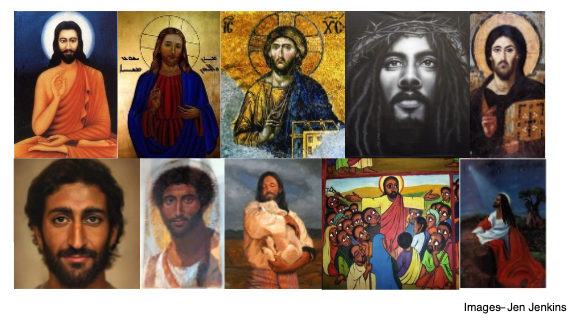
We met online to discuss and plan our lessons. We analysed the religious data and aimed to deliver similar style lessons to ensure our research could be replicated. The depiction of Jesus lesson was delivered to the two year 6 classes and a year 7 group. We all introduced our lessons by setting our classrooms up in the style of a gallery, pinning up different depictions of Jesus. Pupils walked around the classroom, guided to discuss each picture, considering questions about the representation of Jesus.
The research project commenced after three of us, who have since completed the Culham St Gabriel’s leadership programme, were offered the opportunity to create and deliver lessons using the online religious data resource; British Religion in Numbers (BRIN). www.brin.ac.uk

This project was cross-phased, we are a group combined of two Primary practitioners and one secondary practitioner. Nadia Nadeem and Debbie Yeomans are both primary practitioners with year 6 classes. Nadia teaches in Barking and Dagenham, East London, an ethnically diverse community. Debbie teaches in Stoke Golding in a small Church of England village school, serving predominantly a white middle class community. Claire Ramalli teaches RE in a large non-denominational secondary school in the coastal town of Eastbourne, East Sussex. The project involved planning and delivering lessons on two sets of religious data. Firstly, lessons linked to the decolonisation of teaching about Jesus.

Secondly, Islamophobia and the misrepresentation of Islam and Muslims in the media. (Discussion on the latter research is found at https://vimeo.com/767284160 .)
We were each eager to deliver lessons that would challenge and question stereotypes, better preparing students for modern day Britain.
We met online to discuss and plan our lessons. We analysed the religious data and aimed to deliver similar style lessons to ensure our research could be replicated. The depiction of Jesus lesson was delivered to the two year 6 classes and a year 7 group. We all introduced our lessons by setting our classrooms up in the style of a gallery, pinning up different depictions of Jesus. Pupils walked around the classroom, guided to discuss each picture, considering questions about the representation of Jesus.

Example questions to support this activity included:

  • Which image do you relate to the most and why?
  • Which image do you think is most realistic, why did you pick this one?
  • Do you think anything has influenced your thoughts?
  • Which picture do you think is most historically accurate and why?
  • Where do you predict the artwork is from?
  • What do you think the artist is trying to convey?
  • What else strikes you about the image?

Pupils were then introduced to the YouGov poll data. The data illustrated the majority of people in the UK expect to see a white Jesus. (58%) Debbie incorporated a small group silent discussion in to one of her lessons to deepen the students’ engagement with the data.
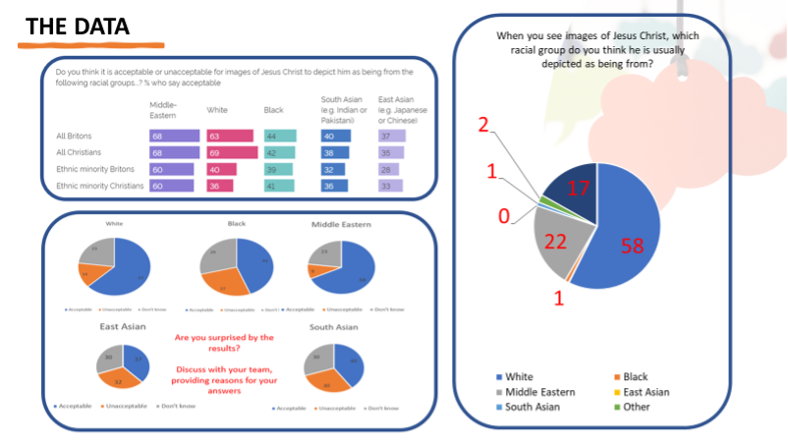
Below are examples of questions to support these discussions:

• Why do you think British people are much more likely to see Jesus depicted as White than Middle Eastern?
• Why is there a big difference between the Jesus most British people would expect to see and the depiction of Jesus that makes most sense to them?
• Why do you think younger people are less accepting of the idea of a White Jesus?

What were the key findings?

Nadia’s year 6 class discussed and debated the statistics through a process of inference and critical thinking, using prior learning to support their claims. For example, a pupil reasoned that Jesus must have been tanned as he was born in Bethlehem and that is near the equator, therefore would have had a lot of sun. Another child added that Jesus cannot be blond and blue eyed because he was a Jew, Jews were killed in WW2 for not being blond and blue eyed.

When questioned have you never seen a blond blue eyed Jesus, all the children said ‘no’. This was very much a contrast to Nadia’s own experience and the experience of Claire’s children, who study in a different borough and have seen images of Jesus where he is depicted as a blond blue eyed man.

Nadia’s class were extremely confident with their opinions and conclusions regarding the data and the depiction of Jesus that they believed to be the most accurate. Nonetheless, when posed with the question, “Can Jesus be portrayed as a different ethnicity to enable people to connect with him?” – they all said “Yes, but that would be their opinion and not a fact.”

Debbie’s lessons led to some deep discussions, giving children the chance to consider not only others’ opinions on the depiction of Jesus but also their own ideas. They considered where the Bible suggests Jesus was born and grew up, which led to some powerful lightbulb moments. The children then became quite concerned that the image they were used to seeing of Jesus were not accurate representations, and led to conversations around the depictions of angels particularly at Christmas. Debbie aimed to follow this up at Christmas using Justine Ball’s work on the decolonisation of teaching about Jesus.

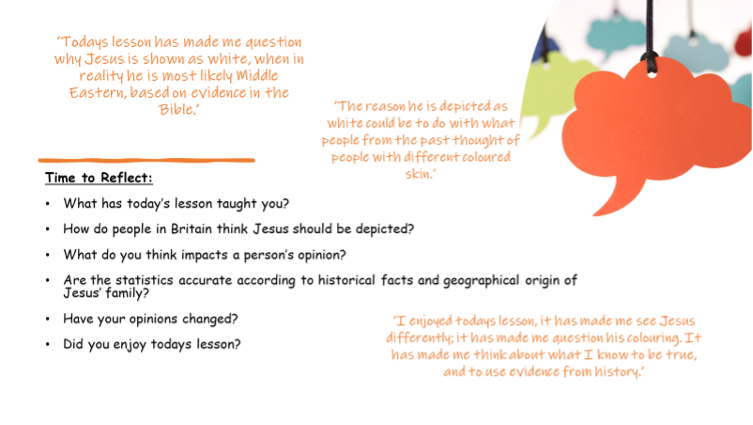
Claire’s year 7 class reflected on what they had learnt and if their opinions of the depiction of Jesus had changed since the start of the lesson. Analysing the feedback forms, the majority of students stated that their opinions of Jesus hadn’t changed, a significant number of students had already perceived Jesus to be Middle Eastern based on their prior knowledge of Jesus being Jewish and from Israel. The majority of students believed people’s attitudes towards the depiction of Jesus’ race was mostly based on an individual’s own ethnicity, whilst some students reflected that a persons’ family or stories and pictures of Jesus were the most influential in how a person perceived Jesus to look. One student commented that some Christians might want Jesus to look like them because of the act of the eucharist, with reference to transubstantiation.

What feedback did we get at RExChange?* What might be useful to do next, as a follow-up?

Lessons were taught as stand alone and we all agreed that the subject matter and data should be taught over two lessons rather than the one. All of us said we will incorporate the lessons in to our curricula. Debbie’s class went on to consider whether the data was reflective of their own community. The children made surveys using the data questions and shared them with staff and adults from home. This led to interesting discussions at home and with children’s families. Debbie’s mathematicians enjoyed collecting the data, presenting it to the class to making comparisons. This is something that we all agreed was a worthwhile activity and would deepen further engagement with the data.
Since delivering our research in the RExChange session we have received the following feedback from attendees:
“I did the lessons and would like to do them again, by incorporating them into my curriculum.”
“This was extremely interesting and opened up an exploration between images and data that I hadn’t even considered before! Great stuff.”

To find out more watch
Research Spotlight: Analysing ‘decolonising pedagogy’ in secondary school Religious Education Lessons

December 2023

Canterbury Christ Church University
John-Paul Riordan, Alexandra Brown, Katie Clemmey, Ciro Genovese, Nqobile Nkala, Sobantu Sibanda
Questions for consideration:

  • How might decolonial thinking be influencing RE classroom pedagogy?
  • How might a classroom teacher, who wishes to decolonise their practice, go about that?
  • How can/should classroom ‘decolonising pedagogy’ be understood and explored?

Who are we and what are we doing?

This project is a partnership between four secondary school RE teachers each with one of their own classes, and a team of five educational researchers from Canterbury Christ Church University. We are interested in understanding and explaining how decolonisation may be influencing secondary school RE classroom pedagogy. The phrase ‘decolonising pedagogy’ is ambiguous and could mean ‘the decolonisation of pedagogy’ and/or ‘pedagogy that aims to decolonise’ (we explore both). Two of the educational researchers are specialists in secondary RE (KC and CG), two in decoloniality (NN and SS), and one in classroom pedagogy analysis (JPR).

Why are we doing that?

The concept of coloniality is disputed (Veracini, 2013). One definition sees coloniality as “ongoing structure[s] of domination” (Paradies, 2016, p. 84). That understanding allows us to consider domination occurring in classrooms as potentially a type of coloniality. Additionally, school subjects (in particular history and RE) sometimes investigate colonialism. Some learners are educated in overtly colonised educational systems, such as classrooms in South Africa during the Apartheid era.

The ‘Decolonising the Curriculum’ and ‘Why is my curriculum white?’ movements challenge domination assumptions (Arday, Belluigi & Thomas, 2021). ‘Decoloniality’ is complex and can be understood in different ways (Gu, 2020). Attempting to capture decoloniality in a “new abstract universal” can, according to Mignolo and Walsh (2018, p. 1), be part of the problem. Since the ‘decolonial turn’ (Grosfoguel, 2007) many struggled with what ‘decolonialising pedagogy’ might be (Walton, 2018). Literature on decolonising pedagogy in secondary schools exists, but research regarding RE is rare. Decolonisation in school is not only about curriculum content and resources.

How are we doing that?

We used four video-based research methods. First, we made video recordings of four secondary RE lessons with four different teachers in four different schools. We asked the teachers to do no special preparation and to let us video record a lesson on an RE topic of their choice. Second, we invited each teacher to watch their lesson back and video recorded them as they ‘thought aloud’. These teacher interviews lasted between one and two hours depending on what the teacher decided. Third, we asked six volunteer pupils to watch video clips of the lesson for 30 minutes whilst again we video recorded their ‘thinking aloud’. Clips were chosen by the research team and the class teacher for pragmatic reasons as we thought watching the whole lesson back would have meant those interviews would be too long. Fourth, we invited all four teachers for a video-recorded focus group interview with the five researchers in the team. In total we recorded about 11 hours of video data and that is all available in the UK Data Service for research and teaching purposes (please get in touch if you want access).
We are exploring these video data using a variety of research designs. For example, one approach is to use Grounded Theory.

What have we found out?

The first theme we wrote about is ‘persuasion and control’ in the classroom. Literature on pedagogical persuasion was discussed and explored by Alexander et al., (2002) who argued that persuasion is neither inherently good nor bad. ‘Control’ of learners by teachers has long been discussed by teachers, policy makers, and researchers according to Maguire, Ball and Braun (2010). Managing disruptive behaviour of pupils in classrooms is a big concern of many teachers (Nash, Schlösser and Scarr, 2016). We present how often persuasion/control occurred during one of the lessons, then analyse three transcript excerpts to illustrate ‘decolonising pedagogy’ in practice.

The second theme we explored is ‘agreement and disagreement (including conflict)’ in the classroom. Decolonisation can involve disagreement and sometimes conflict. We think children need to learn about ‘healthy disagreement’ in the classroom. The project is ongoing.

Feedback and questions welcome (please contact John-Paul on john-paul.riordan@canterbury.ac.uk).

Research Spotlight: An approach to decolonising teaching about Jesus in primary schools

January 2022 research of the month features Justine Ball.

As you look at this research here are some things to consider:

  1. Are Jesus, angels and Christians often depicted as white-skinned and European in your RE resources?
  2. Are you confident to teach children about Jesus’ Jewish context?
  3. Do your teaching resources explore the diversity of Christian groups around the world?

My research centres on areas I observed with the teaching about Jesus in primary RE and considers ways to address these. The first issue is the dominant depiction of Jesus as lighter skinned and European in paintings and imagery that children see. This is well known in other related disciplines such as biblical and religious studies; for example, Pittman and Boyles state that:

The historical-cultural dominance of fair skinned, often blue-eyed Jesus is old news for theologians and biblical scholars. (2019, 315).

Although this is “old news” in other related disciplines, I still observe this in many of the paintings and imagery that children see.

A further issue that I observe is the lack of emphasis about Jesus as Jewish, which again has been noted in biblical studies for years (Pittman and Boyles, 2019, 324). This lack of focus results in younger children not understanding the connection between Jesus as Jewish and the impact of his actions in the stories they hear. When children are older, in Key Stage 2, they will also not understand the later development of the Christian church without first understanding the Jewish context of Jesus and his first disciples (for example, why Jesus is often referred to as a messiah and the fulfilment of Old Testament prophecy). This lack of emphasis does not help children appreciate the historical or religious impact of his actions, which could also result in confusion in the subsequent teaching about Judaism. For example, how to explain to children the fact that Jesus was Jewish, but his followers were Christian.

A further issue is that white, European imagery is not only used when depicting Jesus, but often used when showing pictures of Christians or characters from the gospel stories. Persona dolls, which are popular in Early Years and Key Stage 1 teaching, often present one image of a Christian child with blond hair and blue eyes, without using other dolls that might suggest there is far more diversity among Christians. Using imagery such as this without further diversity gives the impression to children that Christianity is a European religion.

The issue of such dominance in imagery is a major concern because it is not only misleading, but it also does not allow an opportunity for all children regardless of their background to see themselves in the teaching resources used and is something which suggests that a colonised curriculum is present in RE. A colonised curriculum is defined as one where the “thinking, framing and curriculum has a Europe centred, colonial lens” (EachOther, 2021). It is an area that children at a very young age notice.

This led me to research how schools use imagery in their teaching and how important it is for children to see diversity in imagery.

A further issue that I observed was the need for further knowledge about the diversity of Christian churches and the need for knowledge about how other religious groups value Jesus too. Children will often visit their local church, but it might be the case that they visit only one church and hear only one set of views. This results in children failing to see the real diversity within Christianity in the UK. Teaching often also fails to highlight that people from other different religions revere Jesus too. This led me to question how the teaching about Jesus might invite other religious people to say why he is important for them.

The imagery and diversity of views that children are exposed to matters because it is this that they will remember above any content taught in the classroom. Dale’s study in 1969 revealed how powerful images are compared to words in people’s memory. Using a diagram referred to as the Cone of Experience, Dale’s work has gone on to influence educators ever since and it clearly shows that visual imagery helps people to remember information long after the words are forgotten.

What is shown to children therefore need careful selection because getting this wrong can lead to the stereotyping of others (such as seeing Christians as mainly European) and misconceptions about Jesus (for example, not knowing that he was Jewish, or assuming that he was white). It may lead to intolerance of others if the misconceptions lead children to believe that Christianity is only for Europeans, and other cultures or traditions are not valued. Therefore, inaccurate representations of Jesus and a lack of diversity in the imagery and content about Jesus may result in RE indirectly contributing to ignorance and misrepresentations of religion to children.

In my dissertation I argue that the teaching about Jesus in English primary schools urgently needs to address these issues by using biblical studies research and religion and worldviews research, suggested by the Commission on Religious Education in 2018 (Foreword) as the approach that would present a new direction for the teaching of RE. This research calls for the study of religious and non-religious worldviews in different ways, using different disciplinary techniques such as historical and sociological approaches to help children:

understand both a wider range of religious and non-religious worldviews and the idea of diversity within worldviews. (Commission on Religious Education, 2018, 5)

Using such research will help teachers recognise that the historical and geographical context of Jesus being located in Judaea two thousand years ago must be taught so that children understand this context as well as the continuing relevance of Jesus for diverse groups today. A worldviews approach will help the teacher introduce a variety of perspectives about Jesus from different communities and present a diversity of images from the UK and around the world rather than using artwork that continues to reflect the dominant presentation of Jesus as a White Western European[1].

The approach I argue for references anti-racist approaches to education and aspects of historical and theological studies about Jesus, such as marginalised voices and Black theological views of Jesus which are currently not reflected in much primary teaching.

I show that Christianity is a global religion with growth in newer churches in the UK and worldwide in African and Latin American countries and argue that this should be reflected in teaching. I further argue that the artwork that teachers use should not only reflect the worldwide global nature of Christianity, but also reflect the multicultural nature of Christianity in the UK and I call for further resources to help teachers with this. I argue that the demand for progress in this area has become much more urgent with the recent focus on decolonising the curriculum with an emphasis on:

the process in which we rethink, reframe and reconstruct the curricula and research that preserve the Europe-centred, colonial lens. (EachOther, 2021)

This is important as decolonisation research presents opportunities to consider different approaches to the teaching about Jesus and to address the issues that I raise here.

I used qualitative research methods with a small sample of teachers and their children  across 3 very different primary settings to seek further information.

My findings reveal the teachers’ comment that much of the artwork they use for the teaching about Jesus is European in style and imagery. They also comment on the lack of diversity in teaching about Christian views about Jesus or other religious views. Teachers themselves ask for further resources to help them teach about Jesus using artwork and resources from a greater diversity of sources to address this.

My findings show the importance of visual imagery for children in how they answered my questions. They show how the majority describe Jesus with dark hair, blue eyes and peach or light-coloured skin and they clearly reference that they know this from the books or films that they have seen. Children do not always know how other religious people view Jesus, but some children, particularly older children, do know that he was Jewish.

I make recommendations for RE advisors and curriculum writers to make teaching historically accurate by referencing the historical Jewish context of Jesus, to embed the principles of worldviews and decolonisation research and to approach the teaching about Jesus using much greater diversity in the imagery, artwork and examples taught to children in future.

Questions to consider:

  • What have you seen in your own context?
  • What actions can you take?
  • What resources would further help teachers address these issues going forward?

[1] The head of Christ by Warner Sallman has become the best known American artwork of the twentieth century of Jesus in recent years and has influenced the presentation of Jesus since it was painted. (Washington Post, 25 June, 2020).

Bibliography

Aylward, K., and Freathy, R. (2008). Children’s conceptions of Jesus. Journal of Beliefs and Values, 29/3, 297–304.

Bond, H. (2012). The Historical Jesus: A Guide to the Perplexed. London: Bloomsbury.

Carter, J. (2008). Race: A theological account. United States of America: OUP.

Chilisa, B., Major, T., Gaotlhobogwe, M., and Mokgolodi, H. (2016). Decolonising and Indigenizing Evaluation Practice in Africa: Towards African Relational Evaluation Approaches. Canadian Journal of Program Evaluation, 30/3, 313–328.

Commission on Religious Education – CoRE (2018). Final Report, Religions and Worldviews: The Way Forward. London: Religious Education Council. Retrieved August 23, 2021, from FINAL REPORT. Religion and Worldviews: the way forward. A national plan for RE | Commission on Religious Education.

Cone, James. (2011). The Cross and the Lynching Tree. New York: Orbis Books.

Cooling, T., Bowie, R., and Panjwani, F. (2020). Worldviews in Religious Education. London: Theos.

Copley, T. (1994). Religious Education 7–11: Developing Primary Teaching Skills. London: Routledge.

Copley, T. (2008). Teaching Religion: Sixty years of religious education in England and Wales. Exeter: University of Exeter Press.

Cush, D. (1999). The Relationships between Religious Studies, Religious Education and Theology: Big Brother, Little Sister and the Clerical Uncle? British Journal of Religious Education, 21:3, 137–146.

Cush, D., and Robinson, C. (2014). Developments in religious studies: Towards a dialogue with religious education. British Journal of Religious Education, 36/1, 4–17.

Dadzie, S. (2000). Toolkit for Tackling Racism in Schools. Stoke on Trent: Trentham Books.

Docherty, S. (2018). A new dialogue between biblical scholarship and Religious Education. British Journal of Religious Education, 40/3, 298–307.

EachOther: What Decolonising the Curriculum Really Means. Retrieved August 6, 2021, from What Decolonising The Curriculum Really Means | EachOther.

Flanagan, R. (2019). Implementing a Ricoeurian lens to examine the impact of individuals’ worldviews on subject content knowledge in RE in England: a theoretical proposition. British Journal of Religious Education, 43/4, 472–486.

Flanagan, R. (2020). Worldviews: overarching concept, discrete body of knowledge or paradigmatic tool? Journal of Religious Education, 68, 331–344.

France-Williams, A. (2020). Ghost Ship. London: SCM Press.

Garrett, L. (1997). Dewey, Dale, and Bruner: Educational Philosophy, Experiential Learning, and Library School Cataloging Instruction. Journal of Education for Library and Information Science, 38/2, 129–136.

Gayad, A., and Angus, S. (2018). Visual Pedagogies: Decolonising and Decentering the History of Photography. Studies in Art Education, 59/3, 228-242.

Gearon, L., Kuusisto, A., Matemba, Y., Benjamin, S., Du Preez, P., Koirikivi, K., and Simmonds, S.(2021). Decolonising the Religious Education Curriculum. British Journal of Religious Education. 43/1, 1-8.

Glaw, X., Hinder, K., Kable, A., and Hazleton, M. (2017). Visual Methodologies in Qualitative Research: Autophotography and Photo Elicitation Applied to Mental Health Research. International Journal of Qualitative Methods, 16, 1–8.

Harvey, J. (2011). Visual Culture. In The Routledge Handbook of Research Methods in the Study of Religion. London: Routledge, pp. 502–522.

Hayward, M. (2008). The Representation of Christianity in Religious Education in England: The shaping of a tradition. Coventry: University of Warwick.

Jennings, W. (2010). The Christian Imagination: Theology and the Origins of Race, Yale: Yale University Press.

Joy, M. (2001). Postcolonial Reflections: Challenges for Religious Studies 1. Method and Theory in the Study of Religion, 13/1, 177–195.

Knowles, E., and Ridley, W. (2005). Another Spanner in the Works: Challenging Prejudice and Racism in Mainly White Schools. London: Trentham Books Ltd.

Matemba, Y. (2021). Decolonising Religious Education in Sub-Saharan Africa through the Prism of Anti-colonialism: a Conceptual Proposition. British Journal of Religious Education, 43/1, 33–45.

Mercer, J. (2017). A Space for Hard Conversations on Race, Racism, Anti-Racism, and Religious Education. Religious Education, 112/1, 1–2.

Norris, K. (2020). James Cone’s Legacy for White Christians. Political Theology, 21/3, 207–224.

ODIHR Advisory Council of Experts on Freedom of Religion or Belief: Toledo Guiding Principles on Teaching about Religions and Beliefs in Public Schools. Retrieved September 10, 2021, from untitled (osce.org).

Owen, S. (2011). The World Religions Paradigm. Arts and Humanities in Higher Education,10/3, 253–268.

Pink, S. (2013). Doing Visual Ethnography. London: SAGE.

Pittman, A. J., and Boyles, J. H. (2019). Resisting White Jesus: Race and the Undergraduate Bible Classroom. Religious Education, 114/3, 315–327.

Radford Ruether, R. (2012). Is Christ White? In G. Yancy (ed.), Christology and Whiteness: What Would Jesus do? London: Routledge, pp. 101–113.

Revell, L. (2008). Religious Education in England. The History of Religions and Religious Education, Numen, 55 2/3, 218–240.

Rose, G. (2013). On the Relation between Visual Research Methods and Contemporary Visual Culture. The Sociological Review, 62/1, 24–41.

Runnymede Trust (2020). Race and Racism in English Secondary Schools. Retrieved September 10, 2021, from Runnymede Secondary Schools report FINAL.pdf (runnymedetrust.org).

Sanders, E. (1993). The Historical Figure of Jesus. London: Penguin Books.

Thorani, A. (2020). REC Discussion Papers. Retrieved September 10, 2021 from The-Worldview-Project.pdf (religiouseducationcouncil.org.uk).

Vince, M. (2020). ‘Neutrality’, Muslimness and the whiteness of RE professionalism. Journal of Religious Education, 68, 371–383.

Walshe, K. (2005). What Do Young People Today Really Think about Jesus? British Journal of Religious Education, 27/1, 65–78.

Walshe, K. and Copley, T. (2001). The Jesus of Agreed Syllabuses and the Jesus of Theology and Religious Studies in KS2. British Journal of Religious Education, 24/1, 65–78.

Washington PostHow An Iconic Painting of Jesus as a White Man was Distributed Around the World. Retrieved August 4, 2021 from How Jesus became so white – The Washington Post

Thorani, A. (2020). REC Discussion Papers. Retrieved September 10, 2021 from The-Worldview-Project.pdf (religiouseducationcouncil.org.uk).

Vince, M. (2020). ‘Neutrality’, Muslimness and the whiteness of RE professionalism. Journal of Religious Education, 68, 371–383.

Walshe, K. (2005). What Do Young People Today Really Think about Jesus? British Journal of Religious Education, 27/1, 65–78.

Walshe, K. and Copley, T. (2001). The Jesus of Agreed Syllabuses and the Jesus of Theology and Religious Studies in KS2. British Journal of Religious Education, 24/1, 65–78.

Washington PostHow An Iconic Painting of Jesus as a White Man was Distributed Around the World. Retrieved August 4, 2021 from How Jesus became so white – The Washington Post

Yancy, G. (2012). Christology and Whiteness: What Would Jesus Do? London: Routledge.

An Approach to Decolonising Religious Education

November / December 2021 research of the month features Krystian McInnis

Krystian presents an approach to decolonising the curriculum drawing on his research with black students.

Historically, from the fifteenth to the twentieth century, religion and education have been at the epicentre of all European empires (Gearon et al. 2021). Whilst decolonising has had little uptake in recent years, with much left to the outskirts of British academia, a more detailed focus has been found in the US, Sub-Saharan Africa (Matemba 2021) and Canada (Cote-Meek & Moeke-Pickering 2020). The senseless killing of George Floyd however, brought to the forefront not only a conversation regarding race and racism, but the need to see institutional and structural change within society and education. With this the case, my research focuses on exploring decolonising religious education through the Black student perspective, a voice far too often neglected in both society and academia.

Positionality

I feel it vital, at this early stage, in line with postcolonial theorists’ work, to state my position as a Black male secondary practitioner and researcher. With my research exploring decolonising religious education, my cultural identity allows me to write from a position of strength. With very few academics writing within this sphere, and an even fewer number Black; my insider perspective is both valuable and necessary within this topic. Furthermore, my perspective allows for not only my voice, but others like me to have their voices heard and listened to, often a privilege not afforded within education.

Having been educated within the British education system myself from EYFS to postgraduate studies; I know too well of the diversity deficiency regarding religion and culture in secondary education. Moreover, from African-Caribbean lineage, consisting of a recent and brutal past of colonised heritage, I am acutely aware of my culture’s erasure from the British curriculum, confined to an annual acknowledgment of slavery in the month of October (Campbell 2020). Therefore, for me it has been pivotal to explore and research in this space, to bring about a long overdue change, exploring literature, neglected for far too long.

Furthermore, my position as an insider within the topic of decolonising the curriculum I feel is multi-layered and vital. With a severe lack of representation within education, much of the conversation appears to be stagnant with very few academics or school practitioners pushing the conversation forward. With approximately 2.3% of teachers in the UK Black compared to 85.7% White whilst in leadership positions 2.6% Black compared to 95% White, this arguably could be why within secondary education the conversation has not progressed much further. What must be noted however, is the impact this has on students. With a lack of representation, coupled with a non-diverse and colonial-centred curriculum, students with backgrounds similar to mine will continue to not see themselves truly reflected within their educational lifespan, bringing about complex identity issues which we see present in society today.

What is meant by Decolonising?

In recent years, calls for decolonisation have echoed through educational communities with much discussion regarding form, content and interpretation of the curriculum from the colonised and former colonised (Arday and Mirza, 2018). In addition, the debate on decolonising the curriculum has not been more central within history than it is today. However, much of this debate surrounds Higher Education. Arguably, exacerbated by the death of George Floyd, the conversation within academia and education most notably erupted with the infamous, Rhodes Must Fall Campaign, which called for the removal of the Cecil Rhodes statue at Oriel College Oxford (Chaudhuri 2016; Chigudu 2020; Makori & McKay 2020). It is paramount however to assert that decolonising the curriculum is not merely demanding the removal of statues or previously taught material, or the erasure of White history, but rather for an additional lens to be provided, exploring the voice of the ‘other’, the ‘colonised’, the intentionally forgotten. This additional lens allows for a holistic view of historical events, taking into account the lives and experiences both positive and negative of all those involved.

Postcolonial Theory 

In attempting to define postcolonial theory there are a plethora of definitions available, which has caused much debate over the years. Commonly accepted however, is that of a critical academic study of the cultural legacy of colonialism and imperialism, focusing on the human consequences of the control and exploitation of colonised people and their land. In addition, present within postcolonial theory is a false dichotomy between postcolonial theory and postcolonial criticism. Nevertheless, the key works and contributions of Aime Cesaire (Discourse on Colonialism), Frantz Fanon (Black Skin White Masks), Edward Said (Orientalism) and Paulo Freire (Pedagogy of the Oppressed) are a good starting point for exploration within this field. Whilst through a historical lens, postcolonial theory analyses texts, literature and prose, it is also important to note its analysis regarding race, culture and religion. By magnifying the socio-political layers of literature, postcolonial theorists show that aesthetics are not objective, disinterested or natural but rather politically constructed to put white European literature on a pedestal whilst simultaneously disregarding Black, native and aboriginal aesthetics (Eglinton 2019).

Key findings from my semi-structured interviews

  • Students had a lack of awareness regarding decolonising Religious Education. Students who were interviewed were aware of the need to diversify and add more ‘people that look like us’, but decolonising was a phrase they had not come across
  • Students were only able to make links between colonial and History; in particular, slavery however, felt this was limited to the British Empire
  • Students were unaware that Religion and education has played a pivotal role in the colonising of countries and expanding colonial empires
  • There appears to be a wider misunderstanding of what a decolonised curriculum is, with many practitioners believing it is in part to remove aspects of White British History rather than to include the voice of the oppressed
  • For a successful decolonised curriculum, cross-curricular collaboration will be curricular to ensure that students are getting a holistic picture, rather than it confined to one area of subject
  • Many practitioners appear to be apprehensive regarding decolonising the curriculum due to workload and time pressures. However, decolonising religious education does not mean new schemes of work per se, but rather for example additional resources and worksheets showing a different viewpoint

Decolonising Religious Education

My research, still in its early stages, has attempted to explore decolonising religious education taking into account the Black student voice and experience. What was stark however, through my semi-structured interviews, was that the students had no understanding or awareness of the politicised phrasing ‘decolonising the curriculum’ or ‘decolonising religious education’. Whilst students were able to suggest that they felt Religious Education did not represent them fully and needed to be ‘more diverse’ and argued they wanted to see ‘other cultures and backgrounds’ in their lessons and books, they believed that decolonising referred solely to a colonial past which was only relevant to History and the British Empire. Students did however; assert that Religious Education is more diverse than other subjects are.

Furthermore, what was more interesting is that students appeared to make no connection between the colonial past and its role within religion. Missionary work, most remarkably, was central to both the expansion and maintenance of the British Empire (Reichard 2015; Velho 2007; Vandrick 2018; Meier 2018). What this did however make me note, is that within religious education this is not an aspect often covered, nor is there investigation of the Church within History except most notably the Reformation and Counter-Reformation. I argue that perhaps a decolonised curriculum would explore the effects of missionary work in society today in particular within Sub-Saharan Africa.

As aforementioned, decolonising the curriculum requests for the inclusion of content, to both supplement the current curriculum and provide an overlay, exploring the views and perceptions of the ‘other’, the previously colonised. An example of this could be the teaching of key figures, such as Gandhi within religious education. Whilst much conversation appears to surround his teachings, it neglects to highlight his fight was directly against the decades long oppression of the British Empire on India. Additionally, perhaps the teaching of Martin Luther King Jnr, often portrayed as the epitome of pacifism, in direct opposition to Malcolm X, could be studied including recognition that the US government deemed King an ‘enemy of the state’.

Ideally, the impact of my research will help bring about the necessary decolonising of Religious Education and subsequently wider curriculum too. Whilst there is some suggestion Religious Education is already decolonised, I assert that this is not the case, however, arguably in some places the process has certainly started.

Discussion Questions

  • Are there, could there be, or should there be links between the worldview agenda and curriculum decolonisation in RE?
  • What would decolonising the RE curriculum actually mean in practice, not just rhetorically?
  • Discuss and identify some ways in which your own RE curriculum could be decolonised: come up with two or three specific examples of changes that could be made. Think about content, but also approach.

References

Arday, J., and H. S. Mirza, (2018) Dismantling Race in Higher Education: Racism, Whiteness and Decolonising the Academy. London: Palgrave.

Campbell, L. (2020) ‘It isn’t a tick-box’: young BLM activists on Black History Month in UK schools, The Guardian https://www.theguardian.com/world/2020/oct/11/it-isnt-tick-box-young-black-lives-matter-activists-on-black-history-month-uk-schools

Chaudhuri, A. (2016) The real meaning of Rhodes Must Fall:  After the nation’s long retreat from multiculturalism and the return of a rose‑tinted memory of empire, it is no accident that the Rhodes Must Fall movement has come to Britain, The Guardian https://www.theguardian.com/uk-news/2016/mar/16/the-real-meaning-of-rhodes-must-fall

Chigudu, S. (2020) Rhodes Must Fall in Oxford: a critical testimony, Critical African Studies, 12:3, 302-312

Cote-Meek, S., Moeke-Pickering, T. (2020) Decolonizing and Indigenizing Education in Canada, Canadian Scholars

Eglinton, Y. (2019) Postcolonial Literacy Criticism: An introduction Handbook, Textual Matters

Gearon, L., Kuusisto, A., Matemba, Y., Benjamin, S., Petro Du, P., Koirikivi, P., Simmonds, S. (2021) Decolonising the religious education curriculum, British Journal of Religious Education, 43:1, 1-8

Makori, B., McKay, H. (2020) Rhodes Must Fall – Oxford protesters target statue of colonialist https://www.reuters.com/article/us-minneapolis-police-protests-britain-r-idUSKBN23G2CF

Matemba, Y. (2021) Decolonising religious education in sub-Saharan Africa through the prism of anticolonialism: a conceptual proposition, British Journal of religious education 43:1, 33-45

Meier, V. (2018) Neither bloody persecution nor well intended civilizing missions changed their nature or their number, Critical Romani Studies, 1:1, 86-126.

Reichard, J. D. (2015) Mutually transformative missions: A postcolonial, process-relational Pentecostal missiology, Missiology, 43:3, 245–257

Vandrick, S. 2018. Growing up with God and Empire: A Postcolonial Analysis of Missionary Kid Memoirs, Blue Ridge Summit

Velho, O. (2007) ‘Missionization in the post-colonial world: A view from Brazil and elsewhere’, Anthropological Theory, 7:3, 273–293

Research Spotlight: After Religious Education

March 2024

Dr David Lewin, Senior Lecturer in Education, University of Strathclyde

Questions for consideration:

  • How should RE teachers respond to expectations to cover more subject matter with less time?
  • Where do non-religious worldviews fit in?
  • Or should it be less about fitting stuff in, than reimagining RE more broadly?

These are some of the questions that motivated a group of teachers and researchers to come together to think about RE beyond the conventional framing of the world religions paradigm. The group’s discussions were supported by Culham St Gabriel’s Trust to form the After Religious Education project.

After RE aims to explore the nature of the educational representation of religion(s) and to support the development of a new vision for Religion Education (Religion and Worldviews). Its primary question is:

What ought to be the educational logic governing the presentation and representation of the subject matter of Religious Education?

The project draws attention to the limitations of the predominant world religions paradigm in the educational representation of religion(s). Drawing on the expertise of academic specialists in Religious Studies and Education Studies along with skilled and experienced teachers, the project seeks to reimagine Religious Education by recognising the complexity of subject matter while acknowledging the pedagogical challenges.

There’s no getting away from the complexity of the subject, so this project offers a framework of seven principles for dealing with it:

  1. Purposes/aims first: education always begins with an intention, purpose or aim. While teachers have a variety of intentions and influences underpinning their practice, the general purpose of holistic formation (Bildung) allows diverse aims and intentions to be aligned and harmonized.
  2. Agency: acknowledging the agency of teachers in selecting and representing the curriculum content, as well as bringing it to life in the classroom. This means trusting the judgement of teachers.
  3. Pedagogical reduction: we can’t present everything. Selection, simplification and representation are fundamental to teaching. Reduction should not be accidental or prejudiced, but should be self-conscious and considered.
  4. Exemplarity: examples are of something so there is nothing ‘sacred’ about the examples themselves. Teachers are freed from overspecification of subject matter.
  5. Resonance: effective teaching and learning requires a curriculum that resonates with the ‘lifeworld’ of students.
  6. Interpretability: subject matter is not just there, but always arises through interpreting the world. Good RE has a methodological emphasis which highlights that subject matter (knowledge, skills, attitudes, values) is contextual and perspectival.
  7. Decolonising: all knowledge has a history which is not neutral. RE should explore the margins and the unfamiliar and select examples that show diversity.

Instead of only studying examples of ‘religions’, this approach encourages the study of the nature and implications of the term ‘religion’.

This approach can also be called exemplary teaching: because we can’t teach everything, we must select general examples that speak to our students about what we consider worthwhile. The questions for teachers: What are the selected examples chosen for? What are they trying to communicate? What diverse examples could be used (beyond the tried and tested)?

The framework does not begin from the point of view of settled content that must be taught and learned, but by first thinking about what one is trying to achieve and then seeking exemplary content in order to bring that about. This framework employs Wolfgang Klafki’s 5 questions for didactic analysis (https://www.afterre.org/framework): the questions allow for diverse, contextualised, interpretive responses, that acknowledge the agency and responsibility of the teacher, and the emerging autonomy of the student.

For more details check out the website for After RE.

Recent project publications:

Research Spotlight: Islam as a worldview

July 2021 research spotlight features Dr Kate Christopher and Professor Lynn Revell.

Islam as a Worldview

What does a worldviews approach look like in practice? Dr Kate Christopher and Professor Lynn Revell.

What does a worldviews approach look like in practice? This project aims to make sense of and explore worldviews thinking through practical resources for the classroom, focusing on the teaching of Islam.

‘Worldviews’ is a loosely- defined term, not dissimilar to words like ‘religion’ and ‘culture’. However instead of focusing too strictly on the various definitions of ‘worldviews’ in the work of various political and social theorists, we have considered its meaning in in usage. At the moment, in the RE/ Religion and Worldviews community, the word is being used to describe a shared vision of a critical, contextual curriculum, embracing messiness and diversity. In Religion and Worldviews education the ‘worldviews approach’ describes a new paradigm, moving away from the current ‘world religions approach’.

Why the change to worldviews?

Firstly, religious adherence, or more accurately, Christian adherence, in the UK is in sharp decline. There is a corresponding rise in those who describe themselves as non-religious. The UK is also becoming more ethnically, culturally and religiously diverse. Where there is religious adherence, it is more and more likely to be among non-white British groups. The first concern of the worldviews approach is to reflect more accurately the religious and ideological landscape 21st Century pupils recognise.

How does a worldviews approach address this issue? For us, a worldviews approach does not start with buildings, beliefs, objects, books or festivals, it starts with people and with a particular understanding of the person as complex and multi-layered who holds views that are often hard to categorise as either sacred or secular. Because people are inherently diverse and rooted in a time and place, diversity and context are a natural and inherent dimension to worldviews thinking. Taking people as a starting point means integrating diversity and context in worldviews as an ordinary part of people’s identity and beliefs. Although there is an argument that only religious world views should be considered (Barnes, 2015) we believe that a focus on people as the starting point of worldviews education can help teachers engage with the beliefs of people and communities in ways that are genuinely intercultural and holistic (Braten and Everington 2018).

Secondly, a worldviews approach invites pupils’ critical engagement as part of the learning. Pupils’ own responses and questions about what they learn, as they make sense of complexity and context, is woven through the learning. As people in their lives navigate political and economic pressures, cultural traditions, change and diversity, so will pupils engaged in learning through the worldviews approach.

Example: the mosque

Underlying the world religions approach is an assumption that the religions, singly and comparatively, have common characteristics; sacred spaces, sacred texts, important people, core beliefs. A world religions approach to the mosque might be to identify the main features of the mosque and their function. The assumption underlying this approach is that all mosques have common characteristics and Muslims everywhere share a common relationship with the mosque. A further assumption is that all Muslims believe very similar things and that Muslims everywhere practice their religion in very similar way.

To take a worldviews approach to the mosque is to ask different questions from the outset. For example, the mosque in Gillingham in Kent where Lynn has been taking PGCE students for many years, is not an abstract idea of a mosque, but an actual mosque. To start with people is to ask about the people in the mosque: who are they, where are they, what do they say? The majority of this mosque population is 1st, 2nd and 3rd generation Pakistani-heritage Sunni Muslim. The older generation tend to be more liberal, the younger generation are more conservative in their faith, but also more likely to be vocal against racism and confident in their British Muslim identity. To start with people is not to assume that we, the onlooker, knows what Muslims think about their mosque, it is to ask and listen and engage with their influences, pressures and hopes to make sense of what they say.

But why stop in Gillingham? With a worldviews approach we can look at people anywhere in the world. In the lesson resources we present a snapshot of the Egyptian Women’s Mosque Movement. Egyptian women wanted to educate themselves as North African, Muslim women in response to social shifts and their own self-awareness. We feature this fascinating period in our KS3 lessons, allowing students to engage with questions about gender, piety and tradition, as the women of the Mosque Movement did. We also find out that the world’s oldest mosque is in China, the Huaisheng Mosque, highlighting the wide geographical spread of Islam in its early days. A focus on people naturally draws on places, histories and diversity to offer a rich and contextual understanding.

Teaching Resources

We have produced practical lessons resources to introduce worldviews thinking for KS1 – 5. The resources are designed so that teachers can adapt and change them to suit the needs of their classrooms. The resources have also been designed so that teachers can use different disciplinary lenses to frame the questions and learning outcomes. For example, in the KS1 materials pupils learn about the Persian poet Rumi, his work and his links to Sufism and mysticism. Teachers can use the lenses provided by history, creative writing, art or geography to explore Rumi’s worldview or how Rumi’s work could influence the worldview of others. [Update: All of the teaching resources were added to RE:ONLINE in November 2022 and are available here]

Questions arising from the project

An important part of the project is its collaborative nature. We have worked with teachers to explore the potential of this approach and to find ways of making the resources as stimulating and challenging as possible. We are still collecting feedback but two queries that teachers raise is their concern about the perceived lack of a ‘core content’ and their fear that a worldviews approach is ‘not religious enough’. These are both important questions and we will explore them in our analysis.

Questions for discussion

  • What is your response to the idea that the worldviews approach represents a step on from the world religions approach to the subject?
  • Is there a lesson or unit you currently teach that could be adapted to start with people, and discover beliefs from the starting point of people or a person?

Consider these examples of where the worldviews approach starts with specific people rather than abstract beliefs:

KS1- 2: the poet Rumi was a Sufi mystic from Medieval Persia. He was also a friend and a poet. Pupils explore Rumi’s love poetry, his great friendship with Shams, dragons from different parts of the Islamic world, as well as Sufi beliefs and practices.

KS2- 3: Muhammad Ali was a devoted Muslim. He was also an incredible athlete and an activist. Pupils learn about Muhammad Ali the boxer and Muhammad Ali the conscientious objector, as well as exploring Muhammad Ali’s spiritual journey as a Muslim.

  • Is there a lesson or unit you currently teach that could benefit from a wider context, to enable pupils to engage critically?

Consider these examples of where the worldviews approach draws on wider contexts to allow pupils to engage with political or ethical issues as well as religious beliefs:

KS2- 3: Muhammad Ali experienced racism and exclusion. Pupils learn about racial segregation in the Southern USA in order to understand Ali’s later activism. Ali refused to fight in Vietnam. Pupils learn about the reasons why and discuss issues around fighting for justice. In learning about these eras and the ethical questions raised, pupils gain knowledge of key events in world history and have the opportunity to consider their own and their peers’ reactions.

KS3- 4: Malala Yousafzai is a Muslim woman from the Swat valley in Pakistan. She refused to accept the Taliban’s ban on girl’s education and eventually they tried to kill her. She survived and has become a globally recognized campaigner for girls’ education. Students will learn about Malala’s culture and region, views of women and girls, the impact of poverty and fundamentalism. They will make sense of these forces and pressures as Malala has had to. Students will learn about how Malala’s Islamic faith sustains and inspires her, but not in the abstract, in the context of her struggle for girls’ education.

References

Barnes, L. P. (2015) Humanism, non-religious worldviews and the future of Religious Education. Journal of Belief and Values Vol. 36 (1)

Braten, O. M. H. and Everington, J. (2018) Issues in the integration of religious education and worldviews education in an intercultural context. Intercultural Education. Vol. 30. (3s

You may also be interested in the In Conversation event where Lynn and Kate discuss their worldview project. You can find a recording of it below.

In Conversation…

Recorded on 17th March 2021. An audio recording. Professor Lynn Revell and Dr Kate Christopher talk to Dr Kevin O’Grady.