Research Spotlight: Knowing Better in Religious Education
November 2022
Dr Jo Fraser-Pearce and Alexis Stones
Religious Education (RE) is by nature interdisciplinary and therefore has a distinctive contribution to make to the development of epistemic literacy in students. We define ‘epistemic literacy’ as:
Competency and proficiency in the identification, interpretation, understanding, questioning, navigation, application and communication of knowledge.
Our shorthand is “knowing well”.
In the first audio PowerPoint we introduce our research with an overview of a previous project that led us to explore the role of knowledge in RE. The idea of epistemic literacy emerged as a response to our observation of students’ confusion around the different types of knowledge in the RE curriculum. When opinion was confused with knowing something, a culture of respect inhibited challenge and criticality, resulting in the epistemic ‘haves’ and ‘have nots’.
Scroll down for lessons and resources from the RE and Science lessons. Free to access and download with no need for sign up. Please use and adapt! “The New Biology: Implications for Philosophy, Theology and Education” https://www.issr.org.uk/projects/the-new-biology/
In the second audio PowerPoint, we focus on what it looks like to do wrong to students in their capacities as knowers (Fricker 2007), and on how teacher talk can either hinder or support the development of epistemic literacy.
Stones, A., & Fraser-Pearce, J. (forthcoming). Is there a place for Bildung in preparing Religious Education teachers to support and promote epistemic justice in their classrooms? Journal of Religious Education
Drawing on notions of powerful knowledge (Young and Muller 2010; Young 2014), German and Nordic traditions of Bildung informed didatik and Klafki’s (1995) categorial Bildung, we present the case for epistemic literacy as a conceptual framework for teachers and students to develop a more nuanced understanding of the nature of knowledge than epistemology provides. The genesis of epistemic literacy is the result of an empirical study, while its rationale is theoretical. In the final audio PowerPoint we present the theoretical underpinnings that teachers might want to consider.
Questions for consideration:
Is enabling young people to know well a matter of justice?
Does RE have a distinctive part to play?
If the answer is yes, then what is the RE teacher’s role?
Klafki, W. (1995), ‘Didactic Analysis as the Core of Preparation of Instruction (Didaktische Analyse als Kern der Unterrichtsvorbereitung)’, Journal of Curriculum Studies, 27 (1): 13–30.
Stones, A. and Fraser-Pearce, J. (2022). Epistemic Literacy as an Aim for Religious Education and Implications for Teacher Education. In B. Hudson, N. Gericke, C. Olin-Scheller and M. Stolare (Eds.) International Perspectives on Knowledge and Quality: Implications for Innovation in Teacher Education Policy and Practice. London: Bloomsbury Academic.
Young, M. (2014), Knowledge and the Future School, London: Bloomsbury.
Young, M. and Muller, J. (2010), ‘Three Educational Scenarios for the Future: Lessons from the Sociology of Knowledge’, European Journal of Education, 45 (1): 2010, Part I
Dr Jo Fraser-Pearce is Head of Postgraduate Taught Provision at UCL Institute of Education. Jo taught RE for ten years and ITE for a further ten years which has contributed to her wide-ranging practical and theoretical understanding of RE. Her doctoral research was in spiritual education in Steiner schools. Her research interests extend to religious and spiritual education more generally.
Alexis Stones is subject lead for the PGCE Religious Education at UCL Institute of Education. She has worked for many years as an RE teacher with research activities in knowledge and subject specialisms, religion and science, sacred art and peace education. She is also a museum educator and lecturer for ITE at the National Gallery, London.
Ijtihad
Research Spotlight: Ijtihad
February 2023
Zameer Hussain
This month’s research is a follow-up from Zameer Hussain’s highly appreciated RExChange session on Ijtihad. Questions for discussion are:
Why is it harder to find the truth for Muslims the further we are from Muhammad?
How should we read scripture such as the Quran and Hadith? Does everything it says apply to today?
What is the difference between the text and the principles of the text?
Who decides what is true for Muslims today?
Should everyone be able to perform ijtihad or just Muslim scholars? What is the potential problem for each side?
According to my research, which is primarily my own classroom experiences and observations, ijtihad is a concept that is taught far too late. If teaching the Islam component at A-Level, it is certainly explored there but I argue that students should be taught this in KS3 (or even KS2) so that when they are presented with diverse Muslim conclusions on an issue, it should come as natural to them. If not, we are in danger of a single dominant Islamic worldview deemed as most authentic and alternative opinions dismissed as irrelevant or not authentic. This is not to dismiss Islamic tradition where there is consensus on several issues but Islamic tradition also has a rich history of diversity where healthy scholarly debate takes place on several issues – every topic is up for discussion.
Teaching students about ijtihad will allow students to recognise that when Muslims seek to answer questions, they are merely trying to find what is the truth. Post-Muhammad, they are not able to ask Muhammad himself. The Quran, although believed to give eternal principles and guidelines, doesn’t cover every single issue that will ever arise so the need for ijtihad becomes even more important. However, just like different doctors may give different prescriptions to a patient based on the same illness, different scholars will give various opinion on the same moral issue based on their own understanding of the sources and reasoning. Ijtihad unlocks this world of diversity within Islam that removes the binaries of ‘forbidden’ and ‘permissible’ and gives students the understanding of how, particularly in Islamic legalism, there are several conclusions on one issue.
In a lot of classroom practice, when presenting different views on an issue within Islam, especially a moral one, teachers may often default to using phrases such as ‘X type of Muslim would believe…’, ‘Y type of Muslim would say…’, ‘Z type of Muslim would do…’. We may add labels in front of the word ‘Muslim’ such as ‘liberal’, ‘conservative’, ‘progressive’ or ‘reformist’ (despite these labels not existing in Islamic terminology). This can especially affect teachers who are teaching the components of GCSE RE that require diverse views on moral and ethical issues. The end answer to different Muslim views on gender roles, for example, might be presented but do students know how different Muslims came to those conclusions apart from using an isolated quote from a source of authority? Students must not just learn scholarly views but literally be walked through and almost mimic what a scholar of Islam does to come to a conclusion – they should be empowered to perform ijtihad as an activity on a topic so they can see how complex it is for a Muslim scholar to come to a conclusion. It allows students to engage with hermeneutics by reading Islamic sources and asking questions about it: What is being said? Who is it being said to? Is the source authentic? What was culture and custom at the time this was written? Do any of the Arabic words have different translations? If there is a command, is it a binding command or a recommendation? Does what is written apply today? Do we take it literally or draw principles from it? Having students ask these questions empowers them to truly become scholars and ask similar questions when engaging with any religious text, which is powerful RE in itself.
Research Spotlight: How should we talk about our beliefs?
May 2023
Stephen Pihlaja
This month’s research looks at talking about religious faith. Stephen introduces a model for talking about beliefs that you can use in a classroom to help pupils talk about their faith.
For most people, talking about your religious faith, or why you don’t have a religious faith, can be difficult in any context, but particularly in places where people might not believe the same things you believe. People tend to just avoid it, or get out of it as quickly as possible. As Religious Education teachers, we know how difficult it can be sometimes for our pupils to have honest conversations about what they think, particularly when they’re put on the spot in front of others. How do you start a conversation about what you believe in a way that doesn’t make other people uncomfortable, and that encourages others to open up about what they believe as well?
For the last couple of years, I’ve been working on a project to look specifically at how people talk about their faith in superdiverse contexts, as a part of an AHRC-funded project called ‘Language and Religion in the Superdiverse City.’ (www.superdivercity.com; @superdivercity) I did over 50 site visits and had conversations with leaders and community members about religious identity. I then had interviews with about 25 participants to ask them to tell me about how they understand their own religious identity, who they see as part of their religious community and what institutions support that community, and how they see themselves and their own religious community in this superdiverse city.
The main takeaways from the research were:
The first was that people’s identities are very much tied to the stories that they tell about themselves. Rather than talking about their religious identity as a list of beliefs that made them who they were, people quite often talked about how their families and community and their own experiences and how those things were important for them in terms of understanding their own religious beliefs.
Second, in talking about how different communities work together, particularly people of different faiths, recognising shared values was a common theme in good relationships. Even if people didn’t believe exactly the same thing about a sacred text or about the same God, it was quite often the case that people talked about what they had in common with those of different faiths and that those commonalities allowed them to work together.
Lastly, it was clear that hard conversations were a lot easier when people didn’t think about the other person only in terms of their religious category, but worked to understand how they came to believe the things that they believed. When people were able to listen to and understand the experiences of others, it was much easier to talk about differences.
On the basis of this research, I produced an infographic using some of the findings from the project. The idea was to make a model for talking about beliefs that you can use in a classroom to help pupils talk about their faith. You can download the infographic here and use it freely with attribution and without modification for not-for-profit purposes.
The first step of the model is to relax. For many people talking about what they believe and about what other people believe can be quite a stressful thing. It’s important at the beginning of a conversation to recognise that you don’t need to be an expert about your beliefs and that everybody has their own experiences and those experiences are valid.
The second step is to tell your story. What you think and believe comes from your own experience and you don’t have to be afraid of talking about yourself. In fact, when you talk about your beliefs as coming from your own experiences, it’s much easier for people to relate to you and what you believe.
Third, you need to be curious about those around you. In the same way that your story is unique the stories of others and their beliefs are also unique. When we can see people around us as having their own unique stories and backgrounds and experiences we can begin to treat them less like categories and more like people like us.
Fourth, we need to look for shared values and common ground. It’s OK to disagree. But in the disagreement it’s also important to recognise the places where you and those around you value the same things and want the same things for your own community.
And then of course it’s OK to change your mind. Listening to what other people say about themselves and about their communities will often open doors for new ways of thinking about other beliefs and other people in your world. We need to be open to those changes.
If you’d like to know more about the project, please do visit the website! You can also have a read of a research paper I published based on this project which is available to download here.
Good luck facilitating conversations with your students, pupils, family, and friends! Please be in contact if you have any feedback or questions or would like to discuss more about the model or the project.
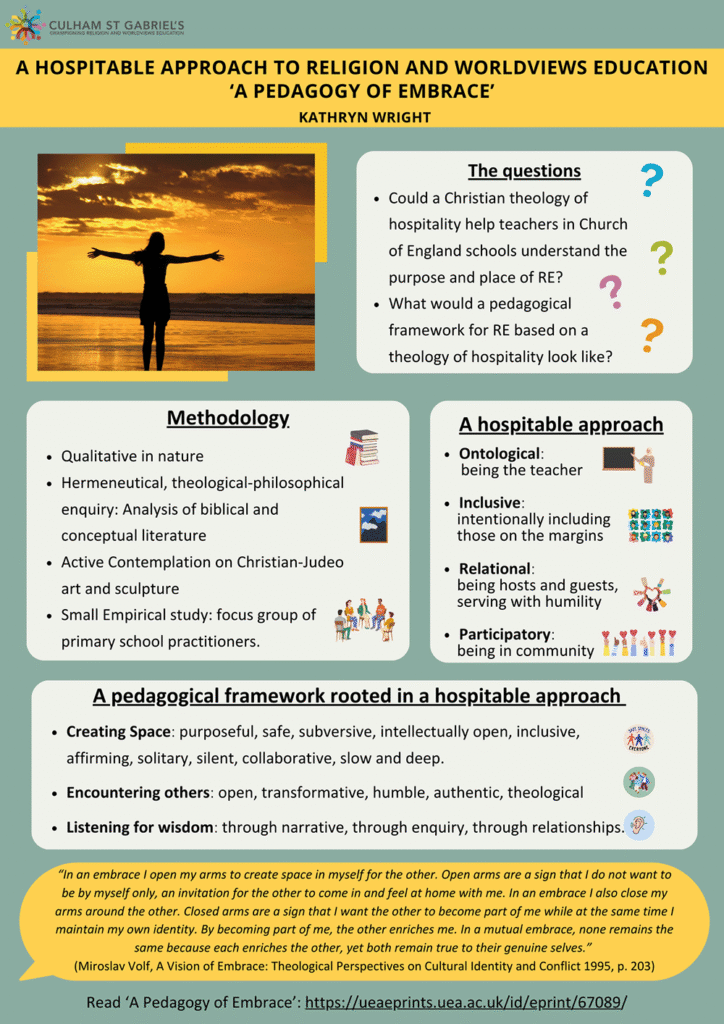
A hospitable approach to religion and worldviews education
Research Spotlight: A hospitable approach to religion and worldviews education
July 2024
Kathryn Wright
Kathryn Wright, CEO Culham St Gabriel’s, focuses on the notion of embrace which lies at the heart of her doctoral thesis.
What would a hospitable approach to religion and worldviews education look like?
Questions for consideration:
How might I approach teaching and learning through a lens of hospitality?
What does creating space, encountering others and listening for wisdom look like in my classroom?
At the heart of a religion and worldviews approach to religious education is the responsibility of the educator to enable children and young people to navigate an increasingly complex, multi religious, multi secular and an increasingly unsettled world.
My own doctoral research considered a hospitable approach to the teaching of religious education which I believe aligns well with this new paradigm. My thesis, A Pedagogy of Embrace (2017) developed pedagogical principles for teaching RE based on a Christian theology of hospitality.
First, hospitality provides an ontological approach. It is about being the teacher; it is about one’s presence in the classroom. Hospitality is about the physical space, but it is far more about who we are and how we serve. At the heart of a religion and worldviews approach is the need for teachers (and pupils) to bring themselves and their own worldview and position to the classroom. Secondly, it is inclusive. Hospitality, seeks to intentionally include those on the margins; listening and engaging with voices of those often unheard. This resonates with the de-colonising of the curriculum and with a focus on lived experiences of worldview communities. Thirdly, hospitality is by nature relational. It involves a host and guests. In A Pedagogy of Embrace, the notion of the host being the guest, and vice versa is put forward. I believe, this removes the power dynamic and facilitates genuine dialogue and conversation. This places the teacher in a position of humility, where they are serving their pupils, and at the same time may be served by them or learn from them. This acknowledges the value of everyone’s worldview, seeing the importance of learning from one another as well as from the subject itself. Lastly, hospitality is by nature participatory. One cannot stand on the sidelines and observe, or if one did it would appear very rude. Imagine no one speaking at the dinner table! I believe, teachers and pupils are to be ‘in community’ with what they are learning. This is at the heart of a religion and worldviews approach. One brings oneself to the subject, participating in it ontologically, relationally and inclusively from a position of humility. A religion and worldviews approach is fundamentally interpretive as we interact with the subject, rather than sitting as an observer on the sidelines. Taking a religion and worldviews approach means we participate in interpreting knowledge; we don’t stand as observers anymore.
I put forward three pedagogical principles, which exemplify this hospitable approach:
Creating space
Encountering others
Listening for wisdom
The visual analogy of an embrace is helpful for considering the practical application of a hospitable approach. Miroslav Volf, a Croatian Protestant theologian, defines an embrace in the following way:
In an embrace I open my arms to create space in myself for the other. Open arms are a sign that I do not want to be by myself only, an invitation for the other to come in and feel at home with me. In an embrace I also close my arms around the other. Closed arms are a sign that I want the other to become part of me while at the same time I maintain my own identity. By becoming part of me, the other enriches me. In a mutual embrace, none remains the same because each enriches the other, yet both remain true to their genuine selves. (Volf 1995, p. 203)
For Volf, an embrace must have the four elements or ‘acts’. These are opening the arms, waiting, closing the arms and then opening them again. The open arms indicate creation of space and invitation. Waiting suggests acceptance of reciprocity; the embrace is not an act of invasion. Closing the arms indicates the host is guest and the guest is host as each person makes their presence felt. Volf sees this as especially powerful because the identity of the self is both preserved and transformed. Lastly, the opening of the arms shows that the two people have not become one but remain two with their difference and uniqueness.
This is a powerful way of understanding the interactions within the religion and worldviews classroom. The sense of insufficiency or having ‘open arms’ means that one needs to have space; to be in some sense empty. I cannot come to a religion and worldviews classroom with a closed mind; I must come open to listen and encounter. I must be intellectually humble. This to me speaks to our own worldviews, including our personal faith (where appropriate), being always incomplete, ever changing. Everything around us impacts on how we see and make sense of the world, including for some relationship with the Divine.
March 2022 research of the month features the Religion Media Centre
As you look at this research here are some things to consider:
What messages are young people hearing about religion and beliefs from the media?
How can people encourage their faith groups to help inform the media about their organisations and beliefs, supporting a better understanding of religion by the public?
Why is it important that the media reports religion well?
How can RE teachers use their local knowledge of religion for wider public benefit?
Culham St Gabriel’s funded an innovative project to bring together the media, faith representatives and education professionals who share the common goal of helping the public understanding of religion. “Creating Connections” events were organised by the Religion Media Centre in 5 cities – Leeds, Plymouth, Nottingham, Birmingham and Manchester, in October and November 2021. RE teachers joined us in every city, contributing their knowledge of the local religious landscape and engaging in conversation with groups not usually brought together in this common endeavour. 86% of the RE teachers, academics and members of SACREs who attended the meetings said the event had improved their idea of the media. One said the meeting was important for networking and sharing contacts “at a level where things might actually happen”.
This film gives a flavour of what the Religion Media Centre set out to achieve. More than 300 people engaged in the project and there was a shared view that this was just the start of establishing new and fruitful relationships. So we are talking to the steering groups in each city about future plans and have been approached by other towns and cities who want us to put on events there. We are so grateful to Culham St Gabriel’s for providing the funding to enable this project to happen. Read about the project here, write to us for further information at info@religionmediacentre.org.uk
Debating, Oracy and Teaching Evaluation
Research Spotlight: Debating, Oracy and Teaching Evaluation (focus week)
In this short film Beth Eades, in a conversation with Fiona Moss, explains what she means when she is talking about oracy and more specifically oracy in RE. She talks about the importance of listening as well as speaking and the importance of the subsequent dialogue that builds up. Beth explains the oral tradition of many of the things we study, the oracy skills we build up in the different disciplines of RE and the importance of modelling disagreeing well, holding different ideas, beliefs and opinions without having an argument.
You might want to watch this film and consider
How are we supporting our pupils to disagree well?
What oracy strategies do we or could we use in RE/RVE/RME?
Beth Eades studied a part time Learning and Teaching Masters at Oxford University and was part of the Culham St Gabriel’s Masters Scholarship Programme.
The research she carried out is focussed on GCSE students but may provide useful to teachers of younger and older pupils too. Looking at her research poster supports you to set up a debate in class and also shares key reading if you would like to look into this area further. Beth has generously shared her sample resources and some sample work from her pupils. Looking at her research poster supports you to set up a debate in class.
She also spoke at RExChange and her slides are available for download.
Developing opportunities for diversity and progression in Religious Studies at A Level
Research Spotlight: Developing opportunities for diversity and progression in Religious Studies at A Level
October 2023
Hayley Ellen
Questions for consideration:
How can schools and colleges collaborate with Theology and Religious Studies (TRS) departments in universities as part of an Equality, Diversity, and Inclusion (EDI) and enrichment strategy?
How can we highlight the transferable skills and progression opportunities offered by the study of Religious Studies at A Level?
How can schools and colleges support universities to address the decline in enrolment in TRS at higher education level?
How can we improve the perception of Religious Studies (RS) at A Level within schools and colleges?
This project was born out of a college wide focus on EDI which led to an in-depth audit of potential opportunities and aspects of our RS A Level course. Due to specification requirements, time constraints and student need it was clear that whilst we would make the most of opportunities to look at EDI within our teaching time, we should also look for subject related opportunities to explore EDI beyond the classroom.
I work as Head of Department in a large, inclusive Sixth Form College in Essex which offers both Philosophy and RS at A Level. I also wanted the project to support our students to consider what it would be like to study TRS or a related subject at a higher level. To do this I arranged a series of lunchtime subject talks. I used the Theology and Religious Studies in Higher Education site to identify contacts in Higher Education and emailed to ask them outlining the EDI project and asked if they would be interested in delivering a talk. I did not specify the topic but asked if the talk could be either an extension of an A Level topic, for example one talk focussed on the question ‘Is God Male?’ or on a topic not included in the A Level course, for example contemporary food ethics in Judaism and Jainism.
To further encourage students to consider studying RS at a higher level I planned a whole day event titled ‘why study TRS at university?’. This involved a programme of talks including;
Making an application to study TRS
Subject taster lecture
Why study TRS at university, what skills you could develop and what careers it could lead to.
This event was very successful, and we hope to have several students applying for TRS courses next year. To build on this project over the next academic year I am now in the planning stage of organising a RS and Philosophy conference for colleagues in local schools and have begun to explore the possibility of streaming our lunchtime talks to other schools, widening the impact of the project.
My message to other teachers is:
Send emails out to HE institutions and local employers in related fields asking if they would like to collaborate, for example I arranged for a local Hospice to deliver a talk on the ‘The ethics of end of life care’.
Look at the TRS website-it is fantastic and has so many excellent resources on it.
Think about how you could use enrichment opportunities to go beyond the specification and explore EDI in your subject.
If you want any information about this project please email me: ellenh@colchsfc.ac.uk
Does a disciplinary approach to religious education improve Reception age children’s knowledge and understanding of their learning?
Research Spotlight: Does a disciplinary approach to religious education improve Reception age children’s knowledge and understanding of their learning?
June 2023
Catriona Card
This month’s research looks at exploring the use of an age-appropriate disciplinary approach to teaching religious education to children in Reception (aged 4-5 years).
Some questions to consider:
What educational philosophies or theories of education underlie your education approach? Do any of these conflict with each other?
Do you use children’s voice to inform your evaluation of how you teach? If not, is this something you could do?
How much do you know about the development of thinking in children and young people of the age group you teach? Are you aware of more recent research in this area and any new discoveries or understandings that have come from this?
My research is based on exploring the use of an age-appropriate disciplinary approach to teaching religious education to children in Reception (aged 4-5 years). My provisional research question is:
Does a disciplinary approach to religious education improve Reception age children’s knowledge and understanding of their learning? This is a doctoral research project under the supervision of Professor Julian Stern and Dr Amy Webster at Bishop Grosseteste University, Lincoln where I am studying part time.
My interest in this question came from two directions, firstly the increasing focus on a disciplinary approach to RE and my concern that if this is to take place in Reception it needs to be done in a way that fits in with good early years practice; and secondly the lack of information about whether such an approach is in fact possible and effective in Reception.
My research project is made both more interesting and more challenging by the fact that my research combines two strands, early years education and a disciplinary approach, which are based on very different philosophies and theories of education.
One finding of a small scale research project I completed in 2021 was that there is no consensus about what is meant by a disciplinary approach, or about what disciplines should be included. For the purposes of this study I am defining a disciplinary approach as using the ‘tools’ of the discipline, e.g. Philosophy being about developing and explaining your thinking.
I am still in the early stages of my study, and my focus has been on my literature review.
What is RE? Why teach RE? How do theories and philosophies of education impact on understanding of this?
The History and Geography of RE – focussing on the impact of key scholars (Hull, Smart, Cooling, Erricker, Jackson)
How RE is currently taught, including what has already been published on disciplinary approaches
Children’s voice – this will link to methodology as I want to gain children’s views on the impact of the approaches explored as part of my research
History and philosophies of early years education – where might the links and tensions be with philosophies and approaches used in disciplinary RE, much of which has been developed with older children?
Development of thinking in young children – what does this have to say about what young children may or may not be able to know/understand/do?
My focus for the next stage, from the autumn, will be my methodology. My reading on children’s voice has already identified some relevant literature, for example articles looking at methods to enable young children to effectively share their ideas.
A number of points have emerged so far from my reading. The roots of current approaches in RE, such as the emphasis on a worldviews approach and the use of a disciplinary approach, appear to be evident in the work of scholars from the 1970s onwards. Children’s voice appears to be most often used to gain information around matters not directly linked to the curriculum and the voice of the youngest children in schools is not always heard. There appear to be some links between the work of Hull and early years philosophers and practitioners.
Can CoRE’s National Entitlement Recommendations work in Primary RE? A Primary RE practitioner-research project
Research Spotlight: Can CoRE’s National Entitlement Recommendations work in Primary RE? A Primary RE practitioner-research project
October 2021 research of the month features Dr Emma Salter.
n this presentation I speak about a research project funded by Culham St Garbriel’s that I conducted with my colleague Prof Lyn Tett at the University of Huddersfield, School of Education. The project ran between September 2019 and September 2021. It’s title is, Can CoRE’s National Entitlement Recommendations work in Primary RE? A Primary RE practitioner-research project. This presentation focusses only on the second – practitioner-research – part of the project. In this project ‘practitioner-research’ refers to teachers conducting intentional, structured research on their own practice. Structured research means research with pre-determined aims or questions, a research design for systematic and ethical data collection, and robust data analysis and interpretation to produce credible research findings that are relevant to professional practice.
To investigate practitioner-research the project aims were:
To understand Primary RE teachers’ experiences of practitioner-research
To find out the benefits, if any, teachers gain from practitioner-research
To find out the best ways to support teachers in practitioner-research.
This presentation reports on the final aim.
The research sample was nine Primary school teachers all experienced in planning and delivering RE. The project adopted a community of practice (Wenger 1998) approach for its methodology in the following ways:
Shared domain of interest: participating teachers shared their expertise and experience of Primary RE.
Becoming a community: participating teachers built mutually supportive relationships with each other through their shared interactions with the group.
Shared practice: participating teachers supported each other in improving their skills and confidence as practitioner-researchers through shared discussion and problem-solving.
To establish the community of practice the teachers and academics met regularly at the University; two full days in September, three half days in October, then half a day monthly until March after which lockdown forced our meetings on-line. Our monthly meetings involved a range of research-focussed activities that including structured training in research skills and on-going support from the academics for the teachers to plan and carry out their own practitioner-research projects. Active researchers in education were also invited to our meetings to discuss their research with the teachers. This was helpful in generating ideas for the teachers for their own research planning. The teachers also attended Strictly RE in January 2020. The shared experience of attending Strictly RE helped cement the community of practice. Discussing their research ideas with Strictly RE delegates – colleagues they hadn’t previously met – and having them affirmed boosted teachers’ motivation and confidence in their research projects.
Six practitioner-researcher projects emerged from the overall project because some of the teachers worked in pairs. This presentation does not discuss these projects individually. look out for project reports that will be posted on RE:ONLINE soon.
Six practitioner-research projects
Contribution of study-visits to pupils’ knowledge, understanding and memory in RE
Teachers use of texts and stories in RE, focusing on Sikhi and Islam
Pupils’ engagement in multi-arts RE classes
‘Spirituality’ in the curriculum: pupils’ perspectives
The new Ofsted framework in Primary Schools: Head teachers’ responses to how CoRE’s National Entitlement can help.
Can Big Ideas can enhance a LA syllabus?
The project used multiple methods to collect qualitative data from the participating teachers across the duration of the project. Gathering data over time, while the teachers were planning and carrying out their own research, means the data shows how their experiences and opinions changed over time; rather than a snapshot of one moment in time. The methods of data collection are listed below:
Base-line short answer questionnaire at the project start to record teachers’ experience and confidence as researchers.
Reflective journals in which teachers reflected on their developing experiences as practitioner-researchers. Teachers made individual monthly journal entries between October 2019 and June 2020.
4 focus-group discussions (October 2019, February 2020, May 2020, December 2020) during which teachers reflected together on their experiences of engaging in teacher-research and its impact on their wider professional practice; as well as other matters relating to RE in professional practice.
Semi-structured interviews (October 2020) during which they reflected on any enduring impact on their professional development of attending Strictly RE in January 2020, as well as further reflections on engaging in teacher-research.
Closing short answer questionnaire at the end of the project to record teachers’ transitions since the project start and their overall project evaluation.
Closing long, qualitative questionnaire to record teachers’ reflections on the impact of their individual research projects on their own professional development and on RE more widely.
The findings presented here are condensed from the qualitative data collected. For the purposes of this presentation findings are presented as ten points to support teachers in practitioner-research.
Create ‘head-space’. Pockets of protected time away from the immediate demands of school-life. In our project teachers appreciated our project meetings so they could concentrate on their research.
Create a mutually supportive community. The collaboration, mutual support and reciprocal affirmation between group members helped teachers stick with their research.
Research in teams. Advantages include sharing tasks to mitigate time barriers; sharing ideas, problem-solving together and being accountable to others. Where members of a research team work at different schools, data collected from different settings can enhance the validity of the findings.
Regular check-ins and accountability. Updating the community of practice and/or research team regularly helps to keep research targets on track and applies a level of soft accountability to stick to targets.
Purpose, relevance and an interested audience. This finding came to life when the teachers attended Strictly RE 2020. At the conference they discussed their research with teachers newly acquainted to them. Through those discussions teachers came to realise that their research projects held genuine interest for others and that there was a potential audience interested in their findings. This was a powerful motivator to stick with the research.
Teacher agency and autonomy. In our project teachers were treated and respected as professional experts. They chose their own research projects, within broad criteria, that were interesting to them and relevant to their practice. This helped to sustain teachers’ enthusiasm and motivation.
Structured training in research methods. Structured training and some ongoing support in research methods to plan and carry out their projects was needed for novice researchers. Having completed their projects, teachers’ knowledge and confidence was strengthened for future practitioner-research.
Opportunities to discuss real-world research with active researchers. Meeting other researchers helped normalise research for teachers. Learning about different methods of data collection gave teachers ideas for their own projects.
Take things at an easy pace; don’t rush. Through our regular meetings teachers came to see themselves as researchers at a gradual pace rather than being confronted with a rapid transition. This slower pace of transition helped build teachers’ confidence as practitioner-researchers.
Create an alliance with a university department. Teachers reported that alliance with a University department gave their involvement in the project, and their own practitioner-research projects, credibility with their schools and senior leadership.
From this list of ten findings to support teachers in practitioner-research I’ve condensed a summary criteria of five key points. I hope that collectively these points create a feasible and manageable approach to practitioner-research for teachers. Though our project focussed on practitioner-research, I think these points are applicable to other types of project work too.
Agency: teachers are empowered to be their own decision-makers and to embark on projects that they deem meaningful.
Purpose: teachers’ belief in the purpose of a project and knowing there’s an audience interested in its outcomes makes a project worth doing.
Access: teachers’ need access to the knowledge and support required to complete a project.
Community: collaborative social learning, shared problem-solving, idea-sharing, task-sharing and accountability to a group or team sustains engagement and is more likely to lead to project completion.
Affirmation: validation of professional knowledge from peers builds self-confidence and courage to take on and complete new endeavours.
References and selected further sources are listed below. In particular I recommend Prof Vivienne Baumfield’s research on Teachers’ engagement with research. BERA’s report on close-to-practice research widens the scope of practitioner-research. The research portal on RE:ONLINE has lots of examples of practitioner-research that are well worth following up. For more information on communities of practice, Wenger and Trayner’s website is a good starting place. If you’re inspired to engage in practitioner-research, Culham St Gabriel’s post-graduate and leaderships schemes are worth looking into.
Research Spotlight: ‘But are you religious yourself?’ Being non-binary between ‘religious’ and ‘non-religious’
May 2022
Denise Cush, Emeritus Professor of Religion and Education at Bath Spa University
As you look at this here are some things to consider:
Does the idea of being ‘non-binary’ help to make the subject of Religion and Worldviews/Religious Education more inclusive for all pupils, and not just something of interest and relevance to the decreasing number of people in many European countries – especially young people – who identify as ‘religious’?
Do you think that RE teachers and/or students might find the non-binary option helpful when reflecting on their own developing worldview or when asked whether they are personally religious or not?
How would you go about introducing discussion of what people mean by terms like religion, non-religious, secular, spiritual, worldview, in your particular classroom context?
‘But are you religious yourself?’ Being non-binary between ‘religious’ and ‘non-religious’
Being invited to be one of the fourteen Commissioners on the RE Council’s 2016-2018 Commission on RE was a great privilege, and it has been very interesting to be involved with the developments since 2018, such as the REC’s follow-up ‘Worldviews’ project resulting in the literature review (Benoit, Hutchings and Shillitoe 2020) and Discussion Papers (Tharani 2020). As pointed out by Trevor Cooling in this series of presentations, the move towards worldviews was not just to include the non-religious as well as the religious in a changing social context – and certainly not about adding a list of non-religious isms to an already expanding list of religious ones – but also about reflecting on the ways in which our own worldviews affect our interpretations of information, including about the worldviews of others.
Having retired in 2015, alongside working on the Commission and with Barbara Wintersgill on the Big Ideas project, I have had more time to read about, reflect on and write about a number of related issues including the concepts of religion and worldviews; the disciplines of Study of Religions, Theology and Religious Education; Buddhism, Hinduism and Paganism as religions (or not); phenomenological approaches to studying religions and in RE; and the role of experience as a source of authority.
The Commission Report, as well as highlighting the term worldview and initiating a developing ‘worldviews approach’ to RE, distinguished between institutional or organised worldviews (in the sense of systematic ‘isms’ such as Christianity or institutional organisations such as the Catholic Church) and personal worldviews. In between are many other levels such as sub-groups and local communities. It also stressed the importance of diversity within as well as between organised worldviews, that these have changed and developed over time and in interactions with each other, and that individuals and communities may draw upon more than one tradition.
In the contemporary globally connected world, researchers have found that in various ways people are increasingly exhibiting forms of multi-religious belonging, whether brought up in mixed heritage families, identifying with one tradition while taking aspects from another, or drawing upon a variety of traditions to form their own ‘patchwork religiosity’ (Lähnemann, 2008). Others, such as Woodhead, Lee, and Cotter have highlighted the increasing number of people (the ‘nones’) who identify as non-religious, becoming a majority in some countries such as England. Yet what is meant by non-religious varies, including at times elements that other may label religious. In this complex context the distinction between religious and non-religious worldviews can start to break down.
The presentation focuses on the possibility of identifying not as belonging to one particular religious tradition, or as influenced by several, or as non-religious, but as being non-binary in relation to the religious/secular divide.
Paying attention to personal worldviews reveals a weakness in the binary division between ‘religious’ and ‘non-religious’, in that people may draw upon or be influenced by a variety of religious, spiritual or secular elements in their beliefs, values, practices and identities. Trying to label this complex and often fluid situation either ‘religious’ or ‘non-religious’ can be difficult. RE professionals are often asked whether they are actually religious themselves – for many decades I found this difficult to answer, once I stopped identifying with one particular tradition. Neither ‘religious’ nor ‘non-religious’ really seemed accurate.
We have recently become more familiar with the term ‘non-binary’ in relation to gender – as used by those who do not find either ‘male’ or ‘female’ appropriate, and have started to use the pronoun ‘they’. The first person I heard applying ‘non-binary’ to religious identity was Richard Holloway – and I found this idea personally very liberating, and also started employing it in RE contexts since about 2018. Norwegian Professor Oddrun Bråten also finds the concept of non-binary worldviews helpful and argues for a ‘superwide’ use of the term ‘worldview’ to include ‘more complex personal worldviews that might relate to several religious or spiritual or humanistic ideas’. This better reflects the diversity of pupils’ worldviews as revealed by research and experience. Another article I found useful was by Finnish Professor Peter Nynäs, who doesn’t actually use the term ‘non-binary’, but argues that individuals have a dialogical relationship with their context, and ‘combine spiritual and religious positions with secular values into authentic and unified outlooks on life’. Not being able to answer the question ‘are you religious?’ doesn’t mean that you are confused, it means that the categories do not fit your experience.
Of course, one response to the question ‘Are you religious or not?’ is ‘it depends what you mean by ‘religious’, and academics have been discussing this for many decades, some arguing that we should drop the term altogether. The Commission argues that discussing what we actually mean by terms like ‘religion’, and recognising that different people mean different things (as academics like to say it is a contested concept) is a vital part of RE. A narrow definition of religion, modelled on Western Christianity, is particularly unhelpful in understanding Dharmic traditions or new forms of religiosity such as contemporary Paganism. It is important to introduce students to traditions such as Buddhism that are not based on the concept of God, and non-Western philosophy that is less based on binary thinking.
Deciding whether something is religious or not is not just a ‘merely academic’ issue however, as defining something as religious, especially in law, can have real life consequences. In practice as well as theory it is often difficult to separate out the religious and the secular, even when required to do so. There is an interesting difference between civil funerals and civil weddings in England. Civil funerals, which began in 2002, often contain a mix of ‘religious’ and ‘secular’ elements. However civil wedding ceremonies are not allowed to have any religious content. Thus, when my partner and I wanted a pluralist, non-binary wedding ceremony in 2018 we ended up having the legal, non-religious part in a deconsecrated chapel licensed for civil weddings only (though handfastings were allowed) and our ‘religious’ (Christian, Buddhist, Hindu and Pagan) blessings in a marquee outside.
So, I am suggesting that getting away from the binary division between religious and non-religious is not only helpful for those like me who have problems identifying with either label, but also is a really important part of keeping our subject relevant to everyone – religious, non-religious or non-binary – not just those who are either adherents of or academic specialists in particular organised traditions.
Bibliography
Barker, M-J & Iantaffi, A. (2019) Life Isn’t Binary: on being both, beyond, and in-between. London: Jessica Kingsley
Biesta, G. & Hannam, eds. (2021) Religion and Education: the Forgotten Dimensions of Religious Education? Leiden: Brill|Sense.
Cush, D. with Francis, D. (2001) ‘Positive Pluralism to Awareness, Mystery and Value: a Case Study in RE Curriculum Development’ in BJRE, 24 (1): 52-67
Cush, D. (2013) ‘Challenging the religious/secular divide.” Editorial, BJRE, 35 (2): 121–124
Cush, D. 2020 ‘Religion and Worldviews in Education’. In C.A. Simon and S. Ward (ed.) Education Studies: a Student Guide (4th Edition) RoutledgeFalmer, pp. 107-117
Cush, D. (2021) ‘Changing the Game in English Religious Education:1971 and 2018’ In O.Frank and Thalen, P.(eds.) Religious Education in a Post-Secular Age: Case Studies from Europe. London: Palgrave, pp.139-156
Cush, D. & Robinson, C. (2021) ‘”Buddhism isn’t a religion but Paganism is.” The applicability of the concept of ‘religion’ to Dharmic and Nature-based traditions, and the implications for religious education’. In P. Hannam and G. Biesta, (eds.) Religion and Education: The Forgotten Dimensions of Religious Education? Leiden: Brill|Sense.
Davies, M. (2022) ‘False divide between religious and secular funerals to be studied’ Church Times. https://www.churchtimes.co.uk/articles/2022/4-february/news/uk/false-divide-between-religious-and-secular-funerals-to-be-studied
Lähnemann, J. (2008). Introduction – Interreligious and Values Education: Challenges, Developments and Projects in Europe. In J. Lähnemann & P. Schreiner (Eds.) Interreligious and values education in Europe. Münster: Comenius Institute.
Nesbitt, E. (2011). Sikh Diversity in the UK: Contexts and Evolution. In K.A. Jacobsen & K. Myrvold (Eds.) Sikhs in Europe: Migrations, Identity and Representations (pp.225-252). Farnham: Ashgate.
Nixon, G., Smith, D. & Fraser-Pearce, J. (2021) ‘Irreligious Educators? An Empirical Study of the Academic Qualifications, (A)theistic Positionality, and Religious Belief of Religious Education Teachers in England and Scotland’ Religions 12(3):184. DOI:3390/rel12030184
Nynäs, P.(2018). ‘Making Space for a Dialogical Notion of Religious Subjects: A Critical Discussion from the Perspective of Postsecularity and Religious Change in the West’ Journal of Constructivist Psychology, 31 (1), 54–71.
Plater, M. (2013) ‘Children, Schools and Hallowe’en’ BJRE 35 (2) pp.201-217
Rudge, L. (1998) ‘ “I am nothing – does it matter?” A critique of current educational policy and practice in England on behalf of the silent majority’ BJRE 20 (1) pp.155-165
Weller, P., Hooley T. and Moore, N. (2011) Religion and Belief in Higher Education: the Experiences of Staff and Students. London: Equality Challenge Unit.