Research Spotlight: Sikh Religious Authority in a Digital World
September 2022
Dr Jasjit Singh
In this video Dr Jasjit Singh talks about the impact of the online environment on Sikhs in diaspora and how the online environment impacts on religion and particularly on religious authority. Questions raised include:
What role does the internet play in religious transmission and learning? What can people do now that they couldn’t do before?
How does different digital tools present different types of information about religion? Are there different types of religious authority?
Think about issues of translation, and what might be lost when simply imposing meanings from English / Christianity on to non-Christian worldviews – e.g. the word Gurdwara. Emphasises the importance of the Guru for Sikhs, unlike ‘Sikh Temple’ which doesn’t.
How might family background and religious affiliation impact on online engagement.
You can find a research report here on RE:ONLINE summarising Jasjit’s research with links to the original articles.
RS Argument at GCSE research project
Research Spotlight: RS Argument at GCSE research project
September 2021 research of the month features Tim Hunting.
Introduction to the RS Argument at GCSE research project, Tim Hunting
Why? Background:
The research project started from the desire amongst colleagues to work together improve teaching of students the skills needed to reach the highest level in RS GCSE essays, which require ‘logical chains of reasoning leading to judgement(s)’. The essays are supposed to be short -guidelines suggest 250 words- and the time frame is around 15 minutes maximum for planning and writing time, so there is a lot of pressure on students to analyse the claim in the title and construct a quality answer very quickly. The idea was to think more deeply about what we mean by argument and concentrate minds on how to teach these skills through deeper reflection, learning and experiment in the classroom, as well as sharing our experience. Kathryn at CSTG put me in touch with Nigel Fancourt whose research with the OARS project was invaluable. Nigel became a regular member and interlocutor for the group along with Kevin O’Grady.
Nigel’s work with the OARS project was a really helpful foundation for our own research. A second aim was an interest in forming a local group for RE teachers in the Brighton area as a means of mutual support. In the event, we met on Zoom so the group quickly expanded and became open to teachers everywhere. (Although the research project finishes this September we hope to meet in the coming year and continue to help contribute to study of argument in RS. If you are interested please contact me. thunting@hovepark.org.uk
What? The Process:
We met online and shared the challenges of teaching essay writing and helping students to construct arguments. Our shared reading of S. Toulmin’s seminal ‘Uses of Argument’ which bridges argument in philosophy with everyday reasoning helped to deepen our reflection. Covid did later bring limitations to what we were able to achieve in the classroom but the fruits of our discussions can be seen in the different materials that the teachers in the group came up with. Some such as Hannah’s and the teachers’ at SGS – Grace, Molly, Hanna and Gwilym – are based on adapting Toulmin’s model of warrant and backing and evidence. Other teachers developed effective metaphors for helping students to understand argument- Julia the courtroom scene- and Fay the tug of war. I concentrated on resources to help students analyse essay titles. All these resources are listed below. Feel free to adapt them for your own classroom practice.
Nigel Fancourt writes:
The broad process of developing one’s own argument has a vital place in current GCSE and A level syllabuses, and indeed across religious education. A recent review of locally agreed syllabuses (Chan Fancourt & Guilfoyle 2020) showed that while it was explicitly mentioned fairly frequently. Argumentation is generally poorly explained; different disciplines are referred to, such as theology or philosophy, but what this means is not developed. The group decided to adopt Toulmin’s (1958) model as a heuristic lens, which had been adopted by the OARS project (https://oarseducation.com/) – a cross-disciplinary study of RE and science teachers at KS3 (Erduran et al. 2019). Toulmin did not define philosophical logic, but rather identified general features of argumentation within and across disciplines and practices. He highlighted its ‘field-invariant’ elements: a claim supported by evidence or data, justified by a warrant, but subject to rebuttal and qualification. This provided a coherent external framework to against which to review current pedagogy, and which had proved workable in schools.
Questions arising from the project:
There are still a lot of questions we all have about helping students to answer the evaluation essays. One issue is helping students to recognise the nature of the claim- is it about judging the importance of a belief or practice, or something very different? Secondly, what materials should students draw on for evidence and warrant? Surely not just texts from scripture and tradition- but what empirical evidence about, for example, the effectiveness of prisons as a means of punishment are relevant?
There are also aspects of the specification which need more detailed understanding in RS specifically such as ‘logical chains of reasoning’. The latter is also part of the A level Economics specification, but here it means analysing a possible sequence of consequences of a policy, for example. In RS it is more difficult to develop such a sequence.
Questions for discussion:
What are the main challenges you experience as a teacher and your students as learners, regarding evaluative essay writing for GCSE in Religious Studies?
What strategies have you adopted to help overcome these challenges? Are any of the resources below helpful to you?
REFERENCES
Jessica Chan, Nigel Fancourt & Liam Guilfoyle. 2020. Argumentation in religious education in England: an analysis of locally agreed syllabuses, British Journal of Religious Education, DOI: 10.1080/01416200.2020.1734916
Erduran, S., L. Guilfoyle, W. Park, J. Chan and N. Fancourt. 2019. Argumentation and Interdisciplinarity: Reflections from the Oxford Argumentation in Religion and Science Project. Disciplinary and Interdisciplinary Science Education Research1 (8). https://diser.springeropen.com/articles/10.1186/s43031-019-0006-9
Toulmin, S. 1958. The Uses of Argument. Cambridge: University Press.
This month’s research looks at the RETOPEA project. It was funded by the European Commission and ran for four years finishing late last year. It linked together partners from eight European countries. Responding to a brief from the European Commission to produce materials engaging with the history of religion and developing innovative methodologies for getting young people to think constructively about religious diversity.
Click on the button below to download a PowerPoint presentation on the project.
Listen to Professor John Wolffe and John Maiden in a recent In Conversation event discuss the project. How did people neutralize religious contradictions in the past? Can we learn from those experiences? These are the questions that were central to a large-scale international research project RETOPEA. It investigated the different ways in which religious coexistence is thought of in different environments and how religious peace treaties have been established in the past.
Religion and Worldviews in an Andalucian pueblo
Research Spotlight: Religion and Worldviews in an Andalucian pueblo
July/August 2022
Dr Kevin O’Grady
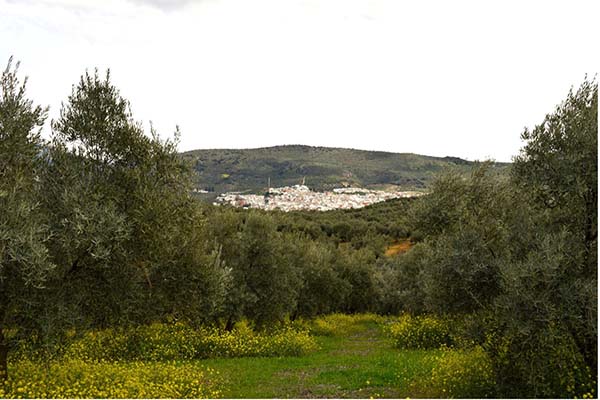
Castillo de Locubín is a traditional pueblo blanco (white village) in the Sierra Sur mountains of Jaén, Andalucía, Spain. In 2022 its population is around 4,500 and some 90% work in agriculture, these days not the subsistence culture of centuries past but mainly olive oil production for sale and export.
he village, usually referred to as Castillo or just El Pueblo, has a strong Catholic identity. As we’ll remark, this is nevertheless not straightforward, neither historically nor in the contemporary sense. We’ll focus on the 2022 Semana Santa (Holy Week) celebrations and develop the discussion from there.
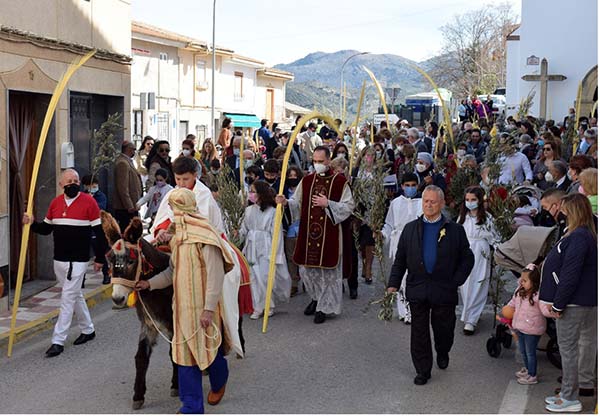
Semana Santa begins with Domingo de Ramos, an evocation of Palm Sunday that can’t strictly be called a procession since no sacred image is involved. Instead, villagers follow a child mounted on a donkey through the streets. As well as the story of the entry into Jerusalem, the event calls up Castillo’s agricultural past and present: until late into the last century most villagers (Castilleros) farmed with animals who lived in the upstairs parts of their houses, and, as you’ll see next, the palms are sometimes substituted by olive branches.
For other nearby towns, Domingo de Ramos begins a series of daily or nightly rituals that continue through the week, but not in Castillo’s case. Because most of its sacred images were destroyed at the outbreak of the Spanish Civil War in 1936, their associated processions vanishing with them, Castillo’s Semana Santa doesn’t pick up again until midnight on Viernes Santo (Good Friday; that’s to say, 00.00 on Good Friday itself).
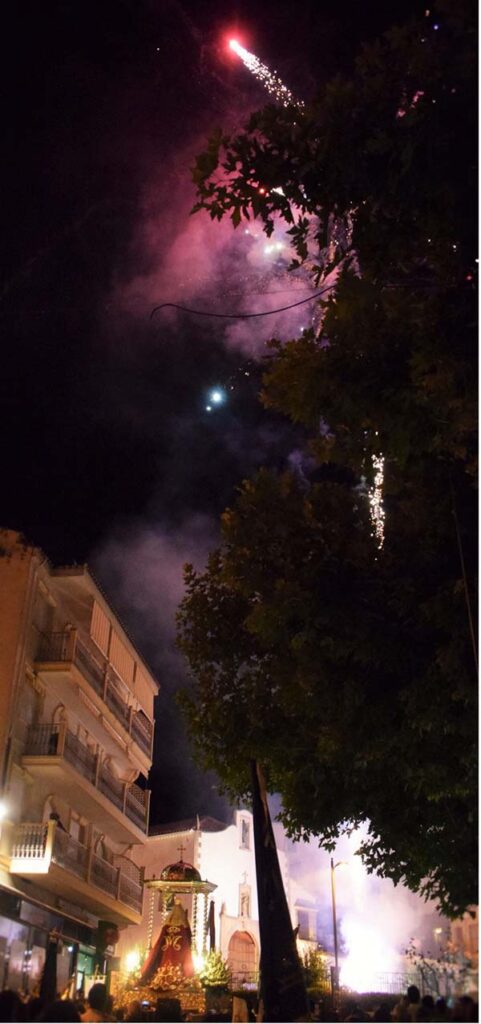
Castillo’s midnight Vía Crucis procession defies easy description. You could see it as blending austere mysticism, Biblical narrative, and street theatre (but more about that suggestion later). By torchlight, an image of Cristo del Perdón, Christ crucified, is processed through the streets to the sounds of a solitary drumbeat and chains rattling, with pauses to read each station of the cross.
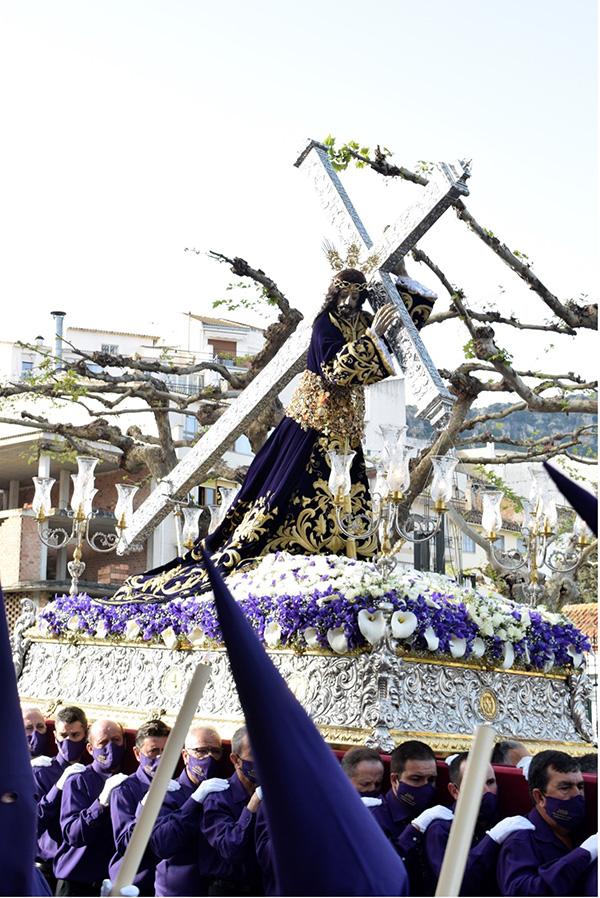
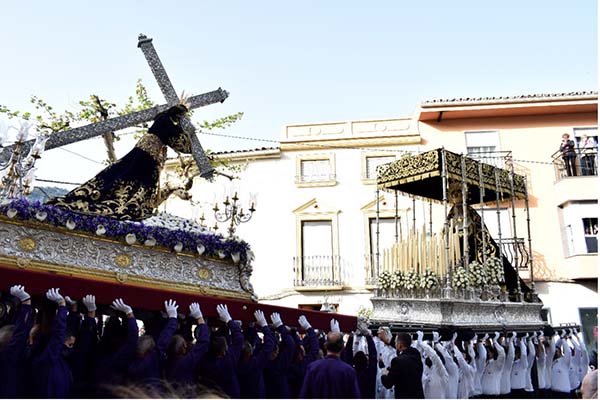
Later in the morning of Viernes Santo come two processions that combine to create an encuentro(meeting) between Jesus and Mary. The image of Jesus is Nuestro Padre Jesús Nazareno (usually shortened to Padre Jesús), that of Mary, La Virgen de los Dolores (the Virgin of Sorrows). These two images attract particularly strong devotion in Castillo, especially Padre Jesús: you could even compare loyalty to Castillo with loyalty to Padre Jesús. Again, more on that in due course, but a mention of the main Padre Jesús myth might help now. Around 1700, the image, an acknowledged masterpiece, was in transit through Castillo on its way to its intended home, the sculptor’s birthplace. The donkey providing the transport died, and this was taken as a sign from God that Padre Jesús should stay in Castillo for good; the Ermita (shrine, small church) in which he has since been housed was built on the spot. Padre Jesús is a depiction of Christ on Calvary at deepest resignation and despair; the encuentrore-creates his meeting with his mother.
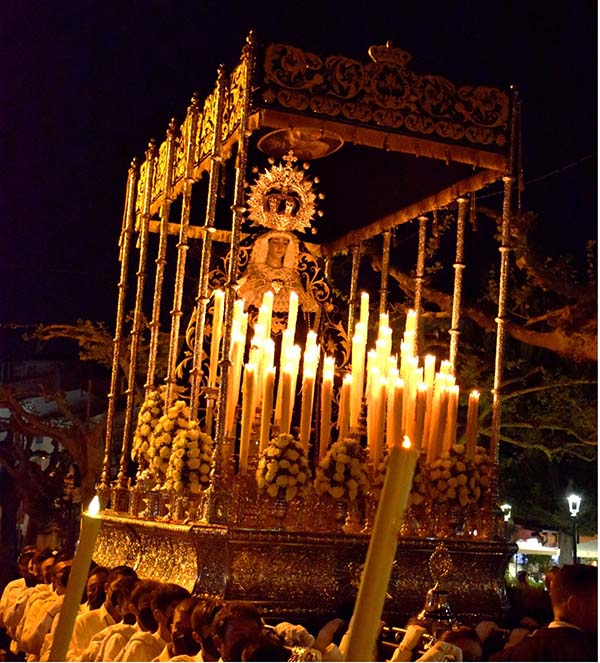
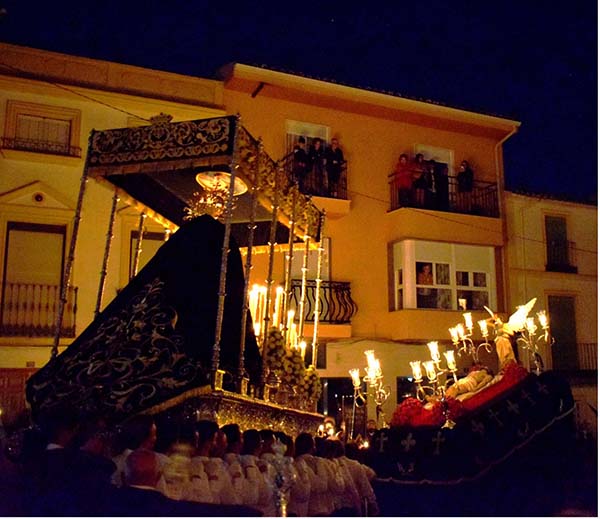
On the night of Viernes Santo, a second pair of processions creates a second encuentro, this time between Santo Entierro (Christ taken down from the cross) and the Virgin of Sorrows.
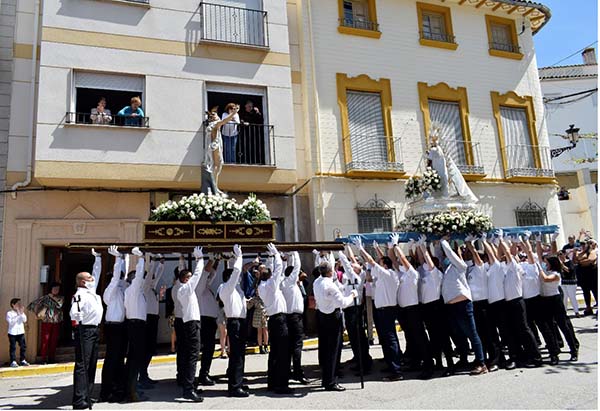
That this encuentro is the climax of Castillo’s Semana Santa can seem strange, but only to outsiders. Theologically, the resurrection would be expected to take centre stage. But Castillo’s Cristo Resucitado (Christ resurrected), is a recent image that has not built up a devotion comparable to those of Padre Jesús or the Virgin of Sorrows, and the Domingo de Resurrección (Easter Sunday) procession has been muted in the memories of most. This year attempts were made to create a fuller Domingo de Resurrección celebration, by creating an encuentro between Cristo Resucitado and La Virgen de la Cabeza. The image of La Virgen de la Cabeza commemorates an appearance of the Virgin Mary to a shepherd on the side of a head-shaped hill in nearby Andújar in the thirteenth century, so also attracts strong devotion in the locality. However, you might note in the next picture the smaller dimensions and simpler working of the images, as well as the reduced atmospheric intensity and, indeed, turnout.
In fact, theology stays in the background. There’s little discussion of the meaning of the rituals, questions about it surprise people, but that’s not to say there’s little meaning. It appears mediated more through the beauty of the images and the ritual choreography, music also playing an important role in ways that my photos can’t show. Visit https://www.youtube.com/watch?v=c9oASrnUEHs to hear how traditional band and flamenco styles create different accents at different stages of Castillo’s Semana Santa.
Social media is an increasingly used resource, in various ways. Emigration from Castillo means a diaspora whose members engage with Semana Santa via Facebook, where one group is solely dedicated to its imagery. A post on another Facebook page, El Pueblo es Tranquillo, concerning the 2022 Vía Crucis procession generated an intense discussion by comment and reply. Did Castillo’s various images of Jesus refer to the same reality? For believers, yes: but on another view, as a symbol of popular local religiosity, Padre Jesús is a singular figure whom all can understand and respect. Similarly, Semana Santa is a mixture of elements with something for everyone, even if just as spectacle or affirmation of the community (atheists and agnostics can be found in Castillo, though not non-Christian faith; and aspects of the history of the Catholic Church in the village are painful).
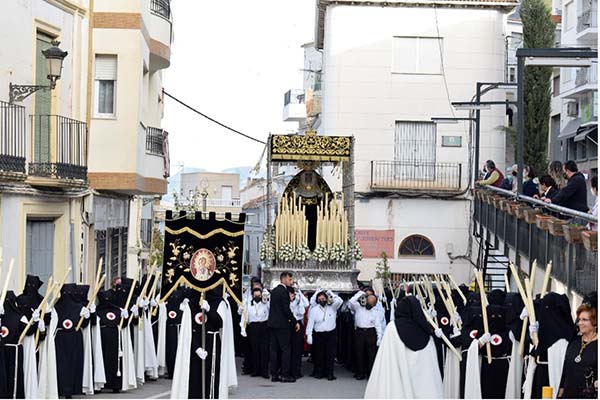
Digging deeper and more speculatively, there’s evidence that considerable numbers of Castillerosare descended from the once-Muslim population. Aspects of its culture linger, some visibly, such as the Arab irrigation system, and the remains of the fort that tower above the plain it continues to water: if you’ve visited Granada, 37 miles south of Castillo, this may sound familiar. It’s known that Sufism was influential in medieval Andalucía. Look back at the photo of the Padre Jesús procession and the purple capirotes (pointed hats) worn by some participants. They’re known as symbols of penitence, and related to the Spanish Inquisition, as those arrested were made to wear them. This is probably enough explanation for present purposes, but a visit to the tomb of Rumi in Konya, Turkey made me wonder – his own tombstone hat sits on it, and they are worn by dervishes of his order as reminders of mortality. In Spain, they don’t appear on Easter Sunday.
In summary, religion in Castillo de Locubín should usefully be seen in a worldview perspective. It helps to:
Look at the historical context.
Consider local traditions. The version of ‘Catholicism’ might not be recognisable elsewhere.
Hesitate to expect that only those identifying as Catholic join with thetraditions, or that the traditions only contain Catholic elements.
Think about emerging forms of tradition, especially digital.
Look for the lived elements. An over-emphasis on theology, or doctrine, may not be appropriate.
Think about how these lived elements add up: the aesthetic, ritual, social and ethical dimensions all connect.
In other places or cases, it might not be these elements that figure most powerfully. And, of course, you may not be considering a majority Catholic situation. However, related to the points above, here are some general questions to consider, that apply whenever you approach localised religion in a worldview perspective, whether in planning teaching or in teaching.
How has local history, tradition or custom influenced what can be seen now?
Are these religious expressions distinctive to the locality, even if related to a wider tradition? In what ways?
How do people from outside the tradition but from within the locality relate to these expressions? And is there evidence of inclusion of elements from outside the main tradition?
How have social media or other digital resources developed the local religious expressions, or how people can participate in them?
What are the main lived elements of the local religious expressions? How, for example, do artistic, ritual, community, ethical or other elements figure, and how do they relate to one another?
A discussion between colleagues in a planning or INSET session might not cover all these questions, but even one or two of them would generate a good analysis. Similarly with classroom teaching: any of the questions provides a good enquiry basis.
You may be travelling this summer. I hope you have opportunities to experience and take photos of local celebrations, talk to people about their history and significance, and listen to stories about them. If you’re in Spain on the 15th of August, look out for celebrations of El Dia de la Virgen (the feast of the assumption of the Virgin Mary into Heaven); we’ll close with a picture of Castillo’s 2017 Dia de la Virgen procession.
A note on methodology
I’ve been visiting Castillo de Locubín regularly since 2012 and lived there from 2015 to 2018. Though I’ve never thought of this in terms of a formal research project, several of my interactions with Castillo and its people have taken on research-like aspects. These include photography collection, participant observation during processions and other events, interviews with participants, reading, and discussions with researchers including local historians and a US-based anthropologist who completed a doctoral study on Castillo in the 1970s.
RE:Connect religion, belief and the environment
Research Spotlight: RE:Connect religion, belief and the environment
February 2025
This RE Teacher fellowship programme, part funded by Culham St Gabriel’s, aims for a generation of pupils and their teachers becoming confident, informed and generous agents in caring for the earth, through their learning about environment, climate and nature through their studies. The 12 teacher fellows, in two cohorts, worked for 6 months with the university, alongside their normal jobs. Watch this space for opportunities to be part of Cohort 3-which will hopefully be launched later in 2025.
The Teacher fellows have written and trialled primary and secondary resources as a result of their membership of the programme. Jeremy Kidwell, who along with Ian Jones is a co-director of the project, explains what the project is about and why you should engage with the results of the project
The resources that have been created can be found on the RE:Connect website in the projects gallery. More resources will be added soon.
At the beginning of the project the results of a teacher survey showed that there is a huge amount that RE teachers can contribute through their subject teaching to the issue of climate change. And there’s a huge desire out there to get this kind of work underway – 89% of the teachers we surveyed shared that they would like to do more work to explore the environment more fully as a theme in their current RE teaching. However, there are also significant barriers to this work. On that same survey, the highest number (45%) of respondents suggested that one the current syllabus prevents them from exploring the environment more fully as a theme their RE teaching. A lack of available work schemes (35%) and resources (29%) came in second as barriers to exploring teaching on this subject. The work of RE:Connect has attempted to provide some these resources based on the research that was shared with the Teacher fellows on the programme.
As you look at the work that has been created consider these questions
Where in your curriculum do you look at this area?
What different pedagogies can be used to look at this area of the curriculum?
If you want to find out more about this work, would be interested in trialling some of the resources that have been created by the teacher fellows or might be interested in being involved in the next cohort of teacher fellows contact Ian Jones on Director@saltleytrust.org.uk
Promoting the Exploration of Religion and Worldviews in Schools
Research Spotlight: Promoting the Exploration of Religion and Worldviews in Schools
June 2022
Sarah Harvey, Inform; Suzanne Newcombe, Inform and The Open University; Carrie Alderton, The Faith & Belief Forum; Amy Ark, The Faith & Belief Forum As you look at this here are some things to consider:
What is your experience of engaging with different stakeholder groups when teaching RE?
Are you surprised by any of our data or does it tally with your own engagements with different stakeholder groups?
How could you draw on the expertise of different stakeholders in your teaching of RE/R&W?
What would you like to convey to different stakeholders about teaching RE/R&W? What would best help you to do this?
Introducing the Project
Promoting the Exploration of Religion and Worldviews in Schools is an 18-month project funded by Culham St Gabriel’s and undertaken by three partner organisations: The Open University, Inform and The Faith & Belief Forum. All three organisations have interests in promoting critical religious literacy, in increasing social cohesion, and in ‘joined-up’ teaching of religion at the school and the university level.
The project aims to generate more positive attitudes towards an education in religion and worldviews (R&W) from and for those with a stake and influence outside the classroom. It aims to better align attitudes within the education sector but ‘outside the classroom’ to the importance of good teaching of R&W inside the classroom. The project is limited to England only.
The main objectives of the project are:
To gather data on a range of different stakeholders’ views of existing RE and R&W.
To use this data to create resources to support key stakeholders in ensuring that the study of R&W is incorporated in schools.
To create a free Open University Open Learn Course, entitled ‘An Education in Religion and Worldviews’, which will provide an introduction to R&W for parents, community group members and anyone else with an interest in the field. This will be released in Summer 2022 – so please check the RE:ONLINE website for announcements!
To support the development of a network to raise the profile of the importance of R&W.
We began the project with some baseline research in order to ascertain current opinions on RE and R&W, as well as to explore attitudes to religion in England today that impact schools and government policy. Baseline Report 1: Setting the Context provides an overview of existing reports relative to both RE and to the perception of religion in public life more generally, with a focus on policy reports and those written by think tanks and RE professional organisations. Baseline Report 2: Public Perception: Student and Teacher Views first summarises the few existing public opinion surveys available about opinions of RE. These paint a rather negative picture, such as the YouGov polls and ‘opinion trackers’ on RE which suggest that both adults and students do not think RE is particularly important or enjoyable. This information was collected before Culham’s own public perception survey of RE, conducted in Summer 2021, which suggests a much more favourable view of RE/R&W, perhaps because good definitions of these were given at the beginning of the survey. As part of Baseline Report 2, we also conducted small scale surveys with teachers (n=25) in order to gather their thoughts on R&W, and with undergraduate students (n=67) asking them to reflect back on their experiences of RE at school. Our student data, like the Culham survey, presents more favourable opinions than existing surveys would suggest:
84% agreed or strongly agreed that RE is a useful subject
72% agreed or strongly agreed that they enjoyed RE
70% agreed or strongly agreed that they personally learnt a lot from studying RE.
Gathering the Data
The main data collection phase of the project took place between July and November 2021 and involved 12 focus groups and 2 further surveys. The national lockdowns of the Covid pandemic impacted the project as, due to the ongoing uncertainties, we had to conduct all focus groups online. This had some benefits in that participants could access the groups more easily but there were also downsides in that we could not build so strongly on existing connections with schools in particular locations and could not build face-to-face connections. Some focus group numbers were lower than expected and we found it particularly difficult to engage parents in the project. This raises interesting questions about how to engage parents – and other stakeholders – who are not already enthusiastic about the subject. How can we reach and then stress the importance of an education in R&W to disinterested stakeholders? This is something with which we, and many others in the field, are still grappling.
The focus groups were arranged by stakeholder group. We began with a series of eight focus groups with ‘community interest groups’ (religious and nonreligious organisations which have an interest in RE) (n= 31). Two groups were held in the four geographical areas regions of Barking and Dagenham, Birmingham, Lincolnshire and Sunderland. Whilst these areas do not necessarily comprise a representative sample, we aimed for a mix of urban and rural locations, coupled with areas of our existing networks. Other data collected for the project includes:
A focus group with SACRE members (n=9) supplemented by a survey (n=144)
A focus group with parents (n=3) supplemented by a survey (n=45)
A focus group with those employed in school or local authority settings, including heads of MATs (Multi Academy Trusts) and SLTs (Senior Leadership Teams) (n=6)
A focus group with academics and policy professionals (n=14).
The focus groups and surveys had three primary areas of exploration:
The current state of RE, including gathering thoughts on the purpose of RE and to explore the idea of a current ‘crisis’.
The R&W proposal, including gathering thoughts on the strengths and weaknesses or challenges of the approach.
What resources are needed for stakeholders to understand the approach better and to promote or implement it in the schools with which they are connected, as well as exploring suggestions for ways forward to implement R&W.
Our discussions focused on the following areas: the purpose of RE, the challenges to current RE, the strengths of the RW approach, the challenges to or concerns around the RW approach and possible ways forward and learning points.
1.The Purpose of RE
Community interest groups and SACRE members saw RE as having a primarily functional or practical purpose suggesting that RE should fulfil a social role of teaching religious literacy which will lead to social cohesion. However, community groups also thought that RE should have a moral or pastoral function, teaching pupils how to “live well together”. Parents also stressed the “character-forming” and “holistic” purpose of RE and were the stakeholder group most accepting of RE as having multiple purposes. Academics and policy professionals were more likely to see the lack of clarity of purpose as problematic and called for a rethink or reclarification as one of the contemporary challenges.
2.The challenges to current RE
The challenges to current RE teaching were seen as stemming from a number of interlinked factors including structural issues, public perception, and the curriculum content, although the majority of stakeholders saw structural issues as the predominant issue. These include the challenges of a lack of curriculum time, a lack of specialist teachers and support for teachers, a lack of investment, and a lack of resources. The unique status of RE and the lack of a nationally agreed syllabus was seen as a challenge by many. The content of current RE was recognised as not being relevant for all pupils, leading to a lack of interest by some pupils. However, the negative perception of the general public, and parents in particular, was noted as a particular challenge by some stakeholders. However, parents holding a negative perception was not borne out in our data. There is an interesting discrepancy here between what other stakeholders think parents think and what parents actually think – although our parent participants were likely to be biased in favour of a positive view – or at least an interest in RE, due to their wiliness to engage with the remote research.
3.The potential strengths of the R&W approach
Our participants were generally in favour of the R&W proposal and its strengths were seen to be:
It is more inclusive of all pupils, particularly those who are non-religious
It recognises diversity
It recognises historical and social context
It encourages critical analysis of worldviews
It encourages self-reflexivity
It has greater potential for cross-over with over curriculum subjects.
4.The potential challenges of the R&W approach
However, the approach was not seen to be without problems. Challenges and concerns raised included the lack of agreement in the RE and academic communities around what is a ‘worldview’? Other concerns include:
The R&W approach might be a dilution or ‘watering down’ of the ‘religion’ component of RE
Or it could just become a means of adding in extra content about ‘non-religious’ with the term ‘worldviews’ reserved only for this content
Worldviews is not clearly defined and is not a neutral term
Is it correct to assume that everyone has a worldview?
Do worldviews prioritise individualism at the expense of community and tradition?
Does the approach overemphasise cognition, belief and ways of ‘seeing’ the world, rather than materiality, corporeality, and social networks?
Could R&W’s critical approach lead to greater child withdrawal from religious parents?
Could there be defensiveness around worldviews, whether this is from pupils/parents or at a higher level from SACRE members/ community interest groups/ established religious organisations with a stake in schooling?
How relativistic will an education in R&W be? Will all worldviews be considered equal? How will issues of, for example, extremism and minority religions be engaged with?
5.Ways Forward
Our data suggests that there is a need and appetite for greater engagement between the different stakeholders we have reached. Schools, SACREs, community groups and parents all expressed enthusiasm for working together and suggested that support and best practice guidance on this would be appreciated. Academics were keen to host and/or facilitate networking meetings.
We suggest that greater community engagement could also contribute to greater positive perceptions of RE/R&W education and hence to greater critical religious literacy in the long term. Greater interaction with academics could ensure that school and university-level teaching on religion can be more in-line, whilst recognising the differences between the two.
If you would like to know anything more about the project, please feel free to contact us:
Primary pupils can! A richer encounter with parables
Research Spotlight: Primary pupils can! A richer encounter with parables
A research spotlight for Primary Focus Week
In this short film Dr Ryan Parker, RE Adviser and previously a teacher of primary age pupils, explores whether 9 and 10 year olds can engage with deep questions about meaning and interpretation of parables. He used a series of practical strategies in his sample lessons, all the resources he used in his lessons, based on the parable of the Good Samaritan are available to download at the bottom of this piece. I was struck by his initial questions for pupils after reading the parables:
What stands out for me in this parable?
Are there any parts that don’t add up or make sense? Why not?
What information might help us to understand this text more?
Ryan’s work will be of interest to all but certainly builds on the work in this area by Pett et al. In ‘Understanding Christianity’.
As you watch and read consider;
Are too many encounters with texts in RE too narrow and predetermined? How can we enable reflective, knowledge-rich encounters with sacred texts?
How can we help primary pupils reason through why different people, including themselves, read a text the way they do?
What do you think is the value of more open pedagogies, which enable pupils to use their volition and voice as interpreters, in enriching pupils’ religious literacy?
An emerging question from the chalkface
As a primary practitioner, I was – and still am – struck by how often curriculum resources on the parables do not invite pupils to reflect upon diverse interpretations. Too often, students are directed to a single, incontestable meaning. ‘Success’ in these lessons is determined upon whether or not they can parrot back that particular meaning on the lesson plan. With pupils essentially told how to read these texts, opportunities for them the share their own ideas and questions are stymied. This sits uneasily with me. As parables stimulate different readings, surely pupils should encounter and reason across/through diverse interpretations in religious education (RE)? Furthermore, wouldn’t pupils’ religious literacy be enriched if they also engaged with deeper questions around why different people (including themselves) interpret a parable differently? Sadly, there remains a view in RE (entrenched since the 1960s) that primary-aged pupils are not cognitively ready to engage meaningfully with the parables of Jesus; better to communicate one meaning or simply present as stories to enjoy until the secondary phase.
I wished to challenge this assumption. Through part-time doctoral research (University of Birmingham), I designed and trialled two lessons with pupils aged 9-11 to develop their hermeneutical awareness and construct informed responses to the enquiry question, ‘Why do different people interpret a parable differently?’. The parable used was The Parable of the Good Samaritan (Luke 10: 25-37). Such an enquiry was designed to contribute meaningfully to pupils’ substantive, disciplinary and personal knowledge (Ofsted, 2021).
Aspects underpinning the lessons
Three key aspects emerged from my engagement with literature which informed the envisioning, exemplification and evaluation of these lessons: pupil agency, dialogic learning and reception history of the parables.
Pupil agency. Pupils are not passive recipients of content; they are agentive hermeneutics who construct meaning and pursue lines of enquiry through engaging with subject matter and others. Through the lessons, I employed a slow, open pedagogy to provide a range of opportunities for pupils to use their volition and voice to reason through different aspects linked to the enquiry question.
Dialogic learning. According to Gadamer (2004) and Ricoeur (1992), it is through encountering views which are new to, of differ from one’s own, that we understand others and ourselves better. I therefore provided numerous opportunities for pupils to encounter diverse views within a shared enquiry, both presented within the subject matter and emerging from students themselves. This included reasoning through a range of interpretations and hermeneutical issues constellating around the parable to help them more efficaciously understand why different people, including themselves, interpret a parable differently.
Reception history. The hermeneutical issues mentioned above were sourced from parabolic scholarship. Such scholarship includes a vast array of views on the parables, with various ideas about the original context within which the parable was first spoken and read, as well as questions around the positionality of readers in encountering these texts.
Also valuable was the field of reception history (e.g. Lyons, 2010; Beal, 2011). I considered it purposeful to enable pupils to engage with a range of authentic interpretations and their interpreters, from different times and places. This would, I hoped, help pupils recognise that interpretation of texts is often a dynamic, ongoing, contextual conversation, one which they are also contributors.
Conclusions
‘It’s quite interesting to see how [other interpreters] think…It just made me really think about the different times, the different cultures, the different backgrounds and experiences that lead up to similarities, differences…and unique people thinking different things’ (Pupil CA)
This research demonstrated compellingly that primary-aged pupils are able to reason meaningfully through why different people interpret a parable differently; this has not been revealed before in formal research. Some key conclusions are:
With appropriate support, space, pedagogies and resources, pupils aged 9-11 can ably engage in rich reasoning pertaining to why a parable is interpreted differently by different people. In considering a range of questions taken from parabolic scholarship, pupils’ substantive, disciplinary and personal knowledge developed;
In encountering a range of ideas and interpretations (from their peers and interpreters across different times and places), pupils stood self-consciously in front of a parable. In other words, they recognised that their own positionality informed how they engaged with this text. They were also able to appreciate how others arrived at the interpretations they did; and
this deep thinking empowered pupils to express their views, questions and developing thinking within an open enquiry. They used their volition and voice to explore interpretive issues. This was valued by pupils – they and their perspectives were ‘heard’ (Pupil BD) in a way not always granted in textual enquiry.
The full thesis and all lesson plans and resources can be found here.
Dr Ryan Parker, RE and Christian Ethos Adviser, Diocese of St Albans
Reference List
Beal, T. (2011) ‘Reception History and Beyond: Toward the Cultural History of Scriptures’, Biblical Interpretation, 19 (4): 357-372.
Gadamer, H-G. (2004) Truth and Method. London: Continuum.
Lyons, W. J. (2010) ‘Hope for a Troubled Discipline? Contributions to New Testament Studies from Reception History’, Journal for the Study of the New Testament, 33 (2): 207-220.
Ofsted. (2021) Research review series: religious education. Available at: https://www.gov.uk/government/publications/research-review-series-religious- education/research-review-series-religious-education
Pett et al (2016) ‘Understanding Christianity: Text Impact Connections’ Birmingham: RE Today. Ricoeur, P. (1992) Oneself as Another. Chicago, IL: The University of Chicago Press.
Primary Practitioners Research
Research Spotlight: Primary Practitioners Research
July/August 2023
During July and August, we are featuring the research of primary practitioners from the 2022-23 Culham St Gabriel’s master’s community of practice. See their presentations below:
Ian Coles looks at the impact that using worldview community visitors in the Primary RE curriculum has
Nadia Nadeem on creating a series of sequential and progressive lessons and resources on Christian ethics and farmed animal welfare
Killian Barrett on our mission to the poor: rhetoric or reality within a Catholic Primary School
Using the voices of worldview community members in the classroom
Ian Coles
Some questions to consider:
Do you use the voices of worldview community members effectively in your classroom?
Are your pupils brave enough to satisfy their curiosity by asking important questions?
Are they brave enough to engage with the answers in a way that might change their own beliefs?
My research aims to discover the impact that using worldview community visitors in the Primary RE curriculum has. I am looking at this from four angles: the academic impact; the impact on pupils’ prejudices; the vicarious impact that this might have on parents; and the impact that these events have on the worldview community members themselves. Next year, as part of my MA, I will be conducting a small scale, practitioner research project at my own school, however I will be backing this up with research drawn from a wide variety of sources.
I have been particularly interested in the use of worldview community visitors for a number of years now. The schools in which I have worked have been populated overwhelmingly by White British staff and pupils. In my twelve years and three schools, I have never worked with a teacher or teaching assistant who was not either Christian or non-religious. I have wondered whether this has contributed to a lack of awareness, knowledge and understanding of peoples from non-Christian religions amongst the pupils, and I have always felt that worldview community members could be a significant resource in addressing these issues.
In regards to the academic impact that such visitors can have, they can of course be effective in overcoming a number of obstacles to teaching RE in the classroom. Insight’s 2021 report on the state of Hinduism in RE, which analysed data from Hindu parents of primary school children, stated that ‘76% of primary school parents are unhappy about RE teachers’ knowledge of Hinduism’ (INSIGHT UK, 2021[1]). Given that many teachers get little to no RE input in their training, it is worthwhile to assume that this lack of subject knowledge extends to other worldviews as well. This issue, which is particularly acute for primary school teachers who are required to be experts on a seemingly unending number of topics, is something that can be addressed by bringing in an expert. It also resolves the worry that many teachers have of misrepresenting a religion when trying to teach it themselves. Most importantly, worldview community members provide pupils with an example of lived religion. Real lives and real authenticity can have a real impact on pupils.
Using ‘live contact’ as opposed to videos also enables pupils to partake in, what I have noticed to be the most effective part of any faith visit, the Q&A session. Studies have shown that pupils ask considerably more questions of a visitor than they do of their teacher (Jackson, 2014[2]; Riegel and Kindermann, 2015[3]). In these situations, pupils are able to satisfy their curiosity in not just a safe space, but a ‘brave space’. A space where people are empowered to articulate their own understanding, but also willing to be vulnerable and allow their beliefs to evolve. This is effective for our children but is also a useful experience for worldview community members themselves.
Research has been done into the benefits of vicarious contact (Mazziotta, Mummendey and Wright, 2011[4]), and it will be interesting to see if any weakening of the pupils’ prejudices can be transferred to their parents. Prejudice may often arise from a lack of understanding, and a lot of research has been done into contact theory and using peer to peer contact experiences to break down prejudicial barriers (Peacock, 2020[5]; Peacock, 2023[6]; Allport, 1979[7]). However, in situations like the one I and many other teachers face it is incredibly difficult to create these experiences for our children. My hope is that my research will provide further insights into the issue of whether worldview community members can be effective in recreating the effects of peer-to-peer contact in reducing religious prejudice amongst pupils.
[2] Jackson, R. (2014) Signposts – Policy and practice for teaching about religions and non-religious world views in intercultural education, Strasbourg: Council of Europe Publishing.
[3] Riegel, U. and Kindermann, K. (2015) ‘Why leave the classroom? How field trips to the church affect cognitive learning outcomes’, Learning and Instruction, 41(2016), pp. 106-114.
[4] Mazziotta, A., Mummendey, A. and Wright, S. (2011) ‘Vicarious intergroup contact effects: Applying social-cognitive theory to intergroup contact research’, Group Processes and Intergroup Relations, 14(2), pp. 255-274.
[6] Peacock, L. (2023) ‘Contact-based interfaith programmes in schools and changing religious education landscape: negotiating a worldviews curriculum’, Journal of Beliefs and Values, 44(1), pp. 1-15.
[7] Allport, G. (1979) The Nature of Prejudice. 25th Anniversary Edition. New York: Perseus Books Publishing.
Christian Ethics and Farmed Animal Welfare
Nadia Nadeem
Questions for consideration:
Why should pupils discuss controversial issues in lessons?
How can we help pupils to learn deeply?
How can we help them to consider their future roles as adults?
I initially learnt about the Christian Ethics and Farmed Animal Welfare project (CEFAW) when I was completing stage 1 of the Culham St Gabriel’s Leadership Programme. I was fascinated to discover the harsh realities of the treatment of farmed animals in the UK. Subsequently, I completed a MA module on Research for Teaching at the University of Chester, as a Culham St Gabriel’s scholarship student.
As part of the project, I collaborated with 2 other primary school teachers to create a series of sequential and progressive lessons and resources that built on prior learning and included links for future learning.
I created lessons that were discursive in nature because from previous research experience (British Religion in Numbers in the classroom), I learnt that RE lessons are much more effective when they are discursive as they allow deeper thinking to take place.
Using discursive strategies enables pupils to apply their learning and understanding outside the classroom and potentially in later life. Using statistics to facilitate a discussion makes the experience real, purposeful and provides context with the possibility of having real impact.
Giving pupils statistics on farmed animal welfare raised many questions including: how does poor treatment hinder the animal’s ability to flourish? Here pupils had to consider what flourishing is. How is flourishing established/reduced? How can limitations on flourishing impact the quality of the animal’s life? Can they result in stress hormones being present in the animal’s meat? How does this meat impact humans after it is consumed? Would it be better to become vegan rather than put an animal through suffering – especially if it is a result of trying to meet supply and demand needs?
Moreover, I wanted pupils to think about the ethical aspect of the treatment of farmed animals and the key concepts of flourishing, stewardship, and dominion in relation to CEFAW but also other facets of life. Can they take responsibility for the flourishing of others around them? How important is flourishing for development and wellbeing?
In my opinion, R&W curriculum needs to teach ethics. In this modern era of social media where pupils have access to surplus information which they are not always mature enough to interpret or fully understand the implications of, it is pertinent for pupils to have ethical values that enable them to develop characters with moral compasses. Teaching ethics supports character building, character education and is learning that can be applied in later life.
After trialling my lessons, I felt they could be adapted further. For example, take the children to a farm, allow them to interview farmers on their practice. This would provide a concrete experience and allow pupils to think deeper and reflect on why certain practices are followed and what changes may be put in place to make a difference.
My message to other teachers is:
Use discursive/controversial lessons even if it seems daunting to begin with; they enable pupils to think in depth and breadth – use discussions regularly.
Controversial questions are great for unpicking pupils’ opinions and thinking. They help to stretch and extend pupils understanding of a particular concept/idea and how it can connect to other learning and aspects of life. Encourage pupils to analyse what they have learnt and what they are going to take away.
Lastly, use statistics because when you provide real a snapshot of society and how it really thinks and works: it compels pupils to consider the type of society they want to live in and what they need to do as the next generations of adults.
Our Mission to the Poor: rhetoric or reality within a Catholic Primary School
Killian Barrett
Questions to consider:
Where does our language of ‘the poor’ come from? How might we reflect on and critique our language of ‘the poor’?
How might we critique images and appeals we encounter through our studies that influence our attitudes to ‘the poor’?
How might we challenge neo-colonial stereotypes through this theme in RE?
The aim of my dissertation project is to explore and examine if the traditional view of duty and service to the poor and disadvantaged is evident in contemporary Catholic education today.
The research and study of literature included biblical, historical and contemporary perspectives of the poor and disadvantaged in relation to the Catholic Church’s Mission, together with a examination of challenges and opportunities related to leadership in fulfilling this mission in a meaningful and practical way today. The dissertation focused on research evidence and example through the examination of a case study school. This case study school is located in Lurgan, Co. Armagh, Northern Ireland and caters for children 4 – 11 years of age.
I was keen to examine how schools can practically improve their care and support to children who may be experiencing poverty. I was interested in investigating our school curriculum (RE programme), Personal Development and Mutual Understanding Program (PDMU), World Views on Poverty, and various other initiatives and outside agencies who visit our school to explore if these subjects and programmes in the school, alongside the pastoral care, are actively and adequately helping to fulfil our mission in helping to serve ‘the poor’.
I undertook research through the mediums of face to face interviews with our current Principal, Vice Principal and one other member of our School’s Senior Leadership Team. These interviews were followed by questionnaires for all of our permanent and temporary full-time teaching staff as well as our SEN and general classroom assistants. These forms of research involved quantitative and qualitative methods of gathering data.
After analysing the data collected it was clear to see that there was a strong agreement from all members of it staff towards supporting the poor in our society. They believed that our school was contributing to this mission by supporting various charities throughout the year, quietly helping families in need and teaching children this moral issue through our curriculum. It was interesting to note that all admin staff believed our curriculum was sufficient in helping teach children about our true Catholic mission towards helping the poor.
Furthermore, a challenge faced by schools in upholding this Mission towards the poor was the negative influence from parents and lack of support from the local parish. Through the data collected, it was clear to see that staff believe there is not enough support from families or the parish community in helping support schools in this mission and instead there is too much of a focus on academic results.
Through the use of findings in the literature reviewed and the subsequent qualitative and quantitative research methods it is recommended that teachers and staff continue to support and build upon the work already done in fulfilling our Catholic mission of helping the poor, no matter what extrinsic challenges they may face. These findings are not just for schools that are solely Catholic but can also be linked to schools of various faith denominations as it is everyones moral duty, regardless of religion, to help those in need.
References:
Byron, W. J. (2015) “What Catholic Schools Can Do About World Hunger.” International Studies in Catholic Education 7 (2): 201–209.
Grace, G. (2002) ‘Mission Integrity: Contemporary Challenges for Catholic School Leaders.’ In K. Leithwood and P. Hallinger (Eds) Second International Handbook of Catholic Educational Leadership and Administration, Dordrecht. Kluwer Academic Press.
Groome, T. (2014) ‘Catholic education: from and for faith’, International Studies in Catholic Education, 6:2, 113-127.
McKinney, S.J (2018) ‘The roots of the preferential option for the poor in Catholic schools in Luke’s Gospel,’ International Studies in Catholic Education, 10:2, 220-232.
O’Malley, D. SBD (2007) Christian Leadership, Bolton: Don Bosco Publications.
The Congregation for Catholic Education (2007) The Catholic School on the Threshold of the Third Millennium’.
Joseph Rowntree Foundation (2011) The influence of parents, places and poverty on educational attitudes and aspirations
Deep and meaningful? The Ofsted religious education subject report
Research Spotlight: Deep and meaningful? The Ofsted religious education subject report
January 2025
Nine months have passed since the publication of the religious education subject report. Twenty-five primary school and twenty-five secondary school research visits were undertaken between September 2021 and April 2023. This evidence, together with the OFSTED conception of quality in the 2021 RE research review, provided the basis for the OFSTED subject report.
The inspectors gathered evidence relating to curriculum, pedagogy, assessment as well as school level systems and their impact on RE. It is interesting note, as we await the publication of the of the interim report of the Curriculum and assessment review in England, that OFSTED commented on the statutory arrangements for RE and the lack of clarity in expectations. The report noted that the OFSTED subject report in 2013 had suggested reviewing statutory arrangements but that this had not happened. One of the recommendations of this 2024 report is that;
‘The government should urgently update guidance for schools about its statutory expectations for RE. The government should also ensure that there is appropriate clarity about what is taught in RE, and when and where it is taught, for those schools where Ofsted inspects the subject. This would help schools and, particularly, leaders and teachers of RE.’
OFSTED 2024
Although Deep and meaningful? The Ofsted religious education subject report is a long read, it is an important read for those working in English settings. If you are pressed for time read the first section and then the section for your phase- primary or secondary.
How does this research based subject report support you to review RE?
How have you used the findings and recommendations from the report in your school, MAT, local group, group or establishment?
One finding of the report was that the quality of RE was not determined by school type of the source of the curriculum that was used. Instead they found that better quality RE was found when key factors were in place including
strong teacher subject knowledge
access to professional development
regular time for RE lessons
a well-organised curriculum containing knowledge chosen by leaders to enable pupils to deepen their understanding term by term
As you look at the above
what are the strengths or areas for development in your school or schools you support?
Finally, you might find it useful to watch this short clip that goes through the main findings and poses some questions.
Monitoring students’ use of disciplinary language in Religious Education
Research Spotlight: Monitoring students’ use of disciplinary language in Religious Education
November 2023
Cristo Rodriguez-Casado and Chris McMillan
Questions for consideration:
How is the teaching of philosophy as a discipline impacting student talk?
How can Tier 3 words support students to reason philosophically?
What impact does teaching argument related concepts have on students’ approach to philosophical arguments?
Our Project
Our project looks at student utterances across several schools in our trust in years 7, 8 and 9. We want to understand how students are using Tier 3 philosophical language. The project came about because we wanted to specifically monitor the impact of our explicit teaching of Tier 3 language (subject specific language from a particular field) from the discipline of Philosophy in our trust-wide RE curriculum. We wanted to ascertain how disciplinary language has impacted students’ ability to explain philosophical concepts, relate them to beliefs based on texts and also how students might be employing the Tier 3 words or the concepts that sit behind them to engage in reasoning.
Methodology
Our methodology took the form of audio recordings from lessons and transcript analysis (TA), pupil panel sessions capturing student talk (ST) and observations by teachers from the experience of teaching or from lesson visits by the project leader.
Our first stage was to visit lessons and record observations of student speak and analyse the audio transcripts. We then looked at what themes emerged from this talk. We asked if and how student utterances were moving beyond the descriptive and into the analytical. Based on these analyses we created questions for student panel interviews where students were asked about philosophy and engaged in philosophical discussion.
Examples of Findings
Tier 3 vocabulary enabled students to think deeply about concepts such as ‘creation’. Language such as ‘ex-nihilo’, infinite past, finite past and absolute beginning when pre-taught explicitly helped students to speak about the beginning of the universe.
Argument analysis emerged as powerful and practical. Students needed help to avoid substituting Tier 3 terms for more well-known words.
Student panels suggested there was high credibility in the purpose of learning these terms.
Disciplinary reasoning happened ‘live’ in some of our student panels.
Students became more aware of the ways to criticise a conclusion by objecting to premises.
Overall, we found that students were willing to engage with philosophical reasoning as a process or ‘extended project’ and we feel this mitigates against ‘early closure’ (Ashley, 2005 quoted in Stones and Fraser-Pearce, 2021).
Current and Future Developments
We have developed oracy tasks with authentic and accountable student talk through a Talk Moves approach (particularly Turn and Talk and Push for Justification). We have developed multiple choice questions to use at the end of a learning sequence which ask students to analyse an argument as valid but not sound, not valid or sound and then use logical chains of reasoning, tier 3 vocabulary to justify their claims. We are applying some of these oracy opportunities into other areas of RE such as theology (justifying interpretations based on texts) and this year sociology (justifying qualitative statements by sociologists and media based on quantitative data such as the 2021 census).
We are interested in the work of Stephen Toulmin (1958) in general and, in RE, how argument is conceived in curricula and syllabi, especially the differences and similarities between the disciplines of Theology, Philosophy, History and Human Sciences. We are interested in how these considerations might contribute to epistemic literacy. Please do get in touch if you are interested in these or related themes. crodriguez@dret.co.uk
References
Alexis Stones and Jo Fraser-Pearce. Some pupils should know better (because there is better knowledge than opinion). Interim findings from an empirical study of pupils’ and teachers’ understandings of knowledge and big questions in Religious Education, Journal of Religious Education 69 (353-366): 2021.
Stephen Toulmin. The Uses of Argument, Cambridge University Press: 1958.