Global terms: Teaching & Classroom Practice

Karen Longden | 18 October, 2022

Karen Longden, RE Lead at St Barnabas CE Primary School in Warrington, received grant funding from Culham St Gabriel’s to improve children’s’ literacy and develop Religion and Worldviews in the curriculum. In this blog Karen sets out the process and outcomes of this inspiring project.
At St Barnabas CE Primary School our vision is to give our children the knowledge, skills, self-belief and love of learning to ‘let their light shine’. We prioritise the teaching of religion, worldviews and values because we feel it promotes a curiosity within our pupils, about themselves, their peers, their local community and the global community. We applied for Culham St Gabriel’s grant funding to connect literacy to Religion and Worldviews. Literacy is a core part of our school vision because it enables all pupils to flourish by developing essential communication skills. Evidence indicates that success in literacy relies on the secure development of language, and that these skills are amongst the best predictors of educational success and economic wellbeing. As a school we are always investigating innovative approaches which will support our pupils. We recognised that a project bringing together literacy and Religion and Worldviews both support pupils’ skills development while broadening their knowledge and understanding. We arrived at the idea of a ‘Story Tent’ for Early Years, involving both pupils, their carers and local faith representatives. Our aim is to develop language and communication through play sessions and workshops. In connecting literacy with Religion and Worldviews we are developing the ‘whole child’. Through these experiences children and carers have been able to discover the views and beliefs of others in a safe, fun and memorable way. When children listen to, create or talk about stories their imaginations are fired up and they are fully engaged. These sessions provide an effective model for carers to promote language and literacy skills. Involving carers adds an additional layer of complexity but evidence has proven it has the potential to improve children’s communication, language, and literacy. I am delighted to report we have parents, grandparents and siblings attending. Carers who have experienced high-quality storytelling, questioning and discussion techniques have seen the clear impact of the use of children’s language use and comprehension. Additionally, we have involved local faith representatives so children have been introduced to a wide range of traditional tales and faith stories. This provides our families with extra relevance and interest. We wanted to offer memorable experiences, to enhance the impact of children’s learning. This part of the project is developing well. We are fortunate that staff, governors and those in the local community are happy to share their experiences. Liverpool Community Spirit, which offer ‘faith encounter’ workshops have supported us with practical help and resources. The group has now developed into a regular weekly session with numbers increasing. We try to create a relaxed social atmosphere so everyone feels welcome, despite reservations they may have. As a school it has enabled us to support families and introduce them to other agencies if necessary, and our parents are forming new friendships and joining new social groups. Covid has not held us back. As well as the weekly storytelling sessions we have designed whole-school Story Tent events across the summer term, exploring a range of religions. We also have been approached by local primary schools asking if they can be involved. To other teachers thinking of applying for grant funding, I would say go for it! Culham St.Gabriel’s have been supportive at every stage of the grant process. The funding has helped not only pupils but the wider community, providing learning opportunities and first- hand experiences to help support our children and their families.   More information on the project can be found here Link to Liverpool Community Spirit: Liverpool Community Spirit

About

Karen Longden is the RE Lead at St.Barnabas CE Primary School in Warrington. With over 20 years' experience of teaching, she became RE SLE for the Warrington Primary Academy Trust in 2017. Karen has shared her creative approaches at Liverpool Diocese events. She successfully achieved her NPQSL in 2021.

See all posts by Karen Longden

Clare Hewitson | 20 September, 2022

Last October I jumped at the invitation from Angela Rundle of Wandsworth SACRE to pilot a faith trail in Wimbledon. Not least because during the covid pandemic, real school, let alone school trips had become rare pleasures. As RE coordinator, I was able to prepare Year 6 for the trip with some discussion about expectations and answer some questions. I was wondering if any parents would want to know more details, but perhaps because we had previously been in the habit of visiting a different place of worship each year, there were no concerns.

We started at the white, red and gold Buddhapadipa temple. We are immensely fortunate to have such a fabulous temple close by. After removing their shoes, the children were immediately captivated by the colourful paintings covering the interior walls and ceiling. They were able to see scenes from the Buddha’s life and spot some well-known characters besides. These, plus the dramatically drawn eyes of Mara at the temple door, raised their interest. Seated on the red carpet, a talk from the Venerable Piyobhaso gave a succinct yet detailed overview of the Buddhist faith and how the Thai monks in Wimbledon live. A walk through the garden with a bridge across the lake imbued all with a profound sense of peace.

Next came Wimbledon Synagogue where we were welcomed by Sharon and Tony. A contrast in building style was immediately apparent. A modern structure with few external clues of what lay within, although the sharp-eyed noticed a tiny mezuzah at the entrance. Inside, a large hall with stylish stained glass windows revealed more evidence of stories of creation and prophets. As we took our seats in chairs, we were all given jewel-bright kippahs to cover our heads. Sharon and Tony invited children to take out the precious Torah scrolls from the ark and display them to us all.

Finally we walked to the Roman Catholic church of Our Lady and St Peter, where the children inspected the stations of the cross and the confessional booths. The priest demonstrated the Eucharist and Angela gave a rousing performance on the organ.

As a non-denominational school with one or two families from each of the six major faiths, each of these holy places was a source of wonder. Visiting three in one day heightened our ability to compare what we’d experienced. The children noticed the similar ways that respect was shown and were also able to reflect on how this resonated or differed from either their own faith’s place of worship or those previously visited with school. A Muslim pupil observed that she felt most connection with the synagogue where similar stories and the lack of visual images felt more familiar to her.

It takes significant organisation to line up three visits and as two schools were involved, everything has to run to time to avoid congestion. However, the outcome is even greater than the sum of its parts, so well worth the effort to arrange it if possible.

About

Clare is a teacher and RE Coordinator at Finton House School in Wandsworth.

See all posts by Clare Hewitson

Katy McKay | 07 September, 2022

When I encountered the new Norfolk Agreed Syllabus, which brings Theology, Philosophy and the social sciences to the classroom, I experienced trepidation mixed with excitement. However, I could immediately see links with other curriculum subjects and clear opportunities for enhanced learning. For example, the new ‘Philosophy’ strand gives children ‘permission’ to ask deep and searching questions. Change is something we might be tempted to avoid, with all the new work and uncertainty it brings, but it also brings positive new opportunities.

After some reflection and time spent with the Norfolk Agreed Syllabus, a multidisciplinary syllabus, we alighted on knowledge organisers as the best way to meet several goals. We wanted to support non-specialists with planning and resourcing as well as cement good practice throughout schools, to enhance all teaching and provide consistency. We hoped that we would be developing a more effective and exciting way of teaching RE that would engage learners.

We predicted that increased challenge and opportunity for complex and reflective thinking would lead to a higher level of achievement in RE. This is certainly something we have seen in practice. We can see that our children are able to articulate complex ideas, as well as express themselves with confidence. We can also see that the children enjoy exploring the religions and worldviews in their local area. We wanted to build an awareness of worldviews in the world around us, as well as develop scholarly thinking in pupils.

Covid presented somewhat of a barrier. We had lost the face-to-face connection and immediacy of learning and conversation in the classroom, which made it hard to assess the effectiveness of our planning. Usually new teaching evolves over time through trial and evaluation. We embarked on this project before Covid hit and assumed we would have this time to assess the foundations of the new syllabus. Due to Covid, we have had to rethink what might need repeating, and building on, to ensure children have secure understanding. We have put a lot of emphasis on the Enquiry Cycle for this reason and we feel this has had a very positive impact on children’s confidence and understanding.

Through translating the Agreed Syllabus into knowledge organisers we have gained new understanding of our own. We love the idea that everyone has a worldview. It is our job to enable the children to critically engage with worldviews in a complicated and ever-changing world. We also find the multidisciplinary approach very helpful for the balance it provides. Theology builds knowledge and information, philosophy enables the children to ask questions and think freely and the human and social sciences give them the opportunity to see the impact a worldview can have in a person’s life and in a society. So far we feel the results have been positive. We are seeing inquisitive learners who want to know more, ask more, to be able to explore and experience more of the world around them.

Other teaching staff across Norfolk have also reacted positively. The syllabus offers a clear intent and steps of progression, which is welcomed. Moreover, questions that engage learners are clear to see. Overall, I am excited about the impact and opportunity to change the presumption that RE is a boring and dead subject. To anyone thinking of embarking on your own project, I would say go for it! Unlock your potential. Be part of change.

Knowledge organisers:

https://www.dioceseofnorwich.org/schools/siams-re-collective-worship/religious-education/curriculum-planning/

‘RE in a Broad and Balanced Curriculum’. This practical panning tool provides essential background thinking for developing a multidisciplinary Religion and worldviews curriculum: RE in a broad and balanced curriculum: A practical tool – RE:ONLINE (reonline.org.uk)

About

Katy McKay, Dereham Junior School

See all posts by Katy McKay

Mary Myatt | 19 July, 2022

Jane Brooke and I started the REQM in 2012. We realised that while there were quality marks for other curriculum areas such as art, geography and science, religious education would benefit from a similar scheme to recognise and celebrate high quality provision in the subject.

We wanted to create an award that would showcase the best work being done in religious education across the country. What was distinctive about the REQM is that we started with pupil voice – what were their experiences of the subject? Only then did we consider the evidence provided by the subject leader.

Jane and I were closely involved for about five years, before handing over to the brilliant Linda Rudge. At the beginning, we were fortunate to receive seed funding from Culham St Gabriel’s. This allowed us to do the original scoping work with RE colleagues on the criteria, as well as recruit and train assessors and set up the website. We were very lucky to have Sharon Artley on board, as an assessor, website manager and wise sounding- board. After about a year, we arranged for the REQM to be under the auspices of the RE Council. This brought a level of accountability which we needed.

When I look back over 10 years of the REQM, I reflect on how exciting it was to start something from scratch. While we took inspiration from the other quality marks, we ensured that the REQM was distinctive, not least in making sure that evidence required to secure an award was light touch. We had a wonderful launch in the House of Lords, invited pupils and their teachers along with the great and the good, including Stephen Lloyd MP founder of the chair of the APPG for RE.

I very much think the REQM still has value in the RE world. In fact, the ‘quality of education judgement’ in Ofsted’s Education Inspection Framework has increased the focus on high quality provision in all subjects, not just the core subjects. Achieving the REQM is solid evidence that a school is taking the subject seriously and that pupils are getting a good deal.

So much I have encountered over the years has delighted me, but I do remember visiting two special schools and seeing the stunning provision and the delight expressed by pupils in the encounters with and experience of appropriately developed provision: no dumbing down there! It has also been interesting working with teachers in school to note how keen they are to share what they are providing for pupils. This becomes a space for reflection, evaluation and to think about next steps.

To teachers today I would say that the REQM represents excellent professional development. You focus on your headline work and achievements for an external, supportive audience. There are also great networking opportunities. To heads and school leaders I would say that pupils and colleagues deserve to have their hard work recognised.

In another 10 years I hope the REQM is still supporting, still challenging and still celebrating brilliant work in religious education in schools.

About

Mary Myatt is an education adviser, writer and speaker. She trained as an RE teacher and is former local authority adviser and inspector.

See all posts by Mary Myatt

Matthew Lane | 05 July, 2022

We are a small, Norfolk Primary school and I am delighted to say that we were awarded a Gold REQM. We decided to go for the REQM to celebrate the completion of our Religion & Worldviews curriculum. We had been told that it was an innovative way of designing a curriculum, so this was a great opportunity and method for having our work and ideas externally validated. What happened next was surprising and very encouraging.

When we were making the application we actually discovered that the teaching of RE in our school was of a much higher standard than we had realised. We had hoped to achieve Bronze, maybe Silver, yet working through the assessment grids and checking with advisors from our Diocese showed that we are at the Gold standard. As a primary school, there are few ways to check how you are performing against neighbours or nationally. Therefore, REQM helped us see how we compared in a subject that does not normally produce performance data at KS1 or KS2.

The process hugely improved our confidence as a team and mine as subject lead. When discussing our curriculum before we went through this process, there was the ever-present feeling of impostor syndrome. While we knew our RE was helping our children learn and grow, we had little idea as to how I compared to other high performing schools. With an REQM, you have the badge, but also a sense of a national standard.

Since achieving the award, I have been invited to speak at conferences and schools have made contact asking for advice. As a subject leader, earning the REQM has certainly improved my profile!

The experience of being assessed was surprisingly pleasant! Our assessment was in 2021, so we spoke via video calls and submitted evidence electronically. It was very much a professional discussion with the assessor doing their best to help us show off our RE. The student voice activities were very insightful and ones we will be repeating in 2022.

We received the support we needed from our leadership team and this is essential. Our leadership liked the idea of external accreditation to showcase our RE, especially as a church school. The REQM process provided validation to the previous 18-month process of curriculum improvement that the whole school, including the leadership, had firmly supported. The REQM is an opportunity for each school to highlight their unique contribution to education at a local and national level.

Our pupils were very involved in the process and this was particularly pleasing. They hugely enjoyed the pupil voice interviews: at times I couldn’t get away! They were proud to share their work as part of our assessment information. Giving pupils the sense that the adult world cares about their progress is so important.

Achieving a Gold award was my professional highlight of 2021, showing that the hundreds of hours spent developing our curriculum was well worth it. I would really encourage teaches to jump in- the process is friendly and professional, and aids teachers in the critical reflection of their practice that is so essential for growth and development.

About

Matthew is RE Lead at Hethersett CEVC Primary School in Norfolk. He tweets about Religious Education and leadership @MrMJLane and on his website www.theteachinglane.co.uk

See all posts by Matthew Lane

Lizzie McWhirter | 07 June, 2022

I have been an REQM Assessor since 2014, with the privilege of an REQM visit on average once a term. I was on the REQM Review Group in 2018-19 and am currently on the REQM Advisory Group. I was asked several times if I would apply to be an REQM Assessor- and so on the third time of asking- I did! I haven’t looked back since! It is a very enjoyable role.

I have seen the award change over time. I have greatly enjoyed being part of the journey since REQM’s conception with Mary Myatt and Jane Brooke, and now under Linda’s guidance, we have made great leaps forward. Currently we are making online visits to schools, so no travel is involved! We also meet online every term for valuable CPD and to share good practice.

When I look back over 10 years of the REQM I remember when I first started assessing, one of my colleagues saying to me that you will recognise a Gold school when you meet it, as it will shine out! How true that is! I am very excited about the way forward with REQM, which has always been about raising the profile and celebrating good practice in RE. During lockdown I think RE subject leaders were so creative, filming short cameo videos to showcase their school RE. The current REQM evidence form is crisp, focussed and helps to engage schools.

I am absolutely clear that the REQM still has value. Gold award schools can share their expertise and best practice with others and help to firmly put RE on the map. The maturity of pupil comments and their obvious enjoyment of RE is always delightful to encounter. RE clearly drives the curriculum in many schools, and for some pupils this extends to composing music in RE lessons as well as being fully integrated in their learning. So too, are hard-working, committed staff, passionate about RE. Many of the RE subject leaders are leading by example, and some have had articles published in national journals or have taken part in NATRE videos. Parent voice has praised the championing of RE in schools.

I enjoy working with teachers in schools. It is so wonderful to meet such extremely enthusiastic staff, enabling high quality learning and excellent achievement. It has been lovely to talk with staff and see the wealth of evidence they bring to the table, demonstrating the richness of RE. It has been especially good to meet pupils in person as we gather the all- important pupil voice.

For any readers considering applying for an REQM, I would encourage you. For church schools, the perfect time to apply is in between SIAMS inspections. For all schools, an REQM award is a great accolade. You won’t regret applying and putting your case together so the RE world can celebrate with you all the good and great things you do, and will continue to do. The REQM questionnaires can provide a valuable part of your monitoring and evaluation in RE, even if you not apply for an REQM award.

In 20 years I am sure we will be moving onwards and upwards! Hopefully, we will see the RE map has grown. Above all, I am sure we will remain clear that RE remains the Queen of the school curriculum, helping to drive forward school improvement.

About

Lizzie McWhirter is an independent consultant and has been an REQM assessor since 2014 and a member of both the REQM Review Group and REQM Advisory Group.

See all posts by Lizzie McWhirter

Chris Giles | 24 May, 2022

In November 2021 my team at South Bromsgrove High School were delighted to achieve a Gold RE Quality Mark award.

We decided to go for it after using the REQM Evidence form to complete a 360-degree assessment of the department. We realised we met much of the criteria. We found the form invaluable to guide us, particularly focussing on the 4 main strands of learning, teaching, curriculum, and leadership.

A pleasant surprise was discovering we could apply for a Westhill grant that made the process financially possible. There are actually lots of trusts and organisations that offer funding, see link to article at the end of this blog.

For me personally the award has given me the confidence to assure other RE teachers that they are not alone, as well as increase the presence of RE in my school. As an RE team the process helped to identify leadership strengths and areas to develop from a more objective perspective, particularly in preparation for a forthcoming OFSTED.

The experience of being assessed wasn’t too painful! The professionalism of the assessor was noteworthy, causing us to really think more objectively about how we can be more creative in our learning, develop more opportunities for project work, trips, and visitors in lessons. My Senior Leadership Team were supportive of the process and I was thankful to the assessor who really made the SLT stand to account on the provision of core RE at KS5. Since receiving the award we feel proud of the department. Seeing the students being interviewed and celebrating high quality teaching and learning in the department are my highlights.

We wanted our pupils to be at the heart of the process, from being interviewed to sharing their reflections through student questionnaires. A choice comment from a Year 9 student: “We have studied worldviews I never knew about before Confucianism, Daoism and Jainism” A Year 10 student noted “I love the struggle part in RS, the teachers really challenge your thinking.”

I would encourage others to give it a go. An REQM can raise the profile and presence of RE across the school and wider community. Celebrate your hard work! If you want to ‘sell’ the idea to your leadership team, talk about how the REQM develops links within the community, with visitors to school, charities, and projects. It helped us to produce new schemes of work for our GCSE course, and of course allowed our students to share their views.

Our curriculum design plans are continuing, we feel that we are on the right path. We are also focusing on RE-related careers. Receiving the award has helped develop staff confidence and help identify further CPD aims of leadership across different Key Stages.

I will finish this piece with the words of a Year 12 student ambassador for RS: RS at South Bromsgrove has really opened my mind to leadership opportunities, attending meetings with staff and completing the VITA coaching programme so I can support other students in the lower school. The teachers are committed to helping everyone do their best, this has helped not only in developing my knowledge, but my approach to writing, and opened up new career options for me personally.”

Follow this link to find out about other organisations that offer funding and support:

How to develop partnerships and obtain funding: https://teachers-talk.natre.org.uk/how-to-develop-partnerships-and-obtain-funding/

Want to find out more about enhancing the status of RE? Check out this blog:

How to increase the presence of RE in your school: https://teachers-talk.natre.org.uk/how-to-increase-the-presence-of-re-in-your-school/
About

Chris is Head of RE at South Bromsgrove High School

See all posts by Chris Giles

Linda Rudge | 10 May, 2022

Over a decade ago I enjoyed discussions with two influential advisers in the RE world; Mary Myatt and Jane Brooke about their ideas for an accredited award scheme for RE. Here we are in 2022, with an award designed to develop great RE in all settings and contexts. It is a wonderful achievement by all concerned.

I became project director in 2016, appointed by the REC (Religious Education Council). I remember the day clearly – a phone call came through to a garden in Winchester where I was sitting thinking about the interview experience in London, and what leading REQM with the existing team would mean….So pleased I said yes!

Of course I have seen changes over time, not least the move online during the last two years, but one of the great things about REQM is its continuity. It has been one of the longer lasting RE projects and that’s because it was so well thought out in 2011. No major changes were needed until 2017-2018 when the REC agreed that the criteria needed to be updated to take account of changing education contexts, and the CoRE report of the same year. Criteria that made closer reference to the new language of RE, the and the new foci of inspections, were published for schools to use in January 2020.

When I look back over 10 years of the REQM I reflect on the dedication, resilience and flexibility of teachers, and REQM assessors, the gems of great RE emerging from pupil voice evidence, and the impact of the award on wider school development. Senior leaders in schools, universities and local authorities have helped develop the scheme over the years, and it shows. National RE associations promote the REQM, and inspectors are aware of the contributions this Quality Mark makes to education as a whole.

I also reflect on the way that we have not always been able to engage as many schools as we would like, and how we increase participation. To any school thinking of applying for the REQM, my advice is that there is no need to rush. Use the REQM materials on the website as a development toolkit. Only apply when you are all ready for the conversations with your assessor.

If you are not sure how to ensure support (and funding) from the school’s leadership team, ask yourself: where is our school at the moment, what are its wider priorities? REQM materials contribute not only to great RE across the school, but also to curriculum and professional development. The award is an investment in celebrating success, which is not such a hard thing to ask for if the RE is appreciated by your school’s community – sometimes that takes time. Everything to help your school’s progress is freely available on the site until you apply for the award visit.

In another 10 years, REQM should still be thriving. The REQM community continues to offer a great deal within the RE (or Religion and Worldviews) networks in England, Wales and beyond, and schools still want to celebrate their great RE.

In this tenth anniversary year, I feel privileged to have been part of REQM’s story and look forward to the next chapter.


Please send any questions to: linda@reqm.org

About

Linda is the REQM manager

See all posts by Linda Rudge

Dr Alastair Lockhart | 26 April, 2022

‘Apocalyptic thinking’ is a term that usually refers to thinking about the end of the world or a great catastrophe that completely changes the way humans live. Historically this has tended to be seen in religious terms related to the end-point of a divine plan for creation. ‘Millenarian thinking’ is linked to apocalyptic thinking but refers to a period of time when humans live in a hoped-for peaceful “Golden Age”, sometimes before a divine judgement and cataclysm takes place.

These two ways of thinking can help teachers of religion and worldviews to make sense of religion and belief. They are a fundamental but often overlooked aspect of many traditional religions, and are evident in secular and political thought. They can be helpful cross-cultural reference points for teaching about religion and belief.

To gain a better sense of apocalyptic and millenarian thinking it is helpful to look at examples. In Christianity an example would be teachings about the expectation for divine rule and perfect loving relationships between all people. In Judaism and Islam examples are the expectation of a future saviour. In more recent times, the “Y2K” bug and worries about environmental degradation can also be thought of apocalyptic ways of thinking.

In an explicit form this way of thinking seems to be more common in the Abrahamic religions, but is also identifiable in, for example, the cosmic cycles of flourishing and destruction in Hinduism and Buddhism. It is also evident in ideas about cataclysmic disasters caused by natural forces (like a devastating asteroid impact on the earth) or by humans (for example through the use of nuclear weapons), and many political and revolutionary movements include ideas about an idealised future state of society.

The Centre for Critical Study of Apocalyptic and Millenarian Movements (CenSAMM) encourages and promotes high quality critical and academic research into apocalyptic and millenarian movements, and supports ways to extend public understanding of the field – including through our present major project the Critical Dictionary of Apocalyptic and Millenarian Movements (CDAMM).

CDAMM is an online encyclopaedia of articles about religious and secular instances of apocalyptic and millenarian thinking throughout history and across cultures. It emerged from an awareness of apocalypticism and millenarianism as important themes in religion that also have a significant presence in all sorts of ways in wider and popular culture. Despite being so common, movements and ideas in this area can often be misunderstood and it can be hard to find reliable information about them, our response to that was to produce an authoritative and accessible (and free!) resource about these themes and movements.

All our writers are emerging or established academics with research expertise in the topics they are commissioned to write on. Some, like Eileen Barker (Children of God, written with Sarah Harvey) and John Collins (Millenarianism in Ancient Judaism), are long-established distinguished professors in their fields, others like Ellie Fielding-Redpath (Far Cry) and Damian Cyrocki (Mariavites), are early-career scholars opening up new areas of research and study. Generally, articles are about individual movements (for example, Church of Jesus Christ of Latter-day Saints, or Nation of Islam) or individuals (like John the Baptist, or Kimpa Vita), but we also have articles on important themes (from Gender to UFO Religion), and broader introductory articles on fundamental topics (like Apocalypticism and Armageddon). The Dictionary presently has around 75 articles, and it will keep on growing as we commission new writers to develop new topics.

CDAMM can support teachers in their developing subject knowledge. It provides a wide-ranging (and growing) resource for information about a great diversity of movements and belief systems across time and cultures. It has a great search function and browsing topics broken down by period, tradition and geography. Every article has a clear summary introduction and then goes into detail about its topic – so it is useful for a quick refresh or a more developed read.

It is of course important to be sensitive to the fact that the topic may have direct personal relevance to pupils in ways that may not be obvious or that they have not disclosed. And, while they are very common, some of the ideas are regarded as unconventional or controversial. However, despite this warning, apocalyptic and millenarian thinking is an important strand in today’s world and well worth understanding.

About

Alastair is Director of Studies for Theology, Religion, and Philosophy of Religion at the University of Cambridge, and an Academic Director at the Centre for the Critical Study of Apocalyptic and Millenarian Movements in Bedford.

See all posts by Dr Alastair Lockhart

Dr Chloë Reddaway | 04 April, 2022

The Visual Commentary on Scripture (VCS) is a freely accessible online publication that provides theological commentary on the Bible in dialogue with works of art.

Each section of the VCS is a virtual exhibition comprising a biblical passage, three high-resolution (zoomable) art works, a short commentary on each one, and a longer ‘comparative’ commentary drawing them together.

Using visual art to help unlock and support understanding for pupils

VCS exhibitions aim to transform interaction with Scripture. Our hope is that our users will never read the biblical passages or see the art works in the same way again.

The exhibition curators represent a diversity of disciplines, methodologies, and perspectives as they explore illuminating interactions between the text and images. Their choice of artworks ranges from the ancient world to the contemporary: you’ll find Hans Holbein next to Banksy, and video art alongside illuminated manuscripts.

Hermeneutical principles

The VCS is a constructive contribution to living traditions of thought and practice that converse with the Bible as an authoritative resource in contemporary contexts.

Its theological hermeneutics align with the seminal defences of the role of images in Christianity advanced by theologians like John of Damascus. Artworks are selected on grounds comparable to those that governed the choice of commentary for inclusion in Jewish Talmud or in Christian Catenae: not because they all said the same thing, but because their insight and dialogical potential were fruitful for their communities.

Interdisciplinary thinking

The VCS is a theologically driven project, informed by biblical studies and art history, with an interdisciplinary team based in the TRS department at King’s College London. Each page of the VCS is theologically ‘curated’, and each has the potential to become a dramatic event, perhaps even an ‘epiphany’ for the viewer.

The contemporary conversational engagement of art with Scripture builds mutual understanding and creative perspectives on present issues for non-religious as well as religious audiences, in our increasingly polarised times. Visual art offers an hospitable space for multiple viewpoints to be explored, and the ‘conversational’ mode of interaction fostered by groups of three artworks promotes peaceable rather than conflictual interpretative practices.

The VCS in the classroom

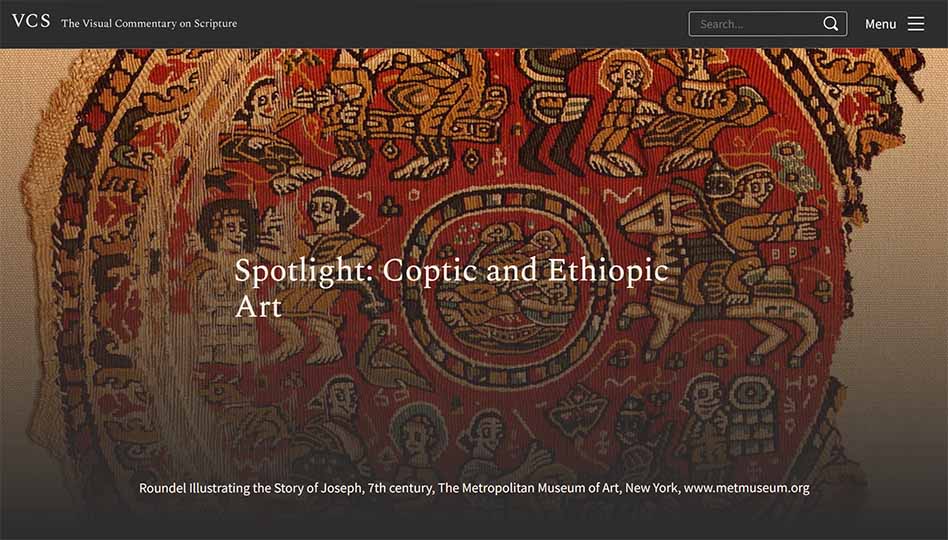
RE teachers are already discovering the VCS and using it in the classroom. You can search the website by book within the Old Testament and Apocrypha or New Testament or by theme (e.g. Wisdom, Creation, Miracles…), explore a ‘spotlight’ topic (currently Coptic and Ethiopic art), use the video channel, or learn more about the hermeneutical principles behind the VCS. There are 265 exhibitions currently online, and hundreds more in the pipeline.

The VCS is working on tailored school resources to bring the Bible alive in new ways for students. If you would like to join a focus group for school resources, or pilot them in your teaching, or if you’d just like to discuss ways of using the VCS, please contact Dr Chloë Reddaway at vcs@kcl.ac.uk

You can subscribe to the free VCS mailing list at the bottom of the homepage.

About

Chloë is Research Fellow, Arts and the Sacred at King's College London

See all posts by Dr Chloë Reddaway