The Worldviews of the so-called ‘Nones’ Listening, Understanding & Teaching in Rural Lincolnshire
Research Spotlight: The Worldviews of the so-called ‘Nones’ Listening, Understanding & Teaching in Rural Lincolnshire
September 2023
Professor Andy Wright and Dr Elina Wright
At the start of a new academic year, we are sharing some early-stage research being done by Professor Andy Wright and Dr Elina Wright. Alongside other current developments in the subject, their work builds on the Commission on RE (2018) and explores new ways of thinking about a religion and worldviews approach. They use their local context, rural Lincolnshire, to exemplify their approach.
Research Spotlight: Religion and Worldviews in an Andalucian pueblo
July/August 2022
Dr Kevin O’Grady
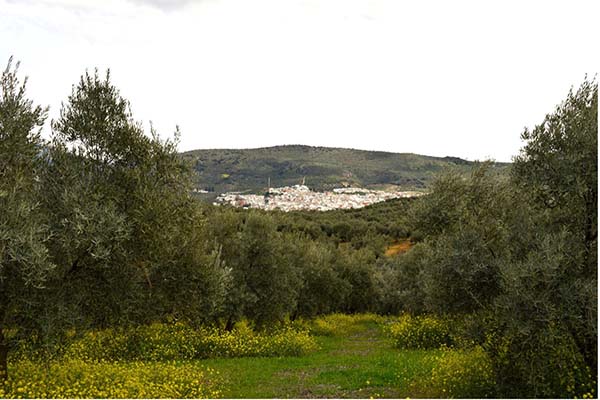
Castillo de Locubín is a traditional pueblo blanco (white village) in the Sierra Sur mountains of Jaén, Andalucía, Spain. In 2022 its population is around 4,500 and some 90% work in agriculture, these days not the subsistence culture of centuries past but mainly olive oil production for sale and export.
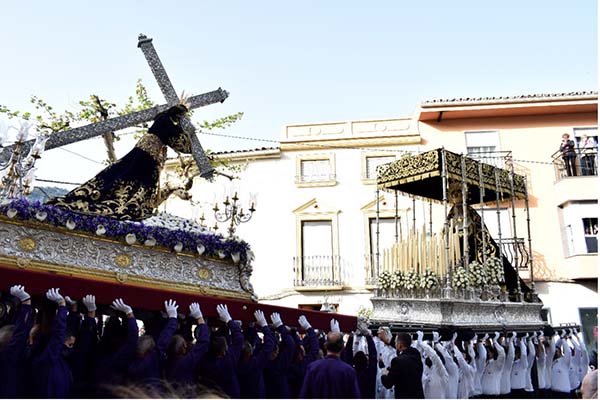
he village, usually referred to as Castillo or just El Pueblo, has a strong Catholic identity. As we’ll remark, this is nevertheless not straightforward, neither historically nor in the contemporary sense. We’ll focus on the 2022 Semana Santa (Holy Week) celebrations and develop the discussion from there.
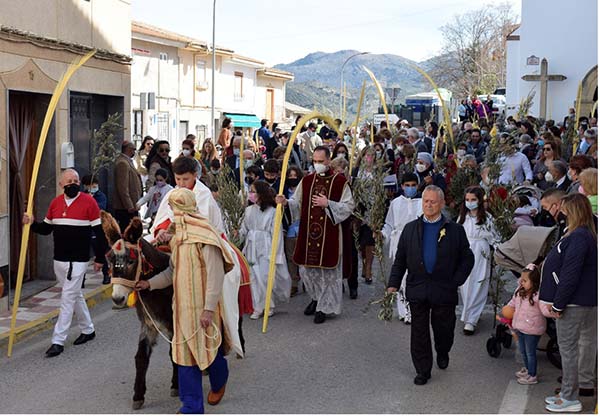
Semana Santa begins with Domingo de Ramos, an evocation of Palm Sunday that can’t strictly be called a procession since no sacred image is involved. Instead, villagers follow a child mounted on a donkey through the streets. As well as the story of the entry into Jerusalem, the event calls up Castillo’s agricultural past and present: until late into the last century most villagers (Castilleros) farmed with animals who lived in the upstairs parts of their houses, and, as you’ll see next, the palms are sometimes substituted by olive branches.
For other nearby towns, Domingo de Ramos begins a series of daily or nightly rituals that continue through the week, but not in Castillo’s case. Because most of its sacred images were destroyed at the outbreak of the Spanish Civil War in 1936, their associated processions vanishing with them, Castillo’s Semana Santa doesn’t pick up again until midnight on Viernes Santo (Good Friday; that’s to say, 00.00 on Good Friday itself).
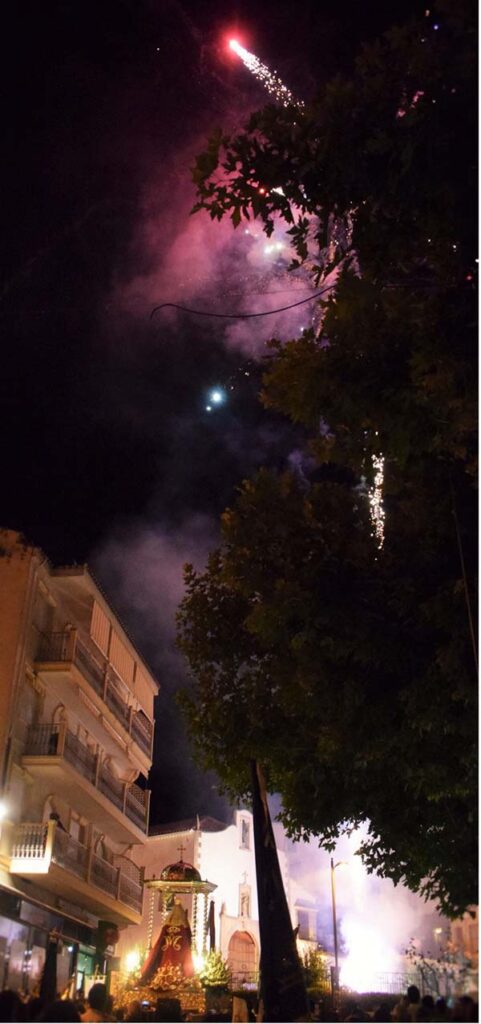
Castillo’s midnight Vía Crucis procession defies easy description. You could see it as blending austere mysticism, Biblical narrative, and street theatre (but more about that suggestion later). By torchlight, an image of Cristo del Perdón, Christ crucified, is processed through the streets to the sounds of a solitary drumbeat and chains rattling, with pauses to read each station of the cross.
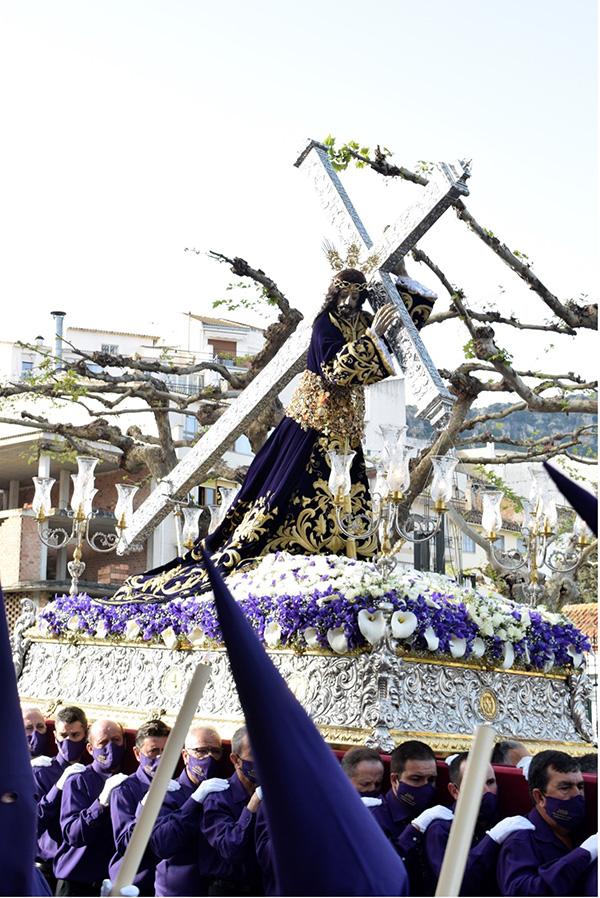
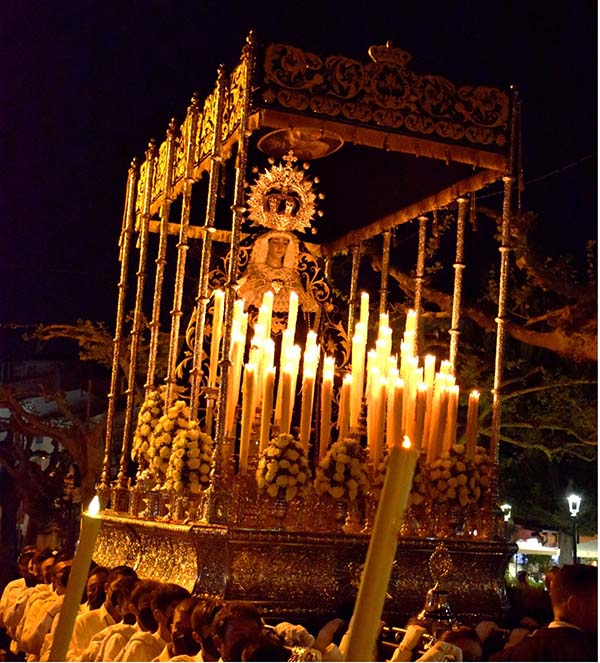
Later in the morning of Viernes Santo come two processions that combine to create an encuentro(meeting) between Jesus and Mary. The image of Jesus is Nuestro Padre Jesús Nazareno (usually shortened to Padre Jesús), that of Mary, La Virgen de los Dolores (the Virgin of Sorrows). These two images attract particularly strong devotion in Castillo, especially Padre Jesús: you could even compare loyalty to Castillo with loyalty to Padre Jesús. Again, more on that in due course, but a mention of the main Padre Jesús myth might help now. Around 1700, the image, an acknowledged masterpiece, was in transit through Castillo on its way to its intended home, the sculptor’s birthplace. The donkey providing the transport died, and this was taken as a sign from God that Padre Jesús should stay in Castillo for good; the Ermita (shrine, small church) in which he has since been housed was built on the spot. Padre Jesús is a depiction of Christ on Calvary at deepest resignation and despair; the encuentrore-creates his meeting with his mother.
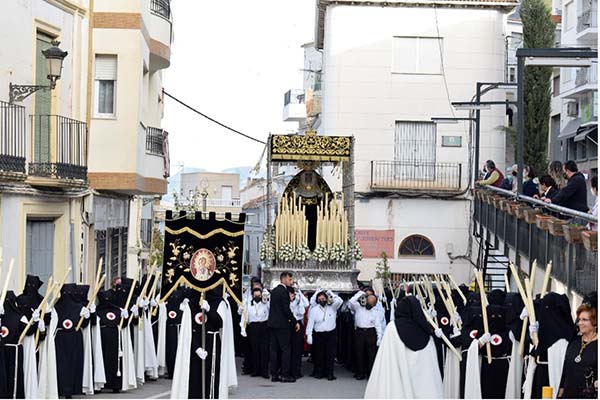
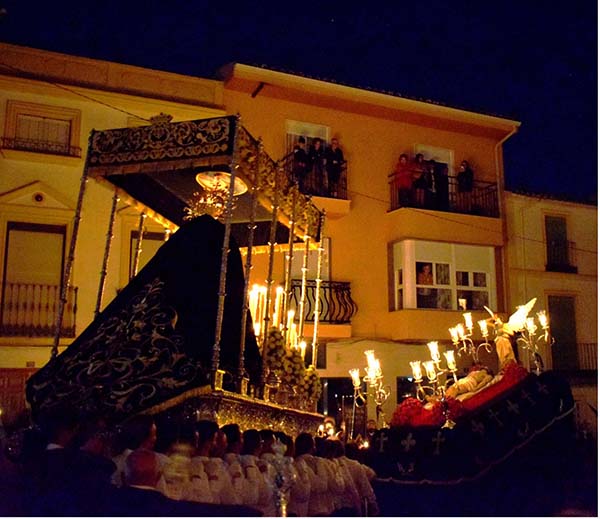
On the night of Viernes Santo, a second pair of processions creates a second encuentro, this time between Santo Entierro (Christ taken down from the cross) and the Virgin of Sorrows.
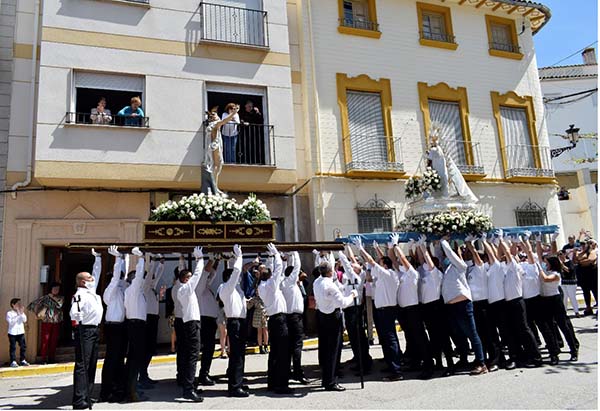
That this encuentro is the climax of Castillo’s Semana Santa can seem strange, but only to outsiders. Theologically, the resurrection would be expected to take centre stage. But Castillo’s Cristo Resucitado (Christ resurrected), is a recent image that has not built up a devotion comparable to those of Padre Jesús or the Virgin of Sorrows, and the Domingo de Resurrección (Easter Sunday) procession has been muted in the memories of most. This year attempts were made to create a fuller Domingo de Resurrección celebration, by creating an encuentro between Cristo Resucitado and La Virgen de la Cabeza. The image of La Virgen de la Cabeza commemorates an appearance of the Virgin Mary to a shepherd on the side of a head-shaped hill in nearby Andújar in the thirteenth century, so also attracts strong devotion in the locality. However, you might note in the next picture the smaller dimensions and simpler working of the images, as well as the reduced atmospheric intensity and, indeed, turnout.
In fact, theology stays in the background. There’s little discussion of the meaning of the rituals, questions about it surprise people, but that’s not to say there’s little meaning. It appears mediated more through the beauty of the images and the ritual choreography, music also playing an important role in ways that my photos can’t show. Visit https://www.youtube.com/watch?v=c9oASrnUEHs to hear how traditional band and flamenco styles create different accents at different stages of Castillo’s Semana Santa.
Social media is an increasingly used resource, in various ways. Emigration from Castillo means a diaspora whose members engage with Semana Santa via Facebook, where one group is solely dedicated to its imagery. A post on another Facebook page, El Pueblo es Tranquillo, concerning the 2022 Vía Crucis procession generated an intense discussion by comment and reply. Did Castillo’s various images of Jesus refer to the same reality? For believers, yes: but on another view, as a symbol of popular local religiosity, Padre Jesús is a singular figure whom all can understand and respect. Similarly, Semana Santa is a mixture of elements with something for everyone, even if just as spectacle or affirmation of the community (atheists and agnostics can be found in Castillo, though not non-Christian faith; and aspects of the history of the Catholic Church in the village are painful).
Digging deeper and more speculatively, there’s evidence that considerable numbers of Castillerosare descended from the once-Muslim population. Aspects of its culture linger, some visibly, such as the Arab irrigation system, and the remains of the fort that tower above the plain it continues to water: if you’ve visited Granada, 37 miles south of Castillo, this may sound familiar. It’s known that Sufism was influential in medieval Andalucía. Look back at the photo of the Padre Jesús procession and the purple capirotes (pointed hats) worn by some participants. They’re known as symbols of penitence, and related to the Spanish Inquisition, as those arrested were made to wear them. This is probably enough explanation for present purposes, but a visit to the tomb of Rumi in Konya, Turkey made me wonder – his own tombstone hat sits on it, and they are worn by dervishes of his order as reminders of mortality. In Spain, they don’t appear on Easter Sunday.
In summary, religion in Castillo de Locubín should usefully be seen in a worldview perspective. It helps to:
Look at the historical context.
Consider local traditions. The version of ‘Catholicism’ might not be recognisable elsewhere.
Hesitate to expect that only those identifying as Catholic join with thetraditions, or that the traditions only contain Catholic elements.
Think about emerging forms of tradition, especially digital.
Look for the lived elements. An over-emphasis on theology, or doctrine, may not be appropriate.
Think about how these lived elements add up: the aesthetic, ritual, social and ethical dimensions all connect.
In other places or cases, it might not be these elements that figure most powerfully. And, of course, you may not be considering a majority Catholic situation. However, related to the points above, here are some general questions to consider, that apply whenever you approach localised religion in a worldview perspective, whether in planning teaching or in teaching.
How has local history, tradition or custom influenced what can be seen now?
Are these religious expressions distinctive to the locality, even if related to a wider tradition? In what ways?
How do people from outside the tradition but from within the locality relate to these expressions? And is there evidence of inclusion of elements from outside the main tradition?
How have social media or other digital resources developed the local religious expressions, or how people can participate in them?
What are the main lived elements of the local religious expressions? How, for example, do artistic, ritual, community, ethical or other elements figure, and how do they relate to one another?
A discussion between colleagues in a planning or INSET session might not cover all these questions, but even one or two of them would generate a good analysis. Similarly with classroom teaching: any of the questions provides a good enquiry basis.
You may be travelling this summer. I hope you have opportunities to experience and take photos of local celebrations, talk to people about their history and significance, and listen to stories about them. If you’re in Spain on the 15th of August, look out for celebrations of El Dia de la Virgen (the feast of the assumption of the Virgin Mary into Heaven); we’ll close with a picture of Castillo’s 2017 Dia de la Virgen procession.
A note on methodology
I’ve been visiting Castillo de Locubín regularly since 2012 and lived there from 2015 to 2018. Though I’ve never thought of this in terms of a formal research project, several of my interactions with Castillo and its people have taken on research-like aspects. These include photography collection, participant observation during processions and other events, interviews with participants, reading, and discussions with researchers including local historians and a US-based anthropologist who completed a doctoral study on Castillo in the 1970s.
Sunday Assembly – an atheist church?
Research Summary: Sunday Assembly – an atheist church?
The Sunday Assembly has a complex relationship with atheism and religion. It holds events which look and feel like religious worship, but uses this format to create a ‘godless congregation’. Described as an ‘atheist church’ by the media, members prefer to talk about inclusive communities. If the Sunday Assembly simultaneously embraces and rejects both atheism and religion, then how do attendees identify and describe themselves? A qualitative study based on interviews with Sunday Assembly attendees is presented. The findings show that a significant number of attendees publicly identify as indifferent towards religion, while privately maintaining a more strongly non-religious identity, thus suggesting that for Sunday Assembly attendees, inclusivity is imperative.
Researchers
Melanie Prideaux & Tim Mortimer
Research Institution
University of Leeds
What is this about?
This research is about the Sunday Assembly, a movement with 80 chapters in 8 countries that focusses on community, service, a lack of doctrine or deity and inclusivity. Meetings resemble Anglican church services but the structure is used to create a godless alternative. The movement began in London in 2013, receiving a considerable amount of media attention as an ‘atheist church’. But the Sunday Assembly publicly rejects an atheist label or concern with related themes. The Sunday Assembly thus presents a good opportunity to study a range of issues related to religion and non-religion.
What was done?
The data were gathered through an online survey, promoted through social media, and semi-structured interviews and participant observation over a six-month period at two different Sunday Assembly meetings in the UK: Leeds and London. Thirty individuals were either interviewed or responded to the survey. The fieldwork was conducted during 2013–2014 in the first year of the Sunday Assembly.
Main findings and outputs
The expressed identities of Sunday Assembly attendees are complex.
The three concepts of non-religion, the secular sacred and indifferentism help to explain them.
The data show that attendees of the Sunday Assembly reject classification, both of the poles of observant religion and overt irreligion, and further of classifying their identity between these poles.
Sunday Assembly attendees often identify publicly with indifferentism or indifference to issues of religion or belief, though the details of their interview answers often suggest that they are not so indifferent.
Privately, respondents regularly identify as non-religious.
Many are reluctant to be identified with the Richard Dawkins style of atheism, which, together with organised religion, is sometimes described as aggressive.
The public display of indifference is due to a secular sacred boundary around the concept of inclusivity.
It is non-negotiable for Sunday Assembly members that all should be included without judgement.
An abrupt distinction between non-religion and the secular is problematic. Sunday Assembly members do not primarily identify as non-religious, but inclusive.
Relevance to RE
Within RE, there is continuing discussion of the nature of non-religious worldviews and how to approach teaching about them. The research provides evidence, insights and discussion on an interesting example. RE teachers might use it to help develop their knowledge base on non-religious worldviews (even though the researchers find that non-religious is not the best way to describe the Sunday Assembly). They could also find the material useful in preparing to teach about the Sunday Assembly, e.g. as preparation for hosting visitors in lessons and thinking about the questions pupils could ask and explore with them.
Generalisability and potential limitations
The researchers discuss some limitations of the research. The scale is quite small and the study took place when the Sunday Assembly was in its infancy. They suggest, however, that the study raises questions that would repay more detailed, updated studies.
Find out more
The full article is: Tim Mortimer & Melanie Prideaux (2018) Exploring identities between the religious and the secular through the attendees of an ostensibly ‘Atheist Church’, Religion, 48:1, 64-82.
Research Spotlight: Sikh Religious Authority in a Digital World
September 2022
Dr Jasjit Singh
In this video Dr Jasjit Singh talks about the impact of the online environment on Sikhs in diaspora and how the online environment impacts on religion and particularly on religious authority. Questions raised include:
What role does the internet play in religious transmission and learning? What can people do now that they couldn’t do before?
How does different digital tools present different types of information about religion? Are there different types of religious authority?
Think about issues of translation, and what might be lost when simply imposing meanings from English / Christianity on to non-Christian worldviews – e.g. the word Gurdwara. Emphasises the importance of the Guru for Sikhs, unlike ‘Sikh Temple’ which doesn’t.
How might family background and religious affiliation impact on online engagement.
You can find a research report here on RE:ONLINE summarising Jasjit’s research with links to the original articles.
LGBT Muslims – a different view of Islam?
Research Summary: LGBT Muslims – a different view of Islam?
The research builds on the idea that religions can be a cultural resource from which people can draw rather than a controlling background framework. In relation to Islam, different Muslim groups are seen to present different expressions of their own, that bypass traditional authorities. Anti-LGBT violence and pro-LGBT activism can both be viewed in this way. The research focuses on LGBT Muslims and their improvements on traditional Islamic scholarship, aimed at presenting Islam as a religion which embraces sexual and other forms of diversity. Teachers should take note of their challenges to notions of Islam as homophobic or authoritarian; their ‘different view’ of Islam points to diversity within the religion and how it can act as a vehicle for social justice.
Researcher
Shanon Shah
Research Institution
King’s College, University of London; William Temple foundation; Information network on religious movements; the Muslim Institute.
What is this about?
Can people use religions ‘independently’, without referrring to official authorities?
What are the experiences snd beliefs of LGBT Muslims?
Can Islam be presented as a religion of equality and diversity?
How can stereotypical views of Islam as homophobic or authoritarian be challenged?
How might RE teachers consider these issues in their teaching?
What was done?
The researcher conducted in-depth interviews with 29 individuals – 17 in Malaysia and 12 in Britain, also observing and participating in their various social activities, including recreational sports, nightclubbing and activism, and in public events related to Islam and/or LGBT issues; and attended and made notes on congregational Friday prayers and sermons in both countries to assess if or how gender and sexuality were discussed. Media analysis was also carried out.
Main findings and outputs
Traditionally, homosexuality is often viewed as ‘forbidden’ in Islam.
However, some LGBT Muslims are taking charge and reinterpreting Islam to expand its notions of equality, diversity and social justice. The research looks at how they have created educational projects to spread their beliefs.
For example, educational workshops are held during which Qur’anic passages often held to condemn homosexuality are re-interpreted: are these passages, which refer to Lut (the Biblical figure Lot), about loving, consensual same-sex relationships or sexualised forms of assault, exploitation and violence? How can these passages be squared with others that emphasise equality and diversity?
A small number of UK Muslims are developing their religious literacy to form new Islamic groups that embrace gender and sexual diversity. They do this to reconcile their own personal identities with their faith, but also to re-shape Islam’s public profile.
Relevance to RE
RE policy should reflect that religions need to be represented fairly and recognised as internally diverse. This research is a compelling example of these needs.
Curriculum also should be planned to ensure that a range of views and practices within each religion is covered.
In terms of pedagogy, the research offers rich resources. When teaching about Islam, family life and sexuality, teachers can ask pupils to consider: what are the different beliefs about these issues, within Islam? How might the different texts be intepreted, in different ways?
Important reflective questions for pedagogy are also posed by the research. Having learned about LGBT Muslims and their understanding of their faith, pupils could be asked to reflect on how their own view of Islam has been affected by what they have learned.
Generalisability and potential limitations
By its nature, the research focuses on a minority group, but this is its appeal. It seems clear that the experiences reported are generalised, e.g. the author is right to suggest that several Islamic authorities state that homosexuality is forbidden and that gay Muslims have to work out how to react.
Find out more
Constructing an alternative pedagogy of Islam: the experiences of lesbian, gay, bisexual and transgender Muslims, Journal of Beliefs & Values 37:3, 308-319 (published online 1 August 2016), 10.1080/13617672.2016.1212179
Paganism: hard to live by, but still relevant to 21st century life?
Research Summary: Paganism: hard to live by, but still relevant to 21st century life?
Neo-paganism – contemporary ‘Western’ paganism, as distinct from the animist beliefs of ‘traditional’ people – is an international movement with branches in 30 countries. The Pagan Federation, founded in Britain in 1971, has as its first principle ‘Love for and kinship with nature’. But what does this mean for contemporary pagans? Is it really a description of their way of life, or is it metaphorical language, or is it romantic wishful thinking? The article gives an account of neo-pagan beliefs and practices. Neo-pagans do identify their beliefs with those of traditional animist peoples, and the article also spends some time giving accounts of those. The researcher shows that they are not totally comparable. Neo-pagan belief in kinship with nature is restricted to belief and ritual, whilst in traditional animist societies, it actually determines all of the rules of life, something which is impossible in a contemporary, pluralist society. Yet neo-pagan principles of kinship with nature are still important to the huge task of shifting people away from the damaging ideology of consumerism.
Researcher
Kathryn Rountree
Research Institution
University of Massey, New Zealand
What is this about?
Who are Neo-Pagans and what do they believe and practice?
How does their principle of ‘kinship with nature’ affect their lifestyles?
They identify their principle of ‘kinship with nature’ with the beliefs and cultures of traditional animist peoples, but to what extent can they be compared to such peoples? (What, in turn, do such peoples actually believe and practice?)
Neo-Pagans see their commitment to ‘kinship with nature’ as a solution to problems caused by twenty-first century consumerism, especially environmental problems. To what extent is this view justified?
What was done?
Mostly, the author’s research method is to review existing literature on Neo-Paganism and on traditional animist societies, but some communication via email with contemporary practitioners of neo-paganism is also evident.
Main findings and outputs
Neo-Paganism is an international movement with diverse members: Pagans, Wiccans, Heathens, Earth Goddess-Worshippers, Druids and Shamans. Most Neo-Paganists are animists, believing that all things on Earth have spirits. Humans are one kind of ‘people’ amongst ‘bird-people’, ‘waterfall-people’ and so on. All such ‘people’ have rights, all are inter-linked.
The key belief in Neo-Paganism is ‘kinship with nature’: humans have a familial relationship to all things on Earth. Some Neo-Pagans, especially in Britain, express this through environmental activism or protest. Participation in ancient rituals at sacred sites e.g. stone circles or springs is common. During such rituals, Neo-Pagans report feelings of intense communication with or non-separation from nature, or abilities to connect with local spirit beings or human ancestors.
Neo-Pagans choose these beliefs and rituals, but ‘traditional’ animists inherit animism as a matter of culture and law. Their kinship is with particular places, animals and / or plants. Various examples are given: for the Kamea of New Guinea, strict marriage laws mean that husbands and wives each have specific plants to grow, pieces of land take the names and identities of those working on them, trees are given names and young girls grow up eating food produced on their future husband’s land (marriages are arranged at birth).
Neo-Paganism is a radical alternative, hard to establish as ‘normal’, whilst traditional animism is taken for granted (though under pressure from Westernisation). It may be romantic, but ‘kinship with nature’ could be a useful strategy for working towards Earth’s sustainability.
Relevance to RE
The research offers very interesting and useful background information for those RE teachers seeking to include studies of Paganism in the curriculum.
Pedagogically speaking, the approach taken by the research could well be fruitful in the classroom. It is enquiring, sympathetic yet critical. Pupils could look into Paganism in a variety of ways (listening and responding to teacher presentations based on the article and other sources1, carrying out their own background research, receiving and interviewing a visitor, etc.) Some of the critical questions posed by the article could then be offered to pupils for discussion and debate, e.g. is it true that we are related to all other forms of life on Earth? Is it actually possible to live as if all other forms of life belong to your family? What are the strengths and weaknesses of Paganism as a way of life or philosophy, in relation to protecting the Earth for future generations? Does it have more or less to offer than the ‘mainstream’ religions which the pupils have studied?
Generalisability and potential limitations
The study is of the broad international Pagan movement, The Pagan Federation. It takes account of the fact that this movement is diverse in its membership. In comparing the beliefs of neo-pagans to traditional animist beliefs, it gives several different examples of these. The environmental issues that it raises are of very wide relevance and good for pedagogy.
Find out more
Neo-Paganism, Animism, and Kinship with Nature, Journal of Contemporary Religion, 27:2, 305-320 (published online 23 April 2012), 10.1080/13537903.2012.675746
Research Spotlight: Primary Practitioners Research
July/August 2023
During July and August, we are featuring the research of primary practitioners from the 2022-23 Culham St Gabriel’s master’s community of practice. See their presentations below:
Ian Coles looks at the impact that using worldview community visitors in the Primary RE curriculum has
Nadia Nadeem on creating a series of sequential and progressive lessons and resources on Christian ethics and farmed animal welfare
Killian Barrett on our mission to the poor: rhetoric or reality within a Catholic Primary School
Using the voices of worldview community members in the classroom
Ian Coles
Some questions to consider:
Do you use the voices of worldview community members effectively in your classroom?
Are your pupils brave enough to satisfy their curiosity by asking important questions?
Are they brave enough to engage with the answers in a way that might change their own beliefs?
My research aims to discover the impact that using worldview community visitors in the Primary RE curriculum has. I am looking at this from four angles: the academic impact; the impact on pupils’ prejudices; the vicarious impact that this might have on parents; and the impact that these events have on the worldview community members themselves. Next year, as part of my MA, I will be conducting a small scale, practitioner research project at my own school, however I will be backing this up with research drawn from a wide variety of sources.
I have been particularly interested in the use of worldview community visitors for a number of years now. The schools in which I have worked have been populated overwhelmingly by White British staff and pupils. In my twelve years and three schools, I have never worked with a teacher or teaching assistant who was not either Christian or non-religious. I have wondered whether this has contributed to a lack of awareness, knowledge and understanding of peoples from non-Christian religions amongst the pupils, and I have always felt that worldview community members could be a significant resource in addressing these issues.
In regards to the academic impact that such visitors can have, they can of course be effective in overcoming a number of obstacles to teaching RE in the classroom. Insight’s 2021 report on the state of Hinduism in RE, which analysed data from Hindu parents of primary school children, stated that ‘76% of primary school parents are unhappy about RE teachers’ knowledge of Hinduism’ (INSIGHT UK, 2021[1]). Given that many teachers get little to no RE input in their training, it is worthwhile to assume that this lack of subject knowledge extends to other worldviews as well. This issue, which is particularly acute for primary school teachers who are required to be experts on a seemingly unending number of topics, is something that can be addressed by bringing in an expert. It also resolves the worry that many teachers have of misrepresenting a religion when trying to teach it themselves. Most importantly, worldview community members provide pupils with an example of lived religion. Real lives and real authenticity can have a real impact on pupils.
Using ‘live contact’ as opposed to videos also enables pupils to partake in, what I have noticed to be the most effective part of any faith visit, the Q&A session. Studies have shown that pupils ask considerably more questions of a visitor than they do of their teacher (Jackson, 2014[2]; Riegel and Kindermann, 2015[3]). In these situations, pupils are able to satisfy their curiosity in not just a safe space, but a ‘brave space’. A space where people are empowered to articulate their own understanding, but also willing to be vulnerable and allow their beliefs to evolve. This is effective for our children but is also a useful experience for worldview community members themselves.
Research has been done into the benefits of vicarious contact (Mazziotta, Mummendey and Wright, 2011[4]), and it will be interesting to see if any weakening of the pupils’ prejudices can be transferred to their parents. Prejudice may often arise from a lack of understanding, and a lot of research has been done into contact theory and using peer to peer contact experiences to break down prejudicial barriers (Peacock, 2020[5]; Peacock, 2023[6]; Allport, 1979[7]). However, in situations like the one I and many other teachers face it is incredibly difficult to create these experiences for our children. My hope is that my research will provide further insights into the issue of whether worldview community members can be effective in recreating the effects of peer-to-peer contact in reducing religious prejudice amongst pupils.
[2] Jackson, R. (2014) Signposts – Policy and practice for teaching about religions and non-religious world views in intercultural education, Strasbourg: Council of Europe Publishing.
[3] Riegel, U. and Kindermann, K. (2015) ‘Why leave the classroom? How field trips to the church affect cognitive learning outcomes’, Learning and Instruction, 41(2016), pp. 106-114.
[4] Mazziotta, A., Mummendey, A. and Wright, S. (2011) ‘Vicarious intergroup contact effects: Applying social-cognitive theory to intergroup contact research’, Group Processes and Intergroup Relations, 14(2), pp. 255-274.
[6] Peacock, L. (2023) ‘Contact-based interfaith programmes in schools and changing religious education landscape: negotiating a worldviews curriculum’, Journal of Beliefs and Values, 44(1), pp. 1-15.
[7] Allport, G. (1979) The Nature of Prejudice. 25th Anniversary Edition. New York: Perseus Books Publishing.
Christian Ethics and Farmed Animal Welfare
Nadia Nadeem
Questions for consideration:
Why should pupils discuss controversial issues in lessons?
How can we help pupils to learn deeply?
How can we help them to consider their future roles as adults?
I initially learnt about the Christian Ethics and Farmed Animal Welfare project (CEFAW) when I was completing stage 1 of the Culham St Gabriel’s Leadership Programme. I was fascinated to discover the harsh realities of the treatment of farmed animals in the UK. Subsequently, I completed a MA module on Research for Teaching at the University of Chester, as a Culham St Gabriel’s scholarship student.
As part of the project, I collaborated with 2 other primary school teachers to create a series of sequential and progressive lessons and resources that built on prior learning and included links for future learning.
I created lessons that were discursive in nature because from previous research experience (British Religion in Numbers in the classroom), I learnt that RE lessons are much more effective when they are discursive as they allow deeper thinking to take place.
Using discursive strategies enables pupils to apply their learning and understanding outside the classroom and potentially in later life. Using statistics to facilitate a discussion makes the experience real, purposeful and provides context with the possibility of having real impact.
Giving pupils statistics on farmed animal welfare raised many questions including: how does poor treatment hinder the animal’s ability to flourish? Here pupils had to consider what flourishing is. How is flourishing established/reduced? How can limitations on flourishing impact the quality of the animal’s life? Can they result in stress hormones being present in the animal’s meat? How does this meat impact humans after it is consumed? Would it be better to become vegan rather than put an animal through suffering – especially if it is a result of trying to meet supply and demand needs?
Moreover, I wanted pupils to think about the ethical aspect of the treatment of farmed animals and the key concepts of flourishing, stewardship, and dominion in relation to CEFAW but also other facets of life. Can they take responsibility for the flourishing of others around them? How important is flourishing for development and wellbeing?
In my opinion, R&W curriculum needs to teach ethics. In this modern era of social media where pupils have access to surplus information which they are not always mature enough to interpret or fully understand the implications of, it is pertinent for pupils to have ethical values that enable them to develop characters with moral compasses. Teaching ethics supports character building, character education and is learning that can be applied in later life.
After trialling my lessons, I felt they could be adapted further. For example, take the children to a farm, allow them to interview farmers on their practice. This would provide a concrete experience and allow pupils to think deeper and reflect on why certain practices are followed and what changes may be put in place to make a difference.
My message to other teachers is:
Use discursive/controversial lessons even if it seems daunting to begin with; they enable pupils to think in depth and breadth – use discussions regularly.
Controversial questions are great for unpicking pupils’ opinions and thinking. They help to stretch and extend pupils understanding of a particular concept/idea and how it can connect to other learning and aspects of life. Encourage pupils to analyse what they have learnt and what they are going to take away.
Lastly, use statistics because when you provide real a snapshot of society and how it really thinks and works: it compels pupils to consider the type of society they want to live in and what they need to do as the next generations of adults.
Our Mission to the Poor: rhetoric or reality within a Catholic Primary School
Killian Barrett
Questions to consider:
Where does our language of ‘the poor’ come from? How might we reflect on and critique our language of ‘the poor’?
How might we critique images and appeals we encounter through our studies that influence our attitudes to ‘the poor’?
How might we challenge neo-colonial stereotypes through this theme in RE?
The aim of my dissertation project is to explore and examine if the traditional view of duty and service to the poor and disadvantaged is evident in contemporary Catholic education today.
The research and study of literature included biblical, historical and contemporary perspectives of the poor and disadvantaged in relation to the Catholic Church’s Mission, together with a examination of challenges and opportunities related to leadership in fulfilling this mission in a meaningful and practical way today. The dissertation focused on research evidence and example through the examination of a case study school. This case study school is located in Lurgan, Co. Armagh, Northern Ireland and caters for children 4 – 11 years of age.
I was keen to examine how schools can practically improve their care and support to children who may be experiencing poverty. I was interested in investigating our school curriculum (RE programme), Personal Development and Mutual Understanding Program (PDMU), World Views on Poverty, and various other initiatives and outside agencies who visit our school to explore if these subjects and programmes in the school, alongside the pastoral care, are actively and adequately helping to fulfil our mission in helping to serve ‘the poor’.
I undertook research through the mediums of face to face interviews with our current Principal, Vice Principal and one other member of our School’s Senior Leadership Team. These interviews were followed by questionnaires for all of our permanent and temporary full-time teaching staff as well as our SEN and general classroom assistants. These forms of research involved quantitative and qualitative methods of gathering data.
After analysing the data collected it was clear to see that there was a strong agreement from all members of it staff towards supporting the poor in our society. They believed that our school was contributing to this mission by supporting various charities throughout the year, quietly helping families in need and teaching children this moral issue through our curriculum. It was interesting to note that all admin staff believed our curriculum was sufficient in helping teach children about our true Catholic mission towards helping the poor.
Furthermore, a challenge faced by schools in upholding this Mission towards the poor was the negative influence from parents and lack of support from the local parish. Through the data collected, it was clear to see that staff believe there is not enough support from families or the parish community in helping support schools in this mission and instead there is too much of a focus on academic results.
Through the use of findings in the literature reviewed and the subsequent qualitative and quantitative research methods it is recommended that teachers and staff continue to support and build upon the work already done in fulfilling our Catholic mission of helping the poor, no matter what extrinsic challenges they may face. These findings are not just for schools that are solely Catholic but can also be linked to schools of various faith denominations as it is everyones moral duty, regardless of religion, to help those in need.
References:
Byron, W. J. (2015) “What Catholic Schools Can Do About World Hunger.” International Studies in Catholic Education 7 (2): 201–209.
Grace, G. (2002) ‘Mission Integrity: Contemporary Challenges for Catholic School Leaders.’ In K. Leithwood and P. Hallinger (Eds) Second International Handbook of Catholic Educational Leadership and Administration, Dordrecht. Kluwer Academic Press.
Groome, T. (2014) ‘Catholic education: from and for faith’, International Studies in Catholic Education, 6:2, 113-127.
McKinney, S.J (2018) ‘The roots of the preferential option for the poor in Catholic schools in Luke’s Gospel,’ International Studies in Catholic Education, 10:2, 220-232.
O’Malley, D. SBD (2007) Christian Leadership, Bolton: Don Bosco Publications.
The Congregation for Catholic Education (2007) The Catholic School on the Threshold of the Third Millennium’.
Joseph Rowntree Foundation (2011) The influence of parents, places and poverty on educational attitudes and aspirations
Primary pupils can! A richer encounter with parables
Research Spotlight: Primary pupils can! A richer encounter with parables
A research spotlight for Primary Focus Week
In this short film Dr Ryan Parker, RE Adviser and previously a teacher of primary age pupils, explores whether 9 and 10 year olds can engage with deep questions about meaning and interpretation of parables. He used a series of practical strategies in his sample lessons, all the resources he used in his lessons, based on the parable of the Good Samaritan are available to download at the bottom of this piece. I was struck by his initial questions for pupils after reading the parables:
What stands out for me in this parable?
Are there any parts that don’t add up or make sense? Why not?
What information might help us to understand this text more?
Ryan’s work will be of interest to all but certainly builds on the work in this area by Pett et al. In ‘Understanding Christianity’.
As you watch and read consider;
Are too many encounters with texts in RE too narrow and predetermined? How can we enable reflective, knowledge-rich encounters with sacred texts?
How can we help primary pupils reason through why different people, including themselves, read a text the way they do?
What do you think is the value of more open pedagogies, which enable pupils to use their volition and voice as interpreters, in enriching pupils’ religious literacy?
An emerging question from the chalkface
As a primary practitioner, I was – and still am – struck by how often curriculum resources on the parables do not invite pupils to reflect upon diverse interpretations. Too often, students are directed to a single, incontestable meaning. ‘Success’ in these lessons is determined upon whether or not they can parrot back that particular meaning on the lesson plan. With pupils essentially told how to read these texts, opportunities for them the share their own ideas and questions are stymied. This sits uneasily with me. As parables stimulate different readings, surely pupils should encounter and reason across/through diverse interpretations in religious education (RE)? Furthermore, wouldn’t pupils’ religious literacy be enriched if they also engaged with deeper questions around why different people (including themselves) interpret a parable differently? Sadly, there remains a view in RE (entrenched since the 1960s) that primary-aged pupils are not cognitively ready to engage meaningfully with the parables of Jesus; better to communicate one meaning or simply present as stories to enjoy until the secondary phase.
I wished to challenge this assumption. Through part-time doctoral research (University of Birmingham), I designed and trialled two lessons with pupils aged 9-11 to develop their hermeneutical awareness and construct informed responses to the enquiry question, ‘Why do different people interpret a parable differently?’. The parable used was The Parable of the Good Samaritan (Luke 10: 25-37). Such an enquiry was designed to contribute meaningfully to pupils’ substantive, disciplinary and personal knowledge (Ofsted, 2021).
Aspects underpinning the lessons
Three key aspects emerged from my engagement with literature which informed the envisioning, exemplification and evaluation of these lessons: pupil agency, dialogic learning and reception history of the parables.
Pupil agency. Pupils are not passive recipients of content; they are agentive hermeneutics who construct meaning and pursue lines of enquiry through engaging with subject matter and others. Through the lessons, I employed a slow, open pedagogy to provide a range of opportunities for pupils to use their volition and voice to reason through different aspects linked to the enquiry question.
Dialogic learning. According to Gadamer (2004) and Ricoeur (1992), it is through encountering views which are new to, of differ from one’s own, that we understand others and ourselves better. I therefore provided numerous opportunities for pupils to encounter diverse views within a shared enquiry, both presented within the subject matter and emerging from students themselves. This included reasoning through a range of interpretations and hermeneutical issues constellating around the parable to help them more efficaciously understand why different people, including themselves, interpret a parable differently.
Reception history. The hermeneutical issues mentioned above were sourced from parabolic scholarship. Such scholarship includes a vast array of views on the parables, with various ideas about the original context within which the parable was first spoken and read, as well as questions around the positionality of readers in encountering these texts.
Also valuable was the field of reception history (e.g. Lyons, 2010; Beal, 2011). I considered it purposeful to enable pupils to engage with a range of authentic interpretations and their interpreters, from different times and places. This would, I hoped, help pupils recognise that interpretation of texts is often a dynamic, ongoing, contextual conversation, one which they are also contributors.
Conclusions
‘It’s quite interesting to see how [other interpreters] think…It just made me really think about the different times, the different cultures, the different backgrounds and experiences that lead up to similarities, differences…and unique people thinking different things’ (Pupil CA)
This research demonstrated compellingly that primary-aged pupils are able to reason meaningfully through why different people interpret a parable differently; this has not been revealed before in formal research. Some key conclusions are:
With appropriate support, space, pedagogies and resources, pupils aged 9-11 can ably engage in rich reasoning pertaining to why a parable is interpreted differently by different people. In considering a range of questions taken from parabolic scholarship, pupils’ substantive, disciplinary and personal knowledge developed;
In encountering a range of ideas and interpretations (from their peers and interpreters across different times and places), pupils stood self-consciously in front of a parable. In other words, they recognised that their own positionality informed how they engaged with this text. They were also able to appreciate how others arrived at the interpretations they did; and
this deep thinking empowered pupils to express their views, questions and developing thinking within an open enquiry. They used their volition and voice to explore interpretive issues. This was valued by pupils – they and their perspectives were ‘heard’ (Pupil BD) in a way not always granted in textual enquiry.
The full thesis and all lesson plans and resources can be found here.
Dr Ryan Parker, RE and Christian Ethos Adviser, Diocese of St Albans
Reference List
Beal, T. (2011) ‘Reception History and Beyond: Toward the Cultural History of Scriptures’, Biblical Interpretation, 19 (4): 357-372.
Gadamer, H-G. (2004) Truth and Method. London: Continuum.
Lyons, W. J. (2010) ‘Hope for a Troubled Discipline? Contributions to New Testament Studies from Reception History’, Journal for the Study of the New Testament, 33 (2): 207-220.
Ofsted. (2021) Research review series: religious education. Available at: https://www.gov.uk/government/publications/research-review-series-religious- education/research-review-series-religious-education
Pett et al (2016) ‘Understanding Christianity: Text Impact Connections’ Birmingham: RE Today. Ricoeur, P. (1992) Oneself as Another. Chicago, IL: The University of Chicago Press.
Living the Bhagavad Gita at Gandhi’s Ashrams
Research Summary: Living the Bhagavad Gita at Gandhi’s Ashrams
The Bhagavad Gita is a philosophical Hindu scripture in which the god Krishna imparts lessons to the warrior prince Arjuna about sacred duty (dharma) and the path to spiritual liberation (moksha). This classical scripture has had a long and active life, and by the 19th century it had come to be regarded as a core text, if not the core text, of Hinduism. During the colonial period, interpretations of the Bhagavad Gita considered the relevance of Krishna’s lessons to Arjuna in the context of British colonial rule. While some Indians read a call to arms into their interpretation of this scripture and urged their fellow Indians to rise up in armed resistance, Gandhi famously read a nonviolent message into it. This research argues that equally as important as Gandhi’s hermeneutics of nonviolence is his commitment to enacting the lessons of the Bhagavad Gita as he interpreted them in the daily life of his ashrams (communities). When explored through the lens of daily life in these ashrams, we see that Gandhi’s interpretation of the Bhagavad Gita emphasized not just nonviolence but also disciplined action, including self-sacrifice for the greater good.
Researcher
Karline McLain
Research Institution
Bucknell University, Lewisburg, PA
What is this about?
The Bhagavad Gita.
Mahatma Gandhi.
Life and ethics in Gandhi’s ashrams.
What was done?
This is a scholarly essay, analysing source material to cast light on Gandhi’s interpretation of the Bhagavad Gita.
Main findings and outputs
Firstly, it is clear that Gandhi sought to find the meaning of the Bhagavad Gita in practice, and through life in a community.
For Gandhi, the battlefield scene of the Gita was an allegory: “it described the duel that perpetually went on in the hearts of mankind (sic),and that physical warfare was brought in merely to make the description of the internal duel more alluring.”
The path of karma yoga was understood as disciplined action in pursuit of self-realisation, in the course of everyday life.
For over 40 years, when Gandhi was not residing in prisons run by the British colonial government, he was living on back-to-the-land intentional communities (ashrams) that he founded in South Africa and India. They tried to live out the Gita’s message.
The ethic of the ashram was not a neutral shared space but a ‘nonviolent neighbourliness’. Social ‘equals’ were treated as friends, ‘subordinates’ with service and superiors through civil disobedience. All this was worked out in local situations as self-discipline in everyday life.
In 1906 Gandhi took a vow of celibacy. He did this to better practice the Gita’s principle of self-sacrifice and service of others; he would lessen his attachments to his possession of a wife and four sons and treat all ashram members as co-equals.
When imprisoned, e.g. for refusing to carry an identity card (in South Africa in 1908), he read the Gita in prison and later wrote that its teachings should be carried out fearlessly – people should do their duty by what was right, even at the cost of their lives.
The practice of selfless service was the basis of Gandhi’s ashrams in India. Duncan Greenlees, a British resident, wrote – Then began the day’s work in earnest. Some went daily to the stables to scrub the floors and milk the cows; others swept the Ashram paths with brooms; others again prepared the morning meal in the fine kitchen. All in their turn went to clean the latrines. This was indeed a sacramental, purifying work that, bringing us at once into sympathy with the lowest castes of men, taught us to see God in everything, even in what the ignorant have named unclean.
On the morning of the Salt March in 1930, Gandhi insisted that only ashram members prepared to be killed should join him. They were allowed to take no food or drink, only a copy each of the Gita.
Relevance to RE
The research will develop teachers’ knowledge of Hinduism (the original article is very detailed, fascinating and to be recommended strongly). The material can certainly be of use in classroom teaching. The various stories can be told and discussed: why did Gandhi insist that only those ready to be killed should join him on the Salt March (note: ‘ready’ included having taken vows of celibacy)? Why were none allowed to bring food or drink? Why were all required to bring a copy of the Gita? Students can carry out their own research into life and ethics in Gandhian ashrams, drawing comparisons with communities of which they are members themselves and evaluating how people benefit from different kinds of community membership.
Generalisability and potential limitations
This research does not provide generalisable data as such, more a distinctive case study with which to deepen knowledge and understanding of the Hindu tradition.
Find out more
The original article is Karline McLain, Living the Bhagavad Gita at Gandhi’s Ashrams, Religions 2019: 10 (11), 619.
Non-religious worldviews in RE: teachers’ perspectives
Research Summary: Non-religious worldviews in RE: teachers’ perspectives
In this article, findings from a qualitative study of the views and experiences of 25 RE teachers in England are used to identify and explore a range of issues, in relation to national and international debates and research. Examples of inclusion and the models that they suggest are considered and it is argued that major obstacles, such as limited time and lack of a framework for the integration of religious and nonreligious worldviews, can be overcome. However, it is concluded that this will require further research and curriculum development work and that international collaboration should be pursued.
Researcher
Dr Judith Everington
Research Institution
University of Warwick
What is this about?
Teaching of nonreligious worldviews in RE is recommended in several influential documents, but what are the issues that need to be dealt with?
The views and experiences of 25 teachers are given.
There are obstacles such as lack of time and an agreed framework.
However, it is argued that though further work will be needed, the obstacles can be overcome.
What was done?
The study was undertaken between 2014–16 and employed qualitative research methods. Questionnaires were completed by 25 teachers. Eleven of these (4 men and 7 women) agreed to participate in one-to-one, semi-structured interviews of 45–90 min duration. Participants responded to an invitation disseminated through RE networks. All were RE specialists.
Main findings and outputs
There is controversy about the inclusion of nonreligious worldviews in RE, some viewing it as essential to an inclusive RE, others as diluting RE’s distinctive content, but so far we know little of teachers’ views.
Most teachers were unsure how to define a nonreligious worldview but referred to institutional systems as ways of making sense of human experience or providing beliefs and values, almost all mentioning Humanism but not limited to Humanism.Most encouraged nonreligious students to express their views in the classroom.
All felt that nonreligious worldviews should be included in RE. It would build academic skills, for instance, and social cohesion. But the main reason given was to develop students’ own beliefs or spirituality.
The teaching approach most often referred to was to make frequent reference to nonreligious views or perspectives in RE lessons and to ensure space for the expression of students’ nonreligious views, though specific units or lessons were also included, if rarely on a systematic basis.
The main issue mentioned was lack of time. Others were lack of resources and knowledge. Also, do nonreligious worldviews ‘fit’ in a framework for studying religions?
Relevance to RE
There are key issues for schools, as well as researchers, to consider further. Much appears to depend on:
School support for RE, in providing curriculum time and encouraging the development of innovative approaches.
Teachers’ development of appropriate subject knowledge.
It also seems pertinent to consider other countries’ experiences, e.g. Norway, where nonreligious worldviews have been taught within RE since 1997. In general, work is also needed to identify which worldviews could be studied in addition to Humanism and to develop criteria for making decisions on this.
Generalisability and potential limitations
As the author says on page 20 of the text:
It is not possible to generalise from the findings of a qualitative study which relied on those with sufficient interest in the subject to volunteer their participation. However, the value of the research lies in the rich data provided by teachers who responded in some detail to questions about their views, experiences and concerns.
Find out more
Judith Everington (2019) Including nonreligious worldviews in religious education: the views and experiences of English secondary school teachers, British Journal of Religious Education, 41:1, 14-26.