Jennifer Jenkins, RE Facilitator for Coventry and Warwick, presents Theologies of Reading, a wide-ranging set of information concerning the reading of sacred texts. Taken from research, faith-based reading and techniques of interpretation and contemplation, these presentations contain much rich understanding for the classroom.
How do you read with your pupils? How do you help them make sense of sacred texts? Are there multiple interpretations, and how to explore these?
These presentations will help you consider how meaning is made and the relationship of text to reader with guidance and practical tips to try in the classroom.
Available here:
Introduction: this introductory presentation brings the general thinking to you. A script is given in the ‘notes’ function to help you lead a group through the presentation.
Judaism, Christianity and Islam: three separate presentations focusing on reading and interpretation in these three traditions.
Y12 understandings of Christianity’s internal diversity: enhancement through ethnography?
Research Summary: Y12 understandings of Christianity’s internal diversity: enhancement through ethnography?
Religious Education in British schools seeks to help students learn critically about, and from, a wide range of religious phenomena. Yet, how do we ensure that these religious traditions, in all their rich diversity, are authentically represented within the Religious Education classroom? Many will do so without ever interacting with these faith communities personally. Building on the work of Robert Jackson, this research thus explores the extent to which ethnographic material can be used to invite diverse religious perspectives into the classroom, to ensure that generalised understandings of religious communities are debunked and not perpetuated.
Researchers
Zoë Grainger
Research Institution
University of Cambridge
What is this about?
How do Y12 students develop understanding of the diversity within Christianity?
To what extent can an ethnographic approach help them to do this?
What was done?
There was a review of relevant literature, followed by action research on two questions: What prior knowledge did the class have of Christianity’s internal diversity? What insights did students gain through engaging with the ethnographic material? Jackson’s interpretive approach was adapted in a Y12 scheme of work, using various materials and methods to bring diverse Christian insider voices into the classroom. The students completed questionnaires, the teacher-researcher and her mentor made observation notes, the students’ classwork was analysed and visitors from the different Christian communities were interviewed.
Main findings and outputs
Ethnographic content does clarify and consolidate subject knowledge.
It also aids deconstruction of stereotypes.
Further, it also enables critical engagement with subject matter.
Attention is also needed to how students’ understanding of religion is shaped by social media.
The interpretive approach is best used alongside complementary pedagogical models, e.g. hermeneutical examination of sacred texts.
Relevance to RE
The research has various forms of relevance to RE. The original article gives a useful introduction to the interpretive approach, including practical applications and criticisms, and takes the approach into KS5 for the first documented time. It shows the value to KS5 students of interactions with religious insiders. The main findings suggest potentially useful classroom teaching strategies.
Generalisability and potential limitations
As an action research study, the research does not aim for generalisibility, but the findings certainly suggest promising avenues for other teachers to explore in their own classrooms; and the background and context of the study are very well accounted.
Find out more
The original article is: Zoë Grainger. 2023. Seeing the kaleidoscope: Investigating whether Year 12 understandings of Christianity’s internal diversity can be enhanced through an ethnographic approach. Journal of Trainee Teacher Education Research.
Science and religion’ is one of the most interesting discussions it is possible to have in the classroom – not that you would necessarily know that from the wider public debate.
That debate has often treated science and religion as different (and competing) theories about the way the world is, and so reduced the ensuing conversations to an either/or: evolution or creation? God or the Big Bang? Religious experience or brain chemistry? Science and religion become worlds apart – and even worlds at war. Discussion slides into debate and debate slides into argument.
This animation is based on a three-year research project conducted by Theos and The Faraday Institute for Science and Religion. The researchers conducted over a hundred in-depth interviews with experts (scientists, philosophers, theologians, etc.) and commissioned a 5,000+ national survey of the general public, to get an unprecedentedly deep understanding of how people, at different ‘locations’ in society, conceive of science and of religion.
The research made it clear that the topic was huge and sprawling. Indeed, it is more of a series of topics than just one. Much of this was drawn out in the research report Moving away from the shallow end, and more will emerge in two books on the topic that are due for publication in 2023 and 2024.
However, we are conscious that only a comparatively small number of people read books or research reports on these topics, and we wanted a way to reach a wider audience. Hence the animation.
Worlds Apart sweeps us through a universe of questions surrounding the science and religion debate. Dynamic, fluid visuals illustrate topics such as cosmology, evolution, anthropology, neuroscience, and ethics in a way that engages the imagination and brings the words to life. This allows a young audience to connect with these important concepts in a different way. The overarching idea is moving from seeing things from far off to looking closer at the details of the conversations. The film is bookended with being above the clouds, which acts as the metaphor for how things look different from a distance, and the film takes the audience below the clouds into the details of the conversations. The purpose is to inspire interest in the questions about science and religion, seeing that they are not simply in conflict with each other, and to invite people to join the conversation.
The overall intention of Worlds Apart is to inspire interest, provoke questions, open horizons, and improve conversations. We hope that the resource– along with the on-line Science and Religion Compass which is be launched in autumn 2023 – will (re)kindle students’ interest in a topic that encompasses some of the most important questions in life.
Some discussion questions from the animation follow below. Regarding how to use them, we imagine that teachers will show the animation and then discuss some or all of the questions with pupils, so that the film and questions work together. We would emphasise that the animation should be used to inform and steer the discussion, rather than just being a launch point: the animation serves as an interpretation of what each question means – the bad science vs. good poetry one being a particularly good example of this.The animation and questions seem suited to the secondary phase, but teachers will need to modify the questions depending on the age of pupils within this phase and their state of readiness: in this light, the animation and questions could also usefully guide a department meeting or CPD session during which their use in the classroom is being planned or discussed.
Discussion Questions
When did we become recognisably human, and what makes us different from other animals?
How should we read holy books? Are creation stories bad science or good poetry?
Are spiritual experiences a sign of something deeper, or are they simply an illusion of the brain?
If nature obeys laws, does that mean there is a lawgiver?
Is altruism just an evolutionary trick or a glimpse of who we were meant to be?
Emily Downe and Nick Spencer
What Can RE Teachers Learn From Contemporary Biblical Studies?
Research Summary: What Can RE Teachers Learn From Contemporary Biblical Studies?
Religious Education naturally draws on various aspects of the academic study of religions to ensure the accuracy and currency of its content and pedagogy. This paper sets out the case for a more intense dialogue between RE and the field of biblical studies, by explaining two recent major shifts within biblical scholarship: a greater understanding of the first century Jewish context within which Christianity was formed, and the emergence of new forms of biblical interpretation which draw on the perspectives of previously marginalised groups, including women, people of colour, and the disabled. It then shows how these might fruitfully be applied to the teaching of RE in schools.
Researcher
Susan Docherty
Research Institution
Newman University Birmingham
What is this about?
The paper brings perspectives from current biblical scholarship to bear on teaching the bible in RE in schools.
What was done?
Some recent trends in academic biblical scholarship were identified and explained. It was then shown how they might be applied to topics commonly taught in secondary school RE, such as the identity of Jesus, the problem of evil, or ethical issues.
Main findings and outputs
Lesser known primary texts are analysed to reveal: the common roots of Judaism and Christianity; the variety and historical development of these religions; and the plurality of interpretation of texts and issues possible within them. Contemporary works of biblical scholarship are then investigated to draw out some ways in which the use of the bible in schools can be enhanced by attending to previously neglected interpretative voices and to global perspectives.
Relevance to RE
This paper sets out to address weaknesses highlighted by recent Exam Board reports and other studies in the teaching of Christianity in UK schools, and specifically in the use of biblical material in the classroom. It discusses developments in academic biblical studies which potentially have important and positive implications for RE: demonstrating the breadth and variety of the religions of early Judaism and Christianity; offering new information about central topics on current RE syllabi; raising important wider questions about the plurality and ‘ownership’ of the interpretation of sacred texts; encouraging greater nuance in applying biblical texts to contemporary theological and ethical debates; and providing space for people from varied backgrounds to engage directly with the biblical texts in informed and innovative ways.
Generalisability and potential limitations
The research aims to support all teachers in making effective use of the primary texts of the Christian scriptures (the New Testament) in their teaching and in preparing students for public exams in RE. It is therefore more useful for those working with syllabi which cover Christianity in detail.
Find out more
Susan Docherty (2018) A new dialogue between biblical scholarship and Religious Education, British Journal of Religious Education, 40:3, 298-307, DOI: 10.1080/01416200.2018.1493272
What are the effects of migration on religion? Polish Catholics in the UK and Ireland
Research Summary: What are the effects of migration on religion? Polish Catholics in the UK and Ireland
The question is often asked, how does migration affect religion? The number of Polish Catholics in the UK and Ireland has grown rapidly, but little is known about the religious aspects of their journey. This report is based on the researchers’ fieldwork with Polish migrants in the UK and Ireland. Drawing on interviews and participant observation with Polish migrants of various ages and class backgrounds, three possible outcomes are identified for Catholics transplanted to a new context. Firstly, they continue to practise in the same way as they did in their home country. Secondly, they begin to question their faith and leave the church altogether. Thirdly, they take the opportunity to explore their faith in a flexible and relatively independent manner.
Researchers
Kerry Gallagher & Marta Trzebiatowska
Research Institution
University of Maynooth, University of Aberdeen
What is this about?
When people migrate, how does it effect their religion.
Specifically, when Catholics migrate from Poland to the UK or Ireland, how does it affect their religion?
What kinds of continuities and changes can be found in their religious views and practices? How are these religious views and practices affected by the transplantation of themselves and their Catholicism to the new country?
What was done?
The data come from two research projects conducted between 2008 and 2013. The interview material from England and Scotland is drawn from a larger study of Polish priests and parishioners in Great Britain, carried out simultaneously in London, Nottingham, and Aberdeen. The Irish portion of the data comes from a project based in County Dublin. Both projects comprised interviews with Polish migrants as well as participant observation at masses and social and cultural events. Overall, data from 71 interviews inform this research: 10 from Scotland, 20 from England, 41 from the Republic of Ireland. All participants had been residents in the UK and Ireland for at least a year. Of the 71 interviewees, 58 were female.
Main findings and outputs
Polish migration into the UK and Ireland has been significant. Official statistics from 2011 and 2008 show that Polish is the second most spoken language in the UK, 600,000 people of Polish background live in the UK, and 200,000 in Ireland.
There is a deep link between Polish identity and Catholicism. The presence of Polish migrants has ‘transformed’ Catholic parishes in the UK, with comparable effects in Ireland.
But little is known of the effect of the journey on migrants’ religion. Does it strengthen or weaken it, for instance? Faiths moving from one place to another has always been part of the religious landscape.
There is some evidence that the migrants’ Catholic identity is unchanged by the move. Masses are in Polish, people stay connected to the Church, or their connectedness increases and helps negotiate the change to the new country.
Yet there is also evidence that migrants feel freer in the new setting, presented with new choices and opportunities including the decision not to stay part of the faith community.
There is also evidence that some people use the change as a way to explore their faith in a more individual, open, personal manner, which has also altered the status of priests.
Relevance to RE
RE sets out to prepare young people for life in twenty-first century Britain, and the research is an example of how the country’s social and religious make-up changes all the time; teachers need to keep in touch with this. The relationship between migration and religion is a significant one but is perhaps under-explored in RE. Young people can sometimes express prejudices about it. Perhaps the researchers’ methodology offers a good model for a community or lived religion RE topic where pupils meet members of different communities and talk with them about how the experience of moving countries has affected their religious beliefs and practices.
Generalisability and potential limitations
The data are drawn from two fairly large-scale quantitative studies. The researchers acknowledge that their ‘snowball’ (spreading via networks) sample is not representative, but does reflect different settings and chime with other relevant literature.
Find out more
The full article is: Kerry Gallagher & Marta Trzebiatowska (2017) Becoming a ‘real’ Catholic: Polish migrants and lived religiosity in the UK and Ireland, Journal of Contemporary Religion, 32:3, 431-445.
Disagreements about how Christianity should be taught in state-funded school RE have a long history. In this article are considered debates that have arisen about theologically-based pedagogy. The focus is Understanding Christianity, a resource inspired by recent developments in hermeneutics. When studying the Bible, should pupils should be viewed as insiders or outsiders? The argument is that hermeneutics offers a robust model for an academically rigorous approach that enables pupils to be both insiders and outsiders. There is explanation of how Understanding Christianity has attempted to embody this aspiration.
Researchers
Stephen Pett & Professor Trevor Cooling
Research Institution
RE Today Services / Canterbury Christ Church University
What is this about?
How should Christianity be approached in state-funded school RE? Especially, how should the Bible be approached?
Are theological approaches to Christianity appropriate in state-funded school RE?
Hermeneutical approaches to Christianity are argued to be appropriate: academically rigorous, requiring pupils to examine the nature of the text but also attending to their own backgrounds and responses.
It is shown how the Understanding Christianity resource puts this approach into practice.
What was done?
The article is a scholarly essay on theological approaches to RE, examining the different arguments for and against and presenting the strengths of a hermeneutical theological approach, as exemplified in the Understanding Christianity resource.
Main findings and outputs
There is suspicion that using theology as a pedagogy of RE is hijacking RE for faith formation.
However, Understanding Christianity and its hermeneutical approach answers this concern.
Julia Ipgrave’s work is cited, whereby it is possible for students as academic outsiders to learn from the Bible as insiders with personal integrity, without being treated as Christian insiders.
Pupils should ask what their ‘pre-understanding’ of texts is; from what point of view do they interpret?
They should try to discern its originally intended meaning, through study of the various background factors, then ask about its significance (if any) for themselves.
In these ways, there can be responsible interpretation and awareness of diversity.
The selection of material for and pedagogy of Understanding Christianity reflect these priorities.
Relevance to RE
The article presents and defends the merits of an increasingly known though contested approach to Christianity in RE. It offers thought-provoking points for teachers to consider when preparing lessons (e.g. on page 265 where we are asked to consider the effect of offering pupils various titles for the same parable: Prodigal Son, Wasteful Son, Lost Son, Foolish Father, Careless Country, Forgiving Father or Two Lost Sons). Many RE teachers will be familiar with the Understanding Christianity materials and readers are encouraged to read the original BJRE article.
Generalisability and potential limitations
Because this is a scholarly essay, the question of generalisability does not really apply. Rather, readers are encouraged to try out and evaluate the approach in their own classrooms.
Find out more
Stephen Pett & Trevor Cooling (2018) Understanding Christianity: exploring a hermeneutical pedagogy for teaching Christianity, British Journal of Religious Education, 40:3, 257-267.
The Good Samaritan: what was his religion and does it still exist?
Research Summary: The Good Samaritan: what was his religion and does it still exist?
Everybody knows the Good Samaritan parable, but who were, and are, the Samaritans? This research tells you about the history of the group – an ancient minority whose religion is close to Judaism, but from which they differentiate themselves – as well as their culture, its relationship to tourism, and how Samaritanism has been internationalised, e.g. to Brazil. Samaritans are a good case of ‘religious transnationalisation’, of more interest than the tiny size of the group suggests.
Researcher
Fanny Urien-Lefranc
Research Institution
Institut interdisciplinaire d’anthropologie du contemporain, Paris (original article in English)
What is this about?
Who were and are the Samaritans, of ‘Good Samaritan parable’ fame?
What do we know about their history, religion and culture?
How do they understand themselves today, and how does this link to tourism?
Why are the Samaritans generating new members in Brazil – and what is ‘religious transnationalisation’?
What was done?
The research was done through a broad, mixed methods approach. Field visits were made and surveys and interviews carried out over the internet. The article also shows evidence of very detailed engagement with relevant published literature.
Main findings and outputs
The Samaritans of today are a community of about 810 people split between Mount Gerizim, their holy place near Nablus (West Bank) and Holon (Israel).
According to them, their name comes not from the province of Samaria from which they originate, but from the Hebrew word Shômrîm, which means “the keepers” and, by extension, “the keepers of the Law.”
There is dispute over their origins, but Samaritans are now considered Jews by the Israeli state.
Kyriat Luza, their village on Mount Gerizim, attracts more and more tourists each year, particularly on the Samaritan Passover, during which about fifty sheep are sacrificed. The ceremony brings together Palestinians, Israelis, and many foreign tourists curious to attend a ritual supposedly representing a centuries-old heritage.
‘Cultural entrepreneurs’ make full use of this: there is a market in ‘authentic’ Samaritan foods, amulets, texts, music, etc.
There are now about 300 Brazilian ‘entrants’ into Samaritanism (there is no concept or method of conversion). The movement began in 2015. Many have Jewish links and seek an authentic, pure, ancient form of Judaism. Religiously, Samaritanism accepts the Pentateuch and rejects later tradition. Migration is not a part of this spreading of Samaritanism out of its historical / geographical roots: it tends to be fuelled by the internet, e.g. a way of identification is to post a Facebook photo of yourself holding a laminated amulet containing a verse in Samaritan Hebrew.
Are these new modes of religiosity and new relationships between ethnicity and religion? More research is needed.
Relevance to RE
The research offers a welcome addition to ‘standard practice’. Teachers could use it to supplement teaching about the Good Samaritan parable by introducing contextual material on the Samaritans, including their place in the 21st century. Pupils could be helped to consider challenging questions such as the relationship between religion and tourism, and challenging concepts such as transnationalisation.
Generalisability and potential limitations
This is probably as detailed a study of contemporary Samaritanism as a teacher would use, though for those with special interests in the area, the article has a very full bibliography.
Find out more
The original article is Fanny Urien-Lefranc, From Religious to Cultural and Back Again: Tourism Development, Heritage Revitalization and Religious Transnationalizations among the Samaritans: Religions 2020, 11, 86
The Art of Narrative Theology in Religious Education
Research Summary: The Art of Narrative Theology in Religious Education
This project, funded by the Bible Society and Westhill Endowment Trust, developed curriculum resources for use with Key Stage 3 pupils using the contemporary biblical paintings of Brian J. Turner (www.bibleproject.co.uk) which show biblical scenes in a quirky, contemporary style that is both engaging and thought-provoking. This use of art serves to bring the idea of interpretation to life for pupils, giving license to their own, personal interpretations of the narratives, and introducing the concept of participation in respectful dialogue with the beliefs and interpretations of others. Over the course of 12 lessons, pupils are introduced to the Bible and explore a selection of eight significant biblical narratives. They also consider the single, over-arching narrative of the Christian faith – the story of creation, fall and redemption – that runs through the Bible as a whole, and to which each of the individual narratives contributes.
Researchers
Professor Rob Freathy, Professor Esther D Reed, Dr Anna Davis & Dr Susannah Cornwall
Research Institution
University of Exeter
What is this about?
The project seeks to develop a pedagogy of Religious Education (RE) based upon a narratival framework informed by both narrative theology and narrative philosophy. Working from the narrative assumption that individuals and communities are formed by reading, sharing and living within stories, the project team suggest that such a narratival pedagogy of RE might encourage pupils to think about how the lives of Christians are shaped by their interpretations of biblical narratives, to offer their own interpretations of biblical and other texts, and to consider the stories – religious, non-religious or both – which shape their own lives. In so doing, the project seeks to move away from a ‘proof-texting’ approach to the Bible towards one in which pupils are enabled to think about the significance of biblical narratives for both Christians and themselves. The resultant pedagogy comprises four phases of learning: (1) encountering narrative; (2) interpreting narrative; (3) understanding narrative in community contexts; and (4) reflecting on narratives of self and others. This pedagogy has been implemented in practice to form a set of commercially-published curriculum materials for use with KS3 students (Freathy, R., E. D. Reed, A. Davis, and S. Cornwall [2014]. The Art of Bible Reading. Buxhall: Kevin Mayhew Ltd).
What was done?
Curriculum materials for an initial 3-lesson block were designed and trialled. A workshop for local schools was held in Exeter Cathedral based on the materials. A further 7-lesson block was designed and trialled. An academic article was published on the approach, outlining the underlying theories.
Main findings and outputs
Narrative theories are widely accepted as proposing that human beings – both as individuals and within societies – experience, understand and explain life not as a succession of disconnected momentary occurrences but primarily in ‘story’ form, as a series of on-going, interconnected narratives that are subject to time and bound up with history, culture and context. These narratives comprise multiple interweaving layers that include, but are not limited to, shared texts, histories and traditions, and the realities of daily life experiences.
Narrative theories have been adopted by many Christian theologians as a way of talking about the doctrines and practices of their faith. These theologians understand the Bible first and foremost not as a set of abstract moral commands or doctrinal edicts but as a collection of stories that tell about the revelation of God through history, and perceive communities of faith as ‘living stories’ comprising individual members whose community life is an on-going interpretation of biblical narratives. Less widely known or developed is a similar embracing of narrative theories by scholars of Judaism and Islam among other faiths.
We understand narrative as a descriptive (rather than prescriptive), flexible and inclusive term that can hold shared meanings for both faith traditions and a range of pragmatic thinkers, including those of non-foundationalist and other perspectives. The term does not presuppose the acceptance of particular worldviews or beliefs but can be accepted by theists, atheists, agnostics and others. It is equally important, however, to ensure that each of the faith traditions can recognise and share the narrative approach that is developed.
A narrative approach – drawing upon narrative theology and narrative philosophy – makes possible the study of how people understand the narratives – faith-based or otherwise – that make up their own lives, and how they understand the narratives of the lives of others, challenging the commonly-held view that we exist as neutral individuals with uniformed and objective identities and outlooks.
Relevance to RE
Teachers may wish to explore and experiment with a narrative approach in the classroom. Explanations and lesson resources are available in the YouTube video (URL above), the academic article (Esther D. Reed, Rob Freathy, Susannah Cornwall & Anna Davis [2013] ‘Narrative theology in Religious Education’, British Journal of Religious Education 35[3]: 297-312), and the textbook (student and teacher editions).
Generalisability and potential limitations
The main limitation is that people often assume a narrative approach must be based solely on narrative theology, and that narrative theology must be inherently Christian. It will take further work to convince people that a narrative methodology can be used effectively to conceptualise any faith tradition, and that a narrative pedagogy can be inclusive of all students, regardless of their own faith/non-faith position. Understanding that a narrative approach should also be considered as merely one of many possible and legitimate approaches is also required.
Find out more
Esther D. Reed, Rob Freathy, Susannah Cornwall & Anna Davis [2013] ‘Narrative theology in Religious Education’, British Journal of Religious Education 35[3]: 297-312
Religion and Worldviews in an Andalucian pueblo
Research Spotlight: Religion and Worldviews in an Andalucian pueblo
July/August 2022
Dr Kevin O’Grady
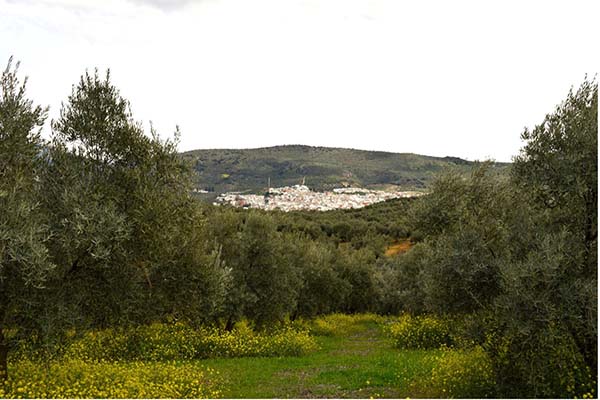
Castillo de Locubín is a traditional pueblo blanco (white village) in the Sierra Sur mountains of Jaén, Andalucía, Spain. In 2022 its population is around 4,500 and some 90% work in agriculture, these days not the subsistence culture of centuries past but mainly olive oil production for sale and export.
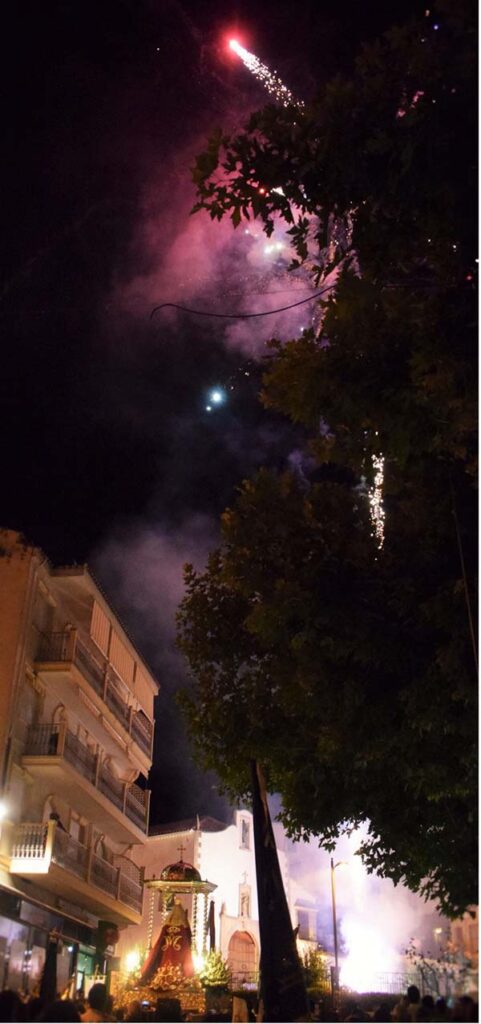
he village, usually referred to as Castillo or just El Pueblo, has a strong Catholic identity. As we’ll remark, this is nevertheless not straightforward, neither historically nor in the contemporary sense. We’ll focus on the 2022 Semana Santa (Holy Week) celebrations and develop the discussion from there.
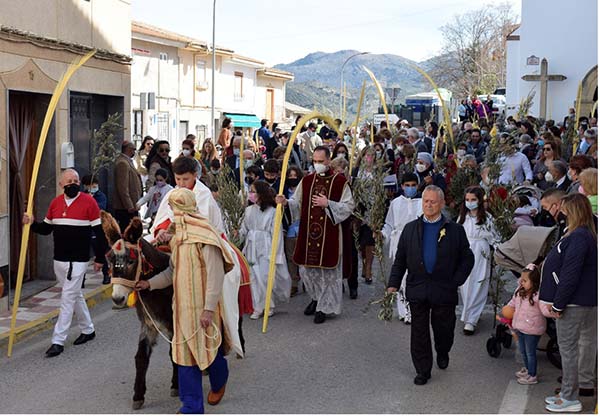
Semana Santa begins with Domingo de Ramos, an evocation of Palm Sunday that can’t strictly be called a procession since no sacred image is involved. Instead, villagers follow a child mounted on a donkey through the streets. As well as the story of the entry into Jerusalem, the event calls up Castillo’s agricultural past and present: until late into the last century most villagers (Castilleros) farmed with animals who lived in the upstairs parts of their houses, and, as you’ll see next, the palms are sometimes substituted by olive branches.
For other nearby towns, Domingo de Ramos begins a series of daily or nightly rituals that continue through the week, but not in Castillo’s case. Because most of its sacred images were destroyed at the outbreak of the Spanish Civil War in 1936, their associated processions vanishing with them, Castillo’s Semana Santa doesn’t pick up again until midnight on Viernes Santo (Good Friday; that’s to say, 00.00 on Good Friday itself).
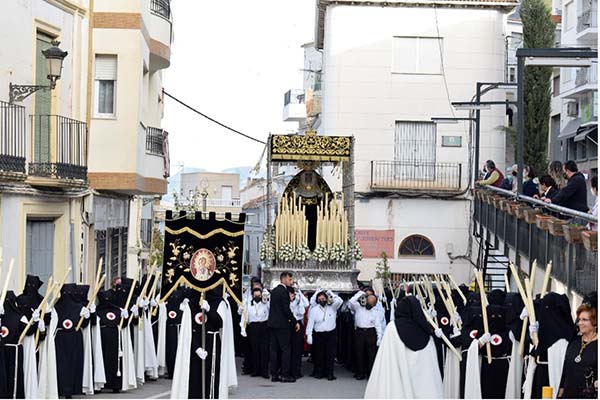
Castillo’s midnight Vía Crucis procession defies easy description. You could see it as blending austere mysticism, Biblical narrative, and street theatre (but more about that suggestion later). By torchlight, an image of Cristo del Perdón, Christ crucified, is processed through the streets to the sounds of a solitary drumbeat and chains rattling, with pauses to read each station of the cross.
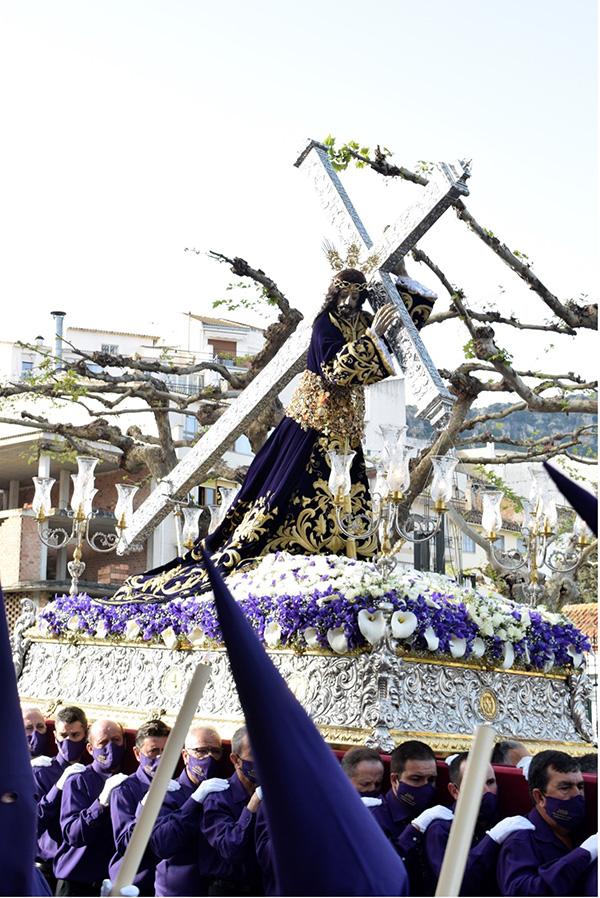
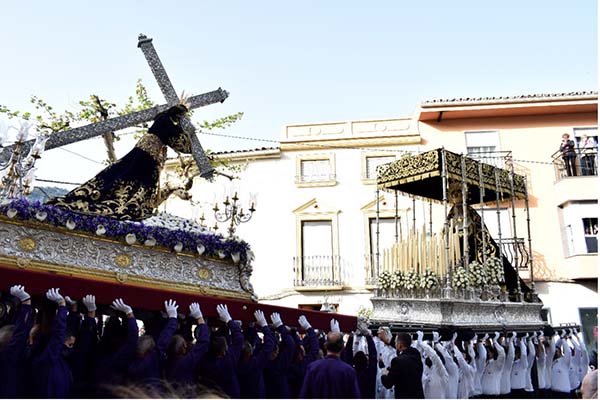
Later in the morning of Viernes Santo come two processions that combine to create an encuentro(meeting) between Jesus and Mary. The image of Jesus is Nuestro Padre Jesús Nazareno (usually shortened to Padre Jesús), that of Mary, La Virgen de los Dolores (the Virgin of Sorrows). These two images attract particularly strong devotion in Castillo, especially Padre Jesús: you could even compare loyalty to Castillo with loyalty to Padre Jesús. Again, more on that in due course, but a mention of the main Padre Jesús myth might help now. Around 1700, the image, an acknowledged masterpiece, was in transit through Castillo on its way to its intended home, the sculptor’s birthplace. The donkey providing the transport died, and this was taken as a sign from God that Padre Jesús should stay in Castillo for good; the Ermita (shrine, small church) in which he has since been housed was built on the spot. Padre Jesús is a depiction of Christ on Calvary at deepest resignation and despair; the encuentrore-creates his meeting with his mother.
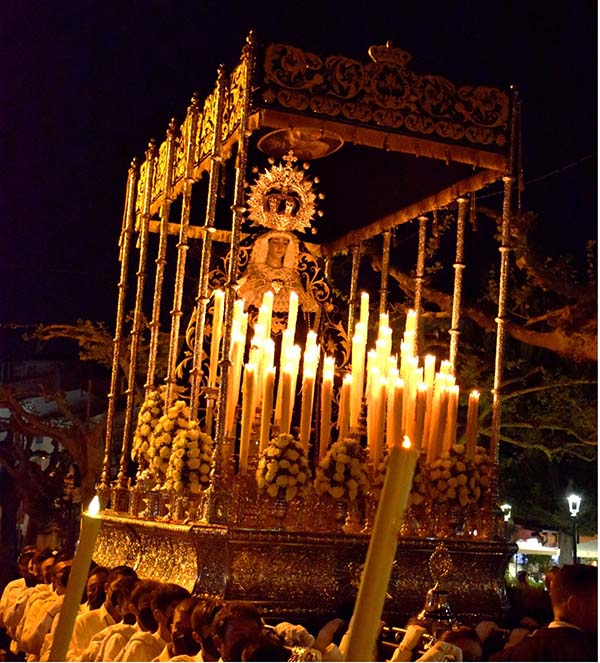
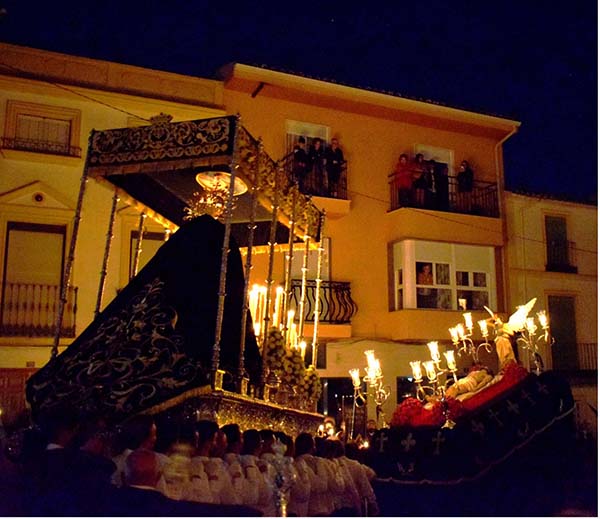
On the night of Viernes Santo, a second pair of processions creates a second encuentro, this time between Santo Entierro (Christ taken down from the cross) and the Virgin of Sorrows.
That this encuentro is the climax of Castillo’s Semana Santa can seem strange, but only to outsiders. Theologically, the resurrection would be expected to take centre stage. But Castillo’s Cristo Resucitado (Christ resurrected), is a recent image that has not built up a devotion comparable to those of Padre Jesús or the Virgin of Sorrows, and the Domingo de Resurrección (Easter Sunday) procession has been muted in the memories of most. This year attempts were made to create a fuller Domingo de Resurrección celebration, by creating an encuentro between Cristo Resucitado and La Virgen de la Cabeza. The image of La Virgen de la Cabeza commemorates an appearance of the Virgin Mary to a shepherd on the side of a head-shaped hill in nearby Andújar in the thirteenth century, so also attracts strong devotion in the locality. However, you might note in the next picture the smaller dimensions and simpler working of the images, as well as the reduced atmospheric intensity and, indeed, turnout.
In fact, theology stays in the background. There’s little discussion of the meaning of the rituals, questions about it surprise people, but that’s not to say there’s little meaning. It appears mediated more through the beauty of the images and the ritual choreography, music also playing an important role in ways that my photos can’t show. Visit https://www.youtube.com/watch?v=c9oASrnUEHs to hear how traditional band and flamenco styles create different accents at different stages of Castillo’s Semana Santa.
Social media is an increasingly used resource, in various ways. Emigration from Castillo means a diaspora whose members engage with Semana Santa via Facebook, where one group is solely dedicated to its imagery. A post on another Facebook page, El Pueblo es Tranquillo, concerning the 2022 Vía Crucis procession generated an intense discussion by comment and reply. Did Castillo’s various images of Jesus refer to the same reality? For believers, yes: but on another view, as a symbol of popular local religiosity, Padre Jesús is a singular figure whom all can understand and respect. Similarly, Semana Santa is a mixture of elements with something for everyone, even if just as spectacle or affirmation of the community (atheists and agnostics can be found in Castillo, though not non-Christian faith; and aspects of the history of the Catholic Church in the village are painful).
Digging deeper and more speculatively, there’s evidence that considerable numbers of Castillerosare descended from the once-Muslim population. Aspects of its culture linger, some visibly, such as the Arab irrigation system, and the remains of the fort that tower above the plain it continues to water: if you’ve visited Granada, 37 miles south of Castillo, this may sound familiar. It’s known that Sufism was influential in medieval Andalucía. Look back at the photo of the Padre Jesús procession and the purple capirotes (pointed hats) worn by some participants. They’re known as symbols of penitence, and related to the Spanish Inquisition, as those arrested were made to wear them. This is probably enough explanation for present purposes, but a visit to the tomb of Rumi in Konya, Turkey made me wonder – his own tombstone hat sits on it, and they are worn by dervishes of his order as reminders of mortality. In Spain, they don’t appear on Easter Sunday.
In summary, religion in Castillo de Locubín should usefully be seen in a worldview perspective. It helps to:
Look at the historical context.
Consider local traditions. The version of ‘Catholicism’ might not be recognisable elsewhere.
Hesitate to expect that only those identifying as Catholic join with thetraditions, or that the traditions only contain Catholic elements.
Think about emerging forms of tradition, especially digital.
Look for the lived elements. An over-emphasis on theology, or doctrine, may not be appropriate.
Think about how these lived elements add up: the aesthetic, ritual, social and ethical dimensions all connect.
In other places or cases, it might not be these elements that figure most powerfully. And, of course, you may not be considering a majority Catholic situation. However, related to the points above, here are some general questions to consider, that apply whenever you approach localised religion in a worldview perspective, whether in planning teaching or in teaching.
How has local history, tradition or custom influenced what can be seen now?
Are these religious expressions distinctive to the locality, even if related to a wider tradition? In what ways?
How do people from outside the tradition but from within the locality relate to these expressions? And is there evidence of inclusion of elements from outside the main tradition?
How have social media or other digital resources developed the local religious expressions, or how people can participate in them?
What are the main lived elements of the local religious expressions? How, for example, do artistic, ritual, community, ethical or other elements figure, and how do they relate to one another?
A discussion between colleagues in a planning or INSET session might not cover all these questions, but even one or two of them would generate a good analysis. Similarly with classroom teaching: any of the questions provides a good enquiry basis.
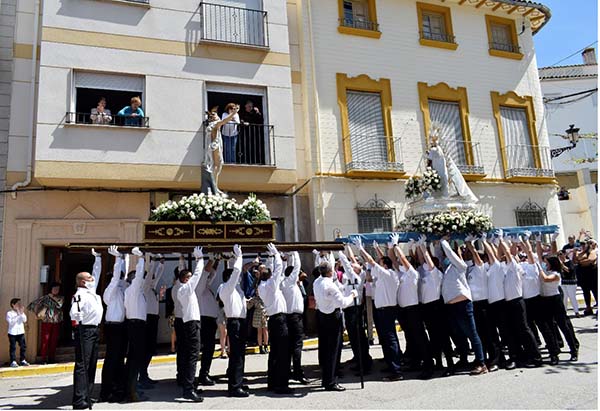
You may be travelling this summer. I hope you have opportunities to experience and take photos of local celebrations, talk to people about their history and significance, and listen to stories about them. If you’re in Spain on the 15th of August, look out for celebrations of El Dia de la Virgen (the feast of the assumption of the Virgin Mary into Heaven); we’ll close with a picture of Castillo’s 2017 Dia de la Virgen procession.
A note on methodology
I’ve been visiting Castillo de Locubín regularly since 2012 and lived there from 2015 to 2018. Though I’ve never thought of this in terms of a formal research project, several of my interactions with Castillo and its people have taken on research-like aspects. These include photography collection, participant observation during processions and other events, interviews with participants, reading, and discussions with researchers including local historians and a US-based anthropologist who completed a doctoral study on Castillo in the 1970s.