Global terms: Jewish

RE-searchers Approach

A team from Exeter University and the Learning Institute has developed a new approach to Religious Education in Primary Schools. It is called ‘the RE-searchers approach’. It encourages pupils to think about the significance and effectiveness of different methodologies and methods of enquiry in Religious Education. To make these accessible to young children, they have personified some of them as cartoon characters. Individually these characters are called Debate-it-all Derek, Ask-it-all Ava, Have-a-go Hugo, and See-the-story Suzie, but collectively they’re known as the ‘RE-searchers’. Each character holds different assumptions about religion(s) and advocates different research methods (e.g. questioning and arguing, interviewing and empathizing, participating and experiencing, and narrating and exploring interpretations). Once acquainted with our characters and their respective characteristics as researchers, pupils can undertake learning activities associated with each of them in pursuit of different understandings of religion(s).

Resource of the month: Practical introduction to hermeneutics

February 2022

You might have heard the dreaded ‘H’ word: hermeneutics. What is it? This month we present a practical introduction to hermeneutics in the classroom by adviser Jen Jenkins. In a series of Powerpoints Jen sets out the aim of hermeneutics and the great benefits it can offer for learning. These PPTs would be great for a staff or department meeting, CPD for your local network, or just for your own understanding. Stuffed with clear explanations, practical ideas and resources, find out how hermeneutics can enhance your teaching and develop your pupils’ understanding.

Jen has voiced the PPT slides, click on the grey ‘speaker’ button on each slide to hear her explanations.

Judaism and G-d – David Hampshire

The nub of the problem

If you look at books on Judaism you’ll find very little about G-d. This seems to be quite odd from a non-Jewish perspective. Christians have whole books about God: from the nature of the Trinity to the nature of the incarnation and God’s relationship to humanity in Jesus. Not so for Jews. In fact the flourishing of writings about G-d from a Jewish perspective occur in two specific contexts. Firstly, though, why so little about G-d? Judaism tends to focus on the covenants that G-d established with Abraham, Isaac, Jacob and Moses. These covenants, especially the covenant at Sinai with the people of Israel, focus on G-d’s promises and Israel’s responsibilities in fulfilling the covenant. Hence, Jews tend to focus on what they should do to fulfil the covenant as opposed to speculating about the nature of G-d.

All Jewish thinking about G-d starts in the Torah, the first five books of the Hebrew Bible. The Torah is more significant than the Prophets or the Writings as a source for Jewish understanding about G-d. Anybody who has read the Hebrew Bible, though, will realise that it does not present a systematic view about the nature of G-d. On the contrary the picture of G-d is quite confusing. This is because the Hebrew Bible was compiled over a period of five hundred years with some traditions going back over a thousand years.

So what can be said about G-d from the Hebrew Bible? Well, there is only one G-d who is the creator of the universe, our world and us. This G-d enters into relationship with human beings and has expectations of us. These are universal expectations, the Noahide Code. G-d also chooses a nation to be a witness to G-d in the world, this is Am Israel (the People Israel) they do this by fulfilling the commandments in the Torah. G-d also appears tender and loving and at the same time jealous and vindictive. Jews lived with this tension until challenged by Greek thinkers and later by Christians and Muslims.

Two contexts for Jewish theology

As stated above there are two contexts in which Jewish thinking about G-d has developed. The first context is when Jews have been challenged to explain their beliefs about G-d to others. The second context is when Jews have faced persecution; often these contexts have coincided. The first real Jewish thinker who tries to make sense of G-d to others, Jews and non-Jews, is Philo of Alexandria (c20 BCE to 40 CE). Philo tries to defend the Jewish Scriptures to the Greek world, the world of Socrates, Plato and Aristotle. Philo sees G-d as the One who ‘speaks’ and it is through the Word that the world is created. For G-d to speak G-d must have a mind and the world, and us, reflect something of that mind of G-d. Philo sees G-d as transcendent and has having two supreme powers: goodness and authority. As we are made in the image and likeness of G-d we too share these powers.

Other notable Jewish theologians are Maimonides (1135 – 1204 CE) and Nachmanides (1194 – 1270 CE). They became Jewish theologians because they had to defend Judaism in light of their encounter with Christianity and Islam. The most famous philosophical work of Maimonides is the Guide for the Perplexed. The Guide attempts to present Judaism according to a rationalist model and in it Maimonides develops what is sometimes called a negative theology. Such a theology states that G-d is so different from what we are that what we can say about G-d is extremely limited. In fact it is easier to say what G-d isn’t (negative). But Maimonides does say some things about G-d in his Thirteen Principles of Faith in his commentary on the Mishnah Sanhedrin:

  • G-d exists and our existence is dependent on G-d
  • G-d is ONE and is indivisible
  • G-d is pure spirit and has no body
  • G-d is eternal – without beginning or end
  • G-d reveals the Self
  • G-d knows what we think and do
  • G-d judges our actions and will reward and punish them
  • G-d has the power to resurrect the dead

In many Jewish prayer books (Siddurim) these Thirteen Principles are included in full and they have been turned into a hymn often sung on Shabbat (Yigdal).

Perhaps the most infamous Jewish theologian was Baruch Spinoza (1632 – 1677 CE) who tried to re-think Jewish ideas about G-d in terms of the emerging Enlightenment. In the end he was expelled from the Jewish community where he lived because he seemed to suggest that G-d is the world’s soul, making him a pantheist or panentheist. More worryingly he argued that Good and Evil have no real meaning.

Perhaps the greatest and most neglected Jewish theologian was Bahya ben Joseph ibn Pakuda (c1000 CE), his great work The Book of Direction to the Duties of the Heart deserves reading and rereading and gives one of the best systematic presentations of theology in action of any Jewish writer.

The second context for Jewish thinking about G-d is persecution. This might at first appear odd but it makes sense in terms of the Jewish belief that the Jews are G-d’s chosen people. If the Jews are G-d’s chosen people and are faithful to the covenant by keeping the commandments why do they face persecution? The response to this is Jewish mysticism, often referred to as Kabbalah. It is impossible to underestimate the influence of the Kabbalah on Jewish thinking and practice but its most important contribution has been to Jewish thinking about G-d.

The Kabbalah isn’t one single set of ideas or school of thought but it develops in response to the lived experience of Jews. It has its roots in the apocalyptic writings in the Hebrew Bible, such as Daniel – who is not a prophet in the Jewish Biblical tradition. As such the Kabbalah is a dynamic mix of the Biblical and Rabbinic tradition with Neo-Platonism. This works out in a number of ways. Firstly, G-d’s creation is perfect and is possible because G-d contracts (tzimtzum) the Self to enable the universe to exist. A cosmic accident occurs which causes our world to emerge, a world of mixed spirit and matter. G-d gives us the Torah so we can start to piece our world back together. By keeping the commandments we bring G-d into the world and the cosmic accident is repaired. We will know it is repaired when the Messiah comes and the world is perfected. Hence, our actions have cosmic consequences and therefore if we are faithful in keeping the commandments our lives have meaning and purpose, even in persecution. Perhaps the most important Kabbalistic thinker was Isaac Luria (1534 – 1572 CE) and his work has been developed in the Chassidic tradition by Shneur Zalman of Liadi (1745 – 1812) the Baal HaTanya, among others.

One way that this has developed Jewish thinking about G-d results in the reflection on the destruction of the Temple in Jerusalem. A Kabbalistic teaching is that when the Temple was destroyed the Tiferet (Glory m.) of G-d was separated from the Shekhinah (Presence f.) of G-d. Now the Shekhinah wanders the earth with the lost as one of the lost. The only time this isn’t true is when the candles are lit in the home on a Friday evening and the glory of G-d is apparent to all. In this act of divine copulation souls flood the world and as a result righteous souls are born when a husband and wife are united.

So what does this tell us about G-d? Firstly, G-d is One but contains both male and female aspects. If humans are made in the image and likeness of G-d we are only fully human when we are united as male and female. Secondly, there is virtually nothing about any opposition to G-d. Whilst Satan is mentioned in Jewish sources Satan is not the source of evil. It is G-d who is the origin of all and ‘all’ includes evil. The Kabbalistic tradition refers to this as the Sitra Achra – literally the ‘other side’ of G-d.

Jewish thinking about G-d was further challenged by the Holocaust and provoked much debate about where G-d was in the camps. Writers of note have been Eliezer Berkovitz, Milton Steinberg and Irving Greenberg amongst others.

So what?

If you’ve followed the argument so far you might feel more confused than when you started. This confusion might arise out of thinking that Jews haven’t really done any thinking about G-d since the Bible. In reality Jews have only really had to develop their thinking about G-d when they’ve been challenged by others to do so or by their experience. So what can be said? Here are some pointers:

  1. G-d is not definable, we can use human language but it will always be limited.
  2. The Biblical tradition, supported by the Rabbinic tradition, uses language about G-d which is contradictory because G-d cannot be rationalised by human thought but G-d created all that is whilst remaining uncreated.
  3. G-d is transcendent, totally other, and eternal. Everything that exists exists only to the extent that G-d exists. We are contingent beings and our meaning is dependent on G-d.
  4. G-d is immanent, open to us as One who desires to enter into covenant but that implies responsibility on both parts.
  5. We can’t always make sense of G-d or our world or our experience.

In the end Jews will probably never develop a theology to compare with Christianity or Islam because they are much more concerned on how to live a life in faith with the G-d of Abraham, Isaac and Jacob, my G-d and the G-d of my fathers.

Note: Many Jews substitute the English word ‘God’ as ‘G-d’ in order to avoid any disrespect. A document containing the holiest Name should not be destroyed, so a potential difficulty can be avoided if the name of God is not used. For other Jews this is not so important, particularly if God’s Hebrew name is not being used.

Seven videos of good learning in RE, produced by NATRE. Taken from the DVD Good Learning in Religious Education: Seven Short Films to Make Teachers Think.

The following videos are provided by NATRE, Good Learning in Religious Education: Seven short films to makes teachers think.  The films were sponsored by Culham St Gabriel’s and the Diocese of St Albans and are available to watch on NATRE’s website. There is one sample film below and the rest can be found on the NATRE website or here.


Enquiring into Worship with 7-9 Year Olds

Concepts of God and the Ultimate

In 2015 we commissioned a group of writers to produce articles on the concept of God and the Ultimate from a variety of different belief traditions: Buddhist, Christian, Hindu, Humanist, Muslim, Jewish and Sikhi. You can find links to each of them below.

Ultimate reality, God and gods in Buddhism – Denise Cush

Summary explaining that Buddhism does not centre on a creator God but on awakening to ultimate reality through the Dharma; seen as truth, nirvana, emptiness, mind‑only or Buddha‑nature depending on the tradition.

Christianity and God – Jane Brooke

Christian concepts of God and ultimate reality, providing insights and teaching ideas for Religious Education lessons.

The Hindu Concept of God – Jim Robinson

Summary explaining how Hindu traditions understand the divine as both one ultimate reality (Brahman) and many deities who express its different qualities, allowing diverse ways of relating to and realising the sacred.

Humanism, Ultimate Reality, God and Gods – Sara Passmore

How humanists understand ultimate reality—rejecting supernatural gods, grounding meaning and morality in human experience, and turning to science and reason to explain the natural world.

Islam and God – Aliya Azam

Summary explaining Islamic beliefs about God as absolutely one, unique and indivisible, transcendent and beyond human comprehension, with any association of partners rejected as shirk.

Judaism and G-d – David Hampshire

Summary explaining how Jewish thought focuses less on defining God’s essence and more on covenant, scripture and lived responsibility.

The nature of God in Sikhi – Ranvir Singh

Summary of Sikh belief in one formless, timeless and all‑pervading God, known through the Guru and realised by remembering the divine Name.

Christianity and God – Jane Brooke

For both Judaism and Christianity the basis for the concept of God is monotheism (one God). Abraham, one of the patriarchs, questioned the existence of many gods such as a moon or sun god and determined that there was only one. One of the meanings behind the creation accounts in Genesis is that there is only one creator God to be worshipped.

The God of the Old Testament is a God who is spoken of as the creator, the sustainer and the redeemer of the world. God permits all things and is revealed through people such as Moses and the prophets. God wants to form a covenant (two-way promise) with humanity and is seen as active and present in the world as demonstrated when Moses speaks to a voice from the burning bush (Exodus Chapter 3). The voice gives the name ‘I am..’ , an active verb rather than a noun.

God in the New Testament relates more intimately to people in the form of Jesus. God is incarnate in the world, revealed in the world and redeems humanity through the man Jesus. The old covenants are replaced by the new covenant which Jesus makes at the last supper.

The Council of Chalcedon was a turning point in stating explicitly the church’s understanding of the nature of God and of Jesus Christ. It was held from October 8 to November 1, AD 451, at Chalcedon in Asia Minor. It marked the separation of the Eastern and Western Church with the western church accepting the ‘Chalcedonian Definition’ which stated that Christ has two natures: both divine and human.

Some of the characteristics of the Christian God may be seen as:

  1. God as creator. God’s word brings order out of chaos into the world. God is living and working in and through every aspect of the world as well as continually creating (immanent).
  2. God as an omniscient (all knowing) being. Some Christians consider God knows everything whilst others would say that although God works in and through the world, God does not know the future.
  3. God as love. God’s love is demonstrated in the crucifixion of Jesus which embodies a self giving, sacrificial love. This love is not just passion but includes ethical commitment and justice.
  4. God as holy. The Lord’s prayer speaks of the intimacy of a father (Abba) and the holiness of God: ‘Our father which art in heaven, hallowed be thy name’.

The Council of Nicea in 325 (from which came the Nicene Creed), based around the Trinity, helped Christians to understand the nature of God in three parts: the Trinity. God is understood as God the Father, God the Son and God the Holy Spirit. St Patrick famously used a shamrock as a visual aid to explain how uniting all three aspects constitute the one God.

Christians understand God relationally and communication through prayer centres around the living presence of God.

God is understood as:

  1. a creator God with the closeness of a father.
  2. a son where Jesus’ love is shown in his living and dying upon the cross.
  3. the holy spirit which is an unseen but strongly felt presence within people directing and challenging decisions and actions.

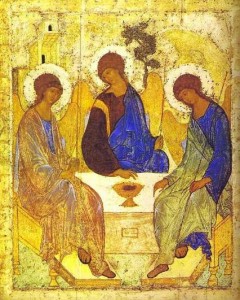
Rublev’s icon of the three visitors to Abraham, painted in the fifteenth century shows a graceful representation of the Trinity where all three elements incline to each other whilst keeping their own identity. God the Father on the left leans towards God the Son in the centre and God the Holy Spirit leans towards them both. They are seated around a table holding a wafer and a chalice representing the death of Jesus and holy communion. The icon leaves a space for the onlooker inviting them to be seated and to eat the meal. Christians understand themselves as entering into a relationship with the Trinity through worship and prayer.

Christians pray daily in a personal and intimate way to God as Abba: the conversation is two way as they wait on God to reply. Christians seek the love that has been revealed in the death of Jesus knowing that regardless of their mistakes, God’s love is sufficiently gracious and great to forgive them. Rublev’s icon shows how Christians understand, relate and love the triune God in a personal way.

St Augustine speaks of an innate longing to eat at the table and to be in the presence of God: it is only when Christians have searched and found such presence, that they find peace.

You have made us for yourself, O Lord, and our heart is restless until it rests in you’ (Augustine).

Main source: Mills, Watson E. (General Editor) 1998. The Lutterworth Dictionary of the Bible. Lutterworth Press, especially the William Hendricks article on God.

Resource Spotlight: Watch and Learn: BBC and the Educational Recording Agency

December 2024

Where do you go to find programmes suitable for showing lived religion and belief to your pupils?

As you sample the programmes below you might like to consider

  • Who might these programmes be useful to support teacher subject knowledge?
  • Where might snippets of these programmes exemplify the concepts and understanding we are teaching?

BBC

There is some interesting programming coming up on BBC radio and TV next year, but what did you miss in 2024? Look on iPlayer- lifestyle and page down to Faith and Hope to find Sacred wonders, Big Zuu goes to Mecca and much more. For those of you teaching younger pupils also look at Treasure Champs which has stories you may share in lessons.

If you would like to read a little more from Daisy Scalchi, Head of Religion and Ethics at the BBC, read this professional reflection piece, Religion, the most important subject on the curriculum?

The Educational Recording Agency (ERA)

The Educational Recording Agency (ERA) offers you free access to a wide range of high-quality, ad-free video content to support your lessons on religion, faith, and ethics. Their curated resources align with the RE curriculum and are available for instant streaming in your classroom, including:

These programmes provide engaging, real-life examples of how religion shapes individual lives and societies, making them excellent tools to bring classroom discussions to life. Search Religious Education and the age group you teach to see all the programmes available. Alternatively click on the links below for some curated resources.

Primary religious education

Secondary religious education

Resource Spotlight: Abrahamic Commentary to support the teaching of RSE

To continue our theme of ‘ways of knowing’ we bring you something new this month- an Abrahamic Commentary to support the teaching of RSE (Relationships and Sex Education). Aliya Azam has kindly shared this commentary for RSE teachers, or anyone who would find it useful in the classroom.

Aliya was interested to explore how teachers in faith schools could address some of the issues raised in the RSE curriculum. She found a great many people also considering this question, and this commentary is the end result. Although RSE is not part of the Religion and Worldviews curriculum, Aliya’s research speaks to a wider context of health, society, community and identity. Read more about Aliya’s findings in this field in her blog.

The Shema in Jewish traditions

Origins

The Shema may be seen as the beginning and end of Judaism. It is a Jewish prayer extracted from three places from the Torah and composed into a sequence of paragraphs. It does not appear in its entirety at the beginning of the Torah, rather it is found in Deuteronomy 6.4-9; 11.13-21 and Numbers 15.37-41. The Shema derives its name from the Hebrew word sema, meaning ‘to hear’, which is the initial word of the first verse, which states, ‘Hear O Israel’. Thereby, instructing Jews to listen. It is believed that they were received by Moses on Mount Sinai.

Significance

The Shema is included as part of every weekday synagogue service. Its significance is inferred by the fact that its centrality is recognised in all Jewish traditions, in various ways. The recitation of the passage is taken as a commandment to be fulfilled by Jewish adult men twice daily, morning and evening. It is also a core text in other prayer books.

The Shema is taught for the love of God, loyalty to the Jewish tradition and it encourages the Jewish community to study the Torah. It is reported that Jacob’s sons read it to him and therefore adults recite it to children so that they remain within their tradition. The Shema might be the first thing that some Jewish children learn in a Jewish primary schools and at home to express belonging.

Meaning

The Shema sets out what Jews believe and how they should demonstrate their dedication to God through daily actions.

It represents their belief that they have made a Covenant with God: an agreement that they will love God and follow His laws and in return God will take care of them. Thus, as an artefact, the Shema is a way for Jewish people to remind themselves of their promises to God. This is why families have a responsibility to teach their faith to the next generation.

Practice

Unsurprisingly, the Shema has acquired a pivotal position in the collective and personal life of Jewish communities. Communally, adults recite it in the morning and evening and in the afternoon at the synagogue to fulfil the commandment and remember God.

 Individually, some Jews recite it before bed and after waking up, as it is the most holy thing to say during these times. It is also a way of thanking God for waking them up from sleep and to ask God for good sleep. Thus, it is a prayer which covers all activities of the day and night.

As a family, in some homes, mothers regularly recite the Shema with their children whilst putting them to bed. Some children memorise it and others prefer to look at the text when reciting it.

At happy events, such as moving into a new home, the mezuzah, which contains the Shema, is fixed to the doorpost and is followed by a religious service.

During festival days and especially on Shabbat, a double reading honours the Shema: at the time the Torah scroll is bought out from the Ark the opening verse of the Shema is recited collectively, and again, individually by the reader prior to reading the Torah.

There are some physical gestures adopted by Jews during various prayers and worship. On the Day of Atonement whilst reciting the opening verse of the Shema, the eyes are covered to remove distractions.

As death approaches, those gathered recite some passages from the Torah and end with the opening words of the Shema. In this way the dying person is helped to affirm their faith in the oneness of God. It is worth noting that the Shema may be recited in Hebrew and in other languages too.

Structure

The Shema has three paragraphs. The English translation is provided with an explanation of what it might mean to some Jews, how they might put it into practice and what they could learn from it.

Hear O Israel, the Lord is our God, the Lord is One (Deuteronomy, 6.4)

From this, Jews learn to be attentive to the Torah so that God’s commands are with them. It also means their religion is monotheistic. Moreover, a closer examination reveals God as addressing Israel rather than Israel addressing God, thus Jews make claims of a reciprocal relationship because God chose them, and consequently, they believe God cannot ignore them.

Blessed is His name, whose glorious kingdom is forever and ever

This phrase does not appear in the Torah and is attributed to Jacob. Since he had whispered it, Jews whisper it as well. It tells the Jewish community to praise God. They know, through this, that God’s kingdom is everlasting. They recognise the holiness and greatness of God. It gives them hope too.

Love the Lord your God with all your heart, and all your soul, and all your might (Deuteronomy, 6.5)

The demand from God is unequivocal in this phrase: total obedience and wholehearted devotion and to remember God’s word. It implies that Jews be prepared to sacrifice everything. They are to love God with their might, heart and soul. God loves them; therefore, they too should have unflinching love for Him.

These words that I command you today shall be upon your heart (Deuteronomy, 6.6)

Jews learn to affirm these as laws and learn them orally. But there is also an emotional attachment. The heart is mentioned so that it can act as a guide following the dictum ‘in doing right follow your heart’, and in the heart should be the Torah.

Repeat them to your children, and talk about them when you sit in your home, and when you walk in the street; when you lie down, and when you rise up (Deuteronomy, 6.7)

This phrase gives adults the responsibility to pass on their faith to children, and this can take place in formal and informal settings. The key message is to keep it alive at all times. Literally, it means Jews should recite it every evening and morning.

Hold fast to them as a sign upon your hand, and let them be as reminders before your eyes (Deuteronomy, 6.8)

Literally, this means to hold fast onto the Shema and the Torah by wearing the verses on the hand and upon the forehead between the eyes. This is how the practice of wearing phylacteries (tefillin) became established. The tefillin consists of four small joined-up boxes containing the first two passages of the Shema (Deuteronomy, 6.4-9 and Deuteronomy, 11.13-21) and two other Exodus phrases of the Torah. These are handwritten on a parchment and worn on the stronger hand as this is what is used by individuals or on the left arm so that it is directed to the heart. It is a constant visual reminder for Jews that God is there, whatever they do.

Write them on the doorposts of your home and at your gates (Deuteronomy, 6.9)

The final instruction is to handwrite a parchment and fix it to the doorpost of the home and gates. In practice, to preserve the sanctity of the text, a rectangular elongated box with a slight opening, called a mezuzah, is made to house this kosher parchment, which contains the first two of the three paragraphs of the Shema (Deuteronomy, 6.4-9 and Deuteronomy, 11.13-21) and at the back, the word Shaddai (Almighty). The mezuzah is affixed on the right hand doorframe, with a little slant upwards in the direction of the room, at about shoulder height, in individual dwellings and collective compounds. In doing so, most Jews express their obedience, and, when they come into and go out of their homes, they are reminded to renew their covenant daily. The mezuzah is fixed on every door (except the lavatory and bathroom), so the whole house is covered in holiness and purity as a gift of God. Some Jews kiss the mezuzah to show their adherence to the Torah in everything they do, including daily actions like entering and leaving the home.

Mezuzah literally means ‘doorpost’, but over time came to refer to the doorpost and what is attached to it. Interestingly, a sukkah does not need a mezuzah as it is not permanent dwelling.

Deuteronomy 11.13-21

This section is an exhortation to obey, love and serve God alone with everything. In return God promises the Jewish community abundance in material well-being. Should they turn to serve other gods, the anger of God awaits them (Deuteronomy, 11. 13-17).

The next phrases (Deut. 11.18-21) repeat the instructions given above in (Deut. 6-9). Thereafter, God promises that should these be fulfilled then God will keep His promise of the land for them (Deut. 11. 21).

Numbers 15.37-41

This verse establishes the custom of Jews adorning clothes with tzitzit (fringes). Tzitzit are tassels made of several threads tied together to symbolise the numerical value of the name of God. The Shema says that when people look at the tassels they will remember their promise to keep God’s laws. Some Jews follow this rule all the time and wear a vest with tassels on four corners, called a tallit katan. At the synagogue, some also wear a special prayer shawl called a tallit gadol when praying in the morning.

To summarise, the Shema is a prayer in the first instance and a belief statement thereafter. It has a golden principle for the Jewish community in stressing that learning is initiated at home and establishes the duty to educate their children in the faith. The Shema establishes the practice of learning the three paragraphs contained within it, and of wearing the tefillin and affixing the mezuzah. These actions remind Jewish people of the promises made to and by God, their belief about unity of God and the One to be worshipped.

Learning about the Shema in RE

Here are some examples of what primary pupils might be able to do as a result of their learning about the Shema.

They can:

-use the right names for things that are special to Jews, e.g. when shown a picture, say: ‘That is a mezuzah’

-talk about what they find interesting or puzzling, e.g. talk about how interesting it was to hear that Jewish people put a prayer in a small box and fix it to their doorposts

-talk about some things that are similar for different religious people, e.g. say that Muslims, Christians and Jews all says prayers to God

-talk about some things in stories that make people ask questions, e.g. say, ‘It was mysterious when God spoke to Moses’

-describe things that are similar and different for religious people, e.g. record or say how Jews recite the Shema, but that they may say it in different languages

-ask important questions about life and compare their ideas with those of other people, e.g. ask why Jews think the Shemais such an important prayer and give their own ideas about important prayers and wishes

-use the right religious words to describe and compare what practices and experiences may be involved in belonging to different religious groups, e.g., say how different Jewish communities might have different ways of remembering God’s laws – through recitation of the Shema, through wearing of the tallit and tefillin, though doing good deeds and so on

-ask questions about the meaning and purpose of life, and suggest a range of answers which might be given by them as well as members of different religious groups or individuals, e.g. asking questions about the importance of the Shema in Jewish life and suggesting answers that might be given by a Jewish visitor to the classroom, or with reference to answers given in authoritative texts or websites.

Some common discussion questions:

  • What do you think it means when the Shema says: “These words […] shall be upon your heart”?
  • In the Shema, where does it say that Jews should talk about God’s laws?
  • Why do you think the Shema says that Jewish people should repeat the words to their children?
  • What could you use or do to help you to remember promises that you have made?

Further reading

Cohn-Sherbok, D. (2003) Judaism: History, Belief and Practice, London: Routledge.

Hoffman, C. M. (2010) Judaism: An Introduction, London: Hodder Education.

Written by Imran Mogra
Ria Searle | 05 January, 2021

Over the last year, I have had the opportunity to build my department from essentially scratch, shaping our Key Stage 3 (KS3) curriculum in line with my vision for RE. After exhausting the Locally Agreed Syllabus, I went about ascertaining ‘priority’ topics for our pupils. Prior to the re-sequencing a student could complete secondary education spending only one one hour studying Judaism. Exploring Judaism was then my priority. However, I was stuck as to how to do justice to this extremely rich and diverse religion and tradition. Luckily, a PGCE peer came to my aid and allowed me to borrow her Scheme of Work (SOW), from which I drew much inspiration, adapting it to suit our school and pupils.

To promote religious literacy, we begin examining the notion of identity, particularly diverse identities within the Jewish tradition. The ‘Do Now’ starter task invites pupils to note what makes them, them; exploring their own identities. It is really important to start the SOW exploring the multiplicity of identities within the Jewish tradition, because if pupils’ have any knowledge of Judaism prior to the unit, it is overwhelmingly based on overgeneralized, single-lensed stereotypes, often images of Haredi Jews. Many are simply unaware that there are varied identities within Judaism and believe they do not know anyone who is Jewish, which isn’t true; they just didn’t know any Haredi Jews as they believe all Jewish people to be like.

We look at Orthodox, Liberal, and Secular identities and expression in daily and yearly life. I try to stress that Liberal and Orthodox Jews are no less ‘devoted’ or believe any less, but simply express faith differently. This provides a sustained reference point throughout the SOW. While exploring Kosher, Shabbat and Passover we refer back these and how expressions are varied in divergent Jewish tradition communities. For example, with observance of Shabbat, we suggest Orthodox Communities may avoid all work: light switches, cars, and mobile phones. Whereas some Liberal or Reform Jews may observe in adapted, often more modern ways, such as using cars to drive to Synagogue, allowing some electrical appliances (ovens, kettles) or, as one student offered from her own life observing when with Grandparents and using her phone (Instagram!) throughout.

Most effective for religious literacy is drawing on those with personal experience. I was fortunate to have Jewish pupils who offered their worldviews and traditions. This enabled students to connect ideas to varied interpretations and individuals they knew, bringing their learning to life and allowing them to interact positively with various worldviews. In addition, we invited in our local Liberal Rabbi to speak to the whole cohort about her faith, worldview and traditions. This was an incredible experience! It shocked the pupils to learn that, as part of her Liberal Jewish identity, she did not ‘keep kosher’ – for she could not then eat and celebrate with non-Jewish neigbours, and that she had had a scientific career in the traditionally male-dominated field of Chemistry prior to becoming a Rabbi, another traditionally male-dominated vocation. They were full of questions about her experience as a female faith leader: the reaction of Orthodox Jews to her position as Rabbi, her favourite parts of Shabbat – community worship, foods, time to pause and reflect on life, the week, and faith – and her experiences of Anti-Semitism. In particular, her family’s connection to the Holocaust and the inspiring journey of her Grandmother across Europe during the War, including liberation at Mauthausen in 1945 and her return to Prague, where she had fled 6 years prior. These personal experiences held the key to unlocking my pupils’ religious literacy about the multiplicity of Jewish traditions and worldviews, how lived faith was so different to the strict, traditional and ‘textbook’ religion many had expected from a Rabbi and leader in their local Jewish community – shamefully, far greater than I could achieve teaching in the classroom.

I understand this is not possible for all schools in all areas, my hometown wouldn’t have such a luxury of a nearby Liberal Rabbi however there are many websites and services online that would willingly engage in a dialogue, whether it be a prerecorded Q&A session, or even a live virtual meet, as we have all become accustomed to since the start of the pandemic! However, with certainty I say it was by far the best way of promoting religious literacy around the multiplicity of lived Judaism and real-life Jewish worldviews. I would advise starting with the basics – bust the myths, dispel stereotypes and open eyes to the diverse identities within the Jewish tradition, this will allow for more effective personal dialogue further into their learning.

About

Ria is Curriculum coordinator of RE and PSHCE in the London Borough of Hillingdon.

See all posts by Ria Searle