Global terms: Christian

Understanding Christianity is a substantial resource aimed at supporting RE teachers’ work in teaching Christianity.

With funding from Culham St Gabriel’s Trust, Jerusalem Trust and Sir Halley Stewart Trust, the resource has been created by the Church of England Education Office in Partnership with RE Today.

Built on Theological concepts, the project aims to help teachers support pupils in their learning about Christianity.

This resource is a useful part of teaching and learning about religion and belief and should be used alongside other resources focused on the wide range of religions and beliefs relevant to the UK.

To access the resource, go to: www.understandingchristianity.org.uk 

Theologies of Reading – New perspectives on pupil engagement with texts

This resource will:

  • explore this question of how reading relates to questions of truth and meaning
  • equip teachers with an awareness of a range of reading practices
  • invite teachers to consider how these different reading practices, or ‘theologies of reading’ can be applied in the classroom context

A paper by Dr Ruth Jackson Ravenscroft, David Thompson Research Fellow, Sidney Sussex College, University of Cambridge and Dr Kathryn Wright, CEO, Culham St Gabriel’s Trust.

Published January 2020.

Resource Spotlight: Theologies of Reading

November 2021

This month we present a resource by Jen Jenkins, RE Facilitator for Coventry and Warwick, exploring ‘Theologies of Reading’. Jen explains how holy texts are read in a variety of ways in Judaism, Christianity and Islam. You will find the whole resource interesting with practical uses in the classroom.

This is a resource for Primary pupils, but there is much Secondary-age pupils can gain.

Whole resource

Islam Section

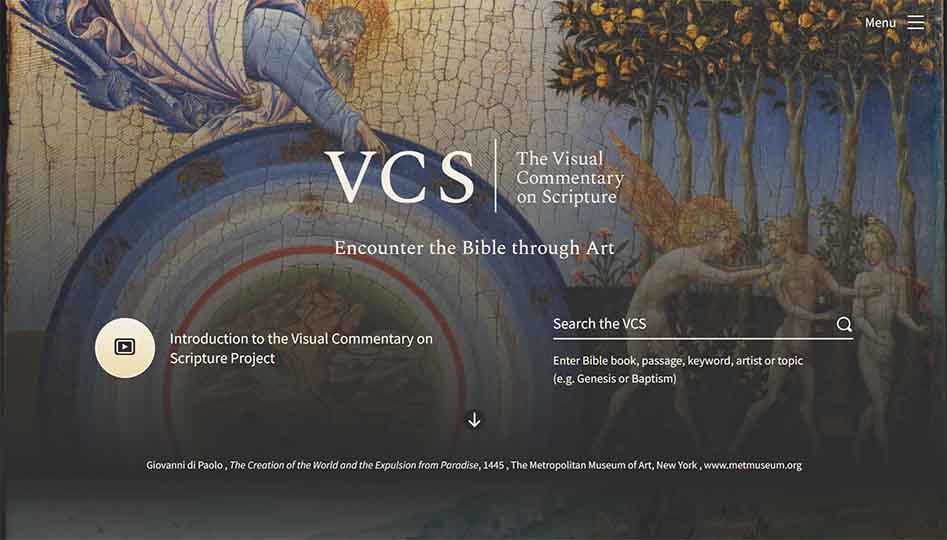
Resource Spotlight: The Visual Commentary on Scripture: (Re)discover the Bible in Conversation with Art

We are delighted to present the Visual Commentary on Scripture (VCS) which explores the Bible in connection with works of art. The resource opens up a wealth of themes, symbolism, history and interpretation. Whatever the age of your pupils this rich and fascinating resource will mean you never see the bible in the same way again.

Read curator Dr Chloë Reddaway’s blog to understand in more detail the potential of this resource

The Visual Commentary on Scripture (VCS) is a freely accessible online publication providing theological commentary on the Bible in dialogue with works of art.

Each section of the VCS is a virtual exhibition comprising a biblical passage, three high-resolution (zoomable) art works, and short commentaries exploring how the scripture and the artworks illuminate each other.

It is a rich, inter-disciplinary resource for teachers and pupils, transforming understanding of the Bible through diverse works of art and a wide range of authorial voices and perspectives.

Use the menu to explore the VCS through ‘themes’, including Creation, Biblical Women, and Miracles, search by Bible book, watch VCS films, or find additional resources such as our Stations of the Cross and spotlight feature on Coptic and Ethiopic art.

https://thevcs.org/


Resource spotlight: The Lived Worldviews of Tower Hamlets

Ruth Marx was awarded a 10th anniversary grant from Culham St Gabriel’s to research and create resources into core- Religion and Worldviews for Key Stage 5. This suite of resources is the result of this research and explores the worldviews of 13 individuals who live or work in Tower Hamlets interviewed about their worldviews. The worldviews discussed are from a range of religious and non-religious traditions and the interviewees are expressing their own opinions and not representing any organisation as a whole. Each video is accompanied by an editable power point with activities to embed and extend the learning and an overview document shows the worldview(s), themes discussed and cross curricular links which can be explored with this resource. Whilst created with core 16-19 Religion and Worldviews in mind these resources may be of use for younger age groups and for teacher CPD.

  • Could you create a suite of resources like this for your area?
  • Could you share one of these resources and compare it to a case study of a person in your area?
  • Do let us know how you use these resources?

All the resources are available in The Lived Worldviews of Tower Hamlets Padlet

A taster video is available below:

Parables and Hermeneutics an introduction

Jesus’ parables reveal the range of different approaches to interpretation, or hermeneutical method. Compare historical and reader response approaches. From an historical perspective we can always try to put the parable in the context, the situation of the time. Some parables open up a narrative world, and invite a response from the reader. Which is correct? Will they lead to a ‘right’ interpretation?

Dodd’s definition of a parable is “At its simplest the parable is a metaphor or simile drawn from nature or common life, arresting the hearer by its vividness or strangeness, and leaving the mind in sufficient doubt about its precise application to provoke it into active thought.” This is often summarised as a story with a hidden meaning, but actually key active elements here are doubt and active thought. They stimulate engagement. This is a little different from suggesting that there is a single hidden meaning that can be explained easier and definitively. They are metaphors, rather than simply analogies as they are person-centred. They are vivid, drawn from everyday life. So they are about just and unjust managers, they are focussed on agriculture, or some other aspect of culture or working life. Other scholars suggest some parables contain self-evident truths, rather than the uncertain doubts to which Dodd refers.

Anthony Thiselton (Hermeneutics, An introduction, 2009, Eerdmans, Cambridge) thinks both views are a little right, and both are a little wrong. Parables have quite different patterns and are not easily analysed or simplified by these definitions. He argues, “A parable proper catches a listener off guard. It wounds from behind. How did the prophet Nathan approach King David when God told him to expose his adultery with Bathsheba? He could simply have confronted him, but confrontation is seldom wise with Oriental kings, even an Israelite king. He told him a story… The parable draws the listener into a narrative world, and gently the application places him under attack.”

Thiselton considers the different approaches including existential, historical, rhetorical and post-modern.

There are existential readings of parables. For example, in the parable of the labourers in the vineyard (Matthew 20:1-16) every worker receives an agreed upon wage. Some object feeling that justice is more important than grace, and the latecomers should not get as much as those who truly worked all day long. In tragic parables, such as the parable of the foolish maidens, the maidens presumptuously believed their wellbeing was guaranteed, that someone else would look after them and they were deceived because for a long time nothing happened.

The historical approach is concerned to establish whether the parable is authentically Jesus’ words, whether it is based on the life of Jesus or the life of the early Church, whether it relates to general truths or specific situations. Many parables are concerned with the Kingdom, a central element of Jesus teaching. Some parables cannot be understood unless groups such as Pharisees, or tax collectors are understood in their historical setting. It may be argued that if we understand these elements, we are more likely to have a better grasp of the meaning.

A third approach is rhetorical and literary criticism. This focuses on the literary style, rather than historical or theological. Here patterns of language and form are sought out in the text. As dynamic and potent words they invite a reader response. They can lead to a modification of the tradition. In some parables there is a profound reversal, such as the unforgiving servant. And so in reading parables reversals or unexpected turns should be a feature of how they are understood.

More post-modern approaches are drawn from the work of Paul Ricoeur and others. Ricoeur sees the world of the active agent, and the self as a narrative world. Readers therefore are participants, active agents and not simply spectators. Dialogue with the parables and the text is what is necessary.

Do parables have a correct interpretation? For some the answer is a clear ‘yes’, while other approaches suggest this is not the case. Can one interpretative approach be taken over the others? Or from the other approach, is it possible to mix post-modern or reader responses with historical approaches? Consider these questions with the parables you are studying and identify how different interpretations may be drawn from these and other distinctive hermeneutics.


Resource of the month: Practical introduction to hermeneutics

February 2022

You might have heard the dreaded ‘H’ word: hermeneutics. What is it? This month we present a practical introduction to hermeneutics in the classroom by adviser Jen Jenkins. In a series of Powerpoints Jen sets out the aim of hermeneutics and the great benefits it can offer for learning. These PPTs would be great for a staff or department meeting, CPD for your local network, or just for your own understanding. Stuffed with clear explanations, practical ideas and resources, find out how hermeneutics can enhance your teaching and develop your pupils’ understanding.

Jen has voiced the PPT slides, click on the grey ‘speaker’ button on each slide to hear her explanations.

RE-searchers Approach

A team from Exeter University and the Learning Institute has developed a new approach to Religious Education in Primary Schools. It is called ‘the RE-searchers approach’. It encourages pupils to think about the significance and effectiveness of different methodologies and methods of enquiry in Religious Education. To make these accessible to young children, they have personified some of them as cartoon characters. Individually these characters are called Debate-it-all Derek, Ask-it-all Ava, Have-a-go Hugo, and See-the-story Suzie, but collectively they’re known as the ‘RE-searchers’. Each character holds different assumptions about religion(s) and advocates different research methods (e.g. questioning and arguing, interviewing and empathizing, participating and experiencing, and narrating and exploring interpretations). Once acquainted with our characters and their respective characteristics as researchers, pupils can undertake learning activities associated with each of them in pursuit of different understandings of religion(s).

Resource Spotlight: Resources for Primary and Secondary

July 2024

We have explored innovative new curriculum developments this term, and for July we bring you exciting resources from the University of Exeter. For Primary- the ‘REsearchers’, and for Secondary- ‘Who is Jesus?’ Researchers and teachers from Exeter have developed these groundbreaking resources to exemplify a more contextual, critical engagement with religion and worldviews approach, for all age ranges.

The REsearchers

Designed for Primary- age pupils, this approach allows teachers to explore with children how we find out in RE. You will join the ‘RE-searchers’, characters who love to learn, as you explore methods of knowing in RE in the RE-searchers approach.

Who is Jesus?

This unit of work for Secondary students brings a fascinating analysis of a familiar topic: Jesus. Students will view Jesus from the perspective of a feminist, a Muslim, an artist an others, and reflect on the experience of seeing through multiple perspectives. Find the Who is Jesus? resource on the University on Exeter website.

What are teachers up to?

Read blogs from two leaders in RE, one Secondary and one in the SEN sector. What are their current inspirations, plans and ideas for the future?

Sophie Smith: A Worldviews Journey: Disciplinary Knowledge and the Curriculum

Neil Duncalf: Thoughts on the challenges of leading RE